|
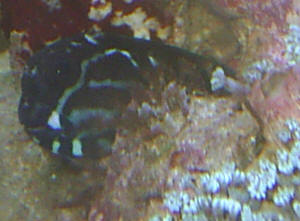
species ID
12/27/14
<My guess is on Ecsenius namiyei. Bob Fenner>
|
.png)
.png) |
|
Re: species ID
12/27/14
Thanks
<Welcome>
Hitchhiked on live rock, never see it eating but appears happy and fat.
<A lucky haul!>
Maybe eating Copepods but new tank ( 5 months ) worried he may deplete any
supply from rock eventually.
<The genus are broad consumers on many types of fare. BobF>
|
Breeding blennies 2/13/12
Hello WWM Crew :) My name is Kate. At the urging of my LFS manager, I
have been doing some research, because my blennies have spawned in my
120g reef system. One of the proud parents (dad I believe) was
purchased as a Tribal Blenny, which I have seen listed online
as both Atrosalarias sp and Ecsenius sp. Can you tell me which
is correct?
<I too have seen this fish/species attributed to both genera.
Fishbase.org does not have it in either genus... the head,
dorsal fin (being singular) to me appears more like
Atrosalarias>
The other proud parent is a Bicolor Blenny, which is definitely
Ecsenius, yes?
<Yes; as far as common names go, matching up sometimes w/
scientific>
First, if the Tribal Blenny is Atrosalarias sp, could it
reproduce with a Bicolor Blenny?
<Not as far as I'm aware, no>
If not, then I believe mine to be a Black Combtooth Blenny
(Ecsenius namiyei), which could reproduce with a Bicolor Blenny,
yes?
<I don't know if this is possible either>
Second, is this a rare event?
<Mmm, first time I've read of it>
I read "not recorded in captivity" in regards to
breeding Bicolor Blennies. Third, will this pairing produce a
bunch of "mystery blennies"?
<Don't know what you mean>
The manager of my LFS stopped by my home to observe the fry and
suggested that I find a quality forum to post this information to. I am
quite excited and having a ball observing the goings on in my aquarium.
So, even if it is not a big deal to the world of aquaria, I'm still
thrilled! I have 3 large barnacle clusters where the fry seem to find
plenty of shelter and lots of copepods. They are also found bottom
dwelling and among the rocks. They are at least 3 weeks old, and appear
to be very active and thriving. I don't think it will be possible
to remove the fry to another system, so I'm not sure how many, if
any, will ultimately survive. Other tank inhabitants include: Regal
Tang, Yellow Tang, a mated pair of Ocellaris Clownfish (initially
suspected parents) with Bubble Tip Anemone, Flame Angel, Watchman Goby
and Pistol Shrimp, Scooter Blenny, various members of the clean up
crew, and soft corals. Thank you for your time, Kate.
<Thank you for your report. Please do follow up in time w/ photos of
all.
Bob Fenner>
Re: Breeding blennies, Tribal ID 2/15.12
Hello Bob and WWM Crew, Thanks for responding to my questions. I have
an update and need to clarify one of my earlier questions. So, I
have a Bicolor Blenny whose scientific name is Ecsenius Bicolor. I also
have a fish
that was purchased as a Tribal Blenny, and I'm not really sure of
its scientific name.
<Am glad you've written back. Yesterday I was up visiting
friends in the wholesale trade and spoke w/ Robert at Quality Marine.
They have this fish listed as Ecsenius namiyei>
These two have definitely reproduced in my 120g reef tank.
Can fish of a different genus reproduce?
<Mmm, strictly speaking this is rare... Do consider that species and
genera are human constructs... change-able; and that there are
variations/extents of species distinctness... IT may be that these two
Ecsenius species are "close enough" genetically to
inter-breed>
Is it more likely that I have a Bicolor Blenny and a Black
Combtooth Blenny, since they are both Ecsenius?
I also asked earlier whether the offspring produced will be
"mystery blennies". I have seen some fish labeled as
"mystery blenny",
<Oh! This is most often just a label applied to species unknown... a
dative case for the trade for species no one can easily identify...
sort of like "Miscellaneous">
and am just not sure what that means. As of yet, I have not
photographed the fry, at least not very well. My LFS suggested
siphoning some out into a glass to get pictures, which I may do when
they are a little bigger. Here's the update:
they are at it again, spawning. I now know the "Tribal
Blenny" to be the female, and the Bicolor Blenny to be the
male. I have attached a link to a video (I hope that is OK).
<Certainly>
Can you help me identify the female? I have had some
communication with Fishbase as well. It's quite
exciting! Thanks for your time, and forgive the Coralline Algae
and the Scooter Blenny for interfering with the video, haha. Here is
the link
http://youtu.be/RJf8_CrMMzI
Kate :)
<I cannot sex these fishes externally. BobF>
|
Black Blenny with Blue Spots... ID
03/21/2008 Hello, <<G'Morning, Andrew today>>
I picked up a blenny today. It was labeled as "Black Midas
Blenny w/ blue spots (Ecsenius midas)". However I
haven't been able to find any information on this fish.
<<Read here
http://www.wetwebmedia.com/ecseniusblennies1.htm >> I also
haven't been able to get pictures yet, due to the fact that
as soon as I released it into its new home, it hid and isn't
being cooperative in posing as of yet. <<It will, as soon
as it settles in>> After looking at the site I think the
fish looks most like Atrosalarias or Cirripectes, although I know
that outside appearance doesn't always determine the Genus or
species of a fish. <<True, these do change colour when
stressed>> Any information would be appreciated. Thank you
in advance, Doran <<Thanks for the questions, hope this
helps. A Nixon>>
Re: Black Blenny with Blue Spots 03/23/2008 This
isn't the best picture, but it shows off the blue on the
face. <<Ecsenius namiyei>> I looked at Ecsenius, here
and on FishBase, and I am leaning towards either E. midas
variant, or E. namiyei. I don't know where they originated
but they came to the US from the Philippines area of the
Indian/Pacific Oceans. Thanks again, Doran
<<Thanks for the follow up. A Nixon>>
|
|
|
Midas Blenny Dear Mr. Fenner, So, how can I determine which
specimen that I have? Does it possibly just need more time? The
fish is about 3 1/2 in. long now, could it just not be a mature
specimen? Also, How am I suppose to know that the fish that I
am receiving does not look anything like the fish in the picture
before I purchase it? Is this an isolated incident for this
specimen? Or is it possible for me to order a Purple Tang and
receive a modeled brown on? At 3 plus inches this is a mature
individual... and it may well be a/the species Ecsenius midas... and
may still change color... There is a large amount of variability in the
color/markings of this blenny... For what it's worth, the Purple
Tang is a much more "standard" color/markings species. Bob
Fenner> > Dear Mr. Fenner, > Last week I purchased a Midas
blenny from FFExpress. When he arrived he was a dull brown color
with light colored patches all over him. The first > day all he
did was swim into the power head, and by the next day he had developed
a white fleshy looking patch that covered half of his left >
pectoral fin. He is now quite established to the aquarium,
finding himself a hole to live in, eating, and no longer swimming
into the power head, and > the white patch is about half the
size that it was. However he is still a brown - white modeled
color and he still has the fleshy looking thing on > his
pectoral fin. Do you have any suggestions on what I can do?
The patch on his fin has not shrunk any in the last few days and
he does not appear > to be coloring at all. > Thanks, >
Bryan Hunt > Hmm, I'm wondering first off about the coloration
of this Midas Blenny... there is a wide range in the species
Ecsenius midas...(most are yellow, > orangish... with white banding
posteriorly, underneath...) but there are also a bunch of other
Ecsenius blennies... The initial behavior is nothing to be >
concerned about... just a bit of acclimating to new conditions,
shipping stress... And the patch on the pectoral could be resultant to
a small, simple > injury... and should clear of its own
accord... The color though... may be the actual permanent one of
this specimen/species... > Bob Fenner
Carnivore Bi-Color Blenny I recently acquired a bi-color
blenny, and it was to my surprise and shock when I saw it eat live
brine shrimp and squid flesh. I saw that others have posted accounts of
blennies eating carnivore flakes, but none that would eat flesh. Is
there any fish that may mimic a bi-color blenny? I'm wondering if I
have the real deal. <Erik, you have the real deal. James
(Salty Dog)> Thanks again, Erik Cornelissen
Re: Carnivore Bi-Color Blenny Bi-Color Blenny Thanks James.
Does this imply that some blennies are omnivores, contrary to what is
commonly thought, or that they simply eat flesh in new surroundings or
under special conditions? <Erik, all fish will eat meat. Take
a tang for instance or a Sailfin Blenny known to be algae eaters. That
is a preference, but they will eat other foods readily. James (Salty
Dog)>