|
FAQs about Faviid Coral Disease/Health, Pests
2
FAQs on Faviid Disease:
Faviid
Disease 1, Faviid Disease 3,
Faviid Disease 4, Faviid Disease 5, Faviid Disease,
FAQs on Faviid Disease by Category:
Diagnosing,
Environmental (Pollution/Poisoning, Lighting...),
Nutritional, Social (Allelopathy),
Trauma,
Pathogenic (Infectious, Parasitic, Viral)
Predatory/Pest, Treatments
Related Articles: Coral Pests and Disease; pests, predators,
diseases and conditions by Sara Mavinkurve, Faviid Corals,
FAQs on Stony Coral Disease: Stony Coral Disease 1, Stony Coral Disease 2, Stony Coral Disease 3, Stony Coral Disease 4, Stony Coral Disease 5, Stony Coral Disease 6, Stony Coral Disease 7, Stony Coral Disease 8, Stony Coral Disease 9, Stony Coral Disease 10, Stony Coral Disease 11, Stony Coral Disease
12, Stony Coral Disease 13,
Stony Coral Disease 14,
Stony Coral Disease 15, Stony Coral
Disease ,
FAQs on Stony Coral Disease by Category: Diagnosing:
Environmental (Pollution/Poisoning, Lighting...),
Nutritional, Social (Allelopathy),
Trauma,
Pathogenic (Infectious, Parasitic, Viral)
Predatory/Pest,
Treatments
FAQs on Stony Coral Disease by Type: Brown Jelly Disease, RTN,
|
|
|
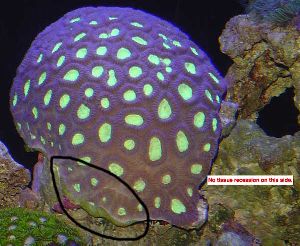
Recovering from Sandy - Is my coral dead?
11/11/12
> Hi
> I appreciate you reading my question. I lost power for a week due to
Sandy. My only loss was my fish tank so I am very lucky. I have a 30
gallon reef tank with live rock, two brain corals (Favites or Goniastrea and
a Trachyphyllia geoffroyi), some soft button and leather corals (Zoanthid,
Protopalythoa and Rhodactis) and two Damsel fish. The tank is 8 years
old and I have kept the coral for at least 6 years. Prior to the power
outage, I changed 25% of the water every two weeks and during the weeklong
power outage I periodically tried to circulate the water (with a cup) and I
performed two 2.5 gallon water changes. Despite my efforts, the tank
suffered from lack of filtration, light and warm water. I have
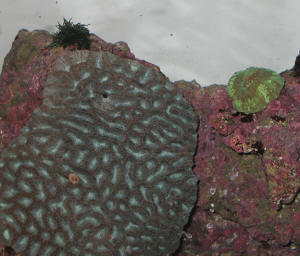
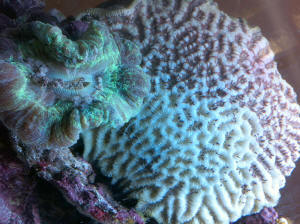
attached two photos: the first taken in 2007 when the coral was very new to
my tank, the second taken today, one week after power was restored to my
house. My questions are simple. Is my brain coral dead?
<Not quite all the way dead>
Should I remove them from the tank
<I would not move>
The fish, button and leather corals all seem to be OK.
> Thank you again. I appreciate your expert advice.
<Keep the faith... as long as there is some attendant tissue, just white
(not algae covered) skeleton, these Stony corals may well come back. Bob
Fenner>
|
 |
|
Re: Recovering from Sandy - Is my coral dead?
11/15/12
Thank you for answering the question so quickly. The open brain coral is
recovering nicely. I am not sure about the other one. I will continue to
monitor.
<Ah good. BobF>
|
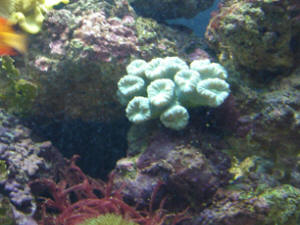
Sick Candy cane? 12/30/06 Hello
and thanks for reading my question. <Hi there! Mich
here reading your question.> I have a teal candy cane coral that
is showing signs of tissue regression. The polyps
themselves look fine, but the tissue is receding from the base
drawing closer and closer to the actual polyps leaving
the skeleton exposed at the base. My water parameters
are as follows: salinity 1.025 temp 79-81 pH 8.3 nitrites 0
nitrates <5 <How are your calcium levels? I
suspect this might be part of the problem. I see a
Yellow Leather (Sarcophyton elegans) in the
photo. Sometimes you will also see evidence of
unhappiness related to allelopathy. Candy Canes
(Caulastrea) typically lose the chemical warfare
battle.> For lighting I have 2 65 watt actinics and
a 150 watt MH. The coral is located about midway in the
tank. I add Phytofeast and Cyclop-eeze about twice
a week. Is there anything I can do to help this
coral? <Test your calcium level. You might try some
direct feedings also. Caulastrea usually will respond to
meaty foods such as Mysis shrimp, even small pieces of scallop,
fish or shrimp. Be sure to turn off you circulation
before feeding. They will engulf pieces up to the size of a grain
of rice with ease.> It is the bluish green one
in the center of the photo. Thanks for your help.
<Welcome. Good luck! -Mich>
Angela |
Re: Sick Candy Cane part 2 12/30/2006 Dear
Mich, <Hi Angela, Mich here again.> Thanks for your reply.
<You are very welcome.> Should I try moving the coral further
away from the yellow leather or is the effect of the chemical
warfare the same for all places in the tank? <It
will in theory be more concentrated closer to the source, in this
case the leather, but will obviously circulate throughout the
tank.> Should candy canes not be kept in
the same tank as yellow leathers? <They would do better in
different systems.> My calcium is at 400...I do not add calcium,
but I do weekly water changes with Tropic Marine Pro Reef
Salt, so my calcium level seems to stay stable.
<Your calcium levels are fine.> I looked more closely today
and the polyps showing the most regression are those on the lower
side that get the least amount of light. <This could
be the cause.> Should I move the coral further up in the tank or
angle it differently? <I would try angling it
first.> Thanks so much for your help. <I think
you helped yourself. -Mich>
Angela |
|
|
Strange encrusting coral... actually strange lack of
info. query 11/6/06 Hi, Newbie here. Not real good at
maneuvering the site yet, but I checked everywhere I thought
appropriate, both on WWM and internet, and could not find an answer. I
will not bore you with complete tank set up for ID question. I have a 4
month old Fox Coral, <The Euphylliid?> that started a few weeks
ago recessing. It gets fed regular and seemed very happy with its tank
location Med flow and high in the tank under 40 watt PC. I looked
closely and found what appeared to be a brown flatworm. I think, I have
finally located enough photos to say this is some sort of Cyphastrea
ocellina or crusty star coral. <?... the Faviid?> It is tan in
color. I can find photos, but no information on this thing. It seems to
be growing very fast. Does my conditions seem favorable for such coral?
<Which? Actually your lighting is a bit low for either> Is it
harmful to my fox? Is it LPS, SPS, or what? <What? The Faviid? See
WWM re...> Should I try and remove it from the fox coral and if so
how, or.......is the fox going to die (skeleton exposed) and I should
let it have the space for encrusting? Thanks in advance for your
help. Cindy
<... Where is information re water quality? Maintenance, feeding?...
Please... read what is archived on our site for these species. Bob
Fenner>
Rare Faviid?/Repeat Post? - encrusting... 11/07/06
Hi, Newbie here. <<Hi Newbie!>> I am not real good at
maneuvering the site yet, but I checked everywhere I thought
appropriate, both on WWM and the Internet, and could not find an
answer. <<Ok>> I will not bore you with complete tank
set-up for ID question. <<...?>> I have a 4-month old Fox
Coral, that started a few weeks ago recessing. It gets fed
regular and seemed very happy with its tank location, medium flow and
high in the tank under 40 watts PC. I looked closely and found what
appeared to be a brown flatworm. I think I have finally located enough
photos to say this is some sort of Cyphastrea ocellina or crusty star
coral. <<Interesting>> It is tan in color. I can find
photos, but no information on this thing. <<Have you seen
this? http://whelk.aims.gov.au/coralsearch/html/401-500/Species%20pages/438.htm
>> It seems to be growing very fast. Do my conditions
seem favorable for such coral? <<Apparently>> Is it harmful
to my fox? <<Will probably "overcome">> Is it
LPS, SPS, or what? <<It is a LPS...in the same family as Faviids
and would need the same care>> Should I try and remove it from
the fox coral and if so, how or...is the fox going to die (skeleton
exposed) and I should let it have the space for encrusting? <<Up
to you, though attempting removal may result in the demise of
both>> Thanks in advance for your help. Cynne <<Very happy
to assist. Eric Russell>> This is the original email,
I sent yesterday. I wasn't sure if you had received it
or not. <<Indeed it was (received)...have you checked the
dailies?>> I appreciate you taking the time to get back with me
on this. <<No problem Cynne...is what we do...>> I was very
careful to check the grammar and spelling before resending.
<<Much appreciated>> I also searched your site, the best
that I could before asking. <<Also much appreciated>> I
have been using your site, for research, for months.
<<Excellent...hope you have found it useful>> I cannot
guarantee I will not repeat a question, or include a typographical
error, but it will not be for lack of effort on my part. <<Is all
we can ask...>> Thanks again for your work here. Your
efforts do not go unnoticed by all. <<Ah, thank you very much for
this...redeeming to know. EricR>>
Re: strange encrusting coral 5/8/06
Hello Bob, <Wayne> Thanks for the reply. My apologies for not
using scientific names, <Mmm, not necessary... but your message just
wasn't clear to me... at one point you referred to a flatworm...
and then asked questions of another hard coral...> I haven't
been at this long. I will check the info. provided for the Faviid.
Water perimeters are all perfect. Nitrates <20, <I would strive
to keep this below 10 ppm> Nitrites 0, pH 8.4, Ammonia 0, Salinity
1.024, Temp 75, I do realize lighting is a little as well as
temperature is a little low, however, I am maintaining a seahorse tank
with mostly gorgonians sponges and soft corals. <Can be done... do
live with these in the wild... as well as many more noxious groups of
organisms> I use an Emperor bio wheel filter system, Red Sea prism
skimmer, and 2 Maxi jet 400 power heads. This is a fifty-five gallon
aquarium and the set-up was designed and maintained with the assistance
of Pete Giwojna <A fine gentleman, "keeper of the faith"
in our interest> from OR, who, by the way recommended I direct most
coral issues to you. Thanks again for your time and I will get the info
I need now in regards to my new found Faviid. Have a great day.
<Thank you for this follow-up. Bob Fenner>
Re: strange
encrusting coral. 5/8/06 Thanks Again, <Welcome>
The flatworm was a reference to the shape of the hard coral.
<Ohhh> I apologize for the confusion. Have you any
recommendations on the nitrates? <Yes... read on WWM re... much
posted re "causes", cures> I currently perform 2-3 water
changes weekly, use a poly filter and nitrate sponge. <Mmm, perhaps
the addition of a sump/refugium, macroalgae, DSB..> I blame it on 2
feedings a day. I can't cut the feedings back, but I am concerned
with the nitrates. I cannot seem to get algae to grow, except the
occasional brown diatoms. When I buy Macroalgae it dies in weeks, My
low lighting perhaps? <Mmm... could be... but might be due mainly to
other influences... Perhaps the already established mix of algae... a
lack of some essential nutrient (rate limiter)... Bob
Fenner
Thanks
Cynne
Re: Rare Faviid? - 11/09/06 Hello, <<Howdy>>
Thanks so much for your help. <<My pleasure>> You were
right on the money with the Faviid description, and without a photo
too, I am impressed. <<Mmm, don't be "too"
impressed <grin>...after all, you did provide the scientific
name>> I guess my fox coral is doomed:(. <<Probably...as
the Faviid grows it will prove to be quite aggressive/will likely
extend sweeper-tentacles to kill the fox coral>> I find this hard
to believe that under such low lighting, not only was the fox coral
happy, but the Faviid showed up as well. <<Many Faviids do very
well under moderate lighting>> I can tell it's growing daily
from the distance it has before actually touching the fox coral itself;
currently it is just growing on the skeletal base. <<Will
eventually overgrow/encrust entirely>> Thanks again. Cynne
<<Very welcome. Eric Russell>>
Candy Cane Coral ... misplaced/health 9/5/06 Good
Evening All, First I'd like to thank you for your informative site
as it has assisted me through all stages of this hobby. <Welcome>
I recently purchased a Candy Cane Coral with about 15 - 20
heads. The issue seems to be now a few of those heads are receding and
two of them has completely melted away. All my other corals seem to be
doing OK, I even purchased a Brain coral (what the LFS called
watermelon coral due to it's pink color) the same time I purchased
the Candy Cane Coral. <And quarantined both?> Everything else is
doing fine, Yellow Leather, Crocea clam, Clove polyp (recovering
possibly from high phosphate levels due to the Proper PH 8.2 I've
been adding), Bubble Coral, assorted polyps and mushrooms. It's a
50 gallon with a 30 gallon refugium and 10-15 gallon sump. The lights
are on nine hours MH 150w 14,000K with two hours of 65w PC X 2 daily.
The Candy Cane coral is located towards the top with decent current,
the heads with receding are on opposite sides of the coral. Please
help! I want to save this coral any way I can. <It is a/the loser
amongst a mix of non-compatible "mixed garden"
cnidarians...> Water parameters seems to be good except for low
calcium. Ammonia 0 Phosphate <=1 Nitrate 5-10 Nitrite 0 KH 7 Calcium
350 James Yan <Please read here: http://www.wetwebmedia.com/cnidcompfaqs.htm and
the linked files above. There are ways/means of granting oneself more
"chances" of success with such mixes... see WWM re. Bob
Fenner>
Re: Candy Cane Coral 9/6/06 Thank you for your
quick response! Hope you had a wonderful labor day weekend. <All
days are about the same wonderful to me> Would separating some of
the corals, for example, moving the mushrooms to the refugium help or
remove them all together? <Either one...> I have traded a large
chunk of mushrooms to the LFS recently to decrease the possible
chemical warfare going on. I'm trying to balance my tank for more
LPS corals with some polyps and possibly keep the yellow leather as the
only soft coral besides assorted polyps. <... need to read...> No
hard corals will be added. Does the WWM have articles where there are
suggestions possibly mixing corals? Thanks again! <All sorts...
start reading: http://www.wetwebmedia.com/marine/inverts/index.htm
Bob Fenner>
Candycane skeleton disintegrating
8/22/06 Greeting from Nova Scotia <Hello from San Diego, CA>
I have a small coral reef tank since 9 months that causes
no troubles. One of mine Candycanes got now about 11 branches (had
7 or 8 when we got it) and it's doing really good (dividing,
long tentacles at night, bright colours, etc...). Two days ago
however, I noticed that 2 of the branches are actually disintegrating.
I am talking about the skeleton at the back of the polyp, and
surprisingly enough, the polyps at the end of those branches are
looking awesome and do not seems to be bothered at all. I am
suspecting a lack of Calcium and/or the fact that my pH might be a bit
too low (7.8/8.0) <Could be more...> so it drives
the carbonate equilibrium of sea water toward the HCO3- side but I
am not sure. A friend of mine (has a big coral reef tank) said
that it might be the fact that my Candycane is submitted to water flow
that are two high. <Another factor> I doubt it, but do you
have any suggestions ? Thanks so much in advance Flavienne <Mmm, the
ultrastructure of the alkaline earth skeletal matrix is likely
"missing" something... happens frequently with (your as
stated) imbalance of calcium, magnesium and alkalinity... Do you have
the "Kalk habit"? This is a common situation (soft skeletons)
with this use... other methods of supplying ready alkaline earth,
carbonate produce "harder" bio-matrix (calcium reactors, two
part supplements...). Bob Fenner>
-------------------------------------- Dalhousie University Department
of Oceanography
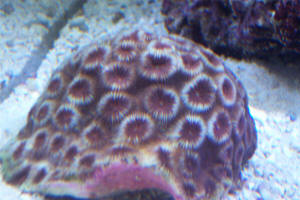
| Favia brain received in bad condition
7/8/06 Hello again. So I work at a LFS
and on their stocklist has a red Favia brain which sounded
appealing to me and it was rather expensive, so I expected
something great. Well I did not receive anything great,
but because I asked the owners to order it for me I took it and
kissed the cash goodbye. The problem is, it is suffering
from major recession. My question is can it be nursed
back to health, and can it cause any other corals in my
tank to have problems? <Yes, and unlikely, but can add to
overall "stress" for sure> It doesn't appear to be
suffering from any infection, it was probably just in a bad
"holding" tank for a while. To me it just
appears like it was not fed properly or was in bad water. <I
concur> The other corals I have in my tank are: Favites brain,
torch coral, Trachy brain, green star polyps, and some finger
leathers and mushrooms all of which are doing very
well. My water quality is excellent, ammonia 0, nitrite
0, nitrate 0, phosphate 0.1, calcium 400, alk 10 dKH. So
with proper feeding (by the way his tentacles did extend last night
to my surprise) and excellent water will it be ok? <Likely
so> I usually feed finely chopped Mysis to my brain
corals. I have attached a picture which is a little
blurry and from that I hope you can tell me if this coral can be
saved. <Can be... You do administer weekly iodine/ide/ate?>
Thank you very much, Ryan Nienhuis. P.S. I did contact
the wholesaler the coral came from and she said she would make
things right....there not all bad. Once again thank you
in advance for your advise. <Ah, good. Thank you for writing so
clearly, completely. Bob Fenner> Thank you very much for the
response I really appreciate it. If it is OK with you I
will give you periodic updates on the corals
health. Thanks again, Ryan Nienhuis. <Would
appreciate this. Thank you, BobF> |
|
|
|
Re: Favia improvement 7/15/06 Thanks for
the response. Another thing, although the red Favia is
improving I have only seen it's tentacles come out once. <Things
take time...> Any suggestions (tried the juice and
turkey baster trick)? The only time the tentacles came out,
I was fooling around with the powerheads, any idea why this would
trigger such a response? <Yes, improved circulation, oxygen...>
My replies don't seem to be getting through to you but
I will try again. Hopefully I will not bother you for a
while with any more questions. Thanks again, Ryan Nienhuis.
<Welcome. Bob Fenner>
Re: Favia brain update 7/23/06
Hello again. I told Mr. Fenner I would keep
him updated on a Favia brain I received in absolutely terrible
condition. It has improved greatly over the past couple
weeks and is now opening its tentacles at night so I can feed it.
<Ah, good> The color is coming back and the
recession is slowly fading, although still evident. I do
have a new question, I have read the article on your site about
Aiptasia and I have a reproduction crisis. The dumb
things are going crazy. Little babies are floating in
the tank...what do I do? <Your options are posted on WWM as
well...> It seems the more I try to kill the more they reproduce
(@#$%). It could, and probably is a result of
overfeeding, trying to save the coral and get the new fish to eat.
<Very likely nutrient abundance is a factor here>
My water parameters are excellent which leads me to
believe nutrient export is good. <... Or...
imagine... that nutrient uptake is excellent... eh?> I also have
a issue with a Kole tang harassing a newly purchased blue
flavivertex Pseudochromis, it does not appear to be
trying to hurt it, just chasing it which makes it hard to
feed...any ideas? <If not apparently harming
it...> By the way my water parameters are ammonia 0, nitrite 0,
nitrate 0, calcium 400 ppm, alkalinity 10 dKH, phosphate 0.1, and
pH 8.3. Tank is 90 gallon with 20 gallon (half full)
sump and aqua c remora pro skimmer. Tank inhabitants
Kole tang, false percula clown, blue flavivertex Pseudochromis,
cleaner shrimp, Montipora, Acropora, Trachy brain, Favites brain,
Favia brain, green star polyps, torch coral, several
mushrooms, finger leather, several unpurchased green sponges,
Trochus snails and a queen conch. Sorry if this was a
little lengthy didn't want to leave anything
out. Thanks very much, Ryan Nienhuis
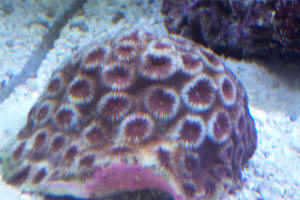
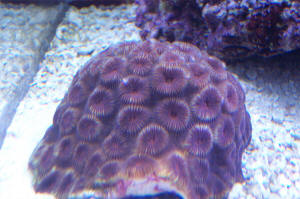
(again). Oh yes by the way I have included pictures of
purchased Favia before and a couple of weeks after. <Thank you
for this update. Bob Fenner> |
|
|
Sick or just over-illuminated Faviid; neon green
trumpet discoloration... a paucity of info.
7/1/06 Hello, I did a lot of searching and learned a lot I might
add, but I could not find the answer to my question. I have
a fluorescent green trumpet. Within the last few weeks the
color has been changing a bit. I am starting to see brownish colored
stripes going through them. One of the heads has turned that
brownish color. It is not letting any mucous
out. I am unsure if this is still brown jelly disease or
maybe a lighting issue. <More likely this last... where's info.
re your water quality, history of maintenance, nutrition...?>
We have 5.4 watts per gal in a 72 gal tank and he is pretty
high up, about 8 inches from the top. If a pic is needed,
let me know. Thanks! Chris <Please read here: http://www.wetwebmedia.com/faviiddisfaqs.htm and the linked
files above. Bob Fenner>
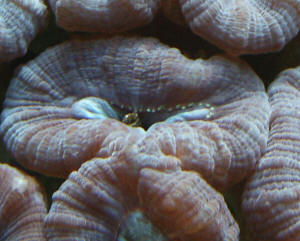
| Caulastrea - potential parasite - 05/22/2006 Hello
crew, <Bob... it's... Bob> I wanted to thank everyone for
all the help I've received from reading you
FAQs. Finally, after 8 months in the hobby, I have a
question that I can not find the answer to. I purchased
a Caulastrea coral about two weeks ago and the coral is currently
in quarantine. <Good> All polyps seem to be doing well except
for the one that is shown in the attached photo. <Great pic>
Several times in the past two weeks I have noticed a brown
substance being expelled from the malformed polyp, which I assumed
to be Zooxanthellae. <Mmm, or just waste...> However, a few
days ago I noticed what appeared to be a tube was protruding from
the mouth of the polyp. Also, although it can't be
seen in the photo, I have noticed what appear to be two ~2mm long
antennae protruding from the tube. Finally, unlike all other polyps
this one has never extended its feeding tentacles at night. Any
help you could give me about the nature of this potential parasite
and any actions that could be taken to remove it would be much
appreciated. Thank, Mark <Might be a boring organism... likely a
worm/Polychaete, or possibly just the polyp recovering from
collection, shipping trauma... I would continue your observation,
finish the quarantine and place this animal. If it is indeed a
parasite, space or more deleterious in nature, it will likely
perish in time (and not reproduce) in your main system. Bob
Fenner> |
|
|
About trumpet coral... health, systems - 05/20/2006 Hey
guys, I bought a trumpet coral from my LFS (which I actually work at
now) and it doesn't seem to be doing so hot. It
looks normal during the day, but never really fully
expands. At night it shows it sweeper tentacles and it eats
regularly, but like I said it never fully expands and some of the
polyps have some bone showing through the tissue. Is there
anything I can do to help him out. By the way, my water
tests 0 for Nitrite and Ammonia, Nitrate is less than 5 ppm and pH is
around 8.2-8.3. I dose Kalkwasser and I do regular water
changes to keep up trace elements and add a little purple up also to
help with that. He is under 130 watts of power compacts
about 4 or 5 inches from the surface. Any advice would be
awesome. Thanks guys. <... I would take care re adding
these adjuncts... do so in water to be changed out, that is pre-mixed,
stored... And read here: http://www.google.com/custom?q=trumpet++coral+health&sitesearch=wetwebmedia.com
Bob Fenner>
Brown Jelly infection on candy cane? The Amazing Kreskin?
Can't see this far, guess re system, history... 10/19/05
Hey guys, <What about the ladies here?> I have a
candy cane coral of which one polyp has brown filaments in the
center. Is this brown jelly? <... can't tell from
here> I recently lost a hammer coral to brown jelly and
I'm afraid that it has spread in my tank. If so, should
I cut off the polyp or siphon it off? <... under what circumstances?
Please read here: http://wetwebmedia.com/faviiddisfaqs.htm
and the linked files above. Bob Fenner>
Disintegrating Candycane
polyp 10/13/05 Hi All, I've had my 34 polyp Candycane now for
approx. 1 1/2 years. Actually, polyp count was 24 when it was purchased
and has since been splitting and looking really good. Within the last
two weeks, I've noticed the outer edges on two polyps lose its
fullness but not quite emaciated. Then: 1) the mouths stayed
open, 2) the center green flesh on one pulled away from the mouth
causing a gaping hole and brown mesenterial filaments are
showing. The other polyp's brown outer flesh in one location
has started to drip, taking with it two spines! It just hangs
from the polyp. I've checked the FAQ section and was unable to come
up with an example of my problem. I would appreciate it if you could
help me figure out what's going on with my beautiful Candycane
before whatever it is affects the whole head. <Congrats on your
success with this coral! What you are seeing has been described by
other aquarists and seems to be a form of reproduction. Eventually, the
"dripping" tissue will fall free from the parent polyp, and
if they find (or are placed on) a suitable substrate, they will survive
and grow.> Water parameters: SG 1.026, pH 8.1 (can't get it
higher?), dKH 10.9, Alk. 3.66, CA 395 Nitrate 10, Nitrite 0, Amm 0,
phos. 0. I do a 12 to 15 gal water change every week on my 55 gal.
Thanks for your help. Lynn <Keep up the good work! Best
Regards. AdamC.>
Disintegrating Candycane polyps part 2 10/16/05 Hi Adam C,
Thanks for the speedy reply and news that my Candycane is reproducing.
How is that different from each polyp splitting itself in half to form
new polyps other than maybe dripping forms new individual
colonies? <I don't know, and I don't think anyone else
does. Some suspect that it is stress related.> Also, how about the
polyp that developed a gapping hole around its mouth and one can see
the mesenterial filaments inside? I can see a couple of spines inside
the hole. Has this polyp had it? If so, should I cut that particular
stalk away? Thanks again for your help. Lynn <It is hard to
guess if this is part of the same process or not. I would keep an eye
on it. As long as it does not develop signs of any kind of infection
(brown or white jelly like material), I would not worry about removing
it. Best Regards. AdamC.>
Favia Brain Problem - 07/04/05 I have a very large Favia
Brain. I have had it for a very long time.
<<Excellent>> Last night I noticed a couple of white,
crusty like spots on it. Tonight there seems to be a few
more. I touched the spots and they are hard. What
is it and what can I do? <<Mmm...hard to say really without
seeing it. May be exposed skeleton from some physical trauma
(added any new fish/inverts?).>> I have metal halides and blue
VHO light system. Everything else seems to be
okay. Please advise ASAP. I added a few drops of Lugol's
solution tonight. <<The iodine can be beneficial as an aid to
healing if this is indeed an injury, but be "very" careful
with the dosage. Optimum water conditions/frequent water
changes are also needed to help avoid secondary bacterial
infections.>> Judy <<Eric R.>>
Bubble In The Candy
Cane - 06/24/05 Hey guys how are you? <<Well...thank
you.>> Well the last days in the reef have not been so great.
<<uh oh>> First I came home and saw my yellow tang tail
first caught in a power head! <<Curious, these fish are usually
able to avoid such calamity.>> I did all I could but overtime
stress got to him :( Since my tang was a massive grazer my
hair algae is starting to bloom! <<The tang was only treating the
symptom. Do look to your water quality/husbandry to
determine/correct the problem.>> Now I see my candy
cane coral has a bubble in it!.....What else could happen? anyway, will
my candy cane pass/expel this bubble or is this life threatening?
<<Have experienced this in the past myself...the coral should
absorb the bubble in time and will be fine.>> I have him under
about 7 inches of water that's crystal clear due to carbon. My
lighting isn't that powerful though I have 1 65 watt 7100K actinic
and one 65 watt daylight. Please help I would hate to lose another
inhabitant! <<No worries mate.>> thanks for your help,
Aaron <<Regards, Eric R.>>
Candycane dying Hey guys, <Nilesh> I have 155 gal new
tank established for the past 4 months with live, skimmer, 4-802
powerheads, 175 watt venture MH bulbs. I bought
this tank second hand and inherited a Candycane coral.
<Okay> For a while, about 2 months the coral was doing fine but
lately I've noticed that the coral is bleaching. Also
the green pigmentation, I guess Zooxanthellae sort of split
open. Is this coral dying? <Doesn't sound/read as if
it is well> Can I save it? <Probably> All my parameters are
normal... salt, pH, ammonia, nitrate, nitrite, temp. The
coral is placed in medium depth, no direct lighting, and medium
flow. I haven't really spot fed the coral...I thought
that the light would provide enough food. What do you think?
<Lighting is not a sufficient source of nutrition for this
species... a healthy refugium might supply other food... but...> The
calcium may be the problem, it's 280. I know that this
is low but I'm having a hard time maintaining it at
400+. I don't have a calcium reactor, so I've
been using Tropic Marin's Bio Calcium with trace
elements. Do you think that the low calcium/trace element
level is causing the death or lack of growth? <Definitely is
contributing to the poor health> Since it's a new
set up, I.e. it's still going through those awful algae
phases...I'm at Cyano right now and the coral has quite a bit of
hair algae on it. I've tried to blow it off with a
powerhead. it works but comes back... is this preventing the
Zooxanthellae from taking in light? <Among other
ill-effects> Last question, I'm wondering why my levels of
calcium has fluctuated from 400 to 280 in 2 weeks. I've
been doing 5% water changes and have been adding calcium. I'm
guessing that the calcium is used up for coralline algae growth
although I don't see any coralline at this time. Pleas
help...Any info would be appreciated Nilesh <These questions and the
next several sets that you will have are posted on WWM... please take
the time to read what is posted there re your species health,
environment, feeding... calcium... And soon. Your system will fare
better with your knowing what you're about here. Bob Fenner>
Re: Candycane dying Hey guys, One
more addition to the info which I left out. I had a pink tip
anemone in the tank which got crushed when a rock fell over
it. I wasn't sure if it was going to die so I watched it
for a day. The next day, it stunk! I immediately
threw it away. Do you think that the anemone released toxins
or waste that killed my Candycane? I've tested the
ammonia and it is less than 01. The cane
started dying a day later... Nilesh <Definitely could be
related... again, please stop spending your money experimenting... and
read/study... these organisms cannot be successfully mixed, placed near
each other. Bob Fenner>
|
Favia sp. Tissue Recession 3.21.05 Hi, <Hello,
Ryan with you> I've had this Favia for at least 6 months
and in the last 4 weeks I've noticed tissue recession along
the lower edges of the skeleton. Since noticing the tissue
recession I have religiously made weekly water changes of 5-7
gallons, changed each lamp in the canopy and routinely added
supplements (Iodide, Reef Complete, Reef Plus, Reef Trace,
Seachem Calcium) and yet, the tissue recedes further. The tissue
isn't receding all the way around the coral, only on the side
nearest the a Sinularia and adjacent to the aquarium's back
wall. <Sand bed creatures can also disturb a Favia that lives
directly on the bed. Have you considered elevating the Favia a
few inches with a few pieces of rubble?> I inherited this 75g
tank from a friend in August '04. At the time, it was powered
by only 120w of mixed fluorescents and had only the Sinularia and
a Lemon peel tang. I've upgraded the canopy's lighting to
252W Fluorescent (96w PC 10K, 96w PC Actinic 03, 30w 20K and 30w
Actinic 03). Filtration is wet/dry filter/sump and an AquaC 120
Skimmer (the skimmer is 2 weeks new and the system was run w/out
a skimmer for at least two months prior to installing the AquaC
120. The tank came with a Sanders round hang on, but I could
never adjust it correctly.). The tank has a thin crushed coral
bed (up to 1" deep, large grain), and the lower portion of
the sumps has Aragonite sand). <Okay> Current residents
are: A small blue tang, one Ocellaris clown (the other went down
the overflow box), 1 cleaner shrimp, several red leg hermits, a
handful of snails (several varieties), Red-Orange w/ black
speckles Fromia, and several small brittle stars (one of which
resides inside the rock the Favia has encrusted). Cnidarians
include: Entacmaea Quad (1), Trachyphyllia (1), Short tentacle
Fungia (1), two rocks encrusted w/ green star polyps (small
polyps), several colonies of Zoos, 1 rock covered w/
Parazoanthus, 6 Ricordea Yuma (5 added to tank on 03/18/05), 1
Ricordea floridae, 2 Rhodactis (added to tank on 03/18/05),
several Discosoma Shrooms and 1 large rock covered with some type
of soft coral. Water parameters are: Ammonia-Low, Nitrite-Low,
Nitrate-Low, Calcium 430, Alk 12. Salinity 1.024-1.025 and PH
8.1-8.2 <What is low? No nitrite/ammonia should be present. If
they are, even in trace amounts, it can be lethal to this type of
animal.> What can I do to save this coral? <Give him a bit
of a lift, and supplement his feeding with a weekly feeding. If
you are having any ammonia/nitrite issues, these should be
corrected ASAP. Good luck! Ryan>
|
|
|
|
Favia Tissue Recession pt. 2 ( 3.24.2005) Hello and thank you
for the reply. <No problem! Ryan with you again.> The Favia is
elevated at least 8" to 10" atop LR (has been so since
purchasing it). <Nice> Ammonia, Nitrite and Nitrate test at 0.
The Favia hasn't extended its tentacles in a long time (I'm up
in early in the mornings before the lights come on and I haven't
seen the tentacles in a long while, I assumed it was getting plenty of
nutrients from the Zooxanthellae) and I've never been able to get a
reaction from food while the lights are on (other than the polyps
mouths opening very slightly). <Certainly a sign of stress. Keep the
current higher in the area to dilute the chemical warfare, if any. Keep
the water changes regular.> Is there any chance that my Sinularia or
any of the polyps are having a chemical war at the Favia's expense?
<Yes, it's a good possibility. Google allelopathy, and read up a
bit. There are some easy ways to make nice! Good luck, Ryan> Thanks,
Ken PS Should I increase wattage closer to 5w/gal? I'm currently @
3.36 on a 24" tall aquarium. <If PC/VHO, yes. Metal Halide
should be penetrating deep enough for a decent amount of usable light.
Thanks, Ryan>
|
Brain coral <Hello EAM917> We have a
46 gal reef tank which has been working for approx 7
months. A few months ago we got a green brain
coral. It would change size during the course of the day and
evening. Usually large during the day and much smaller in
the evening.<Sounds normal> During the past 3 or 3 days it has
not changed size, it is small. The sides appear to have some white
coloring which we have not seen before.<Sounds like bleaching> Do
you have any idea what is happening and what we should do.<Several
factors can cause this. First, what kind of lighting are you
using? Do you feed your corals? The hard corals
of which the brain is a member of require very intense lighting of the
proper spectrum to survive along with good water movement. Answer the
questions I have asked and we can try to help you. James (Salty
Dog)>Thanks Elizabeth
Re: Brain coral, health Thanks for getting back to me so
quickly. <You're welcome Elizabeth> We have never heard of
bleaching, what is it & can it be corrected?<In a
nutshell bleaching occurs when things are not to the corals
liking> We use a coral life Aqualight double strip 34 in
96 w Actinic and 96 w 10000k square bulb. Water movement in
the tank is good. We are using flake food for the fish and
were never told by the store to use anything else. They said they would
get their food from this. Do you think this coral can be saved.<What
is the height of your tank? The PC lighting may not be
intense enough for the brain coral. Corals don't require
feeding on a daily basis but a weekly feeding is
good. DT's phytoplankton is a good choice. As far as
saving the coral, keep your lights on for 12 hours, replace the bulbs
if they are over one year old, do 10% water changes weekly. There is no
cure in a bottle that will save corals, just good sound maintenance of
the aquarium is all you can do for now. James <Salty Dog)>
(Thanks Elizabeth
Re: Brain coral, health My husband said to tell you that the
nitrite and ammonia is 0ppm however the nitrate is over
160ppm. Would that stress it.<yes, corals do require
pristine water quality. This tells me you do not do 10%
weekly water changes. This helps reduce the nitrate level by
dilution.> He has put in a nitrate sponge<the nitrate
sponge is fine but nitrates have to be controlled at the source of the
problem or the levels will just return>in the filtering system to
try to lower it earlier today and did a water change 6 days
ago. The water temp is 78. Thanks Elizabeth<James (Salty
Dog)
Re: Brain coral We have done 2 water changes and the levels
are still high. Any suggestions to lower it. I
was wondering, parts of the brain are looking better and are enlarging
during the day. You can see them moving or pulsing like
water is going through them. I don't know what actually
causes that. Other parts seem to have split open
and you see an off white color that appears skeletal. Is
there a possibility that parts will continue to live on the brain coral
or is it just a matter of time before the entire brain changes to
white. If this happens is it dead ? Thanks
Elizabeth <Elizabeth, if you have a canister filter I would
recommend you get some "Chemi-pure" and use
this. It is an excellent product for removing nutrients in
the form that protein skimmers will not take out. You do
have a protein skimmer, correct?. James (Salty Dog) Re: Brain coral
part 2 Sorry the mail somehow was sent. I am bad on the
computer. We did a water change again last night. The brain
is enlarging during the day but only is some sections., We
can see is moving or pulsing like water is going through
it. Some parts seem to have split open and you see an off
white color that appears skeletal. Is there a possibility
that parts will continue to live on the brain or is it just a matter of
time before the entire brain changes to white. If this
happens is it dead. Thanks Elizabeth <Hello Elizabeth,
One thing you have to keep in mind with keeping hard corals, or
anything marine for that matter is that weekly water changes (not just
till things get better) is one of the best things you can do
for the overall health of the tank. It not only removes
nitrates etc. by dilution, but also replenishes traces elements that
have been absorbed by the animals. You will know when the
brain is dead. You will end up with a white
skeleton. These corals are not one of the easiest to
keep. The elegance or bubble corals are a little easier to
maintain. James (Salty Dog)
Re: Helping injured brain coral 1/12/04 This is for James,
Salty Dog. You have been helping me with a problem with the
46 gal reef tank. I was just wondering if a brain coral
could still live when a portion of it is damaged or will it eventually
die? <Anthony Calfo with a contribution as well :) indeed, most any
can survive and recover with adequate water quality (do not move the
animal and stress with a change in light... provide good turbulent
water flow but never laminar, etc.). The addition of small amounts of
iodine (reef supplement) may be of some indirect benefit too. Feeding
the coral with tiny bits of food (Mysids or Pacifica plankton...
nothing larger) will be of tremendous help! 3-5 times weekly. Best of
luck, Anthony>
Helping injured brain coral 1/12/04 This is for James, Salty
Dog. You have been helping me with a problem with the 46 gal
reef tank. I was just wondering if a brain coral could still
live when a portion of it is damaged or will it eventually die?
<Anthony Calfo with a contribution as well :) indeed, most any can
survive and recover with adequate water quality (do not move the animal
and stress with a change in light... provide good turbulent water flow
but never laminar, etc.). The addition of small amounts of iodine (reef
supplement) may be of some indirect benefit too. Feeding the coral with
tiny bits of food (Mysids or Pacifica plankton... nothing larger) will
be of tremendous help! 3-5 times weekly. Best of luck, Anthony>
|
|