 |
|
| Home | Marine Aquariums |
Freshwater Aquariums |
Planted Aquariums |
Brackish Systems |
Ponds,
lakes & fountains |
Turtles & Amphibians |
Aquatic Business |
Aquatic Science |
Ask the WWM Crew a Question |
| Please visit our Sponsors | ||||
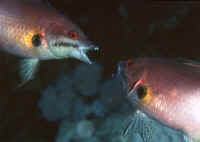
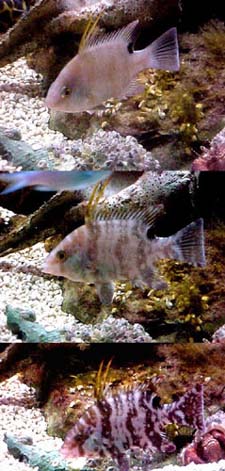
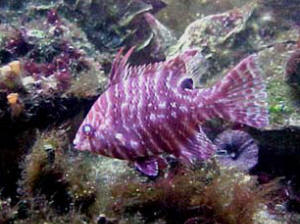
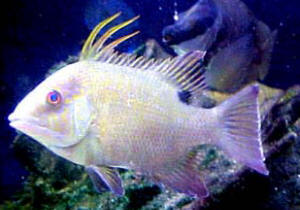
Bodianus pulchellus (Cuban hogfish) and gastropod
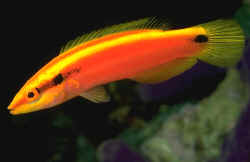
snacks Hi Crew. <Matt> I have a short simple question :-) I
would like to add a Cuban Hogfish (Bodianus pulchellus) to my tank (its
a 180). My only concern is if he would assassinate my population of
snails? <Too likely so in time. http://www.fishbase.org/Summary/SpeciesSummary.cfm?ID=1066&genusname=Bodianus&speciesname=pulchellus
Bob Fenner>
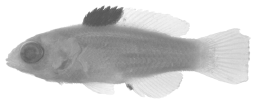
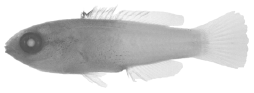
Hogfish sex??... Good Morning Wise Wet Ones- <Hey Andy> I recently got a 4" Cuban Hogfish for my 180 FOWLR, which also includes an adult Imperator angel, clown, royal Gramma, hippo tang and 3 small damsels. After a few days of harassment from the angel, everyone has now settled down. In CMA. Bob mentions to keep only one supermale per tank. I checked your site and FishBase.org for help, but haven't been able find out how to tell the difference. I would like to get another and haven't a clue how to tell the sexes apart. Any ideas? Do you think it would be too crowded if I added one more? Thanks! Andy <Hard to discern the sexes in hogfish wrasse species... Males are decidedly larger, and do develop something in the way of a nuchal hump on their heads. Best to house just one of a given genus in all but the most humungous of systems (several hundred to thousands of gallons), unless all are small (a few inches)... or (risky) one very much smaller than another. Bob Fenner> Student Working on Thesis on Local Fishery Hola, soy estudiante de licenciatura y actualmente realizo mi tesis de licenciatura, y estoy trabajando con la especie Lachnolaimus maximus, entre a su pagina de internet y por esta razon acudo a usted, ya que en el lugar donde estoy hay poca informacion sobre esta especie, mi tesis se titula "Analisis de la pesqueria de Boquinete Lachnolaimus maximus, en la isla de Holbox, Quintana Roo, M?ico" si ustede me podria proporcionar informaci? sobre aspectos ecologicos de esta especie y tal vez datos meristicos y parametros de crecimiento para poder realizar una comparacion con los que yo obtendre en este trabajo, sin mas por el momento quedo de ustede agradecido. Oswaldo S?chez Ak?br>Colegio de la Frontera Sur (ECOSUR), Unidad Chetumal Translated by Digna Cassens Hello, I am a student of "licensing", and I am writing my thesis on the species Lachnolaimus maximus. I found your page online, but with very little information. The thesis title is "Analysis of the Fishery of 'Boquinete - Lachnolaimus maximus on the island of Holbox, Quintana Roo, Mexico". If you could provide me with information regarding the ecological aspects of the species and perhaps data "meristicos" and parameters of growth so that I can compare with the data I will obtain in this work. I would be very grateful to you. Oswaldo Sanchez Ake Southern Frontier College <Oswaldo, no tengo/tenemos mas en el especio, lo siento. Nos vemos. Roberto Fenner> <Oswaldo, I/we don't have much on this species, I'm sorry. We'll see you. Robert Fenner> Bodianus bimaculatus (12/28/2003) Dear crew; <Steve Allen tonight> I have purchased a Bodianus bimaculatus <aka Twinspot Hogfish> and it seems to be a great fish. It has been in quarantine for 25 days with no ill effects. I have not found much aquarium info on this species. it is intended to be housed in a 65gal FOWLR with a coral beauty and a Dascyllus damsel. Any opinions or advice would be appreciated. Seems to be a very nice omnivore. <I checked Scott W. Michael's "Marine Fishes" book and found that this fish is generally peaceful and tops out at about 4" It is an omnivore that will do well with a variety of meaty foods. It is generally considered reef-safe. Like most Hogfish, it does get boisterous and may bully timid fish like Firefish & Dartfish. Consider buying the book--very useful.> Thanks a bunch, Stanley C. Krol <You're welcome.> Species ID, info (Bodianus spp.) Recently purchased a fish that is virtually indiscernible from the fish pictured on your site that you call a "Blackspot Hogfish" (Bodianus opercularis). The wholesaler's invoice, however, identified it as B. masudai. This is also the name given on the Marine Center website, about the only e-tailer that ever offers it for sale. <I see: http://www.themarinecenter.com/bodianusopercularis.htm This is what I believe to be B. opercularis...> I looked on the fishbase.org site and my fish bears much greater resemblance to their photos of opercularis, so I am inclined to think the wholesalers (and the Marine Center) are wrong, <Me too. Fishbase: http://www.fishbase.org/Summary/SpeciesSummary.cfm?ID=23526&genusname=Bodianus&speciesname=masudai (for B. masudai) and http://www.fishbase.org/Summary/SpeciesSummary.cfm?ID=25754&genusname=Bodianus&speciesname=opercularis (for B. opercularis)> especially since the invoice that accompanied my fish stated that it came from Oceania-- not exactly specific, but B. masduai is only found in Japan according to fishbase.org, while B. opercularis would logically be found in Oceania. <This is correct. B. opercularis occurs from the Red Sea, in various places of tropical Indian Ocean over to Christmas Island... its range with B. masudai is distinct, does not overlap> This is an important question for two reasons-- first, B. masudai must be sub-tropical if it only comes from Japan, and therefore, I assume, will perish in my 80 degree tank. <Mmm, IS subtropical... according to Fishbase as well as logic (location)... would try to keep temperature below 80 F> On the other hand, masudai only attains a size of 12 cm, whereas you list opercularis at a more gargantuan 9 inches (Fishbase claims 18cm max-- any idea why your figure is higher?). <Thanks for this... can't discern from my paltry notes on WWM (but/and am soon to be "on to" the labrids (am on the labroids which are... now,... the damsels)... for NMA v.2...)... can't recall or reason where I would have come up with the nine inch maximum... About the biggest I've seen (Red Sea) are six inches, and those in captivity even smaller. I suspect the 18 cm., about seven inch maximum (or a fudge mark for "real" standard length) is closer to reality> In my case, "size matters" as well, since I've got it in a 90 gallon reef, where it is, by all behavioral measures, a perfect fish at this point. Any chance your 9 inch claim is (as they tend to be) an exaggeration? 18 cm or less is much more to my liking. <Ha! I suspect your fish will be fine, will "max. out" at a handful (not two!) of inches> Thanks again, Derek Milne <Thank you for writing. Let's go diving this next year (after Interzoo in May... in the Red Sea) and measure them ourselves! Bob Fenner> Cuban Hogfish behavior Hello I have had a 120 saltwater fish only tank going for about a year now. I have a lionfish, Foxface and a Cuban hogfish. I just recently purchased the hog a couple of days ago from my LFS. He Lays on the sand in the corner but when someone goes into that room he comes up swims around and acts normal. I have been feeding him a variety frozen prepared twice a day. Is laying down on the sand for a while normal for a Cuban hogfish? Do you think I should be feeding him more often? <Likely normal, you can read about how they are when introduced on WetWebMedia.com (look up Cuban Hogfish). As long as he recognizes you and reacts when you come in the room he is likely alright. I wouldn't feed any more often than you are. Craig>
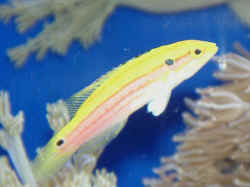
Cuban hogfish Hello <<And hello to you.>> I just bought a Cuban Hogfish for my 120 gallon fish only aquarium. He is only about 2in. big. I was wondering how fast he would grow and to what size? <<Speed of growth will depend on how much you feed. Size... fishbase.org has the Bodianus pulchellus at 28.5 cm max - that's over 11" - you can read up on the hogfish here: http://www.wetwebmedia.com/marine/fishes/wrasses/bodianus/index.htm >> Thank you for all your help. <<You are quite welcome. Cheers, J -- >> RE: IDENTIFICATION OF WRASSE Thanks for your quick response. I might be a little washed out due to my photographic skills. I appreciate your help. <Could just be the specimen. Bob Fenner, who is for sure washed-out from micro-brews and hot wings night last> Regards, Jim Hogfish (Note: add corr.s below for Bodianus/WWM) Dear Robert, In doing a bit of web surfing to see if I could locate someone who might have images of juvenile hogfishes (Bodianus), I came across your web pages featuring wrasses, including species of this genus. I found your images and accounts quite good, considering the current understanding as conveyed in the literature. My interest in finding the above mentioned images is associated with a revision of the genus I am in the process of completing for publication. I have color photos of all species, but not necessarily of all color phases. Interestingly, American species are among the more elusive. Specifically, I am attempting to locate good quality photos of very small Spanish and Cuban hogfishes (B. rufus and B. pulchellus, respectively). Any suggestions? <Have a bunch of these... can look through (am just back from a Bahamas trip and onto the labrids on my light table soon). Send you thumbnails or better, TIFF scans if for print.> Incidentally, your image of the intermediate specimen of B. diana is actually a juvenile B. neilli, a species closely related to B. axillaris and B. mesothorax, living in north-central and northwestern Indian Ocean (Maldives, Sri Lanka, India, Andaman Sea). Also, your B. macrourus images are of B. loxozonus. The former occurs exclusively in the Indian Ocean, especially around Mauritius and Reunion, and the latter in the central and western Pacific only. <Thank you for these corrections. Will add. Glad to have these (many and grievous) errors... corrected> I was similarly impressed with your accounts of Cheilinus and Oxycheilinus, two genera that I am studying with Jack Randall (Hawaii) and Mark Westneat (Field Museum of Natural History, Chicago). It is also a difficult group. <Agreed... Do know of both these gentlemen.> I look forward to hearing from you. Sincerely, Martin <Will gladly make my image work available to you for your work. Bob Fenner> Martin F Gomon Senior Curator, Ichthyology Department of Sciences Museum Victoria PO Box 666E Melbourne, Victoria, 3001 AUSTRALIA phone: (613) 8341 7435 fax: (613) 8341 7442 email: mgomon@museum.vic.gov.au http://www.museum.vic.gov.au/ Museum Victoria, Australia's International Museum Cuban hogfish question hello bob, allow me to shoot a few question on Cuban hog fish ok? 1. are Cuban hog origin brazil caught with any form of cyanide? <No, all collected in the tropical West Atlantic with hand and fence nets> ( almost all I saw here don't survive for 3 mth and had a thin back) <Hmm, sounds like a lack of feeding...> 2. what type of food are best for Cuban hog? <This info. is posted on the "Hog/Bodianus Wrasse" section on the WWM site> 3.can you say that Cuban and Spanish hog are extremely hardy? <Extremely? I give them my highest score out of three levels... out of ten, at least an "eight"... for captive survivability. Bob Fenner> your answer are much appreciate good day! Split-level Hogfish Hello Mr. Fenner! <Hello again> I've written to you several times, most recently regarding my husband throwing a dog bone through the side of our tank the night before our vacation (you may remember this one). Anyway, we have purchased a new 55 gallon tank, all of the fish have been moved in, and the tank is doing very well. <Yowsah, bowsah. Good to hear> Today's question revolves around a new purchase. This past weekend, I purchased a red spotted wrasse and a splitlevel hogfish. I was a bit nervous about the hogfish, since he was about 3 1/2 inches long, which is much longer than any of my other tank mates (1 blue damsel, 3 firefish, 1 red pencil urchin). But, the gentleman at the store indicated to me that he was very docile, and that he would not get much bigger than his current size. <Hmm...> So, finding him a very pretty fish, I rolled the dice and took him home. Well, I've since read that he may grow to between 10 and 12 inches long! This could be a very bad thing, since my tank isn't quite big enough to support this. So, my question is, will his growth be limited by the size of my tank, or will he just keep growing and potentially causing problems for himself and his tankmates? <More of the latter than the former... perhaps this same store, person will let you trade in this duplex Bodianus if/when it's oversized?> If he is going to keep growing, I may be forced to take him back to the store for a smaller fish. It should be noted, I spent 5 hours observing his behavior within the tank last night, and he has not shown aggression towards any of the other fish. The wrasse, on the other hand, was a bit curious about my mini hermit crabs. <Yes, and if/when hungry... will likely consume them> Also, I've read that some hogfish eat crustaceans, etc. I had hopes of putting some shrimp in my tank at some point, and I currently have very tiny hermit crabs in there. Does this variety of hogfish pose a threat to crustaceans? <Yes, please see my Labrid/Wrasse, Bodianus coverage on our site: www.WetWebMedia.com> As always, any advice you could give would be welcomed! Thanks much! Deborah H. Colella <You're welcome. Bob Fenner> |
|
|||||||||||||||||||||

|
Features: |
|
| Featured Sponsors: |