|
|
| Home | Marine Aquariums |
Freshwater Aquariums |
Planted Aquariums |
Brackish Systems |
Ponds,
lakes & fountains |
Turtles & Amphibians |
Aquatic Business |
Aquatic Science |
Ask the WWM Crew a Question |
| Please visit our Sponsors | ||||
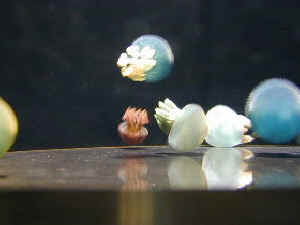
Jellyfish Appearance Robert, < Anthony Calfo here sucking down donuts like they were oxygen and answering questions> I just wanted to drop you a line and say thanks for all the help you and your site have provided me. Because of your expertise and willingness to share I have accomplished the following in about 6 months and now have a much more stable and flourishing aquarium. Not only can I enjoy my system more, I no longer find myself constantly mucking around with it or battling something that had gone out of whack ! <fantastic... it is a beautiful hobby, more so thanks to Bob> In only a few months, this is what I (we) have accomplished: . Eliminated "bad" algae from taking over my live rock and just plain stalled its growth . Boosted coralline algae growth. Now all over back glass and spreading nicely on LR. Wish I could keep the stuff off the front glass though :( . Reduced Nitrates to about 5 PPM (finally) according to Salifert. These were actually between 50-75. Ouch ! . Reduced phosphates to about .1 - .2 I have you to thank for helping me build a successful refugium and cultivate macros (God this stuff grows fast when its happy); teaching me the importance of dKH, Mg and CA and maintaining healthy levels, proper water changes, and much more valuable information. <a good student with a good teacher> Attached are some shots. they're a bit blurry, but I hope you like them ! PS, as always some questions if you don't mind ? <excellent polyp extension on your corals across the board... I should say that you certainly are on the right track> My Blue Tip Acropora (sp?) was deteriorating a few months ago. Now polyps are fuller, tips are bluer, and its receding appears to have stopped. Also, button polyps are finally spreading like crazy and are opened fully. Do you think this is a result of the (dramatically) reduced Nitrates? <in part... but no doubt a reflection of your overall improved water quality and husbandry> Is it wise to use a plant fertilizer for your macros? I've been using Sera Florena bi-monthly (iron chloride .089%, sulfuric acid .00016%, ethylene diamine .00040%) in half doses and don't know if it's doing anything positive...may even be detrimental for all I know. <modest experimentation is helpful... go slow and monitor nuisance organisms as an indicator of excess> Macros will flourish like weeds and will double in density in only a few weeks. But whenever I touch them (i.e. move them around so they don't penetrate water surface, or clean front glass or canopy glass, or move lighting) I always lose a good portion of them. I will have clumps just turn white then brown and crumple on me. But in a couple of weeks it all seems to bounce back (until my next cleaning). All I have is a few species of grape Caulerpa. <not at all uncommon although not necessarily good. The die back can sometimes suddenly liberate noxious elements that irritate coral. You can reduce this dynamic by avoiding excessive breaking of Caulerpa fronds and more selectively extract whole fronds rather than cutting/breaking clumps out> I don't know where it came from, but I have a jelly fish in my refugium. He has grown from the size of a pencil tip eraser to the size of a dime now in about 2 months. Where could this guy have come from? He's brownish/pink...will try to identify. Is he sensitive to water quality (i.e. if he stays alive, does it me my water is immaculate?). Is this a rare find in a captive system? <yes, fairly uncommon. I wrote about this phenomenon in my book. It was brought into your system as a medusae with hermit crabs or snails. It will most likely turn out to be Cassiopeia (the upside down jelly-fish): a photosynthetic "non-stinging" animal. Its presence does not indicate immaculate water quality as they frequent seagrass beds and muddy lagoon... but it is not a bad sign either. It is simply beautiful, and a marvel to behold. You are blessed, and it sounds like you are on the right track. Best regards, Anthony Calfo> Upside down jellyfish (Cassiopeia and Mastigias) Hey Crew! <whassup?> I have a 54 corner set up with 30 some pounds of live rock, 1 long tentacle, 2 common anemones, 1 sea cucumber, 1 clam, 1 clown, misc feather dusters and many crabs. Any chance of having a couple of upside down jellyfish or is this a mistake waiting to happen? <almost guaranteed failure. Motile stinging cnidarians with sessile or other motile species (anemones) is simply not possible/responsible. It is already tough enough (long term dubious for success) for you to have two or more anemone species together. It works for a year or two... but not 5 or more> I have a store near me that is selling these for only $6 and they seem to be fascinating! <they are delightful creatures... but need species-specific tanks specially designed for them (protection from pump intakes, overflows and other cnidarians)> Thanks for the advise. Michael J. Bukosky <best regards, Anthony> - Jellyfish Questions - <Greetings, JasonC here...> Hello, I was wondering if you guys knew any knowledgeable jellyfish suppliers. <Not specifically, but I would give Marine Center [ http://www.themarinecenter.com/ ] a try, they do specialize in rare/hard-to-get items.> I have been searching the web for days and nothing has come up yet. I was hoping to get some in-depth info on the Moon jelly (Aurelia aurita). I have learned about the certain current and filtering needs as well as the fact they like cold water (that is true, right? 55-60 degrees is what I read but you never know if what you read is true). <That is consistent with what I've read, I no direct experience with these.> I wouldn't call myself a experienced aquarist, but I have a few fresh and salt tanks. <Well... I do think the first and most complicated trick with any jellyfish system is the system itself - a highly specialized aquarium.> Do the Moon jellies eat zooplankton? <I would think so... they are opportunistic feeders, and don't have the equipment to be super picky.> I read that some jellies can eat live brine shrimp and some eat larger shrimp and even fish. <Yes, again... is about the size of the organism and targets of opportunity - I would think you could offer all - I'm not sure brine shrimp would be useful, but everything else from the all-of-the-above group would work.> Do the Moon jellies need the high intensity lighting as well? <Not that I'm aware of.> I fist got interested in these after I saw a set-up at The Mall of America's Underwater Adventures. It looks like they only have an actinic bulb or a purple (black light bulb). <This is really just to accentuate and highlight, and make for an interesting display.> Thank you very much for any info you can give me! Anna <Cheers, J -- >
Jellyfish... for the Ocean 5/26/04 Hello Anthony! <cheers Thanassis> I just brought home a beautiful jelly fish, which I caught from the sea near my country house. It is possibly a Aurelia aurita (transparent). I have placed it in my quarantine tank. Is there any possibility that they survive in my reef ? Are there any problems with keeping such species in a reef tank? Thanks Thanassis <Thanassis... I have kind regards for you my friend and empathize with your admiration for the sea. Be it pains me to hear of anybody collecting animals from the sea before they even know how to keep them if they can be kept at all. Causing the premature death of these animals otherwise, as your jellyfish will die soon, is not an ethical or responsible use of a living resource. Jellyfish require specially built cylindrical aquaria and highly specialized feedings to have any chance at survival (support of the invertebrate itself, suspension of feeds and feeding opportunities, etc.). Returning the animal to the ocean is also not a responsible solution as it may have not come into contact with xenopathens from other fish and invertebrates you keep in the house (wet hands, nets, water, etc. shared or dipped into this animals tank)... which if returned to your local sea could introduce a devastating pathogen or pest. The bottom line is that this jelly fish must now die in your care or be destroyed. If you wish to pursue this further... do seek articles on husbandry from academic and zoological institutions on their care. The Monterey Bay Aquarium in California has one of the worlds leading programs and a wonderful website. Perhaps you can make contact there. Best of luck, Anthony> Jellyfish Hey Bob, I just purchased an upside-down jellyfish. I had never seen one before and I probably shouldn't have bought it, but it was only five dollars. I don't know anything about it. Is it hard to keep alive? I assume that it is. Also, what would I feed it? I know some jellyfish sting, but does this one? It has feathery branches and blue leaf-shaped appendages. It is in a thirty gallon reef-tank. Thanks for the advice. Joshua Burney >> Arrgghhh, I do hope you're not absconded by aliens in a UFO who have a similar approach to livestock selection... These are photosynthetic reef animals... that need "reef type" settings to survive for any period of time... TAKE THIS ONE BACK! Bob Fenner |
|

|
Features: |
|
| Featured Sponsors: |