|
|
| Home | Marine Aquariums |
Freshwater Aquariums |
Planted Aquariums |
Brackish Systems |
Ponds,
lakes & fountains |
Turtles & Amphibians |
Aquatic Business |
Aquatic Science |
Ask the WWM Crew a Question |
| Please visit our Sponsors | ||||
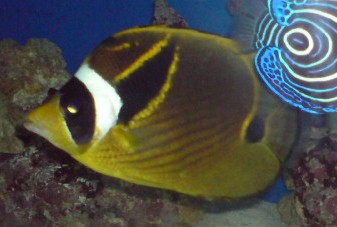
Locally Caught Hawaiian Raccoon BFF; health concerns
9/16/17 Raccoon Butterfly/Aiptasia - Comp. Mushrooms / Leather Coral
8/28/16 Raccoon butterfly flashing
5/4/16 Read the FAQs and came up with a winning strategy
11/2/14
Raccoon butterfly-Reef Safe? 8/8/12 Re: Aiptasia Anemone issues; bad C.
lunula
2/9/12 Raccoon butterfly and disappearing
snails/Butterflyfish/Compatibility 12/5/11 Raccoon Butterfly cleaning
12/6/10
Australian CB in hiding, BF comp. -
8/1/10 fish disease? Chaetodon lunula scratching, hlth.,
beh. 6/24/10 Chaetodon auriga, comp. -- 1/21/10 Raccoon Butterfly Only Wants Bloodworms --
05/08/09 Re: Regal Angel only tank?? 4/20/09 Raccoon Selection 12/19/08 Hi Guys and Gals
<Si> I have made a decision to add a Raccoon butterfly to my 180
reef tank for the control of aiptasia. I have lots of live rock in my
QT tank with aiptasia on it that I intend to use to test the fish
before introduction during the 2-4 week QT period. My reef is nearly
all hard corals, SPS and LPS. The LPS corals are Goniopora, Sinuosa,
Duncanopsammia, Euphyllia, Galaxia. SPS are Montipora, Acropora,
Porites, Hydnophora, Seriatopora. I also have a Turbinaria coral as
well. I have two choices on the raccoon butterfly. I am aware that
either, or neither may work both for aiptasia and potential coral/ fish
compatibility but the question I have is based on the 'chance'
of success. Choice number 1 is a Chaetodon Lunula from the Indian Ocean
at two inches (small). Choice number 2 is a stunning Chaetodon
Fasciatus from the Red Sea at five inches (largish). This is an
extremely beautiful fish. <Mmm, am very partial to the Red Sea
endemic myself...> Both are feeding well, on mysis. The only
potential troublemakers territory-wise in my reef are the Emperor Angel
(6 inches) and Flame Angel (2 inches). Your advice would be really
helpful. Thanks muchly! Si <Should get along with these two
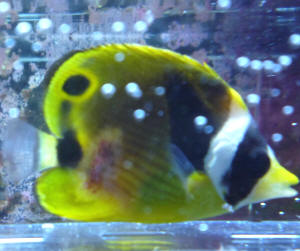
Pomacanthids... I'd go with the C. fasciatus. Bob Fenner> Raccoon Butterfly, comp. 12/01/08 Hey WWM, Smaller size Raccoon Butterflies (1-2inches) will they eat mushrooms, and a polyp rock similar to green star polyps but they aren't just not sure the actual name. I know they are reef pickers but just wondering if they will tend to nip at these two items. and at the smaller size as well. <This Butterfly species will indeed eat less noxious Polypoid Cnidarian life... they're often used for keeping Aiptasia/Glass Anemone populations in check in commercial settings...> Secondly, starfish, hermit crabs, and snails will they get eaten by a raccoon as well? <Not so> thanks for the help Ryan <Welcome. Bob Fenner> Raccoon Butterfly Question, for Majano control 11/30/08 Dear WWM <Ryan> Common question but couldn't get quite an exact answer. I have Majanos in my tank. Have been treating them with Joes juice daily towards every single one i can see. But still after 3 weeks of doing this.... i get still a couple a day...so i was thinking would getting a Raccoon Butterfly be good? <Mmm, maybe... do you have room...?> I saw smaller ones at the petstore and really liked them and thought that they would help. So just wondering if this would be a good idea even with only a few coming in every day that are REALLY small (less than 1/2 cent) also relating to all this the raccoon is about 1/2 inch if not a little less. <?! In length? Have never seen this fish, or other Chaetodont offered so small> But i really like that as i don't want a big one cause i want to see it grow. So even at small size will it still be effective is effective at all? <I doubt it... I even doubt it will live period> thanks for your help Ryan <If interested in eradication of this anemone... I encourage you to investigate the new Red Sea product: Aiptasia-X... really works and appears to be very "reef safe". Bob Fenner> Struggling To Get My Raccoon Butterfly To Eat ? 10/29/08 Hello? <<Hiya Tom>> I think this is my third or fourth time emailing you and you have always provided a lot of help. Thanks! <<Ahh, good to know? I hope I can continue the trend>> In this case my problem is getting somewhat urgent. <<Uh-oh>> I purchased a raccoon Butterflyfish from Blue Zoo aquatics on 10/17, and today is 10/28. He is in solitary quarantine in a 29 g tank. He is about 3" long. Ultimately he will go into a 210 g display tank. Through this entire time he swims around the tank like he is perfectly healthy. He is always inspecting the decorations I put in the tank for shelter. However, I have not been able to get him to eat anything consistently. <<Mmm, I see? and yes, time to get concerned>> I feed my fish a homemade mixture of thawed Mysis shrimp, brine shrimp, grated scallops, grated shrimp, and krill, all of which is soaked in Selcon and garlic juice before being frozen in little cubes. <<A good offering?>> Normally my fish love it, but the Butterflyfish doesn't. I have tried giving him pieces of algae sheets, and he seems to nibble on them, but he doesn't eat them consistently nor in large amounts. <<Indeed? not an algae eater>> I have also tried some different pellet and flake foods, but not surprisingly he is not interested in those either. I've soaked pretty much everything in garlic, but he seems to resist it. I did find a live rock in an old display tank with a few mushroom polyps on it, which I put in the quarantine tank. He apparently ate the polyps pretty quickly, although I did not actually witness this. I have heard that to induce feeding with raccoon Butterflyfish you can try giving them a small anemone. <<Is an option, yes>> Unfortunately I live in a small town and my ability to get an anemone for this purpose is somewhat limited. Do you have any other ideas? <<A couple? Try some live, or at least fresh, clam or mussel in the shell. Crack or spread the shell open so the fish can get to the meat and place on the bottom of the tank. Another favorite of mine for inducing finicky feeders is frozen glass worms (white mosquito larvae). Although a ?freshwater? organism they are still quite nutritious for marines? and something about their texture/look seems to be quite hard for fish to resist in my experience. I would also go ahead and move this fish to the larger display tank. The larger quarters will with the presence of the live rock upon which to browse will help here, along with seeing its tankmates eating to help induce a feeding response toward your prepared foods>> Thanks a lot for your help. Tom Dahl <<Happy to share? please let me know how things go. Eric Russell>> Re: Struggling To Get My Raccoon Butterfly To Eat 11/08/08 Thank you for the advice. <<My pleasure>> I picked up some clams at the grocery store and broke them up with a hammer so that I can feed the raccoon butterflyfish small pieces at a time. <<Very good>> He really seems to love it. <<Ah!>> I thought that it would be a simple matter to eventually grate up the clams, feed him the grated clam, and then gradually mix in my regular mix of mysis shrimp, etc. But unfortunately he won't eat the grated clam--he only eats the clam if it's on the shell! <<But at least it is eating>> What a picky eater. <<I have a Copperband that is almost as finicky>> He has even put the grated clam into his mouth and then spat it out. So I am kind of at a loss on how to proceed. <<Perseverance? or simply feed it the clam on-the half-shell>> Thanks to your advice he is no longer in any danger of starvation, but obviously at some point I would like to get him eating the prepared food. Should I continue to try feeding him the grated clam? <<Sure can't hurt>> Is it wise to "starve" him for a few days beforehand so that he is more likely to take the food? <<This too is worth a try from time to time>> Thanks again for the help. I was so relieved the first time I put a clam piece in the tank and he tore into it. I feel like your advice bought me the time to approach this problem patiently. <<Ah yes, much better for all. It's so good to know this fish is eating, thank you for the update>> Tom <<Eric Russell>> Need Diagnosis for Raccoon Butterfly 3/6/08 Hi crew, <David> Just found your site a few weeks ago and have found it very informative. I'm having some trouble though so I was hoping you could help me out. I have a medium sized Raccoon Butterfly fish in a 29 gallon tank <... needs more room than this> with along with a Midas Blenny. I picked up the Raccoon at Petco about a month ago. He's been healthy, and he eats-though pretty much only brine shrimp, which I know has little nutritional value. <Yes... so?> About a week after I brought him home he seemed to start developing a cottony growth on one of his fins. It spread to the tail, then to his dorsal fin. At first I thought it might be ich, did a water change, treated the tank with Coppersafe. <... see WWM re copper, Butterflyfishes... too toxic> Then I realized it wasn't ich. Now I'm not sure if it's a virus or a bacteria. In addition to the cottony growth, it appears he has some sort of abrasion on his skin. <Likely mostly copper burn, poisoning> The Blenny seems entirely unaffected by all of this (I had him quarantined for awhile but it was stressing him out so I put him back with the Raccoon, who he loves.) Anyway, I've included a link to some video footage I took of the sickness. Maybe you guys can take a look. Any feedback would be greatly appreciated! Here's the link: http://www.youtube.com/watch?v=8qMVEZNGy54 Thanks! David <Oh! Nice video, commentary... very clear. the fin growths are almost certainly a case of Lymphocystis... viral, environmental... Does look like a very nice specimen otherwise... Please read here: http://wetwebmedia.com/lymphfaqs.htm and http://wetwebmedia.com/raccoon.htm and the linked files above. The body marking is trouble... an infection from a physical abrasion... Likely the best route to go here is environmental and nutritional improvement (e.g. Spectrum Pelleted food)... the "root causes" here will be therefore "cured". Bob Fenner>
Butterfly Attacking Anemone 3/19/07 Hello <Hi! Mich here.> I love your site and it has helped answer a lot of my questions in the past. <Glad to hear!> However, 2 days ago I stopped into the fish store and since my tank has cycled I was interested in maybe purchasing and anemone. I told the owners what I had in my tank: only a raccoon butterfly fish and a cleaner shrimp... <Anemones and Raccoon Butterfly are NOT suitable tank mates.> I was not really planning on purchasing anything when I came in and stupidly did not do any research, <Hopefully, you will not repeat this mistake.> however, the owner said that they would not bother it and recommended a Haitian pink tip anemone. <This is why YOU have to do the research. Anemones are the Raccoon Butterflyfish (Chaetodon lunula) most favorite snack, sort of like chocolate for many women... a temptation too great to resist. In fact, if a newly introduced Raccoon Butterflyfish is not eating when introduced, one trick to get it to feed is to offer a small anemone. More here and links in blue: http://www.wetwebmedia.com/raccoon.htm http://www.wetwebmedia.com/condybehfaq.htm > At this time I also purchased a small piece of pulsing xenia with a small piece of hard coral attached. <Anemones are the favorite but no inverts or corals are safe with this fish. Xenia will likely be eaten also. More here and links in blue: http://www.wetwebmedia.com/xeniidarts.htm > All seemed fine the day I brought it home and yesterday but this evening I came home and found my butterfly fish biting my anemone. <Yep!> I threw some Mysis in the tank to try to distract it and then proceeded to remove the anemone and presently have it in a ventilated plastic box in my aquarium. <A temporary solution.> After this I started looking on the Internet and found out that they are one of their predators, correct? <Absolutely.> The anemone is able to attach itself to the side of the box but on some of its tentacles where it was bitten, it is fine up until the bite and is all shriveled up and grey and droopy. <Mmm, yes, is unhappy… lost an appendage...> I was wondering if it would be able to recover and what were its chances? <Hopefully.> or if you has any suggestions. <Yes, return the anemone. These creatures are, in my opinion, disasters waiting to happen because of their mobile tendency. Then get the bible: The Conscientious Marine Aquarist by Robert M. Fenner... read it. Decide if you want a fish only tank or a reef tank and plan accordingly.> Thank you <Welcome! -Mich> Overly Simplistic Questions 11/24/06 what info do you have about schooling Raccoon Butterflies? thanks <In what regards? If you mean in terms of aquarium compatibility of a school of butterflies, not without a volume of several hundred gallons. Google is your friend. Use it. -JustinN> Raccoon Butterfly problems, too small at purchase 8/23/06 Hi, I have read through all your articles I could find on getting a raccoon b/f to eat, but I am not having any luck. My new arrival is small (1 to 1 1/2 inches) <... too small> and I was very leery about buying such a small specimen. <You should be... I would take it back, pronto> I visited this fish four times over the course of so many weeks though, and he appeared healthy and was eating flakes like a pig. <Can't, won't live for long on flake food... try it> When I got him home, he ate for the first day, and then quit. I have to mention that when he met my cleaner shrimp, the shrimp went wild on him and exposed (?) a white patch behind his gills (not near them). <Could be a factor> It has not spread and neither the shrimp or the patch have bothered him since that first day, so I am not sure what it is. As far as eating, he will pick off the live rock occasionally, <Good> but will not eat anything else I put in the tank (flakes, Mysis shrimp, brine shrimp, Nori, krill, marine cuisine, oysters). So, I followed your advice and bought two different types of clams, pried them open and put them in the tank, so far- no interest. <Mmm, I'd be adding more, fresh live rock...> He is falling fast, I think, starting to lay on his side <A very bad sign> occasionally, swimming around fairly well otherwise. I know I am running out of time. There are no noticeable marks/redness around his mouth or gills. So, finally, for my question, we are thinking if he refuses to eat the clam, should we try transferring him to the refugium for a little while, so he has plenty of access to the copepods with no competition? <An excellent idea> I have to get him to eat something soon -this is about day 5 that I have had him. I am worried though that moving him again may just stress him out so much that he wouldn't make it. Do you think the move would be worth the risk? <Yes... about the only thing that might save this too-small specimen> Also, if I do put him in the refugium, should I put a clam or any other food down there with him? <No, I would not> I would appreciate any help you can give me! Thanks so much for your time. -Take care, Jennifer <Next time... please read re the species, genus (if they're available), family information on WWM re "Selection" for input on ideal size range for first purchasing specimens... like Goldilocks and the tres ursids and pudding temp... Not too big, or small... Bob Fenner> Compatibility/Raccoon Butterfly 5/2/06 Hi,
<Good morning.> I was hoping you could give me some advice. I am
looking for a new fish for my FOWLR tank, and I am trying to choose
between a raccoon butterfly and either an asfur or map angel. My
concern is I have a cleaner shrimp and a fire shrimp, and I am unsure
if any of these fish would nip at/kill the shrimp. I had a bad
experience and learned the hard way that parrotfish will eat cleaner
shrimp. Any advice you can give me would be appreciated. <Jenn,
these fish shouldn't bother the cleaner shrimp.> Thanks,
<You're welcome. James (Salty Dog)> Jenn Raccoon Butterfly
for Aiptasia control part 2 12/4/05 Hi Adam. Thanks for the help.
Does it matter which species of Raccoon Butterfly Fish for munching
Aiptasia. One local dealer has a nice adult Red Sea one Chaetodon
fasciatus), and the other species (Chaetodon lunula), but younger.
Thanks, Bill <If the fish both look healthy, I would go for
the Red Sea fish unless it is very large (larger than your hand). Best
Regards. AdamC.> Raccoon Butterflies and Pest Anemones 1/28/2005 Hello Bob,
<Hi Bill, actually Adam J with you this morning.> Awesome Site!
:-D <Thank you.> Question on Butterfly's. I'm a wee bit
confused on this page: <Okay, I'll see if I can help you
out.> http://www.wetwebmedia.com/raccoon.htm
I have a Fish Only tank with Live Rock. I'd love to add a Raccoon
to 'hopefully' munch glass anemones. Will both the Chaetodon
lunula & Chaetodon fasciatus be likely to graze upon them? <From
what I have gathered most are about as likely to eat them. Though
Chaetodon lunula seems to be the easier to find out of the two and thus
it will probably be easier to find a healthier specimen of this
species. However I might add that in my experience a lot of folks who
employ butterfly to rid themselves of pest anemones tend to be
disappointed at times. Often the fish is already spoiled on prepared
foods and tend not to be so "hot" on picking these critters
out of the rockwork. If you have an abundance of pest anemones it can
usually be traced back to overfeeding or a nutrient problem. See here
for some more ideas/details:
http://www.wetwebmedia.com/marine/inverts/cnidaria/anthozoa/aiptasia/aip&bfsfaqs.htm
and here
http://www.wetwebmedia.com/ca/cav1i3/aiptasia_impressions/aiptaisia_impressions.htm
> Raccoon Butterfly, Copper, Quarantine 9/30/05 My name is Kristen and I just bought a raccoon butterfly for my 70gal tank. Currently he is in my 25gal QT tank that I am treating with copper. The last fish in the QT tank had been treated with copper before because of either velvet or angel fish disease (I figured after 4 months of letting the tank sit with no hosts, the parasite would die off). <Although Ick and velvet would die after this amount of time, quarantine tanks should always be drained and allowed to completely dry between uses to be absolutely sure than any pathogens can't survive.> Surely enough, my butterfly started to get white spots and was darting all over the tank. So I'm assuming he contracted the same thing. <Most likely, it was carrying the disease when you purchased it.> I do notice that he is breathing very fast and heavy at times, other times not. I have a good-sized air bar in the tank along with good circulation with a bio filter running and heater. <Rapid gill movement is usually a sign of stress and often of parasites damaging gills. This occurs even when there is plenty of oxygen in the water.> Before I put my butterfly in the tank, the copper treated water had been sitting a good four months w/o any fish in it. One quarter of the water evaporated, and I sucked out the other 1/4 of the water for a 50% water change (including the water that evaporated). So 50% of the old water still remained and I put the other 50% full of new water. <Yikes! If the water was allowed to evaporate 25%, this could cause unpredictable changes in water quality. Also, if you have not done so, please be sure that the salinity is correct as it would have increased with evaporation. I would suggest performing a couple of large (25-30%) water changes with water from your display to ensure proper water quality. Replace the water in your display with new well aerated salt water.> Do you think after all that time there was still copper left (I forgot to test to see)? As of right now, I only put the first dose of two in the tank. Im going to hold off on putting the second and final dose in until I hear from you. <It is impossible to predict how much copper might have been left in the water. Copper treatment must be done according to the package directions and should be tested regularly during treatment (some preparations can't be tested for... just follow the directions to the letter).> Do you think his fast breathing are signs of a copper overdose already, only after 2 days? I'm concerned even though the fish looks great/very colorful, is eating, and is active. He just seems a little spazzy. Please help!! Thanks so much, Kristen :-) <I doubt that this is copper toxicity. I would guess that it is a water quality/stress issue. The fish should have plenty of cover to make it feel secure (flower pots or pieces of PVC pipe work well) and water quality should be optimized with water changes and good filtration. Be sure to add the appropriate amount of copper to make up for water changes. Hope this all helps. Best Regards. AdamC.> Red coloration on a raccoon 8/25/05 Hello again WWM crew. Update. My pacific tang has started eating just about anything I put in his QT tank, and is now also rather hyper. He has another week to go before his trip to the big tank! I purchased a raccoon butterfly yesterday from my local LFS. I looked for all of the bad indicators as described in the article on raccoon butterflyfish. ( http://www.wetwebmedia.com/raccoon.htm) He ate at the store, had no reddening, and was very bright colored. This evening I got home from work and noticed that the top of his mouth/nose area was starting to get slightly red and it looked like he had a small piece of flesh coming off. <Common... from being moved, netted... bumping into things... dangerous if the mouth is too damaged...> I attempted to take a picture, but it is hard to get a close up shot of his nose with any sort of clarity. I didn't notice any red coloration around his fins as of yet. Today he seems less energetic and would eat none of the brine shrimp I dropped in the tank unlike last night. He still has good coloring, but does appear to be breathing slightly quicker. I'm not sure how the reddening nose ties into this next fact, but I have seen him glance off of the pvc couplings I have put in his QT tank. After researching your site, and searching for just about every combination of red mouth, glancing, and butterflyfish I could think of I'm now writing to you for help. He is currently in a 10 gallon tank with a whisper 10 gallon power filter, a heater set to 81 degrees, and two 3'' pvc elbows (I have been thinking about putting in an air stone). <I would> The water parameters are 1.0235 specific gravity, ph of 8.2, ammonia and nitrites at zero, and a slightly detectable nitrate of about 2-3(barely registers on test kit). The water from the tank came directly from my main tank which currently has about 75 lbs of live rock and 18 turbo snails. The raccoon was drip acclimated for about 2.5 hours when I initially obtained him. Thanks in advance for any tips on care or diagnosis you can provide. Rick <... very likely just resultant from the move... keep observing, be ready to dip, move the fish to better, larger quarters... Bob Fenner> - White Spots on Raccoon Butterfly - I have a small raccoon butterfly in my main tank - FOWLR. I had it in quarantine for 2 weeks and now in my main tank for 2 weeks. I see some tiny white dots on the tail. It's eating normally and acting fine. Should I put it back into quarantine tank with medicine or is it nothing and will it go away? <I'd leave it be for now - a few spots on a fin shouldn't be an extreme concern and better at this point for the fish to resume a "normal" life rather than quarantine. Do keep an eye on those spots and make sure they don't multiply - if they do then you know what you'll need to do.> Thanks. Mitch <Cheers, J -- > Aiptasia-Eating Raccoon Butterflies (3/19/05) Hi Folks, <Hi there. Steve Allen with you tonight.> You have all been so helpful that I thought I should report my results for anyone who may have a similar problem. <Thanks for sharing.> I have a 300 gallon reef tank that has been going for many years now. I recently had an Aiptasia infestation. Well, plague would be a better word. <Yikes!> They were everywhere, including starting to sting my polyp colonies. <Yes, this is one of their many problems. I have a Blastomussa that was harmed in this way.> Nothing that I tried worked. Peppermint shrimp did nothing. <It's definitely frustrating when they don't eat what they're supposed to. It's sort of like trying to get a recalcitrant child to eat healthy food.> I turned to a Copperband Butterflyfish. I couldn't keep one alive through quarantine... <These are tough fish to keep alive long-term, and some don't have a personal taste for Aiptasia either.> ... so I finally broke down decided it was time to take a risk with a Raccoon. <Interesting> I got a small one. I kept him in 75-gallon quarantine for 45 days, passing Aiptasia infested rock through to give him a taste. <Good idea.> He has been in my 300 for about a month now, and there is not an Aiptasia to be found! <Congratulations!> The better news is that he has touched none of my corals, and none of my polyps. <I hope that this remains true now that the Aiptasia is gone. Keep him well-fed with other things and keep a close eye on your corals. Again, all fishes have their individual variations, so "reef-safe" and other traits are generalizations that may not hold for a given individual.> I even have two Condylactis Anemones I had taken in as rescues to help out the prior owner, and he hasn't touched those, either. He tells me that the books give his species a bum rap. Maybe its just blind luck, <Good fortune is always welcome. Take it when you can get it.> and there are certainly no guarantees or warranties, but this has been my experience. <Thank goodness for small favors, eh?> Regards, Dale M. <Again, thanks for sharing.> Re: Butterfly fish Bob, In the past I have asked for your advise and it has always been right on the mark. One thing I have learned in this hobby is do your homework, before you create a problem. <Yes, Hallelujah!> I want to add a butterfly Raccoon (Chaetodon fasciatus) or Threadfin (Chaetodon auriga) to my display tank (after a three week Q). First question is in the trade almost all raccoons I see are not from the Red Sea and appear to be Chaetodon lunula. <Yes. Lunulas distribution range is much closer to us/U.S.> Any ideas on how to find Chaetodon fasciatus in the Cleveland area. <Have your dealer's contact Quality Marine in Los Angeles> Also, I have about 15 snails that are breeding rapidly (probably 20 or 30 little snails developing), a cleaner shrimp, several hermit crabs, and two peppermint shrimp (to keep Aiptasia under control). This is a FOWLR tank (no corals). Are either of these good choices or would they likely make a meal out of my inverts. If not what would be a better choice? <Should be fine together> Thanks for your help, Geoff Goodfellow <Welcome. Bob Fenner> No Butterfly Kisses Here (Butterfly in a Reef)... Oh knowledgeable ones, <Wow! I've been called susceptible, corruptible, culpable, even palatable...but knowledgeable- that's cool! Scott F. here tonight> I am thinking of adding a raccoon butterfly to a 500 gallon reef tank. Mostly SPS. I do have some rose anemones in the tank. Would they be at risk or the SPS. Any thoughts would be appreciated. I did try to page through you question pages but could not find this are describing this. Thanks in advance. <On the whole, I'd have to call this fish "reef-unsafe". It really will eat, or at least sample, most of the SPS and other corals and inverts that you are keeping. In fact- I can recall at least one book that recommends trying an anemone as an appetite stimulant for a Raccoon Butterfly who's a reluctant feeder. Yikes! Much better to try a Chaetodon kleinii, or a Forcipiger longirostris ("Big Long-Nosed Butterflyfish"), IMO. These fishes are a bit less of a threat to your corals. Granted, in a large tank with lots of corals- the "damage" is spread out over a lot of specimens, but do you really want to put them at risk? It's really a "roll of the dice" when attempting to keep a Butterfly in a coral-dominated reef system. Keep researching these fishes, and make the decision based upon your level of comfort...Good luck! Regards, Scott F> Chaetodon lunula Help, just added a Raccoon Butterfly to my 140 gallon tank. I have tried to get him to eat, no luck so far. I have tried Hikari "Marine S", pellets. Frozen food tried is as follows; mega marine, brine shrimp, blood worms with no luck. He just looks at it and swims on buy. I have also tried morning and night feedings. I have only had the fish 3 days but my concern grows. Specs on the tank are, total four fish 5" dogface,3" Picasso trigger, 5" Sailfin tang, raccoon 3".....thanks for your help...I check your website daily, have your book and love it, it has served me very well........thx again. good day <Hi Theresa, There are several issues specific to BF's. Please read about them at http://www.wetwebmedia.com/raccoon.htm and the general links about BF's at the top of the page. I would keep offering food, hopefully he will eat soon. The activity of the other fish eating should help if he is up to it. Craig> Raccoon butterfly? Hello doctor, <Bob's not here right now, and I've been called a lot of things before but "doctor" has never been one of them.... well, there was that one time after a crazy convention in Vegas... but that is really another matter altogether (?!?) Anthony Calfo in your service> I am on day 10 of a copper treatment @ .20ppm. <for the record...many of the copper tolerant fishes seem to navigate a antiparasitic treatment better at .25ppm. Under .20 is rather ineffective... a judgment call for each of us. >30 is lethal to many fishes just the same.> All of my other fish have long stopped itching except my raccoon bf. He really seems to be aggravated. I have several other different butterfly fish, and a Foxface and a tomato clown. None of these fish seem to be troubled at all in this 135 tank. Are raccoon butterfly fish especially sensitive to copper? <Ahh... yes. Butterflies, Angels...some tangs, drumfish/croakers, Elasmobranchs, dragonets, Firefish, cardinals...the list goes on...> My 4 eyed butterfly appears to be very similar to the raccoon, yet like the rest of the fish he is ok. <not a fair comparison over such a short span of time or between species which likely have different tolerances. Many fish make it through a symptomatic stage of treatment only to die days or weeks later from overmedication or drug sensitivity (meds stored in body fats, used up and OD later)> Help. I can't stand to see him so bothered. Would a partial water change help? <sure... water changes daily from the tank bottom reduce tomites that eventually infect hosts... but this fish really needs freshwater dips. They are more effective and direct than copper for many fish anyways. If unsure, please review protocol for conducting proper FW dips in the WWM archives or Bob's Conscientious Marine Aquarist if you are fortunate to have it. Have faith... Raccoons are incredibly hardy... but what's up with the 4-eye butterfly? Who the heck suggested that to you?! It can't be more than a year old and odds are against it ever seeing it sorry to say, although I hope for the best indeed. Especially without QT for all new fishes... really critical. Please be sure to feed an extraordinary and varied diet. > Thank you, Steve <best regards, Anthony> Raccoon B/F Mr. Fenner, I have looked to you for advice in
the past and most of the time your experience is a huge asset to me. I
need your advice again. I recently purchased a Raccoon b/f from
FFExpress and it is about 3-3.5" long and pretty robust for a b/f
(not paper thin like most). He is in my 10g qt tank with the following
stats: 0-.1 ammonia just a smidge over the 0, but not quit .2, but my
qt tank never goes any lower than that, and I have QT'd a Naso tang
and emperor angel in it with no problems), 0 nitrate, 0 nitrite, 1.025
salinity, 78* temp, ph 8. The reason I am asking for your advice is
because the little bugger has not taken a bite of one thing I have put
in the tank yet. I have tried small amounts(3-5) of live black worms,
small pieces of squid, and small pieces of formula 2, and he will not
even go near the food, let alone nibble on it. I have the Naso and
emperor that I mentioned above and they took a few days to start eating
the angel took about 2-3 days to start eating all the food, but he
nibbled at least the first day or so). I have had the raccoon since
Thursday evening, and he still shows no sign of eating or of settling
down. He is very skittish, shy, and secretive. I come into the room
were his tank is and he either hides close to the pvc tube I put in the
tank for him or he rushes behind the sponge filter and just stays there
all freaked out for about a minute or two and then comes out, but not
very far from safety (My emperor and Naso were shy like the b/f for
about a day maybe two, but after that, just like a puppy, out and
about) . I am not scared yet that he is going to die, but I am getting
concerned after 4 days of him not eating a damn thing. I also put a
piece of live rock in the tank that has some good algae growth on it so
that he can nibble on that I have noticed him one time, taking a nibble
on it, but that will not sustain him). So, what are my options, what do
I do to get him to eat, what can I try that I haven't? <I would
take a calculated risk here... pH adjusted freshwater dip this specimen
and place it in your main/display tank> I have read that b/f's
can not pass up a fresh opened clam, live brine shrimp, or a certain
type of cheap anemone you state in your book that Condylactis are
prolific and cheap). I have not tried these, but where would I get a
fresh clam? And if you could recommend a few things that have worked
for you to get a shy b/f to start eating, that would be great. The
b/f's at one of my LFS's are shy, but once they are used to you
being in front of the tank, they come out flying around, chasing each
other all over the place, and eating chunks of meat or flake food like
rabid dogs. If the live anemone is almost a sure thing, I would have no
problem buying one to get him eating. I just don't understand why
the little guy is not eating yet, from what yourself, other authors,
and people in the fish community say, the raccoon is one of the best
b/f's to have in captivity. They supposedly eat well and are very
hardy as well as the saddleback and auriga b/f. So what gives? <Hmm,
nothing... just an at-times skittish species of small size> When I
had the angel and he did not really eat for about 3-4 days, I was
freaking out, but by the 4th day, he started eating and within another
few days, he was a rapid dog (as of now, he basically eats whatever is
in tank: formula 2, pygmy angel formula, sponge formula, Nori, seaweed
selects, and even flake food)! But the point is, he did begin to at
least check the food out and take a few goes at it in the first few
days, were as the b/f is still freaked out and not at all interested in
eating yet. And if you tell me, "well, you should probably only
buy fish that you can see eating before you buy", I would respond,
"I don't have 100 dollars to spend on one freaking little tiny
fish." And even if I did have that type of money to blow on a fish
I wouldn't because it is way cheaper on the net. From what I have
found, the fish I own and the fish my friends own, FFExpress and marine
center have much higher quality fish than what I see in the
LFS's. The fish in the LFS sometimes have ich or other
diseases and are sometimes dead or pretty thin, were as FFExpress and
Marin center fish are very robust, have no disease what so ever, and
are beautiful. I bought the raccoon from one the most reputable fish
dealers on the net, FFExpress, and I have never had a problem with them
nor anyone I know. Thanks for any help in advance and as always, I love
receiving insight from an experienced person like yourself. Ryan Fick
<I think you and the B/F are better off going ahead with the
above... this is what I would do. Bob Fenner> Raccoon Fish Hi, I just bought a raccoon and pacific Double
Saddled Butterfly. Any suggestions on keeping them alive and healthy?
do you have any tricks or tips for keeping them in good shape. I heard
that live brine shrimp is a must on arrivals for butterflies, I can
only get live brine shrimp in a few days so I hope they survive the
first few days. any suggestions would be great. and I really like your
book! -Matt <Thanks for writing... and pumping me up! Yes to having
a bunch to say about these two great Butterflyfish species... actually
have separate articles on both posted on the site: www.WetWebMedia.com
Bob Fenner> Raccoon Butterfly Dear Mr. Fenner, Don't know if
you'll get this in time, but here goes: I took your advice on using
a raccoon butterflyfish to control Aiptasia, which is getting totally
out of hand in my 55 reef. No sooner was the fish out of the bag today,
but he nailed several Aips! I thought, "Great!" and then the
wars broke out. My old (3 yrs) gold & black Chromis had to be
removed as he was determined to kill the butterfly within the hour. All
seemed fine until a few minutes ago, the adult tomato clown attacked
the raccoon, and is spitting out scales! <Yikes, some established
social dynamic now!> The lights are out, I already rearranged the
liverock to some extent (had to get to the darn Chromis!) thinking that
would re-establish territories. <Not likely in such a small
system> I hope this beautiful fish is still alive in the morning, (I
don't have a place to put him) but what can I do to prevent WW3 in
this tank? <Move the other grand offendis, the other fishes>
Hoping you can help, thanks in advance :) Stephanie <Peace to you,
and your livestock! Bob Fenner> Raccoon Butterfly I recently bought a raccoon butterfly for
Aiptasia control. My first two choices were unavailable, they were
peppermint shrimps and an Auriga butterfly. there was a Copperband
available but I was not confident enough to keep it, because I've
had bad luck with them. Anyways. I brought the fish home, acclimated it
and introduced it into my reef. I've had it for 4 days now. Its not
eating. it only picks at the liverock. wont touch the Aiptasia nor will
it eat frozen Mysis or live brine. nothing is harassing it. My water is
0 Ammonia, Nitrate and nitrite. temp is 78?F. The tank is a 60gallon
reef, with 80lbs of live rock. 2 leather corals and over 160 mushroom
anemones and a large pink tip that split. Fish consist of 1 Marine
Betta, 1 tomato clown, 1 Tailspot wrasse, and 1 Sailfin tang. Algae
crew is 30 Astrea snails and 1 large turbo snail. and 20 scarlet reef
crabs and 2 emerald crabs. Lighting consists of 4 96w PC lights. I have
an AquaMaster 600 to hold media like carbon. I use a SeaClone as a
protein skimmer, which I will be upgrading within a month. I have 2
power heads, one on each end of the tank. I do 25% water change every
month. I also have a large problem with Blue Green algae
(Cyanobacteria) I presume. I need help getting rid of this too. Hope
this is enough detail for you to trouble shoot. thanks. Dexter >>
Hmm, who can say re the non-feeding Raccoon... it should start feeding
soon... I would be hopeful here. Concerning the Aiptasia and the C.
lunula...? Also, hard to tell... some do munch on Glass Anemones...
others stick with zooplankton or substitutes of same... I do have a
concern re your stmt. of so many Corallimorphs... these may need to be
thinned/traded... and your Cyano problems will definitely be helped by
way of upgrading the skimming... Additionally, I would start using some
(a unit, like Chemipure) of activated carbon replaced every month... to
lower dissolved organics... possibly the chemical effects of the coral
anemones and the BGA. Bob Fenner I have a Raccoon Butterfly fish that I just got yesterday. I don't know what they eat. I tried frozen algae cubes and he liked it just fine. What else do they eat?? Do they like baby brine??? >> What? No! Buying livestock without first checking out its husbandry... This is a generalized zooplanktivore species that eats most anything meaty that is small enough to get in its mouth. Bob Fenner Red Sea Raccoon Hi Bob- Well impulse selection has reared its ugly head again. It all started as I entered a local Petco and wandered over to the marine section. Something caught my eye immediately it was what appeared to be a 3" Red Sea Raccoon. I believe it to be a Red Sea specimen as the colors are very bright and the tail is distinctive as to what I have seen before as a Red Sea Raccoon. The origin was not noted on the price, which was another thing that caught my eye it was priced at 18.99 with 25% off all Tropical fish, total was 14.24. There was another Raccoon there half the size and was distinctively different than the larger one. I owned a 1" non Red Sea Raccoon for about 15 months until it stopped eating and perished. My question is
that I very much want to keep this fish alive and hopefully
thriving for many years as it is indeed a very beautiful species.
The problem I think I will encounter is in regards to feeding and
I would like some tips on caring for this fish. Current
inhabitants are: Black finned Trigger, Assasi Trigger, Naso Tang,
Yellow Tang all in a 125 gal. How can I make sure he will get
enough nutrition. While feeding the other Raccoon I had to wait
for him to surface in the corner and drop food in the tank right
in front of him it was kind of a pain but he was small. Last night
he ate a little scallop and was constantly scourging the live rock
for something. He was very active and swimming at all levels. I
have a Aug 97 issue of Tropical Fish Hobbyist and you wrote an
article called "Rating the Red Sea Butterflyfishes".
The article is brief but states that the SG should be no lower
than 1025 has this changed at all since then?
|
|

|
Features: |
|
| Featured Sponsors: |