Featured
Sponsor


Related FAQs: Xeniids, Pulsing Corals, Xeniid FAQs 2, Xeniid FAQs 3, Xeniid FAQs 4, Xeniid ID, Xeniid Behavior, Xeniid Selection, Xeniid Compatibility, Xeniid Systems, Xeniid Systems 2, Xeniid Feeding, Xeniid Disease, Xeniid Health 2, Xeniid Health 3, Xeniid Reproduction, Soft Coral Propagation, Soft Coral Health

Related Articles: Soft Corals, Order Alcyonacea

/The Best Livestock For Your Reef Aquarium:

The Pulsing Soft Corals, Family Xeniidae

By Bob Fenner

Xeniid in the Red Sea, DF Pic


<To do: make chart differentiating different Xeniid genera: Criteria: size of colonies, arrangement of polyps, number of rows of pinnules...>
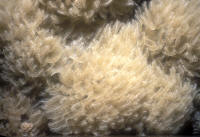
Genus Anthelia Lamarck 1816: Clusters of polyps all arising from a united stolon base that is soft, ribbon-like. Polyp pinnules in rows of 1-4 in number; slightly contractile, not retractile; some don't even respond to touch. Unlike Heteroxenia and Xenia species, Anthelia colonies branch at their base of attachment.

Anthelia sp. (perhaps A. flava) N. Sulawesi. 

Anthelia edmondsonii (Verrill 1928). Light blue in color this is one of the few soft corals found in Hawai'i (and only there). Predated nightly by the Nudibranch Tritonia hawaiiensis. 1/4" inch across polyps in colonies 3-12" across.  Big Island photos. 

Anthelia glauca, Red Sea.


Genus Cespitularia Milne-Edwards & Haime 1850: Soft colonies, appear translucent, comprised of a few lobe-like branches. Polyps only on apex and upper areas of stalks. Similar to Xenia, but polyps extend downward on stalks. Polyps often appear "basket like" (tips closely together). Numerous pinnules arranged in 1-4 rows on edges of tentacles. 

Cespitularia sp. N. Sulawesi pix. 

Cespitularia sp. 2 N. White body fading to blue tentacles. Shallow water, reef flat species. One of the hobbyist-called "Blue Cespitularias". Sulawesi pix. 

Genus Heteroxenia Kolliker 1874: Characterized by their heteromorphic condition; possession of longer, non-retractile auto- and siphonozoid (much shorter polyps, placed on stalks in-between the autozoids... may only be seen when autozoids are retracted) polyps. Highly pinnate, long tentacles, typically non-branching colonies. 

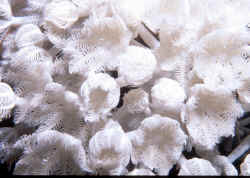
Heteroxenia fuscescens (Ehrenberg 1834), Pom-Pom, Palaver, Pulse Coral. Indo-Pacific; most common in the Red Sea. Red Sea image.

Genus Xenia Lamarck 1816: Small cylindrical colonies (up to 4 cm in all dimensions typically), dome shaped. Sometimes branched, with polyps only at apical stems. One-shape polyps with varying capacity to retract, 1-6 pinnules on both sides (number of rows, pinnules species-specific). Some pulsate, some don't.  Forty plus species, scattered over the Indo-Pacific. Fed on by similar appearing Nudibranchs of the genus Phyllodesmium

Xenia cf. actuosa Verseveldt & Tursch 1979. Large colonies, tentacles tubular shaped, white with brown pinnules. A rapidly pulsing species. Western Pacific; New Guinea, Philippines. N. Sulawesi pix. 

Xenia cf. elongata, Red Sea. 

Xenia umbellata Lamarck 1816, Bouquet Encrusting Coral. Indo-Pacific; including the Red Sea. To about five inches in overall dimension. Tissues contain zooxanthellae. On import, do look for parasitic Nudibranchs and copepods (Paradoridicola glabripes). This colony off of Queensland, Australia.

Xenia sp. Branches support capitulums that bear polyps at end. Stalks smooth, white, polyps mottled, brown. Indo-West Pacific; Red Sea, East Africa to Australia, S. Japan, Polynesia. N. Sulawesi pic. 

About Pulsing Coral Abundance: They can take over your tanks...

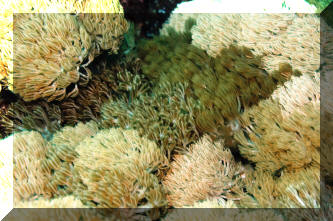
In places, the Pulsing Corals will dominate a given environmental niche. Here three species, including the blue Efflatournaria crowd a tridacnid clam off of Queensland, Australia.


Featured Sponsors:
Google
 
Web www.WetWebMedia.com

Amazon Honor System Click Here to Pay Learn More