|
|
| Home | Marine Aquariums |
Freshwater Aquariums |
Planted Aquariums |
Brackish Systems |
Ponds,
lakes & fountains |
Turtles & Amphibians |
Aquatic Business |
Aquatic Science |
Ask the WWM Crew a Question |
| Please visit our Sponsors | ||||
Lighting choices are some of the most important
decisions you will make for your marine aquarium. Proper lighting
schemes and their good maintenance over time are instrumental to the
success of any display. They also consume a significant portion of a
display's budget to buy and operate. Shopping the many lighting
options and products available may seem daunting at first, but rest
assured that sense and solutions can be readily discerned to serve you
best. Some of the first questions that need to be asked
are: what kind of organisms will be kept, and what are their specific
lighting needs? Too often, aquarists get caught up in wonder and
marketing claims in search of a fixture that fits their tank size and
not their livestock's needs specifically. The keeping of
photosynthetic invertebrates like corals and anemones imposes certain
demands on lamps and intensities. Systems without such symbiotic
animals, however, will still require careful consideration of hardware
beyond aesthetics for the cultivation of desirable plants and algae or
attempts to prevent undesirable life forms (diatoms, cyanobacteria,
etc). Numerous other organisms on and in common living substrates (sand
and rock) are influenced with light quality in kind. Good decisions
with lighting applications will help ensure that new aquarists start
well, and that established aquarists fare better with keeping and
culturing the most desirable marine creatures under attractive
illumination. Lamp color is the first grade in the
decision making process. Light bulbs are rated and evaluated in a
number of different ways having various measures of importance in
different applications. "Color" or "temperature",
measured in degrees Kelvin (K), is perhaps the most popular unit in
marketing and advertising. The spectrum of light is described on the
warm end (red, orange, yellow) of the Kelvin scale with lower numbers,
while cool colors (blue, violet) are assigned higher numbers. Most
desirable aquatic plants, corals and algae fare best in light within
the range of 6500 to 10,000 Kelvin. Undesirable algae and very
shallow species are supported by warmer colors (below 6500K). Many
lamps are known to stray toward this lower end of the Kelvin scale as
they age, and may be evidenced by an increase in nuisance algae growth
in the aquarium. Deepwater species and various cnidarians fare better
in cooler light schemes (heavy blue color) in the range of 10,000 to
20, 000 K, while most plants and algae do not. You are advised to
finesse the needs of your livestock within these guidelines when known,
or make the conservative choice and stay between 6500 and 10,000 K for
general-purpose applications. Advancements in fluorescent lighting technologies in recent years have flooded the market with numerous choices of bulb types. Standard output (SO) fluorescents are essentially the earliest and most popular types of lamp used on modern marine aquaria for their common availability and because they are fairly inexpensive. SO lamps are efficient to operate and are available in a wide array of colors. Unfortunately, they have a very short useful lifespan for photosynthetic organisms at 6-10 months for most. Standard output fluorescents may be fine for very shallow water applications and low-light biotopes, but are too weak to be useful for many aquariums. More intense fluorescent bulbs of several different types are more effective and attractive in aquariums up to 24" (60 cm) deep. Very High Output (VHO) and Power Compact (PC) technologies have become tried and true strategies combining good color and energy efficiency. Lifespan for these more expensive bulbs is not especially envious, though, being quite similar to SO lamps. Nonetheless, they are some of the best and most practical forms of lighting for marine aquariums. A new technology on the market, T5 fluorescents, has shown even greater promise for efficacy and quality.
Although it is best to avoid generalized rules of
thumb as primary influences on your decision making process, most
aquarists find themselves using 4 to 5 watts per gallon of aquarium in
their lighting applications. Where such guidelines do not hold up well,
however, are in deeper aquaria and with demanding plants and
invertebrates at depths towards 30" (75 cm) and beyond. In such
circumstances, a more intense lamp will be necessary; metal halides
(MH) are commonly used for such applications as they have the
ability to penetrate water better than fluorescents. Most MH lamps are
also likely to last longer (over 18 months) and stay truer in color
(useful lifespan) than fluorescent technologies. The initial purchase
price for MH hardware, however, tends to be more expensive. The merits
and limitations of various types of lighting at length must be weighed
against the goals you are trying to reach in your marine
aquarium. Once you have decided on a lamp color and type, be
sure to optimize the delivery of your light into the aquarium with a
good reflector. Numerous DIY reflectors have been used to line
fixture housings, running the gamut from simple to sophisticated. The
list of reflective materials commonly used is amazing and includes
polished aluminum and steel, rain gutters, shiny hobby films (model
planes), foil, and bright or light colored paints. Most all fall
woefully short of an engineered reflector. Some fluorescent lamps are
manufactured with a built-in internal reflector; these bulbs tend to be
rather efficient. All bulbs though will benefit from the use of a
parabolic reflector (angular, polished metal feature designed for the
purpose. Always use the best possible reflector within the limitations
of your lamp housing. Lamp housings have evolved to become
necessarily ingenious for the many needs and preferences of aquarists
working on their aquariums in varied living spaces. Much could be
written at length on the commercial variations of light housings, while
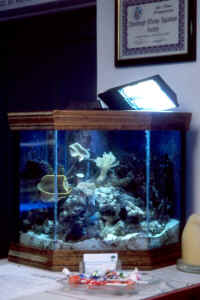
DIY interpretations are even more bountiful! The three
fundamental types of housing are: fixed, independent or hybridized.
Which type you choose is mostly a matter of personal preference and
aesthetics. Independent housings are generally reserved for the less
intense light fixtures and include the traditional strip-light
fixtures. They are most always self contained with a shell, reflector,
lamp and protective lens all in one tidy package that sits upon the
aquarium glass top or plastic lid and is easy to move if necessary.
Aesthetically, they may not be as handsome as fixed pendants and
finished light canopies, but they are convenient and usually the least
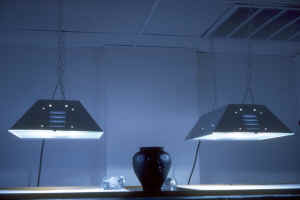
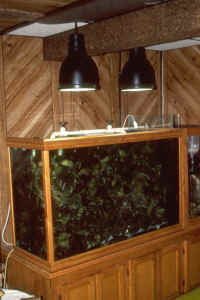
expensive choice. Pendant fixtures (suspended from the ceiling) are
usually installed out of necessity (space) or desire to make and
aesthetic impact as a hardware feature. They tend to concentrate and
focus light in a limited pattern like a beam and are not often the most
efficient distribution of light. Suspended lamps are usually convenient
and easy to work around, however, and are helpful in living spaces
where heat (as with an enclosed fixed or independent canopy) is an
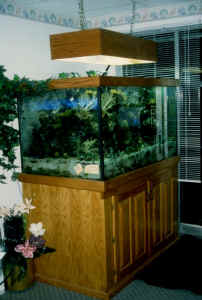
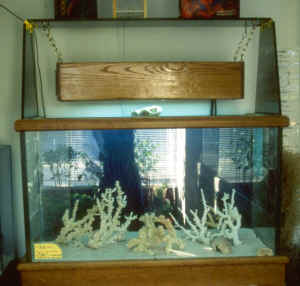
issue. Enclosed, fixed canopies are the largest and most cumbersome
forms of housing, but they usually offer the best distribution of light
through the freedom of extra space for hardware. Novel adaptations for
moving such large canopies to work on and around abound including
tracks on bearings, piano hinges, pulleys and simple doors. Accumulated
heat is sometimes an issue in enclosed housings but is easily corrected
with inexpensive exhaust fans. Whichever housing you choose, try to
keep the efficient delivery of light (via mounting and lamp positions)
and optimal reflector options in mind with buying decisions.
The correct mounting of aquarium lamps is
an oft-overlooked yet crucial aspect of lighting applications.
Fluorescent lamps should be mounted no further than 3" (7.5 cm)
off the surface of the water, while metal halide lamps are generally
kept 6-10" (15-25 cm) off the surface (up to 175 watt lamps).
Bulbs kept at even slightly greater distances can be significantly
reduced in intensity and efficacy (measured in water at depth). A light
meter can be very revealing regarding this dynamic and will also
indicate waning lamp intensities for the efficient exploitation of lamp
life. For large aquariums especially, a light meter is highly
recommended (its also a wonderful aquarium toy for the technologically
fixated!). At last, light and canopy maintenance is a simple but necessary matter. Housings with exhaust fans will inevitably accumulate dust and debris quickly and require extra care to keep clean. Fluorescent lamps kept necessarily close to the water surface will also accumulate salt creep fast. All lenses and lamps should be wiped clean at least weekly to ensure a consistent and maximum delivery of light. It is remarkable how such a very small amount of debris can significantly reduce light transmission! A word of caution is warranted too for the fearless DIY aquarists: wiring and electricity are very serious matters, of course. Please be mindful of building codes for safety, and be realistic about your abilities with construction and wiring of DIY light fixtures and canopies. It is a very common mistake inside of custom canopies, for example, to forget to protect shielded wiring that is exposed within the fixture. The UV stability of wire shielding can become an issue over time; some coatings degrade from the prolonged exposure to intense light within the housing day after day and leave exposed live wires! Commercially constructed and professionally built fixtures are recommended. Seek the advice of your local merchants and fellow aquarists (online and at local aquarium clubs) to help you make an informed decision to suit your aquarium's lighting needs. With kind regards, Anthony.
|
|

|
Features: |
|
| Featured Sponsors: |