|
|
| Home | Marine Aquariums |
Freshwater Aquariums |
Planted Aquariums |
Brackish Systems |
Ponds,
lakes & fountains |
Turtles & Amphibians |
Aquatic Business |
Aquatic Science |
Ask the WWM Crew a Question |
| Please visit our Sponsors | ||||
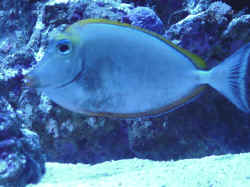
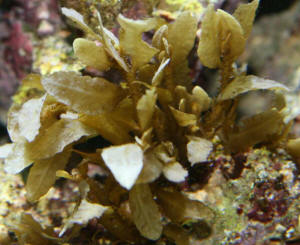
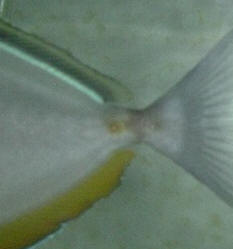
Lipstick tang health, sel. 3/15/06 Hi I would like to know if you have any ideas on why our lipstick tang died. We've had the tank 5ft- 380litres) for 3 months. We have a blue damsel, 2 coral banded shrimp, Fijian damsel, 2 clownfish and a coral beauty (all small specimens). We test regularly, everything stays relatively the same, and I tested again after the tang died. Ph-8.4, ammonia 0.1, <Should be zip> nitrate 20ppm. <Borderline high> We had the tang 9 days, when we first got it there was a small amount of tail fighting with the coral beauty, but after this all seemed harmonious. The tang ate well each feed either brine shrimp or vege cubes and we also added seaweed which it grazed on. The night before it fed well and seemed happy. Dead as a door nail the next morning! Shop said maybe stress but that it would have white spots if this was the case. I examines the tang, there were no marks at all, it looked perfectly healthy, other than being dead obviously. Any ideas would be appreciated Cheers Megan <Naso species do often "just die" shortly after arrival/collection from the wild. Likely "cumulative stress" could sum up the "cause" here. Buying a specimen that has been "on hand" for a few weeks will likely assure its survival in your setting. Bob Fenner> Offer food to my Naso Tang 02/12/06 Hello, <Hi there> I got my 3 to 3.5 inches Naso Tang for approx. 2 weeks now. <A small size to start> After 3 - 4 days, he turned to a lighter color and recently I seem him stretch his fins often at dawn. I assume this is a good sign. But I am concern of his eating. He is not taking any food that I offered him, <What is it with the change of tense?> the foods are eaten quickly by my two Crown fishes and Foxface. Foods that I offered him includes marine green flakes, hard and soft pellet food in brown color and green color, and dried marine green algae sheet; for some reasons, the green algae sheet is in red and not green. None of them he eat or even tried. But he constantly picks on the those brown hair algae grow on the circulation pump and occasionally pick on those tough cup type Caulerpa Macroalgae. <Good> Which is one of the reasons I brought the Foxface and the Naso Tang to try to control those Caulerpa Macroalgae, as they damage one of my hard coral. The Caulerpa Macroalgae is approx. in 6 inches of diameter in size. Are those brown algae on the pump and Caulerpa macroalgae enough food for the Naso for short term and long term? <... does the fish look thin?> His stomach look flat to me, I seen Naso tang with big full stomach like my Foxface has. I can see the bone line and some small round patch poked out from my Naso's stomach, his stomach is not smooth and round. I hardly see him remove any hair algae or those Caulerpa Macroalgae, may be occasionally pull some Caulerpa out. But for sure I seen him excrete at least these couple days and it is in light brown and like more solid than my other fishes' excrete. Say he has enough food right now, what happen if those Caulerpa ran out in my tank? <You tell me> Will he accept the food I offer then? Or will he still not eating since he is custom to what the current environment in the tank offer him? What and how should I train him to eat? Thanks in advance for your assistance. Gregory <Methinks this fish was/is too small to start in captivity. Bob Fenner> Rethinking A Stocking Plan? Don't Buy the Naso Tang!!! 10/10/05 Dear Crew, <Hey there! Scott F. here today!> I appreciate that there is much relevant information on your website, but I would be most grateful if you could please spell it out for me - apologies in advance for taking up your time. I have a 55 gal FOWLR system, with 66lbs of live rock. I use a Fluval 304 for mechanical filtration, a Red Sea Prizm skimmer and two MaxiJet 600 powerheads for circulation. In the aquarium, I currently have 2 mated Percula Clownfish, 1 Mandarin Dragonet (who thankfully is happy to eat frozen food) and a Flameback Pygmy Angel. Unfortunately, the Pygmy Angel has become unsurprisingly territorial. I recently tried to add 2 Cardinal fish but these were chased by the Pygmy Angel until I had to return the surviving one to the LFS where I had bought him. I subsequently tried introducing a Lemonpeel Pygmy Angel, taking in part the advice from your site to rearrange the rocks into two distinct piles and removed the Flameback for a couple of days into the QT tank to allow the lemon peel to establish himself but again he did not survive. <Unfortunately, the Lemonpeel was a really bad idea. First off, it's one of the largest of the Centropyge group, and needs a much larger aquarium. Placing it in the tank with an established, known "bully" Centropyge in residence sealed his fate. This was an unfortunate lesson that you had to learn the hard way (Don't feel bad, we've all learned that way). Unfortunately, the fish was the one who paid the price. The breaking up of the territories is a recommended move when adding another Centropyge to an established system, but that assumes that the system is large enough to support more than one to begin with. My thinking is to allow at least 50 gallons per Angel, or at least two feet square for each. Even then, you could have problems, depending on the individuals involved. It's generally best to add all the Centropyge at once when attempting this, to allow them to establish their own territories and hierarchy. Adding them as juveniles is a better move still.> My question therefore, is whether there are any fish that you could recommend to me, in particular, fish that will be strong enough to not be affected by the behaviour of the Flameback, but at the same time gentle enough not to frighten my Dragonet (of whom I am incredibly fond!). I read on the saltwater.about.com website that a Yellow and a Naso tang might be possible contenders? <The Yellow Tang would be a possible candidate, but I think that the tank should be a bit larger for this fish. As far as the Naso - Please, NO! These Tangs require very large systems, and even then can be problematic due to their sheer size and requirements for swimming room. Possible candidates for your sized tank would be fishes like Gobies, Blennies, or small Wrasses, like the Sixline Wrasse, Pseudocheilinus hexataenia, or the mid-sized Canary Wrasse, Halichoeres chrysus. Fishes like these inhabit different environmental niches, and may not arouse the "ire" of the feisty little Angel. Even then, there are no guarantees here. Do your homework on potential candidates, and make your decisions accordingly.> I appreciate that I will in a few years need to buy a larger aquarium to accommodate the Naso. <Less than a few years- more like less than a year, really. I will repeat the oft-stated recommendation that we use on WWM; Don't buy a potentially large fish on the basis of your plans to get a larger system "someday". Too often, something happens to derail our best laid plans, and the fish can suffer as a result. When planning a fish population, make your plans on the system that you are running NOW, and assume that you will NOT be upgrading in the near future. This is the best way to plan a system, IMO.> Or do you recommend that I remove the Flameback and return him to the LFS (although he is all but impossible to catch without removing all the LR from the tank)? <If you are not happy with the fish, then I would certainly make efforts to remove him, and possibly trade him with another hobbyist. Otherwise, you may simply need to compromise and stock appropriate additional fishes, as discussed above. This little fish is one of the more aggressive of the Centropyge group, and is unlikely to change his behaviour.> Thank you so much for all your help and assistance! Kindest Regards, Tim Kroemer <My pleasure, Tim. I hope I don't come across as overly negative, but I wanted to use this opportunity to revisit our philosophy on stocking once again for the benefit of our other readers. Your heart is in the right place...it's just that the execution was a bit off. Study a bit more, rethink your goals for the system, and think about which fish will be the "principal" in your "cast of characters". Derive your stocking list based on this fish, and you should be fine. Make use of the ample resources on WWM to research potential candidate fishes from the groups mentioned above. Good luck! Regards, Scott F.> Sourcing a blonde Naso Do you know where a good place to purchase a healthy blonde Naso tang? <Likely the big etailers of marine livestock... Drs. Foster & Smith, Marine Center...> I thought Hawaii would be the best place if I could order direct. <Can't as far as I know... and I am there very often> To spare the fish from being transported to more than one place. <Good thought> We also have a 10 gal QT tank and wanted to place him in it. We would cover the side of the tank to reduce stress. Is this a big enough tank? and how long should he be in it? Thank you for any help. <Only if this is a very small specimen... Naso species should be quarantined in no smaller than a two foot by one foot long/wide tank... and kept in no smaller than twice this. Bob Fenner> Look before you leap...please research before (!) you buy! 2/17/04 Hey there, <howdy> I have to tell you, I love this site. There is an almost unlimited amount of information here and I've definitely put it to use. <good to hear> I do have one question though. I bought this tang at the LFS for $14 but the catch was they didn't know what it was. There invoice had it listed as assorted tangs. And I've been all over the web looking for a positive id with no luck, please help. Scott Ballantyne 125 g reef <Scott... this story may very well have a sad ending. You have your work cut out for you if nothing else. This is exactly why one should research an animal before they buy it. Your fish is a Vlamingi Naso (juvenile) and reaches 2 feet long as an adult. Some people feel that this fish should not even be imported for private aquarium use. Even if it only gets half of its adult size in time... your 125 gallon aquarium is cramped if not cruel in my opinion as housing for it. I see you state that you've been all over the net looking, but I must say... where? From our site or most any other archive/database you can see that your tang's body shape is unique to the Naso genus. Our archives are filled with advice and occasional pleads with aquarists to use fishbase.org as a research tool to browse for fish IDs. There you will find the following info: http://www.fishbase.org/Summary/SpeciesSummary.cfm?ID=6024&genusname=Naso&speciesname=vlamingii Juv pic: http://www.fishbase.org/Photos/PicturesSummary.cfm?StartRow=5&ID=6024&what=species please do be more resourceful and thorough in your searches and above all... do not buy any animal that you do not know how to feed, house or even name. My advice is to see if you can find a better home for this fish (300 gallon plus) in the next year to spare it from stunting or dying prematurely. To you/our future success. Anthony> Look before you leap...please research before you buy II 2/17/04 Thanks for the quick response. (Anthony) I feel the need to defend my self though. <no offence intended... but it is what it is. A fish purchased without a name or any concept of adult size/needs> I'm usually very cautious with what I put in my tanks. And I know what the feeding requirements for all my fish are. <very good to hear> I have mostly tangs in the tank. <Ughhh! Mostly tangs?! Not good to hear. Assuming you have one than one of the likely following: Sailfin, blue hepatus, another Naso species like lipstick/lituratus, etc... then you have what is or will be a crowded tank and no proper regard for the cumulative adult sizes of these fishes. Its simply not true that fishes grow to their tanks size. The "wait and see" or "ill get a bigger tank later" approach always ends up abbreviating the life of such crowded fishes. Yet aquarists commonly disregard this because a fish that will grow to 2 feet long but only grows to 6" and dies at 5 years old seems like success. The truth of the matter is that the fish should have lived well over 10 years (actually.... many are on record over 30 yrs old... see the Nancy or Shedd Aquarium longevity records, for example) and I have personally seen a P. hepatus blue tang 26 years old! These fishes can/do stunt and die prematurely> Also I did look at the Vlamingi as a possible match to my fish but I could never find a picture of one that looked like mine. <Hmmm... do use fishbase.org in the future> The other possible match I found on a online retailer (saltwaterfish.com) they had a Lopezi that looked close too. <understood... yet you did recognize it as a Naso, my friend... and any fish atlas or website will show you that the adult size of the majority of Naso species is still 60-100 cm (24 - 40' long) and the few species that are only 12-16" as adults clearly do not look like your Vlamingi. I'm sorry if this offends you, but frankly... ask yourself if in part you are not defensive for making the wrong/impulsive call? Case in point... you didn't feel the need to share with me that you thought it might be a Lopezi or Vlamingi in your first e-mail.. but you were sure to mention it was only $14. That was an impulse purchase and it now affects the quality of this fishes life and your response to my chagrin over your choice> Then I recently moved , so I had the LFS hold my fish till I could set up the tank and the owner thought it was a Blue spot tang and I cant find any thing but Lopezi under that name. But I am trying really hard to keep the animals I have. <I'm grateful for it... and realize that your response here is out of concern> And at any point I feel that he/she is unhappy I can trade with my buddy at the LFS he has two 300+ gal displays that I'm sure could accommodate. <you cannot gage "happiness" in any fish any more than you can gage developmental (growth) anomalies that will lead to premature death in an improperly stocked aquarium. If the fish is under 7" long in 2-3 years, then it will not see even half of its potential natural lifespan IMO. I'm not trying to irritate you, Scott... but I am disheartened and frankly a bit miffed myself to see aquarists that should know better forget that these are living creatures. For perspective, do us both a favor before you write in next and visit fishbase.org... a bonafide accurate reference... and add up the cumulative potential adult sizes of the fish in your tank... then even cut that number in half, and ask yourself if you'd keep say 3 foot long puppy dog in a 6 foot long cage for life? The ASPCA would not allow it if your sense of ethics did. And so... a blue tang (31 cm), Naso lituratus (45 cm) and Sailfin tang (40cm) added to this Vlamingi now (60 cm) total of 35" of fish at only half-grown/potential. And that's not even counting the yellow tang, etc you have ;) And these fishes have longer swimming ranges than dogs run. They need room to grow and swim dude. This is all about being a conscientious aquarist all the time... even when pretty fish are only $14> Thank you so much for your time, Scott Ballantyne <and I appreciate your concern to reply. You are not the first person to have this conversation with me or others here on the WWM crew. View the FAQs in the archives on this subject and you will see other responses and positions from folks that have made the mistake you have. Lets live and learn. To every day, a better way. Anthony>
|
|

|
Features: |
|
| Featured Sponsors: |