|
|
| Home | Marine Aquariums |
Freshwater Aquariums |
Planted Aquariums |
Brackish Systems |
Ponds,
lakes & fountains |
Turtles & Amphibians |
Aquatic Business |
Aquatic Science |
Ask the WWM Crew a Question |
| Please visit our Sponsors | ||||
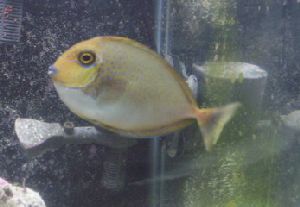
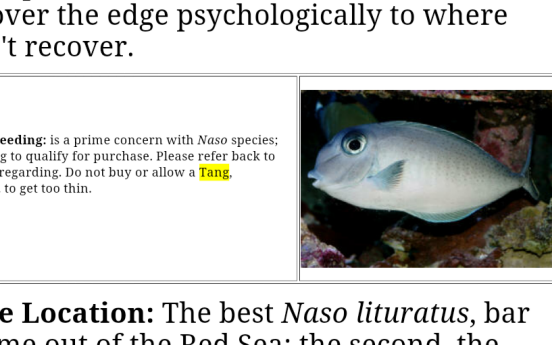
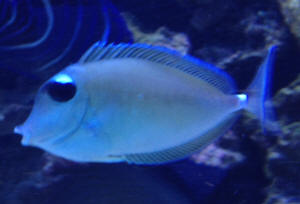
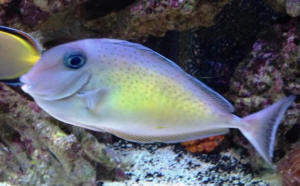
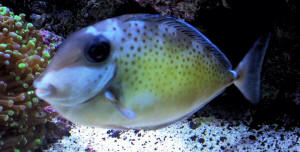
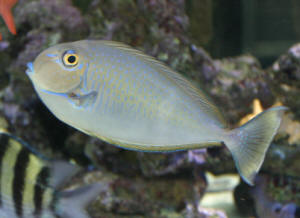
Naso tang ID 5/12/07 Hi Bob/Crew, <Joe> Thanks for taking the time to read my question. I would like to get your opinion on identifying a surgeonfish at my LFS. It was white/very light grey in colour, with blue spots around its face and head. There were no other colours on the body, however, I did see it randomly change colour and take on a brown body colour with white spots. It was only approximately 3-4 inches in length, with no noticeable 'horn'. <Can develop with time, age, growth> I have read the WWM content on Naso identification, but can't seem to find an exact matching juvenile picture. I am of the opinion that it may possibly be a Naso tuberosus or Naso vlamingii. What do you think? Regards, Joe. <Need a photo or two here Joe... Have seen juveniles of each in captivity but mostly Vlaming's... A notable Tuberosus (minus frontal protuberance) in Toronto a couple weeks back... Bob Fenner> Blonde and Naso Tang 2/22/07 Hi Bob, I have a quick and easy question for you.. What is the difference between a Blonde Naso Tang and a Naso Tang. <Heeeee! About the same as a blonde and brunette in our species... the color...> Everywhere I look they both look the same. <Are the same species, Naso lituratus> I heard that the Blonde is just more colorful. <Okay> I am thinking of purchasing one for my 125 gallon tank, but just want to know what the difference is between the two. Thank You Aaron <Mmm, color is about it... both need big systems to be happy, healthy... eat the same foods, are about the same hardiness. Blondes... do cost more (careful here Bob...). BobF> Re: Blonde and Naso Tang 2/23/07 Thank You, that's what I was hoping to here, my next quick one is, I have a 125 gallon reef ready with 150#'s of live sand, 100#'s of live rock, one small tomato clown, and one emerald crab. It's been like that for over a month. Water parameters are fine. Would it be to <too> much for me to add a Naso, Diamond Goby, Cleaner shrimp, and couple more crabs? <I'd be chary of adding crabs...> I add NitroMax <Is capitalized... a proper noun> bacteria additive when I add fish or change the water. <Mmm, not necessary, or advised> Do you think I'd be alright adding that or am I looking for trouble. I would do a water change a couple days before adding, and watch and be ready to do another if necessary. Thanks for all your help Aaron <You should be fine here... with this much space, age of system, presently under-crowded state. Bob Fenner> Some type of Naso Care - 01/09/2006 Hello <Hi, Adam J.> Today I got a unicorn tang for my tank I'm not shore what kind it is can you help .It has fluorescent blue dots on its face and its lips are blue it has a gray color and it is a juvenile and will it get a horn and how big of a tank. <Actually sounds like you have a juvenile Naso vlamingii rather than a juvenile Naso unicornis. They look quite similar when young but completely different as adults compare here: Unicorn: http://fins.actwin.com/pics/Naso_unicornis2.jpg Vlamingii: http://www.hallofreun.de/bilder/f2005/naso-vlamingii.jpg Those are adult photos, I would search Google (where I found the above) for more comparison of juveniles, but as stated above I believe you have the Vlamingii. At any rate both animals grow to be VERY large and need mucho swimming room. Yuppers, you got a tank buster on your hands at a potential 24" for either specimen. You will need a tank of at least 3' in width and 7' in length for an adult. See here for general Naso care: http://www.wetwebmedia.com/naso.htm , be sure to also read the linked FAQ's and articles linked in blue at the top of the page.> Thank you for the help love your web site please excuse any miss spelled words. <Hehe, no need to fret, but thank you for the consideration many folks don't even give their queries a read over. Adam J.>
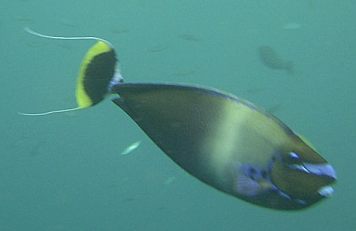
Re: Naso unicornis... Bluespine Unicornfish - 11/16/05 Thanks Eric, <<Welcome Julie>> I have been trying to find out since we returned. I have attached the other photos we have of it - you can zoom in a bit better on these. <<Hee! Looks like it is hanging out waiting to be fed eh?>> I was very impressed with him and very frustrated not being able to work out what it was. <<A remarkable fish...but then I think they all are. <G> >> Thanks for your reply, Julie xx <<Pleased I could help, EricR>> <<Pretty much photos of pier, fish not easily made out, am leaving out for bandwidth and time considerations. Marina>>
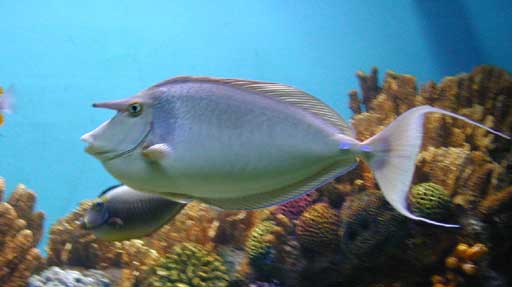
Naso lopezi/Naso vlamingii 7/21/05 Hi! <Hello there> At first I would like to start oft by thanking you guys for all the valuable information and pictures across this site. <Welcome> My question is a short one: Is there any way of telling the difference between a juvenile Naso lopezi and Naso Vlamingii? <Mmm, not when they're very small... under ten cm. total length let's say> The only reference I have seen is that Naso vlamingii has blue lips as a juvenile whereas Naso lopezi hasn't... <Mmm, well, N. lopezi is a bit more elongated in side profile, and N. vlamingii has a nuchal hump (a protuberance on the forehead)... if you/we saw the two side by side we could discern them> Looking around the internet and different books I REALLY have a hard time separating the two fishes. Thanks in advance! Fredrik from Sweden <Do look on fishbase.org re these... and maybe the newer books by Rudie Kuiter and Jack/John Randall on the family Acanthuridae. Bob Fenner> Re: Naso lopezi/Naso vlamingii 7/21/05 Thank you so much for the quick and helpful advice! Fishbase.org is the first place I go whenever I'm interested in a fish, but I hadn't heard about the books you suggested. <Ah, you will enjoy, gain by their viewing> I will have to look them up. <Are on Amazon...> If I can find them in Sweden that is... Once again big thanks, it's always an inspiration when you get friendly and educated information! <Welcome my friend. Bob Fenner> Tang Identification, Naso tang sp ID Please help me in identifying a Surgeonfish at my LFS! The staff there has this fish in one a 650 gallon show tank, but has no idea what it is. It's a gorgeous blue Tang with an elongated body, a very light blue or grey colored body and small blue neon spots and short stripes and a triangular tail, similar to Naso vlamingii. In fact, with the exception of the coloration and streamers he looks identical to the vlamingii shown in CMA. <Hmmm.. some variation with N. vlamingii between individuals and diff ages. N. brevirostris is also quite similar and lacks the lyretail (more triangular indeed). A Naso species at any rate and all that we need to know since all such reach nearly 3 feet long as adults. Few private aquariums are large enough to fairly house this Genus> I haven't been able to find the fish with similar coloration in my reference books. What would you recommend the minimum tank size for this fish be as well? CMA says the vlamingii is far too big for most aquariums. Thanks, Marc <agreed... all Naso species are too big for most home tanks. Even the common "Lipstick" Naso lituratus gets 2 feet long. We are literally talking about a need for 8 to 10 foot long aquaria at bare minimum for just the 3-5 year plan. I cannot recommend Nasos for most fellow aquarists. I do thank you kindly for inquiring before you bought it, though. Very responsible aquarium husbandry here! Kudos to you. Best regards, Anthony> Tangling With Tangs! 1) I saw a Naso with streamers, are these just old old old tangs? <Not always> Will they only get streamers if they are of a certain sex? <External sex differences in Surgeonfishes are generally undetectable, except during breeding, when males may darken a bit in color> 2) Is their much personality difference between Blonde Naso and a regular Naso? <I have never noticed a difference in personality between the two> Does Red sea make for a calmer fish than a Naso from another location? <Again, I have never noticed this. Calmer behavior generally is a result of tank conditions, such as size of system, water quality, lighting, and tankmates> 3) I heard that if you get a big Naso and put it in the tank that it will wreak havoc on the other fish, even outside of it's species. So I was told to get a medium sized one, and let it grow big in captivity. What do you think about that? <These tangs can be aggressive, yes! I always like to purchase smaller fish and let them grow. You need to have a very large aquarium to really accommodate this species for anything approaching its natural life span. I hate to see large tangs caught and offered for sale. Many simply cannot adjust to the confinement and conditions of captive life.> 4) I would like to get a school of small powders (blue or gold rimmed). How many would it take? I will be getting ones that are 1.5 inches long. My tank is 8ft long 268 gallons. <Well- I don't think you'll like my answer, but here goes: Yes, you can keep them in groups (I have seen this done before), but I really believe that you would need an even larger tank (hundreds of gallons) than you have to truly accommodate them for the long term in a group> 5) Here is what I would like to do : introduce three small powders , and have them school. Introduce a purple tang that is 2-3inches. finally introduce a 10-12 in Naso with streamers (do blonde Naso get streamer?) <This type of grouping has been, and can be done. Again, I will tell you that you have to consider their ultimate size. These fishes can be crowded to a certain extent, provided that their other needs (water quality, stability, diet. etc.) have been met. Keep in mind, however, that this may not always work in captivity. On a reef, these fish have been shown to maintain territories of several square yards each! Start with small specimens. Behavior in captivity in groups could be unpredictable; be prepared to remove a specimen if it is suffering from harassment. Do consider all of the needs of these beautiful fishes before attempting such a grouping. Good luck!> Thanks for your time and expertise <And thank you for stopping by! Scott F.> - Tang ID - <Greetings, JasonC here...> I have just found your photo ID number 1166 of the above noted fish. <I'm guessing you mean this one: http://wetwebfotos.com/Home?actionRequest=mediaView&ID=1166 > I set up a marine tank in may last year, and have progressed to a larger tank just recently. During one of my weekly trips to the local marine fish stockist, I can across the same fish as in your picture. Unfortunately, I an unable to find an good information on this fish. <You should try your hand at fishbase.org - pretty much the definitive list of species and their related facts.> I bought the fish from the stockist. It had for the last couple of weeks been in a relatively small tank approx 2ft, and looked to be in a lot of distress. The fish is now in a much larger tank, at present and is eating well, it did have a lot of difficulty breathing in its previous home (too small a tank, no rocks to hide behind, and (possibly too strong lighting), before going into its final home. <Sounds like what I would expect.> I have not seen this fish before in any of the shops, and wondered if you might have some useful information. <It's a Naso tang - Fishbase has the full size at 54cm - that's pretty big. You may need a larger tank before too long.> What is the correct name for this fish, as different shops have different names against its photo. <Just going by the image-match, Naso lopezi - I've seen it called the Blue Dot Tang - Fishbase calls it the Elongate Unicornfish.> kind regards Amir Morsi <Cheers, J -- > Naso Greetings friends (there are so many of you I feel disrespectful to whom ever will answer my question to say a name: Bob, Anthony, etc.) <No worries> Question about a mystery Naso. I work at our LFS and am the marine care taker. We ordered a Naso tang and I was thinking we would get a Naso lituratus (lituratus) like we usually do, however they mixed up and sent us something different but it is in the Naso family. They said it was a blue spot Naso but I have never herd of this kind. Are they right. <Likely N. unicornis. Please see here: http://www.wetwebmedia.com/naso.htm> He is a great eater and is quite different from the usually expected Naso coloration, even unicorn Nasos. He has a blotched grey to tan body color (dark colors) With deep blue spots around his face. Other than that he has the Naso body form. Could you also guide me to some info on this particular species of Naso with some pictures to see what an adult looks like. Thanks for your help, if more info is needed to find the species let me know. John <You will find what you seek at the above citation. Bob Fenner> Rock and Nasos >Hello fellas, Hey! There are a couple of gals here, too. ;) Marina is the lady of choice today. >Got a couple of questions for you today. Quick ones too so I don't take too much of your time. First, how much rock can an aquarium within reason hold without compromising the structure of the tank? I have a 72gal bow front that at the moment has around 130lbs of live rock. How much will cause the tank to be in danger or cause leaks? >>Boy, good question. The tank can *easily* hold 2-3lbs. of rock/substrate/gallon without problems. Truthfully, to the best of my knowledge there's little that we can put in our tanks that's heavier than water, so there's little reason to think that what you have will cause problems. As long as the tank suffers no torsion stresses, you should be golden. >Second, I know that Blonde Nasos and Nasos are the same fish but why are blonds sold specifically as either male or female? What is the difference in sexes that would make a male more expensive than a female in the blond variety? Color or some other specific feature? >>Blonde Naso tangs, to the best of my knowledge, are at most a color variant, but I believe that they are one and the same fish. I'll call it a marketing ploy. The long streamers off the tails are the desirable feature. See here (almost to the bottom of the page) for a brief description (also, please do search our site) >>--> http://www.wetwebmedia.com/tangscks.htm >>Now, I'm going to make an assumption here, I believe you're asking because you'd like to put one of these big fellas in your 72 gallon tank. I would like to suggest to you that you go with a Zebrasoma species, instead, as Nasos and other large, free swimming tangs really do need far more space, and are known to hurt themselves and other fish if darting about rapidly. I'll also tell you that these fish are a PAIN to ship, they rip bags open like nobody's business! >Thanks for your help guys. I look forward to reading the second book on reefs, I love The Conscientious Marine Aquarist, however, I have found that a majority of the stuff in the book is right on WWM, but I love the book anyway and am still glad I bought it. Thanks for the help guys. John (Fin) >>Yes, just (finally!) having purchased the book myself, I'm quite glad I've got it. I am also a big proponent of a full, well-rounded reference library, so please do continue buying as much literature as you can. Good luck! Marina Unicorn Tang Robert, <Stuart, Anthony Calfo here assisting our good friend Bob while he's at home in full leather regalia practicing for an Iron Maiden lip-sync contest> I enjoyed your site and the pictures. From the time I began my saltwater aquarium, Tangs have always been my favorite. I've been through some tough, heart-breaking, times with the species. I've lost several to Ich, however, finally believe to have things under control. <Quarantine, consistency and diligence my friend> I have a reef tank that has been up and running for about 19 months. The picture I am enclosing is of a Tang that was sold to me and advertised as a Unicorn Tang. While it doesn't have the elongated horn, it does resemble a picture on your site. Would you believe this to be a Unicorn and if not what would you believe it to be? <Looks like a juvenile or female Unicorn, quite frankly. Although several Naso species develop the horned feature including N. brevirostris and N. vlamingii. Select males with horns are uncommon in the trade because of sensitivity in shipping and large size for development of the feature. Some folks frown on the importation of this fish because few aquarists have a tank responsibly large enough. The adult fish approaches three feet in length!!! Even if you only see two feet in length, the tank required is extremely large or you will find that the animal may suffer (appear to do well for a couple of years but die prematurely from complications in a crowded dynamic). A six foot long tank (150-240 gallon) is recommended for juvenile fish towards two years old... a public aquarium may be its only hope after that without a dear expense on your part. I regret that the LFS store didn't advise you of the matter up front. Best regards with this beautiful creature, Anthony>
|
|

|
Features: |
|
| Featured Sponsors: |