|
FAQs about Nudibranch Identification
3
Related Articles: Nudibranchs, Sea Slugs,
Related FAQs: Nudi ID
1, Nudi ID 2, Nudi ID 4, & Nudibranchs 1, Nudibranchs 2, Berghia Nudibranchs, Nudibranch Behavior, Nudibranch Compatibility, Nudibranch Selection, Nudibranch Systems, Nudibranch Feeding, Nudibranch Disease, Nudibranch Reproduction, & Sea Slugs, Marine
Snails 1, Marine Snails
2, Marine Snails
3,
|
%20HH%20on%20organ%20pipe.JPG)
|
|
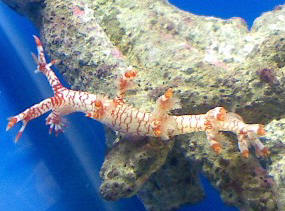
Nudibranch ID: Bornella sp. -- 1/28/08 Can you ID this
type of Nudi? <I sure hope so! Please see follow-up email for
reply. --Lynn>
Re: Nudibranch ID: Bornella sp. -- 1/28/08 Hey there at
WWM... <Hey there, Mitch!> I sent a picture email from my
cell phone earlier..... <Yes, thanks, I saw it. Terrific photo
considering it's from a cell phone!> It was of a Nudi/sea
slug that I have no clue on.... didn't know if you could tell
me or even take a guess on the genus? <I believe it's
Bornella stellifer, and according to Bill Rudman of
SeaSlugForum.net, is a common Indo-West Pacific species that
feeds on hydroids. Please see this link for more information:
http://www.seaslugforum.net/factsheet.cfm?base=bornstel .>
Thanks a lot Mitch
<You're very welcome! Take care --Lynn>
|
|
|
| Re: New marine tank with surprise critter -
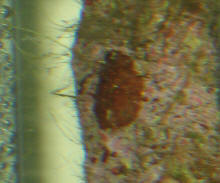
Nudibranch? Update: 1/18/08 Hi Lynn, <Hi Richard! How's
my friend from 'Down Under' doing?> Thanks very much for
the helpful links! <You're very welcome!> I finally
managed to get a (halfway) decent picture, only he seems to have
lost the markings on his back now! I guess they were just bits of
'rubbish'. <Heeeee! No more smiley face, huh? Alright,
well this is going to sound a little odd, but the next time you see
this little critter, gently poke at it and try to determine if
it's entirely fleshy/soft, or if it feels like there's
something hard right under the surface tissue. I just want to rule
out something like a cowry. When they pull their mantle completely
up around their shell, they can look somewhat like a sea slug. That
would account for the teardrop shape and even the white
'smiley' spots. I just can't tell in the photo if/how
much your little critter is domed along the back. Naturally,
I've got some links for you to check out! The first species
isn't from Australia, but there are others from this genus in
your area (that look very similar). Check out the mantle and spots
beneath. If the mantle on your critter wasn't completely
together at the top (the first time you saw it), you could have
seen some spots. http://www.flmnh.ufl.edu/cowries/comma.htm
http://www.divegallery.com/cowry_cribraria.htm Here's one of
the species from Australia that's a little darker, has fewer
spots, and isn't all that highly domed. It doesn't show the
mantle -- just wanted you to see the profile.
http://www.gastropods.com/4/Shell_39544.html If we rule these
possibilities out, and it is indeed a slug of some sort, then your
best chance for an ID is going to require a detailed, close-up
photo. If you're able to get this, I'd be glad to take a
look at it and see if I can figure out what it is. Even better,
though, would be to send the photo(s) on to Bill Rudman at the Sea
Slug Forum. Here's the link to an instruction page for sending
inquiries: http://www.seaslugforum.net/factsheet.cfm?base=sendmess
By the way, if you contact the SSF and find out what this little
creature is, please send us a follow-up and let us know!
Thanks!> Cheers again, <Cheers to you too! Take care
--Lynn> |
|
|
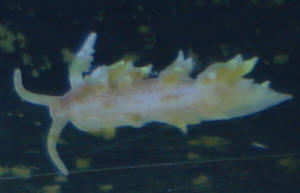
Tiny Sea Slug ID? Aeolid Nudibranch, Possibly
Phyllodesmium briareum 12/28/2007 Hello WWM, <Hello Jesse,
Mich here apologizing for the very delayed response.> I have a
tiny sea slug (3mm) <Really 3mm? Do you mean 3cm?> that came
off of live rock I guess. <Perhaps or maybe a recently
introduced coral.> I have not seen it eat. <I'm not
surprised, perhaps if you had some Pachyclavularia or
Briareum...> I would like it to grow. <This will likely be
difficult if not impossible. They are typical obligate
corallivorous> Do you have any idea what type? <Looks like an
Aeolid Nudibranch to me, possibly Phyllodesmium briareum. More
here: http://www.seaslugforum.net/factsheet.cfm?base=phylbria
http://www.wetwebmedia.com/nudispt3.htm What it eats? <Generally
soft corals, in this case I would guess perhaps GSP/Briarium.>
Attached is a picture of it, belly side on glass. <Thank you for
the pictures. Most always helpful.> Thank you,
<Welcome! Mich>
Jesse |
|
| Re: Tiny Sea Slug ID? Aeolid
Nudibranch, Possibly Phyllodesmium briareum... maybe Berghia?
12/30/2007 Thanks for the reply Mich, <Welcome
Jesse!> Yes it is tiny, 3mm. <Wow! Barely measurable!
Your pictures are quite good, especially considering how
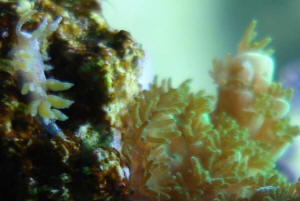
small your subject is!> Here is a pick next to what I
think is a green Acro coral. My coral ID is also not very
good. <This small size reminds me of a Berghia... Do you
have any Aiptasia in your tank? You might want to see if this
Nudi has any interest in them... or perhaps a friend with
some Aiptasia? Nudis can be quite difficult to ID, and this
small size makes it harder... Something to consider here:
http://www.wetwebmedia.com/ca/cav1i3/aiptasia_impressions/aiptaisia_impressions.htm
Mich> |
|
|
|
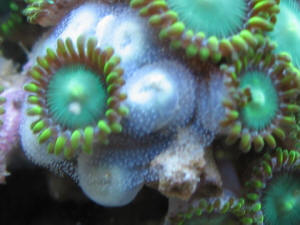
| Possible Nudibranch Eggs... Elysia Spp.
Eggs 11/26/07 Hello once again crew. <Hello Chris,
Mich with you again.> Chris here looking for a little education.
<Mich here seeking the same.> I am attaching a picture of
what I think may be Lettuce Nudibranch eggs. <It sure does look
like it!> I looked through the site, read a lot of descriptions
and saw a few pictures, but I am not totally sure at this point.
<Yes, this is what you have. You can see similar photos and find
more info here: http://www.seaslugforum.net/display.cfm?id=15227
http://www.seaslugforum.net/display.cfm?id=11846
http://www.seaslugforum.net/display.cfm?id=3090
http://www.seaslugforum.net/display.cfm?id=3174 > If I missed
something obvious I apologize. <No worries.> But in true Army
fashion, I will always provide a solution to my problem when I ask
a question and then look for guidance from you. <Interesting
Cheers, Mich> |
|
|
|
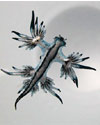
Please Help With ID of This Nudibranch... Glaucus atlanticus
11/26/2007 Hi there, <Hello, Mich here.> I came across
this same species of Nudibranch of the coast of Kenya. <Lucky
you! It is beautiful!> This isn't the picture I took, but
managed to find it on the net. <OK.> I would be grateful if
you could give me the common name, if possible. <Is a Glaucus
atlanticus. Some common names include The Blue sea slug, Blue
ocean slug, Blue dragon, Sea lizard and Butterfly Winged Sea
Swallow. More here:
http://www.seaslugforum.net/factsheet.cfm?base=glauatla
http://en.wikipedia.org/wiki/Glaucus_atlanticus > Look forward
to hearing from you soon, thanks in advance, Zeeyad <Welcome,
Mich>
Re: Please Help With ID of This Nudibranch... Glaucus
atlanticus 11/29/2007 Thanks so much for your reply...
<You're welcome Zeeyad.> it finally cleared the 1 1/2yr
old 'alien from outer space' comments I've been
getting from people I've shown the picture to. <Heehee! Is
a beauty. Does look otherworldly! Neat that you saw it. This Nudi
generally feeds on "Portuguese man-of-war" (Physalia
spp.) and incorporate their toxins, so if you ever see it again,
don't touch it. This Nudi can deliver a powerful painful
sting!> Keep up the great <Will try! Mich>
|
|
|
Hitchhiker on Organ Pipe Coral ID Phyllodesmium
colemani 11/22/07 I have recently bought an organ pipe coral
and it wasn't until I got it home that I noticed what appears
to be a hitchhiker. <Sure looks that way!> I have absolutely
no idea what it is and hope that someone here can let me know.
<It is an Aeolid Nudibranch and likely predatory on your pipe
organ coral... Doing more looking I'm fairly certain this is a
Phyllodesmium colemani, which feeds exclusively on Tubipora musica.
More here: http://www.seaslugforum.net/factsheet.cfm?base=phylcole
> I have attached a picture. You can clearly see "whatever
it is" in amongst the red coral tubes. <Yes, I see.>
Many thanks in advance.
<Welcome! Mich> |
|
Nice pic and good ID. RMF.
|
|
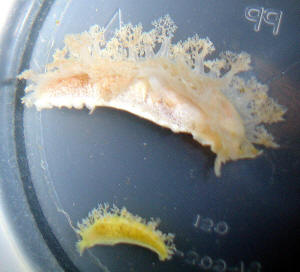
Re: Hey Bob, its Niki. Got an anemone
question here. Actually, now a predaceous Nudi. on Sarcophyton
(elegans?) 11/21/07 You are the best! That site rocks.
Thanks, Bob. One more question...have you ever seen/heard of a
'Yellow Fiji Umbrella' specific Nudibranch? <Mmm, have
been to Fiji a few times, diving... seen yellow Nudibranchs
there... Do you have a pic?> I found a few Nudis the same
exact color of the coral latched onto some very unhappy Sarcos.
<Bad... should be physically removed, search the soft corals
for egg packets, those removed as well> They reminded me very
much of smaller versions of the larger white Nudibranchs that we
find on the Sinularia and such. The difference is that they
mimic the yellow color of the umbrellas, much like the
Nudibranchs found on P. cylindrica. I do have pics if you need to
see them. Thanks, Niki <Please do send these along... have
collected, and discourage the collection of the "Yellow
Sarcos" from here, and Tonga... as for whatever reasons (I
know naught) they don't often live for long... but have been
so inobservant as to not notice these apparent predators. Be
chatting, BobF>
Re: Niki here, w/ pic of our little yellow friend. Nudi
feeding on Sarcos... 11/22/07 So here's the
culprit. <Ah, yes. Nice pix> I found about 10 or so
embedded very deep in the tissue, all hidden very cleverly within
the ruffles of the Fiji Yellows. The only reason they came to my
attention was the fact that I was treating all of my Alcyonaceans
with Levamisole Hydrochloride due to a rampant infestation of the
run-of-the-mill white Nudibranchs, mostly on my Sinularia. The
little yellow guys started bailing off. I have included a pic
next to the other Nudibranch so you can get a feel for the size.
<Yes... reports up to 1"> The white Nudi is almost an
inch long. All of the yellow ones were about the same size. Let
me know what you think, thanks again, Niki <Mmm, I do think
you are wise to be using a dewormer. Look for the spiral egg
masses... and remove them as well. Cheers, Bob Fenner>
|
|
|
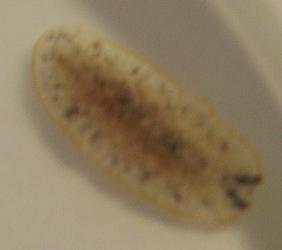
Nudibranch? 10/12/07 Crew, <Hi Russ>
First, thank you all for the wealth of knowledge and information
you have provided, which has greatly helped me begin my first
marine aquarium. <Terrific -- always good to hear!> Second, I
have attached a pic of a critter I found in my tank today. <I
see> I believe it may be a Nudibranch, but I am not certain.
<Understandable> I have read through/searched your site and
seaslugforum.net, but I have not been able to make a positive ID
yet. <Unfortunately, you may not be able to -- can be quite a
challenge (need to know place of origin, there are many species
involved, coloration/pattern can vary, mimicry sometimes involved,
etc).> I noticed this guy as he was balled up tumbling through
the water, being carried by a current. I can only assume this may
be his form of 'high-speed' travel? <Wheee!> Anyway,
it is not nearly as exotic as many of the Nudibranch photos I have
seen, but the lack of any shell and the presence of what I believe
to be rhinophores makes me think it is a Nudibranch. <Does
appear so, though some flatworms have similar.> Again, I saw him
just 'riding the current', <Ha - Powerhead surfing!>
so there is nothing to lead me to what his diet may consist of, or
if he may be dangerous to any corals I may add in the future.
<Yes, it's much better to find him surfing today, than
half-way up your favorite coral tomorrow!> Please let me know
what you think, as I would like to place him back in the display
tank, as long as he wont eat my corals and poison everything when
he dies! <Well Russ, after looking through what feels like a
zillion photos, I'm not absolutely sure what it is either - but
I know I'm going to be dreaming about these guys tonight! In
order to narrow things down a bit more, I'd need a close up
image to see the head area/apparent rhinophores, as well as the
dorsal surface of the body to see the anatomy/texture, etc. From
what I've seen, I think it's likely either a Dorid
Nudibranch, or a Polyclad flatworm. Unfortunately, that's about
as specific as I can get. What's important is that if it is
indeed one of those two, both are predatory/have specific diets,
and I would not put it back in the tank. It falls under the
category of "When in doubt, leave it out.". Please see
here for more info regarding:
http://www.wetwebmedia.com/nudibran.htm
http://www.wetwebmedia.com/flatworms.htm
http://www.reefkeeping.com/issues/2002-09/rs/index.php I know
you've already been to the SeaSlug forum, but here's the
link to the species page:
http://www.seaslugforum.net/specieslist.cfm> Thanks, Russ
<You're very welcome! Take care -Lynn> |
|
|
|
FAQs about Nudibranch Identification
3
Related Articles: Nudibranchs, Sea Slugs,
Related FAQs: Nudi ID
1, Nudi ID 2, Nudi ID 4, & Nudibranchs 1, Nudibranchs 2, Berghia Nudibranchs, Nudibranch Behavior, Nudibranch Compatibility, Nudibranch Selection, Nudibranch Systems, Nudibranch Feeding, Nudibranch Disease, Nudibranch Reproduction, & Sea Slugs, Marine
Snails 1, Marine Snails
2, Marine Snails
3,
|
|
|
|

