|
FAQs about Nudibranch Identification
4
Related Articles: Nudibranchs, Sea Slugs,
Related FAQs: Nudi ID
1, Nudi ID 2, Nudi ID 3, Nudibranch
ID 5, Nudibranch ID 6, Nudibranch ID 7, & Nudibranchs 1, Nudibranchs 2, Berghia Nudibranchs, Nudibranch Behavior, Nudibranch Compatibility, Nudibranch Selection, Nudibranch Systems, Nudibranch Feeding, Nudibranch Disease, Nudibranch Reproduction, & Sea Slugs, Marine
Snails 1, Marine Snails 2,
Marine Snails 3,
|
|
|
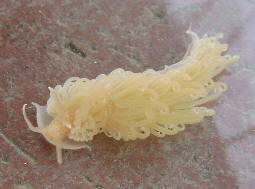
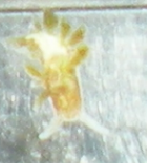
Hitchhiking Aeolid? Help ID Please...
9/23/11
Ahoy There! Alex again... I'll try to keep this one less
verbose than the past few...
<Verbosity never an issue>
As Bob suggested, I added a truly deep DSB to my sump when I
rebuilt it and have been having virtually no problems since... My
nitrates dropped from 80-100+ to down below 20ppm in about a week
(the 50gal water change undoubtedly helped but after resting and
testing I was shocked at how much difference the new sump makes)
and my phosphates are below 0.5ppm (decreased by a full order of
magnitude!), so that's all good.
<Ah yes>
As promised, I will send pictures soon; I just want to let it
grow in a little and then I'll write an article for the WWM
forum. I learned a lot building my own and I am excited to
share.
Anyway, while you're thinking about that, think about this
(hehheh): I recently discovered a stowaway in my tank! I know,
this is all too common on the high (maintenance) seas, but I
can't figure out what this guy is. I can tell it is
definitely some kind of Nudibranch, probably an Aeolid but for
all I know it could just as easily be from the Glaucidae family,
and by my guess it is still a juvenile.
<Does appear to be an Aeolid>
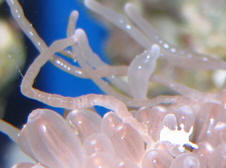
It has somewhere around 4-6 pairs of brownish-orange cerata and a
milky-white-to-almost-transparent body, and it looks to be just
over 0.25" long (not quite a centimeter). I do not have a
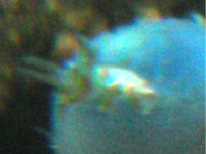
submersible camera but after many (literally hundreds) attempts I
was able to deftly snap a few halfway-decent shots through a
magnifying glass and then zoom in on the computer, which is why
these chosen few images are still pretty grainy. I wish I could
offer better ones. In these pictures, the big fork that looks
like rhinophores is actually (I think) a large pair or cerata,
and the two pairs of tiny whitish prongs at the anterior end are
what I understand to be the rhinophores and oral tentacles (but
these are nearly invisible in all but the top-leftmost
image).
I am curious not only because it looks so much like an adolescent
*Aeolidiella stephanieae*, but because if it's not then
I'm concerned it's probably eating the Zoanthid polyp
it's been hanging out on for the past two days (shown in the
pictures).
<Likely so>
If it is a Berghia-type Nudi,
<Not likely>
then it's a bit ironic since I was considering trying to find
some but I chose peppermint shrimp instead (which, by the way,
decimated the Aiptasia in my tank in about 4 days... now if they
can just survive long enough to clean up the tiny ones that will
inevitably sprout soon after...), but I'd also like to know
so that I can make a decision one way or another as to whether I
should leave the little guy in the tank or give it to one of my
FOWLR friends who actually has some Aiptasia for it to eat.
<Maybe the latter, but I would definitely at least remove from
here>
I am dubious that it is actually a Berghia though, because not
only does it not seem to have a clear activity cycle (it slowly
paces around this particular clump of Zoanthids night and day),
but also because I feel like there would probably have been more
than one with whatever rock this one came in on. I do not know
how small juvenile Hermissenda crassida specimens can be...
perhaps I have one that is recently past the veliger stage?
<Doubtful to the extreme in captivity... the water moving
pumps, mechanical filtration, lack of foodstuffs of
use...>
Zoanthids are in that weird Cnidarian nether-region between a
hydroid and a coral,
<Mmm, much more toward the latter/Anthozoans>
so it wouldn't surprise me to learn that H. crassida might be
eating them, but I also can't tell with certainty that the
polyp is being eaten. These Zoanthids are sensitive enough that I
find it equally possible they would just close up because
they're being crawled on, and I can't distinguish any
areas with visible damage. Unfortunately, I don't know the
exact species of these Zoa's, so I can't offer much in
the way of spotlighting diet preferences to help identify this
hitchhiker... I hope this image is small enough to accept. I was
trying to retain sufficient
detail in the shots.
As always, your scholarly wisdom is highly valued and graciously
accepted.
Oh great gurus, what should I do?
<When in doubt I vac it out; it's a free-for-all! Bob (not
Ted) Nugent>
PLAH!
Alex:D
|
|
|
Hitchhiking Aeolid? Help ID Please (amendment)
9/23/11
Sorry to send multiple messages, but I just realized a grievous
error in my last note:
I mentioned that possibly my stowaway is a juvenile Hermissenda
crassicornis
because I had found a picture of a baby one (possibly
misidentified, now that I've looked around more...) that
looks very similar to the tiny thing crawling on my Zoanthids.
Obviously (to you maybe) that is impossible or at least very
unlikely, because H. crassicornis comes from cooler waters than
my tropical tank and so is unlikely to have survived long on any
rocks from the LFS. But after looking at all the pictures listed
under the Family Aeolidiidae on Bill Rudman's Sea Slug Forum
species list,
<A fave>
I am still not sure what I've got. The closest match besides
Aeolidiella stephanieae might be A. oliviae, with its diet of
anemones and maximum size of ~20mm, but the ones pictured are
supposedly 12mm long and they have many many times the number of
cerata I see on the stowaway, and like the Hermissenda sp. they
also seem to be from cooler water.
I will pipette it out of my DT and put it in a jar so I can try
to get a better picture.
Alex
<Thank you. Plah Bob>
|
Hitchhiking Aeolid (Better Pix)
9/24/11
Howdy Bob F. Nugent (good to know the 'F' stands
for 'Fletch' haha)
<I wish I had the Chevy Chase income, and much more
acting ability!>
So taking good pictures of tiny sea slugs with a marginal
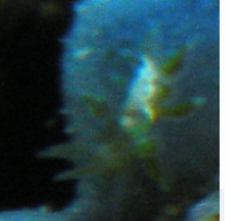
camera is basically impossible, but after much diligence I
was able to get these images. As you can see, the beast has
far fewer cerata than *A. oliviae* and actually does have a
faint orange stripe down its white back, so perhaps it is
closer to being a juvenile *Hermissenda* than I thought
(but if that's what it is then supposedly it can get
pretty large). I also noticed that the tips of said cerata
are indeed whitish-colored, and though none of the
blacklighted pictures were worth sending (partly because
the camera battery died as I started attempting them), I
was able to clearly see green glowing specks within the
cerata, which confirms that it *was* eating the Zoanthids
(or at least eating their zooxanthellae). I currently have
the creature isolated in a little plastic magnifier box. I
still have not seen any others in the tank, so I'm not
sure how likely it is this one has reproduced; it is
probably a loner. It's too bad I can't keep it;
sure is purdy.
<Can/could... either suffer some attrition of your Zoas,
risk reproduction... or place/keep/feed elsewhere
selectively>
Do these shots lend any better clues as to the species, or
even whether I'm dealing with an adult specimen versus
a juvenile?
<Not really. Per BillR's excellent SSForum,
you'll note that there is often a very large range of
colours/markings, variations in size/dimensions per
species, geographical distribution>
Note the edge of the straight razor placed for size
comparison... If I could confirm that it will survive
eating more than just Zoa's, then maybe I could put it
in my refugium and let it cruise around in there.
<Mmm, most Nudibranchs are quite food-specific... Hence
my standard issue of collecting/purchasing ONLY w/ their
food organisms>
I doubt it can lay eggs without a partner... Even if it
could there's apparently almost no chance that any
young would make it through the pumps alive.
<Not likely so>
I still don't know which piece of rock/coral it was
stashed on, but at this point it has to have been living in
the tank at least a couple of weeks
<Greatly probable>
because I doubt it was hiding on the lawnmower blenny I
bought last week.
<Highly dubious indeed>
I have examined all the other areas of Zoanthids in the
tank and as yet haven't seen any others, so hopefully I
lucked out and only got one. I guess we'll find
out...
PLAH!
Alex:D
PS: Kudos for saying 'PLAH' back... most people are
pretty dismissive of the idea because they don't try to
figure out what it stands for. But I think it's the
future of salutation. Now if we can just make it the future
of Foreign Policy as well...
<I do agree. Cheers, BobF>
|
 |
|
Re: Hitchhiking Aeolid (Better Pix)
9/24/11
Sorry, I neglected to attach the pictures to that last
note...
<Mmm, I just cropped and optimized one of the
prev.>
they probably still don't help much though... You guys
are troopers. Thanks for your help.
<Nos vemos. B>
|
 |
|
|
Nudibranch Hitchhiker ID
7/1/11
Dear WWM,
<Michele>
I have been an avid reader of your site for several years, but
this is my first time writing. I am hoping you can help me with
the identification of a hitchhiker. Please see the attached
photos. I found it in the filter sock of the sump during my
weekly water change. My best guess is that it is some kind of
Nudibranch or sea slug.
<The former>
I searched the WWM Nudibranch identification pages, and my
mystery creature seems similar to one labeled a Nudibranch in the
suborder Dendronotina, family Tritoniidae. Do you think that is
what this is?
<I do>
I have a 75 gallon reef tank. Current inhabitants are 2 Ocellaris
clowns, a yellow tang, a scarlet shrimp, a toadstool leather,
<Likely the principal food item>
a hammer coral, a torch coral, hitchhiker mushrooms, and a xenia
frag.
All inhabitants have been in the tank for 3-4 years, with the
exception of the xenia and shrimp. They were added two months
ago. Based on the tank inhabitants, do you think my hitchhiker is
friend or foe?
<The latter. I would remove these via siphoning>
Thank you for your help and the wonderful website.
Michele
<Thank you for being part of it, sharing. Bob Fenner>
|
|
|
|
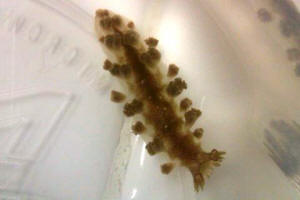
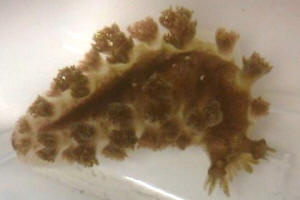
Tritoniopsis elegans? 5/8/11
Is this the dreaded Soft Coral-Eating Nudibranch?
<Appears to be, yes>
Before I kill the thing, I'd like to make sure. it's
about half an inch long. Very pretty, with blue tips on its
edges.
It looks just like the Tritonidae, however it has blue tips. I
haven't seen them with blue tips. Came in some coral.
Thanks, in advance, for your expertise.
<Welcome. Please see BillR's site here: http://www.seaslugforum.net/find/triteleg
Bob Fenner>
|
|
|
|
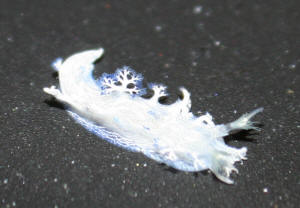
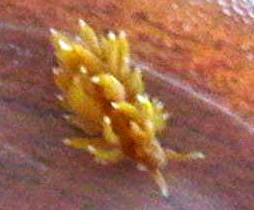
Nudibranch: Suborder Aeolidina, ID --
3/10/11
Hi,
<Hello Jonathon, Lynn here this evening.>
I found this little guy cruising the front glass in my reef tank
this afternoon.
<Yowza>
I was thinking it may be a Berghia but the colour seems
wrong.
<Yep, it's similar but not quite right.>
I have it in a dish until I can determine what it is for sure.
Any help would be appreciated.
<Unfortunately, I can't quite see enough detail to give
you a positive ID, but I can tell you that it looks like a
Nudibranch in the suborder Aeolidina (which includes Berghia
spp.). Most of these Nudi's feed on Cnidarians (corals,
anemones, etc.) so I would not put your individual back in the
tank if you have any of these you wish to keep. If you'd like
to pursue an ID, your best bet is to go through Bob's
article/photos first, starting here (two pages):
http://www.wetwebmedia.com/MolluscPIX/Gastropods/Opistobranchs%20Sea%20Slugs/Nudibranchs/nudibran5.htm
Next, I'd recommend going through the individual species
sheets listed at the following link. Just scroll down toward the
bottom of the page and you'll find suborder Aeolidina.
http://www.seaslugforum.net/specieslist.htm
By the way, if you're able to get a close-up, detailed photo
of your Nudi, do send it along and I'll gladly give you a
hand.>
Thank you
<You're very welcome.>
Jonathon
<Take care, Lynn Z>
|
|
|
|
Nudibranch Question: Probable Tritoniid Nudibranchs --
7/12/10
Hi Folks!
<Hi Adam, Lynn here today!>
Once again thanks for the invaluable resource.
<On behalf of Bob and the rest of the crew, you're very
welcome.>
I have one question (with pics this time!) that I think I already
know the answer to but I'm hoping you can confirm it for me
before I commit mass murder.
<Fire away.>
In my 20 gallon Nano I had one large colony of soft leather type
coral (I can't remember the type, they are tall, very soft
and when their polyps are out they look sort of like an inside
out lungs with bronchioles), go from massive, purple and healthy
to melted in a matter of days.
<Yikes!>
It was during a pretty busy month for me so beyond making sure
the water parameters were ok I didn't have much time to
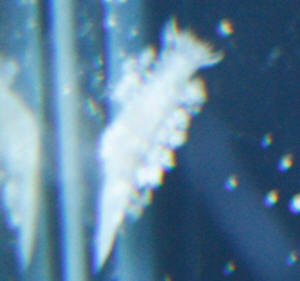
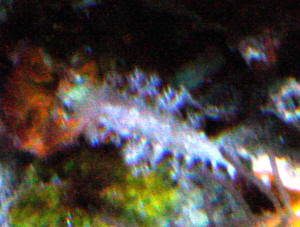
trouble shoot. However, a few days ago I noticed these white,
feathery looking Nudibranchs in my tank.
<Uh-oh>
How this many managed to appear without me noticing until now is
beyond me,
<Unfortunately, it happens. They could have been introduced
through attached egg masses, as minute juveniles, or as
overlooked individuals that eventually reproduced. Some
Nudibranchs blend in so well with their prey that hobbyists can
have a difficult time seeing/recognizing them. They also tend to
be nocturnal, so they can be easily overlooked until the hobbyist
notices a decline in the coral's health, the individuals
grow/mature, and/or the population explodes.>
..but I have another colony of the same type of soft coral on the
other side of the tank that is neon pink and neon yellow
<It always makes me think 'dyed coral' when I hear/see
the word 'neon' used to describe any soft coral, but if
these are Nephtheids, then it's understandable. See Bob's
article for more info/photos: http://www.wetwebmedia.com/nephtheids.htm
>
-and was thus considerably more money - that I've noticed
them gravitating towards. Upon closer inspection today I realized
that there wasn't just one or two, but dozens of these
Nudibranchs with what appears to be a dense mat of them right
where the foot of the largest of the now vanished coral was
attached.
<Double yikes!>
If I've done it right, clicking the links below should just
open the pictures I uploaded to drop box in a browser window.
<It all works fine, thanks.>
I'm a terrible photographer
<Not so! Bad is when all you see is an indistinguishable
blur!>
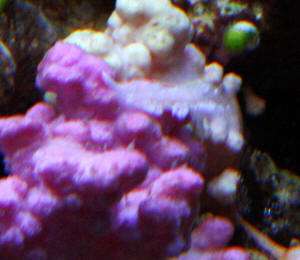
..so I tried to get them in as many different kinds of light as
possible to highlight their anatomical details, as well as show
one on the pink coral they've started moving towards.
<Thanks, the more information and photos people can supply,
the better we're able to help.>
As you can see, the pink guy is no longer extending its polyps,
though it does periodically molt and goes through cycles
throughout the day where it expands and then shrinks. I suspect
that these guys were the culprit behind the demise of my other
coral, but I would love to know if you can identify them for sure
as it will be the difference between them going in the toilet and
going back to the store.
<From what I can see in the photos, you're most likely
dealing with a Trinoniid of some sort (family Tritoniidae); that
is, a soft coral predator that needs to go bye-bye. I'd use
something like a turkey baster to remove all individuals, as well
as any eggs (usually on/near the base of the coral), and keep an
eye out for more. Please see the following link for a commonly
seen tropical species, Tritoniopsis elegans. Note the variation
in Nudibranch color and shape/placement of the egg masses:
http://www.seaslugforum.net/showall/triteleg . We also have
several FAQ's regarding Tritoniids, starting at the top of
this page: http://www.wetwebmedia.com/NudiIDF7.htm >
Oh, and as I was writing this, I discovered one in the tank that
isn't white, it's an orange pink. Possibly absorbing the
colour of my pink coral as it eats it?
<Well, normally that would be my guess as well, but according
to Bill Rudman of the SeaSlugForum, it sounds like prey color
isn't really a factor; at least with the common species
(Tritoniopsis elegans) linked above (see initial post, second
paragraph).>
Thanks!
<You're very welcome and good luck!>
Adam
<Take care, Lynn Z>
http://dl.dropbox.com/u/463210/Nudibranch%20pics/_MG_5750.JPG
http://dl.dropbox.com/u/463210/Nudibranch%20pics/_MG_5755.JPG
http://dl.dropbox.com/u/463210/Nudibranch%20pics/_MG_5756.JPG
http://dl.dropbox.com/u/463210/Nudibranch%20pics/_MG_5758.JPG
http://dl.dropbox.com/u/463210/Nudibranch%20pics/_MG_5759.JPG
http://dl.dropbox.com/u/463210/Nudibranch%20pics/_MG_5760.JPG
|
 |
|
Sea Slug ID: Likely Tritoniid Nudibranch -
5/23/10
Hi Bob, et al,
<Hello Nick, Lynn here tonight.>
Had a problem with one of my corals recently,
<Uh-oh>
..lifted it up to take some photos and found these two slugs
below
<Not good>
(Please excuse the Aiptasia, that's another headache).
<Yep, they definitely can be a headache!>
I believe they are the culprits for the nasty damage to the
coral, coming out to eat it at night.
<If the damage was done to soft corals, you'd be right.
What you have looks very much like a couple of Nudibranchs in the
family Tritoniidae (Suborder: Dendronotina). Nudi's in this
family prey on soft corals, hydroids, sea pens, and Gorgonians.
I'd recommend removing any and all individuals (as well as
any egg masses) with something like a turkey baster. Quarantining
the corals would be a good idea, if possible. If not, keep
checking the corals (especially at night) and remove every Nudi
you see. Please see the following link for an example of a common
tropical specie: http://www.seaslugforum.net/showall/triteleg
>
Are you able to help with identification, and confirm they would
be eating it?
<Well, it would help to know what kind of corals were being
preyed upon, but since those look like Tritoniids, I'm
guessing they're softies. For more photos of species in this
family, please see the following link. Tritoniidae starts about
3/4 way down the page. Each species is a link to an information
page with photos. http://www.seaslugforum.net/specieslist.cfm
>
I've tried www.nudipixel.net but can't seem to find a
match.
<There are an awful lot of Nudibranchs out there!>
Many thanks for your help.
<You're very welcome.>
Regards
<Take care.>
Nick
<Lynn Z>
|
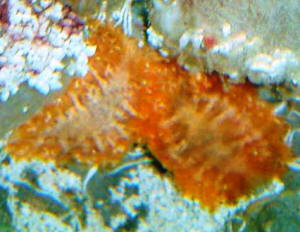 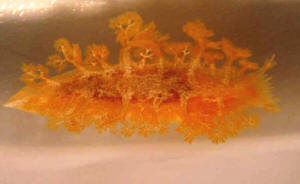 |
Questionable Nudibranch... ID --
3/25/10
Aloha,
<Aloha John, Lynn here today.>
Saw a Nudibranch off Hanauma Bay that I could not identify, despite
going through 100's of Nudibranch photos. Can any of you identify
it?
<I'd be happy to give it a try but I'd need at least one
photo and any other information you could supply regarding size, color,
location (on the rocks, coral, sand, etc.), along with anything else
noteworthy that might not be visible in the photo. If you do have a
photo (or several), please send them along and I'll do my best to
get you an ID.>
Thanks,
<You're very welcome.>
John
<Take care, LynnZ>
|
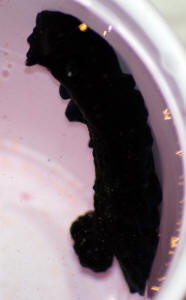
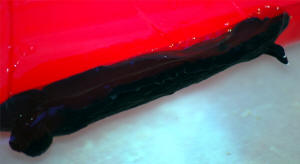
Flatworm Identification: Actually, A Nudibranch:
Dendrodoris nigra or fumata -- 2/17/10
Hello,
<Hello Cassdy, Lynn here today.>
Any idea what this might be?
<Yep, it looks like either Dendrodoris nigra or Dendrodoris
fumata. Both are very common Nudibranchs from the Indo-West
Pacific region that share the same variations in color, prey on
sponges, and are often mistaken for each other. Where they differ
is the gills (the feathery structures you see arranged in a
cluster towards the posterior end of the animal) and the mantle
(the frilly area skirting the animal). Dendrodoris nigra has many
small gills, arranged in a relatively tight circle, whereas
Dendrodoris fumata has a few large gills that can extend the
width of the animal. Unfortunately, I can't quite tell in the
best photo whether the gills are fully extended, or partially, so
we're out of luck there. As for the mantle, Dendrodoris
fumata usually has some sort of papillae (warty growths/bumps) on
it while D. nigra's should be fairly smooth. Complicating
matters is the fact that the papillae can be very small or very
prominent. Again, I'm sorry to say that I can't quite see
enough detail in the photos to determine whether these are
present.>
I found it in my reef tank.
<It happens. These are very common Nudibranchs.>
Have taken out since. Should he be removed to separate tank?
<Unfortunately, these Nudi's only eat sponges (probably a
specific specie), so unless you have a continual supply, the poor
thing is doomed. If it were me, I'd opt for humane euthanasia
as opposed to letting it slowly starve to death. For more
information on euthanasia, please see the following links:
http://www.wetwebmedia.com/euthanasia.htm
http://www.wetwebmedia.com/euthanasiafaqs.htm >
Pics attached.
<Thanks, I was able to enlarge/lighten them enough to see more
detail, but unfortunately it wasn't quite enough to confirm
for you which Nudi you have. However, you might be able to
accomplish this on your own with a magnifying glass and the
information supplied within the following links:
Dendrodoris nigra:
http://www.seaslugforum.net/showall/dendnigr
Dendrodoris fumata: http://www.seaslugforum.net/showall/dendfuma
>
I think it's some kind of flatworm,
<It's actually a Nudibranch, but the two are commonly
mistaken for each other!>
..when I found it was thin and circled under liverock.
<That's fairly typical. These animals are usually
nocturnal so they hide out during the day under rocks or within
crevices, etc..>
Body is pure jet black with tiny white tips on antenna/eyes.
<It's a beauty alright!>
Any help would be great.
<Hopefully the above information will do, but if not, or you
need anything else, please don't hesitate to contact
me/us.>
-Cassdy
<Take care, LynnZ>
|
  |
Re: Flatworm Identification:
Actually, A Nudibranch: Dendrodoris nigra or fumata --
2/17/10
<Hello again!>
I just wanted to follow up with this. I did some reading and the
closest thing I could find was a Scutus sp.
<Neat animals, but what you have is definitely a
Nudibranch.>
I checked pics and I'm almost certain this animal has no shell
whatsoever.
<You're right!>
The antennae have tiny white tips which other Scutus did not.
<Right again!>
It also has a bushy like appendage on its back portion of its
body.
<Yep, those are gills.>
Looks a lot like the nematocysts of Nudibranchs.
<Sometimes the gills can be mistaken for various shaped
structures/'cerata', present on the dorsal surface of some
Nudibranchs, particularly the Aeolids. The cerata can be used for
digestion along with defense (nematocysts). For more information,
please see the following link:
http://www.seaslugforum.net/showall/ceras >
I'm wondering if this animal is actually harmful.
<Dendrodoris spp. do pose a viable threat to their prey:
sponges. Also, Nudibranchs can release a toxin upon death which can
harm livestock. Risk increases with large Nudi's in small
systems (less water volume to dilute the toxin). In cases of toxin
release, a large water change and running carbon is
advised.>
It's very beautiful and I would love to put it back into my
display tank.
<It's indeed very beautiful, but after reading ahead and
seeing the size of this animal, I wouldn't advise it.>
But I do not want to risk being injury to myself or other animals
in the tank. It's about 6 inches in length when crawling.
<Yowza, I didn't realize it was that big! That helps quite a
bit with the ID. Dendrodoris nigra supposedly only reaches about
8cm (just under 3 1/4") in length, while Dendrodoris fumata
can be 10cm/almost 4' or more. I've seen Nudi's stretch
a surprising amount beyond their supposed length, but if your
animal is that length (and not stretched for all its worth!), then
it's more likely that it's Dendrodoris fumata.>
I have it isolated in a Rubbermaid container with some live rock.
It won't really eat any types of fish food I have
introduced.
<It's unfortunate, but you're right, it won't eat
any of those foods.>
Let me know if you need any more info. Would love to ID this
guy.
<I think that thanks to your latest information we're
probably good to go. I'd still check those gills and mantle
though, in order to confirm or refute. Take care, LynnZ>
Re: Re: Flatworm Identification: Actually, A Nudibranch:
Dendrodoris nigra or fumata -- 2/17/10
<Hello!>
It's been in my tank for a year or longer.
<Evidently, it's had enough sponges available to sustain it
thus far. You'd be surprised though, how long it can take for
some marine animals to starve to death. What concerns me is that
unless you have a very large tank indeed with a lot of rock and
available sponges in it, a large Nudi such as yours could finally
exhaust the food supply and die. Six inches of any animal
dying/decomposing in a tank is a problem. Personally, I
wouldn't take the chance, but it's ultimately up to you. If
you feel it's worth the risk, go for it. Just keep an eye out
for trouble and be ready to act. In cases where there's less
risk, I advise people to keep an eye on the critter, and remove
if/when it seems to be in decline. The problem with this critter is
that you may not see it again, even after it's dead.>
So the food supply is def good for it. I just want to now if
it's harmful? To me if touched accidentally or to fish or
corals...
<There shouldn't be a problem if you accidentally touch it,
but I would avoid all contact. Although there are no cerata with
cnidosacs/nematocysts to actually sting you, you may be
sensitive/have a reaction to something else on the skin of the
Nudibranch. Different people have different levels of sensitivity
to things. As for the fish and other livestock, with the exception
of the prey sponges, they should be fine.>
Don't care about sponges!
<Awww, poor little sponges! Take care, LynnZ>
Re: Re: Re: Flatworm Identification: Actually, A
Nudibranch: Dendrodoris nigra or fumata -- 2/17/10
Thanks for all your help!
<You're very welcome!>
I have a 300G system
<Whew, I was afraid the Nudi might be in a small system!>
..and run carbon 24/7 so if it did die - I doubt it could be much
of an issue.
<Yep, that definitely lessens the possibility of a system-wide
nuke.>
I do 80G wc a week as well.
<Good> |
|
Worm ID: That's No Worm, That's Trouble with A
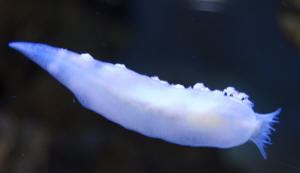
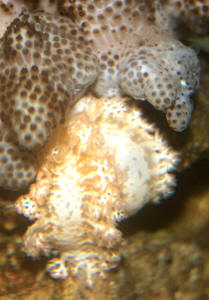
Capital T: Tritoniid Nudibranch - 1/26/10
Hi Crew, Hi Mr. Fenner,
<Hello Claire, Lynn here this evening.>
I hope you all are feeling well.
<Thanks, just like the old song, I'm feelin'
alright!>
I have a problem.
<I'm sorry to say that judging from the photos, you do
indeed.>
A few days ago, during the night, I paid attention to a worm
(looking like a slug) on the glass of the aquarium. I took a
picture, but I did not send it, as I got only the ventral
face.
Yesterday night, I remarked that two curious "critters"
were on the rock of my Cladiella (closed for the night).
<Never a good sign, but helpful for ID purposes.>
I succeed to take an "acceptable" shot today and my
questions are:
1)What kind of worm is it (I did not succeed to identify it
myself from the WetWebMedia site)?
<Unfortunately, it's not a worm. It's a predatory
Nudibranch, most likely Tritoniopsis elegans (family
Tritoniidae). These little guys are very pretty but unfortunately
eat soft corals like your little Cladiella. Have you noticed any
damage to this, or any other softies?>
2) Is it a pest,
<When it comes to soft corals, yes indeed.>
..and if yes, how to eradicate it (I never saw it in the tank
before,
<Hopefully they'll be out and about again tonight. If so,
I'd opt for physical removal. You might want to try
suctioning them out with a turkey baster. Be sure to have a net
handy though, just in case one gets away. Please see the
following link for more information (be sure to go through all
associated links at the bottom of the page as well):
http://www.seaslugforum.net/factsheet/triteleg
Google Tritoniopsis for the many WWM FAQ's re:
http://www.wetwebmedia.com/Googlesearch.htm >
..but I suppose that there are a lot of creatures I never
remarked too) ?
<Yep, there's a whole other crew that emerges when the
lights go out!>
Thank you for your wonderful help and patience,
<You're very welcome and good hunting!>
Kind regards,
Claire
<Take care, LynnZ>
|
  |
|
Re: Worm ID: That's No Worm, That's Trouble
with A Capital T: Tritoniid Nudibranch -- 1/27/10
Hi LynnZ,
<Hi Claire>
Thank you for answering so fast.
<Well, I knew that if I were in your situation, I'd want
to know right away!>
I have in my aquarium one very big Elegance Coral, one Goniopora,
one anemone, a baby Bubble Coral, the Cladiella (the victim here)
and two rocks with on each one a little colony of mushrooms (one
colony of green mushrooms and one colony of green striped
mushrooms), two false Percula (hosting the anemone) and two
yellow Coris (yellow Wrasse).
<Sounds pretty.>
I did not notice any damage to any of the corals, but what I
noticed is that the skimmer went amok today (perhaps because we
had a power surge of 45 minutes yesterday). Everybody is looking
fine, fully open and closing at night.
<Excellent>
I hope that I will succeed to get rid of these beautiful pests
tonight, when the actinic is the only light. I do not like the
idea to trash living creatures in the toilets, but if I get the
idea, I do not have any other choice.
<Unfortunately, that does seem to be the case here. This sort
of situation always presents me with a moral dilemma. I have a
very hard time destroying (or recommending the destruction of)
anything that only through man's interference, has made its
way into our systems. The way I see it, whatever the animal, it
contributed to the balance of an ecosystem in the wild, so to
destroy it because it has suddenly become inconvenient to our
artificially skewed systems is just abhorrent. That's why
most of the time I recommend that people try to find new homes
for unwanted organisms instead of destroying them. One man's
pest can be another man's treasure, so to speak.
Unfortunately, in cases such as yours, the choices are limited.
Those beautiful little Nudibranchs eat soft corals and that's
it. If you left them in the display, they'd reproduce, go
through the food supply, and all would starve to death. Removing
them to their own tank, without corals, would end the same. The
only real option for keeping them alive (since they cannot be
returned to the wild) would be to keep them supplied with all the
corals they could eat, which could become very costly. Without
that option, the best and kindest thing to do is to put them down
as humanely as possible. Please see the following link for more
information re: http://www.wetwebmedia.com/euthanasia.htm
>
And Thank you for the links - I am reading them now.
<Super. There's a lot of good information in
there.>
Take care,
<And you as well>
regards,
Claire
<LynnZ>
Re: Worm ID: That's No Worm, That's Trouble
with A Capital T: Tritoniid Nudibranch -- 1/28/10
Hi LynnZ,
<Hello Claire>
The Nudibranch who was on the photo was eliminated yesterday,
I'm afraid to say that I did it the right moment I saw him on
the Cladiella (before receiving your mail) with less humanity
that it is described in the link concerning euthanasia. I took
him off with tweezers and it was very hard because he was
literally glued to the rock of the Cladiella.
<I bet!>
But I write you about your ethical considerations which I
entirely share. It's the reason why I try to construct a
little Indo-Pacific biotope including species non predators to
each others. But of course, when you introduce a piece of live
rock in your tank coming from the sea, you never know which
inhabitants laid eggs there before.
<Exactly, or what's hiding out within the rock. You just
never quite know what little surprises you're going to get.
Most of the time, the organisms are good/beneficial; other times,
not so much. At that point, you just have to weigh the risks and
make the call to leave in place or remove.>
I'm happy when I see one of my two blue-legged Marshall
hermits wandering naked after molting to find another shell
without predators willing to eat him.
<Wow that is a predator-free zone!>
And I think a lot of people should have your wonderful sense of
ethics concerning the living creatures.
<Thankfully, there seems to be many, many hobbyists out there
like you that do share those ethics. Truly, it gives me hope for
the future of us all.>
Take care, and thanks again,
<It was my pleasure, Claire, and thank you.>
Claire
<LynnZ>
|
|
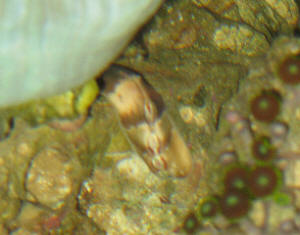
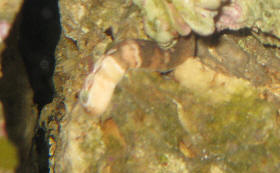
Nudi/Worm ID? 10/6/08 Hello Everyone at WWM!
<Art> Yet again I find that I need some advice, or, at
least an ID of some sort... A few days ago I found this creature
crawling around my 55 Gallon Reef Tank. I looked up the worm FAQ
and had no luck. Whatever this thing is, it seems to be sensitive
to light. If I have the lights off and shine a light on it, it
quickly retracts into wherever it is anchored to. Another thing
is, I've never seen it in it's entirety. So it could be a
few inches long, or ...? The top of it has several
"openings" <"Polyplacophora"> I guess
you could call them, but I haven't been able to keep it in
the open long enough to see if they actually open. It's kinda
freaking me out. I was thinking a Nudibranch of some sort, but it
looks like nothing in your 6 or so Nudibranch ID pages. Please
help! I appreciate any info you can give me! -Art Perez <Is a
Chiton... not harmful. Please read here:
http://wetwebmedia.com/chitonidf.htm Bob Fenner>
|
 |
|
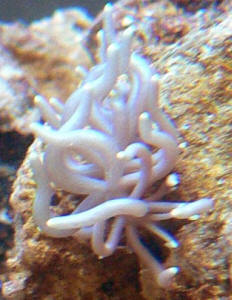
Unidentified Nudibranch: Phyllodesmium briareum --
9/6/08 Hello folks! <Hi there, Allison!> I'm
having difficulty identifying this creature which came in on a
chunk of green star polyps. At first, I actually thought it was a
Condy that moved a lot trying to settle down! <It does look
similar doesn't it!> Picture quality is the best I can get
with my camera...I hope it is sufficient for identification.
<It's great, thanks.> I THINK from as much as I can
find on the 'net that it is a Nudibranch, possibly a
Flabellina -type species. <Good work, you're in the right
neighborhood (suborder (Aeolidina). What you have is a Nudibranch
in the family Aeolidiidae, most likely Phyllodesmium
briareum.> Nothing looks exactly like it (isn't that
always the case?) <Yep, it's frustrating, isn't
it!> ..but I hope if I can get a fairly confident ID, I can
then research and find out if it can stay in my tank, and if so
how to take care of it! <I'd remove it. These are obligate
soft coral predators -- known to eat Green Star Polyps
(Pachyclavularia violacea).> Behaviors I've observed so
far: the tentacles(?) <cerata> along the length of the
animal are light greenish-purple, with fluorescence at the tips.
<Yep, all the better to blend in with what it's
eating!> When gently prodded, all tentacles quickly wrap
around the object--but it will not "hold on" to flakes
of shrimp offered in this fashion <Understandable. The cerata
are used for defense rather than for grasping food. Nudibranchs
in the genus Phyllodesmium have a particularly neat adaptation
for defense. Instead of being armed with potent stinging cells in
the tips of their cerata (like most Aeolids), they instead
release a sticky substance from the tips and, if push comes to
shove, can detach the wriggling cerata - much like a lizard
dropping part of its tail. The predator is left with an easy
target, thereby giving the little Nudibranch a chance to get
away.> (seriously--at first I thought it was an anemone!).
<I can understand that. It's a pretty bizarre looking
little creature!> It reacts to light, with tentacles gently
stretching towards the light source, but is not a strong
reaction, and doesn't position itself in relation to the
available light. <Great observations! These Nudibranchs are
'solar-powered', that is they use light to sustain the
symbiotic zooxanthellae within their bodies that help sustain the
Nudibranch (like many corals)> Its body is long and narrow,
with no discernible demarcation of head. It does have two lower
"feelers" tipped with green (visible on one of the
photos) and two more "horns" on top of the head. It
moves about, but stays close or on the green star polyps.
<That's typical. You, my friend, have made a terrific
study of this neat little animal. Thank you so much for sharing
it with us! For more information on Phyllodesmium briareum,
please see this link:
http://www.seaslugforum.net/showall.cfm?base=phylbria > I have
not seen any damage to the polyps from this presence. <Not
yet, but you will if it's allowed to remain.> Probably not
important for this, but my tank is a 29g with CSL power compacts,
live rock, and mushrooms and star polyps. Some snails, and a
brittle star ("Bruce"),,,and one fan worm. Thank you so
much! --Allison <You're very welcome and again, thanks for
writing us! Take care --Lynn>
|
 |
| Re: Unidentified Nudibranch:
Phyllodesmium briareum -- 9/7/08 Lynn, thank you so much!
<It was my pleasure, Allison!> I poured over the sea slug
forum for hours and hours <LOL Been there, done that.> (also
Nudi Pixel...nice site!) <Yes, indeed. That site
(http://www.nudipixel.net/) shows a lot of promise.> ..and here
you give me the exact link! <Thanks to your excellent
observations and photos, it was a piece of cake!> Thanks again!
Allison <You're very welcome. Take care -- Lynn> |
|
What is this? Goniopora Eating Nudibranch - Phestilla sp.
6/18/08 Hi folks, <Hi Tineke!> Can you tell me what
this is? <I believe so. An important clue comes from what the
creature is eating - Goniopora. It looks like it's well on
the way to finishing off that poor coral. By the way, nice
photo!> This was found at a night dive in the Red sea.
<Boy, that's been a hot spot lately! Bob and some of the
crew were there several weeks ago.> What puzzles me are the
two *horns* (rhinophores?) <Yep, you have a good eye. The two
slightly longer and lighter appendages on the right are indeed
rhinophores.> ..Is this a anemone or maybe a Nudibranch?
<It's an Aeolid Nudibranch in the genus Phestilla. I'm
not sure what species it is, but you can see a similar individual
here: http://www.seaslugforum.net/display.cfm?id=1813
http://rfbolland.com/okislugs/phes_sp1.html (larger photo)>
Thank you for your answer. <It was a pleasure, Tineke.>
Greetings from Holland, <Best wishes to you too from the
US> Tineke Smit <-Lynn>
Re: What Is This? Goniopora Eating Nudibranch - Phestilla
sp. 6/19/08 Wouw!!! <Good morning Tineke!> This is good
news! I'm very proud of my picture! :) <You should be!
It's a very nice photo.> Thank you for your quick answer.
<Glad to be of assistance. Luckily, the photo showing the
Nudibranch actively feeding on the Goniopora made all the
difference.> Maybe I will send Rudman a copy of this
Nudibranch. <Please do. I know he'd appreciate the photo,
along with location information, etc., to add to his already
wonderful site (http://www.seaslugforum.net/).> In the book of
Nudibranchs of the world (Debelius/Kuiter) <Excellent
book.> ..it also said that this one was seen in the Red Sea by
Sudan. This one was a little bit more to the north in Lahami.
When you don't know the name it is hard to search! <Very
true!> Thanks to you I have the name and I can look under that
name on the internet! <Makes all the difference, doesn't
it!> You make me very happy! <I'm so glad to have been
able to help. By the way, thank you for sending in your photo and
inquiry!> Keep up the good work! <Heeee! Thankfully, this
sort of 'work' is fun!> Greetings from Holland, Tineke
Ede. <Take care and best wishes, -Lynn><<Ahh! Well
done! RMF>>
|
|
Do you see the Nudi? Pointing up. 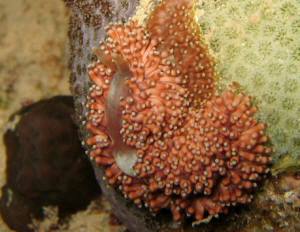 Neat find and pic! RMF. Neat find and pic! RMF.
|
|
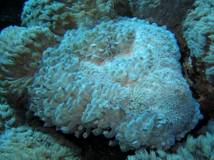
Shell or Nudi 07/07/08 Hey Sara, <Hello Tineke> Here
the answer of Bill about the *hairy* Shell. He is also not able
to determinate this complex thing. <Oh, how kind of him to
answer you so quickly. He is a fabulous man. Thank you so much
for sharing his email with us. And I think he is giving you an
answer (but is simply being prudent in noting that he can't
be certain with only pictures-- which is often very true of these
types of animals).> Do you know already something about that
strange sight I send you of the Goniopora columna? and
<Strange site? I'm sorry, I'm not sure what you're
asking. If you're referring the coral's general state of
poor health, the culprit is likely the Goniopora eating
Nudibranch Lynn IDed for you. The coral certainly looks as if
it's being preyed upon. Or was there something else
"strange" you're asking about?> Greetings Tineke
<Best, Sara M.>
_____ From: Bill Rudman Re: Shell or Nudi Dear Tineke I
am sure there is a snail shell beneath the brown
'growth'. I first thought your photo showed a snail with
algal growth on its shell but the other photo shows an identical
arrangement. Are the photos of the same animal? If not I cant
imagine two animals with the same pattern of algal growth. Which
made me wonder if the growth is in fact a elaborate periostracum
produced by the snail. Some snails have a 'horny' layer
on the outside of their shell and in some this has long hairs.
In the family Ranellidae some species are called 'hairy
tritons' because of this growth. There are some photos on the
web - search 'hairy triton' - but in most photos of
shells this layer is removed so the shell is more
'beautiful' for collectors. I suspect it is a snail,
perhaps a ranellid, but I am afraid photos alone are not always
enough to make an accurate identification. Perhaps it is algal
growth. Sorry I cant help anymore Cheers bill
=========================================== Dr Bill Rudman The
Australian Museum 6 College St, Sydney, NSW 2010 Australia Visit
the Sea Slug Forum at www.seaslugforum.net _____ Subject:
Shell or Nudi Dear Bill, Again a puzzle. WetWebMedia
couldn't find it and referred me to you, so maybe you can
solve this problem. There exist also a picture of this one taken
by somebody else on this site
<http://www.aqualifeimages.com/>
http://www.aqualifeimages.com click on latest release and then
the thirds row from the bottom. This person don't know either
what kind of Nudi this is. if it is a Nudi. I know the shell
(Hydatina physis )looks very much but his mantle is not the same
as on my picture. I hope you have the answer, Greetings from
Holland,
Tineke
Ede
|
|
  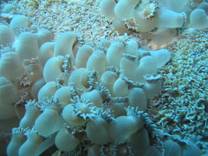
|
Nudi? Possible Sea Slug -- 5/3/08 Hi guys
<Hi Ian, Lynn here this morning.> I think I saw a Nudibranch but
not sure. It was highlighted on the front glass panel otherwise would
never have noticed. It was a tiny yellowish worm looking slug which was
about 10mm in length and 2mm wide. It was moving like a Nudi and had
two little feelers on its head. <It does sound like a sea slug of
some sort.> Please help me to ID this and if a Nudibranch could it
be a pest? <Sorry, Ian, but without a good photo I can't even
begin to narrow down the search. As far as it being a possible pest,
it's undoubtedly a pest to something, but what I have no clue. A
lot of these guys are obligate feeders, feeding on one specific food
item and that's it. Once that food source disappears, so do they.
Have you noticed any damage to your resident corals/cnidarians (if you
have any)? If not, chances are good that this little slug isn't too
much cause for concern. You may see it out an about for a bit and then
no more.> I have not recently introduced anything into the tank but
at this size it could have been around for a long time without being
noticed. <Many are nocturnal but can be seen in systems during the
day when they're running out of food. Also, some are cryptically
colored/adorned so that they blend in unbelievably well with their
surroundings - which in quite a few cases is what they eat!> Your
help is appreciated. <You're very welcome, Ian. For more
information and help in narrowing down the possibilities, please see
the following links (as well as the highlighted links at the tops of
the WWM pages): Sea Slugs:
http://www.wetwebmedia.com/seaslugsopisthobranchs.htm Nudibranchs:
http://www.wetwebmedia.com/nudibran.htm Sea Slug Forum:
http://www.seaslugforum.net/ > Cheers Ian <Good luck! Take care,
-Lynn>
Re: Nudi? Possible Sea Slug -- 5/3/08 Hi
Lynn <Hi Ian> Thanks for your prompt response. Will check out the
web pages you sent. <Sounds good. What you want to do is look for
shared traits in the species of sea slugs/Nudibranchs shown at the WWM
links I provided. That should help you narrow the search to family
level. After that, go to the Sea Slug Forum and compare each individual
species listed under that family. It can be tedious and time consuming,
but ultimately rewarding! Here's a quick link to the SSF species
list: http://www.seaslugforum.net/specieslist.cfm > Cheers for now
Ian <Take care and let me know if you're able to ID that little
fellow! --Lynn)>
Nudibranch ID (follow up) 4/3/08 Hi Crew,
<Hi Steve, Mich here.> After another night of searching your
site (and links to www.seaslugforum.net) I think I have identified
a hitchhiker that came on a soft coral I purchased today. I believe
that I have the same unwelcome guest that another reader named
Arthur submitted. <A link is always helpful...> As your
article requested from him I have captured and photo'd this
critter and thought I would forward the pics for your use. I am
happy for these to be reproduced at your will. <Thank you for
sharing.> I think it is a member of the Order: NUDIBRANCHIA
Suborder: DENDRONOTINA Family: Tritoniidae but welcome your
opinion. <Mmm, I'm not so sure, the description of the
lateral lines appear different than you specimen. It's close
but I'm not certain this is an accurate ID to the genus level.
I would keep looking.> Following your answers to the other
viewer I am pretty certain that this came attached to its'
lunch ;) <Often the case.> so I have removed and isolated it
(unfortunately the only thing I can think of is it to humanely kill
it ?). <Mmm, I hate to recommend euthanasia. Though I don't
have any great suggestions either. Most Nudibranchs are very
difficult to keep in captivity because of their highly specialized
diet and I'm not sure how much of your coral you're willing
to sacrifice. I'm sorry, is a tough place to be. I'm
sorry.> Regards
Steve Heath
Mich> |
|
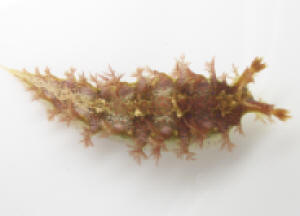
|
|
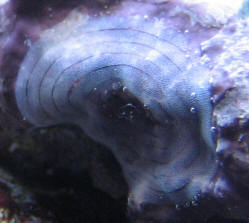
I'm clueless - ID needed: Egg Ribbon -- 3/18/08 Hello!
<Hi there, Sonny!> Hope you can help me to identify this
creature. <Sure hope so!> I set up a nano reef tank about 7
month ago. I am into the hobby about 9 years now. All my water
parameters (including Mg, Ca, Sr..etc..) are close to perfect. I
keep my temperature at 78-80 degrees. 15-17 lbs of live rock, 20
lbs of aragonite, Marineland C-160 canister, Hydor Koralia Nano
powerhead, AquaC Remora Nano skimmer with MJ 900. Current
Satellite light system, 1 dual actinic and 1 dual daylight, 40 W
each, 80 Watts all together, set up with a timer. Only 8 hours
daylight. 1 small colt coral, 1 green eyed and 1 yellow polyps,
trumpet coral. 1 six line wrasse, about a dozen hermits, about
the same amounts of assorted snails. 1 sand shifter
<Sifter?> star, 1 red thorny star, <Uh-oh, these two
stars need much, much, more room in order to survive. They will
not make it in a small tank.> ..and 1 cleaner shrimp. Very
happy and healthy environment. Yesterday I noticed something on
one of my live rock, something I never seen before. If you look
at the picture the creature is right above my fish, and it looks
like a target. <Nice photo!> Round shaped, and has circles
inside.. The color is kinda clear whitish...Please help me
identify this new critter for me! <Hmmm, it looks like an egg
ribbon, possibly left by a Nudibranch or snail. No worries, these
things pop up from time to time and usually disappear within a
few days - as food for the system's inhabitants! Please see
these links for examples of Nudibranch egg ribbons:
http://www.seaslugforum.net/display.cfm?id=1128
http://www.wetwebmedia.com/nudireprofaqs.htm> Your help is
truly appreciated, Sonny <You're very welcome! Take care,
-Lynn>
Re: I'm clueless - ID needed: Egg Ribbon -- 3/18/08
Thank you very much Lynn! <You're very welcome, Sonny!>
I forgot to mention this is a 10G tank. <Yep, I had a feeling
it was when you mentioned the light fixture, but didn't want
to assume.> I also forgot that I just introduced a lettuce
Nudibranch (beautiful creature, I never had one before) about a
week ago, so I suppose he's the source of those eggs. <You
got it!> The sand sifter looks very happy, I don't see him
too much though. <Unfortunately, these need a large area of
mature DSB to survive.> The red thorny star is not the African
red knob sea star, but I'm sure you knew that. <Well, I
wasn't sure if it was Protoreaster lincki or Echinaster
echinophorus, but unfortunately, neither is suitable for this
size tank.> When I purchased him (I bought him and the
Nudibranch at the same time) they told me they won't grow
bigger than 3-4 inches. <Yes, although I've read differing
reports on their size (ranging from 4-8'). Most say it's
around 4', so I'd be more inclined to go with that
number.> Should I take him back? <Yes, actually I'd
take both of those stars back. They'll starve to death in
such a small system.> He seems healthy. My only concern is
that ever since I introduced him to my tank, he's not moving
a lot. Looks like he settled down on one of my live rock, and
he's been there ever since. I see him moving his tentacles
and arms, but he just "sits" there. I don't know..
He's beautiful bright red and orange color.. Any thoughts?
<Yep, if he's been in the same place for a week,
that's not good. Even if he was doing well though, I would
still recommend taking him back.> My heavenly Nudibranch is
all over the place, grazing for algaes all day. Actually I
don't have too much of nuisance algaes of any kind anymore,
is there any supplement I can use if unfortunately ( I can
believe I said that:-) I run out of algaes? <Hmmm, you could
try Nori, but I'm not too confident that it will be eaten.
These sea slugs are nothing if not picky little eaters! They tend
to like one particular algae and that's it. Some like
Bryopsis, others eat Caulerpa, etc. Sadly, they're usually
short-lived in aquariums.> Again, thank you very much for the
info and those great articles, I think you made my night much
better. <You're very welcome. I'm sorry to be the
bearer of bad news about the stars, but they really do need to be
in a much larger system.> If you have chance Lynn, please let
Anthony know that He rule the saltwater world.. By any means, He
is the greatest. <Hey, what about Bob! I say he's the
greatest! :-) Sorry, but I can't help being partial. LOL I
just couldn't let that go without saying something! I've
never met Anthony Calfo but he does seem like a terrific guy --
knowledgeable, funny and kind. I'm hoping to meet him at IMAC
in May. At that time, I would be most happy to relay your
message!> Thank you Lynn, good night <You're most
welcome, Sonny. Goodnight to you too, -Lynn>
|
|
|
Berghia Nudibranchs? 3/2/08 Hi Folks, <Hi
Tyson!> I hope all is well with you. <It's going very well,
thank you!> My question is in regards to some Berghia Nudibranch
that I have recently found wandering my tank. <Okay> I have
encountered several red and olive green colored Berghia, not your
typical cream colored variety. The body shape and characteristics are
identical to the specimens typically sold for Aiptasia control.
<Could easily be something else within the same family (Aeolidiidae)
or suborder (Aeolidacea). If you have the time, please look through the
species listed under those names at this link for comparison:
http://www.seaslugforum.net/specieslist.cfm .> I have one Aiptasia
near the top of my tank that they seem to have no interest in. Instead
I find them wandering my Zoanthid colonies. <Uh-oh. That concerns
me, as Aeolids prey on cnidarians (corals, anemones, etc.). Please see
the information/photos at the following link, as well as those within
the links listed at the bottom for comparison:
http://www.seaslugforum.net/display.cfm?id=18140> It's hard to
tell if they are causing any damage because I have only seen four or
five of them in the last few weeks. Do you think that these Berghia
pose a threat to my zoo colonies or perhaps any other coral?
<It's entirely possible. I'd keep a sharp eye on things and
be prepared to act quickly. These Nudibranchs tend to be fairly
specific about what they eat. If you haven't seen any damage to
your Zoanthids, they may have a taste for something else.> If they
are not eating Aiptasia, what are they eating? <Likely some other
Cnidarian (if present) in your tank. It's also possible that their
preferred food isn't available and that they're not going to be
around too much longer. In the meantime, I'd keep a very sharp eye
out for damage/loss. Please see this link for more information
regarding Aeolid Nudibranchs: http://www.wetwebmedia.com/nudispt3.htm
(also see related links within)
http://www.seaslugforum.net/display.cfm?id=18140> Thanks! Tyson
<You're welcome and good luck! Take care, -Lynn>
|
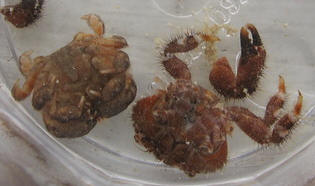
Two Crabs and a White Nudibranch? 2/24/08
Hello crew! <Hi there!> I've attached a few pics of
life (and former life) that I cannot identify. Whilst my intent
was not malicious, the two crabs did not survive the extraction.
<Unfortunate, but understandable - can be difficult to
remove!> As you can see, one is missing several appendages.
<Yep> I would've left them alone if my scarlet hermits
were not being ripped to pieces at night <Yikes!> and if I
hadn't read Calfo's opinion that crabs should be removed.
<They can indeed be very destructive.> So, right or wrong,
they are out and no longer alive. For the sake of learning and
not repeating a mistake if they were harmless, can these be
identified from the pictures I've provided? <They appear
to be in the superfamily Xanthoidea. The hairy crab looks like it
might be in the family Pilumnidae while the other could be in one
of several different families. No matter, this group of crabs can
be very destructive and I would have recommended their removal.
Please see these links (and those within at WWM) for more
information and photos for comparison:
http://www.wetwebmedia.com/marine/inverts/arthropoda/crabs/swcrabs.htm
http://www.nhm.org/guana/bvi-invt/bvi-surv/crab-g06.htm> Also,
there is a small interesting white (Nudibranch?) life form in my
tank. Pictures also attached. Ideas about ID? <Unfortunately
there are just too many possibilities. I can tell you, however,
that due to their specialized diets, these little guys do not
usually survive long term in most systems. Please see the
following links, especially the section at the bottom of the
first regarding issues associated with Nudibranchs:
http://www.wetwebmedia.com/nudispt3.htm
http://www.seaslugforum.net/ > Thanks so much. <You're
very welcome! Take care, -Lynn>
|
   |
Nudibranch... ID, Behavior 2/23/08 Hi, <Hello
Tina, Mich here.> I found a critter in my tank. At first I thought a
piece of my pulsating xenia had broke off and stuck on the tank glass.
Later I noticed it had moved. <Just as an FYI, Xenia can move...
just very, very slowly.> Immediately I captured it and placed in a
glass tumbler. It was sliding about the tumbler like a slug so as you
do I went on your web site to ID my critter. <Excellent.> I have
come to the conclusion it is a Nudibranch (Bornella calcarata) was the
picture that matched mine the most as listed on page 2 Nudibranch).
<Nudibranchs be a challenge to ID, even for some of the most
experienced... Please see here heehee!
http://www.seaslugforum.net/display.cfm?id=8163 > But before get rid
of this coral-eating critter <Often are but not always, but their
diets are usually very specific, and typically difficult if not
impossible to provide in captivity.> I would like clarification of
what it is as all of a sudden it stopped sliding around the tumbler,
it's body turned flat and double its normal width and started to
swim i.e. it's body kept bending in half and straighten again sort
of flapping kind of like a caterpillar movement and it was swimming
quite fast. <Nudibranchs can swim. Here is some video of a Spanish
Dancer (Hexabranchus sanguineus)
http://www.oceanfootage.com/stockfootage/Spanish_Dancer/owner%3Dkandykendall
> I read on Nudibranch behaviour but this wasn't mentioned. I
don't want to get rid of it if it is going to do no harm.
<Really depends on what it is, a picture could help with
identification, but I'm sad to say it will likely face an untimely
death in captivity due to lack of nutritional resources.> Look
forward for your reply Tina .x
<Cheers, Mich>
|
LR Hitchhiker: Sea Slug or Flatworm -
2/12/08 Hey WWM, (great site!) <Hey Bill, thanks!>
Today, my roommate and I were upgrading from our 28g reef tank to
a nice 46g bowfront. <Nice!> As I was moving the live rock
from the 28g, I noticed a very small critter crawling on the
glass. <How small/what size?> It looks like a slug of
sorts, two antennas, slug like body, with very small bright neon
green things running down it's back. <What kind of
'things' - stripes, bumps, ruffled/finger-like
projections (cerata), etc?> I was amazed to find yet ANOTHER
critter to appear, and in turn, it brought me directly to my
computer in search of an answer. Any help would be much
appreciated. <Hmmmm, it does sound like a sea slug or flatworm
of some sort but without a photo, that's about as close as I
can get to an ID. Most of these guys are obligate feeders that
hitchhike into our tanks, survive until the food source is gone,
then die out. Unless you have a tremendous number of these, or
are seeing some damage, I'd leave them and enjoy them for as
long as they're around. Please see WWM for more information,
comparison: http://www.wetwebmedia.com/seaslugsopisthobranchs.htm
http://www.wetwebmedia.com/nudibran.htm > Thanks Bill
<You're very welcome! Take care, -Lynn>
Re: LR Hitchhiker: Sea Slug or Flatworm -
2/12/08 <Hi Bill!> Thanks, for that great info,
<You're very welcome.> it appears to be very similar to
Flabellina exoptata, which I found through your link.
<Great.> I would say, it was about a centimeter long with
finger like projections running down it's back, just like you
asked. However, the colors weren't like anything I saw in
those pictures. Maybe it varies coloring as it ages. <Color
can vary quite a bit with sea slugs. I'm not sure whether it
varies with age, but it's possible. I know they vary
according to region, diet, whether they've just fed, or are
starving, etc. It's entirely possible, though, that your
little sea slugs could be another species within the genus
Flabellina, or in the same family, Flabellinidae. There's a
lot of red, orange, and violet in that family, but not much
green, however. I did find one (Tularia bractea) that had green
cerata. Here's the link for you to compare:
http://www.seaslugforum.net/factsheet.cfm?base=tulabrac Also,
here's the species page for the Sea Slug Forum. This is a
terrific site. If you have the time (and T. bractea isn't the
right species), you can look through, and compare the others
listed: http://www.seaslugforum.net/specieslist.cfm .> Thanks
again, and I'm sure you guys appreciate proper spelling and
punctuation. ;) <Heheeee! Yes, we do, and thank you! Take
care, -Lynn>
|
| Sea Slug ID 2/11/08 <Hi Victor>
Greetings to all. In reference to the E-Mail below, I managed to
photograph the slugs so that you can confirm your ID or make a
correction on your analysis. I isolated the slugs in another tank
with a coral shrimp and the latter acts like they don't exist
which to me seems unusual since these shrimps will attack
practically anything they could get there claws on. I also removed
the eggs from my tank and I placed one string of eggs with the
shrimp, immediately he went for the eggs but as soon as he touched
them he jumped back as if he was hit by an electrical shock. I can
only assume that the eggs have some kind of protective toxin to
ensure their development. Another observation is prior to removing
the slugs one of them was attached to an anemone and as a result
the same is in very poor condition, my conclusion is that it was
being eaten by the slug and in the process toxin was deposited on
the anemone resulting the condition mentioned previously. Also I
noticed that when I touched the slugs the strands on their back
would instantly spring up like a porcupine. Well I hope these
photos will assist you further in identifying this species. Hoping
to hear from you soon and once again thanking you in advance and
also I would like to mention that your dedication to your
profession is truly admirable and deeply appreciated by many around
the world. <Your Sea Slug appears to be a Pteraeolidia ianthina,
commonly found in the Lembeh Straits, North Sulawesi and Indonesia.
This should help you do further research on the animal. James
(Salty Dog)> |
|
|
|
FAQs about Nudibranch Identification
4
Related Articles: Nudibranchs, Sea Slugs,
Related FAQs: Nudi ID
1, Nudi ID 2, Nudi ID 3, Nudibranch
ID 5, Nudibranch ID 6, Nudibranch ID 7, & Nudibranchs 1, Nudibranchs 2, Berghia Nudibranchs, Nudibranch Behavior, Nudibranch Compatibility, Nudibranch Selection, Nudibranch Systems, Nudibranch Feeding, Nudibranch Disease, Nudibranch Reproduction, & Sea Slugs, Marine
Snails 1, Marine Snails 2,
Marine Snails 3,
|
|
|
|




