|
Related FAQs: Nudibranchs,
Nudibranchs 2, Nudibranch Identification,
Nudi ID 2, Nudi ID 3, Nudi ID 4, & Nudibranch Behavior, Nudibranch Compatibility,
Nudibranch Selection,
Nudibranch Systems,
Nudibranch Feeding,
Nudibranch Disease,
Nudibranch
Reproduction, Berghia
Nudibranchs, Marine Snails
1, Marine Snails
2, Marine Snails
3, Marine Snails
4, Sea Slugs,
Seaslugs 2,
Snail ID
1, Snail ID 2,
Snail ID
3,
Related Articles: Dorid et al. Nudibranchs pt. 2,
Aeolid Nudibranchs pt.
3, Sea
Slugs, Gastropods, Mollusks,
Aiptasia/Glass
Anemones
/The Conscientious Marine
Aquarist
Nudibranchs, The
Naked-Gill Sea Slugs, pt. 5, Dorids
To: Pt. 1,
Pt. 2,
Pt.
3,
Pt. 4,
Pt. 6,
Pt. 7,
Pt. 8,
Pt. 9,
Pt. 10,
Pt. 11,
Pt. 12,
Pt. 13,
Pt. 14,
Pt. 15,
Pt. 16
|
|
|
By Bob Fenner
|
|
Genus Reticulidia:
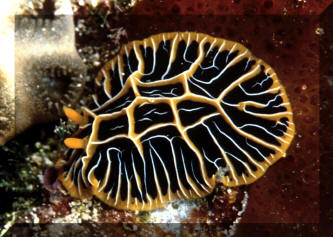
| Reticulidia halgerda Brunckhorst & Burn
1990. Black body, raised orange ridges with white borders are
distinctive. Similar to Halgerda spp., but lack the circum-anal
gills of the latter. Fiji image. |
|
Family Polyceridae, Polycerid Dorids: Western Indian Ocean to
Western Pacific; mostly tropical, some temperate. Many distinctive
colored species. Characterized by elongated bodies, with gills on
elevated part of their backs, short/slender mantles (with foot behind
it). Their chemo- and tactical-sensory apparatus (rhinophores) are
almost always branching (foliaceous). Feed on bryozoans, ascidians,
cnidarians, other Nudibranchs... Genera Nembrotha, Roboastra, Tambja
can be distinguished only by dissection: radula and sex organs in
particular. Larger animals (up to 15 cm.) for Nudis... use their
narrow, extendable throats as a suction pump in feeding (rather than as
a scraping radula)... easier than many Nudis therefore to care for in
captivity. Possible Aiptasia feeders.
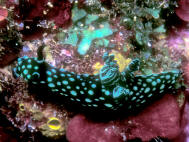
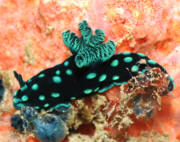
| Nembrotha cristata N. Sulawesi (Lembeh
Strait) |
|
Bigger PIX:
The images in this table are linked to large
(desktop size) copies. Click on "framed" images to go to
the larger size. |
.JPG)
%20MD.JPG) |
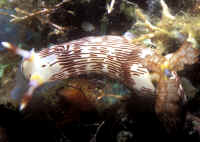
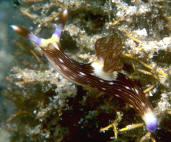
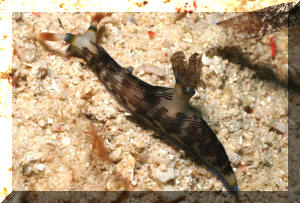
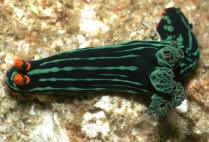
| Nembrotha lineolata Western I.O and Pacific;
Seychelles, Philippines, Western Australia, Fiji. To 4.5 cm. More
than five lines on the body. Sea Squirt feeder. A fast-moving
species. N. Sulawesi pix. |
|
Bigger PIX:
The images in this table are linked to large (desktop size) copies.
Click on "framed" images to go to the larger size. |
.JPG)
 |
To: Pt. 1,
Pt. 2,
Pt.
3,
Pt. 4,
Pt. 6,
Pt. 7,
Pt. 8,
Pt. 9,
Pt. 10,
Pt. 11,
Pt. 12,
Pt. 13,
Pt. 14,
Pt. 15,
Pt. 16
|
|


%20MD.JPG)
%20MD.JPG)
%20MD.JPG)
%20MD.JPG)