Become a Sponsor

 
Home
Information Pages:
Marine Aquarium
Articles/ FAQs
(enter words you'd like highlighted in this page)
Freshwater Aquarium
Articles/ FAQs
Planted Aquarium
Articles/ FAQs
Brackish Systems
Articles/ FAQs
Popular Pages:
Features:
Daily FAQs
FW Daily FAQs
SW Pix of the Day
FW Pix of the Day
Conscientious Aquarist Magazine
New On WWM
Helpful Links
Hobbyist Forum bb.WetWebMedia
Ask the WWM Crew a Question
Calendars
Search Feature
Admin Index
Cover Images


Related FAQs: Nudibranchs, Nudibranchs 2, Nudibranch Identification, Nudi ID 2, Nudi ID 3, Nudi ID 4, & Nudibranch Behavior, Nudibranch Compatibility, Nudibranch Selection, Nudibranch Systems, Nudibranch Feeding, Nudibranch Disease, Nudibranch Reproduction, Berghia Nudibranchs, Marine Snails 1, Marine Snails 2, Marine Snails 3Marine Snails 4, Sea SlugsSeaslugs 2, Snail ID 1, Snail ID 2, Snail ID 3

Related Articles: Dorid et al. Nudibranchs pt. 2, Aeolid Nudibranchs pt. 3, Sea Slugs, Gastropods, Mollusks, Aiptasia/Glass Anemones

/The Conscientious Marine Aquarist

Nudibranchs, The Naked-Gill Sea Slugs, pt. 4, Dorids, Dendronotaceans, Arminaceans

To: Pt. 1, Pt. 2, Pt. 3, Pt. 5, Pt. 6,

Bigger PIX:
The images in this table are linked to large (desktop size) copies. Click on "framed" images to go to the larger size.
  

By Bob Fenner


Re: lynx nudibranch
Hi Bob,
Sorry for the lack of info.... this little critter is on pae 303 in Humann's 2nd ed. They call it Phidiana lynceus subclass Opisthobranchia.  
aquah0lic
<I see it on pg. 229 in my copy of "Reef Creatures". A beauty. Bob Fenner>

Family Phyllidiidae
: identified by their warty bodies and placement of gills (between the mantle and foot, not the dorsum). Tough-bodied. Mainly feeders on sponges. Noted for releasing toxins in aquariums that are toxic to fishes and crustaceans. 

Phyllidia arabica,  Ehrenberg 1831.Off of Pulau Redang, Malaysia, and N. Sulawesi. Is this the same species as P. varicosa? Appears so: http://www.seaslugforum.net/search.cfm?searchstring=Phyllidia+varicosa

Bigger PIX: The images in this table are linked to large (desktop size) copies. Click on "framed" images to go to the larger size.
Phyllidia coelestis Bergh 1905. South Africa, China Sea, Australia, Fiji. To 6 cm. Similar to P. verrucosa, but distinguishable by P. coelistis divided black markings. N. Sulawesi image. 

Phyllidia elegans Bergh 1869. Red Sea to Maldives, to Fiji, Australia. One in Bunaken/Manado/Sulawesi/Indonesia, another from S. Sulawesi. 
http://www.seaslugforum.net/search.cfm?searchstring=Phyllidia+elegans

Bigger PIX: The images in this table are linked to large (desktop size) copies. Click on "framed" images to go to the larger size.
  
Phyllidia ocellata Yonow & Debelius 1991. Highly variable in appearance over its wide range in the Indo-Pacific. One in Fiji, N. Sulawesi far right and below. 
http://www.seaslugforum.net/search.cfm?searchstring=Phyllidia+ocellata

Phyllidia varicosa. Red Sea to Hawai'i. To nearly three inches in length. One in Bunaken/Manado/Sulawesi/Indonesia, one in Hawai'i, and a third in Nuka Hiva, Marquesas.  The middle one is about three inches in length.
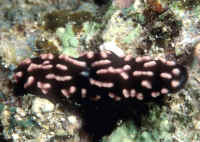
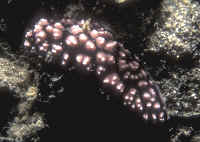
Phyllidiella pustulosa (Cuvier 1804). Black body with pink tuberculations arranged in rows to clusters. Common from the Red Sea to Hawai'i. One in Fiji, another in Hawai'i.

Phyllidiopsis annae. Thailand, New Guinea. Blue and black body color, three longitudinal body ridges. Small... to 1.5 cm. in length. N. Sulawesi image. 

Phyllidiopsis fissuratus, Thailand, Fiji to Australia. Images made off of Bunaken/Manado/Sulawesi/Indonesia.  To eight cm. 

Phyllidiopsis shireenae. Indo-Pacific; Maldives to Solomon Islands. Distinctive mid-body crest/rise. To ten cm. N. & S. Sulawesi pix. 
http://www.seaslugforum.net/factsheet.cfm?base=phylshir

Reticulidia halgerda Brunckhorst & Burn 1990. Black body, raised orange ridges with white borders are distinctive. Similar to Halgerda spp., but lack the circum-anal gills of the latter. Fiji image. 

Family Polyceridae, Polycerid Dorids: Western Indian Ocean to Western Pacific; mostly tropical, some temperate. Many distinctive colored species. Characterized by elongated bodies, with gills on elevated part of their backs, short/slender mantles (with foot behind it). Their chemo- and tactical-sensory apparatus (rhinophores) are almost always branching (foliaceous). Feed on bryozoans, ascidians, cnidarians, other nudibranchs... Genera Nembrotha, Roboastra, Tambja can be distinguished only by dissection: radula and sex organs in particular. Larger animals (up to 15 cm.) for nudi.s... use their narrow, extendable throats as a suction pump in feeding (rather than as a scraping radula)... easier than many nudi.s therefore to care for in captivity. Possible Aiptasia feeders.

Nembrotha cristata  N. Sulawesi (Lembah Strait)

Bigger PIX: The images in this table are linked to large (desktop size) copies. Click on "framed" images to go to the larger size.
  
Nembrotha kubaryana Bergh 1877. Indo-Pacific; South Africa to Micronesia. To 7 cm. N. Sulawesi (Lembah Strait) pix. http://www.seaslugforum.net/search.cfm?searchstring=nembrotha+kubaryana
 
Nembrotha lineolata Western I.O and Pacific; Seychelles, Philippines, Western Australia, Fiji. To 4.5 cm. More than five lines on the body. Sea Squirt feeder. A fast-moving species. N. Sulawesi pix.

Bigger PIX:
The images in this table are linked to large (desktop size) copies. Click on "framed" images to go to the larger size.
  
Nembrotha megalocera Red Sea endemic. To 7.5 cm. A swimmer when disturbed. Red Sea pic.

Nembrotha rutilans N. Indonesia, Australia. To 5 cm. Some genetic exchange going on here. Sulawesi pix by Di.F.
http://www.seaslugforum.net/search.cfm?searchstring=nembrotha+rutilans

Roboastra arika Burn 1967. Purple bodied with yellow/orange lines. Feed on bryozoans. Fiji photo.

Roboastra tigris. Sea Tiger. Tropical Eastern Pacific; Sea of Cortez. To 30 cm. Body green to yellowish, with five longitudinal dark stripes outlined in green. Rhinophores and gills blue-black, the latter with yellow internally, oral region blue. Feeds on other nudibranchs.

Tambja fusca. Eastern Pacific; around the end of and inside the Sea of Cortez. To 5 cm. Loreto pic.

Tambja kushimotoensis. Mauritius to Japan. To 5 cm. N. Sulawesi pix.

Tambja morosa. East Africa, Indonesia, Philippines, Hawai'i. To 7 cm. Found near base of reef slopes. Lembah, Sulawesi, Indonesia pic.

Tambja sp. #5: http://www.seaslugforum.net/tambsp5.htm

N. Sulawesi pix. 

Thecacera picta Baba 1972. N. Sulawesi (Lembeh Strait) pic. http://www.seaslugforum.net/factsheet.cfm?base=thecpict

Thecacera sp. 2. N. Sulawesi (Lembeh Strait) pic. 

Bigger PIX:
The images in this table are linked to large (desktop size) copies. Click on "framed" images to go to the larger size.

Suborder Dendronotacea:

Family Bornellidae:

Bornella calcarata Borch 1863. Tropical West Atlantic. 

Family Tethyidae:

Melibe mirifica (Allan 1932). To 30 cm. Small rhinophores and conical, unbranched ceratal tubercles. This specimen in N. Sulawesi's Lembeh Strait (tentative identification). A huge animal (about a foot in length) with a "extensible head" that came out every few seconds, seemingly sampling the substrate for food.

Seaslugforum: http://www.seaslugforum.net/melimiri.htm


To: Pt. 1, Pt. 2, Pt. 3, Pt. 5, Pt. 6,


Featured Sponsors:
Google
 
Web www.WetWebMedia.com