|
|
| Home | Marine Aquariums |
Freshwater Aquariums |
Planted Aquariums |
Brackish Systems |
Ponds,
lakes & fountains |
Turtles & Amphibians |
Aquatic Business |
Aquatic Science |
Ask the WWM Crew a Question |
| Please visit our Sponsors | ||||
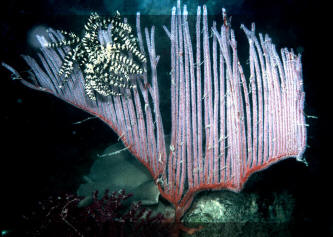
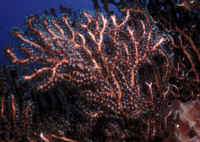
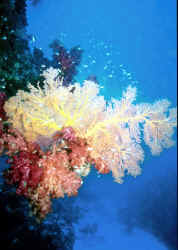
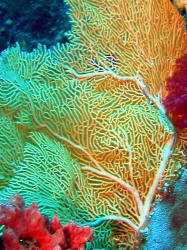
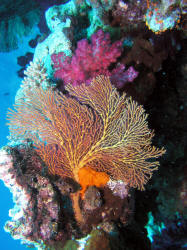
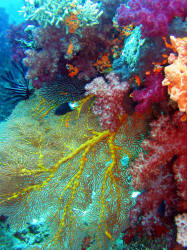
What the deuces are sea fans anyway? Those scraggly stick things you see in fish stores or hanging on the wall at The Seafood Restaurant? Well, sort of; those are actually only the vestiges (skeletons) of what were sea fans. Looking at a human skeleton, have you ever heard, "What a babe/hunk!"; probably not. If you think sea fans are attractive as dead remnants "you ain't seen nothing yet". Most everyone has seen sea fans on the boob tube; even had a sea fan in their hand, Order Gorgonacea, as a skeleton turned into a piece of jewelry. If you've been diving in tropical seas, you've brushed by them "waving" in the current.
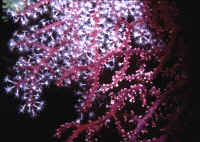
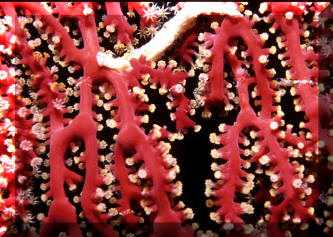
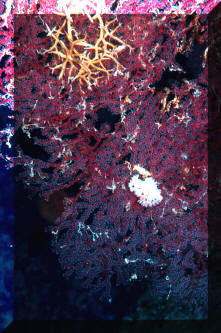
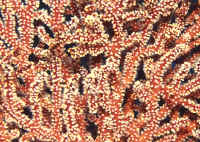
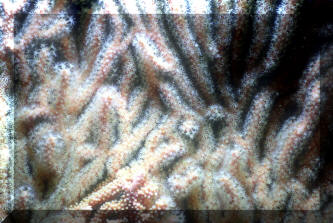
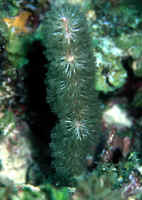
Can they be kept in captivity? Yes. There is a much stultified place/market for these octocorallians in the schema of marine aquaria. Like many saltwater invertebrate groups, sea fans have been kept on the side lines thus far for simple, correctable reasons/problems. Classification: Sea fans and their relatives are members of the Phylum Cnidaria (Coelenterata) and therefore possess specialized stinging cells and sticking cells, no organs, "bag in a bag" body structures. Evolutionarily they were the first group to have a gastrovascular cavity; allowing them to take advantage of larger prey (up from the simpler sponges). Like the previous coral, tube and "true" anemone groups, the sea fans are members of the Class Anthozoa. In contrast with the other Cnidarian classes (Hydrozoa, Scyphozoa) that have medusa body plans (inverted bells with either a simple body tube or one divided into four areas), the polypoid Anthozoans bodies' are divided into numerous chambers by septa (partitions). If you want, refer back to the systematic overview of the stinging-celled animals, Section 4) A) ii) b) for a clearer picture of how this group is further placed. The Class Anthozoa is comprised of two Subclasses. The anemones in Subclass Zoantharia have polyps with more than eight tentacles, typically in cycles of twelve. Our sea fans are in the Subclass Octocorallia (or Alcyonaria) have polyps with eight pinnate tentacles. Almost all of them are colonial. Octocorallians include the soft corals, that lack stiff skeletons, Order Alcyonacea; and other non- "true corals" such as the Pacific blue coral, Heliopora (Order Helioporacea); the organ pipe coral, Tubipora (Order Stolonifera); and more. These don't possess the calcium carbonate skeletons of "true" stony corals (Subclass Zoantharia, Order Scleractinia), though they do have scattered CaCO3 spicules. Sea fans, Order Gorgonacea, are colonial Anthozoans anchored on hard substrates, supported by an internal, central horny/wood-like skeleton. They're colonies are covered by a thick "rind-like" skin. Unlike anemones, but like corals, sea fan polyps are interconnected by an internal germ layer (gastrodermis) and mesoglea. This feature explains much regarding how one part can feed and sustain the rest of the colony, and unfortunately how disease can easily spread. Common genera include Gorgonia, the purple sea fan from Florida/Caribbean, the dried "ornamental" fan skeletons in stores. Corallium is the beautiful red sea fan used in jewelry. Paragorgia, Pterogorgia, and Pseudopterogorgia; and others are often encountered, offered for aquarium use. Gorgonians are found worldwide in tropical seas. They are prominent of most reefs, attached to rocks, corals, oriented to prevailing currents. Gorgonian Species on Parade!
Family Briareidae:
Genus Ctenocella:
Genus Diodogorgia:
|
|

|
Features: |
|
| Featured Sponsors: |
%20MD.JPG)
MD.JPG)
%20MD.JPG)
%20MD.JPG)
%20crop%20MD.JPG)