|
FAQs about Sea Fan Disease/Health, Parasites,
Pests
Related Articles: Sea
Fans,
Related FAQs: Sea Fans
1, Sea Fans 2,
Sea Fan Identification, Sea Fan Behavior, Sea Fan Selection, Sea Fan Compatibility, Sea Fan Systems, Sea Fan Feeding, Sea Fan Reproduction,
|
|
Diodogorgia nodulifera advice
11/10/16
Hi Bob & Crew,
<Hey Nick>
You have been very helpful in the past so I was hoping you could once again
assist me with some advice.
<Let's see if we/I have some>
I have recently inherited a couple of what I believe to be D. nodulifera (one
red / one yellow) from a friends tank whose bicolor angel had developed a taste
for them. Within 24hours the yellow had around 60% of its polyps extended so I
have been target feeding with Vitalis soft coral food (micronised flake) but the
red has some tissue loss at the base and the tip
of one of the branches and has not extended any polyps as yet, from reading WWM
and anything else I can find it sounds as though this one may be a goner?
<Maybe; but I hate to give up... what have you tried so far? Additions of simple
sugar/s? Overdosing of iodide-ate?>
If you have any advice as to actions for saving it or indeed at what point I
should cut my losses and remove it I would be very grateful. (have read
conflicting reports of them releasing toxins when they die).
<More pollution than toxins w/ this genus>
I have placed them both in the most shaded areas I can find that still receive a
moderate amount of flow.
They have been in my friends tank for over a month and he was sold them with the
advice that they would need to be fed twice a week on soft coral food.
<Mmm; I'd feed more frequently... and/or have a VERY large and vigorous
refugium>
I have been reading up as much as possible on their husbandry requirements and
it seems there are many different opinions on feeding regimes varying from twice
per week up to continuously! (the gold standard I'm sure but not
achievable in my setup). I am planning to make my own food based on a recipe I
saw on the GARF website consisting of mysis/brine, flake, SeaChem ReefPlus
blended together and target fed. I was hoping that 1 feed per day would be
sufficient with this mix but wanted to get your expert opinion on regime and
recipe/alternative foods?
<I would definitely try the DIY recipe you list; and feed at least for minutes
every other day... WHEN polyps are open>
Seems like this is one of those species best left in the ocean for those without
an AZoo tank and I don't usually add anything to my tank without researching
first but given they were angel food otherwise thought it best to try and give
them a chance. Tank param.s listed below.
Thanks in advance
Nick
Tank param.s - 48"x18"x24" w/20g sump/fuge - Temp 25-26 C/ pH 8.1 / Ammo 0 /
Nitri 0 / Nitrate <5 / Phos undetectable / Calc 440 / KH 8 / Mag 1230
Livestock - various soft corals leathers, xenia, GSP, PS gorgs / CUC / 2 x
ocellaris clowns
<Please read re the Glucose, I2 mentioned above... and let's re-chat in a day or
two. Bob Fenner>
Re: Diodogorgia nodulifera advice 11/26/16
Hi Bob,
<Hey Nick>
More of an update than a question, I exercised some patience as per your advice
and am happy to report all is now back to normal, my corals are looking great
and the NPS gorgs are both out and appear to be doing okay with a feeding every
other day.
<Ah, good>
I unfortunately lost the majority of my Trochus but it appears as though the
many tiny Stomatella from a pre-incident spawn have survived and are all growing
rapidly. One silver lining in all of this is that I had the torch out one
morning to assess the troches before I went to work and found a large predatory
flatworm engulfing one of them which I doubt I would have found otherwise. I
suspect it came in on a star polyp colony I added a month or so ago as I have
lost 2 troches unexpectedly since, that'll teach me to be more thorough
inspecting corals before putting them in!
Thanks once again, your site really is an invaluable tool for the hobby, I very
much appreciate you taking the time to respond to my questions and have sent a
small donation by way of thanks.
Nick
<Thank you for your kind, encouraging words. Much appreciated. Bob Fenner>
|
Small Red Snail ID 9/15/16
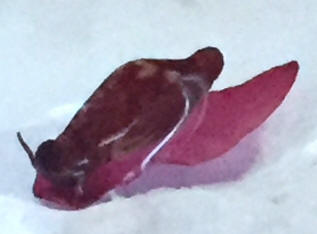
Hi WWM crew!! I go to your site first to try to ID things and couldn't find
anything on this guy. It's a small snail, almost looks like a Stomatella.
It's pretty much bright red - both the shell and the foot. I found it on a
yellow polyp gorgonian (Menella sp.). I thought it might be a pest but
wanted to check. It's very pretty so I don't want to harm it if I don't have
to! Any ideas? Photos below. It's less than 1/4 inch long and less than 1/8
wide.
<Ahh; I do think this IS a Stomatella (sp.). They do occur in varying
colors, markings... yours has likely been eating a good deal of something
that bears red pigment. I would keep this animal>
Thanks,
Rachel Fogle
<Welcome. Bob Fenner>
|
 |
Re: Small Red Snail ID
9/15/16
Awesome!! Thank you, Bob! I'm definitely keeping him :)
<Yay!>
Rachel Fogle
<BobF>
|
<corr.> Small Red Snail ID: Ovulid- 9/15/16
Hi WWM crew!!
<Hey Rachel!>
I go to your site first to try to ID things and couldn't find anything
on this guy. It's a small snail, almost looks like a Stomatella. It's
pretty much bright red - both the shell and the foot.
<Yep, it’s a pretty little thing.>
I found it on a yellow polyp gorgonian (Menella sp.).
<Yep, these guys love ‘em.>
I thought it might be a pest but wanted to check. It's very pretty so I
don't want to harm it if I don't
have to! Any ideas?
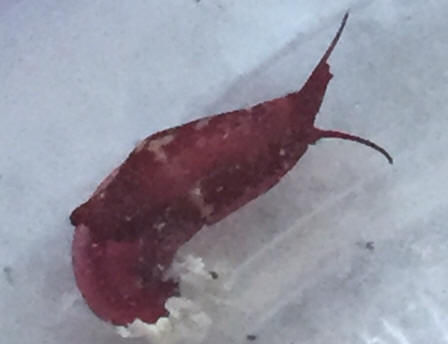
<I’m sorry to say that although it does look like a Stomatellid, and
it’s undoubtedly pretty, it’s a pest (at least as far as the gorgonian
is concerned!). It’s an Ovulid, (family Ovulidae), a group of predatory
snails similar to cowries, that feeds on gorgonians (sea whips and
fans). These snails have an interesting two-fold defense strategy thanks
to a soft mantle typically extended over the shell. On the one hand, it
can mimic the color and texture of its prey to a surprising degree,
while on the other hand, the bright colors warn predators to stay away.
The mantle retains some of the noxious chemicals from whatever soft
coral the snail preys upon. Bottom line – this an interesting little
beauty, but I would remove it, along with any others that appear. Please
see the following links for more information:
http://www.wetwebmedia.com/gastropo.htm
http://www.wetwebmedia.com/MolluscPIX/Gastropods/Prosobranch%20PIX/Ovulids/OvulidsF1.htm
>
Photos below. It's less than 1/4 inch long and less than 1/8 wide.
<Thanks>
Thanks,
<You’re very welcome; I’m just sorry to be the bearer of bad news!>
Rachel Fogle
<Take care, Lynn Zurik>
|
 |
|
Yeeikes! Thank you Lynn. I mis-ID'd this as Stomatella sp.!!!
BobF 9/16/16
Snail Query - Ovulid
Hi Bob, I am so sorry that I didn't get to the snail query until today.
<Ahh! I'd sent a bad ID on thinking we/I'd missed you. B>
Re: Small Red Snail ID - Ovulid - 9/15/16
Thank you, Lynn!
<You are most welcome!>
I'll get rid of him. I'm sure my gorgonians will appreciate it.
<Oh yes, indeed!>
Rachel
<Take care, Lynn>
Re: Small Red Snail ID 9/16/16
Ha!!! I liked your ID better, Bob
<Heeee! Me too! B>
Rachel
|
|
|
Red Gorgonian; hlth., fdg.
7/12/15
Hi All.
<Jo>
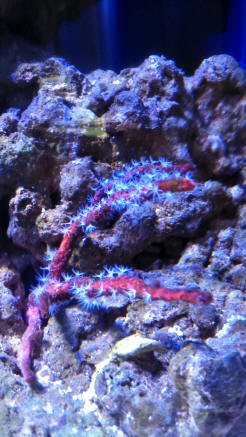
Four days ago I inherited a sun coral and red gorgonian in a nanoreef tank I
purchased on an auction site. The previous owner had lost interest and said I
was welcome to both corals, but suspected they were both on their way out. I run
a 225 litre sumped system, which is home to photosynthetic Gorgonia, xenia,
gsp's zoos, Acan and trumpet coral, the only fish in the
system is a linear blenny. Nitrates are at 5, phosphate at zero, kH at 10,
salinity 1.025 and temp at 26 degrees c. On putting the Gorgonia in the tank and
acclimating, it showed no polyp extension, over the last four days I
have target fed with Reef Roids, on each day more polyps have emerged,
<Yay!>
I have it in low light and moderate flow. As of this evening the gorgonian looks
as the attached pic. I have researched online and I have read that once 10% of
the polyps stop feeding death is imminent.
<Mmm; nah... As long as some are coming out, feeding, hope is not lost>
Is this correct or do you think looking at the pic I have a chance if I keep up
the same care?
<I think this looks like a very nice specimen indeed>
Thanks for your time. Joanne
<Thank you for sharing. Bob Fenner>
|
 |
|
Re: Red Gorgonian 7/12/15
Thanks Bob :) I shall keep it up! is there anything else I can be feeding?
<Yes; quite a few possibilities; and some additional, related input. Read here:
http://wetwebmedia.com/gorgfdgfaqs.htm
I have ordered mysis, brine shrimp and oyster eggs for the sun coral, though I
imagine these will be too large particles for the gorgonian?
<Can be chopped up; prepared in ways to make more useful (in suspension); soaked
in nutritive solution/s....
BobF>
|
Update and help needed please. 8/8/15
Hi Bob and crew!
<Joanne>
I contacted you about a month ago regarding a red gorgonian I
had inherited that was in bad shape. I kept up with the tlc, cut away some
tissue I suspected was not healthy and now the gorgonian looks brilliant (pic
attached) the polyps have grown larger and nearly every single polyp comes out
now, with smaller ones appearing.... So pleased and thanks for your help.
<Ahh!>
A few days ago I purchased the contents of a marine set-up and paid
slightly over the odds in my opinion but I felt compelled to when I discovered
the contents were being kept in a 26 litre tank! These are a 3 inch
maroon clown, two blue/green Chromis, a rock goby, a 2 inch sea hare, a green
Goniopora and an anemone!
<Yeeikes!>
The Goniopora he didn't have a clue what it was and it's in bad shape, I would
say a quarter of it remains (pic attached)
<Mmm; not.... just the Gorg and what appears to be a pinkish Condylactis
gigantea>
I know they aren't easy to care for but am hoping I can rescue it with some
care?
<.... not easy to care for... Like "dirty" water, must have indiv. polyps fed...
See/READ on WWM re this genus of Poritids husbandry>
(I have a purple Goniopora and a green Alveopora that are doing great)
<Oh!>
The anemone is probably three inches diameter but I am unsure if this is a
Condylactis or a Macrodactyla doreensis,
<The former almost certainly>
what do you think please? I am target feeding enriched mysis at the moment and
it Is taking these, I realise it will probably need larger bites as it gets
bigger, I'm just hoping it survives. Thanks in advance. Joanne :)
<Thank you for this report. Bob Fenner>
|
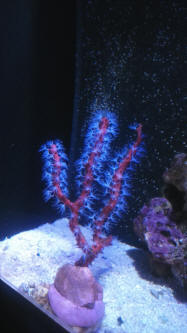
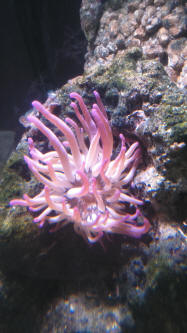 |
|
re: Update and help needed please. 8/8/15
Thanks Bob! Think I may have to rehome the Condy at some point as there's not an
awful lot of room in my 300l cube tank if it decides to go for a walk about and
I have a fair few corals im there.
<Uh, yes. Trouble>
It's a shame but at least it's not in a 26l tank still.
<For sure. BobF>
|
|
Sea fan disease ?
5/20/14
Dear WWM crew,
<Thierry>
My sea fan is showing symptoms of which I cannot find a description on the
Web.
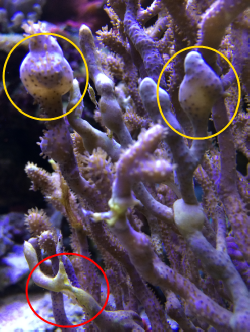
<I see your pic...>
A bubble appears and stretches the tissue (yellow circles) and after a few
days, it pops and leaves the bare skeleton (red circle).
I cannot figure if it is a disease or a reaction due to water parameters,
light level, current or something else.
<My guess, bet is on the middle one>
Do you have a suggestion on how to deal with this ?
<I'd first and foremost look into concentrations of Ca and relative Mg, HPO4
and Fe (3)...
Light, not so important w/ this color/specimen....
Do you use supplements? What sorts of foods employed here; refugium?>
Thank you
Best regards
Thierry
Switzerland
<And you; Bob Fenner> |
 |
|
Re: Sea fan disease ?
5/27/14
Dear Bob,
<Thierry>
Thank you for your answer.
<Welcome>
I guess I had messed up my last Ca measurement because it was down to 280 !
<Yikes! And I'd be checking (of course) Mg and Alkalinity>
The cause was the CO2 pipe of my calcium reactor which was plugged.
<Happens... hopefully just vinegar, acetic acid will remove the clog>
I have now made a 20% water change and I am raising my Ca with the reactor
plus some additional Kalkwasser.
<Good>
I do add supplements but since my dosing system died I do it by hand and I
am certainly not as regular as the pump was.
Food is either frozen Artemia or small pellets and occasional dried
plankton.
One quick question on this : I use high quality Artemia, not the cheap ones
found in larger pet stores. I melt the cube in a glass containing aquarium
water and then I empty everything in the tank assuming the
"juice" will contain smaller particles for the corals. Is this a bas idea ?
Should I rinse the melted Artemia ?
<I'd use your observation as guide here. IF your gorgonian/s are feeding, I
would not be concerned. Be sure to direct laminar flow to/toward them>
Once my parameters are back on track, I will give you some feedback so that
this can possibly serve other reefers.
<Again; I thank you>
Best regards
Thierry
<And you, Bob Fenner>
|
Gorgonian trouble 4/3/14
Oh Mighty Crew, your help please.
<Jim>
I did search WWM and could not find anything obviously relevant to my
issue, forgive me if I missed something, I did learn a ton, though, from
the exercise.
I have had a Purple Gorgonian (Pseudopterogorgia elisabethae,
I think) for 13 months, and I *thought* it had been doing well - full
polyp extension over the entire animal nearly every day (sometimes at
night as well), slow to moderate growth (as compared to my other
gorgonian - Eunicea sp.) and a waxy, sloughing-off of material about
every 7-10 days which sheds with help from the current.
About two weeks ago the polyps stopped extending -
there has been no polyp extension, at all, anywhere. The tissue on the
stem looks normal with respect to color and texture. About three days
ago I noticed what I thought was a light dusting of cyanobacteria or
diatoms over the entirety of the coral, but when I went to try to remove
it using a turkey-baster or power-head it would not "blow" off which
makes me unsure that this dusting is, in fact, Cyano or diatoms.
<Could tell easily w/ a 'scope look/see>
My parameters have been consistent; although my salinity has crept-up to
1.0265 from its usual range of 1.025 - 1.0260 (although, honestly, I
don't know what my real margin of error is in my testing so this might
not be significant).
<Not of/by itself>
No other coral is within 4 inches of this one -- the closest being a
Harry Mushroom (Rhodactis indosinensis) colony. All other corals are
showing excellent growth and signs of good health.
<Mmm, well Corallimorphs can work other Cnidarians woe distally...
chemically>
The tank is a 55 Gallon, corner, with no skimmer, but I run Purigen and
Chemi-pure changed monthly with 5 gallon WC weekly.
<Good practices>
Corals:
* Ricordea florida,
* Acanthastrea,
* Bicolor Hammer (Euphyllia parancora) - very far away,
* Red Goniopora,
* Torch Coral (Euphyllia glabrescens) - very far away,
* A few Leaf Plate Montiporas,
* Pagoda Cup Coral (Turbinaria peltata),
* Montipora Digitata
* Purple Tree Gorgonian (Eunicea Sp.)
7 Fish:
* A Sailfin and a Kole Yellow Eye Tang (I will re-home one and/or both
when they become too large or begin to show aggression or distress),
* Mandarin Goby,
* Yellow & Purple Wrasse (Halichoeres leucoxanthus),
* 2 Ocellaris Clownfish
* Royal Gramma Basslet
Parameters, as measured by Salifert test-kits:
* Ammonia and Nitrites: 0
* Nitrates: 0.2 but I suspect I have higher concentrations that feed
algae which feed the tangs
<Good; and need some HPO4>
* Ca: 460
* KH: 7.8 - 8.0
* Mg: 1380
* Temp: 78F - 80F, mostly 79F, I have a chiller and heater which keeps
it in a pretty narrow range
Any thoughts as to what might be going on and whether it is likely
hopeless?
<Well, Mmmm; could be that this die-back for wont of a better term is
due/simply to an ongoing lack of nutrient/nutrition... I would try
bolstering this... with fine foods released at intervals... with added
HUFA, Vitamin, juice from frozen/defrosted foods mixed in>
Thanks for all you do for the community,
Jim Rosenblum
<Glad to share... and again on last week's trip, saw many Gorg.s in
Cozumel with similar symptoms: Overgrowth w/ BGA, Hydrozoans...
Environmental in one word; as in degradation... effects of wastes washed
from resorts mostly.
Bob Fenner>
Re: Gorgonian trouble – 04/09/14
Bob,
I came home on Friday to discover that the "dusting" mentioned below had
become what looked like goose pimples, and today I find the Gorgonian
with polyps extended and looking "normal".
<Ah, good>
With respect to your last comment, as a kid, in the mid- to late-70's, I
used to occasionally snorkel off of St. Thomas and Virgin Gorda.
Recently, I returned and was shocked to see the difference. What was a
teeming, colorful mass of life seemed, now, like a desert in comparison.
Sometimes I worry that we have past the tipping point and not enough
people notice... or care.
<I have been to this USVI; I think in 2001... and observed too much BGA
(though not as much as at Cozumel last week). I do fear for coastal
waters w/ too much accompanying human impact. Cheers, Bob Fenner>
|
"Leptogorgia sp" 10/14/13
Hey Crew!
I have been at WetWeb for some time this morning, and cannot find info
on this species; "Leptogorgia sp" I bought one 4 days ago and have
followed the sites "directions" but it remains closed. Can you provide
me with a link ?
Thanks!
Pam
<Mmm, had to search the WWM site myself:
http://www.wetwebmedia.com/gorgsysfaqs.htm?h=Leptogorgia+sp
Don't know much re the genus, its care/use in captivity. What little I
gleaned from a cursory review of the Net shows it doesn't typically do
(as) well; even amongst the not-so suitable gorgonians period. Bob
Fenner>
Re: "Leptogorgia sp 10/14/13
Although I was aware that this particular coral requires target feedings
and specialized care (strong flow / low light)
I prepared for the challenge.
<Ah good. We had a very nice write in today re "Blue berry" Gorg.
success.
Look for its posting in the AM>
But, if this coral doesn't even open, there's no way to feed it,
correct?
<Mmm, yes; but you may be able to elicit a feeding response through
introduction of food, liquid from same... from changing the colony's
orientation, amount of current...>
I was wondering why it was so inexpensive ($15.00)!
Thanks Bob, I'll keep trying!
Pam
<Good. B>
Re: Leptogorgia virgulata, hey Bob!
10/19/13
Hey Bob,
Just wanted you to know, that the Leptogorgia virgulata coral is
feeding!
Your advise to blow food in its direction worked!
Within 30 minutes of doing so, it opened up!
Thank you !
Pam Anderson
<Ah, congratulations on your success! B>
|
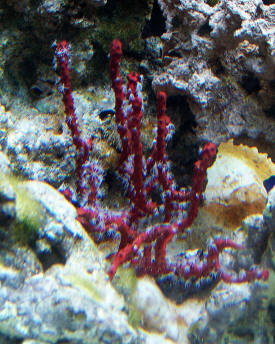
A link for Bob Fenner 10/22/13
Hi Bob!
You told me you weren't very familiar with Leptogorgia virgulata,
So here's a link.
Just a few tidbits of info.
http://www.dnr.sc.gov/marine/sertc/octocoral%20guide/Leptogorgia_virgulata.htm
Pam
<Ah, thank you. B>
|
Gorgonian coral; hlth. concern
8/18/13
Hi bob I bought a gorgonian coral 3 days ago, I know their demands and I
am prepared to look after it.
The coral had some injured areas which are healing nicely. I have
noticed these bubbles forming under the Skin and was enquiring as to
what has caused it. The water param.s are fine no nitrate or anything!
<Mmm, let's hope they're/these bubbles are indicative of healing on the
Octocorals part. Bob Fenner>
|
Sea Rod Identification/Care/Health?
4/24/13
Mmm, can't open .png's... Please resend just two decent files of size as
jpg's, bmp's, tiff's. BobF
Hi Crew,
NateG here. I purchased a sea rod last Saturday and was told that it was
photosynthetic. I have another unidentified photosynthetic sponge in my
tank that has been doing quite well so I figured I would add another for
some more variety in my 60 cube. Picture #1 is during acclimation and is
of the same color when I saw it under the LFS's halides. Pictures 2-4
are
washed out under my blue and white LED's.
From the reading I've done on WWM I'm leaning towards it being Eunicea
mammosa (aka swollen knob candelabrum). I tested the LFS salinity prior
to
acclimation and found it to be 1.033. I gave it a nice long drip while
the
collection cup was sitting within the water of my sump. Dripped to 1.025
then I introduced to my display without it touching the air. Can I mount
this species to a rock out of water or is this a no no?
Pictures 2 and 3 show the general size and shape of it while showing
what
would appear to me as "normal" polyp extension. My concern for this
coral
is that is will periodically retract all/most of its polyps at strange
times of day. I have yet see a trend in this aside from slight
retraction
after the lights come on. Today I noticed for a second time a few of the
polyps swelling (pictures 4,5). Are these the swollen knobs in the
common
name? Is it a good or bad thing?
So if we can I would like to find out what exactly it is, see if it is
behaving this way simply to being a new addition to my system or perhaps
something else. Or if there is anything else I need to provide it with
in
addition to my daily routine: 2-part, trace, iodine.
I just picked up an Aqua Medic Ocean Light 250w HQI pendant. Waiting on
XM
20k and a new glass shield. Right now my photoperiod is on the lengthy
side
because my fixture is a weak. Actinics are 13 hr and daylights are 7.5
hr
with a good amount of natural sunlight. Any recommendations on the
new
photoperiod for the new halide?
Thanks for your time,
-Nate
Re: Sea Rod Identification/Care/Health?
Oops sorry about that Bob. Windows 7 snipping tool defaults to png.
Thanks!
<My guess is the same as yours, Eunicia mammosa... Rarely does well in
captivity. Bob Fenner>
|
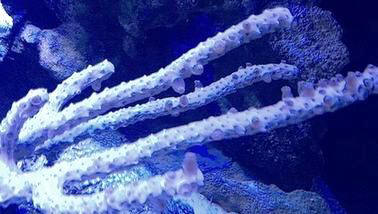
Before and after |
Re: Sea Rod
Identification/Care/Health?
4/24/13
<My guess is the same as yours, Eunicia mammosa... Rarely does well in
captivity. Bob Fenner>
One of those eh? Wonderful. I guess I'll have to keep a close eye on it.
Thx. -Nate
<Welcome. B> |
Purple Sea Blade Issues 9/4/12
Bob,
<Eric>
Happy labor day. Hope you enjoyed the nice long weekend. I
had to rearrange part of my tank two weeks ago do to some overgrowth
with my corals. Ever since then one of my purple sea blades
<Pterogorgia spp.... not easily kept>
have not extended its polyps. At first I thought this may have been
due to a change in the flow pattern due to the new rock work. It
has been two weeks and no changes.
I have done water changes,
<Data re quality please>
replaced carbon, adjusted flow, and tried some coral food.
<Some? What? >
Nothing I have done has it worked. Any other ideas I can try here?
<Search on the Net re this genus care... Do you utilize iodide-ate? You
should administer a booster dose or two (removing the carbon)... Bob
Fenner>
Thanks,
Eric
re: Purple Sea Blade Issues 9/4/12
Bob,
<Mr. H>
All parameters are in check. Listed below. I have had this
coral for 6 years and fragged it 3 times. The other 2 colonies are
looking good. I actually just tested my iodine levels and it was.
03 so i can boost it up to .06.
<Ok>
Do you think potassium has any play here at all?
<Not likely>
Ph. -8.0
Temp - 80.5
Cal - 430
<Mg?>
Alk- 10dkh
<Spg?>
Ammonia, nitrite, and nitrate - 0
<Umm, need some/measurable NO3... and HPO4... B>
Re: Purple Sea Blade Issues 9/4/12
Bob,
Spg is 1.025 and Mg is 1320. Do you think I should possibly try
and move it or give it a few more weeks?
<I wouldn't move this gorgonian... unless it was too close to other
Cnidarians that couldn't be moved more easily, it was necrotic... and IF
touched, I would do so w/ gloves and very tenderly>
Gorgonian/cleaner shrimp question
7/25/12
Hi: Thanks in advance for your help. I have a 38g tank, with
one panel of AI sol super blue leds (suspended approximately 8 inches
above the water line). I have a mated pair of black clown fish, a
BTA, a few zoos a few mushrooms, a Duncan coral, a flower pot (which
hosts the clowns) and a gorgonian (the one with the tiny blue
"flowers"). I also have one cleaner shrimp and a fire shrimp.
My salinity is constant .024/.025,
<A 1 in front of the decimal places>
nitrates at zero
<How is this accomplished? Photosynthates need measurable NO3, HPO4>
and I dose ESV 2-part calcium daily. Water temp ranges from 79-81
degrees. I add one drop of Lugol's a couple of times a week and do
a 10% water change once a week. The brown "branches" of the gorgonian
are losing color and the "flowers" are disappearing. I feel oyster
feast to the corals 2-3 times a week. The base of the coral is still
dark brown and showing new growth. My cleaner shrimp, which is
quite small, basically lives on the gorgonian, and I was wondering if it
is possible it could be causing the problem.
<The brown coloring? Not likely much of a contributor>
It does seem to be active on the coral and perhaps cleaning it or eating
it, but that could be my imagination. The gorgonian was a really
pretty coral (has not been exposed to air, by the way) and I would hate
to lose it. Any advice you can give would be much appreciated.
Best, Lindsey
<The lack of Nitrate is likely an issue... there may well be
allelopathy involved w/ the Anemone, Zoanthids, Shrooms...
Search on WWM re these, read.
Bob Fenner>
Re: Gorgonian/cleaner shrimp question 7/25/12
Thank you. Glad it's not the shrimp. Will re-test
everything. Thanks again.
<Welcome Lindsey. BobF>
Losing Gorgonian Battle (A very common tale) --
12/14/10
Hi all - Chris K here again with a gorgonian question.
<<Hey there Chris -- Eric here today>>
I have a red gorgonian, although the LFS owner could not tell me what
kind
<<This is likely Diodogorgia nodulifera, collected from the
tropical Western Atlantic -- and best left to experienced hobbyists
with systems designed and dedicated to such
azooxanthellate/non-photosynthetic creatures>>
- she did say that as long as I kept it near a powerhead I should have
no problem.
<<This was/is exceedingly poor advice here. These animals do
require strong water flow (though diffuse enough not to blast tissue
from the skeleton'¦as a simple powerhead can do), but there is
much more to providing for the long term health of non-photosynthetic
species such as this. Though maybe not as eye-catching, there are
zooxanthellate/photosynthetic species of Gorgonian that can be kept
with relative ease in my experience (a Pterogorgia species often
described/sold as Purple Ribbon Gorgonian comes to mind), but the
majority of Gorgonians offered require expert knowledge and care, in my
opinion>>
When will I ever learn?
<<You're learning now'¦I hope [grin]>>
To make a long story short (unusual for me) I have had it for months
and it looked fine.
<<This is typical'¦ Assuming water quality is up to par
and predation is not an issue, these organisms generally waste slowly
-- from starvation>>
Within the past few weeks it is obviously having problems. The
"red" is sloughing off leaving a black skeleton underneath
which started from the bottom and is slowly working its way up to the
top.
<<Again, very typical of how these organisms decline>>
It does still have white polyps that protrude from the top. It is kept
in the middle of the aquarium - it came already attached to its own
base rock. It is near a power head so that it gets a nice strong
current
<<A strong oscillating flow is best -- a too strong laminar blast
from a powerhead can prove detrimental>>
and I feed Rod's Food.
<<Insufficient'¦ The vast majority of these organisms
are lost due to slow starvation. They require target feedings of
'each polyp' with suitable foods (e.g. - freshly hatched
Artemia nauplii, live and/or frozen rotifers, phytoplankton, and the
like) to do well, or sufficient bulk feeding of the system to provide
same -- though the latter requires a system designed for such, and a
hobbyist ready to deal with the problems such bulk system feeding can
spawn>>
Can it heal and be saved?
<<Under the right care/conditions'¦>>
What if anything can I do at this point - or is it beyond hope?
<<Depends'¦ Are you ready/willing to- '¦culture
your own foods? '¦set up a drip feeder? '¦provide
multiple weekly target feedings? '¦deal with the effects heavy
feeding will have on your system? '¦invest in more suitable
water flow devices? '¦perhaps redesign your system altogether?
The point I'm trying to make is that these corals require
specialized care and knowledge, and are not for the casual or beginning
hobbyist'¦in 'my' opinion. Your experience here is not
unique, and it's likely you will not be able to save this specimen.
But hopefully the experience will reaffirm the necessity to
research/learn the needs of your purchases, beforehand>>
Thanks as always,
Christine K
<<And as always, happy to share'¦ Eric Russell>>
Re: Losing Gorgonian Battle (A very common tale) -
12/16/10
Hi Eric!
<<Hey Chris!>>
Yes, I am learning.
<<Never a doubt [grin]>>
The first lesson is that no matter how knowledgeable the LFS owner
appears - I need to stop falling for it!
<<Indeed'¦the onus is 'always' on you, to do
your homework>>
What would be a more suitable water flow device?
<<Some of the 'propeller' flow devices available (Tunze
Stream, Vortech, etc.), of a suitable size for your system. The
'controllable' devices will provide the surge/flow oscillation
desired. Though for a system of azooxanthellate creatures a Tunze
Wavebox would provide for some very nice water movement. Be
prepared'¦none of these come cheap! A less expensive
alternative could be to utilize the 'non-controllable'
propeller devices available (for instance, a couple of the
'standard' Koralia propeller pumps) and place two opposing
pumps on timers to switch flow direction every 'few
hours'>>
- is there something that I can buy
<<Yup>>
- or do I have to make it?
<<Not these days, though not all that long ago some hobbyists
were doing just that>>
Would Roti-Feast work until I could begin to cultivate my own food?
<<Maybe'¦can only try and see'¦but simple
'frozen' Rotifers and Baby Brine Shrimp may serve as well. Just
be sure that 'each polyp' receives/accepts food>>
How do you set up a "drip feeder" for a gorgonian?
<<A container to hold the 'food''¦ Some airline
tubing and a device to control flow'¦ Some way to
'mix' the contents of the container to keep it in suspension
(those low-rpm motors used on some Kalkwasser stirrers do a dandy job
of this)'¦ A search of the WEB will no doubt turn up
plans/other methods re. But for a single specimen as you have, target
feeding is a much simpler way to go>>
I understand that it is most likely too late to save my current
specimen, but as long as there are white polyps protruding from it, I
am sure going to try...I would appreciate any help you could give me or
anyplace that you could direct me....
As always,
Chris K
<<Try also a Google search of the Net for 'azooxanthellate
aquarium systems.' Good luck! EricR>>
Yellow Sea Rod Help, mortuus est
1/18/10
I'm having a host of Yellow Sea Rod troubles.
<... Diodogorgia species are very hard to keep in
captivity...>
About four days ago I purchased a Yellow Sea Rod from my local fish
store. It's got three main sections, and the whole thing is about
6"x5". I'd been watching it for about a month, and
I've seen it have its white polyps out before, but it didn't
have them out when I bought it, and it hasn't extended them since
I've had it.
<A bad sign>
My tank is slightly crowded, but I'm diligent with water changes
and monitoring feedings, and my water quality has been great to my
knowledge, pH - 8.3, ammonia, nitrite, and nitrate all undetectable,
with pineapple sponges and coralline algae growing all over the rocks,
which I've heard is a good indicator of calcium/magnesium levels
but I don't have a way to test those at this time.
<This bioassay as you state is indicative>
I've got halide and actinic lights,
<... not photosynthetic species>
and the Sea Rod is placed away from other corals, where it's away
from the direct actinic light and it has flow from the return on my
filter.
<Good. Do require good water movement>
I thought it might take a day or two to adjust, but everything else in
my tank is thriving. I've been target feeding it zooplankton
nightly, but since none of the polyps are out, I worry it's not
eating.
<It is not>
Yesterday I woke up to find it with some cyanobacteria along its
base,
<Very bad>
and I've noticed that in some of the tanks at the store before. So
I followed the directions of the ChemiClean Red Slime Remover,
<...>
and used a soft brush to scrape it clean. Today I noticed about four of
the tips decaying so I clipped them off (about 1/4"), and then I
noticed some decay along the center section base where the
cyanobacteria had been. I don't know if I should try to patch this
with a sealant, try to clip off the branches and hope they survive as
propagated fans, or just let the poor thing go. I feel like I've
done nothing but pester it since it's been here. Any advice you
have would be great.
Thank you in advance,
Lauren
<I do wish I had more or even just "something" encouraging
to relate to you. This specimen is likely gone. As gorgonians don't
have "much" organic content, it will likely do little harm to
leave it in your system; but the prognosis... is dire indeed. Bob
Fenner>
Re: Yellow Sea Rod Help
Thanks, Bob. Would you try to propagate part of the undamaged
branches?
Lauren
<Mmm... am torn twixt wanting to urge you to reasonable action, and
the almost certain knowledge that this specimen is doomed. Lauren, I am
a person of considerable intuition (put one way); and sense your deep,
earnest desire to "do what you can" here... and in general
(likely more than just in the ornamental aquatics interest). I am sorry
to state that the likelihood of success with this small specimen is
abysmally small. It will not do any more harm to cut away the "bad
pieces". BobF>
Re: Yellow Sea Rod Help
Haha- busted. Thank you, Bob.
<Welcome Lauren. B>
Gorgonian Question/Gorgonian/Health
9/18/09
Hello,
<Hi Jeff>
I have a green lace/yellow blade gorgonian (Pterogorgia citrine??)
<citrina>
that has been doing great for about 1.5 years. It has gotten 5 times as
full at least and was always fully opened and would eat a ton of small
food such as daphnia, rotifers, prawn eggs, etc. 1.5 months ago I
noticed it was no longer opening and then one of the branched started
losing flesh. My PC lights were overdue for a change so I replaced them
right away. Well after I did that the two spots that were loosing
flesh, maybe .5 inches total length, grew back in less then 3 days. I
was amazed at this pace. The flesh is fine now but it will still not
open. I have seen some polyps here and there poke out but not fully
open and not for a very long time. I have brushed it off a couple times
to keep the algae from building up on it since it is not opening. I
have a small 3 inch gorgonian frag next to this one and it is doing
fine. I was wondering on
you thoughts on the polyps not opening for so long now. At first I
thought it may need to acclimate to the light. I would think the flesh
would keep rotting if it was not healthy instead of growing right
back.
I thought the polyps are what absorbed the light for photosynthesis is
this correct?
<Some gorgonians contain algae, or zooxanthellae. This symbiotic
relationship assists in giving the gorgonian nutrition via
photosynthesis.
Gorgonians possessing zooxanthellae usually have brownish polyps. Those
without zooxanthellae usually have more brightly colored polyps.
Lacking this additional nutrition, they are more dependent on the
nutrition they derive from filter feeding. Your gorgonian is dependent
on both photosynthesis and filter feeding. Most gorgonians are
colonial, thereby sharing the photosynthesis by-product/food.>
Have you heard of healthy gorgs going this long with out opening? Any
suggestions or thoughts are appreciated.
<Is possible considering it is new growth. Gorgonians do appreciate
at least a moderate current in the tank, otherwise they can have a
tendency to "wax over".
Supplementing strontium and iodine is also beneficial to their health.
I would continue to observe, and keep algae growth off the
branches as you have
been doing.>
Tank 72 gal bow with 20g long sump containing 5 gallon refugium
Ammonia 0
Ph 8.3
Specific gravity 1.025
<No calcium level? Is needed here along with magnesium.>
Thanks for the help
<You're welcome. James (Salty Dog)>
Jeff
Gorgonian discoloration question... leaping
before looking, no reading 4/4/09
Hello Crew,
<Andrea>
I have been reading your very helpful advice for a while, but this is
the first time that I actually can't find an answer so I decided to
ask myself.
I bought some really pretty stick-like corals at the LFS today, and I
was told they are gorgonians, not exactly what type though.
<... Ummm, you need to find out, know... so you can hope to provide
whatever species these are with adequate/appropriate care... there are
some "more" hardy species (strongly photosynthetic), all the
way to a more "normal" spectrum of mixed photo- and
planktivorous ones that rarely do well in captivity>
One is yellow and the other one was a bright red-orange.
<Mmmm, a bunch of the common "warm color" (reds, yellow,
oranges...) ones are amongst the poor survivors>
Like I always do with any new addition, I did a quick FW dip with
distilled water.
<?! NOT a good idea>
I adjusted the temperature to match my tank and checked to make sure
the PH was as close as possible. I did not add anything else to the
water. I dipped the yellow one first, and left it in for about 3
minutes and then transferred into my tank. Then I went ahead and did
the same with the red one, but this time after about a minute and a
half the water started turning red, and I realized that the color was
literally coming off of it!
<... more than this>
After I took 10 seconds to process what was going on?(I really
wasn't expecting anything like that) and debating if to put it into
the tank or if the red coloring would also spread in it I rushed it
in.
<And possibly poison all>
The red coloration did not show up in my tank, much to my relief, the
saltwater seemed to immediately stop it.?However, the whole piece had
turned white! Except for a small section that was not completely
submerged in the FW while I did the dip. So first of all I'm
wondering what happened to it?
<It was being killed, dying>
Did I do something wrong, or should a FW dip not be used with this type
of coral?
<... first... Gorgonians are NOT actually corals...>
The yellow one looks just fine though... And also, will it recover or
is it dead? Could it harm anything in my tank?
<Who knows and yes>
Thank you!
-Andrea
<Read here: http://wetwebmedia.com/seafans.htm
and ALL the linked files above. Bob Fenner>
Will Octocorals Repopulate Exposed Skeleton?
(Damaged Gorgonian) -- 09/26/08 Hey Crew! <<Hey
Darby!>> About 2 weeks ago I purchased a Purple Plume Gorgonian
online. <<Hmm'¦probably Muriceopsis flavida I'm
thinking>> It had a bit of a rough trip, being delayed in
shipping, but has bounced back better than I expected. <<Mmm,
yes'¦these animals are not so 'delicate' as maybe
thought by many>> One problem though is that about 1-1/2" of
the skeleton is exposed in the center of the plume, as well as the
branches coming off of that area, the rind having come off there within
a week of arrival. <<And common to damaged specimens>> The
rest of 12" specimen seems fine, full polyp extension and no signs
of further degradation. <<Excellent>> One of the branches
with exposed skeleton has about 1/4" of rind left at the tip,
where the polyps act as though it's business as usual.
<<Indeed'¦but colonization of the exposed skeleton by
alga is a concern>> Will the skeleton be reclaimed eventually?
<<I've not seen this happen with captive specimens>>
Should I go ahead and snip it at that point to create 2 colonies?
(Wouldn't mind having more in the biotope!) <<I love to here
hobbyists use that word (biotope)'¦and I would,
yes'¦best to reduce the exposed skeleton. I would also snip
off any branches tips with exposed skeleton. These too can be
propagated. I once had a Purple Ribbon Gorgonian (Pterogorgia sp.) that
I fragged regularly by snipping off an inch or so of the branch
tips>> If so, should I snip off the bits of un-colonized
skeleton? <<Leave enough to anchor the new colony/frags with a
bit of Super Glue or epoxy putty in a hole in a piece of live rock/rock
rubble>> Thanks, Darby E. <<Happy to share.
EricR>>
Re: Will Octocorals Repopulate Exposed Skeleton?
(Damaged Gorgonian) -- 09/26/08 Thanks for the response Eric!
<<Quite welcome Darby>> Guess I'll be doing a bit
o' fragging this weekend, probably donate some to the DFWMAS coral
co-op. <<An excellent idea!>> This'll be my first
attempt at multiplying gorgonians, so hopefully I can do it right!
<<Is quite simple/straight forward'¦you will do
fine>> Follow up question: After snipping at the start of the
damaged area, I'll have a 5" specimen (the top) and a 6"
specimen (the bottom, which is glued to the reef). Will the top of the
attached specimen heal and continue to grow upwards, or will it just
"bush out"? <<In my experience, with a healthy
environment the tips will heal over and continue to
grow'¦though the cutting may also induce side branches to
'sprout out'>> Thanks again, Darby E. <<Cheers,
EricR>>
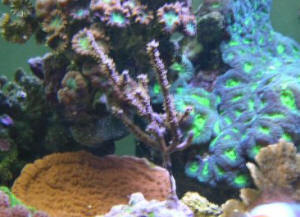
| Help with my gorgonian
11/19/06 <Hi Cathy, Michelle
here.> I wonder if I could impose. I have
a wonderful gorgonian that has been growing well for over a
year. It was quite tiny and set out many
branches. Two weeks ago I noticed a crack on the
base. It has gotten wider and wider. Is there
something I should be doing? I am not sure if it is
related but I have a fairly new a small pulsing xenia and it seems
a bit stumped with white lines across. It does not seem
to be flourishing but all the other corals seem to be doing very
well. thanks for any info you can offer.
<As far as the gorgonian is
concerned, you may want to consider a little minor
surgery. I would recommend cutting off the health part
and reattaching to some live rock with a little cyanoacrylate
(super glue) Remove the gorgonian from the
tank. You may want to allow it to dry for several
minutes. Use a sharp pair of scissors to make a clean
cut through the flesh and woody stem in an area where the skin is
still intact. Place some super glue on the fresh cut and
place it into a hole in the live rock. It will be far
easier for the gorgonian to heal from a clean cut than to try to
mend a tattered edge.
Xenia can be a coral weed for some
people, while others struggle to try to maintain a
stalk. Sometimes xenia takes a good bit of time to
acclimate, also. By the way the other corals in your
tank are quite beautiful.> |
|
|
| Re: help with my gorgonian
11/20/06 Thanks so much for the
advice. <You are very welcome.> I did
perform the surgery and now have three small
gorgonians. <Congratulations on your new
frags. Now you have something to share with your
"salty" friends> I left the affected stalk in hoping
that the problem would not spread but possibly grow
back. <It may,...it may not,> Also, I wonder if
you have any suggestions. I use Kalkwasser drip each
night about an hour after lights go out. I add about a
1/-gal as regularly as I can. Is there a better way of
maintaining calcium. <It's as good a way as any
and it's economical and simple to use.> I don't seem to
be able to keep the calcium level up or the pH high enough for the
xenia. <Xenia don't require a high calcium
levels> I do have a refugium sump and keep the lights on about
18hrs a night and part of day to maintain pH. <OK, 12/12 photo
period is common and some choose to light the sump
continuously.> thanks again for the
advice. <Welcome> I can't tell you how often
your site has saved my beautiful reef. <Glad to hear,
Mich> thanks again Cathy |
Yellow Finger Gorgonian and Cyanobacteria - 05/01/06 Hi
again, from Mobile, Alabama. <<Hello...from Columbia, South
Carolina>> I am writing in regards to my yellow finger gorgonian.
<<Mmm, Diodogorgia nodulifera, a difficult specimen to
keep>> I have had a lot of problems with Cyano lately and he
seems to be covered in it. <<They are susceptible to this,
yes. Increased water flow in the direction of the gorgonian
may help (being careful not to blast the tissue away!). A
brief (1-minute) temperature and pH adjusted freshwater dip may also be
of benefit>> I wipe him off with a soft-bristled tooth brush once
a week. Well maybe this was a bad idea because one of the
branches fell off. <<A bit too "rough" with the brush
maybe>> On the actual Gorgonian it still looks good, you can see
the skeleton but it is being covered back with the skin.
<<Surprising...a good thing...but surprising. You must
be managing to provide a useful diet>> For the little branch that
fell off... It still has polyps that come out pretty often and looks
pretty healthy. Is there anyway for me to just attach him to
a rock and let him go? <<Certainly...scrape the tissue from the
end of the branch you wish to attach for about a quarter-inch up the
branch, and use a gel cyanoacrylate (super glue) to attach the branch
to a small piece of rock>> Or is there something else I should do
with him? <<Mmm, nope>> Thanks, Dana <<Welcome,
EricR>>
Yellow Gorgonian Save 10/18/05 (Sorry for the
three-step email, I don't know which one is the main account to
send information too since I had all three.) <Is posted, but no
worries> Hello team, since I absolutely LOVE reading your site, I
thought I might share some helpful information on the only way I was
able to save my yellow gorgonian. <Thank you for this> I had to
propagate it and ended up losing the base. BUT I have many little
propagations that are doing very well. I am not sure what has caused
the smaller ones to do so much better. I have a 29 gal reef tank, and
perhaps my tank was not large enough to sustain such a large specimen
(it stood perhaps 7 inches tall) - it had started to develop
deterioration on it that I also found information on Wet Web Media
about. Basically, I knew it was dying. I tried what was suggested
(at that time) on the post, which was nip off the degenerate areas.
Well here was my dilemma, when it first started happening, it was all
the main "forks" that were showing signs of this crumbling
deterioration (the rubbery outer yellow shell was just flaking off), so
I would snip off the whole branch - even though the tips would seem
very healthy and showing signs of the polyps extending. I did this on
just three of the 6 branches to test it out. No luck, it got
worse. SO I did the opposite, I clipped off the healthy tips from the
main branch (kept the main branch in the tank to make sure I didn't
do a major boo-boo and if it were still alive it would have a chance to
survive. Well now the tips have even over-grown the clipped end (a
round little hotdog looking thing) and I have placed them in various
places in the live rock and they are doing fantastic. I don't know
what I did or why it worked, but I wanted to share so anyone else
having this problem may have a chance to save a specimen. Thanks
for all the help you give Wet Web Media team! Us aquarists appreciate
it! Christine, Ocala FL <Thank you for your kind words and sharing
your experience. Bob Fenner>
Interzoo Odessa - water quality params 7/31/04
Dear Anthony Calfo! This message repeats that was sent in 19 of July,
and, perhaps was missed. <my apologues... it does seem so. I was out
of town that weekend too for a rip/lecture in KY state> We were glad
to read your answer. Let us represent ourselves. We work in aquarium
husbandry in Odessa, Ukraine, and our staff includes experienced
hydrobiologists. Not all literature in English is available here, and
e-mail ordering is too unsure. <sorry to hear of the limited
mail-order access> So, an on-line ID key would be preferable. Could
you recommend us any web-site? <yes... http://www.coralrealm.com/ may be a
good start> By the way, the livestock is supplied by international
wholesalers and is licensed. Nevertheless, frequently it comes without
exact identification. <this is sadly the standard> Our
preliminary ID of at least one gorgonian species was wrong. It is
Calycigorgia sp. instead of Eunicea succinea, the other species
(Muriceopsis flavida (?)) still on question. Nevertheless, we had
success with both them, including their active growth in our aquarium.
<growth spurts are not uncommon with these animals... but they still
suffer from attrition in less than a year or two for most aquarists.
Very rare to get azooxanthellate species to survive one year in aquaria
let alone two> The other deal, is our client. We have described his
livestock. Sorry for misunderstanding, but we meant the species'
compatibility, not their specific needs, assuming that they are
satisfied completely. As we understand, the whole population seems you
normal and not troublesome. In any case, thank you for your help! Let
us ask you some additional question: - What are the basic hydrochemical
requirements of gorgonians, in particular, regarding Ca, Sr, Mg, I?
<there is variation on reefs around the world as to what is
"natural" levels for such parameters... but most tropical
reef cnidarians will tolerate a standardized water quality. Calcium can
be supplemented to a range of 350-435 ppm (avoid excess/higher
levels)... and Mg should be about tripe whatever your Calcium is
(around 1000-1200 ppm is fine). Iodine and Strontium can be replaced
perhaps with regular weekly water exchanges (20% or more of tank
water)> - Could a melting of a given gorgonian cause shrinking of
the branches' tips & prolonged closing of the polyps?
<yes... and it can be contagious to other healthy corals in the
system> - On separate locations of some Calycigorgia branches the
brown film is appeared, and the branches in those places became
thinner. Is it just melting or some abnormal process (infection)?
<it sounds like the aquarium does not have adequate water flow (20X
turnover or more is needed) and some diatom algae has grown onto the
branches and is smothering them> - What's your opinion about the
following parameters: [PO4---], [NO3-], [NH4+] - all them - 0 ppm;
<a small amount of nitrates is needed to feed most cnidarians...
5-10 ppm is fine> [Ca++] = 400 - 420 ppm; <very good> pH = 8,1
- 8,2, <too low... especially if this is a daytime reading (it gets
lower at night). Target 8.4-8.6 for stability> KH = 9o, S. G.
=1,023, t = 82o F <very good> P. s. sorry for our English. Best
regards, Interzoo,
Odessa.
<no worries at all... your English is quite good :) I wish you the
very best of luck, my friend. Anthony>
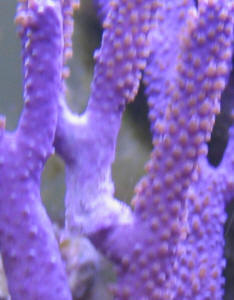
| Gorgonian and mushroom problem 8/10/04 Hi
all, I am having a problem with the gorgonian. Over a
short time, like maybe a couple days, I have noticed some decay of
on of the branches and it seems to be spreading. It started with
sloughing of the skin and then progressed. Images of this
progression are attached for you to see. I don't know what
caused it or how to stop it from spreading except to cut off the
infected branch. We are also thinking of doing a water change.
<I would suggest cutting off the affected branch and discarding
it. Water changes never hurt.> I have seen the emerald green
crab on its branches at night and wonder if it's snacked on
one. Please advise. <Very unlikely. I
suspect the crab was just exploring. There are much more
accessible and tasty things to eat in your tank.> The tank specs
are 45gal, 50lbs LR, aragonite fine grained sand, salinity 1.024,
pH 8.2, ammonia 0, nitrate/nitrite 0, ca 400ppm, 82F. Bioload is
mostly corals: gorgonian, green star polyp, cutting of brown star
polyp, anthelia-type coral Adam says is really Clavularia with
mushroom anemone, candy cane, zoanthid cluster, mushroom cluster,
single mushroom, and a small coral the LFS said was the poisonous
p. toxica. The only fish is a green spotted false mandarin (s.
picturatus) and looking into setting up a pod refugium for him as
well. A peppermint shrimp (feed him shrimp pellets occasionally as
concerned he might be eating the mandarin's pods, although I
saw him catch and eat a big amphipod in broad daylight!) An emerald
crab and a dark purple crab that stowed away in the LR. So not that
much, just 8 corals, 1 fish, 2 crabs, 1 shrimp, and a bunch of
Turbos. <I am not a fan of crabs in general, but I would look
toward the purple one with particular suspicion.> Regarding the
mushroom, it's foot seems to be stretched from the left. I
thought they divide down the center to reproduce, but could this
also be some form of reproduction or just trying to get a better
grip? Thanks for your advise, Daphne <The mushroom
could be stretching out to bud off a daughter, could be creeping
along the rock, etc, but it looks fine. Do keep an eye
out for daughters to sprout up! Best
Regards. AdamC> |
 |
|
Orange Tree Gorgonian vs. Algae 1/5/05 Hi,
purchased a Orange Tree Gorgonian for a 12g. NanoCube set-up almost two
weeks ago. <Sorry to hear that. These animals have
terrible survival records in captivity.> I went out of town for a
week for the holidays and upon return found my glass, rocks, substrate,
and the gorgonian (not as much) covered in what I think is
Cyanobacteria (slime to 'hairy' appearance and a dark red to
brown color). I did a 40% water change and removed some of
the slime covered substrate and replaced with some live aragonite sand
and cleaned the sides of the tank. I might mention I believe
the bacteria/algae outbreak was due to overfeeding the system before I
left. <Overfeeding certainly can contribute to algae or
Cyano blooms. Maintaining pH and Alkalinity on the high end
will help prevent/combat these issues.> Anywho, the gorgonian I was
wary to interfere with too much. After reading some of your
articles/forums I decided to take a chance to brush away some of the
algae/bacteria with one of my watercolor brushes and it worked to a
degree. Also, the tips of three of the six branches are
wearing thin, as in skeleton is all that remains. I feed it
once every-other day with Marine Live Phytoplankton and roughly 60% of
the polyps come out regularly, even those near the decaying tips.
<Unfortunately, phytoplankton is probably not a suitable food for
this animal (too small). Tiny zooplankton is probably more
appropriate. Some of these animals can be very specific in
what they will capture. Sometime Artemia nauplii will be
captured, but you must observe that they are captured AND ingested.>
I moved the gorgonian to be more in path with the one powerhead outlet
in the tank so as all the branches are getting water flow. <These
animals do appreciate a lot of flow, but those that grow in a flat
"fan" are generally used to gentle sweeping and waving
currents, not the blast of a powerhead. Reproducing this
kind of water movement is difficult even in very large aquaria with
surge devices.> I read that it is sometimes wise to amputate the
gorgonian to prevent any further decay. Any thoughts or
ideas as to the prevent further decay. <I would snip off
any branch tips that are fouled with algae. This may slow
the loss of tissue.> One last thing, I know that these corals are
not the easiest, but I've had one tank going for more than a year
now with no deaths so I thought this NanoCube would be easy, are the
Tree Gorgonians relatively successful in home aquariums or
do most fail? Thank you very much for your help in advance.
-David H. <Photosynthetic gorgonians (usually gray and/or brown) are
very hardy and generally do well in aquaria. Most of the
colorful ones are not photosynthetic and do very
poorly. Their strict requirements for food and water
movement are very difficult to reproduce in captivity. Sorry
to be so negative, but non-photosynthetic gorgonians almost never
survive. Best Regards. AdamC.>
Re: Orange Tree Gorgonian vs. Algae (?) Do you believe it
would be best for me to immediately remove the Gorgonian from the
nanocube, or should I give it time and possible a chance to rejuvenate?
<AdamC is out, so I'm responding in his stead. I would move this
Gorgonian only if you have better circumstances for it elsewhere...
larger, more stable, with more plankton... otherwise it is likely
doomed... Do pay close attention to water quality...> I hate to just
throw away $30 like this but I suppose it is my fault for not looking
further into it. <Yes, if you're asking> I do
have a xenia that was given to me as a Christmas present, I was told it
was a Pulsing Xenia, but I am not so sure it is. Please view
the attached picture. <Umm, please read here: http://www.wetwebmedia.com/xeniidarts.htm and the
Related FAQs (linked, in blue, at top)... Xeniids pulse or not...
depending...> Also, can you recommend any corals that would do well
in a 12 gal. Nanocube? I was considering Colony polyps and
maybe Green Grape Caulerpa or some other macroalgae. Any
suggestions welcome. Thanks again! <... Please read here: http://www.wetwebmedia.com/smmarsysstkgfaqs.htm
and on to... the areas on WWM re coral selection... Bob Fenner>
Re: Orange Tree Gorgonian vs. Algae(?) Ok sorry, one last
question, I hate to abuse all of your time. <No worries.
Not possible> Thanks for helping me get things on the right
track. In regards to the Gorgonia, I do have a 44 gal. Pent.
tank which has been established for one year now. There is
'low' lighting conditions in this tank, it only runs with
two 18", 15watt bulbs (50% 6000K & 50% Actinic 03
Blue). Right now the tank is running with a Penguin
powerhead that pushes 145gph, and I've got roughly 30-40lbs of LR
with some good spots of Coralline going. Would it be better
to move the Gorgonian to this tank? <Yes... on two basic important
counts... one, that it may help it to recover (move underwater, not in
the air... in a bag...), and that if it does continue to slide, die, it
will have vastly more water to do so in> Also, on a completely
different note, I'm considering bolstering my lighting system on my
44gal corner pentagon. The hood that came with the tank is
pretty crummy and only has room for two light fixtures with
18'' bulbs. I was considering buying a glass canopy
for this tank so I could have more flexibility in lighting and not have
it so that it only fits two rectangles 3.75''W x
18.5''L. If I were to get this glass hood, and put a
new PC lighting system on top would I leave space between the glass
hood and the lights, or just press the light system flush with the hood
and leave no space between? <The latter is much better. Bob
Fenner> Thank you very, very much for all your help on these
matters. Sincerely, David H.
Gorgonians-bacterial infection? What can be done for a
bacterial infection on a gorgonian? Calcium level is at 495. All other
test except phosphates (1.2) are at parameters that they should be.
Corals are being fed invert food. I have a 75 gallon tank, Emperor 400
and two 300 gph powerheads. Do you think this is enough current for the
gorgonian? All other corals and sponges are doing fine. >> A few
things... some have responded favorably to the administration of
antimicrobials (mainly broad spectrum gram-negative antibiotics) either
administered to their water, or soaked into their foods before adding
to their tank. Sometimes a lowering of temperature seems to help... if
the condition is spreading, some authors (myself included) advocate
cutting off the distal, mal-affected area to save the rest of the
animal... Bob Fenner
Gorgonian appears to be dying back.. Mr. Fenner, I have a
quick question regarding my Yellow finger gorgonian (Diodogorgia
Nodulifera). I purchased it approx. 1 week ago and at the store it
had been in the display tank for many months, the owner had
become frustrated because it wasn't growing or doing much of
anything other than a couple of white polyps here and there. I
did some research and found out the they like a brisk current and
are relatively easy to care for. Although I did find out that
most people have had trouble with them. I purchased the 7"
tall by 8" wide gorgonian for $20.00 and it appeared to be in good
health at the time. I brought it home with some other corals
which I'd purchased and began acclimating them all. I took
care not to expose it to air and to acclimate it to the salinity
and temp. I placed it in the middle of the tank on the substrate
gently wedged the base between two small rocks so that it
wouldn't fall over. There is a powerhead that discharges
against the glass directly above the gorgonian and provides a
gentle and constant flow. After about a day the white polyps
began to come out of the red dots in great numbers. This is
something that I had never seen at the LFS. Over the course of a
couple days the thing really started to take off with polyps on
most of the branches. During day and night the polyps were out
and looking healthy. After about 4 days I started to notice that
some segments of the branches where polyps had not been, were
thinning and others were turning a dark red. As of today, the
fingers which are appear healthy have the polyps out, but about
20% of the branches are brown, thinning at the tips and have no
polyps. I've noticed at night that the hermit crabs and
amphipods have been climbing on the branches in fairly large
numbers ( hermits usually 3 to 4, and amphipods usually 6 to 10
at any given time). I'm concerned that this is spreading and
will eventually kill the entire thing. Should I cut/break off the
darkened branches? is this normal, maybe some sort of molting?
could it have been exposed to air at some point? Thanks for your
help in advance. John Boiger >> Could well be a few things going
on here... Sounds like you did the due diligence investigation, and
can't fault your process... but the "critters" in your
system may be eating the sea fan... and/or it may be starving (a
zooplanktivore if memory serves)... or, or, or... inadequate
circulation, aeration... I would move it to a different system if you
had one. Bob Fenner
Gorgonian problem help!!!! Hi Bob! I Hope you can help. I
have a orange gorgonian I purchased from the Flying Fish. I'm not
sure of its name, but it has white polyps and about seven inches high
and across. It was doing great at first. I have it in a good water flow
area kinda high in the aquarium. I have a 29 gallon tank with power
compacts. The gorgonian hasn't shown its polyps in a month and is
starting to shed its outer skin exposing its skeleton. I moved it all
over the aquarium thinking it was light . Nothing seems to help. I do
regular water changes Ph 8.2 Alkalinity is at 2.5 and I fed it brine
shrimp. I'm afraid it deteriorating will harm my other corals and
few gobies? Any suggestions? Liz XXXX@yahoo.com <Hmm, actually...
this is not likely a photosynthetic species... likely a Diodogorgia
species... and you should try other foodstuffs... Most importantly
one/some of the "phytoplankton" prep.s sold for the purpose
(like DT's...), administered to your system water... during
different times of day... with the pumps turned off to the filters (not
the non-filter pumps though) for a good fifteen minutes... And yes, sea
fans, gorgonians can prove toxic to all other life if/when they
"fall apart"... you may want to remove this specimen (in a
bag with water in it, w/o lifting it into the air)... to another
system, isolated... Sometimes the "bad parts" of the
"rind" of these animals/colonies can be excised to save the
remainder... Please read over the "Gorgonian" section posted
on our website: www.WetWebMedia.com and associated FAQs files as
well... and do endeavor to get the name, know the basic husbandry of
the animals you utilize ahead of their acquisition going forward. Bob
Fenner>
Pseudopterygorgia Gorgonian Hello Again Bob, Sorry for the
long letter that follows...I know you must be busy. <Not so much...
on dive/adventure/photo odyssey in Asia... in Senggigi, Lombok,
Indonesia now...> In the past I have had a red slime problem that
has since been stopped (thanks to suggestions from you and your website
FAQs!!!) by turning down the CO2 to my calcium reactor and installing a
larger pump feeding my protein skimmer. However, I think that the red
slime injured my photosynthetic gorg. It started when the red slime
started to grow on the gorg. Then more and more the gorg's outer
purple skin died away exposing the black under-structure (not sure what
you call it....skeleton ????). <Yes, and not unusual to have this
damage by way of Cyanobacteria problems> The gorg still has patches
of purple with white-brown polyps but there is much more black than
purple. I would like to save the gorg and was thinking of cutting the
"black skeleton" parts of the gorg that are void of purple
skin/white-brown polyps thus making a few frags to try and propagate
them. Is this a wise thing to do....or will the purple skin and polyps
eventually grow back over the black under-layer ? <Both are valid
possibilities... any evidence of regrowth? If not or things getting
worse, I would consider the surgery> Alternatively I was going to
try not cutting the gorg and start direct feeding and Vitamin C
application. Is this a better alternative ? <See/read above>
Also, do you think that this gorg's demise was due to red-slime
problem or more likely black-band disease and/or bacterial?
<Secondarily bacterial> Incidentally, the ich problem I had seems
to be subsiding...after adding beaucoup cleaner shrimp as you
suggested. Two nights ago my yellow tank had some white spots on his
fins and the next morning ...viola they were gone !!! Same thing
happened to my flame angel... these guys (cleaner shrimp) should be
called the "medics of the sea"!!!! They are great...and I
found that the Grabhami species is much less shy than the amboinensis
species (sorry about the spelling). Thanks for your help on this and
the red slime problem. <Glad to be of service/help... sorry this
message is late> I also have set up a 10 gallon quarantine tank with
a small 8W UV sterilizer and a colonized sponge from my sump. I keep it
running continuously.. seems easier than
tear-down/set-up/tear-down...... I think that the UV sterilizer is a
good idea to maintain a sterile hospital tank...is there a problem with
UV sterilizers in combination with copper therapy for ich ?
<Possibly... some chelated formulations are taken out via UV... read
the manufacturer's label> A friend at a local fish store told me
that UV would only be a problem with antibiotic medicines....do you
concur ? <Hmm, not with antibiotics as far as I'm aware...>
Thanks Again ! <Be chatting, Bob Fenner> Chuck Spyropulos PS: I
will be going diving in Bonaire next month...any tips on good diving
sites ? <A great part of the Caribbean... study up on the Internet
re>
Purple Gorgonia Dear. Mr. What you say about buy a purple
gorgonian Saturday night and Monday morning this animal totally
disintegrate your skin? When the bag is open in retailer we smell a
strong odor (yes, I buy in the arrival day). Is the gorgonian dead on
arrival? <Likely so> I have my aquarium with soft and hard corals
and I have some invertebrates for 5 years. Thanks, Nelson <Hopefully
you didn't pour any of the water from this shipment into your
system... a good idea to quarantine even sea fans. Bob Fenner>
Gorgonian question I have a red finger gorgonian (supposedly
a Gorgonia sp) that came with slight damage on one of its branches. Now
however, the damage is spreading and is now on other limbs (the skin
seems to be coming off). Also, the gorgonian is getting overgrown by a
filamentous green algae that I cannot remove without fear of damaging
the gorgonian. The Baensch atlas mentions an algal overgrowth but does
not mention what problems may be associated with such an event. What
could be causing this? <Previous damage, infection... coupled
possibly with less than optimal water quality, a lack of nutrition in
your system... possibly competition, predation, chemical
incompatibility with other animals... > Does touching by hands cause
this? How can I remedy the problem and save the gorgonian? <Some
drastic measure may have to be taken (cutting away the "lost"
part... moving the colony to low light conditions (like a sump)...
these species are not photosynthetic...> In my last e-mail, I
mentioned a Daisy Polyp and a finger leather coral. They are both doing
good now. The coral is completely expanded (I think the closed area
might have been new growth). With the daisy polyps (or Xenia, I
can¹t tell, more on that later), I found what looked like
small Nudibranchs. I pulled these off and the polyps have seemed to
improve. <... perhaps a predator...> I need help identifying an
invertebrate. It looks like the picture of Daisy polyps that is in your
book; however, I can¹t find anything that mentions Daisy
polyps propagating by runners (which my polyps are doing). Do they do
this? <Yes> As I was looking through the Baensch Aquarium Atlas I
noticed that Xenia umbellata also looks similar, but Xenias pulsate and
mine does not seem to do this. Any ideas about what this may be?
<All sorts... but your description isn't specific enough to help
me... Do take a look through Fossa and Nilsen's v.2 of The Modern
Coral Reef Aquarium for now... Bob Fenner> Thank you, Kevin
Cossel
Purple Gorgonian necrotic patches Good morning everyone,
Cheers from Anthony> I purchased a purple gorgonian (I believe
it's Pseudopterygorgia bipinnata based on pix but I'm
never 100% sure) from an online fish store. After I floated the bag I
tried to open it to acclimate it by adding water from the tank. Being a
sped, I cut the bag wrong and the whole thing busted open. It never
acclimated properly (the note I got from the store said they keep their
salinity at 1.017 and I keep mine at 1.023 (seahorse tank).
<wow... not a real big deal, but 1.017 is a fish only salinity...
inverts fare much better at a more natural SG (1.024-1.026). And you
are correct about the seahorses favoring more saline waters. As high as
1.028! 1.023 would be the low end for me with most species> So......
for the past three weeks the center part has been in decline. The top
four inches and the bottom three inches are beautiful - purple with
polyps extended. However, the center part is starting to show the
spine <most likely stress from import, but possibly inadequate
current in your display. Be sure to provide very string water flow for
gorgonians> (it looks like a little wire coming from the
stem). <yes... it is called gorgonian> I've been adding
phytoplankton every other day to help it out but I don't think
those center parts will grow back. <actually they may, but not
very quickly> Can I cut the top part and glue it on some rock and
then cut the center part out in the hopes that the bottom will just
grow better? <absolutely... and be sure to cut a full 1/2 or
more into good tissue (away from the necrotic area). Also, if you
glue... use thick super glue and not epoxy... gorgonians respond poorly
to epoxy!> Is scissors appropriate or a straight edged
razorblade? <either, although scissors may be best to cut
through the woody stem> Should I leave everything alone? BTW,
it's a 35 g hex with 56w PC. Thanks in advance for your help and
thanks for answering everyone else's questions... they're
really helpful! Ted <hmmm... if you really get into this coral
propagation thing, I know of a good book <wink>:
http://www.WetWebMedia.com/bkcorlproprev.htm Best regards, Anthony
Calfo>
Encrusting gorgonian "problem" 3/10/03 I purchased
what my LFS calls an encrusting gorgonian 5 days ago. <Briareum is
now the genus that encompasses both Pacific Starpolyp and one of the
two common Atlantic "gorgonians" (the other is
Erythropodium)> It very closely resembles star polyps. Problem is,
it's retracted it's polyps and it's base has turned from
light pink to an off-white color. I can see bumps all over the base, as
if it is trying to extends it's polyps. The rest of the tank is in
hale condition. Water params are very good. How long can I expect it to
remain dormant? <without knowing anything about your water quality
and other physical parameters (light, weekly carbon use, none at all,
water clarity, etc) I can only speculate. The most common cause of poor
polyps extension here is lack of dynamic water flow. These corals need
very strong water movement, but it must not be laminar (no power head
blasting it! <G>). Please do read the articles on water flow in
the WetWebMedia.Com archives for more insight> Is it dying/dead?
<not likely... you'll know it... it decays quickly> Are they
pretty hardy corals. <very much so. In fact, they are considered a
nuisance and a weed by many because they grow fast and over take rocks
and kill corals. Still, I admit they are quite beautiful if kept in
check (keep a rubble "campfire" around them)> The LFS
seems to think that they are hardy and hard to kill. <agreed>
Please advice. Best, Balachandran Chandrasekaran <with kind regards,
Anthony>
Dying or Stressed encrusting gorgonian? 3/19/03 Dear WWM
Crew: <cheers, my friend> Last week I wrote to Anthony regarding
a newly purchased encrusting gorgonian. He suggested that I install an
additional powerhead to obviate laminar water flow and run activated
carbon to ameliorate the lighting conditions/intensity. Despite
following his advice, the gorgonian's polyps remain retracted.
<have patience my friend... some coral even take a couple months
(Lobophytum are notorious for example)> It appears to be trying to
extends it's polyps as there are bumps all over the surface.
<ahhh... good sign. Slowly but surely> Today, I noticed that my
red Lobophyllia started showing signs of die-off and I instantly moved
the gorgonian to the QT tank and did a 40% water change. The rest of
the tank look a little lackadaisical. <wow! Ahhh... I must say you
need to be careful of such knee-jerk reactions. The tank overall may
have a problem, but the gorgonian is not likely the cause. The gorg
will be further stressed for having to deal with yet another lighting
scheme in such a short period since purchase> Question: What does a
dying/decaying gorgonian look like? <unmistakable... rotting,
dissolving and foul smelling> Please advice and thanks in advance.
Best, Balachandran Chandrasekaran <sudden or frequent moves of coral
under any circumstance can kill newly acquired coral, my friend. Simply
have more patience than one week for polyps extension.... even one
month in a new tank. The move from QT to the display reset the clock so
to speak. And now that its back, you still may not see polyp extension
soon. If the tank overall looks pale, test all parameters and do a
larger water change to be safe and buy time (25-50%). Best regards,
Anthony>
Bubbles in my Briareum! A weekend full of "Tiny
Bubbles" [sing to yourself] 4/19/03 Hey all! <cheers,
Katherine> I have tried searching
google and thumbing through various books on coral, but I am stumped on
a current problem with my tank. I have a specimen of
Briareum stechei in my tank, measuring about 5.5 x 4 inches (height
varies) of which all of the polyps have remained shut for almost two
weeks now. From where the polyps are budding, there are
swollen little "bubbles" in the tissue (looks as if an air
bubble were under the tissue). Earlier in the year (2/16, removed
3/10), I had an anemone (Condylactis gigantea) in my tank which caused
a similar reaction. Other creatures in tank: Aiptasia, about
6 Blue Legged Hermit Crabs, 5 Turbo Snails (Astrea), Spaghetti worms
(several attached to coral itself recently...could this be a cause??),
several copepods, and isopods. <I just replied to a
similar question at length to be posted on the dailies tomorrow... is
has been pasted below this message for your convenience... several
possibilities for trapped air bubbles>
All parameters are within acceptable
ranges, with the exception of salinity
(1.026-1.028). However, my Briareum has remained open
through a period of 1.029 before, and I'm extremely worried about
the length of time for which it has been withdrawn.
<With Briareum... water flow is a huge issue! They are very
sensitive to the exact amount and delivery (tend to need moderate to
strong random turbulent, never linear)> I do not think salinity is
the cause of the problem, <agreed... although getting scary high if
accurate> as the three propagated pieces in the tank (I'm
experimenting with alternating flows on the coral) are doing relatively
well. A hanging propagation is doing marvelously, with some polyps
extended at nearly 5/8"! (Thank you, Mr. Calfo, for that
suggestion!) <all good <G>> Any help or suggestions you
might offer would be appreciated extremely! Sincerely, Katherine
Almquist <With kind regards... Anthony>
Gorgonian parasite Greetings WWM Gorgonian Guru: <I guess
I am a whip specialist of sorts <G>> I have a recently
acquired purple Gorgonian (thick, tree like branched version.) It's
doing great, but there are 2 large parasitic-like algal growths growing
out of it. <minor concern.... opportunistic on previous old dead
spots> The algae itself looks like a regular Caulerpa type growth,
the Gorgonian seems none the worse, and my Regal tang loves to munch on
this algae. Should I leave the green tag-alongs alone, or can I clip
them off ? Thanks, SLC <please do remove the algae for the benefit
of the gorgonian. Anthony>
-Necrotic Gorgo- Mr. Fenner (or one of the other WWM crew), I
recently bought a porous sea rod from my LFS. I'm pretty sure
it's a Plexaura sp., but there's a very slight chance that
it's a Pseudoplexaura. <The latter has pretty fat branches.>
Either way, after a few days, parts of it started "melting"
(for lack of a better term). Excepting these few (maybe 3) areas, all
the polyps are extended, night and day. It "melted" for a day
or two very rapidly, exposing the skeleton, but has slowed down now.
<You may want to start by running fresh carbon and changing it
frequently, as there may be some toxins released in this decay.>
What, if anything, can/should I do to prevent this from spreading, and
can it heal? <I would start by removing it from the tank, and in a
separate bucket of seawater, vigorously shake off all the nastiness,
and if there is a blatantly infected area, clip it off. Make sure that
no parts of the Gorgo are touching anything, and that it is anchored
firmly on the substrate (don't want it falling over, areas laying
on the rock will go necrotic fast). Make sure that it gets lots of
water flow throughout the whole thing, this is very important,
especially when you're hoping it will heal. I must warn you, they
don't always do so hot once they're pretty well infected. Just
keep removing any necrotic areas so the tank doesn't go foul.>
Tank parameters are: 30 gallon 96 Watts PC Ammonia, Nitrite=0
Nitrate=barely detectable (less than 2) pH=8.3 I'm pretty sure it
was damaged by rough handling, and not a tank condition, but I'm
presenting them just in case. <Good luck! -Kevin> Any help is
greatly appreciated.
Gorgonian (it's recovering!) 10/16/03 Thanks for the
help. I'd already done most of that (a lot of which I learned from
your site, so I thank you for that also), but I did redirect the
current. I'm happy to report that, for the time being, it has
stopped dying and is even growing back parts that had decayed or been
cut away. If it continues like it is, you'll be able to add another
notch to your "corals saved" display. Yours, An extremely
grateful reefer <it is a great pleasure to hear of your progress and
intuition. Thanks for the update, and best of luck! Anthony>
|
|

