|
FAQs on Shrimp/Watchman Gobies
Reproduction
Related Articles: Shrimp Gobies, Marine
Scavengers, Alpheid (including
Shrimp) Gobies,
Related FAQs: Shrimp Gobies 1, Shrimp Gobies 2, & Shrimp Goby Identification,
Shrimp Goby Behavior, Shrimp Goby Compatibility, Shrimp Goby Selection, Shrimp Goby Systems, Shrimp Goby Feeding, Shrimp Goby Disease, &
Alpheid (including
Shrimp) Gobies, True
Gobies, Gobies 2, Goby
Identification, Goby Behavior,
Goby Selection, Goby Compatibility, Goby Feeding, Goby Systems, Goby Disease, Goby Reproduction, Amblygobius Gobies,
Clown Gobies, Neon Gobies, Genus Coryphopterus Gobies, Mudskippers, Sifter Gobies,
|
|
yellow prawn puberty 5/28/13
Hey everyone!
Once again thanks for all the great info and dedication! You guys
and gals are a true aquatic blessing!:)
So I've been searching all over and can't seem to find an answer to my
question, hopefully you guys can offer some input. I recently purchased
2 yellow watchmen (prawn) gobies! one is significantly smaller than the
other and of course the larger one is bullying the smaller one, but my
hope was that one day they would pair up, the smaller one is probably a
little over and inch, while the larger is about an inch an a half, the
larger is a little more yellow so its probably a male( i know its not an
absolute but I'm going with the odds) since I've heard the males are
more likely to stay yellow. The smaller one is a little darker so
presumably a female, they are currently in a 29 gallon biocube,
my question is at what age/length i guess do they reach sexual
maturity.
<Mmm, only a guess, but I'd say at three inches to 3.5" overall length>
I ask because maybe if I'm right and they are the opposite sex, maybe the
male hasn't accepted the female because she isn't sexually mature. (Or
they will never get along and ill get rid of one).
<They will likely pair... if both persist... a 29 cube is not much
space>
Also there is a tiger pistol shrimp in the tank for obvious reasons and
they haven't found him when his burrow is literally right next to one of
the gobies burrows…any idea how to expedite the process?
<Insert a piece of 3/4" ID PVC pipe with the tip out of the sand...
nearby with part stuck under the rock>
Nothing is going right haha! Thanks in advance for your quick reply!
Regards,
Eli Ramos
<Cheers, Bob Fenner>
Re: yellow prawn puberty 5/28/13
Thanks for the quick reply as always! I will definitely try the PVC
pipe, and as far as the bullying goes they don't really seek each other
out so it is peaceful most of the time, aggression seems to only happen
when they cross paths. But of course if I see any damage, one of them
will be out!
Thanks again for your help! If I'm lucky ill get a mated pair with the
pistol! Fingers crossed!
Regards,
Eli Ramos
<Do keep us informed please. BobF>
Yellow Watchman Pairing 9/23/10
I have had a Yellow Watchman Goby (YWG) for some time now. It lives
with a pistol shrimp inside a PVC system. Since my YWG has begun to
reach a larger size and is exhibiting some darker colors (mostly bands)
I figured that I had a female. I really wanted to have a pair of YWGs
but research has
yielded little results. I ended up purchasing a small (much smaller
than mine) bright YWG in the hopes that they would pair off. As it so
happens my new YWG has selected a hiding spot no more than 4" away
(75 gallon aquarium) from my old YWG/pistol shrimp burrow. The larger
YWG has shown a little aggression towards the new smaller one but
nothing to harm it. I have even seen the little YWG pull up the courage
to submissively approach the larger one, she will then chase him back
to his rock. One thing to note is that
they are always in view of each other. I'm wondering if anyone you
know has ever successfully paired YWGs together and how. Am I on the
right track? Will the larger YWG ever let off the smaller one share its
burrow
<Mmm, possibly. There are a few accounts of this fish, Cryptocentrus
cinctus spawning/breeding and being reared... by hobbyists and
commercial concerns. One of the better:
http://reefkeeping.com/issues/2005-12/ft/index.php
You'd do well to get/read Frank Hoff's (RIP) culture work/s...
for food production if you intend to raise young. Please do write back
if you have specific questions. Bob Fenner>
|
How to sex a Yellow Watchman Goby
12/22/09
Hey guys,
<All right>
I have been doing some research and would like to ask a question.
About 3 months ago at the LFS I work we got in a what was
supposed to be a blue spotted watchman goby, but what we got is a
yellow watchman, Cryptocentrus cinctus.
<... is the same species... Can/do change colour at
times>
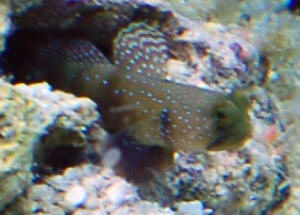
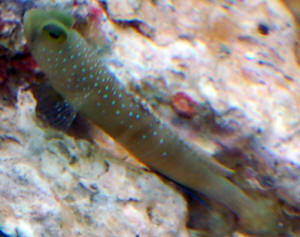
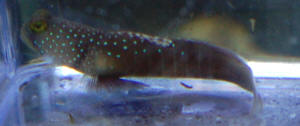
I have been reading WWM and the web, especially an article by Amy
Drehmel, http://reefkeeping.com/issues/2005-12/ft/index.php, and
I am wondering if what I have is a female yellow watchman. I have
included a few pictures. The first two were taken the day she was
added to my tank, the
last couple this week. I wish the recent pictures were better,
but Ernie (along with Bert the shrimp) are shy. I have seen Bert,
but this is the first I have seen Ernie in 10 weeks. I did not
have time to grab a macro lens.
So, my question is, do you think that Ernie is a female, and if
so, what do you think the chances are that if I add a male they
will pair up? And how do I make sure it is a male? Would this be
a good idea?
<Mmm... let's see... Don't know re the sex of this
specimen. Females are said to generally be "more gray"
than males, but I've seen all ranges from mostly yellow to
dark gray for both apparent sexes (mating pairs). Not hard
to pair this species if you have plenty of space, time for trials
of mixing individuals... A good idea? An interesting one if
nothing else.>
For background, the tank is a 90 gallon tank, with 50 pounds live
rock, a bunch of sea grass, one Firefish (Nemateleotris
magnifica), one lawnmower blenny (Salarias fasciatus), one
scissor tail Dartfish (Ptereleotris
evides), a tiger pistol shrimp (Alpheus bellulus), and two
cleaner shrimp(Lysmata amboinensis).
<The Microdesmids are social animals... the first most often
occurring in twos, the evides in small numbered groups>
Thanks
Dean
<Welcome. Bob Fenner>
|
 |
Re: How to sex a Yellow Watchman
Goby 12/22/09
Thanks Bob,
<Dean>
I must confess that I had more Microdesmids; these are the two that
survived QT.
<Mmm, by and large I don't encourage quarantining dart
gobies... actually most all Gobioids for that matter. Too much
stress, likely loss vs. the small likelihood of disease
transmission>
I work part time at an LFS and we lost practically the whole
shipment, including tank raised fish, over the course of about two
weeks. I suspect something happened during shipping.
<Mmm, yes>
I have a 30 I was setting up to breed in.
<The fish I take it>
Maybe I will just establish a pair at work and bring them home. I
am perfectly happy with my brown watchman -
I think he is a beauty the way he is.
Dean
<Does look like a very nice specimen to me. BobF> |
|
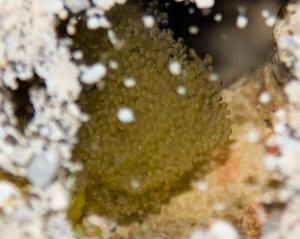
Watchman Goby Babies??-- 12/04/09
Dear Crew,
<Justin>
Last night as I was staring at my 29g tank in the dark with a
flashlight when I came across a most interesting situation.
Underneath one of my chunks of live rock, dug in a deep burrow
was a large egg mass being guarded by one of the watchman gobies
I have.
<Neat!>
What is strange to me though is the fact that one of the gobies
was a Yellow Watchman, and another was labeled as a Diamond Blue
Dot Watchman Goby (I have included a picture for reference).
<Oh! These are likely the same species... See here:
http://wetwebmedia.com/GobioidPIX/ShrimpGobiesPIX/AsterropteryxCryptocentrusCtenogobiops.htm
Cryptocentrus cinctus "come" in blue and yellow
varieties>
After introducing the two in to the same aquarium (originally a
125g) they immediately took to one another. It was quite funny to
see them, one watching out one way the other the opposite. Things
started to change in the Diamond after awhile and I started to
notice his/her color changing. Long story short, The diamond now
looks like the Yellow Watchman, but still with his/her original
markings, but I am wondering if maybe I have the possibility of
some captive bred gobies on my hands.
<Appears so>
I wanted so bad to send a picture of the eggs (me being an avid
fisherman I know what egg sacks look like..but it's always
nice to throw in a reference photo to be sure),
<Ah yes>
but where the eggs are it's impossible to take a picture.
One, there is a rather large Elegance coral in the way, and two,
it's at such a sharp angle from the glass and so far back in
the little cave, the camera just can't focus.
I didn't want to disturb them until/unless I have to.. that
and I get attacked when my hand is near =). Is there any
possibility of these being fertile and me possibly getting to be
a goby grandpa?
<Mmm, in a manner of speaking, yes>
If so, what are my best chances of getting them to survive
without anything else in the tank eating them?
<Actually... this batch will not likely "make it"...
as you need to have on hand sufficient foodstuffs... Purchased
from afar, and/or cultured in advance. ... Uhh... learn to use
the search tool/indices on WWM:
http://wetwebmedia.com/shrpgobrepro.htm>
Or should I leave them and lets nature take its course?
<Up to you... but the young will very likely not survive in
the present circumstances. IF you're interested in being an
earnest aquaculturist, you'll need to move the broodstock and
study, develop a culture "plant" for live foods,
organisms to rear them>
Part of me is optimistic hoping that somehow they would be
fertile and survive. The other part of me is pretty doubtful,
knowing that it could just be a fluke, or perhaps the goby laid
them in the chance that a passing by male would fertilize the
cluster.
<Mmm, good chance they are fertile... will hatch... the pair
will continue to spawn>
I just don't know enough about the species to know their
breeding habits and behavior, if this could just be the way they
breed and these will be always be just eggs, or if it's
because the one of the gobies is a male, and I might have a
breeding pair. I have been searching the net, but not a lot of
help there. From what I can tell, a lot of people are pretty
tight lipped about captive breeding their critters.
<Mmmm... see the sites: MOFIB and Breeders Registry (.coms)...
and the in-print works available... Much help is available that
is perhaps just not easily indexed>
Thanks Crew,
I really appreciate it!!
Sincerely,
Justin Baysinger
p.s. If they are fertile, and I can somehow get them to
survive..anyone want a hybrid Yellow/Diamond Captive Bred
Watchman Goby? Hehe
<You'll see... Bob Fenner>
Goby eggs
Dear Crew,
Sorry for the plethora of emails. I happened to notice that the
burrow went all the way down to the glass bottom, and I was able
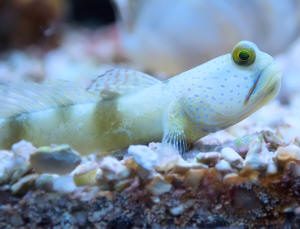
to capture the eggs. I have included it here.
Justin Baysinger
<This be them. BobF>
Forgot the picture in my previous email
Sorry Crew, here is the picture.
Justin
<This be C. cinctus. BobF>
|
 |
Watchman goby breeding. Hello, I was wondering a couple of
things about Watchman Gobies (Yellow in particular and others) that I
did not see in the related webpage: 1. How long do they live?<I know
people who have kept these fish for about 2-3 years. I am not quite
sure on how long they can live, but I know they can live at least
2-3.> I know the Neon Gobies make it a year or 2, but I think these
live longer .. true?<I believe so> 2. Are Watchman Gobies
successfully bred in captivity? <yes, they have been bred in
captivity and are sold as captive bred fish.>Is the process the same
as it is for the Neon Gobies? <Have found a couple links that should
help you- http://www.advancedaquarist.com/issues/jan2003/breeder2.htm http://gobiidae.com/
> 3. Is the sugar sized 0.2 -1.2 mm Aragamax acceptable
for them or do they have difficulty with it? This stuff packs pretty
tight, doesn't it?? <Normally people keep these fish in reefs
with DSB (and have sugar fine sand). I would say you should be OK>
Thanks!<your welcome, IanB> Rich
Re: Watchman Gobies Ian B, Thanks for the info. I
appreciate it. I'll check out those links tonight. Rich <glad to
help, IanB>
Blue-spotted Yellow Watchman Goby sexing- Cryptocentrus cinctus
5/5/03 Hello there <howdy> Thanks Anthony for the advice
about the Anchor coral, I dipped it with Tech d and even though it lost
a little tissue it is recovering fine <great to hear!> Local shop
are going to hold my clowns until a anemone becomes available (great
guys) <agreed... kudos to them :) > Now to my question how do you
work out the sex of Cryptocentrus cinctus no one seems to know <not
that difficult... males really do tend to me more colorful (sharper
yellow and more blue spots) but more importantly... they have thicker
lips (fighting/digging), a larger buccal cavity (chin pouch) and the
first hard rays of the first dorsal fin are somewhat exaggerated
(taller/spikier)> also what is the best sand bed depth I'm going
to add one in the sump main tank is 90 gall sump holds 20 galls I
thought of using 1 inch of sugar sand and about 2-3inch of a
courser marine sand on top what do you think? <never mix grain sizes
under any circumstance (little benefit and will stratify without
screening). You will also need 3" of sugar fine sand minimum to
get good denitrification. I'd recommend 4-6" minimum for a
proper DSB> the sump will also be used for fragging and growing
Caulerpa and will be lit on a reverse with the main tank Thanks Tim
<please read through our archives and beyond about the dangers and
limitations of Caulerpa... as well as the (greater IMO) benefits of
other algae like Chaetomorpha and Gracilaria for refugiums. Use the
google search tool from the home page at wetwebmedia.com. Best regards,
Anthony> Sexing of Cryptocentrus aurora 7/22/05 Hi,
<Hello> Let me start off by saying that my wife and I currently
raise Cryptocentrus cinctus (as well as several varieties of
clownfish). <Neat> We want to start raising the
pink-bar goby Cryptocentrus aurora. <A beauty... know that the genus
is now Amblyeleotris: http://www.fishbase.org/Summary/SpeciesSummary.cfm?ID=12694&genusname=Amblyeleotris&speciesname=aurora>
We bought 4 from an online retailer with the hopes of getting at least
one that looks a little different from the others as we already know
that the Cryptocentrus cinctus is sexually dimorphic, <And
dichromic> so we figured the Cryptocentrus aurora may be as
well. Well I can't see any obvious differences in the
fish. I'm rolling the dice and pairing them
up. We may have to see based on aggression. Just
want to know if anyone knows if there is a visual difference between
the male an female of this fish? <Not as far as I know... I'd
look through the few links via "Google Images" (also through
fishbase.org) for others input here. Bob Fenner> Thanks,
Alan
|
|

