|
FAQs about Marine Snail
Identification 15
Related Articles: Gastropods, Sea Slugs, Mollusks, Abalone,
Related FAQs: Snail ID
1, Snail ID 2, Snail ID 3, Snail
ID 4, Snail ID 5, Snail ID 6, Snail
ID 7, Snail ID 8, Snail ID 9, Snail ID
10, Snail ID 11, Snail ID 12, Snail
ID 13, Snail ID 14, Snail ID 16, Snail ID
17, Snail ID 18, Snail ID 19, Snail ID
20, Snail ID 21, Snail ID 22, Snail
ID 24, Snail ID 25, Snail ID 26, & Marine Snails 1, Marine Snails 2, Marine Snails 3, Invertebrate ID, Snail Behavior, Snail Selection, Snail Compatibility, Snail Systems, Snail Feeding, Snail Disease, Snail Reproduction, Mollusks, Sea
Slugs, Abalone,
|
|
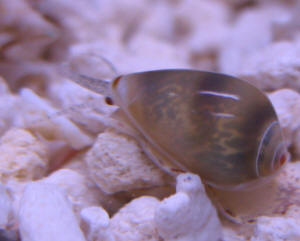
Pyramid snails on Cerith Snails? 04/14/2008
Hello Guys, <Howzit?> I have a very successful, although
unintentional, breeding program for Cerith snails in my aquarium. For
the last couple of weeks I have seen another variety of snail riding
along on many of them. They are small white snails that meet the
description of a Pyramid snail, and sometimes a Cerith will be carting
around two or three of them attached to the front portion of its shell.
I have Zoanthids and a clam that are all untouched and in perfect
health, no snails present. None of my corals have been touched in the
least from what I can see so far. I also breed Checkerboard Nerites and
they are not bothered by them. I understand that Pyramid snails are
specific feeders, but are they this specific? Is it possible I am
seeing something other than Pyramid snails? <Oh yes, of a
certainty> I am not noticing an increase in snail deaths in my
aquarium at this time, as judged by an increase in empty shells, but I
have a couple of hundred Ceriths so a small change would be difficult
to detect. It's hard to tell an occupied shell from an unoccupied
one when there are so many of them. If these do turn out to be Pyramid
Snails that are specific to my Cerith snails is there any way to get
rid of them without harming the Ceriths? <Mmm, not easily... but
some small snail-eating fishes (e.g. wrasses, see WWM re) might reduce
and keep small snail numbers down...> Hand removal is impossible,
there are far too many of them. Never mind, I already know the answer
to that question :) I have a 6-line wrasse, and maybe he is picking
them off the clam but can't get to the ones on the Ceriths, since
they are primarily active after dark when the wrasse is asleep?
<Maybe...> I have seen these snails climb the glass on occasion,
but it's not where I would look for them first if I wanted to find
one. If a picture is important to you it would be easy to obtain one,
if I knew how to use the macro on my camera. I will figure it out if
need be though, don't hesitate to ask. Thanks in advance, Barbra
<If these small snails aren't causing direct trouble, I would
ignore them... there are MANY gastropod species... Most are not
predaceous. Bob Fenner>
|
What Are These Calcareous Discs On The Live Rock? ...Nerite
Snail Egg Capsules 3/30/08 Hi Crew, <Hi Tom, Mich
here.> Could you tell me what these small (1-2mm) gray/white
discs are that are growing all over our live rock? <Yup.>
They're flat, hard, round plates and can easily be popped off
intact, not like the usual coralline algae I'm familiar with.
<They are Nerite snail egg casings. You can read more about
them here:
http://www.advancedaquarist.com/issues/sept2003/invert.htm >
The tank is about 130G and has been set up for 3+ years. Some of
the rock has been in use 6+ years, some less than 2 years. We run
a Chaeto fuge, calcium reactor, PhosBan reactor, EV180, 2x 250W
Ushio 10K MH lamps (10hrs/day) w/T5 actinic/blue. Good
circulation, over 4000GPH total from 2x SeaSwirls, 2x
Koralia-type powerheads, and a chiller loop. We keep mostly SPS
up high, a few small Euphyllids placed low, and a medium fish
load. Water tests as follows: 80-81 deg F SPG 1.026 dKH 10.9 Ca
425 Mg 1320 NO2, NO3, NH3 are all consistently zero I scrubbed
several rocks clean about 2 months ago but the discs are
regrowing. Seems strange that they just started showing up about
a year ago. They only grow on the live rock, while the walls and
sides of the tank grow lots of pink, purple, and maroon
coralline. I'd rather have the coralline cover the live
rock...but mostly just these discs, alga, and a little Cyano seem
to grow well on the rocks. <All very common.> Thanks,
<Welcome! Mich> Tom
Re: What Are These Calcareous Discs On The Live
Rock? ...Nerite Snail Egg -- 04/1/08 Capsules Thanks
Mich, <Hi Tom> Let me provide a better description for you.
I'm not sure these discs are egg casings, at least
they're nothing like other snail eggs we've seen come and
go. <No they are quite different than the gelatinous masses
many other snails produce.> They look/feel like some kind of
non-organic growth. <Yes, they feel very tough, almost calcium
like.> They don't have the sesame seed shape of the Nerite
egg capsules as described in the linked article. These discs are
flatter, thin, and brittle...a tiny, plate-like, calcareous
growth. Think of a miniature poker chip, but even thinner and
with a sharp edge. They're evenly spread over all areas of
the live rock...high, low, everywhere. They number in the
thousands, not just tens or hundreds. <Yes. Your
description/image appear to me to be consistent with Nerite
eggs.> We have mostly Astraea, Nassarius, and Ceriths. We do
have a few Nerites and Stomatellas that hitchhiked in, but not in
large numbers. This morning I couldn't find any Nerites at
all. Wish I could get a better picture for you. Do you still
think these are produced by Nerites? <Yes I Tom
<Cheers, Mich>
|
|
|
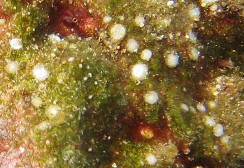
| Baby Snail Question. Hey, I'm not a baby,
I'm a Collonista! 3/30/08 Good day WWM, <Hi Josie!> I
am writing to get an opinion on a baby snail that I discovered in
my tank this morning. <It's actually not a baby/juvenile,
but rather a diminutive snail species usually referred to as a
Collonista, or Mini-Turbo snail. They're harmless and
beneficial herbivores/grazers that are mostly nocturnal, reproduce
readily, stay small (usually around 3mm), and have a characteristic
pit in their operculum (trap door at the opening of a snail).
Color/pattern varies, with some being all white like yours, while
others are combinations of white with varying amounts of mottled
tan/brown/even pink markings.> Currently, as far as snails go, I
only have Nassarius, Fighting Conch, and Margarita Snails and low
and behold, I find a small, ¼?white snail with 2
tentacles crawling on the glass this morning. I have done some
searching and found that Margarita Snails do not typically breed in
captivity; <Not successfully, no. In addition, they're
unfortunately cooler water species that live shortened lives in
reef systems.> ..however, the shape of this baby is nowhere near
the same as either the Fighting Conch or the Nassarius Snails.
<Very true.> I have not added anything new to my tank in
about 3 or 4 months and the tank is over 1.5 years old now.
<Because of their size and nocturnal nature, these little guys
are often overlooked.> The shape is very similar to the
Margarita. I have included a picture although it's not the
greatest as it's difficult to take good pictures of the tank
with the camera I have but it's the best I could do.
<That's okay, I think we're good to go! For more
information, please see the following links as well as WWM's
search engine using the term 'Collonista':
http://www.wetwebmedia.com/snailidf14.htm
http://reefkeeping.com/issues/2004-05/rs/index.php
http://www.wetwebmedia.com/WWMAdminSubWebIndex/question_page.htm
> Again, thank you so much for all the great information on WWM
as it's always my first stop for information! Josie <Mine
too! Bob and the crew past and present have amassed a very
impressive amount of information here, and it just keeps growing!
Take care and enjoy those Collonistas, -Lynn> |
|
|
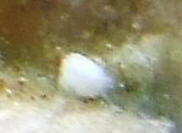
| Flatworm Or Nudibranch... Or Maybe Not... (Not)
-- 03/28/08 Hello guys, <<Adam>> I have an
interesting creature in my tank, I've read through the forums
and search across the Internet and I cannot get a positive ID on it
(Even checked the sea slug site you guys listed as a resource.).
<Okay>> It resembles a Nudibranch, although the one
picture I found of something that resembles it, you guys ID'd
it as a flat worm. (http://www.wetwebmedia.com/fltwmid.htm, second
picture from the top, question titled Nudibranch or Flatworm.)
<<Mmm, not a good picture is it? Regardless 'what
you have is NOT a flatworm>> Flat worms are generally not as
large as this animal is, or at least I thought they weren't.
<<Some do get large>> The guy is around 2 - 2.5"
and only comes out at night, I have seen what seems to be
"antennae" protruding from it. <<Yes>> I
tried several different ways of taking the shot, one strictly with
LED's, others with flashes and/or an LED flashlight. I have
attached a few shots. <<I see them>> One peculiar thing
I witnessed last night was a split in the animals back.
<<Hee-hee! A clue!>> Down the center, which opened
slightly and receded when I placed the light over him. Any ideas?
<<Indeed 'see below>> I am at a loss and
don't know whether to enjoy the little guy or eject him. I
monitored him for about an hour the other night when I saw him open
up down the middle and never really saw him feeding on anything and
he stays around a rock in the tank with Zoanthids, and a piece of
orange Monti. Only thing I could guess is filter feeding or feeding
off the worms and such in/on the rock. Thanks again, Adam
<<Well Adam, I've seen a couple of these before. What you
have there is Scutus antipodes (Black Limpet, Elephant Snail,
etc.). The 'split' you saw is where the mantel parted (the
mantel comes up from both sides to cover the shell on the animals
back). This critter is reputed by some to be reef safe...others to
be a Cnidarian muncher'¦but all seem to agree it's a
good algae grazer and a prolific breeder. Regards,
EricR>> |
|
|
| Re: Yellowhead Jawfish... Horse Conch comp.
Thank you for the answers! I have to apologize again for asking so
many questions, I did find some more info and realized that some of
them probably shouldn't have been asked. It is just so
overwhelming when you have so many different questions and you are
getting different impressions from different sources. <Focus...
one thing... at a time> I will definitely look into reading
those books. I still haven't bought the Jawfish, but he is
still there so I have hope! I bought 20 lbs of live sand and some
live rock, and I'm letting everything cycle. Hopefully all will
be well before he is sold. I am also preparing myself to part with
one of the crabs so I can free up some more tank space for him.
There is one question that you didn't answer in my last email,
and it was a pretty big concern of mine. Will the horse conch try
to eat the Jawfish when he (the conch) gets to be a few inches
long? <Shouldn't, no. Pleuroloca gigantea eats mainly other
snails and bivalves> I have visions of the conch positioning
himself over the jawfish's hole and sticking his body down
there to eat him... the way he does with the snails he eats. I was
able to get a better picture of the conch to send to you; he
wasn't being very photogenic last time. I'll attach a
picture of one of my Marginellas, too. Thank you again for your
time and knowledge! :) <Welcome! BobF> |
|
|
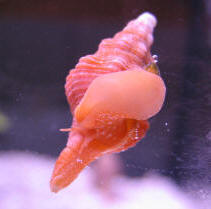
Marine Snail Identification: Likely Fighting
Conch - 3/21/08 <Hi there, Steve> Thanks for the site.
and on to my question. <Okay, let's get to it!> I've
had a snail in my tank since I started it back in April of last
year. I just had someone point out to me that they thought it was a
tulip snail <Good news - it's not!> and that he would eat
other inverts in the tank. <Nope, they're safe.> I
browsed your Marine Snails FAQs and spotted something that sort of
matches my guy but not 100%. Can you give me your thoughts from the
photo?? <It looks to be a harmless/beneficial Strombid, likely
Strombus alatus, aka the 'Fighting' Conch or similar. These
are good sand stirrers and mainly herbivorous, but may also take
meatier fare.> He has eye stalks and a large snout? that he
pushes out whenever I see him above the sand bed. <That's
very typical of Fighting Conchs. Sometimes all you'll see are
just the two eye stalks protruding out of the sand!> He
wasn't being helpful when I took the photo.. <Heheee!
Isn't that annoying!> Most of the time he's digging
around in the sand bed and will disappear for weeks at a time.
<Also typical of Fighting Conchs.> If he is in fact a Tulip
Snail I have never seen him going after other inverts. Is this
something that will occur when he increases in size?? <Nope,
this little guy won't go after your other invertebrates/fishes
- even when he's not so little! Speaking of which, they get up
to about 4" or so in length. These Strombids do, however, need
lots of open areas of DSB to survive long term.> He doesn't
climb the live rock or tank sides. Just stays in the sand. <Yep,
again, that's typical for these. All in all, they're neat
little snails. Please see the following sites for photos and more
information http://www.wetwebmedia.com/gastroart2.htm
http://www.gastropods.com/9/Shell_1329.html (Strombus alatus)
http://www.pirx.com/gallery/mollusks > Love the site and thanks
for you thoughts.. Steve
<You're most welcome! Take care, -Lynn> |
|

|
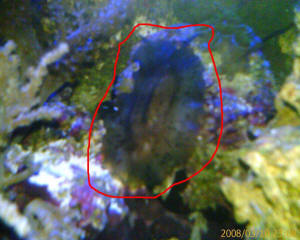
Mystery Creature In My Reef? Scutus - 3/11/08
<Hi Aaron> I caught this guy in action last night and
I've seen him from time to time. One time I observed him on the
glass and his mouth parts look just like a snail's. <Heeee
-- and for good reason! It *is* a snail/Gastropod!> What is he?
<It appears to be a species of Scutus, aka a 'Shield
Limpet', in the family Fissurellidae. This family also includes
Keyhole and Slit Limpets. It also looks a bit like a Chiton, but
the two antennae rule out that possibility.> Is he some type of
Nudibranch? <No, although they're often mistaken as
such.> Would he eat coral polyps? <It's possible. Scutus
spp. are primarily herbivores, but reportedly may also feed on
coral tissue.> Should I take him out of my reef? <It's up
to you. I don't have any personal experience with these, but
most people seem to love them. Apparently they can be very
beneficial when it comes to grazing/removing algae.> I have a 75
gallon reef tank with tons of live rock, Zoas, mushrooms, leathers,
and LPSs corals. <Heeeee! You can add Scutus to the list now as
well!> I've tried some of the more fleshy LPSs corals like
open brains and candy canes and they seemed to have their flesh
devoured. <Yikes! Although I've read cautionary statements
regarding Scutus and corals, I've yet to read any actual
accounts of coral predation within home aquaria.> Other LPSs
corals like frog spawns, torches, bubbles, and Galaxea do fine.
Could this guy be the problem or is it more likely my flame angel?
<Hmmmm. While I can't rule out the Scutus, based on their
popularity with aquarists, it wouldn't be my first choice of
suspects. I'd be more inclined to suspect the Flame Angel,
possibly even a Tang, or one/several of the other usual
'picker' suspects (various crabs, shrimps, etc.)> The
picture isn't the greatest, but it's the best I could get
at night. <Understandable! The good news is that I think
we're good to go. For more information/photos, please see the
following links:
http://www.seaslugforum.net/factsheet.cfm?base=scutus
http://www.poppe-images.com/images/search_results.php?category=Shells&family=FISSURELLIDAE
> Thanks for your help! <You're very welcome! Take care,
-Lynn>
Aaron Chandler |
|
|
Sundial snail babies? Hopefully harmless Collonista
snails! 3/3/08 <Hi there.> I recently found a few sundial
snails in my tank. <Yikes, hopefully not dining on your prized
Zoanthids! Do you keep Zoanthids or were these just incidental
hitchhikers? Sundials only eat Palythoa and Zoanthids, so unless you
have those, they'll simply die out. If you do have/keep Zo's,
definitely remove any Sundials you see.> I now have many tiny, tiny
snails I think could be their babies. Are there any natural predators
for these snails? <I don't know of any that prey exclusively on
Heliacus/Sundials, but I'm sure there are other predators that
include them in their diet. Unfortunately, it's always possible
that the predator(s) could have a taste for more than just Sundials (as
in other beneficial invertebrates)! Complicating matters is the fact
that Heliacus are mostly nocturnal. They're able to hide very
effectively within Zoanthid colonies during the day when snail eating
fishes are active. Regarding those tiny snails, there's a chance
that they might not be juvenile Sundials. There's another very
common snail in the genus Collonista (aka 'mini Turbos') that
has a similar appearance, but is a harmless herbivore/grazer.
They're mostly nocturnal, reproduce readily, and stay small
(usually around 3mm). Color/pattern varies, with some being all white,
while others are combinations of white with varying amounts of mottled
tan/brown/even pink markings. A sure fire way to differentiate Heliacus
from Collonista is to grab a magnifying glass and take a close look at
the operculums (the 'trap door' at the opening of a snail).
Heliacus have conical/pagoda shaped operculums while Collonistas
are relatively flat with a characteristic pit in the center. Basically,
if it's pointed, it's a Sundial. If not, it's likely a
harmless Collonista. I'm hoping that you have the latter! Please
see the following links for comparison/more information:
http://www.wetwebmedia.com/snailidf14.htm (Collonista snails)
http://reefkeeping.com/issues/2004-05/rs/index.php (Collonista -
operculum shown) http://www.wetwebmedia.com/snailidf13.htm (Heliacus -
see pointed operculum in photos about halfway down the page) I've
got my fingers crossed for you! Take care, -Lynn>
What a surprise...but what is it? Looks like
snail eggs! 2/2/08 Hello WWW Crew, <Hi there, Pat.>
Thanks for your site! I have learned a lot from reading your
answers and articles. <Excellent!> Starting a reef tank has
been one heck of a learning experience and even after ~2 years I am
still finding new things in my own tank and I have no idea what
they are! <Heheeee! Isn't it amazing the things that can
crawl out of a rock!> It has led me to purchase a microscope to
examine things in new detail, some pictures which I have included.
<Neat! Opens up a whole new world, doesn't it!> My
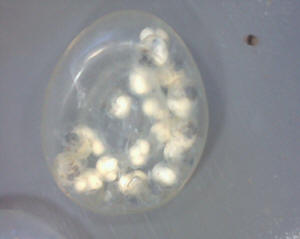
question is I found about a dozen egg sacks on the inside of the
cover of my MJ. They are a little larger than a BB and have some
white things eggs in each one and in this one it looks like they
are alive and moving. The only opening in the MJ is the two small
holes ~1/8", and the sacks are larger than the holes. Do you
know what they are? I am thinking amphipod eggs. <Nope, not
amphipod eggs. The females carry the fertilized eggs in a brood
pouch until they're ready to hatch. What you have looks very
much like snail eggs, but I'd love to know how they got
there!> In the first picture there is a copepod in the upper
right to give you an idea of size. <Thanks.> In the second,
just below center is what I think is a partially developed pod. It
is upright with a black eye and a clear antenna and darker body?
<I see that. Looks like a developing embryo -- hard to tell what
it is at this point. Please see this link for photos/more
information:
http://www.reefkeeping.com/issues/2003-02/rs/index.php.> I guess
I can always wait and see if they develop more. <Yes please, and
document as much as you can! I'd love to see the
progression/development!> Both pictures are in the following
link: http://cmas-md.org/forums/showthread.php?p=305826#post305826
Please feel free to download the pictures from the link to post, I
have had problem with sending you e-mails with attachments. <Ok,
thanks.> Thanks for your time, Pat
<You're very welcome! Take care. --Lynn> |
|
|
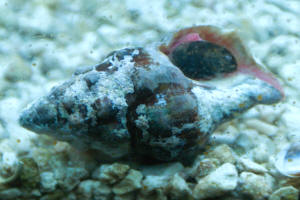
Snail Identification: Likely Horse Conch -
2/2/08 Hi all, <Hi Jenn!> Just a quick thank you for all
the information and first hand knowledge you provide to SW
hobbyists! <You're very welcome! It's a pleasure!> I
have searched your site for the answer to what type of snails we
have in our 75 gallon reef tank. We bought them not long after we
started our tank, a little over a year ago. They are pink bodied.
They do not seem to be aggressive on algae or other waste. I am
also including a few pictures of the snails for identification.
<Thank you for sending multiple angles by the way, that really
helps. Your snail looks like what's commonly called a Horse
Conch, which is in the family: Fasciolariidae. The snails in this
family are predatory towards other molluscs and will scavenge dead
or dying organisms. Have you noticed any other snails missing?
Horse conchs (likely yours is in the genus
Pleuroploca/Triplofuscus) range in soft body color from orange to a
dark red. Please see the snail at this link, just past halfway down
(Florida Horse Conch) for comparison:
http://h2ocreatures.com/mollusks.html .> We are looking to
continue to build our reef with additional LR and also want to get
a hardworking cleanup crew. Suggestions would be great. <Sorry,
would need to know what other livestock you have, what type of
clean-up you need.> Thanks for your help! Jenn H Central PA
<You're very welcome! Take care. --Lynn> |
|
|
|
|

