|
FAQs about Soft Coral Identification
2
Related Articles: Soft
Coral,
Related FAQs: Soft
Coral Identification 1, Cnidarian
Identification, Soft Corals 1,
Soft Corals 2, Soft Coral Behavior, Soft Coral Compatibility, Soft Coral Selection, Soft Coral Systems, Soft Coral Feeding, Soft Coral Health, Soft Coral Propagation, Alcyoniids, Nephtheids, Dendronephthya, Paralcyoniids, Nidaliids, Xeniids,
|
|
|
Coral inquiry 10/25/27
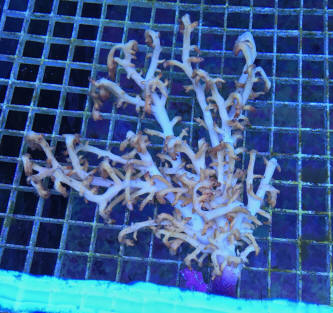
These came in with a shipment of Dendronephthya but I'm not too sure exactly
what they are. Any help?
<I do think these are soft corals, of the family Nidaliidae, perhaps of the
genus Siphonogorgia.
From WWM: "Superficially resemble Gorgonians. Polyps clustered toward ends of
branches, absent from lower trunk, branches. No internal "axis" like sea fans.
Can be completely withdrawn. Western Pacific; Philippines, Belau,
Solomon Islands. Common on reef slopes, overhangs at times. "
Thank you for sharing. Bob Fenner>
|
 |
|
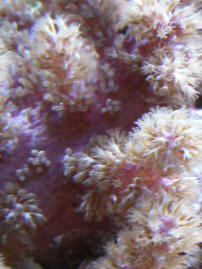
soft coral id 2/18/10
<Hello Kevin>
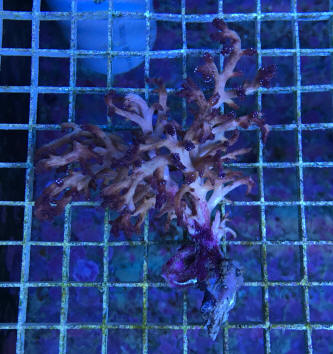
I was at the LFS and saw this coral with a bunch a of colt
corals. It looks extremely similar but at the same time seemed to
have Carnation coral characteristics.
<I think this is an Alcyoniid. Possibly a Cladiella, but I am
no taxonomist>
I knew it wasn't a "normal" Carnation coral but not
a Colt Coral.
<Actually, this common name encompasses a few different
species>
I decided to purchase it which may or may not have been the
greatest idea.
<If you suspected that this coral was non-photosynthetic then
it was not>
Anyhow I decided to put it in a shaded area like a carnation and
it would not open after a couple of days. It was getting plenty
of flow as well. At this point I decided to put it out in the
light. It is in the corner but gets bright light, but not
directly under the 250 watt metal halides.
Within an hour it was 3 times the size completely happy with
polyps open.
<A big clue>
Now this struck me as odd since it appears to be somewhat light
loving/photosynthetic.
<Yes>
My conclusion is that it may be a Stereonephthya sp.
<Mmm, no I don't think so><<RMF sees this as a
Nephtheid, perhaps the genus mentioned>>
I would like to hear your opinion on what this mystery coral
is.
<You have it>
I know the common Carnation corals are a big no no for
captivity....but this one seems like a different case.
<No, it's still a difficult animal that should be
avoided>
Thanks
Kevin
<Cheers! Simon>
|
  |
|
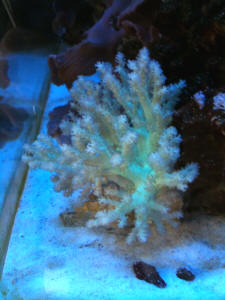
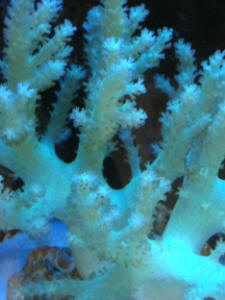
Green Nephtheidae ID? 1/8/10
Crew,
<Hello Bill>
First I should say thank you for creating a website with such
good useful information. Thank you, I am sure I speak for many in
the hobby
<Thank you for your kind words!>.
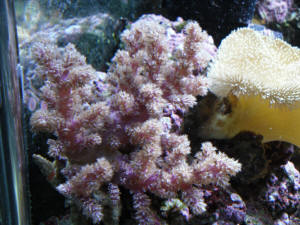
I have had what I think is green Nephthea for years <I
don't think so>. It was bleech <bleach>
white when purchased from the local store in Michigan. Over time
it developed a very nice fluorescent green color. No one seems to
agree on an ID. I have been told green Sinularia <yes> and
green Capnella <no>,
but it still looks like green Nephthea to me even after reading
the website information on Nephtheidae. Pictures are taken about
30 inches from the T5 lighting. The main colony close to lights
does not have as bushy of an appearance and is much more
green.
What is you opinion? Anything else I should know about it? It
grows easily and is easily fragged, so I assume it isn't very
rare. <my opinion, Bill, is that this is indeed a
Sinularia.
http://www.wetwebmedia.com/alcyoniidsii.htm>
Thank you in advance for your help!
Bill
(from Michigan)
|
  |
|
Critter Identification -- 08/26/09
Hi
<Hello.>
I have recently acquired a candy cane and have found what appears
to be a soft coral amongst the heads.
Can you have a look to see if you can ID it please as I have
looked through the site and a couple of books I managed to get my
hands on but cant find anything similar.
It measures approximately 10mm across and the polyps protrude
about 2-6mm (tips are feathery), the top is dome shaped and the
stalk looks like that of an aiptasia.
<It is hard to discern from the photo, but I would guess
family Alcyoniidae, and Genus Sarcophyton.>
Apologies for the quality of the photo but its the best i could
do.
<Do a search on Sarcophyton and see if it might look similar,
but I am afraid that is the best I can do from that photo,
perhaps another crew member will chime in.>
Thanks in advance for your help and the great informative site
that you provide.
Regards
Gavin
<You're welcome,
Josh Solomon.>
|
 |
|
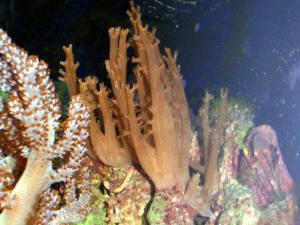
Soft Coral Identification: Xeniidae.
8/25/2009
Hello WWM staff.
<Hi - I love your email name..."Cnidarious
Ptychocyst">
I have a Coral I would like to have identified in my stock 14
gallon BioCube.
I obtained it Free of charge by another aquarist as a somewhat
forgettable little brown frag.
<Ok>
Since that time it has grown from a mere four branches to over
twenty, many of which are almost four inches long.
<Sounds like a Xenia.>
Polyp placement is sparse, the base of the coral seems to creep
across rocks.
the structure of the limbs seems to resemble a system of tubes,
each tube ending in a polyp at the top.
<Looking at your picture, it is definitely a Xenia.>.
It is currently the fastest growing coral in my aquarium and i
have already fragged it several times in the few months I have
had it. It now exists in five different areas of the
aquarium.
<They will spread rapidly, to the point of being a nuisance
when they have conditions they are happy with.> You can remove
them or frag them as you desire.>
Any thoughts?
Do have a read here: http://www.wetwebmedia.com/xeniidarts.htm as
well as the linked pages on the top of that page. Anything you
would want to know about them is answered.>
<MikeV>
<<... to RMF this looks (we are talking about the organism
in the middle?) like some sort of Alcyoniid; likely a Sinularia
sp.>>
|
|
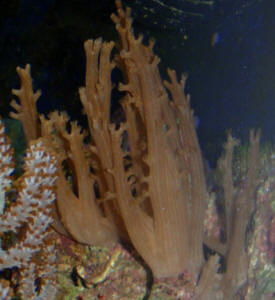
Re soft coral identification Part
2! 9/6/09
Hello again WWM crew.
<CD>
I bring news.
I have identified the coral in question after asking around
in person at my LFS.
A man gave me the name and i did some searching on Google
for it.
This coral is called Paralemnalia which according to
further Google searches is a type of Sinularia.
<Mmm, sep. genera, families... but I do agree with the
ID. BobF>
Cheers.
|
 |
|
|
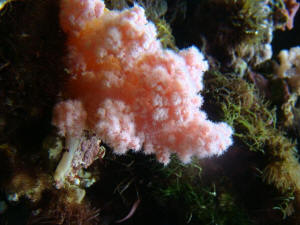
Soft Pink Coral ID... Dendronepthea
5/8/2009
Hi,
<Hi Jay, Mich here.>
I recently purchased what was described as a Soft Pink Coral.
<A vague description, not a name.>
I stupidly purchased it without really knowing what species it
is.
<I am in agreement with you here. Please learn from your
mistake and research any living creature you plan to assume care
for, before actually assuming care!>
Please could you help me in the identification....
<I will try.>
I have done some research and am hoping it isn't a coronation
coral...
<I'm guessing you mean a carnation coral, and yes, that
looks to be what you have.>
as from what I read they are hard to care for.
<Yes, most all Dendronepthea do not survive in captivity. They
do not contain zooxanthellae, which makes feeding them in
captivity all but impossible currently.>
Any help on care would also be greatly appreciated.
<Not a lot I can tell you here. Enjoy this coral while it
lasts, as it most likely won't last more than a couple of
months, if that.>
Many thanks in advance
<Welcome, please learn from this mistake, research before you
buy!>
Jay Driscoll
<Michelle Lemech>
|
 |
Unknown Coral Species Possibly Invertebrate?
(Hee-hee'¦aren't they all?) -- 04/20/09
Hi,
<<Hello>>
I'm sort of embarrassed to ask a question about a species
identification, especially with so much information available over the
net, at the LFS or the library. But in all honesty, I have Googled for
hours and have stopped in every fish store to ask questions and still
have no answers. (didn't make it to the Library)
<<Okay>>
I bought what I thought was a Xenia in one of the many stores that I
frequent, I bought it thinking that I was well read and knowledgeable
enough to take care of a new addition to my tank.
<<But'¦>>
I picked out what I wanted, a light brown healthy looking Xenia with
tentacles that started at the foot that was buried in the sand, and
extended up about 3 inches.
<<Not a Xenia then'¦are 'encrusting'
organisms>>
The shape is like a Christmas tree,
<<And this is your first clue>>
full at the bottom, gradually becoming smaller at the top. I walked
away from the specimen tank to defend a poor little clown fish that was
being picked on by bigger bullies and did not observe the employees
putting my prize of the day in the plastic container, so imagine my
surprise when I get home and see this brown looking morel mushroom
looking thing suspended in saltwater.
<<A good analogy>>
(pick morels in woods every spring) Where's the waving tentacles
and the little fingers at the end of the tentacles? So I fight the urge
to drive back to the store, 50 miles away, plus the store was closed
for the evening and I removed the brown wilting looking mushroom thing
from the bag and have no clue what to do with it because it has a soft
foot with nothing attached to weigh it down or prop it up.
<<Yup'¦another clue>>
First time I have had to deal with this, I always get coral that are
attached to frag or rock. So I bury the foot in the sand,
<<A good move'¦>>
until the little bugger is somewhat upright. An hour or so later the
tentacles start to creep out of the cap, woo hoo!!, the fish store
people didn't switch a slimy mushroom for my Xenia. I turned off
the tank light and went to bed. Next morning, I come downstairs and go
straight to my tank and my poor half Shroom and Xenia are gone.
<<Clue number three'¦>>
Nothing there, vanished. I start on the morning tank regimen and come
back an hour later to turn the skimmer back on and low and behold there
is my Xenia waving around in the current.
<<A good sign>>
Now I am just dying to know how my Houdini Xenia just disappears and
reappears, so I check the tank every hour or so and about 8 hours
later, he starts shrinking, pulls all his tentacles so far into that
funny little mushroom cap that you wouldn't even know that he had
tentacles and he just got smaller and smaller, burying himself in the
sand, until he disappeared.
<<Ah yes'¦>>
Next morning he pops up right against the tank wall, about 3 inches
away from where he buried himself. I sort of push him a couple of
inches away from the wall
<<Mmm, careful'¦best to let this critter pick its own
spot>>
and he happily waved his Houdini arms and fingers around for another 8
hours and disappears. Next morning he pops back up against the tank
wall, where he is currently residing.
<<Ah'¦>>
What do I have?
<<The description and behavior you describe sounds very much like
a Sphaerella or Studeriotes species of soft coral
(http://www.wetwebmedia.com/paralcyoniidae.htm )'¦some common
names are Christmas Tree Coral, and Medusa Coral>>
I cannot find any information on Xenia's that retract their
tentacles and bury themselves in the sand.
<<Is not a Xeniid>>
I can't find any information about an invertebrate with tentacles
like a Xenia.
<<Try a Google search on the Latin and common names I listed and
see what you think>>
All the fish store employees just look at me funny and think that I am
a twit who shouldn't be within 10 feet of an aquarium.
<<But, they don't know what this coral is
either'¦right? >>
Do I care for it like a Xenia?
<<Mmm, no'¦this is an azooxanthellate coral that
requires direct supplemental feeding'¦and much like
Dendronephthya species, is not easy to keep. To be honest, I don't
give you good odds for maintaining this animal for long as it will
likely starve to death in a few weeks to months. You can try feeding
small meaty foods like Cyclops-Eeze, Rotifers, etc'¦but in my
experiences these animals always slowly shrivel away and die. I think
the best thing would be to return this coral to the LFS for a
refund/store credit>>
Houdini seems to be doing okay for now, but I'm concerned that it
will decline in the future if I am not treating it accordingly to its
species.
<<Even so'¦there's not a lot of info on the
'successful' care of this genus>>
I will try to send photos of his tricks, it's just a matter of
catching him doing them.
Thank You for any information at all.
Beth
<<Sorry it's not better info'¦ EricR>>
|
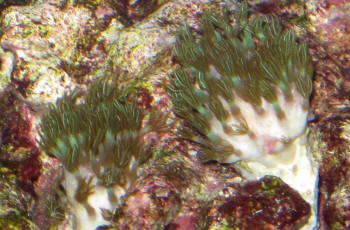
Help ID 2 different corals 03/31/09
Hello:
Truly enjoy WWM and all of your efforts to help educate us. I
read it almost every day and try to practice what I read which I
believe helps to understand how to maintain my tank and what
mistakes I have made & how to correct them.
Ok I have 2 corals in my tank that I am trying to clarify what
they are and I have attached pictures. Sorry for the quality I
have a bow tank and I find it very difficult to properly
focus.
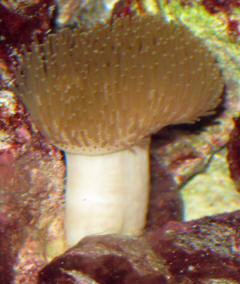
<I'm sorry, did you get an answer to this email? If not...
I think the first pic is of some kind of Xenia. The second is a
leather coral (likely a Sarcophyton).>
Regards,
Tom
<Best,
Sara M.>
|
  |
|
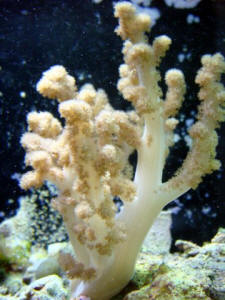
Coral ID 12/9/08 Hey y'all - <Yo! Mich
here.> I've had this coral in my 75g for about a year and
a half. <Cool.> It's about 8 inches tall when fully
expanded, <OK.> and I've divided it twice already.
<Yay! You fragger you!> All 3 are doing well. <Most
excellent!> It's very pink in color and has prominent
vertical lines in the stalk (sclerites?). <OK.> I always
thought of it as a Sinularia, but now I'm not so sure. It
could be a Capnella or Litophyton too. <I do not believe it to
be a Litophyton because of the placement of the polyps. The
polyps of Litophyton are usually on the thinner outer branches
and this seems inconsistent with your photo. Could possibly be
Capnella, but they are generally have a more stocky silhouette
than your picture with polyps more towards the ends of the
branches. I'm more inclined to lean towards a Sinularia,
possibly because of the overall shape and polyp placement,
perhaps Sinularia notanda.> I know these are not so easy to
tell apart. But do you have any ideas? <My opinions above.>
Thanks! <Welcome!> Ed
<Mich>
|
 |
|
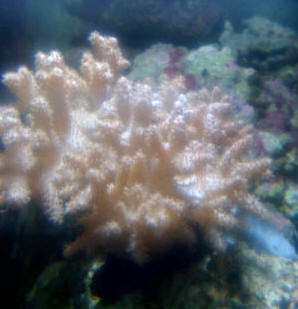
Leather coral identification 11/02/08 Hi
friends :) <Hello Ranjith, I'm sooo sorry it took us so
long to get back to you. It's difficult to see the polyps in
the photo you sent, and leather corals are notoriously difficult
to ID. It might be Sinularia sp. or possibly even Lemnalia sp. I
honestly can't say for sure from that photo. Please see here:
http://www.wetwebmedia.com/alcyoniids.htm http://www.wetwebmedia.com/alcyoniidsii.htm>
Could you identify the below specimen for me? It was sold as a
finger leather coral but I am confused between the many
varieties. Also I see it grabbing some cyclops eeze. Is that
possible? <It is possible it is catching them in its
tentacles... but probably not so likely that it is eating
them.> Cheers Ranjith <Best, Sara M.>
Re: Leather coral identification 11/02/08 Hi
Sara Ok. I also use ocean nutrition coral food in the mix and see
the polyps grabbing them as well. I did go through the pages you
mentioned before sending the pic :) Could not put my finger if it
was colt or devils hand. I guess this next question has been
asked but do I need to feed it? Or is it fully autotrophic?
<They are not fully autrophic, however, you do not need to
specifically feed them. If you are feeding your tank well in
general, then it should feed on the smaller particles.> Cheers
<Best, Sara M.>
|
 |
Softie abbreviation 08/19/2008 Hi there! Just a quickie
for you - what is the abbreviation if any for soft corals? (I keep a
softie only tank) <<Softie....he he he....you got it in
one>> Thanks in advance and regards, Kay. <<Good day. A
Nixon>>
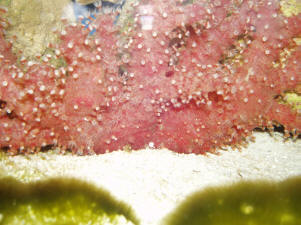
Identification of coral, Chili Coral
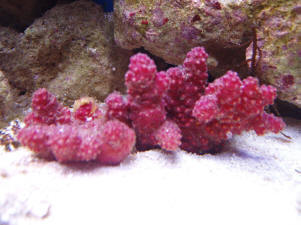
(Nephthyigorgia) 2/27/07 Hello from Belfast, Ireland! <Top
O' the morning to you, Jason! Mich here.> I'd like to
say thanks for doing a great job - I've found your site very
helpful while getting started with my marine setup. <Tis good to
hear!> I was wondering if you could ID this coral for me. It was
sold to me as a fire coral, but having checked out the descriptions
of fire coral on your site, it appears to be something quite
different - no white tips or hairs, and it has star shaped polyps.
<Not a fire coral.> The polyps are retracted during the day,
and the coral shrinks to about 1/3 of its nighttime size. <Very
accurate description.> So, unfortunately for me, it's full
splendour is only visible early in the morning before it retracts
again. <Yes this is normal behavior for this coral, is
nocturnal, like me, commonly called a Chili coral (Nephthyigorgia).
It is aposymbiotic, meaning that it has no zooxanthellae, and
therefore non-photosynthetic. This means this coral must be target
fed, typically when the lights are out and the polyps are extended.
Their nutritional requirements are poorly understood, but are
filter feeder, so think tiny planktonic foods.> Cheers,
Jason
Good day to you!
<And to you! -Mich> |
|
|
Lithophyllum Coral general information
6/16/06 I'm looking at this gorgeous Lithophyllon Coral but I
can't find any information about it anywhere! <... I think you
mean "Litophyton" the Alcyoniid, not the fungus genus
mentioned above...> First, what is it's aggressiveness? Second,
what is it's preferred diet? Third, and lastly, what lighting and
water flow is preferred? Thanks, Krissi P.S. You guys rock! <Please
read here: http://www.wetwebmedia.com/alcyoniids.htm and the linked files
above. Bob Fenner>
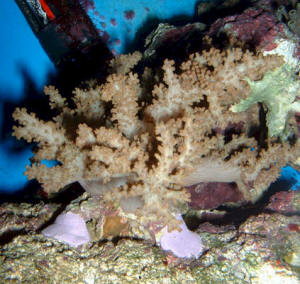
| Colt Coral - 1/30/2006 Good Morning WWM Crew. Please
could you help me with a more precise identification of this coral
I bought from my LFS yesterday? It is sold over here in the UK as a
'Pussy Coral', and all I can tell you is you don't want
to do a google search for that.... <I can imagine...> I
understand from reading up on WWM before purchase that in the US
they are known as 'Colt Corals', and are one of the easier
soft corals to keep, growing rapidly,( sometimes a bit too
rapidly?), and sometimes a little aggressive. They are also capable
of wandering a little. All I'm really after is a Latin name. My
best guess's from your pages is a coral from family
Nephtheidae, genus either Capnella or Lemnalia. <Mmm, doe look
like these to me... likely so. Or an alcyoniid: http://wetwebmedia.com/alcyoniids.htm Maybe an Alcyonium
or Lobophytum sp.> I attach a photograph, taken early in the
light cycle of my tank when the coral is about 75% open. Thank you
once again for your time. Bob Mehen, Cornwall, UK. <My bet's
on Lemnalia as the genus. Cheers. Bob Fenner> |
|
|
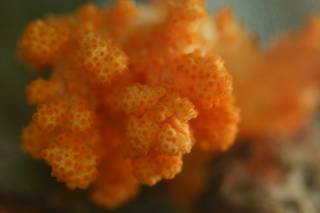
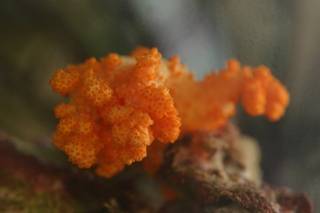
Coral (mis)ID 1/25/06 Hello WWM crew, <Hello Rick>
I have a couple of photos of an unknown coral that I took yesterday
at the LFS. Can anyone tell me what this is & how it would need
to be cared for. The LFS told me that it was an Orange Chili coral,
does this sound right?? <Wish the picture had more detail,
possibly top view. To me it looks like a cauliflower/colt coral of
the genus cladiella which usually have shorter fingers. James
(Salty Dog)><<What? Is a Nephtheid. Please see here:
http://www.google.com/custom?q=chili+soft+coral+genus&sitesearch=wetwebmedia.com
Cheers!
Rick Waibel Jr. |
|
|
| Invasive Xenia-like Softie 6/15/05 Hello WWM Crew! I
have a client with an ever-spreading invasive type of soft coral.
It spreads much like Green Star Polyps. It's actually quite
pretty and I don't want to harm it, but I need to be able to
control it naturally. I've attached a picture. If any of you
know what it is, and how to control the spread, I'll be
grateful. By the way, the polyps are quite small, perhaps 1/2 the
size of Green Stars. This is the only tank I've ever seen it
in. Thanks In Advance, Bob Hartline <It is hard to tell for sure
from your pic, but here are some guidelines... If the polyps arise
from and can retract (completely pull into) the mat, it is probably
Briareum or Erythropodium. If the "stem" of the polyps
have a distinct base into which the polyps retract, the coral is
Clavularia. If the polyps don't retract at all (but maybe
deflate a bit when disturbed), it is probably Anthelia or Sansibia.
This looks very much like a colony of Sansibia that I have in my
tank. You can confirm the ID of Sansibia if you can see iridescent
sclerites through the tissue. Best Regards. AdamC.> |
|
|
Invasive Xenia-like Softie part 2 6/15/05 Any idea about
slowing it down? It spreads mighty fast. I've tried placing LPS
corals in it's midst, but it seems impervious. Maybe a Chocolate
Chip Star on a leash? Hehe...Please advise if you have any other ideas.
Bob <About the only thing you can do is try to corral it with rocks
and rubble. This will also create frags to trade! Covering it up will
also shade it and slow it down. HTH AdamC.> Coral ID 6/15/05
This is a recently purchased 10# live rock from the Solomon Islands
area. I noticed that there was this coral attached to it but I'm
not sure what it is. The picture is located here: http://www.aviansinoil.com/Hitchhikercoral.jpg It is soft and
purplish in color. I'd also like to be able to get it off that area
of the rock and move it to a more lit area of the tank if it's
possible...any ideas for removing and relocating it? <It is
impossible to ID this coral from the pic beyond saying that it is a
"branchy soft coral". If the polyps completely retract into
the flesh when disturbed, it is probably Sinularia. If the polyps only
fold up against the branches, it is probably in the Nephtheidae family
(precise ID is very hard). If it is slippery like a wet bar of soap, it
is probably a colt coral. As far as moving it, you can simply use a
chisel, screwdriver or Dremel tool to chip away a chunk of rock where
the coral is attached and place it where you like. Best Regards.
AdamC.>
| Non-photosynthetic Neptheid 2/27/05 I
acquired this soft coral a couple days ago. I'm hoping its not
Dendronephthya, maybe Scleronephthya. Can you ID it? <it sadly
is a non-photosynthetic Neptheid. Dismal survival in captivity>
Then I can look up its requirements here. If it needs to hang
upside down, how important is this, and what is the advantage?
Thanks for the help. Darren <do look up info (little as there
is) on the successful keeping of Dendronephthya and like kin.
It's really an awful group... most we do not know how to keep
or what they eat. Those that we do know we still can't feed
well if at all (bacteria, floc, specific plankton species). I
strongly encourage you to keep a large fishless refugium with a
DSB, and feed live plankton (phyto and zoo-). Anthony> |
|
|
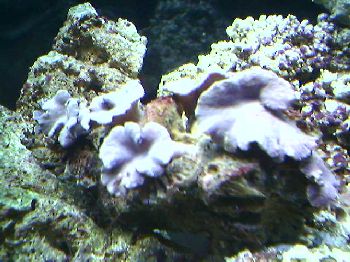
| Soft Coral ID 2/15/05 First off, I love the
site! It's been a great help so far with a lot of questions
I've had with my fairly recently new (5 months old now) reef
tank! I'll make this short and sweet. Any idea what type of
mushrooms these are? <appears to be an Alcyoniid "cabbage
leather" species. Do a keyword search of the site and abroad
to see more on this popular coral> I've searched the web
over and over and found nothing on them. Care to help a guy out
here? Picture is attached. I apologize in advance for the
blurriness. The picture was taken with my camera phone. Any help
you can give me in identifying these critters would be greatly
appreciated! Thanks so much! Steve <kindly, Anthony> |
|
|
Soft Coral Id Hi, I have searched both your site
and web in general trying to identify soft coral I have purchased
recently, but without success. It looks somewhat like Kenya Tree but
not 100%, so I am hoping you would be able to tell me what it is from
the picture I have attached. In the store's tank, this coral was
not really a sale item, but was a "wild", growing on the side
of the tank, unattended. Thus the salesman couldn't identify it for
me, but that also made me believe that this thing is hardy, and since I
have a new tank that hasn't set completely yet, I figured that it
might actually survive in it. And not only it did, but it thrives
really good and even grew a bit in a couple of weeks (to my utter
amazement and disbelief). I am now upgrading the light in my tank and
would like to know what this creature is before I burn it to crisps (I
am adding 2 x 65W PC for that particular spot of tank). Knowing what it
is would also help me to optimize its food, chemistry and company. It
is 5-6" tall, seems OK in 15W PowerGlo it is under right now,
completely deflates and retracts during the night. I would also
appreciate any kind of additional information you can give to me, which
will help me figure out what can I expect from it and what to do with
it in the future. Thanks, Mladen <Hello, MikeB here. I believe the
coral to be a pulsating xenia coral. They can handle a large variety of
light and water quality parameters. They can be hardy but do better in
a well established aquarium. Good Luck. MikeB.>
Re: Soft Coral Id Hi MikeB, First, thank you for
your very prompt answer. However, I don't think that this coral
belongs to Xeniidae family at all, but rather to Nephtheidae family.
While most of the Xeniidae, and pulsating Xenia in particular, have all
of the polyps (their tentacles) or the branches ending at the same
plane - umbrella configuration, my coral (like Nephtheidae in general)
has branches of uneven lengths all along the stalks with polyps all
along the stalks (there is no main stalk but fairly uneven branching)
resulting in the grapes configuration. In any case, again thanks for
your reply. This just reflects how reef keeping and marine biology are
diverse and complex. <Hello, if I remember correctly, the picture
was a little fuzzy and it was difficult to make out. You are correct in
your morphological determination of your coral. But, remember that
there can be variation between the genera of the family. If you feel
that it is not xenia, try looking up anthelia. Good Luck MikeB>
|
|


