|
|
| Home | Marine Aquariums |
Freshwater Aquariums |
Planted Aquariums |
Brackish Systems |
Ponds,
lakes & fountains |
Turtles & Amphibians |
Aquatic Business |
Aquatic Science |
Ask the WWM Crew a Question |
| Please visit our Sponsors | ||||
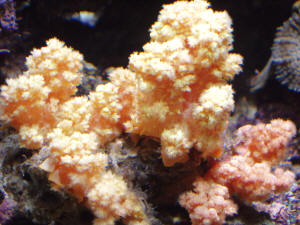
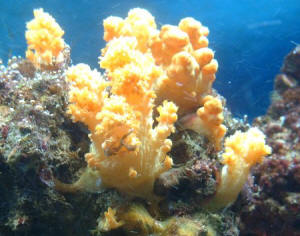
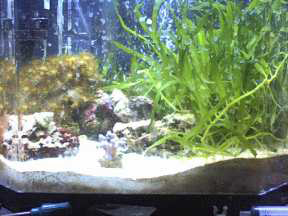
Soft Coral ID - Alcyoniids 9/17/04 Can you please ID these two for me and in the first photo I got this at the same time as the other but it seems to grow so much faster and it is so much more bushy why is this the case as they are beside each other. Thank you Chris <the first image is that of a Cladiella species, and the latter is a Sinularia sp. Do use these names to do a keyword search on google of our site and beyond for more information. Happy hunting :) Anthony> Taxonomy Of a Marine Soft Coral Dr. Fenner, <Just
Bob if you please> My name is Dwight Williams and I am a
student A Virginia Commonwealth University. I am doing a research paper
on the Isolation of a natural products from marine soft corals. In
particular the isolation of Eleutherobin. In 1997 Fenical released a
paper in the Journal of the American Chemical Society that outlined his
discovery of Eleutherobin. They isolated the compound from soft coral
found near Bennett's Shoal in Western Australia. They believed that
the taxonomy of this particular coral to be Eleuterobia alibiflora
Alcyonacea Alcyoniidae. I was wonder if you could confirm the taxonomy
of this particular soft coral. I have not been able to find any
literature that makes any reference to an soft coral of the species
alibiflora. If you could please assist me in this endeavor it would be
greatly appreciated. <I would contact Philip Alderslade.
Australian Institute of Marine Science, Townsville, Queensland,
Australia here... he is likely a definitive source on the systematic
status of this soft coral or will know where next to look. Bob
Fenner> Respectfully,
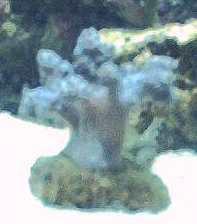
ID on soft coral 12/9/03 Hey guys (Anthony?), <whassup?> I was wondering if you could give me a positive ID on this soft coral. Im not too sure of what it is. <it appears to be a Sinularia sp. and if the color is true (light tan) then this is a stressed/bleached specimen and will need very special care to recover. Since their polyps are too small to target feed (organismally), it needs to take up nutrients by adbsorbtion. Thus, a tank with some nitrates (5-10ppm) and a heavy fish bioload will be helpful... a refugium would be great too> Any help would be appreciated...... Nathan <best of luck. Anthony> Red Lobophytum Hi, I bought a red leather coral @ a local pet store. I tried to find the genus on the web and found that it is a Lobophytum sp. The problem is the color. I could find no information that says that it comes in red. I did find a picture of one that looks just like mine but it is green. The one I have is BRIGHT pink. I'm wondering if this Lobophytum could be dyed. Although it has been 3 weeks it has not faded but the liquid in the protein skimmer IS red. If it is dyed how long will the color last? Lastly will the dye harm anything else? Thanks, Steve <<Hi Steve, I'm sorry to hear about your experience with your local pet store and your coral. As you already found out, Lobophytum is found in shades of brown and some variations in yellow and green. They are ideal for beginners being quite hardy specimens, but they don't come in bright pink. This and the red water in your skimmer aren't a good signs. Usually these dyes are water soluble so the corals will absorb them with water. There is no way to tell how long it will last or if it will harm your other inhabitants. I suggest returning the coral for a refund or if this is not possible, remove it to a quarantine/hospital tank to keep it from possibly harming your other inhabitants until it hopefully recovers it's normal color. Lobophytum requires strong to moderate water flow and this may be needed to help clear any possible dye. I would also look for a reputable shop that specializes in marine fish and reef aquariums and purchase a good book on coral husbandry before laying my money on the counter. You will save many times the purchase price of the book in the future. I recommend Bob's book or there are several good suggestions on WWM. The WWM has a chat option that you could make good use of as well. Again, I'm sorry this happened to you, it is really a horrible fraudulent practice. The best way to avoid it is become better informed before the sale, and don't make impulse purchases. This will also keep you from buying something that is difficult or impossible to keep or that might be aggressive. We are happy to help you make the right choices! Please feel free to write and ask questions before you buy. Sincerely, Craig>> Soft coral ID question I hope you can help me ID a soft coral fragment I currently have in quarantine. It's a frag, so I can't give a complete description, but it's a stub, about 2 inches long, a half inch think, a stubby cylinder. The main body is white, and when they're retracted its polyps are like little black dots, evenly spaced. When they extend, however, it becomes extremely bushy, with the white body cylindrical body effectively hidden behind the puffy polyps. I picked it up at a frag swap, and I'm looking to identify it before moving it out of quarantine. Any help would be greatly appreciated...Arthur <Arthur... a white stalked soft coral is either dead, dying, or aposymbiotic (non-photosynthetic). None bode well for you. Frag swap, LFS or mail order... you really owe it to yourself and the live animals you acquire to research their needs before you take responsibility for them. Our first goal here is to ID the animal as photosynthetic or not. If it is and is just simply bleached, it may recover but does not have the luxury of feeding organismally to support itself while waiting for zooxanthellae to recover like some LPS corals. Please send us a picture or look through Eric Borneman's Aquarium Corals Book for a better indication. More information is needed here bud for you to have any hope of keeping or saving this coral. Best regards, Anthony> Soft coral id, husbandry help Hi to all, Your fan from Istanbul, Turkey. <Sorry for the delay, Murat. Paul here to do my best> Looking forward to your new book I have both Bob's and Anthony's and enjoyed them a lot. <I am sure they are happy to hear of another satisfied customer. I too, look forward to their new book> I have 2 Aquarium 55G and connected in the sump one reef and one FOWLR . Total of 130G water. All my water parameters are ok. I have 4* 55wPC and 3*30W NO on the reef. Here is the Picture of my first SPS coral that I got last week but I think it is a goner it did not open yet and bleached most of its arms any suggestion is appreciated < Good water quality, maybe a little food along the lines of zooplankton (i.e. rotifers or possible brine nauplii). Don't move it around, let it acclimate, and it may recover in time. See here: http://www.wetwebmedia.com/corldisfaqs.htm <<...>> Here is my real question; I got the following sponge 3 weeks ago. My reef tank is a heaven for sponges , I counted 4-5 different sponges thriving on the life rock. I bought blue sponge six month ago and that is also doing very well. Anyhow I put the following sponge under the rocks and it was sulking. Yesterday I decided to fix it under the cave which is partially light and it just opened up to my surprise . Can you identify it? It arrived from Indonesia as Red Chili Pepper Sponge. <Not a sponge at all. This coral is commonly referred to as "chili coral". It is in the family of Nepthyigorgia (thanks Anthony). It is aposymbiotic (NON-photosynthetic) and therefore needs to be fed (heterotrophic). Pretty hardy coral as far as heterotrophic corals go. They occur naturally in overhangs (hang it upside down), with a heavy current of water to bring food to its extended polyps. I would try rotifers and maybe fresh hatched baby brine (Artemia nauplii). Sometimes pureed meaty foods (used sparingly) might also help meet it's nutritional needs. A refugium is your best bet though. Nice picture by the way. Look on page 298-299 in Anthony Calfo's "Book of Coral Propagation Vol. 1" for more information> Do you have any suggestions for its care. <See above> <<...>> <<...>> Murat Ozturan <Again, sorry for the delay. Good luck, Paul> Soft Coral Dear Bob I recently bought what I was told was a finger coral. But from looking at internet pictures, it looks more like a tree coral (Capnella). For the first few days the coral was partially extended and looked like it might recover from its relocating shock. Now the coral remains withdrawn. <This happens... sometimes rather regularly> I have a fluorescent light and the water density is fine. I do water changes of 10% / week. What should I do? Add additives? <I would read up on soft coral husbandry more deeply overall... this animal may need more light, circulation... your water chemistry could be off... too little biomineral, alkalinity... perhaps a poor proportion of magnesium to calcium... Do read through all the "Stinging Celled" sections on www.WetWebMedia.com, and try to get your hands on the reference books listed on those articles> Thanks in advance Jolene PS: We are going to try and import your surely informative book, since you've given great advice to those out there. <You will not be disappointed. Bob Fenner> Purple colt coral?? Hi Bob, <Reef Aquarist and author Anthony Calfo in your service> I purchased a colt coral yesterday in San Francisco (or supposed colt coral) <you didn't happen to see Don Johnson or Cheech Marin while you were there did you... I love that show, hehe> but now am really unsure whether it is a colt coral or not. I researched enough about it to know that it is a good beginner coral that doesn't need intensive lighting. <I'll agree with half of that statement. If it is an upright branching "Colt" coral (and Alcyonium species often mislabeled as Cladiella) then it is indeed likely to be forgiving with regards for lighting. However, it still needs to be fed (one if the few softies that may eat phytoplankton) and is one of the most chemically noxious corals that money can buy. Very inhibiting to some other corals in the tank. You must have excellent skimming and chemical filtration, not to mention water changes to succeed with other corals in its tank> Therefore, I really want to know that I have the correct coral and thus care for it appropriately. I don't want to make the mistake of having a coral I cannot yet care for. Anyway, the guy at the store told me that it was a form of colt coral and seeing that he mentioned that he knew "everything" about corals, <tell me this guy's name and store so that I can fly to SF to kick this guy right in his...er, Colt coral... for making such an asinine and absolute statement. I'll give you a friendly Three Stooges "Moe" slap later for believing that absolute statement...hehe> I trusted him against my own judgments that colt corals were suppose to be brown. In either case, this thing is bluish purple and looks similar to a colt coral if it is not one....any clues? I've scoured the internet and found a picture of something that looks to be exactly what it looks like. It is NOT the large coral in the center but rather the small purple/blue one on the upper right hand corner. I've attached it to this file. Anyway tips to what it is and it's husbandry will be greatly appreciated. Thanks, Sincerely, Jimmy |
|
||||||||||||||||

|
Features: |
|
| Featured Sponsors: |