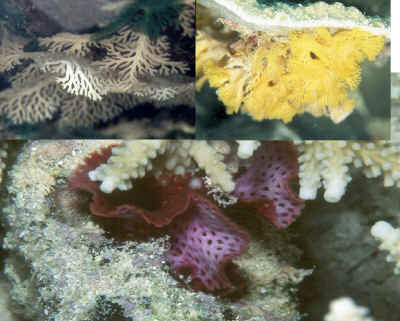
| There are many other groups, like these Bryozoans
(Moss Animals) shown here that are principally filter feeders as
well. To a large extent dependent on sex cells and larval forms for
nutrition. |
 |
| The Whale and Basking Shark, Manta Rays... all
filter feeders. Think of the most intensely fished species of
schooling fishes: herrings, menhaden, anchovies... all filter
feeders at least as young. There are even slime-filter feeders like
some of the Parrotfishes and Wrasses, that collect food items on
their sleeping cocoons, ingesting it on wakening for
nutrition. |
 |
| This is certainly not an exhaustive list, though
the principal sources of mortality in the seas are listed. |
 |
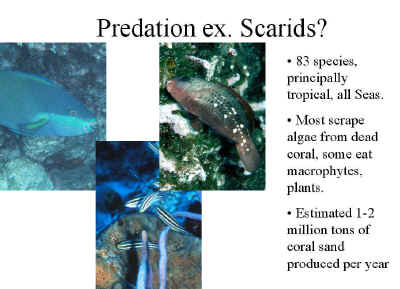
| My fave example, indeed, the ONE I was going to
make my entire pitch, has to do with Parrotfishes, family Scaridae,
and their role as producers of coral sand... Though not all species
feed directly on live coral polyps, one can calculate of the
populations of those that do to some extent, energetics of their
consumption patterns that a good one to two million tons of such
sand is produced, eliminated through the scarids in the course of a
year of their chewing. |
 |
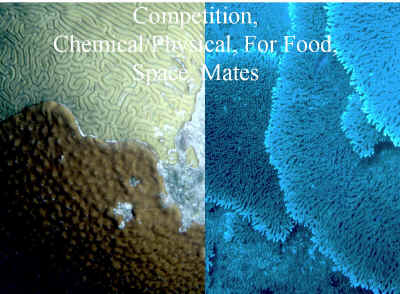
| Overgrowing to gain advantage of using available
light, digestive dominance are observable elements of competition
between stinging-celled animals. To what extent does such
competitive behavior, chemical and physical impugn other
individuals and species ability to survive? |
 |
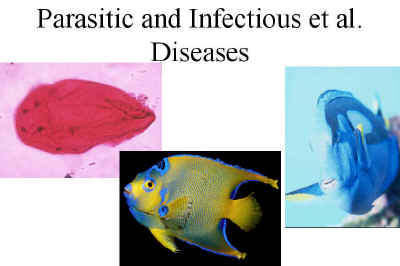
| The role of "living together" (symbioses)
from seeming mutualism to commensalism to degrees of parasitism is
just beginning to get due consideration as direction and pressure
in evolution, let alone the effects of outright infection,
infestation by parasites and infectious agents. Yes, your livestock
encounter the same sorts of complaints in the wild as in your
aquariums. Here is shown a "Black Spot" Paravortex worm,
lymph on a Queen Angel, and crypt on a tang. |
 |
|
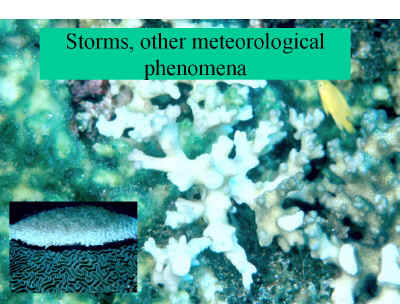
Storms can be a tremendous source of reef damage and outright
mortality. The many tons of dust blown off from northern African
deserts has been implicated on deaths/bleaching of corals of the
tropical West Atlantic...
Another pleasing example might be the seas between Viti Levu
and Vanua Levu in Fiji... Have been there, witnessed a good part
of the reef flat exposed by a cyclonic storm.
|
 |
| Cumulative genetic defects with time, replication
take their toll in the wild. Though it seems rare (most all
"old", sick, less able organisms seem to perish by
"red tooth and claw") there are a few times I have seen
obviously "old age" at work in the end of marine
lives. |
 |
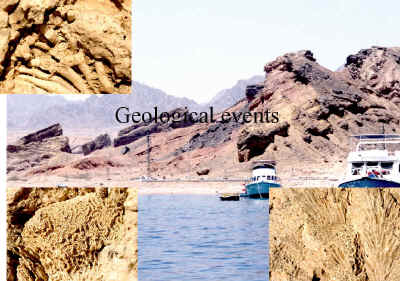
| Though relative to our experience, life spans this
doesn't seem to be a large source of mortality, there are
obvious cases where geological events have produced spectacular
losses of life. Here is an example, the Sinai Peninsula in the
upper Red Sea... the cliffs behind are made up of coral reefs that
have been pushed up eons past. Florida could be used as another
example. |
 |
|
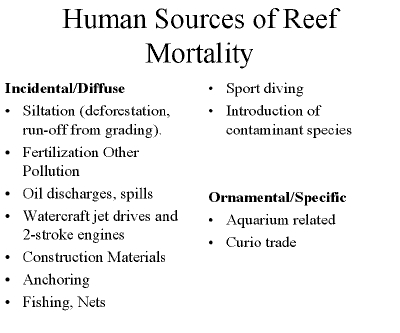
Many human activities are of consequence in ending, changing
which life forms are favored in altered environments. Some of
these sources of mortality that are profligate are little
discussed. Here I've listed (and will give examples) of the
principal categories.
As you will find, the hobby use of wild-collected stocks is
relatively tiny.
|
 |
|
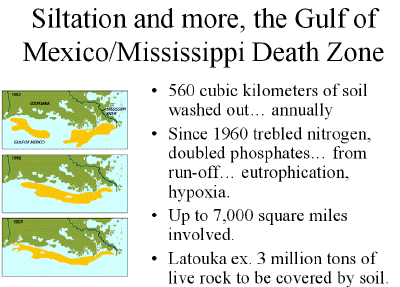
Sessile invertebrates, algae can't "get away" when
activity on neighboring land rains down soil and other solids.
The best documented account are the siltation and fertilization
effects of the Mississippi on the Gulf of Mexico.
Another one: Near Nadi, Fiji to the Harbor at Latouka.
Some 21 kilometers by 500 feet or so of "reclaimed
land" to be filled in seaward...
|
 |
|
|

