Featured
Sponsor


Related FAQs: Stegastes, Damsel Identification, Damsel Selection, Damsel Compatibility, Damsel Feeding, Damsel DiseaseDamsel Reproduction,

Related Articles: The family Pomacentridae, the Damselfishes

/A Diversity of Aquatic Life

 Genus Stegastes Damselfishes

By Bob Fenner

    Stegastes fasciolatus

Species/Notes of Interest To Aquarists:

This genus (now including Eupomacentrus) of some thirty four species, includes the feisty Gregory's and other mainly shallow reef Damsels, that live solitarily... about rocks and caves in the sand they dig.

Stegastes acapulcoensis (Fowler 1944), the Acapulco Major. Eastern Pacific; Baja California to Peru. To five and a half inches in length. To variably brown/tan adults from gorgeous blue juveniles. Shown, one inch specimen off Mexico's Cabo San Lucas. 

Stegastes arcifrons (Heller & Snodgrass 1903), the Island Major. Good looking and... quite a bonus, a known Aiptasia eater! To 13 cm. Eastern Pacific: Costa Rica and from Cocos, Malpelo and Galapagos islands in shallow, rocky shores. Typical for genus, this is a territorial species that is constantly looking for, if not driving off members of its own and often, other fish species. Feeds on algae and small invertebrates, including tubeworms and anemone tentacles.

Intermediate and adult individuals in the Galapagos.

http://www.fishbase.org/Summary/SpeciesSummary.cfm?ID=12510&genusname=Stegastes&speciesname=arcifrons

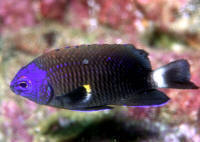
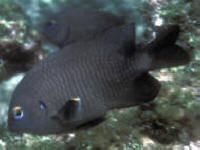
Stegastes beebei (Nichols 1924), the Southern Whitetail Major or Galapagos Ringtail Damselfish. Eastern Pacific, Panama to Galapagos. To six inches maximum length. Juvenile, intermediate and adult photo in the Galapagos.


Stegastes apicalis De Vis 1885, the Australian Gregory. Western Pacific, east coast of Australia. To six inches maximum length. The four inch individual pictured photographed on Australia's GBR off Heron Island.

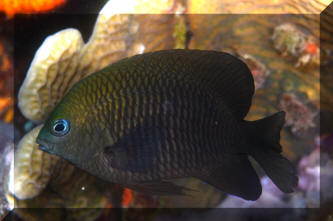
Stegastes diencaeus (Jordan & Rutter 1897), the Longfin Damsel. Tropical west Atlantic. To five inches in length. Occasionally imported and sold as juveniles. Adults an overall brown with dark margins on all scales. Juveniles in the Bahamas and St. Thomas.

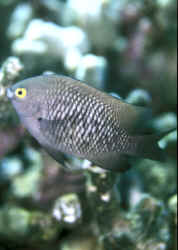
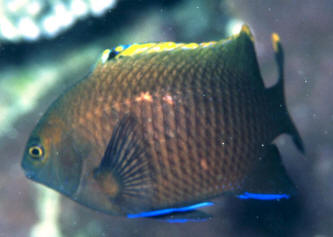
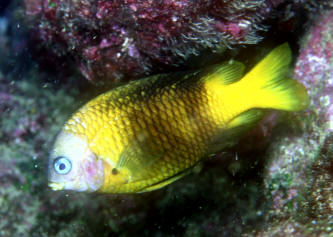
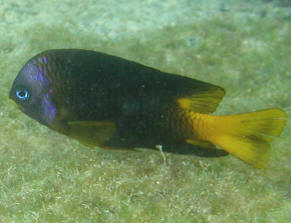
Stegastes fasciolatus (Ogilby 1889), the Pacific Gregory. Indo-west Pacific. Not a great beauty and at up to six inches in length, a handful. But an interesting, intelligent addition to a rougher aquarium setting. These images  younger to older individuals in Hawai'i.
Stegastes favilatus (Gill 1862), the Beaubrummel Gregory. Tropical eastern Pacific. A Pacific model (sibling species) of the Atlantic Beau Gregory, S. leucostictus, and just as feisty. Adults just as plain brown as well. To  almost four inches in length. This juvenile off Mexico's Cabo San Lucas, Baja.

Stegastes fuscus (Cuvier 1830), the Dusky or Brazilian Damselfish. Tropical West Atlantic (and eastern, off Senegal). To five inches in length. Feeds on benthic algae, hydroids, algae, copepods by day. Adult off of Cozumel. 

Stegastes leucorus (Gilbert 1892), the Whitetail Major or Gregory. Below, a series of images of juv., sub-adult and adult specimens of the subspecies S. l. beebei in the Galapagos. To 14 cm. Eastern Central Pacific: Mexico, including the Revillagigedo and Guadalupe islands. Photo taken in the Galapagos.
http://www.fishbase.org/Summary/SpeciesSummary.cfm?ID=
12514&genusname=Stegastes&speciesname=leucorus
Stegastes leucostictus (Muller & Troschel 1848), the Beau Gregory Damsel. Tropical west Atlantic. To almost three inches in length. A standard in the trade, coming out of the Atlantic though feisty toward other fish livestock. Adult in St. Lucia.

Stegastes lividus (Forster 1801), Blunt Snout Gregory. Indo-Pacific; Red Sea, East Africa through to and including the Micronesians. To 13 cm. An aggressive species found in shallow water, feeding on filamentous algae and driving off would-be competitors for food, including divers! N. Sulawesi pic. 


Stegastes partitus (Poey 1868), the Bicolor Damselfish. Tropical west Atlantic. To two and a half inches in length. Occasionally imported for our use. Not tremendously beautiful looks-wise, but an interesting aquarium species just the same. St. Lucia and Cancun photographs.

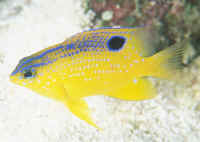
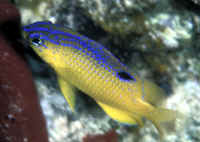
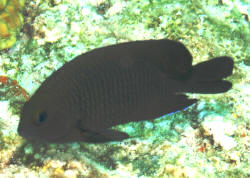
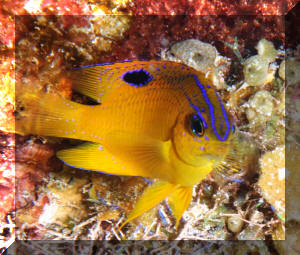
Stegastes planifrons (Cuvier 1830), the Three-Spot (Atlantic) Damsel. Tropical west Atlantic. To three and a half inches overall length. Juveniles, with their bright yellow bodies and bold black body spots are occasionally caught for aquarium use... ultimately turning into bland brown behemoths. Juvenile and sub-adult in the Bahamas. Full size one that bit me in Cozumel.
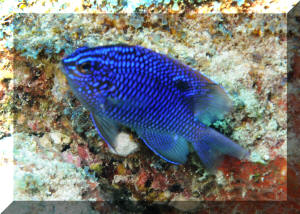
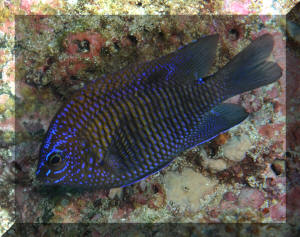
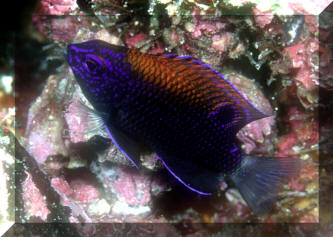
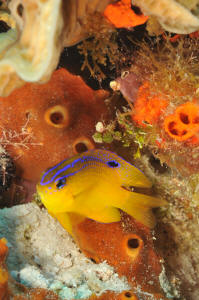
Stegastes rectifraenum (Gill 1862), the Cortez Gregory. A bright blue beauty of the Sea of Cortez, twixt Mexico's Baja and Pacific shore as a juvenile... whose metallic luster breaks up and becomes dull to dark brown as an adult. To three and a half inches in length. Juv. picture from Mulege, adult off Punta Chivato, Mar de Cortes.

Stegastes variabilis (Castelnau 1855), the Cocoa Damselfish. Tropical west Atlantic. To three inches long. Similar to Beaubrummel, but juveniles bear a distinct black ocellus after their dorsal fins. Adults yellowish below, grading to brown above. Juv. and adult images taken in the Bahamas. 


Bibliography/Further Reading:

Allen, Gerald R. 1975. Damselfishes of the South Seas. TFH Publications, Neptune City, N.J.

Allen, Gerald R. 1976. How many sergeant majors? Marine Aquarist 7(6):76.

Allen, Gerald R. 1991. Damselfishes of the World. Aquarium Systems, Mentor, Ohio.

American Society of Ichthyologists and Herpetologists, 1978. The Biology of the Damselfishes a symposium held during the 56th annual meeting of the ASIH. Rosentiel School of Mar. & Atm. Sci. U. of Miami, 1980, 145-328.

Bunn, D., 1987. Spawning the Dusky Damsel. Aquarist Pondkpr. 52(1):41

Fenner, Robert. 1998. The Conscientious Marine Aquarist. Microcosm, VT. 432pp.

Fenner, Robert. 1999. The indomitable damsels- Family Pomacentridae. TFH 1/99.

Gronell, A.M., 1984. Look-alike damsels. TFH 32(8) 48-53.

Hemdal, J., 1985. Pomacentrids of the Atlantic. Freshwater and Marine Aquarium Magazine 8(4) 48-52

Pearson, Scott. 1993. On photographing the feisty damsels. Sea Frontiers May/June 93.

Stratton, Richard F. 1991. The Beau Gregory. TFH 1/91.

Stratton, Richard F. 1992. The Beau Brummel damsel. TFH 7/92.

Thresher, R.E., P.L. Colin & Lori J. Bell. 1989. Planktonic duration, distribution and population structure of western and central Pacific damselfishes (Pomacentridae). Copeia 1989(2), pp. 420-434.


Featured Sponsors:
Google
 
Web www.WetWebMedia.com

Amazon Honor System Click Here to Pay Learn More