 |
|
| Home | Marine Aquariums |
Freshwater Aquariums |
Planted Aquariums |
Brackish Systems |
Ponds,
lakes & fountains |
Turtles & Amphibians |
Aquatic Business |
Aquatic Science |
Ask the WWM Crew a Question |
| Please visit our Sponsors | ||||
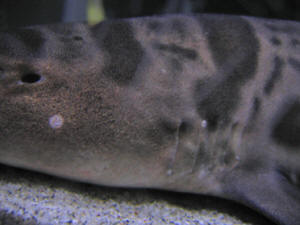
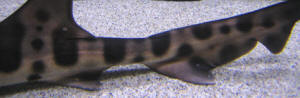
- Cloudy Eye on Leopard shark - <Greetings, JasonC here...> I have a 14 inch Leopard shark that I have owned for about 6 months. Last week I noticed her left eye was beginning to build up a white mucous near the inside corner of the eye. The LFS recommended Mela-Fix, so I tried adding it to the tank as directed. Since, I have noticed that the build up is getting worse. It now covers about half of the eye and has developed a bit of a lump shape. It looks as if it could be wiped off, but I am not sure that would solve the problem. So, I thought I would check with the experts first to see what you would recommend. Thank you, your site has contributed greatly to the aquarium industry, Gene Hart <Well... you don't reveal much about the system this animal is being kept in, and 9.999 times out of 10 the systems people choose for these sharks are completely inappropriate. Additionally, at a size of 14", it sounds like you've obtained a juvenile which would not be in your advantage or the fish's. Sadly, these are often harvested from a live shark by slicing it open, and the pups released and the mother shark disposed of. It's a gruesome harvest that does no one any good... additionally, these sharks are cool water sharks - if you don't have a chiller, it will die. Most often the symptoms you describe are brought on by the environment so I would start by looking there. I can't state strongly enough that these sharks are inappropriate for anything but a public aquarium, and unless that's who you represent, you've done everyone in the chain of obtaining this fish a great disservice. By purchasing it and taking it home, you've encouraged people to continue the forced and sometimes premature birth of these fish - the destruction of the mother - and your local dealer purchasing the fish. These fish should be left in the ocean. Please read this link: http://www.wetwebmedia.com/coolh20sharks.htm Quite sincerely, J -- > - Removal of Infected Fish vs. Medication - Dear Bob. <Actually, it's JasonC today...> I recently discovered the web site you and your other experts are involved in. I have been involved in the marine aquarium hobby for 12yrs. I have a recent complicated scenario which could use some expertise advice. So many of the owners in the local aquarium trade, where I live now have limited knowledge of Elasmobranch health and basic knowledge. Up to this point I have relied mostly on my previous experience and from several books. However I should point out that I have relied heavily on Scott W. Michaels book and of Martin Moe in the past. I have 2 Leopard sharks which from behavior and visual inspection appear to be in good health. They are 18" and I purchased them from a friend who had much to small of an aquarium. My aquarium is 120"L X 42"W X 36" H aprox 800 gal. <Well... if you've been using Scott Michael's book, then you know this tank is too small for these sharks.> Temperature is 72 with the chiller keeping it within 1 degree fluctuation. <That's still too warm - should be in the 60-65 degree range, no higher than 70. If you've ever been diving where these sharks live, then you know the water there only gets to 70 in the dead of summer, and the rest of the time is rarely warmer than 65 degrees. Please consider lowering the temperature.> The wet/dry was made for a 1200 gal tank so ample biological filtration and large down draft. ph 8.2, density 1.020. The plan for a salt water pond is under way so as they grow larger they will have a permanent and healthy life. <How are you going to chill an outdoor pond in Florida?> My main urgent concern is with another tank mate a Vlamingi Naso tang that appears to have a serious case of Cryptocaryon or Marine Ich? I have begun treating the tank with Metronidazole, but have come to the understanding that this may not cure the tang, and the tank itself along with the other fish are probably already hosts. <Correct on both accounts.> If by removing the tang could this help prevent infection of the other tankmates? <Well... as you mentioned, it is probably to late to prevent infestation, but... you need to treat Ich with copper, and that MUST be done in a separate tank - the sharks won't do well with this compound around at all.> I have also begun feeding the sharks shrimp permeated with the Hex-A-Mit. There are a total of 5 fish including the tang. The others are a Panther grouper & Mangrove snapper. <My friend, this livestock mix is inappropriate. As I mentioned before, this tank should really be kept somewhere near 60F - and the other fish you have in here will not do well at that temperature. Likewise, the sharks will not do well at the upper end of their tolerant range. You really need to reconsider this mix.> At this point they show no signs of infection. I know there has been studies that show Tangs are more prone to Marine ick. Would you recommend to continue with the current medication? <No, you need to remove the tang and begin treatment with copper and freshwater dips.> Is there any other recommendations you could advise me of? I know most sharks cannot tolerate a Hyposalinity treatment, but can Leopard sharks tolerate it? <No, they can't - sharks need the salt to regulate their internal systems, and will quickly perish in hypersaline water.> Thank You, for your expertise on this serious situation, Scott Mc Kirgan Naples, FL <J -- > Leopard Shark and Lionfish - No Copper, Please, & No Goldfish Hi, <Hi Tim, MacL here with you today.> I just have a few questions that I have been wondering and you guys seem to be the best fitted to answer the question. I currently have a leopard shark in a 125 gal tank. I have already read many posts from your crew not to keep leopard sharks in captivity, but it's too late I already have one. I would not have purchased the shark if I had done more research on them. The shark is in a 125 and the shark is about 24". I was feeding it Shark Formula put out by Ocean Nutrition until I introduced him to prawn from the local grocery store. It has now been eating the prawn now for about 6 months. Out of nowhere the shark stopped eating. He has not eaten but a few glass shrimp from the local pet shop in the past 2 months. I have tried giving it flounder, scallops, shrimp, and the Shark Formula, but it doesn't seem to want it. It will pick the food up and spit it out. <Sounds to me like your tank conditions might be a bit off, in my experiences with Sharks when they stop eating like that they have high nitrates.> I had thought that it may have been because I was running CopperSafe with it, but I have not had copper in the tank for some time now and still no progress. <EEEK, Sharks do have adverse reactions to the copper so that might indeed be the root of the problem. I would do several changes of the water to try to get as much copper out as possible. Also you can run PolyFilters in the tank and see if it turns colors to indicate that copper is still there. Or an accurate test kit as well.> <Editor's note: Sharks and their kin should be considered as invertebrates, no copper!> So my question is what should I be feeding my leopard shark and why might he be not eating. Could it be some sort of hibernation effect since it is winter months? I am currently in the process of purchasing a 300 gallon tank. to keep him for maybe another year until donating him to an aquarium. <You should check now with the aquarium you plan on talking to a lot of times they need a lot of advance time before taking the shark and /or they might not want them.> Another question about the leopard shark, is there anyway to sex them? <Males have claspers.> I also have a 90 gal tank that I have two lionfish in. I purchased the tank with one lion and it was about 10" at the time and is now about 14", and the other I grew up from a little guy and it is about 10" now. The large lion has always had issues with his side fins growing, they curl as they grow and seem to break easily. <Tank is too small for him I'm sorry to say. Also he probably has a vitamin deficiency if you are feeding freshwater fish to him.> I was thinking that it may be from poor nutrition. <Sounds like you are right on track, they need vitamin supplementation if you use freshwater fish like goldfish to feed them. You should try to get them converted over to things like prawn and smelt etc. Also they need a variety in their diet and not just one type of food. This is much easier to do with the younger fish.> The smaller lion has beautiful side fins and I feed him all live also, but it is fairly young compared to the larger one. I have read recently that lions should not be fed freshwater fish due to some type of toxic chemical that can harm the fish over time. What should I be feeding my lions. Also, is there any way to sex a lion fish? <Not that I am aware of, although a male and female tend to stay closer in a tank to each other. Also, there's an amazing article about lionfish in one of last years articles of Coral, great info there. Good luck, MacL> Leopard Sharks in a small world I have two leopard sharks in a 180. I have had them for 1 year and everything was doing great until my baby nurse was getting red on the bottom and just stopped eating and dies in two days. The same thing is happening to my leopard shark. <Typical...> Just one of them just stop eating and is turning red on the bottom and is not moving. All levels are perfect and my filtration is excellent with two wet dries, protein skimmer, and UV. It like a host that attacks the fish and kills them in two days. I really need help with this it makes me sick that am going to lose both of theses sharks. Any question please call me at XXXX Thanks Darrell <We don't "do calls"... Please read my articles archived on WWM re coldwater sharks, Leopards, Nurses... the inappropriateness of their hobby keeping... Bob Fenner> Leopard Shark Diseases Could you please tell me what are two common diseases of the Leopard Shark (symptoms, treatments, and prognosis)? Thank you <Without a doubt they are both environmental: being kept in too small and non-chilled systems. I take it you've read my bit on Triakis posted on WWM. Bob Fenner>
|
|

|
Features: |
|
| Featured Sponsors: |