|
|
| Home | Marine Aquariums |
Freshwater Aquariums |
Planted Aquariums |
Brackish Systems |
Ponds,
lakes & fountains |
Turtles & Amphibians |
Aquatic Business |
Aquatic Science |
Ask the WWM Crew a Question |
| Please visit our Sponsors | ||||
Question: I have a 240 gallon
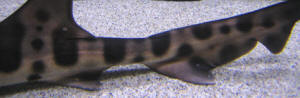
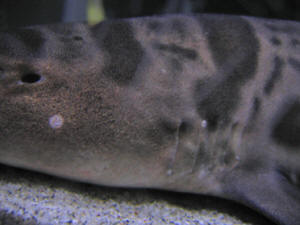
tank, 8ft x2 x 2. I bought a small leopard shark (8-9"). I
have read that they don't see too well and rely on their smell. I
have feed him frozen krill and live fish. The shark seems almost blind.
He eats the krill only after bumping into it. He seems to smell the
food but has a hard time finding it. And the live fish I have to hold
with a pair of tongs and put it directly in front of him. Is this
normal eye sight for the leopard shark? This is the only fish in the
tank and I am concerned if I add another fish, perhaps a trigger
(something aggressive), the shark will not be able to compete for food
due to his eye sight. Feeding a Leopard I recently purchased a 12 inch leopard shark, I was wondering what would be the best food to feed it. Thanks in advance. > In my opinion cut fish, or whole fish... and not too frequently... these are messy feeders... and you don't want yours to grow too fast, or eat, waste too much... BTW, this shark, Triakis fasciatus is a cool/cold water animal... am curious about the environment you're providing it... How big, the shape of the tank, if you're using a chiller, if there are other livestock in with it... Bob Fenner Leopard Shark and Lionfish - No Copper, Please, & No Goldfish Hi, <Hi Tim, MacL here with you today.> I just have a few questions that I have been wondering and you guys seem to be the best fitted to answer the question. I currently have a leopard shark in a 125 gal tank. I have already read many posts from your crew not to keep leopard sharks in captivity, but it's too late I already have one. I would not have purchased the shark if I had done more research on them. The shark is in a 125 and the shark is about 24". I was feeding it Shark Formula put out by Ocean Nutrition until I introduced him to prawn from the local grocery store. It has now been eating the prawn now for about 6 months. Out of nowhere the shark stopped eating. He has not eaten but a few glass shrimp from the local pet shop in the past 2 months. I have tried giving it flounder, scallops, shrimp, and the Shark Formula, but it doesn't seem to want it. It will pick the food up and spit it out. <Sounds to me like your tank conditions might be a bit off, in my experiences with Sharks when they stop eating like that they have high nitrates.> I had thought that it may have been because I was running CopperSafe with it, but I have not had copper in the tank for some time now and still no progress. <EEEK, Sharks do have adverse reactions to the copper so that might indeed be the root of the problem. I would do several changes of the water to try to get as much copper out as possible. Also you can run PolyFilters in the tank and see if it turns colors to indicate that copper is still there. Or an accurate test kit as well.> <Editor's note: Sharks and their kin should be considered as invertebrates, no copper!> So my question is what should I be feeding my leopard shark and why might he be not eating. Could it be some sort of hibernation effect since it is winter months? I am currently in the process of purchasing a 300 gallon tank. to keep him for maybe another year until donating him to an aquarium. <You should check now with the aquarium you plan on talking to a lot of times they need a lot of advance time before taking the shark and /or they might not want them.> Another question about the leopard shark, is there anyway to sex them? <Males have claspers.> I also have a 90 gal tank that I have two lionfish in. I purchased the tank with one lion and it was about 10" at the time and is now about 14", and the other I grew up from a little guy and it is about 10" now. The large lion has always had issues with his side fins growing, they curl as they grow and seem to break easily. <Tank is too small for him I'm sorry to say. Also he probably has a vitamin deficiency if you are feeding freshwater fish to him.> I was thinking that it may be from poor nutrition. <Sounds like you are right on track, they need vitamin supplementation if you use freshwater fish like goldfish to feed them. You should try to get them converted over to things like prawn and smelt etc. Also they need a variety in their diet and not just one type of food. This is much easier to do with the younger fish.> The smaller lion has beautiful side fins and I feed him all live also, but it is fairly young compared to the larger one. I have read recently that lions should not be fed freshwater fish due to some type of toxic chemical that can harm the fish over time. What should I be feeding my lions. Also, is there any way to sex a lion fish? <Not that I am aware of, although a male and female tend to stay closer in a tank to each other. Also, there's an amazing article about lionfish in one of last years articles of Coral, great info there. Good luck, MacL>
|
|

|
Features: |
|
| Featured Sponsors: |