|
FAQs on Freshwater Head & Lateral Line
Disease, HLLE, HITH (Hole In The Head)... Case
Histories
Related Articles: Head and Lateral Line Disease (HLLE), Freshwater
Diseases, FW Disease Troubleshooting, Ich/White Spot Disease, Freshwater Medications,
Related FAQs: Freshwater HLLE 1, FW
HLLE 2, & FAQs on FW HLLE: Causes/Etiology, Cures, Non-Cures, SW Case Histories, & Marine HLLE:
HLLE 1, HLLE 2, HLLE 3, Nutritional Disease, Aquarium
Maintenance, Freshwater
Medications, Freshwater
Infectious Disease, Freshwater Fish Parasites,
Ich/White Spot Disease, African Cichlid Disease 1, Cichlid Disease,
|
|
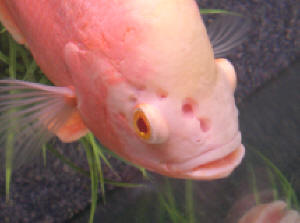
Uaru Hexamita 4/26/16
Hello. I am Svetlana. I have 3 Uaru 3”. I got them in January from local
pet store. They was in the store for 2 month and was eating everything
they would give them. I place them in my 55 gl with 2 butterflies and 3
clown loaches ( I will buy a big tank later). I take water to pet store
to check, they told me everything is good, pH 6.5,
<What is the water hardness here?>
temperature 82F. They stop eating and got white stringy pop after 2
weeks I had them. I treat whole tank with Seachem Metroplex.
They got better and was eating after dosing for 5 times every 2nd day.
<I'd stop... Metronidazole is too nephrotoxic...>
2-3 weeks later same problem ( not eating, white pop). I treat them in
hospital tank 10 gl with 7 doses of metro aging. they did get better and
were eating, but 2 weeks later same problem. Please l have a couple
questions:
1.I think it is Hex and only treatment is metro??
<Is the best>
2. I am dosing them in 10 gl tank for a 5 days now without any
improvement yet… they have not being eating for around 10 days now.
<Stop; the problem is something else>
They are in the 10 gal tank and I dose them with Seachem Metroplex 3
times now accordingly instructions. please let me know if I should
increase the dose? or any other meds i should be using?
<I'd try an Anthelminthic... Praziquantel... see WWM re>
Please help, Svetlana
<Trying. Bob Fenner>
Juvenile Uarus hex? 4/26/16
On the pictures one fish has long white-clear long string (pop?).
<Appears to be... Need to sample and look under a microscope... for
encapsulated eggs, or? BobF>
The other two do not pass any poo last 2 days...
I soaked mini blood worms in metro and garlic and refroze it. I know
they should eat veggies but it is only one of them would have interest
in. But spit it out and nothing is eaten....I even bought and put plants
for them (they was destroying them before), no interest .... Thanks,
sorry for long emails.
Re: Juvenile Uarus hex? 4/27/16
Hello Bob, I will try to find somebody to do the test with microscope.
Should I continue with Metro for now??
<See our first email: No; kills fish kidneys w/ too much exposure>
Do you think the salt in small amount would help?
<Perhaps Epsom; as gone over on WWM.>
higher temperature ( 85F now)??
<IF you can keep up dissolved oxygen. B>
Re: Uaru Hexamita 4/30/16
Hello Bob thank you for reply. I did PraziPro for 5 days prior the last
treatment of metro and was no change. In the store they told me that I
can use PraziPro with metro together.
<Yes; this is so>
I did not remove PraziPro from the water and started metro on april21
daily. Hardness was 9 last time I checked but I will go to pet store
again and send you the correct reading of everything. Due to metro
treatment I have no chemical filtration and I go 30%water change with
bottom clean up daily using 1day aged conditioned water.
<Very good>
I redose the mess for new changed water amount. The tank is not cycled.
<Yikes; bad>
I do have established 55 gl tank with clear water, can I use that?
<Yes>
I live in small town and may be our water is not good?
<Can't say from here>
I can bring water from different city (it is what I did 2 years ago for
5 years) ?? I can even get osmotic water if you think it would help?
<Ask at your "water district"... the contact info. should be on your
water/utility bill; for water quality analysis>
Any of your advise would be very helpful to me. Thank you, will send you
a picture of them��
<Please do. Bob Fenner>
|
Geophagus With Lateral Line Erosion...(all my fault)
4/11/15
Dear Wet Web Media Crew,
<Lynnie,>
The past month was very hectic for me...traveling around the country to visit
grad schools, working on research, lots of presentations to do...as a result, I
STUPIDLY did not do a water change for four weeks...
<Uh-oh... To be fair, some fish handle high nitrates ("old water") rather well,
and these were the popular ones through the 60s and 70s. Non-fancy Guppies, many
of the hardy characins, Corydoras, etc. Provided the tank is
otherwise well-maintained with plenty of plant growth (even algae) to extract at
least some nitrate, these fish don't seem too bothered even by 100 mg/l nitrate
levels. However, as you correctly surmise, cichlids are not among this group!
They are notoriously sensitive, jumbo cichlids, Tanganyikan cichlids and dwarf
cichlids especially.>
I finally had a break in the schedule and decided to do a 50% water change (I
did not do more than that because from experience suddenly doing a 90% water
change after none for a while kills fish) and noticed that my Geophagus has lost
skin in three small patches of his lateral line. It is not white,
pus-filled...just skin missing. I know this species is sensitive to nitrate but
he was perfectly healthy and growing larger until now, leaving the tank without
a water change for so long. I did the 50% change and added 1.5x the usual
SeaChem Prime amount.
Is it possible for the erosion to go away if I return to my weekly water change
schedule and bring the nitrates back down?
<Probably not.>
I know there are antiparasite medications for HLLE but I want to avoid using
them if I can, given that the disease is mostly environmental.
<Yes, the environment triggers the outbreak, and yes, there is some evidence of
a link between HLLE and the Hexamita parasite that is very possibly latent in
all farmed cichlids. But once "the cat's out of the bag", cichlids don't seem to
(usually) recover under their own steam. You need to push back the Hexamita or
whatever bacteria are infecting the pores, and that, in time, allows the skin
tissue to heal again. In short: the Metronidazole and Nitrofuran antibiotic
combination does seem optimal, though eSHa at least manufacturer an all-in-one
product called eSHa
HEXAMITA that supposedly treats mild cases of HLLE and HITH reasonably well
despite lacking both these ingredients.>
Thank you,
Lynnie
<Most welcome, Neale.>
Re: Geophagus With Lateral Line Erosion...(all my fault)
4/11/15
Will these products destroy my bio filter? Because to be honest I am afraid I
don't really have time to set up a hospital aquarium and monitor it a lot...I am
running up the deadline to my senior thesis right now.
<Used as directed they should be safe. If in doubt, reduce/stop feeding, and use
Zeolite in the filter (changed every few days) as a chemical adsorbent of
ammonia. Cheers, Neale.>
Re: Geophagus With Lateral Line Erosion...(all my fault)
4/11/15
Thanks.
<Welcome.>
My hospital tank is much smaller and uses Zeolite, so I need to monitor it very
closely when using it to know how often I need to replace the Zeolite.
<You can't predict this. That's why you test, daily, with ammonia detector.
Assume replacement every couple days, but really, depends on the size of the
fish, how frequently you do water changes, how often you feed the fish, etc...>
I can definitely treat the Geophagus in the main tank.
<Often sensible.>
Out of curiosity I found an "electric blue" blue Acara, but it was sick. If I
find a healthy one, I am going to probably replace the Geophagus with it.
How sensitive are Acara to nitrate?
<Fairly sensitive. Skip water changes for a couple weeks, and you'll know about
it.>
From my experience Severums can tolerate a month without water changes ( I kept
them when the tank was solely cleaned by the monthly service) but I don't know
about Acara.
<Indeed. A good rule of thumb is that "old school" fish were often fairly
tolerant: Port Acara, Severums, Jewel Cichlids, even Angels to some degree.
But all cichlids are more sensitive to nitrate than tetras, barbs or catfish,
and I wouldn't recommend any of them for "near-zero maintenance" systems.>
I am not saying I plan on only doing water changes once a month, but as I said
before I am leaving to grad school this fall and I want something that won't die
if my family end up not changing the water for a couple of weeks...I know
cichlids aren't as hardy as cypriniform fish but there aren't many of those with
bright blues and greens.
<Understood. Cheers, Neale.>
Re: Geophagus With Lateral Line Erosion...(all my fault)
4/12/15
I bought the medications you recommended but their instructions conflict.
Metronidazole bottle says I need to change the water every 24 hours.
Nitrofurazone says every 48 hours. Which one should I follow? I did another 50%
change today. Nitrate was 5-20ppm this morning before that so it shouldn't be
too high now.
<I would go along with what the Metronidazole says. It's the most important, and
in any event, medications get metabolised in the aquarium pretty quickly, so I
doubt much is left behind beyond 24 hours. But I'll leave the last word to Bob
Fenner; he's got more experience of this/these medications than I do. Cheers,
Neale.>
Re: Geophagus With Lateral Line Erosion...(all my fault) RMF, second opinion!!
4/19/15
Dear Wet Web Media Crew,
So I have given the Geophagus four doses of the Metronidazole and two doses of
the Nitrofurazone. I gave the latter in half doses as I didn't want to stress
the bio filter too much. I ran out of the pure Metronidazole but I have API
general cute, which has both Metronidazole and Praziquantel. Could I use it
until I get more pure stuff, or is the unneeded Praziquantel too risky?
<Should be fine.>
I am curious: would it make the Metronidazole more effective if I gave it as
medicated food? I have been using it as a bath.
<It's much, MUCH better as food... gets inside the fish more quickly.>
As for the Geophagus, the erosion is gone on his left side, but is still holding
steady on his right side. To be honest I don't think it is Hexamita as the other
usual symptoms (head erosion, stringy feces, pus etc) are not present. If it
isn't then perhaps the antibiotic is more important and should be stepped up?...
<Metronidazole is an antibiotic, so should help in this direction too.>
-Lynnie
<Cheers, Neale.>
Re: Geophagus With Lateral Line Erosion...(all my fault) RMF, second
opinion!! 4/30/15
Dear Wet Web Media,
I am happy to report that the right side lateral line erosion in my Geophagus is
healing over.
<Excellent.>
I've finished the recommended dosages of Nitrofurazone and Metronidazole. I was
wondering how long you think I should keep medicating him.
<One round may be sufficient if the fish is improving, PROVIDED water quality
and diet are excellent. I'd certainly wait a week or so before considering a
second round of treatment, with a couple decent water changes thrown in to
dilute any remaining medicine.>
Do you recommend any places online for buying medicine for fish?
<Can't help you here. In the UK these med.s. are strictly prescription only.
Indeed, buying from a vet may be cheaper if the vet can prescribe a larger
quantity at once go than you'd get from a pet shop. Otherwise online purchases
may be helpful, but you never really know what you're getting from eBay and the
like.>
Because buying it from my LFS has been very expensive. Just out of curiosity, in
reading about lateral line erosion in cichlids, I've heard some people
claim carbon in the filter can cause it, as well as poor diet.
I'm skeptical about the former, but the latter seems it could have some
validity.
<Absolutely. The carbon thing has been around for years and seems to lack any
science behind it. But diet is surely crucial. Many cichlids are strongly
herbivorous in the wild, but we often don't give them much by way of fresh
greens.>
Then again, I think most of the dietary claims were addressed towards people who
feed their cichlids things they shouldn't like beef hearts and goldfish?
<Indeed. What we're talking about is giving cichlids a safe (i.e.,
parasite-free) diet that's varied (i.e., includes plant as well as animal
foods).>
Just for future reference what are the tolerable nitrate levels for cichlids
like Geophagus and blue Acara? I know in general <20ppm is a good idea but is
that still too high?
<It's fine.>
Thank you,
Lynnie
<Cheers, Neale.>
Re: Geophagus With Lateral Line Erosion...(all my fault) RMF, second
opinion!!
5/30/15
Dear Wet Web Media Crew,
<Lynnie,>
It's been about a month and I can't really tell if the Geophagus' lateral line
is getting better anymore or not. Do you have any idea how long it
generally takes to go away?
<A long time. You should quickly see any loose material fall away and
the holes obviously not getting any bigger (or any new holes appearing). But the
pits themselves, once formed, take a long while to heal. Quite possibly months,
and the fish may well never completely heal, with obvious scars remaining.>
It's restricted to a patch on his right side, and it's sort of just...there.
I've gone back to my weekly 50% water changes.
<Do bear in mind that HITH/HLLE are strongly affected by diet and environment.
Optimise both.>
I will say that I had to fast the fish for three days after one of my giant
Danios ate way too much...they've learned to eat from the bottom now, and
they're so much faster than the other fish. I've been able to get enough food to
the other fish, but it's been difficult to prevent the Danios from eating too
much for their stomach-less bodies. Could the fast have made the Geophagus'
condition worse?
<Nope.>
I know you said many cichlids are mostly herbivorous, but I think Geophagus
mostly eat invertebrates.
<More specifically, they sift the sediment for insect larvae and organic
detritus. They will be consuming a lot of algae in the process. Apart from the
dedicated piscivores, pretty much all cichlids consume some combination of
insects, algae and detritus.>
How often should they be given fresh greens?
<As often as they'll take them; certainly weekly.>
He'll eat carrots, and peas, but tougher things like leafy vegetables and
cucumbers don't interest him at all.
<Indeed. He's not a specialist herbivore like a Severum, but anything soft and
mushy is fair game.>
Thank you,
<You're welcome.>
Lynnie
P.S. I recently saw a really horrifying video of someone feeding their
girlfriend's Finrot-infected Betta to their Oscar to put it out of its misery
(or more likely, transfer its misery to the Oscar). Worst of all, someone I
respected defended it with the standard "it happens in nature" response...kudos
to you guys for standing up to this nonsense. (I once kept a pair of venustus
whose favorite food was seaweed; this idea that predatory cichlids only eat live
fish is complete nonsense.)
<Quite so. Back in the early 80s when I started keeping fish, I came across a
pet shop with half a Goldfish (the front half) swill alive, gills and mouth
moving as it breathed, but obviously unable to swim because it had lost its back
half. They'd been feeding Goldfish to Oscars. This memory has stayed with me,
not just for its inhumanity, but also because it's unnecessary. Thankfully, the
"feeder fish" thing is virtually non-existent in the UK hobby, but it carries on
in the US for some reason, despite the wealth of aquarium talent there. That's
why I keep stressing the "no feeders" message on WWM, in the hope that I'll help
to change that. Cheers, Neale.>
Re: Geophagus With Lateral Line Erosion...(all my fault) RMF, second opinion!!
6/2/15
Dear Wet Web Media Crew,
I found some frozen algae, is it possible I could use this as part of the
Geophagus' vegetable matter?
<Yes; worth trying... as is "Mud" filtration media... biological catalysts...
see WWM re. Most celebrated for marine use, but does have discernible beneficial
effects in freshwater systems>
The issue is that, like I've mentioned before, I've been hoping to replace the
Geophagus with less delicate fish species before I go off to grad school.
However, I am worried that, if it will take months for him to heal,
<Likely so>
then his wounds will just get reinfected from the stress of moving him.
I'm not quite sure what to do in this situation...I'm worried my parents won't
always adhere to the maintenance he requires...I suppose I could add the other
species now and then get my parents to remove him soon after I leave...
<Perhaps gifting to some one, place where the fish will get good care>
As far as what fish species would be best, I'm looking for something brightly
colored, blue, red, green, yellow, etc. that isn't particularly aggressive, but
not delicate either.
I know rainbowfish could possibly work, but how delicate are they exactly?
<Most very hardy... JUST read on WWM Re>
From my experience when I only had monthly service, and what I've read about
them, they seem particularly prone to columnaris threading up their mouths and
gills when the water quality isn't good enough.
Gouramis are nice, and I've tried keeping them with the silver dollars before,
but they seem vulnerable in their pectoral fin threads. I'm concerned they'll
get nipped.
I've seen you recommend platies as a good colorful but hardy fish, and my water
is moderately hard so I think they'll like it, but what concerns me is that
they're too small. From my experience, even though the silver dollars don't try
to eat them, very small fish are stressed out by their presence.
Thank you,
Lynnie
(For the record, it was mentioned many months ago, but my water parameters are
pH 7.9, GH of 11 degrees, and KH of 5 degrees. Could this be stressing out the
Geophagus?
<Would be better if the pH and hardness were a bit lower...>
I doubt it is a large contributor given I've seen other people keeping very
large, healthy Geos in Houston's alkaline tap water)
<Yes. Bob Fenner>
Re: Geophagus With Lateral Line Erosion...(all my fault) RMF, second
opinion!! 5/3/15
Dear Wet Web Media Crew,
<Lynnie>
I think I have found why the Geo has been slow in recovering. Apparently
my nitrate spiked up to 40-80 ppm all of a sudden, despite the water changes,
and I think I know why.
<Yeeikes! Have you read on WWM re controlling NO3 yet?>
After I spilled juice from frozen fish food and angered some of my
family members, I've not been melting the food before putting it in the tank.
<You haven't been reading... all such foods should be rinsed ahead of placing>
I think the juice has been overwhelming me with nitrates.
<Ah yes; a good source>
When I let the frozen food thaw first, and did not let the juice get in the
tank, my nitrates were under 20 ppm if I did weekly water changes. I knew the
juice would raise nitrates, but I did not realize it would produce that much. I
did a 60% water change after getting these readings...I'm sort of freaking out
right now.
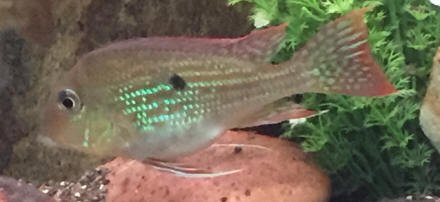
The reason is, I think that the Geo has become bloated, and I'm not sure
if it's dropsy or what. I attached a couple of pictures. Should I go back to the
antibiotics again?
<I would not>
His lateral line issues haven't gotten worse and seem to be healing still, but
now I'm worried he's got a new problem...
I'm sorry if I seem like a complete wreck. Some of my family members do not
appreciate my hobby, and so there are some things I just can't get help with.
Apologies,
Lynnie
<Fix the environment... BobF>
|
 |
|
Re: Geophagus With Lateral Line Erosion...(all my fault) RMF, second
opinion!! 6/21/15
Dear Wet Web Media Crew,
After a combination of lots of water changes, cleaning the gravel/under
gravel filter, and reducing the amount of high-protein food I have gotten the
nitrates to 0-5ppm.
<Good>
I also have been feeding the Geophagus cooked peas, carrots, and whole corn
seeds, and well as New Life Spectrum cichlids pellets and Hikari Algae Wafers.
<Excellent!>
With the improvements in diet & environment the bloating is gone.
<Yay!>
Perhaps I should have been clear when I said I spilled the juice...I didn't
spill it in the tank, but on the floor, and it was bloodworm blood...
<Yuck-o!>
I started feeding whole frozen food after that incident for fear of messing up
my parents' house. Before that I was able to keep nitrates under 20 ppm for a
few months with weekly water changes, but skipping them for a month and then
feeding frozen incorrectly messed up my streak.
After reading I know now I will go back to thawing the food off first and
draining the juice off. If that isn't enough I will buy a brine shrimp net as
advised and rinse them out outside.
Thank you,
Lynnie
<Thank you for this update. Bob Fenner>
Re: Geophagus With Lateral Line Erosion...(all my fault) RMF, second opinion!!
/Neale 6/21/15
Dear Wet Web Media Crew,
I am sorry for this whole debacle. I had read that Geophagus "surinamensis" was
nitrate sensitive before buying him, but I had also read that about most other
cichlids, some of whom I had kept in the past and didn't find more delicate than
other freshwater fish, so I thought this wouldn't be really that much of a
problem.
<Indeed. Cichlids as a group are more sensitive to nitrate than, say, characins.
But within the cichlids there is variation, and many of the farmed cichlids,
particularly Angelfish, are tougher than their ancestors.
On the other hand, there are some cichlids that seem to retain a high degree of
sensitivity to old water, and that's what we're talking about rather than
nitrate per se. Infrequent water changes, overfeeding/inappropriate feeding,
insufficient oxygenation, and excessively high temperatures seem to be the
combination of factors that wear down the immune systems of many cichlid
species. Nitrate is a good shorthand indicator of when these factors are at
play, but I've seen perfectly healthy cichlids in high nitrate tanks were
environmental conditions and diet were otherwise excellent, for example, through
the cultivation of fast-growing floating plants in an understocked,
over-filtered aquarium or tropical pond.>
However he has proven to be far more touchy than literally anything I've kept so
far---this is the first time where just a month without water changes made a
fish sick almost immediately. I guess I had taken on more than I expected.
<This is a common experience with Geophagines (and dwarf cichlids too). Success
with Angels and Kribs doesn't predict success with the touchier cichlids.>
I will keep the nitrates low and feed him what I've been feeding him until his
lateral line heals...then I will try to find somebody else better equipped for
him.
I was also going to follow through on my rainbowfish idea as a "replacement" for
the Geo (at least in terms of blue & red colors). I have a 12g quarantine tank
and zeolite, so I think I could get them clear of diseases before I put them in
the main tank.
<Yes.>
What worries me is that both the Geo and my clown loach chase after the silver
dollars during feeding. The dollars are faster than they are and aren't hurt by
it, but I am concerned rainbowfish might not be able to take it. What is the
risk?
<Agreed with you, this sounds inappropriate. A school of (large species)
Rainbowfish adults might be okay in a rough-and-tumble community, but they're
far less of a certainty than Silver Dollars and Spanner Barbs, the two "go-to"
species for such set-ups. Spanner Barbs in particular are extremely hardy fish,
and back in the 60s and 70s they were practically ubiquitous choices for such
tanks.>
I know clown loaches are more docile in groups, but I don't think I'd be able to
keep a whole group in this tank for long. I could possibly get a couple more at
some point, but only depending on how fast they grow.
<Indeed. Clowns have a tendency to go nuts when kept singly. Most become
reclusive, but some try to school with other fish, perhaps harassing them in the
process. Again, recalling the 70s, it was common for people to report their
single Clown school with Tiger Barbs!>
I looked into the mud and algae filtration systems, but I'm not really sure if I
can set up something like that at this point.
<A simpler choice might be a sump, which you can illuminate with fluorescent
tubes and stock with floating plants and fully expect an improvement in water
quality. Or for that matter, throw some floating Indian Fern into your tank.
These plants are AMAZING at keeping water quality good. They grow rapidly,
turning fish waste into plant material you can physically remove (and share with
other aquarists!). Of course this wonderful plant is also a source of green food
for herbivorous fish, which love to eat it, so it's a win/win. Keeps the water
clean, provides essential vitamins, useful shade, and a holiday food when you're
gone a couple weeks! Do read:
http://www.wetwebmedia.com/plantedtkssubwebindex/ceratopteris.htm
Bob's as much a fan as I am, and truly, this cheap plant is one of the best
investments for any freshwater aquarist.>
To be honest I'm not sure it's worth it, given that I could just keep nitrates
down with water changes/less proteinaceous foods (most of my fish are big
vegetable eaters anyway). My aquarium light rests on a piece of glass above the
tank, and algae grows very much on the underside of the glass...
<Do remove the glass if you add floating plants.>
Is it possible leaving the light on longer could help?
<Theoretically, yes; but in practise extending the lights-on time tends to cause
problems with undesirable algae (blue-green for example) and annoys those fish
that dislike bright light (catfish, loaches, etc.).>
Even diatoms remove nitrate, right?
<Marginally, yes. But nothing like as effectively as higher plants such as
floating Indian Fern. If you aren't removing handfuls per week, then it's not
doing anything useful. Algae scrubbers rely on massive growth rates under
intense lighting. They're not simply letting algae grow somewhere!>
Thank you for everything,
Lynnie
<Welcome. Neale.>
|
Geophagus With Lateral Line Erosion...(all my fault)
4/11/15
Dear Wet Web Media Crew,
<Lynnie,>
The past month was very hectic for me...traveling around the country to visit
grad schools, working on research, lots of presentations to do...as a result, I
STUPIDLY did not do a water change for four weeks...
<Uh-oh... To be fair, some fish handle high nitrates ("old water") rather well,
and these were the popular ones through the 60s and 70s. Non-fancy Guppies, many
of the hardy characins, Corydoras, etc. Provided the tank is
otherwise well-maintained with plenty of plant growth (even algae) to extract at
least some nitrate, these fish don't seem too bothered even by 100 mg/l nitrate
levels. However, as you correctly surmise, cichlids are not among this group!
They are notoriously sensitive, jumbo cichlids, Tanganyikan cichlids and dwarf
cichlids especially.>
I finally had a break in the schedule and decided to do a 50% water change (I
did not do more than that because from experience suddenly doing a 90% water
change after none for a while kills fish) and noticed that my Geophagus has lost
skin in three small patches of his lateral line. It is not white,
pus-filled...just skin missing. I know this species is sensitive to nitrate but
he was perfectly healthy and growing larger until now, leaving the tank without
a water change for so long. I did the 50% change and added 1.5x the usual
SeaChem Prime amount.
Is it possible for the erosion to go away if I return to my weekly water change
schedule and bring the nitrates back down?
<Probably not.>
I know there are antiparasite medications for HLLE but I want to avoid using
them if I can, given that the disease is mostly environmental.
<Yes, the environment triggers the outbreak, and yes, there is some evidence of
a link between HLLE and the Hexamita parasite that is very possibly latent in
all farmed cichlids. But once "the cat's out of the bag", cichlids don't seem to
(usually) recover under their own steam. You need to push back the Hexamita or
whatever bacteria are infecting the pores, and that, in time, allows the skin
tissue to heal again. In short: the Metronidazole and Nitrofuran antibiotic
combination does seem optimal, though eSHa at least manufacturer an all-in-one
product called eSHa
HEXAMITA that supposedly treats mild cases of HLLE and HITH reasonably well
despite lacking both these ingredients.>
Thank you,
Lynnie
<Most welcome, Neale.>
Re: Geophagus With Lateral Line Erosion...(all my fault)
4/11/15
Will these products destroy my bio filter? Because to be honest I am afraid I
don't really have time to set up a hospital aquarium and monitor it a lot...I am
running up the deadline to my senior thesis right now.
<Used as directed they should be safe. If in doubt, reduce/stop feeding, and use
Zeolite in the filter (changed every few days) as a chemical adsorbent of
ammonia. Cheers, Neale.>
Re: Geophagus With Lateral Line Erosion...(all my fault)
4/11/15
Thanks.
<Welcome.>
My hospital tank is much smaller and uses Zeolite, so I need to monitor it very
closely when using it to know how often I need to replace the Zeolite.
<You can't predict this. That's why you test, daily, with ammonia detector.
Assume replacement every couple days, but really, depends on the size of the
fish, how frequently you do water changes, how often you feed the fish, etc...>
I can definitely treat the Geophagus in the main tank.
<Often sensible.>
Out of curiosity I found an "electric blue" blue Acara, but it was sick. If I
find a healthy one, I am going to probably replace the Geophagus with it.
How sensitive are Acara to nitrate?
<Fairly sensitive. Skip water changes for a couple weeks, and you'll know about
it.>
From my experience Severums can tolerate a month without water changes ( I kept
them when the tank was solely cleaned by the monthly service) but I don't know
about Acara.
<Indeed. A good rule of thumb is that "old school" fish were often fairly
tolerant: Port Acara, Severums, Jewel Cichlids, even Angels to some degree.
But all cichlids are more sensitive to nitrate than tetras, barbs or catfish,
and I wouldn't recommend any of them for "near-zero maintenance" systems.>
I am not saying I plan on only doing water changes once a month, but as I said
before I am leaving to grad school this fall and I want something that won't die
if my family end up not changing the water for a couple of weeks...I know
cichlids aren't as hardy as cypriniform fish but there aren't many of those with
bright blues and greens.
<Understood. Cheers, Neale.>
Re: Geophagus With Lateral Line Erosion...(all my fault)
4/12/15
I bought the medications you recommended but their instructions conflict.
Metronidazole bottle says I need to change the water every 24 hours.
Nitrofurazone says every 48 hours. Which one should I follow? I did another 50%
change today. Nitrate was 5-20ppm this morning before that so it shouldn't be
too high now.
<I would go along with what the Metronidazole says. It's the most important, and
in any event, medications get metabolised in the aquarium pretty quickly, so I
doubt much is left behind beyond 24 hours. But I'll leave the last word to Bob
Fenner; he's got more experience of this/these medications than I do. Cheers,
Neale.>
Re: Geophagus With Lateral Line Erosion...(all my fault) RMF, second opinion!!
4/19/15
Dear Wet Web Media Crew,
So I have given the Geophagus four doses of the Metronidazole and two doses of
the Nitrofurazone. I gave the latter in half doses as I didn't want to stress
the bio filter too much. I ran out of the pure Metronidazole but I have API
general cute, which has both Metronidazole and Praziquantel. Could I use it
until I get more pure stuff, or is the unneeded Praziquantel too risky?
<Should be fine.>
I am curious: would it make the Metronidazole more effective if I gave it as
medicated food? I have been using it as a bath.
<It's much, MUCH better as food... gets inside the fish more quickly.>
As for the Geophagus, the erosion is gone on his left side, but is still holding
steady on his right side. To be honest I don't think it is Hexamita as the other
usual symptoms (head erosion, stringy feces, pus etc) are not present. If it
isn't then perhaps the antibiotic is more important and should be stepped up?...
<Metronidazole is an antibiotic, so should help in this direction too.>
-Lynnie
<Cheers, Neale.>
|
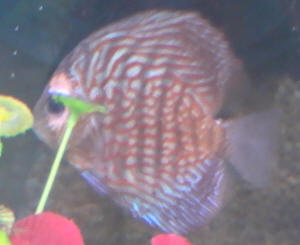
Discus with I believe with HLLE (yep!)
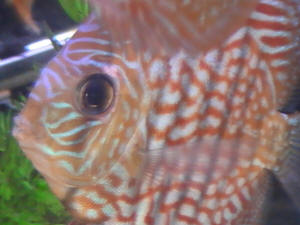
11/05/08 Hi I have a 75 gal tank with 8 Discus four are
the size of the picture I am sending and the remaining being
silver dollar in size. Filtration is a Penguin BioWheel 350
filtered with Bio ceramic filter balls and filter cartridges
w/activated carbon, second one is a whisper filter 60 gal that I
use filter cartridges with. 1 airstone. Gravel1-1 1/2" deep.
Artificial silk plants. Feeding is as follows: San Fran Bay
Frozen Spirulina Brine shrimp, San Fran Bay frozen beef heart,
Beef heart flakes, Hikari bio encapsulated w/vitamins bloodworms,
Hikari microwafers, frozen plankton, omega one color flakes,
omega one vitamin flakes, Tetra cichlid sticks. I dose the water
with VitaChem once a week and add to frozen food. I vary the food
giving flakes and frozen everyday and feed 4-5 times a day. Water
parameters today are: AMM- 0, Nitrite- 0.3, PH- 7.5, temp- 85
degrees. Water changes are done once a week at 75% change with
Kordon NovAqua Plus. I want to make sure this is HLLE I noticed
Sunday clear matter floating around like poop but totally
transparent note all fish have normal poo. This was
discovered on fish yesterday added salt and this morning it is
worse can you let me if I am correct in HLLE and I've read
the threads metro is what I should use. The first picture is
yesterday, next two are today. <Greetings. This does indeed
look very much like Head-and-Lateral-Line-Erosion, or HLLE. This
disease is "caused" by one of two things, possibly
working in combination, though the precise details are obscure.
The Hexamita parasite is at least partially involved, and while
normally associated with problems with the digestive tract
(commonly observed as white, stringy feces due the excess mucous
production) the parasites somehow can spread to the surface of
the fish under certain situations. Once that happens they cause
the sensory pits on the head and flanks to become infected and
ultimately the pits decay, causing the tell-tale wounds we call
Hole-in-the-Head (HITH) or HLLE, depending on where the wounds
are seen. It is possible Hexamita is latent in many fish, and
only under specific situations does it become a problem, and both
diet and water quality seem to be extremely probable triggering
factors. With cichlids, any nitrate level about 20 mg/l seems to
lead to a, elevated risk of HLLE/HITH. Every cichlid I have ever
seen with the disease was in an overcrowded tank or one with
infrequent water changes, and this is based partly on
observations of my own mistakes! Bob Fenner has also written
convincingly about the appearance of HLLE/HITH in marine fish as
being closely related to lack of vitamins. Herbivorous fish are
particularly prone to receiving inadequate diets, and cichlids
are overwhelmingly at least partially herbivorous in the wild.
Even fish-eating cichlids will be consuming herbivorous fish, and
in that way consuming the plant material in the guts of their
prey. Tinned peas, Spirulina flake and cooked spinach are usually
taken by even the most carnivorous cichlids. So while the
immediate treatment is Metronidazole, long term you need to
review water quality and diet, and see if there's anything
there you can improve. Cheers, Neale.>
|
   |
Help with sick Severum
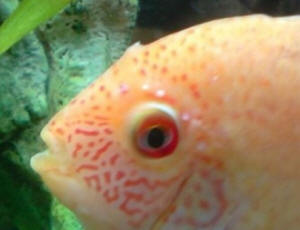
Severum Starting To get Hole-In-The-Head 9/9/08
Hi, I have a 200 litre aquarium which has 5 angels, 1 Oscar, 1
silver shark, 1 bichir, and a breeding pair of Severums.
All fish are totally fine expect for the Severum which has been
getting strange white bumps around his eyes and on his head for the
last few days. I have attached a picture, I wonder if you could
advise what is wrong with my fish and how to treat it?? Many thanks
Jason Ingold
< It looks like you Severum is showing the first signs of
Hole-In-The-Head disease. After the pus filled blisters pop a hole
is left in its place. The holes continue to grow eating away the
skull. There are some ideas to what the cause of this disease could
be but no exact pathogen has been identified. The stress of
breeding could have weakened your fish and made them vulnerable. If
it was my fish I would place it in a hospital tank with clean
warm(82 F) water. Treat the tank with Metronidazole and
Nitrofuranace. If the fish is still eating then feed a medicated
food with Metronidazole in it. Generally I would try to improve the
diet with a quality pellet food. If you fish is still eating I
would try a little trick I stumbled on a few years ago. I had an
south American cichlid like yours that just started to get the
disease but was still eating. He especially love black worms. I
took the portion of black worms in a little plastic cup with some
water and medicated the worms with the dosage of Metronidazole. The
worms died right away and I quickly fed them to my fish. The fish
were unaware that the worms were dead and ate them all up. The
lesions turned black the next day. I did a major water change,
cleaned my filters and got some fresh fish food that was high in
vegetable matter. I felt that this would provide the minerals my
fish may have been missing. Hope this helps.-Chuck> |
 |
Oscars With Hole-In-The-Head 12/30/2005 Greetings Bob,
< Chuck this time.> We have 2 Red Tiger Oscars that both
developed the HLLE. We keep a good tank ( check to make sure that all
the levels are good) for them. However, is there something you can
recommend that we do to help out our fish? We would like to have them
around for a while. Thanks, Robert and JoAnna < This is usually
caused by stress. Check the water chemistry. If that is OK then try a
more nutritious food or change the diet to a better grade of food.
Maybe add some live food too. Metronidazole will work to treat it but
the causes of the stress must be addressed and corrected for a long
term solution.-Chuck> Oscars With Hole-In-The-Head
1/1/06 Thanks Chuck for your reply. We have them in a 72 gallon
tank with 1 canister filter and one Bio wheel filter. We change the
water weekly (25% change). We also have an old Pleco in the tank as
well. He just hangs out on the back of the tank .We are currently
feeding them Tetra Cichlid sticks and the pellets and occasionally
krill. We quit feeding them live food when one of the people in the
Tropical Fish hobbyist said that live fish is not good. What would you
consider a good quality food? Should we be adding broccoli to the tank
also? We would like to keep Felix and Oscar (yes they do act like the
odd couple too!) around for a long time. Your help is greatly
appreciated!!!!Thanks, Robert & JoAnna < Clean the filter and
vacuum the gravel on alternate weeks. I know canister filters are a
pain to service but the should be cleaned at least once every two
weeks. On the weeks that you do not clean the filters you should vacuum
the gravel. There is quite a bit of waste that accumulates there that
needs to be removed. This should keep you water quality at its best.
Forget the broccoli. I would try some Spectrum pellets and Spirulina
flakes. These have lots of vitamins and minerals and should help with a
deficiencies in their diet.-Chuck
Oscar with Hole-In-The-Head 12/16/05 Hi Chuck, I have
still been trying to cure my Oscar, but to no avail. I put
him in a bare 30 gallon and treated just as you described for quite
some time but he did not seem to be recovering at all...getting worse
in fact. He didn't like the medication at all, but I did
it 3 days on one day off for two weeks. After that I just
kept the water pristine and kept the lights out for the whole
day. I did turn the lights on, wait 30 minutes, and try to
feed him. He seemed hungry.....he gets all excited and swims
back and forth waiting for the food, but when the he gets the food in
his mouth he just opens it back up and the food comes out. I
have tried med. pellets, small pellets (Hikari Gold), flakes, brine
shrimp, frozen brine.....pretty much everything, same
result. He just spits the food back out over and over. The
one visible change in him after the treatment was the dimples in his
head, which cover a decent area from behind his left eye all the way
back near his fin, turned black. Well, I should say rather
that they are now outlined in black, but very
prominently. At first I thought it was a good thing, like it
was healing, but the dimples seemed to be worsening still and he still
can't eat. It's been several months now. I am to the
point where I am considering euthanasia, but would like to get your
feedback first. I have really done so much and tried very
hard to cure him. I don't like to think about him being
so uncomfortable, and if he is just going to keep getting worse the I
will have to do it sometime anyway. He isn't eating....what do you
think? Do you know anything about the blackening around the
dimples/holes? Thanks, Tim < The black is a good sign that things
may be healing up, at least around the edges. Try to get him to eat
live black worms. He should. Give him a couple of feedings over a
couple of days. One the third day place some worms in a small plastic
cup with some water. Add a tablet of Metronidazole. It should kill the
worms instantly. The worms now have the medication in them. Now quickly
feed them to your Oscar. Getting the medication inside the fish should
really help. Continue to do this until the spots turn black.-Chuck>
Oscar Still Has Hole In The Head 11/3/05 Hi all, I have read
through the forums and have done what is recommended (mostly
Chuck's recommendations). <<Chuck knows his cichlid
stuff!>> I have a large (12-14 inch) red Oscar in a 75 gallon
tank by himself. I had him with a Tiger Oscar until they outgrew the
tank and he became aggressive with the Tiger. I plan on getting him in
a 125+ but I have to move to a new place first. He developed pitting on
the left side of his head, fairly high up. At first I thought he just
lost a scale from bumping into the top of the tank (he gets very
excited when I feed him), but it has progressed. I use RO water and
treat it lightly with Cichlid Essentials. I feed him Hikari pellets. I
do have frozen brine cubes which I am going to start supplementing in
to his diet. I normally feed him a small amount in the morning and at
night. I bought a bottle of the Hole-In-The-Head Guard with
Metronidazole and have followed the directions on the bottle. They say
to use it every other day for three treatments with 25% water changes
between treatments. I have followed the directions exactly. It has been
a week since the last treatment and I see no improvement. How
long should I wait before I treat him again? Is there anything else I
can do? My nitrates are low, ammonia and nitrites 0. My water
temp is 80ish. This is a large beautiful fish and I really don't
want to lose him. Thanks for any help you can provide. Tim <
Go to Cichlid-Forum.com and
check out the 22 page article on the causes and treatment of hole in
the head disease. Metronidazole reacts to everything, light, heat,
organics etc... In a best case scenario you treat the fish in a bare
tank. Treat with Metronidazole and Nitrofuranace every 8 hours with a
33% water change in between treatments for three days. Lots of work and
lots of money too. After reading this article you will best be able to
determine the cause and be able to treat
appropriately.-Chuck>
| Parrot Cichlids With Hole-In-The-Head - 2/28/2006 HELP.
About two months ago My 2 parrots who are around 2.5 years old - we
had them from babies, started to develop fungus type
'sores' on their head (no where else, and none of my other
Cichlids have this problem) then it disappeared only to return
again and now I need help. I treated them for Velvet, Fungus, Hole
in the head etc., to no avail. Although my water qualities etc.,
were fine, water temp was tried at between 24-28 (this was double
checked by Maidenhead Aquatics) I changed to the fish shops own
water in the hope it would make a difference - it didn't. I
have not added any new fish, gravel, plants etc., Food is still the
same dried in morning and frozen in evening (Krill, bloodworms,
Mysis, Green food, Artemia etc). I do a water change every week,
(sucking up all pop from gravel in process) I have tried to do it
daily, every other day, weekly and even longer - no difference. The
last month 'his' sore has got bigger and does not seem to
be responding to anything. He is eating well and his stools are
normal. For the last month, 'he' has started to hang round
the top of the tank as if trying to get more oxygen, rapid gill
movement (compared to the other parrot) and generally looking off
colour doesn't really want to move, and when he dose it looks
like he hasn't got full balance, although he eats well, and
moves fast and straight into the caves when startled. The other
parrot I am sure knows something isn't right as she is hanging
below him instead of her usual haunt the caves. I have a 5'
tank and an external Fluval 404 pump. I am an experienced Cichlid
keeper but was given these fish from my son, they are magnificent
and very clever and cunning. I have no trouble between my fish
what's so ever, if anything the parrots rule the tank, or at
least did. I have photos of his head if it will help anyone to help
me. My local fish shop said that as they are a hybrid fish, they
are not as healthy and tolerant to changes as the normal cichlid
and that they don't know much about them as they don't and
never will stock these fish. < Do a 50% water change, vacuum the
gravel and clean the filter. The drug of choice is Metronidazole,
but you need to get it inside the fish. Take some live Calif black
worms or Tubifex and wash them very well. Place them in a
disposable plastic cup or bowl. Drain off most of the water. Add
Metronidazole to the worms. It should kill the worms. Immediately
feed them to your affected fish. You know it is working when the
pits turn black. This disease is thought to be caused by stress.
Things like dirty water or a lack of minerals/ vitamins have also
been thought of as a cause. If the fish are not eating then treat
the water . It may help but will not be as effective as getting the
medication inside the fish.-Chuck> |
| Hole-In-The-Head Cichlid Photos - 3/1/2006 Thanks
for this advise, did you see the second email I sent to you from
home last night with photos on this fishes head - showing this
complaint? It may help, also do you think it is Hole in
the Head or Fungus etc???? Many thanks Sheena
Jolliffe < We got the photos and the reply is still the same.
They are posted on the site.-Chuck> |
|
|
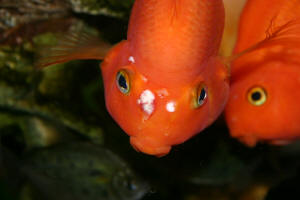
HELP!!!!! I am scared my 6" Jurupari will not make it over
night!! 5/31/07 Jurupari With Hole-In-The-Head Disease Okay
this is the deal, for about 2 years we have had a 55 gallon freshwater
tank and within the first year we had acquired - 2- 1.5" black
tetras, 1 - 1.5" Tiger barb, 1 - 2" Figure Eight puffer, and
1 - 3" algae eater. Every thing was fine for several months, and
then about 6 months ago the Puffer died, we weren't sure why,
probably because I was too busy with an new baby to tend to the tank
like I should have. < Actually as puffers get older they move to
salt water from fresh water. this is not true for all FW puffers but it
is true for most sold at stores.> We observed the fish and took care
of the tank, making sure there was nothing going to harm the other
fish. Since the other fish seemed fine we decided two weeks ago we
would like to get another puffer (they are so much fun.) Well I went to
my LFS in search for a puffer and I came upon a Beautiful 6"
Geophagus Jurupari at the price of $50 - I didn't buy it, but
placed an order for the puffer instead. A week later I came back to
pick up the puffer and the "smart" fish guy was there so I
asked about the Geophagus - he said it was a great hardy fish and that
it would be fine with a puffer and the fish I had at home. < Most
puffers are actually brackish fish unless you got a specific species
that is found in true FW. The Satanoperca jurupari actually comes from
soft, warm, acidic waters of South America.> I said I will take it,
and they loaded him up with the puffer and I brought them home to there
new tank. Since this was my first time to purchase a fish that cost
more than $10 - I had never even heard of putting new fish in a QT
before entering them into my display tank. I have always just
acclimated them then added a little of my water at a time over about an
45 min. time period - and this is what I did with the Jurupari and the
Puffer. After being in our tank for 2 days I noticed tiny white specs
on the puffer and immediately went to the computer to learn it was ich.
I decided to go with the heat, salt and daily water changes instead of
the chemical route. Since I didn't have an extra tank and heater
etc. I used a large clear acrylic salad bowl and placed it into the
large tank to share the 87 degree temp and air with an air stone and a
little gravel. Concerned about the ich and curious to know more about
the Jurupari, I again turned to the web. I began to realize my water
conditions were totally wrong for the Jurupari. Now I was really
concerned my water conditions were going to stress this beautiful fish.
I immediately began to attempt to lower the hardness, pH, &
alkalinity of my tank water with water changes, aquarium salt, and a pH
buffer - I just could not get it down!! After loads of research - I
realized the that the Texas Holey Rock and landscaping gravel I had in
my tank were causing the high alkalinity and water hardness! I
immediately removed the rocks and the next day I removed the gravel
replacing it with black Tahitian Moon Sand for the Eartheater - but now
my bacteria is gone and I have began to notice little tiny holes on the
head of my Jurupari! I immediately searched WWM and found this was
HITH! I did as suggested and ordered Metronidazole (Hole-In-The-Head
Guard) from DrsFosterSmith.com, along with Marc Weiss Instant Amazon,
and Vita-Chem. I did a water change, then administered the HITH meds,
now he wont eat and he has began to get blood streaks in his tail, he
hangs out at the top and is kind of out of balance. Believe It Or Not!
I am already in love with this fish!!! I am willing to do whatever it
takes to save these fish!!! Other than not researching the South
American Cichlid before I bought it - Please tell me what I did wrong,
and what I can do to fix it!! Helpless in Houston, Beth < The genus
Satanoperca overall is a very touchy group of fish. They require very
clean soft acidic water to thrive. Anything less that this and they
break down with a long list of maladies that you have now encountered.
All of the changes have created stress in your fish and he has begun to
shut down. For the short term I would isolate him in a 10 gallon tank
with and airstone and a heater. The water would be 50% treated tap and
50% R/O. Set the heater at 82 F. Treat the tank with a combination of
Metronidazole and Nitrofuranace. The Metro with treat the bloat and the
Nitro will treat the bacterial infections in the fins. Treat on day 1,
3 and 5. On days 2 and 4 just do a 50% water change while vacuuming out
any waste. When the fish acts hungry then you can start to try and bet
him to eat some medicated fish food with Metro in it. In the long term
the big tank really needs softened water. I would recommend using an
R/O unit to remove the dissolved minerals and adding a buffer to
acidify the water to a mildly acidic pH. these fish are bottom feeders
so make sure some food gets to the bottom. They do not like any waste
in the water. The nitrates should be under 10 ppm. This is very clean
water and will require lots of water changes. the other fish will like
the new water with the exception of the puffer.-Chuck>
Re: HELP!!!!! I am scared my 6" Jurupari will not
make it over night!! Finding Nitrofurazone - 6/1/07 > Also,
where can I find Nitrofuranace? I didn't see it on
DrsFosterSmith.com. < They sell it as simply Furanace or
Furan-2.> Can I use API's Triple Sulfa? < You can try it but
I don't think it will be as effective as the medications I have
recommended.> Am I treating hemorrhagic septicemia, is that what the
blood streaks are, or is it some sort of bloat? < These medications
are good for bacterial and fungal infections. Your are treating both
external and internal bacterial infections.> I am going to get an
extra tank right away - I guess because I will be doing a 50% water
change every day I wont need a filter on the QT tank. <When you
medicate a quarantine tank , the medications are affecting the
biological filtration. You remove the fish waste in the tank with the
water changes.-Chuck> Thank you so much with helping me on the
specifics - I am extremely grateful!!!!! > Beth
Re: HELP!!!!! I am scared my 6" Jurupari will not
make it over night!! R/O Water - 6/1/07 > Since I don't have
access to RO water right away can I use bottled distilled for the water
changes? It is 0 everything? < Distilled removes more minerals than
an R/O unit so either would be fine.-Chuck.>
Re: HELP!!!!! I am scared my 6" Jurupari will not
make it over night!! > Jurupari Needs Treatment - 6/1/07 >
WWM Team - THANK YOU for your quick response!!! < We know how
important information is when your fish are sick.> OK, I bought a 10
gallon tank, wiped it out with distilled water, and filled it with
distilled water. < Pure distilled water is not needed. Next time mix
75% distilled with 25% tap water.> I heated the water to 84 so there
wouldn't be a drastic temp change for the Jurupari - I am slowly
lowering it to 82. Right now the tank only has the heater and an
airstone in it. I also put 1 tsp of Instant Amazon and 20 drops of
Vita-Chem, since I did a Metro treatment in the big tank yesterday, I
won't treat him with it again today. My main concern is the other
medicine you mentioned - I was unable to locate it online or at the
LFS's I have near my house. I did find API's Triple Sulfate
Anti-Bacterial Fish Med that is for Hemorrhagic Septicemia - should I
use this to treat the water? < I looked in the Drsfostersmith.com
catalog and found both medications I mentioned available. The
tri-Sulpha is not as effective as the medications I had mentioned. If
cannot find them then go ahead and try the triple Sulpha.> The If
so, should I do it today and alternate the treatments every day, or
should I wait until tomorrow and do both medications at the same time?
< Treat with both medications at the same time.> If not, please
tell me were I can get the Nitrofuranace and I will have it next day
aired to my house. By the way the Jurupari's fins aren't
clenched anymore now that he is in the Distilled Water - but it looks
like he is also suffering from fin rot - is this also because of the
water conditions, or is this something new? < The fin rot is a
bacterial infection from high nitrates in the water. This disease will
respond to the antibiotics.> Also, is there an RO unit you would
suggest for my tank? <If you have a 55 gallon tank and you probably
need to change up to 30% of the water every week. This means you need
to generate about 20 gallons per week for water changes. So you need to
get one that generates at least 20-30 gallons per week. They are
usually sold in Gallons per day. So get a unit that generates at least
5 gallons per day and you can always lower the pressure and reduce the
amount needed.> Now. about the big tank, my tiger barb wont eat and
he is gasping for air - it looks like he has dark green patches on his
sides and the top of his head - and maybe one single spot of ich on his
back fin (if this is possible.) Also, yesterday the puffer looked like
most of his ich spots were gone and this morning he was covered with
twice as many. <The ich medication has probably affected the
biological filtration. Check the water for ammonia and nitrite levels.
Both should be zero. Reduce levels with water changes.> UGH! I feel
like this is all my fault! Not researching before the purchase of new
fish. Now I feel like I am in way over my head. Helplessly trying to
reproduce the Amazon in Houston! Beth <This is all part of the
learning process. We are here to help.-Chuck> Re: HELP!!!!! I am
scared my 6" Jurupari will not make it over night!! - 6/1/07
> Treating A Jurupari > Well after I put the Jurupari in the 10
gallon QT tank he immediately perked up his fins and biting at the
glass as if he was hungry...so I tried mixing some vita-chem and Metro
in with some flakes and letting them dry, but he seemed to just make a
mess with them through his gills. So I thawed some bloodworms and added
vita-chem and Metro to them in a little bowl, let them soak and got him
to eat two servings yesterday. This morning when I woke up he as
floating at the top again with his fins clenched - I tested the ammonia
and it was .5 ppm (How is that possible?) < All fish waste and
uneaten food turn into ammonia. You have no biological filtration. If
he is eating then feed once a day. Feed only enough food so that all of
it is gone in two minutes. Remove all uneaten food while doing the
water change.> Immediately, I did a 50% water change, tested again
and it seemed like it was between 0 and .25. So administered the Metro
and Triple sulfa. After being in the meds for an hour or se he began
shedding some serious slime and his tail was kind of floating up - I
waited a while and there was no change so I did another 50% water
change diluting some of the meds. His fins are clenched and he seems
unbalanced - and he keeps floating up - and he wont eat again. Do you
think he can make it or does it seem unlikely? I am heart broken and
completely consumed by the issues at hand. Thanks for your help! Beth
<When a fish is stressed it develops a heavy slime so the parasites
cannot get to its skin. Now the medications are diluted and you fed him
three times yesterday. Your fish has gone through a lot. Currently he
is not being treated and just sitting in z 10 gallon tank. If he is
strong he may come back.-Chuck>
Re: HELP!!!!! I am scared my 6" Jurupari will not
make it over night!! 6/3/07 Jurupari Worn Out This morning my
Jurupari was upside down in the QT tank - I looked closer and he was
still breathing - I stirred the water up and he swam up top, but
quickly floated back down to the bottom. He is still at the bottom,
although he is upright now - What should I do? Do you think he is
suffering? < You fish has gone through a lot. I would recommend that
you keep up with the daily 50% water changes until he dies or gets
better. He is probably too weak for any medications. Let him rest and
build up his strength and see if he has anything left to fight
back.-Chuck>
Neglected Cichlids With Hole-In-The-Head 7/21/07 I have
been bad. Over the summer I neglected my 150 gallon cichlid community.
I was busy expanding my perennial garden. I only recall doing three 50%
water changes in the past four months. The glass was covered with
crusty hard algae which took forever to scrape off. Now my Geophagus
has HITH syndrome. I have been doing partial water changes every three
days. Is 25% too much of a water change? Should I do less more
frequently? I had been testing my water once a week and all parameters
were normal except the nitrates were about 40 ppm all summer. My test
kit says this is high end in the safe zone. I do have hard water and my
pH is approx. 8. <Most Geophagines require warm soft acidic water
that is very clean and low in nitrogenous wastes. Keep the nitrates
under 20 ppm with water changes.> My major question relates to a
large 8" gold Severum. He is about 1.5 years old. He looks great
except for one thing. For the past 6-7 months I have noticed that he
has a "divot" behind one of his eyes. Like a very small thumb
print indentation (about the size of a pea).. I never really thought
much about it. It wouldn't be the first time I have seen a cichlid
with a deformity. For the longest time I watched it and there has not
been any changes in it till now. Now the impression actually looks like
a hole. It is much deeper. It is not white or fuzzy or pussy like the
Geophagus' holes. I could try and send you a picture of it if that
would help. He is still eating and swims normal with not other signs of
distress other than that divot/hole. < A photo would be helpful.>
Also, I feed my fish a variety of foods, including flakes, pellets,
frozen blood worms and brine shrimp. Also shrimp pellets and algae
wafers. Will the improved water quality reverse the HITHS alone, or
will I need to treat with Metronidazole? < If you see no improvement
then I would add the Metronidazole.> Should I add vitamins? <
Won't hurt.> One last question, would it even help to use a
hospital tank or should I keep everyone in the community?
<Medications may affect the biological filtration. It is always best
to treat sick fish in a hospital tank unless all the fish in the tank
are effected.-Chuck> The rest of the residents include two rainbow
cichlids, two Laetacara curviceps, four large unknown tetras, three
clown loaches, five sajicas, Cory catfish three tiger barbs, one Danio,
and a large chocolate cichlid. Thanks for your help, Linda
Jack Dempsey With Possible Hole-In-The-Head 9/6/07 Hello
Crew, I wrote in on July 17, 2007 regarding my Jack Dempsey Phin who
was having problems with Fish Lice. Thanks to your advice I have gotten
the fish lice cleared up but we still have a significant health
concern. At the time we were treating for fish lice, I mentioned that
there was a spot near his head where the scales had fallen off. The
spot has continued to get bigger and is now about the size of a nickel
that is completely void of scales. In the last few days I noticed that
the scales around the area are becoming extremely inflamed. I mentioned
it to my local fish store clerk and he suggested a five-day cycle of
Maracyn-Two. I have completed the cycle and the situation remains the
same. To compound the problem our algae-eater has become very
aggressive lately and chases Phin around the tank trying to latch onto
his sore area. Do I need to separate the fish in order to give Phin
time to heal? Is there anything that I can do to help him heal? Any
suggestions would be helpful! Best regards, Emily <Separate the
algae eater from the Jack Dempsey. The best option would be to place
the Jack in a clean hospital tank. Treat with a combination of
Nitrofuranace and Metronidazole. The Metro will treat the
Hole-In-The-Head and the Nitro is effective against bacteria and
fungus.-Chuck>
White protrusion on Angelfish... HLLE?,
FW 9/2/07 Hello, <Hi there> My large male
angelfish has several areas around his eye, nose and head that look
like white shreds. From one of these areas, there is a white
protrusion, like the tip of a worm, but from what I've seen
described it's too big to be an Anchorworm. <Ah... not likely...
instead... this sounds like "neuromast destruction"... aka as
Head and Lateral Line Erosion... the white "worm" is mucus
from the fish... maybe accompanied by a good deal of the Protist
Octomita... formerly Hexamita ... necatrix mostly> I also have
discus, <Mmm... much to relate here... by and large I am NOT a fan
of mixing Pterophyllum and Symphysodon...> and in the past two of
them have gotten this same symptom. <Yes... way too often such
parasitic (and infectious) diseases "ping pong" twixt these
genera> The first one I treated with a parasite medication (I think
it was the jungle one that fizzes) <Actually, there are a few...>
and also an antibiotic because the area where the protrusion was coming
out from looked infected. He survived. When the second discus got this,
however, I did the same treatment but she did not survive. Now the
angel seems to have the same thing, only with his there are several
shredded areas (the discus only had one) and the shreds seem to be
coming out from around his eye as well. When I look closely, he also
has a number of very small areas where the scales seem a little popped
out. The protrusion itself is pretty big...about an eighth of an inch
long and wide. These 3 fish have not gotten this one after the
other....there was probably about a 2-3 month span from the first
discus to the second one, and it's now been over 6 months since the
second one died. I can't find anything in the various fish disease
descriptions that matches this. I did notice when I was looking thru
your FAQ's on discus that someone else had written about the same
thing with his discus, and you advised to treat by dabbing
Merthiolate/iodine on it. <Sometimes works> Is this even
available in the U.S.? <Mmm, if not... easily mixed, made-up...>
I thought it was banned because of containing mercury. <Maybe...>
Is there any other treatment for this? <Yes... likely the symptoms
can be cleared by a one-time use of Metronidazole/Flagyl. Please read
here: http://www.wetwebmedia.com/metranidazole.htm and the linked files
above... ... but the root cause... By improving water quality and
separating the Angel/s and Discus...> Have you had anyone else
describe this type of disease? <Oh yes> Thanks so much for your
help. I really don't want to lose this angel, but I'm afraid I
may have discovered it too late, since he has so many areas affected.
P.S. he lives in a well established 60 gallon tank I've had for
over 2 years with various other community fish, including other angels
(his children actually), discus, Congos, Rasboras, rummies, threadfins,
Plecos, catfish, and a black ghost knife fish. Everyone else seems
healthy and happy, and the water tests out fine. Jaz <Well... quite
a mix... Please take the time to read up re each species here... in
terms of water chemistry and temperature ranges... Along with space
issues, you really need two tanks here. Bob Fenner>
Re: White protrusion on Angelfish 9/2/07
Thanks so much for your prompt reply. Unfortunately, he died overnight.
I was afraid he would, given the advanced state of his condition. When
I removed him from the tank, he had several holes where the protrusion
and shreds had been coming out of. The shreds and protrusion were gone.
Before reading your email this morning, I saw that and was thinking it
might be HLLE. I've researched this on the web and there seems to
be varied opinion on whether this disease is contagious, some saying
it's opportunistic towards stressed fish; others saying it's
more genetic. <Agreed on/with all... In addition, does appear that
protozoan involvement might be either a cause or net effect
proposition... IF the conditions are present (stress from various
sources, dietary...) AND coupled with genetic/developmental
allowance... can be or at least appear to be "catching">
I'm concerned now for my other fish in the tank. We are doing a
major water change today and I intend to watch the others closely for
signs, but in your experience is this a contagious disease? <Can be,
yes...> Should I be concerned that my angel released organisms in
the tank that will now attack my other fish? <These "other
organisms" were likely present before... at issue is the entire
equation of initial health, suitability of the environment... AS WELL
as presence and pathogenicity of disease causing organisms> So far
everyone else seems very healthy. Thanks again for responding so
quickly. Like most hobbyists in this field, I love each of my fish just
like I would a cat or a dog, and I hate losing them or seeing them
suffer, so it's great to know that your staff is so prompt in
responding even on a holiday weekend! :) Jaz <Thank you my friend...
I am not advocating the pre-emptive use of Flagyl here... I would try
spiffing up the environment, and bolstering the livestocks' immune
systems through vitamin/HUFA supplementation of foods. BobF>
Help... Flowerhorn hlth. 11/06/07 Good
day! Thank you for continually helping hobbyist. I tried other fish
websites but they do not seem to know anything. I feel like my FH is
dying and they still want me to monitor and observe. Here are the
things that I have noticed. 1. Continual flashing and scratching. 2.
Body, pelvic fins, and dorsal fins twitching. 3. Stays at the bottom or
near surface with clamped fins. (Sometimes, using only 1 pectoral fin)
4. Lethargic. 5. Body slime is visible on the body. 6. Gills are like
hidden inside its gill plates and gill appears to be pale. (He does not
appear to have rapid breathing. Slow and shallow breathing actually.)
7. Losing equilibrium. I also noticed that he began to have small holes
in his head. A secondary disease because he is not eating anymore, I
guess. Is it bacterial or parasite? My guess is gill fluke so I went to
a pet shop in New Zealand but they do not have fluke tabs. I was told
by "apparently a fish doctor" that he's not sure what it
is because fishes are hard to diagnose and that he told me that my best
bet would be Furan 2. I want to know what you guys would suggest before
I medicate my fish. By the way, he recently had Finrot so I gave him
erythromycin, then he had this disease subsequently. Thanks again and
again. Please save my fish from his imminent demise. Take care!!! Nina
<Nina, your fish sounds as if it has the symptoms of Hexamita and/or
Hole-in-the-Head (these may be one and the same disease). It is very
common among cichlids, and seems to be related to water quality and
diet issues. The classic set of causes are a tank with high levels of
nitrate caused by overstocking and infrequent water changes, plus a
monotonous diet, in particular lacking in greens (vitamins!). Some
aquarists have also implicated things as varied as electrical fields
and the dust from activated carbon. Regardless, it's difficult to
treat without recourse to a (normally) prescription drug called
Metronidazole. (See here: http://www.wetwebmedia.com/metranidazole.htm .) Nothing much
else works. Ideally, it's fed directly to the fish. During
treatment, make sure you remove the carbon from the filter (if
you're using it) and make sure you optimise water quality. Once the
fish is better, pay close attention to water quality and diet. Think:
big tank, lots of water changes, no live feeder fish, and a balanced,
varied diet with plenty of greens. Cheers, Neale>
| Oscar Fish Hole in the Head???
4/4/08 Good Evening I have attached a photograph of my Oscar
Fish and wondered if you could help. I'm not sure if my Oscar
has hole in the head disease. I have studied several photo's of
Oscars with this disease however the holes in my Oscar look much
bigger and deeper. I haven't seen anything like this before.
Are you able to advise?? Any thoughts greatly received. Regards
Julie <Julie, yes, that's Hole-in-the-Head disease. Options
for treatment in the UK are limited unless you contact a vet.
Metronidazole is the usual recommendation by American aquarists,
but it isn't freely sold here in the UK. One new product on the
market is eSHa Hexamita Discus Disease. Their other products are
excellent, so that'd be one product I'd recommend. Follow
the instructions carefully, in particular remembering to remove
carbon. In any case, the underlying cause of HITH is water quality
and/or diet, so review those factors. Do see here:
http://www.wetwebmedia.com/FWSubWebIndex/fwhllefaqs.htm Cheers,
Neale.> |
|
|
|
|

