|
FAQs on HLLE, Head and Lateral Line
Disease: Case Histories of Note
Related Articles: Head and Lateral Line Disease, Algae Filters Articles,
Caulerpa Algae,
Related FAQs: HLLE
1, HLLE 2, HLLE 3, HLLE 4, & FAQs on HLLE: Causes/Etiology, Cures, Non-Cures, Vitamins in Marine
Systems,
|
(and HLLE) Bob: Also, I wanted to thank you
greatly for all of your advice on this site. I found HLLE on my
juv. Emperor one day and freaked out. After reading all of the
advice that I could find, I followed all of your advice and am
happy to say my angel is almost 100% recovered in less than a
month. Thank you! Ken <Ah, good news. Be chatting my friend.
Bob Fenner>
|
|
HLLE advice
1/14/14
I have had this scopes tang in hypo at 1.008 for the past six weeks.
<For what purpose/s? Am not a fan... have you read on WWM re Hyposalinity?>
He has been eating well and the water quality has been pretty stable. I have
tried to feed him Nori but he hasn't been that keen on it.
<... the treatment>
I have noticed a small growth on his snout and what I believe is evidence
of HLLE. Could you please confirm.
<Some apparent; again; due to the stress of isolation, exposure to low salt
concentration>
I will begin with Selcon and I am also slowly lifting the salinity back to
normal with fresh salt water.
<Good steps in the right direction>
Cheers
Marc
<Read here:
http://wetwebmedia.com/HLLESWCure.htm
and the linked files above; as well as our bits on hypo. Bob Fenner>
|
.jpeg) .jpeg) |
Tang possibly has HLLE. - 05/11/2012
|
Hello once again WWMD crew,
So i just got a Purple tang, roughly 2 - 3 inches. So i thought it would be
small enough to be in a quarantine tank of 10 gallons... Looks like the small
tank has really stressed the fish out.
|
|
WWM: Likely
so
|
So here is the series of events that has happened. During this entire process i
have been giving an entire sheet of Nori soaked in Selcon, per day. And have
been feeding with new life spectrum pellets and flakes.
Day 1 - looked fine at the LFS
Day 2 - Signs of ick started, so i dosed with Cupramine tested at 0.5 mg/l , (i
may have jumped the gun here). Eye begins to start to look foggy.
Day 3 - No signs of ick, eye Starts to look really bad only left eye though, but
it has really fogged up. So i did a 50% water change
Day 4 - Eye begins to heal up.
Day 5 - Eye fully healed.
Day 6 - Seems like scales are loosing <losing> pigmentation around eye and jaw
line, kind of looks like white pinheads, they are pretty symmetrical with the
other side of the face, Does HLLE have a symmetrical growth with the left and
right side of the face?
|
|
WWM: Yes...
aka neuromast destruction... the lateralis pores themselves are bilaterally
symmetrical about the head and flank
|
|
Or is it typically a random type of growth. - A grayish spot appears close to
the tail fin.
|
|
WWM: This
last is something different. Very likely due to poor conditions in the too-small
quarantine system
|
|
Also the scales look like they have a sort of suede texture the entire time, not
sure if this is normal, as this is my first ever tang. So my thinking is this, I
have a spare 30 gallon long tank that i will set up as a q/t this weekend, and
move the tang to this tank. My concern is that the move might cause more stress
than necessary to the tang. Should i just stick with the 10 q/t with consistent
water changes? Or would the bigger tank be a better environment? Thank you for
your time, Giancarlo
|
|
WWM: T'were it me, I'd dip/move
the fish to the main/display... a risk, but worth it. Bob Fenner
Re: Tang possibly has HLLE. 5/18/12
Hey Bob,
Just wanted to give you an update on the Tang, carbon is completely out
of system, and i have been feeding tang Nori soaked in Selcon, along
with everything else it eats as i feed the other fish, anyway all visual
signs of HLLE have cleared up and the tang looks great.
<Ah good>
Thanks for your time and help, next time i wont be so hasty to jump to
you all for help, as it always seems to be patience and a clear mind
that cures most problems.
- G
<An important lesson, that bears remarking. B>
|
|
Skin Disease? Photos Attached
2/4/12
Hi,
<Hello Lar>
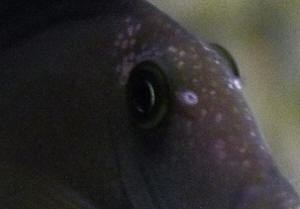
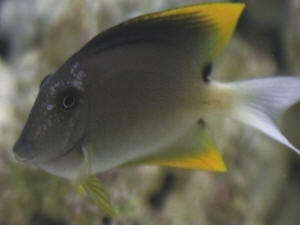
Trying to identify the skim problem with this Tomini tang which
is completing week 6 of a hypo treatment for Ich in the display
tank. The 2 other tank mates (yellow watchman goby and a pj
cardinal) do not show symptoms. The tang is eating well and
otherwise acting normally.
<... "classical" HLLE... Please read here re:
http://www.wetwebmedia.com/HLLESWCauseF.htm
and the linked files above re cures...>
I started Melafix 3
<Worse than worthless>
days ago but cannot yet tell if it has done anything.
Thanks,
Larry
<Welcome. Likely the move to the main display, concurrent
improvement in water quality, nutrition will see a reversal of
this neuromast destruction syndrome. Bob Fenner>
|
  |
|
Re: Skin Disease? <no>
Photos Attached, and Mud use disc.
3/1/12
Hi Bob,
<Hey Lar>
Thanks very much for taking the time to identify the problem
(HLLE) and write. Here's an update on very
a very positive turnaround and some follow-up questions.
<Ok>
The Tomini tang is greatly improved (sorry no photo
attached) with only a very small area now affected, he
seems well on his way to a good and full recovery. This was
accomplished by addition of Selcon and the reintroduction of
frozen Hikari Spirulina Brine Shrimp along with judicious dosing
of garlic to each feeding.
<Good>
At the same time, the salt level (following hypo for Ich)
has just recently been returned to normal 1.024/5.
The salt 'normal' for just a few days, I did see the HLLE
symptoms diminishing at least a week ago. So the turnaround
has been fairly rapid. Again, thank you for the
diagnosis.
<Welcome>
Here is why I am writing now:
During the hyposaline treatment for Ich in the display tank (with
coral and inverts removed), the refugium rock and rubble was
transferred to the coral holding tank (coral doing great!).
Of the original
Caulerpa and Chaeto refugium macroalgae, only the Chaeto
survived.
<Just as well>
I've only recently read that the Caulerpa is sensitive to
changes in salinity.
<Can be>
In retrospect, I'd been smarter to have removed it
before starting the hypo. That damage done, I'm
reassessing how to redo the refugium section (11.75" x
8" x 9.5") in my sump.
As I have more than ample live rock in the 65g display, I am
inclined not have substrate (mud or sand) in the refugium.
Yesterday, I saw an established tank (at least 5 years old) and
have spoken to different hobbyist - they both swear by Miracle
Mud. The hobbyist swears the Miracle Mud keeps his fish
healthier.
<Have seen this as well. The originator/owner, Leng Sy is an
old friend>
I've also seen on WetWebMedia where you have endorsed Leng
Sy. And, I've read Ecosystems claims regarding their
mud and HLLE.
<Ah yes>
There's still as much and controversy on the mud vs. sand vs.
bare bottom refugium as there is about brands and types of
substrates.
My questions:
- Is Miracle Mud really any better or more effective than using
CaribSea Mineral Mud or Walt Smith's Fiji Refugium mud?
Is mud necessary or very beneficial?
<Have read accounts praising all, but I have not seen any
actual scientific testing, comparing these various products...
But do know where I'd first look for such input. From the
various bb, hobbyist forums... from actual users>
- Given large amounts of live rock in the display tank, is there
any significant benefit to using any substrate in the
refugium?
<Mmm, yes; for sure there can be. What often happens in all
types/kinds of human culture systems is "something"
becomes rate limiting... having "mud" present can make
up to large degrees by providing the chemical somethings,
including rates of reaction/catalyst compounds. Think on this...
for planted aquariums, dogs kept in kennels, canaries in a
cage...>
- Maintenance seems easier without the refugium substrate, so I
am not seeing the benefit outweigh the disadvantages. And,
assessing the advantages of one method over another seems mind
boggling given how controversial this topic seems.
<Mmm, am happy for the discourse>
Thanks for advance for considered reply as well as your patience
and dedication to science and hobby!
Larry
<Certainly welcome. Bob Fenner>
|
|
Coral Beauty with HLLE and Worms??
2/21/12
Hello Again,
I have another question on one of my fish it my 150 gallon FOWLR
tank - the coral beauty. I have started to feed NLS pellets
around 8 weeks ago (alternate with frozen).
<Good>
A couple of weeks ago I notice the poop is brown but a string at
times.
Then last night, I noticed the string of poop on the coral beauty
was white with last bit that came out brown. I read brown can be
from too much food but white indicates a parasite.
<Can; not always>
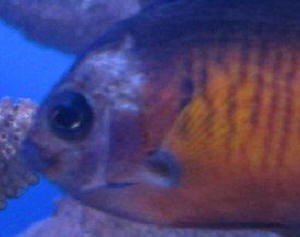
Also, I believe the fish has HLLE.
<I agree>
Since using the NLS pellets, the color has gotten better and the
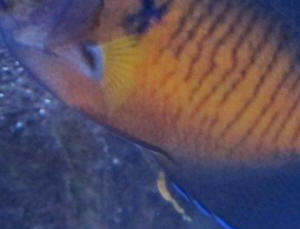
HLLE (if that what it is) is better. What I think is HLLE is like
pock marks (or holes in the head) on both sides of the head
around the eyes.
Up until using the NLS pellets, the diet was not great. The coral
beauty usually got what we left over from frozen mix.
<I see a good deal of highly competitive fish tankmates in
your photos>
I do run activated carbon and have a grounding probe in the sump
(I do not have a probe in the tank). I have no power heads or
anything with electric running inside the display.
<Do see the recent literature linking carbon use and incidence
of HLLE...
Maybe start reading here: http://www.wetwebmedia.com/HLLESWCauseF.htm
then onto the linked files above>
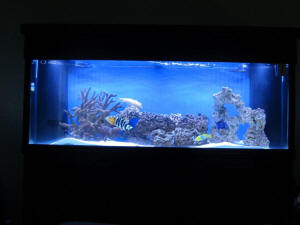
Attached are some pictures (four of the CB and one of the other
fish).
I might try soaking the NLS pellets in Selcon. I rarely use the
Selcon, but probably should.
<Yes; I would>
The CB has been in the display tank for around 5 months. The CB
was QTed and treated with PraziPro and Quinine Sulfate during QT
(I do not recall if I also used QuickCure at the time).
<Hopefully not. Too toxic>
Other fish in the tank were also previously treated with
PraziPro.
Snowflake Eel had for 2 years
Porcupine Puffer had for 1 year 8 months
Red Breasted Wrasse in tank for 10.5 months
Coral Beauty Angel in tank for 5 months
Banana Wrasse in tank for 2.5 months
Niger Trigger in tank for 2.5 months
All the above were QTed and treated with Quinine Sulfate and
PraziPro except for the puffer and the eel. However, while in the
display I previously treated them with Cupramine and also Prazi
pro. That treatment was probably 15 to18 months ago.
All fish seem fat and happy. The CB is harassed at times and
there have been signs of the tail fin nipped pretty good, but
this has grown back quickly.
Is the stringy poop a sign of a parasite?
<Again, not strictly positively correlated... as with
ourselves... fecal appearance can be linked to emotional state,
foods>
If so, is PraziPro in the display the best option? Looking at my
records, I did treat the display with Prazi again around 7/8
months ago. I forget if it was just in case or I saw something.
If my records are correct, this was before I put the CB in the
display.
<I would not further treat w/ an Anthelminthic... Some live
rock addition would help here... as would many aspects of
improved water quality... from refugium use, DSB, RDP...>
If treating the display with PraziPro is not the best option,
anything else I can do in the display or by moving the CB to a QT
(will be a challenge)?
<I would not move the fishes>
Does PraziPro treat internal parasites or only external?
<Both>
thanks again for the help.
Mike
<Cheers, Bob Fenner>
|
|
|
Re: Coral Beauty with HLLE and Worms??
2/21/12
thank you. I will read through the link provided.
so the current recommendation is to not treat at this point? I
just want to confirm.
<... read>
Also, you note some live rock additions. Do you mean for more
hiding places?
<... no>
I do have around . I do have around 80 pounds of very porous live
rock (Pukani from Bulk Reef Supply) plus 4 liters of Seachem Pond
Matrix in my sump (wet/dry sump I took out bio balls). Of the 80
pounds of LR, around 20-30 of it is in the sump.
<I see... this is more than enough, and it's rather
new/fresh>
My ammonia and nitrite are zero. nitrate down to 10ppm. Phosphate
around zero. Salinity is around 1.0245 to 1.025. A couple of
months ago it was lower (around 1.021)
<I'd keep this higher... see WWM re rationale>
and I have raised it over time. Temp ranges from 78 to 79.
I consistently do 20% water changes and do not recall the last
time I skipped one.
thanks again,
Mike
<Welcome. B>
Re: Coral Beauty with HLLE and Worms?? 2/21/12
Thanks again. Already started reading.
I will not treat with PraziPro for now.
I will stop both my ROX Carbon and GFO for a month or two and see
if that helps.
I will also start regularly soaking the NLS pellets and maybe
frozen food with Selcon.
thanks,
Mike
<Real good. B>
|
Re: Coral Beauty with HLLE and Worms??
2/25/12
Attached are some more pictures I took this morning of the
stringy poop.
I wanted to run by you guys to see if it changes the
opinion if this is a parasite or not.
<Can't tell from other than microscopic
examination... feces look like they do for many different
reasons>
I have held off on treating the tank with PraziPro per the
below emails.
I have stopped the carbon and GFO since Tuesday and
treating with Selcon hoping to solve the HLLE, but am
concerned there is a parasite with the poop.
thanks again,
Mike
<... Welcome. BobF>
|
 |
Re: Coral Beauty with HLLE and
Worms?? 2/25/12
ok. so would you say it is best to hold off on treating
for now as long as the fish is still swimming around and
eating.
And just feed better with the NLS and Selcon?
<Yes>
thanks.
Mike
<B> |
|
Please... STOP SHOUTING! Re-key your msg. not in all
cap.s and re-send. B
Subject: hhd and later line disease
I HAVE AN AFRICAN EMPEROR ANGELFISH THAT IS SUFFERING FROM HHD AND
LATERAL
RE: hhd and later line disease 8/2/10
ok ...I wasn't shouting, just wrote in caps..
<Ahh, this is indeed what I was referring to. Please read here
(again):
http://wetwebmedia.com/WWMAdminSubWebIndex/question_page.htm
Item 3b>
I have an African emperor angelfish that is 8 inches or so, she has
developed hhd,lle. I was feeding her spectrum pellets and romaine
<... please see WWM re such terrestrial greens>
but I suppose that wasn't enuff nutritional value, so I switched to
Hikari marine a..she is in a 220 with a lrg puffer and huma huma
trigger...I do 60 gal water changes biweekly. its a fish only with no
live rox, just living color pieces. she was housed with a lrg sohal 8n
inch plus but I sold her about 2 wks ago. the puffer is about 8 inch
and the trigger 5 or so inch, I use a wet/dry, uv ster.,reactor with
seagel in it, chiller..plz help..
<... Please run your writing through spelling/grammar checking
before sending... And read here: http://wetwebmedia.com/EmpAHlthF4.htm
and the linked files, elsewhere where you lead yourself, and here:
http://wetwebmedia.com/HLLESWCure.htm
and the linked files above... And DO search before writing us per our
instructions on how you found to write us period. Bob Fenner>
Re: hhd and later line disease..... 8/3/10
Ok let's try this again....I have an African Emperor Angelfish that
is housed in a 220 gal. it's filtered with a wet/dry, skimmer,
chiller, reactor filled with seagel. The decor is living color
artificial coral, and the substrate is sand. The inhabitants are an 8
inch Cortez blue spotted puffer and a 5 inch Huma Huma. There was an 8
inch Sohal , but I sold her 2 weeks ago.
<Good. Two alpha fish of size in this volume is trouble>
They would beef with each other on occasion, but nothing serious. Then
I was feeding her spectrum and Romaine lettuce. I tried soaking the
pellets in Selcon and let them dry for a few hrs, then feed them. Was
this the ok way of doing it?
<Is a help, but not a cure of itself>
Anyways, she never improved...I also feed the O.S.I. shrimp pellets,
the puffer goes crazy for them. He wont even try the spectrum or
anything else that I feed them. And also he will only go after pellets
that are of a light brown color, nothing else, he used to eat anything
I would put in there. Though he still eats hermits and crabs with
gusto! Now for the angelfish, I'm going to switch to formula II and
ocean nutrition seaweed along with the Hikari that I soak now in Selcon
and VitaChem...
<Please read where you were referred to last time. B>
I do 60 gal water changes every 2 weeks and have 2 ground probes just
in case in the wet/dry. One connected to the surge protector and the
other to the outlet in the wall. Now I feed them Hikari Marine A since
it has Vit C
in it, something spectrum left out. She has a voracious appetite and
eats everything I put in there. Please tell me if my game plan is on
the right track or not...many thanks...Phil
Re: hhd and later line disease -- 8/3/10
ok.... I will do what I read in the article that you mentioned earlier.
I appreciate your help..Phil
<Your (nutrition) plan as stated is good... but you'd do well to
do what you can practically do to improve water quality altogether.
Please do make/take some good photos of your Pomacanthus now... and
track its progress. Cheers, B>
|
Emperor Angel and HLLE 6/15/10
Hey Guys,
<Hello Jimmy>
Been a long time since I asked a question. I have had a 180
Gallon FOWLER for 12 years. (Inhabitants 10" Emperor Angel (
6 yrs old , 7 " Blue Girdle Angel 6 years old , 10"
Naso Tang 11 years old, 4" Heniochus Butterfly 11 years old,
Fox Face, 12 years old, 2 brittle stars )
<Wow, really good ages some of these, well done!>
All going well until approx 3 days ago. Emp. Angel has quit
eating, but still behaving normally.
<Mmm, Pomacanthus not eating is not behaving normally>
Maybe hiding a bit more, but hard to say. (Comes to top of tank
during feeds, approaches food with interest, pecks at it and then
backs away)
<This does not seem good to me>
When I approach tank it swims to the feeding corner, but does not
assume the position of dominance like it did in the past to get
first crack at the food. All other inhabitants doing well.
Emperor Angel has had HLLE but not that badly (some cratering
around nostrils, mild loss of coloration around face but no
visible lateral line disease. Only other thing that I have noted
is that the mouth/ lips is just a bit swollen but not reddened or
obviously traumatized.
<May have been in a tussle with one of the others. Can you
provide a picture of this?>
It almost seems as if "it hurts" for the fish to open
its mouth. I have used multiple food sources to no avail.
I have had a busy work schedule recently, but have changed water
once every 4-6 weeks, on a couple of times went 8-10 weeks.
<With these fish in this volume, this is far too little. I
would be stepping these up to weekly>
Recently I have made a major water change (80 gallons ) with aged
mixed R/O salt. And from there have been doing small partial
water changes daily ( 20 Gallons )
<Ok>
System has been closed to new inhabitants for over 5 years.
Emperor Angel has no other signs of disease...to look at it,
other than the mild protuberance of the mouth, no signs of
disease. I am almost thinking that the mouth has suffered trauma,
but I see no evidence of any abrasions, or redness, just the mild
swelling of the lips.
I will continue doing partial water changes daily, until it
hopefully starts to feed. Try vitamins, iodine supplements,
Selcon.. but food supplements don't do much good if not
eating.
<Agreed>
Any other suggestions
<Yes, moving this fish to another system, a larger and less
crowded one. I suspect a tank-mate as the culprit here.. perhaps
the Naso, although it could be that this fish psychologically
just needs more room now and it is telling you this with it's
change of behaviour. I do think that 180 gallons, even
un-crowded, is too small for P. Imperator. Another possibility is
that this is just an injury of some kind and will heal on
it's own in time>
Thanks
<No worries>
Jimmy
<Simon>
Re: Emperor Angel and HLLE 6/16/10
Thanks Simon,
<No problem Jimmy>
I completely agree on the water changes. The Emperor has been
such a gladiator of a fish
<Indeed so>
and the king ( or queen ) of the tank for years. I have been
reefkeeping for 25 years and it is my impression that this fish
is either traumatized, <Probably> getting old <No. These
can live 30 years>, or outgrown the house (or a
combination).
<Likely the first and last here>
It gives me the impression that it is really hungry but cannot
bring itself to eat!
<The mouth looks swollen to me, but with no sign of an injury.
I wonder if Bob might have some input here.. will post to his box
for his comments if he has any>
If water conditions or trauma are the culprit, it should be able
to recover nicely.
<Yes, it should>
I will send a picture.
<I see these, and apart from the swollen mouth and Neuromast
destruction the fish looks otherwise healthy. I think time is on
your side here, but ultimately this fish needs more room than is
being provided. The HLLE is a clue to the unsuitability of the
environment http://reefkeeping.com/issues/2005-06/sp/index.php
http://www.wetwebmedia.com/hllefaqs.htm?h=>
Thanks
<No prob.s>
Jimmy
<Simon>
Re: Emperor Angel and HLLE 6/16/10
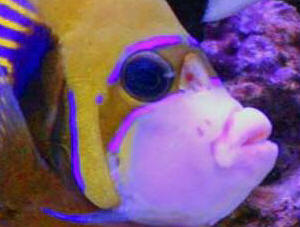
Here are some pictures
What do you think
<Is HLLE in one of its guises... "cures" as Simon
states can be found in the linked pages. BobF>
|
 |
|
Re: Emperor Angel and HLLE 6/17/10
Bob, Simon,
<Jimmy>
Thanks so much for your responses.
<No problem>
As of today the Emp Angel is still not eating. I don't know
how long it can go like this before winding down?
<By the look of the fish, a couple of weeks at least>
I went back and looked at pictures of this fish when I first
adopted it, and I must say, it looked a bit more vibrant 5-6
years ago. I agree, captivity has taken its toll on this animal.
Curiously, however, there is a Naso Tang as well as a Majestic
Angel in the same system that are as vibrant and as healthy as
the day they were adopted.
<Mmm, the Navarchus grows a lot smaller than the Emperor --
not only in length, but overall body mass, so does not have the
same space considerations. If you are talking about N. lituratus,
this also needs more space than this, but Emperor Angels are
sensitive fish, despite their sometimes pugnacious and seemingly
bulletproof behaviour. They require more care than N. Lituratus
and suffer more easily from stress & it's related
maladies such as HLLE>.
To look at the Emperor Angel and to track its behaviour, one
would hardly think that there was anything wrong. The fish still
swims to the top of the tank when I stand in front of the
aquarium and has a very natural and flowing demeanor to its
motion. In no way do I sense a panic or skittish behaviour. As an
avid reef keeper and physician of 25 years, other than the lack
of feeding and the HLLE, it is difficult to tell that there is
anything wrong here.
<I would 'change' something here, either by removing
this fish to another system, or a/ some of the others (the Naso
& Navarchus are the prime candidates) at least temporarily to
see if you can get the animal to feed in a less crowded
setting>
I have been able to recover fish from illness in the past. The
Naso and Majestic are prime examples. Years ago when the tank was
first established, I had an outbreak of crypt and then HLLE after
copper treatment. All fish were QT'd, the display was left
sans fish for 8 weeks and the fish were slowly reintroduced. HLLE
went away and all have been " visibly disease free"
since. Presently, the fact that the other inhabitants of the
system are so robust and without even a hint of HLLE is a bit of
a mystery.
<Mmm, this can build up unseen for a while, only presenting
signs later on. Your other fish could be on their way to visible
symptoms also here>
So, my advice to myself at this point is to exercise patience and
good fish husbandry.
<Oh yes>
WWM and experience has taught me this. Daily partial water
changes, varied diet and TLC is about all I can offer.
<I think one/ other needs to be moved here. Preferably the
Imperator'¦ to an uncrowded 8 foot+ system sans large
aggressive fishes. Have you tried NLS pellet food? Thera A,
supplemented w/ Nori soaked in vitamins + Beta Glucan, some red
macroalgae also http://www.advancedaquarist.com/issues/sept2003/feature.htm
>
The rest is out of my hands. I am thankful that this captive
slice of the sea has provided so much enjoyment for me as well as
my family.
<Maybe it's time to pay this fish back in
kind'¦ with a larger or at least less crowded
home>
Thanks Guys, I will let you know how things turn out
<Good luck Jimmy>
Jimmy
<Simon>
Re: Emperor Angel and HLLE 6/17/10
Emp Angel still in no eat mode...shows interest in food,
approaches to take a nip and then pulls back. How long can a
marine fish "otherwise healthy" live without eating
?
<Depends on the individual fish and species... to 'stay
alive' a good few weeks here. To stay alive AND be able to
recover.. a couple of weeks tops for large Pomacanthus. As
posted, I would change 'something' here>
Thanks
Jimmy
<Simon>
Re: Emperor Angel and HLLE 6/22/10
Hey Guys,
<Hi Jimmy>
Just a bit of an update re : Emperor Angel still not eating (been
8 days ) . HLLE is a bit worse.
<Mmm, need to act then>
Rest of the inhabitants in display are thriving and eating no
problem. The display has had "reef-like" water
parameters for the past week.
<Would be doing 2- 3 water changes per week here>
I am making arrangements to move the fish to a larger tank,
<Marvelous!>
but there is some hesitation on the others accepting the fish
given the fact that the fish is not eating.
<It is great that you recognise that action of some kind is
required. What other fish are in this larger system and how large
is it?>
In the meantime I have set up a 55 g tank as a quarantine of
sorts.
<Ok..>
Unfortunately, despite trying to jump start the nitrogen cycle
with rock and media from the main display, as of day 3 the QT is
running very high ammonia, nitrite, and nitrates.
<Of no use at present then. Have you tried the bottled
bacteria products?>
I had a wet dry filter running back onto itself ( pumping from
sump to media ) that I would occasionally do water changes from
the main display with waste laden water siphoned from the
substrate of the main display to the wet dry to provide necessary
waste to keep the wet dry cycled. I also used 55 gallons of water
from the display (mostly from substrate siphoning) to start the
QT. The fact that ammonia, nitrite, and nitrate are all very high
at 60 hours indicates that the QT already has high populations of
Nitrosomonas, and Nitrobacter present and hopefully will cycle
soon.
I will then transfer the Emperor to this system, while I am in
the process of finding a new home.
<This could go either way.. sometimes moving the fish to a
different system halts the progress of HLLE, but this is a much
smaller system, with all the drawbacks of such, and you are
populating it with stock from your existing system. Moving the
Emperor here might not relieve any stress on the fish,
potentially it will just add new/ different stressors, and the
last thing he needs now is exposure to ammonia. Once this QT is
cycled, you could consider temporarily moving one/ more of the
others here instead, and trying to get the Emperor to feed where
it is now in the main system until you can move it to a larger
home. If there is more live rock available in the 180 as well,
then this will be of more benefit to the Emperor if he decides to
graze. Do you have any more live rock w/ good growth that can be
placed here as well? Maybe some from a sump area>
At this point I am not optimistic, but hoping that in isolation
with optimal water conditions I can nurse this fish back to
health.
<Let's hope so!>
We will see how it goes. Any other suggestions from the experts
would be welcome!
Thanks
Jimmy
<Simon>
Re: Emperor Angel and HLLE 6/23/10
Thanks Simon,
<No problem Jimmy>
All excellent points, all of which, I am taking into
consideration. Though I want to save the Emperor, I also have a
concern for the other animals in the system. The last thing I
need is to risk widespread disease in a closed system that is
brought on by a weak fish.
<Mmm, no. HLLE is not 'catching', is environmental,
and the fish looks otherwise healthy>
Alas, I really do need to move here since I have started to
notice some very mild aggression toward the Emperor by others in
the tank.
<What you perceive is only a small part of what is happening
betwixt the fishes>
They sense there will soon be a change in the pecking
order.......overall a very natural behavior. It is my sense that
the QT will be ready for fish soon ( 3-4 days ) and then I will
go from there. The QT is really not a "new" system, I
just probably overwhelmed the wet dry filter by using water
obtained by siphoning debris from substrate from the display. SO
the irony here is that I am dealing with two cycles.......the
wait for the QT to cycle and the cycle of life in the
display.
One final question, I have two brittle stars in the main display
that have gotten quite large. They are not of the green variety,
rather the flesh is pink with gray bristles. They do a great job
scavenging. The fish seem to stop and stare a bit before moving
through an area that is occupied by them but otherwise seem
undaunted. Are these a threat to the fish in the tank?
<No, these are beneficial scavengers http://www.wetwebmedia.com/brittlestars.htm>
Should I look for a new home for them also?
<These are fine here>
Pretty obvious here that as I inventory my tank, it looks like I
have been a victim of my own success. As I look over pictures
from six years ago ALL of the inhabitants have grown
tremendously!
<Indeed, but you have stocked with some large growers>
Thanks
<No problem>
Jimmy
<Simon>
Re: Emperor Angel and HLLE 6/28/10
Simon,
<Jimmy>
Need some expert advice. I could not find anyone to adopt the
Emperor Angel. I had to take just about every rock out of the
main display to eventually guide it into a Plexiglas container,
with a bit of thrashing afterward. Is this the method you would
use?
<I use a large plastic colander for large fishes, especially
Angels, guided in with a net>
The fact that the fish is not eating was a major deterrent to it
being adopted.
<Yes>
It is now housed in a 75G ( 48x20x18 ) quarantine tank.
<Mmm, as I previously stated, I would have preferred to leave
this fish in the display and temporarily remove the others until
it started to feed>
24 hours after the move, the fish settled down. It now swims
about. Once again, shows interest in food, approaches as if to
take a nibble and then jerks back. To the best of my knowledge it
has not eaten for at least 14, maybe a couple of days longer.
<Mmm, is the fish thinning at all?>
It is unlikely that this fish is going to survive, long term.
<I do think there is hope still here>
Though not eating, as long as the fish shows even some interest
in food....Is it therefore fair to say there is still a
chance?
<Yes - a good one>
What is the longest you have ever seen a fish like this go on a
hunger strike and survive?
<I have never had a fish go on a feeding strike for this
length of time.>
I am still trying to find a new home for this animal...other than
that is there anything else that you would advise me to do?
<Keep persevering with different foods.. keep the water
quality up.. I would have left this fish where there was live
rock present, but...>
Thanks
<No problem>
Jimmy
<Simon>
Re: Emperor Angel and HLLE 6/29/10
Simon,
<Jimmy>
Unfortunately, I do not have multiple tanks set up to house the
others in the display. Difficult decision to push a 75 gallon
system with a 10" Naso, 7" Foxface 6 " Majestic
and 4" Heniochus...would run the risk of overwhelming the
filter.
<One of the drawbacks to putting too many large fish into too
small systems>
I understand that would have been best for the Emperor, though. I
even considered up sizing to a 96x24x24 display, but as Angels
can also outgrow such a system, also.
<This, uncrowded, the barest minimum I would say for this fish
or the Naso>
The fish is thinning out but it was very fat to begin with and
could easily eat 2 ocean nutrition cubes for breakfast. The new
system does have some live rock in it, though, not as
extensive.
<I would persevere here.. as long as the fish is not thinning
around the head & eyes there is hope yet>
I will continue to offer foods and keep water quality up. I am
pleasantly surprised at how well a fan blowing across the top of
the tank cools the water by evaporation. My garage is 85 degrees
but tank temp is 78.
Is the colander that you use semi circular or cylindrical in
shape?
<Is a circular one.. You need to find one that has smooth
edges to the holes & rim.. perhaps stainless steel is an
option as well. Use a net to guide the fish in, a little tricky
sometimes, but negates the possibility of damage to the gill
spines>
Thanks
<No problem, Simon>
Re: Emperor Angel and HLLE 7/2/10
Hey Simon,
<Hey Jimmy>
Thanks for all of your help.
<No problem!>
I have done much thinking over the past few weeks and I have
decided to upgrade my tank.
<Well, that's just marvelous news! Me, I LOVE big tanks
;)>
I will be moving from a 24x24x72 (180g) display to a 24x24x96
(240g )size.
<Nice!>
As I read on WWM, I completely realize that any size tank can be
out grown by its inhabitants, so I will definitely keep my
stocking density low, lower in fact than it is now in the
180.
<Well done.. your fishes will thank you for it>
I am not going to rush into this transition which means that I
may have to find a new home for a couple of my fish. (10"
Naso Tang is way too big for a 24x24x72 display, and probably
likewise for the 96x24x24.
<Agreed>
I have been involved in the hobby so long that I will not really
need to invest in much more than the tank, which will still be a
chunk of change.
<Costly indeed.. my latest glass box set me back nearly
£3,500>
So, my question to you here, is there another tank size that I
should consider ( FOWLR )?
<For the fishes that you have now? The bigger the better. For
the Navarchus, Heniochus & a couple of smaller others? The
new size you state will be fine>
I understand that the difference between an 8 ft tank and a 6
foot tank is a pretty big jump in fishkeeping terms.
<To the fishes it will make a bigger difference, and an 8ft
tank IS impressive to view>
Would a 300g size of the same length but a bit taller be an equal
incremental jump (as the jump from my 180 to the 240).
<No, as surface area is more important than depth. Given the
choice though I would go an extra few inches in height here
myself anyway, but if you could expand the width some 3-6 inches
or more as well this will make a much bigger difference and give
a much nicer look/ feel to the system.>
I know I have said this many times before, but I really want for
this to be my last tank purchase.
<Then I really would have a think and see if you can widen the
tank some.. gives a sensational impression of depth and opens up
far more aquascaping possibilities.>
Thanks Jimmy
<No problem Jimmy. Simon>
Re: Emperor Angel and HLLE -- 7/12/10
Hey Simon,
<Mmm, he's marked "out till 8/2. Has asked that
others resp. in his place. Howdy!>
Just wish to update you on the Emperor Angel. Unfortunately, I
could not find anyone interested in taking the fish since it was
not eating. And to update you I moved it into a 75 G tank in my
garage. In retrospect, you were right, that the thing to do was
either to move this fish to a larger system or to move some of
the other fish in the tank to another system.
<Yes. Have been reading you twos corr. while placing
it.>
Unfortunately, this was not possible for me. After the move the
fish perked up for a day or two and 4 weeks into its hunger
strike it actually did eat two krill. Unfortunately, that was a
week ago, and the hunger strike continues. Aside from this
feeding, this fish has not eaten in 5 + weeks. It is thinning out
and losing tissue ( MHLLE ) between the eyes as well as between
the spines of the dorsal fins. It still orients to me when I walk
into the room and seems less interested in even approaching food.
Things do not look very good for this animal and I really hate to
see it like this. Even though it still swims around the tank, I
sense that the end is near. I am not sure what else I can do at
this point to ease any suffering, but lesson learned here.
<Mmm, have you tried an open bivalve yet? Perhaps with a bit
of appetite enhancer (e.g. SeaChem's Vitality) soaked on it
for a few minutes?>
It seems pretty clear to me now that this fish may have stopped
eating secondary to insufficient space. I looked over my log and
notes that this fish was purchased as a 5" adult in 2004. 18
mo.s ago, at 9.5 inches the first signs of a lack of space
manifested as HLLE. And 5 weeks ago silently just stopped eating.
My understanding of the life cycles of these fish in the ocean is
that at some point they "migrate" to deeper parts of
the reef.
<Mmm, I've encountered full-size adults of this species in
a few tens of feet depths all over its range>
So it all comes down to available real estate. For humans this
lack of space would be kind of like sleeping in a bed that is too
small...can survive but never with truly restful sleep.
<A useful model>
Which leads me to believe that these fish need to be kept in
tanks that are much larger than what most people have available
in their homes.
<Yes... I suggest a minimum of 300 uncrowded gallons for large
Pomacanthids>
Unbelievable, considering the popularity of this beautiful
animal. I am not sure how old this is by my best guess anywhere
from 8-10 years ( 3-4 years when I got it and I have had it for
six )
Thanks
Jimmy
<Welcome... Do have a read here: http://wetwebmedia.com/emperorfdgfaqs.htm
and the linked files above, if you haven't already. Bob
Fenner>
Re: Emperor Angel and HLLE 7/13/10
Bob,
Nice to hear from you again! I do not know if you remember, but I
am the one years ago that really thought hyposalinity worked for
crypt when I brought the imperator in to begin with!
<I seem to recall...>
I went back and read our posts, and I must say , very nice
correspondence.
Amazingly, tonight I put this fish back in the 180g FOWLR. Even
in it's weakened state, it assumed dominance, again, and ate
...after a 5 week hunger strike.
<Ahh, great!>
We will see how things go from here, but I have a suspicion that
this animal may be slowing down due to it's age.
What a beautifully graceful animal! I feel badly as these
creatures really do belong in the wild.
<Mmm, I do want to make a def. statement here: It is my sense
that the sacrifice/use of "some" part of the living
world is merited "IF" said use serves to inform,
inspire humans re our world>
Though I love the hobby, I am, over the past couple of years
beginning to feel against keeping such animals in captivity.
<Some...>
Over the past 20 years I have kept just about every marine fish
that I have had a desire to keep. Perhaps it is time for me to go
full circle and keep damsels or others that are better suited to
the captive marine environment.
<I keep fancy goldfish, and sparse few tropicals>
Thanks
Jimmy
<Thank you Jimmy. BobF>
HLLE 9/21/10
Hey Crew,
<Hello again Jimmy>
Thanks for your diligence in maintaining the site.
<Mostly the work of others not I, but thank you!>
I have a 180G FOWLR that has an Emperor Angelfish (
10" ) Majestic ( 6" ) and Heniochus Butterfly
( 4 " ) the Emperor has moderately severe case of
HLLE that I have been battling for years.
<I remember>
I have increased water change frequency to 5% twice weekly and
tried everything in the book to treat this, to no avail.
<Moving the Emperor I seem to remember was my advice, to a
larger system. Otherwise reducing any stressors on the fish, such
as harassment. I seem to remember you also had a Naso tang here,
or am I mistaken?>
I have noted that the butterfly has a mild case that primarily
causes degeneration of the long extension of the dorsal fin. With
aggressive water changes etc over the years I have noted that the
dorsal fin "banner" extension is a great indicator of
water quality.
<Mmm, water quality should not be allowed to deteriorate so
that it physically affects the fishes>
I have tried feeding Nori with Selcon, a varied diet.
<Have you tried NLSpectrum pellets? Beta Glucan added to the
vitamins? Some real 'daylight' hitting the tank? Creating
a nice large cave for the fish to hide under, as in the wild if
you observe these fishes they will hover under ledges etc. Reduce
the stress on the fish in any way you can, but ultimately 180
gallons is too small no matter what you do>
There is ~ 200 lbs of LR in the tank and I do not have an algae
problem.
I have had the experience of noticing that when I use ozone and
carbon, this seems to exacerbate the HLLE after 2-3 days.
<Interesting observations.. I have/ had/ do use both as well
with no such results>
I run two sumps with bioballs
<Contributors to nitrate here>
two Euroreef skimmers ( CS 135's ) I have read that carbon is
implicated as a possible cause, though controversial.
<Implicated yes, proven no>
In my system there is no controversy on this
"phenomenon" as when carbon ( 1 lb ) is used for over a
day or two I see progression of HLLE. Ozone seems to make matters
worse. Is it common to see this with ozone and carbon?
<No. Perhaps the use of these might possibly 'tip the
balance', but there are other causes that are the main
contributor here>
Is there anything that I can supplement to help things?
<Posted, but this is an environmental problem. Fix the
environment that the fish is living in>
Recently I started carbon dosing the tank with vodka, small
amounts with weekly increases. The Nitrate level is slowly going
down from initially 40 PPM
<Far too high for this fish, a contributor>
to currently 20- 30 PPM. It seems that the HLLE is improving and
there has been pronounced regeneration of the butterfly's
dorsal fin. Can nitrates at 40 PPM ( or higher ) cause contribute
to HLLE ?
<Of course. Water quality is part of this fishes environment.
Nitrate wants to be below 10>
Has carbon dosing with lowering nitrate levels been linked to
improvement in HLLE?
<However the water quality is improved, it does not matter,
improving water quality often yields good results. If nitrates
are your issue and you have exhausted other avenues
http://www.wetwebmedia.com/nitratesmar.htm?h= you might consider
one of the denitrator units on this FOWLR. There are two types,
sulphur or not, either might help but if going the bacteria route
you will want a RedOx computer to go with it. Pricey.>
Thanks
<No problem>
Jimmy
<Simon>
Re: HLLE 9/21/10
Simon!
<Jimmy!>
Tis you again !
<Tis I! Once more unto the breach my friends!>
I have a larger tank on order.
<That is marvelous news!>
The saga of the Emperor Angel is amazing. I actually followed
your instruction.
<Probably one of the first who did ;)>
And after a 10 week hunger strike the fish started eating
again.
<10 weeks? I am surprised the fish made it at all>
In my 40 years of fish keeping I have never seen such. It is now
king of the tank again, eating like a pig, aggressive as ever.
The problem as best I can surmise is that it had either a
gallbladder problem or a partial bowel obstruction.
<I trust you had Bobs help determining this? Difficult to
diagnose>
I had initially QT'd the fish after a 6-8 weeks of hunger
strike. It did not eat in the QT. After writing you ,you stated
that I should put it back in the display, and I did. I opened up
the rock work, took a couple of fish out and gave the fish more
room.
<Good work>
I brought water parameters up before putting the fish back in the
display. Within 2 days it started eating again, but looked like
it was in pain after eating pellet food ( would rear back and try
to regurgitate ) but it started eating. Hunger strike is now over
but I have been intentionally overfeeding to build the fish back
up.
<Understood, and what I would also do, this fish must be
thin.>
And it is now the emperor of the tank again. An amazing , true,
fish story. I know I have things that I need to change but I must
be doing something right.
<Indeed>
Unfortunately, it is taking forever for me to get my new
tank.
<Does always seem to take forever, sometimes even with the
best intentions this never happens. Better to plan for what you
have now, rather than what you might have later>
Thanks,
Jimmy
<Do keep persevering Jimmy, and don't give up on the
bigger tank.. this fish needs it. Simon>
Re: HLLE 9/21/10
<Keep at it Jimmy.. Please don't embed your answers into
the messages in future as these are difficult for others to
follow and also difficult for Bob to post to the dailies/ faq
pages for other's benefit. Thank you, Simon><<Thank
you Simon. BobF>>
Simon!
<Jimmy!>
Tis you again !
<Tis I! Once more unto the breach my friends!>
I have a larger tank on order.
<That is marvelous news!>
The saga of the Emperor Angel is amazing. I actually followed
your instruction.
<Probably one of the first who did ;)>
And after a 10 week hunger strike the fish started eating
again.
<10 weeks? I am surprised the fish made it at all>
In my 40 years of fish keeping I have never seen such. It is now
king of the tank again, eating like a pig, aggressive as ever.
The problem as best I can surmise is that it had either a
gallbladder problem or a partial bowel obstruction.
<I trust you had Bobs help determining this? Difficult to
diagnose>
<< Not really, as you may recall I am an doctor. The fish
feces were white and it looked bloated. I was confident I was not
dealing with parasites as the system has been closed for many
years. While in the QT the fish passed what looked and felt like
a piece of gravel. It took three days to pass from the time it
appeared at the vent...this was probably obstructing the
intestines, or a gallstone that the fish passed on its own
>>
I had initially QT'd the fish after a 6-8 weeks of hunger
strike. It did not eat in the QT. After writing you ,you stated
that I should put it back in the display, and I did. I opened up
the rock work, took a couple of fish out and gave the fish more
room.
<Good work>
I brought water parameters up before putting the fish back in the
display.
Within 2 days it started eating again, but looked like it was in
pain after eating pellet food ( would rear back and try to
regurgitate ) but it started eating. Hunger strike is now over
but I have been intentionally overfeeding to build the fish back
up.
<Understood, and what I would also do, this fish must be
thin.>
And it is now the emperor of the tank again. An amazing , true,
fish story. I know I have things that I need to change but I must
be doing something right.
<Indeed>
Unfortunately, it is taking forever for me to get my new
tank.
<Does always seem to take forever, sometimes even with the
best intentions this never happens. Better to plan for what you
have now, rather than what you might have later>
<<Yep, I ordered an acrylic tank, they said it would be
ready in 8 weeks..that was 10 weeks ago.>>
Thanks,
Jimmy
<Do keep persevering Jimmy, and don't give up on the
bigger tank.. this fish needs it. Simon>
|
HLE Suggestions 5/15/10
I have a 90 gallon SW tank, 100 #'s live rock, 4" DSB. Up
since Jan (was established before then with prior owner) You guys
have helped me through Quinine Sulfate treatment on my Blue Tang,
THANKS! Now the same tang appears to have HLE.
<Appears to be the beginnings of>
When I first got the fish it would not touch Nori, he ate any
frozen food, and flakes, no pellets. I've fed a variety of
Mysis, frozen form 2, Spirulina brine, marine cuisine, and 1 and 2
flakes. I finally got him eating purple sea veggies brand Nori
about 2 weeks ago (the same time the first spots of HLE had shown
up) Last week I got Selcon and vita chem, and am soaking food in
one of those each day (rotating).
<Good>
I also purchased Emerald Cuisine Frozen (he likes) and Spectrum
pellets (which it doesn't seem to eat).
<Give this time>
I added a grounding probe,
<Mmm, usually not of use>
I do weekly PWC's of about 6 gallons. I run a smallish skimmer
and a UV, along with a Tidepool sump. I use Seachem's phos
guard, as well as Purigen. My water tests Ammonia 0, Nitrite 0, and
Nitrates are now 0 (used to run around 10-20). I'm wondering
what I'm missing to help the fish,
<Likely just time going by... though DSB, "mud" use
can be useful adjuncts>
I tried to attach a picture but he dives in the rock when I get the
camera out. Do I need to treat for a bacterial infection?
<No>
Any suggestions are welcome. I do have a QT cycled and running with
a gramma and 2 sharknose gobies, they've been in QT for 3 weeks
doing well. I "could"
move them to the DT if I need to treat the tang in the QT.
Thanks, Pam Speck
<I would just continue w/ your current practices; not move,
"treat". Bob Fenner> |
 |
Sick Hippo Tang question 1/27/10
Hello,
<Hello Adam>
I have a Hippo Tang that seems to be suffering from HLLE. His symptoms
are holes above and below his eyes and along his lateral line (they are
getting bigger). <Ok>
He still has an absolutely wild appetite and only hides when spooked by
out of tank sources, he spends most of the time "schooling"
with the two clowns he shares the tank with.
<Nice behaviour to watch!>
I have taken some steps to cure him, but nothing seems to be
helping.
The Nitrate levels are higher than desirable <a factor>, so I
have started doing smaller and more frequent water changes, I also
purchased a protein skimmer.
<Mmmm, you should have had one of these from the start>
I got him to finally eat seaweed by tearing it up and soaking it in
Mysis shrimp before feeding (he doesn't take seaweed from a clip).
His diet consists of Mysis shrimp, seaweed, and flake food.
<Ok. There is no proof as to what actually causes this condition,
but improving the diet and environment can bring about a halting and/
or a reversal. I would start with the diet here: Cut out the flake and
replace with a decent pellet food such as New Life Spectrum. Feed this
as the staple with a little Mysis every few days. I would soak the
seaweed (Nori?) in a vitamin supplement (something like Selcon) before
feeding daily as well. Don't overfeed so that it affects your water
quality though>.
It has been several months with what I believe is HLLE and I don't
know what else to do. I heard that activated carbon can be a problem
(which is what I use), what can I use instead if it actually is the
cause?
<Mmmm, I am not convinced by this 'carbon as the cause'
argument. I use carbon continuously and my fish have never suffered
from this condition. I have also bought 'second hand' fishes
with this condition and halted/ reversed it. The only way I see carbon
as being a cause would be if it 'removed' some 'mysterious
but necessary' element. If you do your water changes regularly then
you should be replenishing anything lost. As stated, there is no proof
for any cause, but IMO a clue is that a) Wild fish don't get this
at all, and b) Improving the environment & diet works. Fishes like
Tangs & Angels need space, give them this and a decent diet and you
should see things right>.
My Hippo Tang shares his tank with two clowns, two Firefish, and a
coral banded shrimp, all of which are healthy.
<In what size tank?>
The water parameters are (non reef):
<Non-reef systems commonly show this problem on fishes
(environment). Do you have live rock w/ algae growth? If not, I would
suggest adding some>
Nitrate - 40 ppm
<Too high and probably a contributing factor>
Nitrite - 0
pH - 8.0 to 8.5
Specific Gravity - 1.021
<Too low -- I would gradually raise this to 1.025 -- 1.026>
Temperature - 76 degrees F
Thank you
<No problem, I think there are a few things you can do. Try reading
here: http://www.wetwebmedia.com/HLLESWCauseF.htm>
Adam
<Simon>
Re: 26/01/2010 Sick Hippo Tang question
2/3/10
Hi again
<Hi Adam>
I just wanted to thank you for the advice on helping my Hippo Tang with
HLLE.
<I like helping fishes so it is no bother!>
The specific gravity has been raised, and the nitrate levels are
finally going down.
<Good>
The holes along his lateral line are actually healing (no healing on
his head yet though).
<Really? Already? Excellent news, as this usually happens very
slowly over a period of weeks, months>.
You asked me about live rock, the answer to your question is yes I have
some, but not much. I have set up a spot to start curing more live
rock, but have not bought any yet.
<Good, this will add much in the way of 'goodness' to your
tank, both seen and unseen>
There is algae growth on the live rock and elsewhere in the tank.
There is green hair algae (which I have to remove by hand), but there
is also a beautiful purple algae all over the live rock.
<Coralline algae. See here:
http://www.wetwebmedia.com/corallinealg.htm>
Is the purple algae good for the tank because I would love to keep
it?
<Yes, is desirable>
After everything settles down in my tank for a while, I think I would
like to purchase a new fish.
<Hmmm, ok>
I am leaning towards a Blenny, specifically a Lawnmower or a Scooter. I
was nervous about possible aggression towards my Firefish. Do you have
any advice on which would be a better addition to my tank?
<Lawnmower Blennies (Salarias) can be aggressive. Scooter Blennies
will fit much better here, but you need to ensure you have plenty of
'live' food in the way of plankton in your system to support
them: http://www.wetwebmedia.com/mandarins.htm>
Thank you again
<No problem Adam>
Adam
<Simon>
|
Need help with lesions on emperor angel
2/18/09
Hello, crew:
<Steve>
This will be a long email but I want to give you full info of my
tank, inhabitants, and diet. I have a 600 gallon tank with
approx. 150 g sump tank that contains 650 lbs of live rock and
the following livestock:
5" juvenile emperor angel
8" queen angel
6" miniatus grouper
8" panther grouper
9" Volitans lion
5" porcupine puffer
12" Naso tang
6" powder blue tang
7" Lunare wrasse
6" harlequin wrasse
13" snowflake eel
5" blue cheek trigger
5" niger trigger
6" pink tail trigger
very large red hermit
crab (none of the fish even try anything with him)
no other inverts
I feed the fish quite a varied diet as follows: twice a day I
feed a varied combo of Nori alga, angel formula with sponge
frozen cube food, life line frozen cube with Spirulina, mysis
shrimp, prime flake food, spectrum pellets, Dainichi marine and
veggie pellets. I mix and match all these foods during each
feeding so I don't overfeed. I make sure the amount given at
each feeding is fully consumed within 4-5 min. Every M, W, F, I
feed meaty foods consisting of squid, krill, clam, scallops, and
silversides. I don't just drop the meaty foods in, but rather
try to focus on getting them to the groupers, lion, and puffer. I
feed the eel and hermit one piece each with tongs M, W, and F.
The wrasses and triggers always get some too as they are so fast.
I don't feed any live foods or freeze dried foods. I soak the
foods in Zoecon (soon I will try Selcon as I have some on order)
and Kent marine Vit C. The water parameters are as follows:
nitrate 20-30 ppm, nitrite undetectable, pH 8-8.4, temp 76, SG
1.021-1.022, <Too low...>
calcium 420 ppm.
<And Mg?>
I do run a carbon filtration system (uncertain of exact
size/model), UV filter, and ozonizer with orb controller that
reads out 380-430 (generally reads about 400). I don't add
any iodide or calcium or magnesium specifically to the water. I
don't know exact skimmer make but there are two and each is
rated for 600 gallons. Don't know exact watt of lighting but
is a combination of actinic and VHO bulbs set up to give very
nice visibility. No chiller, the water remains at 76 F by itself
with two heaters. Tank was set up about 1 year ago and fish have
been in it for about 10 months. All fish (including emperor
angel-see below) have very healthy appetites and body mass. I
have not found one type of food that every single fish in there
will not go crazy for during feeding. My groupers go nuts over
alga and sponges, and don't spit it out either. The queen
angel occasionally chases the emperor and Naso for maybe 1-2
seconds and then forgets about them. The Naso seems to ignore
this. The emperor moves away and then immediately continues doing
what he was doing when the queen loses interest. This has never
resulted in a fin damage or body damage that I have seen. Have
had no disease outbreaks thus far (see below comments). All the
fish seem to get along well and appear to be acting completely
normal. The tank gets a 20% water change every 2-3 weeks.
Now that you have the info, here is my main question: I need help
figuring out what is affecting my emperor angel. I included some
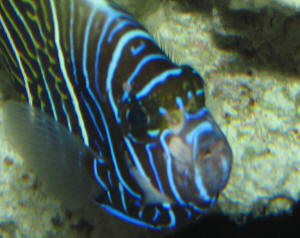
pics for you to see. I figure it is HLLE vs. hole in the
head,
<Yes... neuromast destruction...>
but can't tell which one. The lesions are very symmetric over
his face and around his mouth; and they started about 4 months
ago, gradually.
You really can't tell one side of his face from the other
(lesions are very symmetric). Also, you will see the lesions
going up his gill margins. As you can see, he is in the process
of going toward adult coloration. Not sure if his pale looking
face is just part of that change too, but it seems almost
translucent to me, rather than a healthy white of the adult (his
face is normally more pale and white than shown on the pics). And
the pics may not show it, but I can almost imagine a slight red
tinge around his mouth area (which I have read is a dietary
deficiency issue). The lesions look like deep pitted acne scars
and he has one or two perfectly round "holes" near his
eyes. Again, all very symmetric. Absolutely no lesions along his
body or lateral line area.
Over the last couple of weeks, I think I am noticing two
extremely tiny (1-2 mm size) holes under the chin area of the
queen angel now. These too are symmetric (one on each side of
midline) They are so tiny, however, that I am not sure that they
aren't just a normal marking or something. The queen has
beautiful and full perfect fins and adult coloration otherwise.
None of the other fish show any detectable variances off of their
normal coloration/markings, etc from the wild.
All (including the angels) have perfect fins and clear eyes.
I have been adding some Hikari Metro+ to some of the frozen cube
food in 3 day treatment cycles. I have done this for 2 three day
cycles. I am just not sure what else to do or how long it should
take to see some improvement. This is all a little tricky because
the angel's face is white as an adult so I don't know how
much of this is normal coloration change. Even though I suspect
most if not all of this is HLLE or hole in head. I am kinda at my
wits end. I thought I would be able to take care of this
angelfish in this system by supplying appropriate diet, etc. I
guess I may fall in with all the other aquarists in that I should
not try to keep an angel. I just don't know what else to do
here.
Thanks for any
advice,
Steve
<Does seem unusual... given the foods you list, the use of
Zoecon... to have such a pronounced nutritional deficiency
syndrome here... Do you have another system you could move this
Angel to? Otherwise... perhaps the Selcon will help... I would
supplement Iodide-ate maybe weekly with water changes... And
possibly add "Miracle Mud" to your sump, culture a Red
Algae there... Bob Fenner>
|
 |
Re: need help with lesions on emperor angel
2/18/09
Bob,
<Steve>
Thank you for the quick response on such a lengthy email question
and description. I will try what you suggested. I also will try
some Hikari A and S marine pellets just in case.
<Worthwhile>
Regarding the SG, I thought having it a little low would help with
Cryptocaryon, etc.
<Does, but... the trade off in added stress can be a bad
choice... Pomacanthus imperators from certain areas in particular
are very susceptible to neuromast destruction syndromes>
I saw the article on your website about a year ago of the guy with
20-30 angels, triggers and tangs in a 240 gallon aquarium that
keeps the SG somewhere below 1.015 for that reason (no corals).
<Yes... and is cheaper in terms of salt mix cost, and you can
much higher stocking densities due to higher dissolved oxygen,
and...>
I will, of course, increase the SG if you feel that would be
best.
<I do... along with the "Mud", algal culture... these
will importantly impart desirous chemicals, physical properties to
the water that can reverse the damage here>
I just thought it would not be as crucial for the fish. I was not
sure if it could hurt the hermit crab. I will try to let you know
if the condition of the angel improves by this summer.
<Thank you>
I do have one other question: my blue cheek trigger looks and acts
great, and eats well. He is fat, but he is almost one year old and
just doesn't seem to be growing at the rate of the other fish.
Is that normal for that species?
<Mmm, no... could be other factors at play. Please see my resp.
in the Daily FAQs today re someone with a stunted Porcupine Puffer.
BobF>
Steve
Bob,
<Steve>
Sorry, but I forgot 2 other questions regarding this emperor with
neuromast destruction:
1. Should I keep trying the metro+ addition to the food in 3 day
cycles, or is this condition completely different from what that
medication is designed for?
<None... see WWM re the use of Metronidazole/Flagyl... is very
dangerous to continually, repetitively administer...>
2. Could lighting in the tank have any play in this?
<Mmm, none as far as I'm aware... unless you give more
credence to the possibility of stray voltage being an a priori
cause of HLLE... but, the other fish livestock don't show
symptoms as you note. Ohhh! I see the "angle"
below...>
I ask because I started to reduce the amount of time that the
lights were on to reduce some alga growth on the live rock and
glass. The fish would graze on the alga, but they could not keep up
and every month I would scrape quite a bit off the rock when
cleaning. I decided to manually turn on the lights only during
feedings for about an hour each time and whenever people were over
and wanted to see the tank. This resulted in the lights being on
for 2-4 hours per day rather than the previous 8 or more hours per
day (on a timer). This condition started to occur somewhere around
the time I started to reduce the time the lights are turned on, so
I just didn't know if that could be a factor. I know fish will
do better with actual sunlight, but this is VHO and actinic bulbs.
I just thought that with no coral in there it would be ok to reduce
the lighting to feed time only, etc. The alga has diminished a lot
and the rock looks more natural, but there is still plenty of
surface alga on the rocks and the angels and tangs do graze on
it.
Thank you again,
Steve
<Good point... and... see WWM re lighting periodicity... better
to have on... a timer... regular... and to have the algae to graze
on as you state.
B> |
Free tank - north of Philadelphia... and HLLE
success, Zebrasoma -- 03/10/08 Hi Crew, <Alison> I just
thought I would send you this. If you feel it is inappropriate please
just let me know. I'm moving soon - next week actually. After some
very honest thinking I've realised that that best thing for my salt
water fish would be to give them to my neighbor since he is a very good
and experienced fish person who has similar philosophies. I'm
moving from just north of Philadelphia to FL and my Sailfin tang is
just too high strung in nature for me to want to risk his well being.
Since I will be fishless for a while I thought I'd offer up my
hospital tank to someone who may need it. Its a 30 hex that hasn't
thankfully been used in two years. The seals may need replacing soon
but when last operating it did not leak. They just look worn. Also I
would like to offer up a success story with a milder case of Hole in
the Head. The Sailfin had it when I bought him. It continued until I
drastically changed my husbandry after researching on your site. Since
my main tank is a hex as well I added a deep sand bed, added well cured
live rock, and took out the Magnum 350 I had running. I kept my bioload
exceptionally low - just the tang, cleaner shrimp, brittle star, a
damsel, and originally a pygmy angel (he died I think of old age having
come from a tank where he'd been placed as an adult approx 12 yrs
prior). I had a power head providing water movement, and an airstone to
keep the O2 levels as high as possible. A very low maintenance, simple
set up. The tank was dedicated to just the tang even though it was too
small for him at just 60 galleons. I thought this was at least better
than the 20 long the LFS had him in, and arranged the rock so he had
multiple swim patterns. I thought about a second power head but
didn't want to add additional vibrations to the tank since he shows
great sensitivity to this. I fed him mostly organic Nori from Wegmans
and Algae Plus Formula from Olsen Frozen Fish Food in NJ. I choose this
brand over others because the ingredients were simple: marine algae,
kelp, Spirulina, plankton, clam, krill, gelatin, and mussel. In about
6-9 months later there was no more hole in the head. He still has some
marks on his face which I assume to be scars. Otherwise healthy and
happy though still a high strung individual. I'll miss him greatly
but he's taught me a lot. I know he made it through importation but
I can't see putting him through that again since my life is very
chaotic right now. If anyone wants the tank please email me at
alisongrieco@hotmail.com Thanks, Alison <Thank you for relating your
success with the Zebrasoma, HLLE... many will benefit... And I do
hope/trust we will see you back in the hobby once you've settled
into your new circumstances. Cheers, Bob Fenner>
Success in curing HLLE 05/30/2008 Hi WWM crew,
<<Good afternoon, Andrew today>> I have always appreciated
the fine work you do for the marine fish/reef keeping community, and
keep up the excellent work! <<Thank you for the kind words, much
appreciated>> This time I have something to offer. Not claiming
to be an expert or anything, just one more success story and data point
for the common HLLE problem among Surgeonfishes. <<Ahhh...the
best emails to receive, success>> Some background: I have kept a
Hippo Tang for several years, and he has always been healthy, active,
and eats a lot. I have always fed him frozen brine shrimp, mysis
shrimp, Spirulina pellets and krill pellets. However, due to bad LFS
advice, he was stuck in a 37gal system for a while, which is way too
small for such an active fish. A year later, he started developing
HLLE. He had a small pit developing on both sides of his head, behind
the eyes. <<Such a shame>> This year, I finally setup a
125g system with a 30g sump, and moved him over. He seems much happier,
but the HLLE condition was still there, with no signs of improvement.
Granted, it was only a very mild case, since the rest of the head and
his body looked absolutely fine, but since this is not normal in wild
specimen, I wanted to cure him. Two weeks ago, I started adding sushi
Nori to his food. For the first day or two he refused to touch it. But
persistence paid off when I shred the Nori in little pieces and mixed
it to his favorite frozen mysis/brine shrimp, and he consumed
everything with gusto. <<Superb news>> A week later, I saw
blue color appearing on one side of the pit behind his left eye. It
seems like the HLLE is starting to heal. I wish I could take pictures,
but he wouldn't stay still for a portrait :-( <<he he he he..
they never do stay still when you want them too>> It seems HLLE
is a diet related condition, but until he is fully healed, I will keep
monitoring his progress for the coming weeks and report any more
findings. <<It is of my personal opinion, that diet is one of THE
main contributors to HLLE, so, I agree>> I thought the Hippo Tang
is unique in Surgeonfishes due to it being a planktivore, but I guess
having some more greens in his diet wouldn't hurt, and maybe the
missing link to the mystery of HLLE. <<I am really really glad
you have been able to rectify the HLLE in the tang, such a beautiful
fish, yet seen so often in captivity suffering from HLLE, along with
the yellow tang, such a shame for them. I do hope that you email here
will be a an invaluable read to others who are experiencing the same
issue.>> Hope this little piece of information is valuable! Isaac
<<Many thanks for sharing your experience with us, and really
glad you perceived to achieve a positive outcome. Kind regards, A
Nixon>>
Persistent Hexamita/HLLE 9/9/05 Hello Crew !!!!
<Scott> First let me start by saying what a wonderful wealth of
knowledge you and your crew are!!! They are there at those times when
you most need them. <Ah, yes> Anyway, I own and operate a custom
aquarium design, installation and maintenance company in the Ventura
County area. I've been in the hobby for almost 20 years now and in
business for 5 and I've seen just about everything. <Wait a
while...> From 1998 to 2001 I worked in Aquatic Research at Aquaria,
Inc. (a.k.a. Marineland) under Dr. Tim Hovanec and was taught very
well. So, as I hope you can see, I'm not a fly by night operation
and only insist on the best care for my clients! <Oh, yes... was
contemporaneous with Tim at SDSU... some changes going on there now...
am wondering what B. Sherman would/does think...> Now for the
problem, about 16 months ago I received a call from a someone who
needed help taking care of their existing 500 gallon room-divider,
saltwater, fish-only aquarium. Apparently their current "fish
guy" wasn't working out. Since then, I have had a persistent
problem with Hexamita/HLLE. <Mmm... from what cause... is it really
Octomita (necatrix)... nutritional (usually), water quality (second
most commonly...)> The water quality was less than perfect when I
started, but quickly got it back to center. I have tried everything
that I know of up to and including removing all fish (no small feat)
and quarantining them for several weeks and letting the tank go fallow.
I have only lost one French Angel to this disease but I cant seem to
get rid of it. Every time I heal them up and put them back in the
problem comes back. I visit this tank 3 times a week and make sure that
no overfeeding is occurring and that water quality remains prime. The
tank is fish-only, like i said, and has an old school undergravel
filter with 3 Ocean Clear Canister Filters (1 Carbon, 1 UV with filter
pleat, and 1 filter pleat only). I am starting to wonder if it has
something to do with what lies beneath those undergravel filter plates.
<Indirectly, likely so> This tank has been through some tough
times, much to the chagrin of my clients, and I cant imagine going to
them and telling them that I have to completely tear it down. I've
read tons of literature regarding this and have done many changes
including attempting to remove stray voltage, feeding various types of
properly balanced diets, and performing regular maintenance. Any other
suggestions would be wonderful. Thanks a ton. Scott C. Wirtz Owner Blue
Marlin Aquatic Creations <Mmm, the easiest, most assured route to go
would be to add a "mud filter" in an attached sump (really)
for improving water quality, providing useful biological molecules...
You could try supplementing foods (Selcon, Zoe, Microvit...), even a
one time dose of Metronidazole/Flagyl if you believe (I would check
with smears, a scope) this is rooted in pathogenic protozoa... (I
don't). If it were me, my service account (did this for nineteen
years as well), I would go with the added sump, mud... lighting and
macro-algae there (my choice? Gracilaria). Cheers, Bob Fenner>
Re: Persistent Hexamita/HLLE 9/10/05 Thanks for
the info, Bob. Unfortunately there is absolutely zero room for an added
sump. <Even hanging something in the inside of the tank?> You
know these high end clients.... they need all the room the can get for
their precious wines and the like. <Oh yes... I also need this...
for our "two buck Chuck" vinos> Did I mention that this is
a room divider tank between their main entrance and their sunken bar?
<Negative> Well, it is. I currently have them feeding Formula One
and Two pellets soaked in Selcon and Zoe and then allowed to dry in
addition to sheets of dried seaweed on a clip. They don't want to
touch or smell anything "offensive". The only water quality
parameter that I am having trouble with is temperature. The tank
regularly runs at 85 due to 3 T-2 pumps, very quiet but very hot with
no chiller. If i convince them to change out those pumps to Iwaki or
the like and get the temp down, do you think that would help? <Some,
yes> As an experienced service provider, am sure you can imagine how
much difficulty it is to get people to change their ways. Especially if
it costs money !!!!! <Oh yes... but, the choice of improving their
livestock's health, appearance... given this clear choice? Another
possibility... the water you use for changes? Do you haul it in? If
this was run through a sump with the macro-algae and mud... this would
be of great benefit. Bob Fenner> Scott C. Wirtz Owner Blue Marlin
Aquatic Creations
Re: Persistent Hexamita/HLLE 9/11/05 Bob,
<Scott> The replacement water I use is first run through a
Culligan Carbon Tank and then a Culligan Water Softener to prolong the
life of my RO membrane, then it runs through a Kent RO/DI unit with a 5
micron prefilter and a 1 micron prefilter in place of the normal carbon
block. Currently am getting the TDS down from 250 ppm to approximately
<5 ppm. I then use Tropic Marin and allow it to sit in 300 gallon
batches for approximately 24-48 hours while aerating, depending on
client load. How would I go about running this water through a sump
with Macro Algae at this stage? <You'd have to have a sump added
to the process and recirculate this one customers water through it,
over the mud...> I haven't heard of doing this with replacement
water before. Although I don't have a problem with any of my other
clients, this sounds like it would benefit all of my tanks. Thanks
again Scott C. Wirtz Owner Blue Marlin Aquatic Creations <Yes,
would. Bob Fenner>
| White blotches on mid size Blue Face Angel 3/23/06 Love
the site, and looked over it many times before submitting this
inquiry. <Good> I have a 210 gallon with the double sump wet
dry, protein skimmer, grounding probe, and UV going. The water
quality is as such as I just measured it today: salinity is 1.019,
<Too low...> ammonia is 0.0, nitrate is 10, nitrite is 0, and
ph is 8.2 according to the 'Aquarium Pharmaceutical' kit I
use. Fish roster includes: Australian Harlequin Tusk, green bird
wrasse, 2 lookdowns (small), crosshatch trigger, blue face angel,
zebra moray, squirrelfish, and powder blue tang. <Yikes... you
need a much larger system...> They all eat a daily mixed diet of
mysis, green and red lifeline, krill, angel formula, lancefish,
mussel, romaine, <I'd skip the terrestrial greens... almost
no food value, and trouble with pollution> cockle, and formula
one. all soaked in Selcon daily except for the romaine. Attached
are 2 pics of our 3.5-4 in Blue Face Angel which we've had for
3.5 months. As I read over your site, it looks like this could be
HLLE (of just the head for right now) or a metamorphosis to
becoming an adult. The LFS says it's most likely the latter b/c
the fish is eating like a pig. It seems to be getting worse too and
his skin on his face looks to be deteriorating. <Does look like
HLLE... water quality issue here mainly... Though what you can/do
read/seem okay...> Prior to this he was having those random
white patches that would come and go on his body (literally within
hours - it was a different picture. <Agreed... likely behavioral
reaction... more neuronal, less hormonal... now switched> think
it was that spook factor mentioned in your other write ups). What
do you think this really is? <Is an erosive condition. I would
raise your spg, do what you can with modifying the wet-dries
(switching to refugium/s... or adding, tying a live sump in
somewhere... Consider "live mud", macroalgal culture...
and purposely add the Selcon to whatever foods this fish is
taking> Thanks in advance for your time. Sincerely, Jason
Chamberlain <Thank you for writing so thoroughly, clearly, with
clear graphics, sharing. Bob Fenner> |
|
|
| Coral Beauty Dx HLLE Rx multiple approaches
1/6/07 Hello Everyone, <Hi Carol, Mich with you today.> I
just came across your website tonight and thought you might be able
to help. I have had my Coral Beauty Angel for about 6 months now.
Right after I got it, the new Flame Angel got pop-eye and while
treating for pop-eye the Blue Tang got Ich. <Are you familiar
with quarantine procedures? If not please read here: http://www.wetwebmedia.com/QuarMarFishes.htm > Over
the course of the next few weeks we lost several fish. <Sorry
for your loses.> I got the tank, treatments and fish under
control and have looking good water-wise for about 3 months. The
only problem left now is with my Coral Beauty. At the end of the
Ich, when the other fish either died or got better, it developed
white divots around its eyes and down either side of its body. His
appetite and behavior has not changed. It seems perfectly healthy,
except for these divots. I have asked 3 saltwater fish stores in my
area and no body has heard of anything likes this. Can you tell me
what it might be and what I can do to get my fish beautiful again?
<Does look like HLLE Head and Lateral Line Erosion. Is common in
tangs and angels. HLLE is linked with poor water quality,
nutritional deficiencies, and the protozoan Octomita (Hexamita
necatrix. "Stray voltage" has also been anecdotally
associated with HLLE. To try to improve the health of your beauty,
you will want to make sure you are keeping on top of you water
changes, make sure your tank is grounded, to eliminate any stray
voltage, and try supplementing your feedings with a vitamin
supplement (vitamin C and vitamin D especially) such as Selcon.
Steamed broccoli has also been used to successfully treat HLLE. You
can also read more here: http://www.wetwebmedia.com/hllefaqs.htm and here http://www.wetwebmedia.com/hllefaqs2.htm and here
http://www.wetwebmedia.com/hllefaqs3.htm > My tank is
a 75 gallon fish only that has been set up for 3 years. Thank you
for all your help and time, <Hope this gives you a place to
start. Good luck! -Mich> Carol |
|
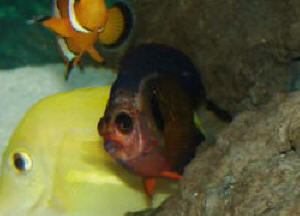 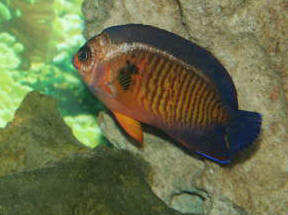
|
Coral Beauty HLLE? 7/1/06 Hi,
question for you. <Hello John> I currently have a mid size coral
beauty in my quarantine system. I purchase him 16 days ago from a LFS.
While in the QT he has developed a small patch (approx the size of a
match head) on his L side near his lateral line. The area appears to be
pale in nature and irregularly circular. At first I thought he may have
just bumped against something in the tank but now watching it over the
past 15 days. It appears to have grown ever so slightly. Also yesterday
I noticed a very tiny pale patch on the R side of his head. Is this the
beginning of HLLE? <Possibly.> I feed sparsely (given that he is
in a QT) brine shrimp and Omega sea veggie flakes once a day each.
<A poor diet such as this can certainly aid in further development
of HLLE, if that is indeed what it is.> The QT is a 15 gal long
w/AquaClear 200 filter and carbon pouch. Airstone w/pump, heater, small
powerhead and PVC piping. 1 gal water is changed daily. If this is HLLE
should I attempt to treat it before placing him in my main aquarium or
place move him in after he finishes out his QT time figuring the better
diet and water quality available in my larger system will fix him.
<You've just answered your own question here. Better vitamin
(Selcon, Vita-Chem) enriched diet and excellent water quality are the
main factors in reversing HLLE. There is no medication, in my opinion,
that will effectively reverse this. Do read FAQ's on this also.
http://www.wetwebmedia.com/hllefaqs.htm>
My main system is a 65 gal w/20gal sump, live rock. Thanks for your
comments, <You're welcome. James (Salty Dog)> John
HLLE in Fish Other than Surgeonfishes, Not the
Happiest Place on Earth.. for a Fish. 1/30/07 Hi! <Hello there,
Mich with you today.> Just returned from a trip last week to Orlando
and was wondering about the health of 2 systems I visited. First was at
Epcot, there I noticed in one of the buildings (In Nemo and Friends)
which housed a huge aquarium that many of the fishes did not looked
very healthy. <Sad.> Most of the fishes I saw, including
yellowtail snappers, grunts and others, looked like suffering HLLE. The
faces looked badly eroded and I was curious to know if in fact those
kinds of fishes suffered from HLLE, I believed not. <Yes it is
possible. HLLE most commonly affects tangs and angels, but can be seen
in other species in captivity.> Other thing I noticed was that the
fins were badly damaged too. <A shame.> I also visited Rain
Forest Café at Downtown Disney and although the systems
looked better, I also noted the condition on some of the fishes there
including Tangs and other species. Have any of you being there
recently? <Unfortunately, no.> Can HLLE affect any species of
fish in aquariums. <Any may be too broad of a word here, but it can
affect many different species in captivity. -Mich> <<RMF
concurs... the fishes in these systems are poster children for
HLLE>>
Marine Hole in Head: What do I do? I have a Kole
tang with what looks to be Marine Hole in head. What steps should I
take to try and save him. Will a freshwater dip do any good and how do
you suggest I prepare the freshwater? <A freshwater dip is unlikely
to help this malady. IMO it would likely do more harm than good> I
have read that the hole in the head is primarily a Tang and Angel
disease. <Correct> Will my others catch it <Nope!> and is
it present only when they are stressed? <Not contagious...> I
didn't notice anything wrong with the Kole until the day after I
put him in the tank. I am thinking it was because he was stressed?!
<So this is a new addition to the tank? Well, the colors that a fish
show when stressed can sometimes allow you to see HLLE that otherwise
isn't noticed. I have had the same experience with a Sailfin tang.
Please realize that...at a minimum the malady is present in this fish
and it will...if not at this moment, in the near future...need help.
HLLE is a symptom of inappropriate environment and feeding. This is
also not a problem that develops quickly. Some authors have implicated
electrical current in the tank as being a factor but this hypothesis
has never been proven. Using a grounding probe in you tank will take
away the possibility of this occurrence. Tangs and angels are affected
most often because they feed heavily on macro algae that live in the
ocean. You need to replicate the natural environment by either growing
algae in your tank which is probably the best solution (Gracilaria is
fabulous: IPSF is one distributor for this algae), or by feeding dried
seaweed (not baked...dried) called Nori. Nori is sold in the Asian
section of your local supermarket. Also consider adding a vitamin
supplement (one that includes vitamin C) such as Selcon. Soak the food
before feeding. As always...keep water quality optimized which means
low organics, no ammonia, no nitrite and low levels (if any) of
nitrate. Much more about this ailment at WetWebMedia.com. It can be
cured but it tends to be slow to heal> Any suggestions will be
carefully considered and followed. Thanks so much. <You got my brain
droppings!> Love your site and have been reading it religiously
since discovering it. <Thanks for the compliment! This is a service
that the WWM crew enjoys providing. It's our pleasure to assist!
David Dowless> Jwithay from NJ.
My angel fish is looking dull! Dear Bob <David
Dowless standing in this afternoon> I have an Imperator angel I have
had for about 5 years. He is housed in a 100gal. aquarium. Filtered by
3 Eheim canister filters a 15 watt UV. He has a few other tank mates
such as a twin spot wrasse, <Do you mean the Coris wrasse? This baby
gets to be more than 21" long!> 6 fire fish, long nose hawk,
Flame angel, Flag fin, 3 butterflies. In, addition I also have a
protein skimmer. <Is it producing a full cup of skimmate daily?>
Water parameters are close to 0 ammonia <.1ppm NO2, N03 between20 to
60. <Ammonia and nitrite need to be zero all of the time.>
Salinity 1.020, temp 77. This was not always the case, however , I
thinned out the population some time ago. I did this because I had
difficulty keeping the water parameters within the range I proffered. I
had blue tangs and a Koran angel that both had bad HLLE. The Imperator
I believe was also developing HLLE so I became extra faithful doing
water changes and adding broccoli and spinach to the diet. This seemed
to arrest any HLLE in the Imperator however his color has dulled. I
should mention that in every other way he is fine. <Poor water
quality, poor diet, and overcrowding will do this..> I occasionally
put carbon in my canister filter some say this contributes to HLLE
also, I do not do anything to guard against stray voltage. <HLLE is
an environmental disease: inappropriate diet and poor water quality due
to overcrowding. Your tank needs to be thinned out even more. I
don't know which ones to get rid of because I don't know their
sizes or the specific species. Consider getting a copy of Scott
Michael's Marine Fishes. It is an excellent pocket guide that would
have helped you avoid overcrowding. You can get it online for less than
$25> My fishes diet is extremely varied including frozen as well as
dry foods and fresh veggies. <Marine algae growing in the tank would
also help> I would welcome any advice you may have. Thank you,
Charles Rayburn <You're welcome, Charles. You can research even
more on this and many other topics at WetWebMedia.com...David
Dowless>
Re: HLLE Reversal Hey WWM team,
Thanks again for your help. My recipe for success in reversing my
Powder Brown Tang's HLLE was: Conditions: Fish only, 30 gallon hex
with porcupine puffer, spotted hawk, and above mentioned tang. Magnum
hang off the back filter, under gravel filter, and Berlin Air Lift
skimmer Actions: Replaced air stone <Good idea> Cleaned
mechanical filter (ph dropped, so I added buffer for two days)
<Okay> Started bolstering healthy bacteria with Cycle because so
much organic material was rinsed off filter sleeve. <Good move>
¼ Cup of Kent carbon replaced, running for three days per
month (I used to just leave it in, but no more) Kent Essential Elements
and Coral Vite to replace trace minerals Added 1800mg (two large gel
caps) of Omega 3 and 6 to 4 oz. Bottle of Boyd's VitaChem for food
additive, which I put on OSI Spirulina and freeze-dried krill (for my
puffer) feeding twice a day Also added 1000mg garlic oil to VitaChem
Lowered specific gravity from .023 to .022 because temperature was
above 23C Results: Tang's HLLE is looking so much better now and
it's only been 3 days, and I did catch it early. He did, however,
develop a slight case of blood streaking (petecchia?) in his tail that
I noticed yesterday, but looks better today too, though not completely
gone. <Excellent> Please let me know if you have any
thoughts/criticism on the above treatments. <Good work,
congratulations. Your apparent grasp of what the principal inputs/cause
of HLLE (degraded environment, poor nutrition) are the same as mine.
Bob Fenner> Thanks again,
Jonathan
Update on French angel w/ HLLE Hi to all of
you! I just wanted to send you another update on my French angel.
After you saw HLLE on him I decided that I would put him in the
main tank in hopes of improvement. I think that 5 weeks in a bare
QT was just too much for him. Anyways, he has improved drastically
this last week!! Here's a picture of him now! can't thank
you enough for all your help!! Lynn
<Great news. Congrats. Bob Fenner> |
|
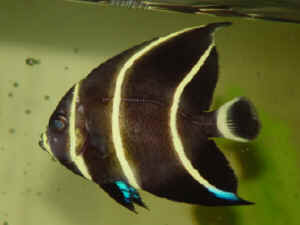
|
Reversing HLLE Dear WWM Crew- <Scott F. your
Crew Member tonight> I have a flame angel that has been in my tank
for about 4 months now. About 2 months ago, it started to develop what
looked like head erosion around his eyes and temple areas. I checked my
water and everything looked okay, but when I tested with a new test
kit, it turned out that my nitrate was around 80, and my phosphate was
around .5. <Wow- that's some serious nitrate! Lots of ways to
lower nitrate, all of which can be found on the WWM site- do
investigate them and take action accordingly> After discovering
this, I immediately changed out 50% of the water, and did a few more
water changes on a weekly basis and brought the nitrate down below 5 in
a few weeks. <Excellent! Way to go!> After doing this, and with
increased maintenance to maintain water quality, I hoped that the flame
angels symptoms would go away. Anyways, after a month, it seems as if
the symptoms are getting worse, and I don't know why. My tank is
grounded, and I am feeding my tank Ocean Nutrition formulas, Nori,
marine cuisine, HBH pellets, and Caulerpa, all coated in Vita Chem. Do
you have any ideas what could be making this head erosion worse, and do
you have any ideas that I could try to reverse it? Thanks! <Well,
the problem with HLLE is that no one is 100% certain what causes it to
begin with...Poor water quality, stray voltage, improper nutrition (all
of which you seem to have addressed) have been implicated in its
occurrence. Another possibility is Hexamita, a protozoan. It sounds
like the damage to the fish should have at least stopped, if not
reversed, based on the actions that you have taken! My recommendations
here would be to continue the good husbandry practices, feeding of high
quality, vitamin-enriched foods, and careful observation. I'm of
the opinion that it is an environmental and dietary-induced malady, and
as such- can be arrested (if not reversed) by continuing what
you're doing. You could also research the possible protozoan
theory, and investigate treatment methods (in a separate aquarium, of
course). However- I like what you're doing- give it more time, and
I would not be surprised if the damage improves, or even disappears
entirely in time. Hang in there! Scott F>
HLLE Hey all, I just wanted to offer my
observations on HLLE. I have a Hippo Tang that developed it about a
year ago. I've recently been using Vita-Chem and Selcon heavily and
have seen about a 50% reduction in the disease in about 8 weeks. For
your readers out there, use it. It works. Thx <Thank you for this
input. Will post to share. Bob Fenner> Angelo
HLLE Permanency I'm not having problems with
this (knock on wood), but after reading the FAQs I was wondering. Can a
fish with a severe case of HLLE ever fully recover? <Probably not to
its full coloration.> Is the best one can do is stop it? or can it
be "reversed" (scaring and holes)? <It can be reversed.
The amount of scarring and color is going to depend on the amount of
HLLE.> Thanks again for your guy's devotion, Mark <You are
welcome. -Steven Pro>
|
|


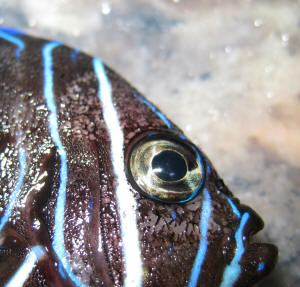
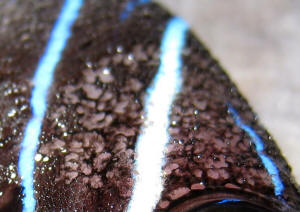
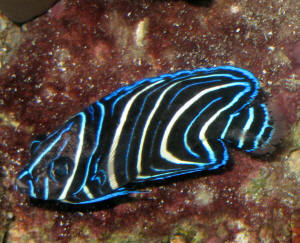 Note the BGA...