|
Related FAQs: Green Brittlestars, Brittle & Basket Stars, Brittlestars 2, Brittlestars 3, Brittlestar ID, Brittlestar ID 2, Brittlestar ID 3 & Brittlestar Behavior, Brittlestar Compatibility, Brittlestar Selection, Brittlestar Systems, Brittlestar Feeding, Brittlestar Reproduction, Brittlestar Disease, Brittlestar Disease 2, Sea Stars, Seastar
ID 1, Seastar Selection,
Seastar Compatibility, Seastar Systems, Seastar Feeding, Seastar Disease, Seastar Disease 2, Seastar Reproduction,
Related Articles: Echinoderms, An Introduction to the
Echinoderms: The Sea Stars, Sea Urchins, Sea Cucumbers and
More... By James W. Fatherree, M.Sc. Sea Stars,
Crown of Thorns Seastars, Marine Scavengers,
Brittle and Basket Stars, Class
Ophiuroidea
|
|
| Bob Fenner |
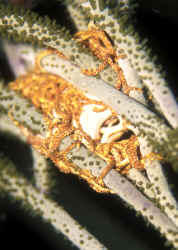
Astrophyton muricatum
|
The Brittle or Serpent Stars are grouped as the Class
Ophiuroidea, characterized by having highly mobile arms that can be
used to assist in (relatively) rapid motion. These starfish-like
echinoderms are decidedly quicker and more delicate than asteroids.
Their common name is derived from their sinuous, snake-like movements,
and the fact that they're truly brittle and break away easily if
they come under attack. The podia in this class are generally used as
sensory organs, rather than for active feeding as with their kin, the
asteroids. There are more than 2,000 described species worldwide, and
they're found congregating throughout shallow reef environments,
hiding under rocks and within and between other living
organisms.
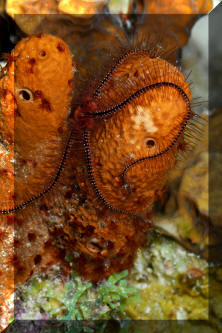
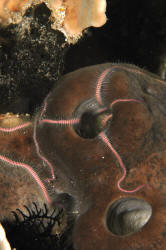
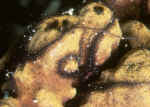
| Seemingly on the other end of the machismo scale
are the Brittle or Serpent Stars, which are so retiring and
nocturnal that you may never see them in your system. In the
world's reefs, they are everywhere. Two examples showing
Ophiuroids tell-tale arms coming out and over soft coral in
Bunaken, Indonesia, and a sponge in the Fiji. |
|
Many reef aquarists have grown fond of them, as
they diligently work the underside and unseen recesses of the captive
reef, scurrying around under the ledges and rocks, eating detritus.
They can play an important role in keeping inaccessible areas of your
tank cleaned up, and they stir up and aerate the sand bed where the
aquarist can't reach.
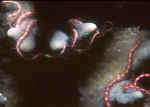
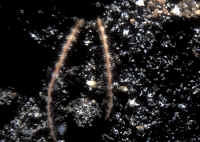
| They are literally and actually everywhere in
marine environments. If you look closely, especially by dark of
night, you will find Ophiuroids lurking and feeding about. Here are
some Brittlestar arms sampling the mud about its borrowed hole/home
in shallow water muck in N. Sulawesi. |
|
Beware the Midnight Fish Eater!
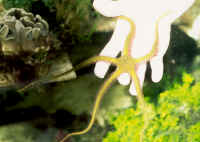
| One species in common use warrants a
statutory warning. This is the Green Brittle Star of the genus
Ophiarachna. This animal is a predatory fish eater, that does
indeed do a spiffy janitorial job when small... but grows quickly,
and under darkness of night can/does learn to eat aquarium fishes.
This species has been documented to arch up in "sleeping
caves" of captive fishes and drop down on unsuspecting meals.
If you use this species, keep an eye on it, and a count on your
piscine livestock. |
|
|
|
|

|
|
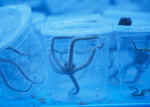
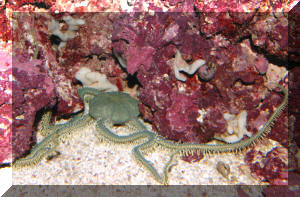
Green Brittle Stars at a wholesalers. This is
one way to keep them from eating your fishes!
|
A foot wide individual on the
prowl! |
A retailers tank that has just
had some fish-food water applied to it. |
Bigger PIX:
The images in this table are linked to large (desktop size) copies.
Click on "framed" images to go to the larger size. |
%20MD.JPG) |
For the appropriately small Brittle/Serpent Star
species, selection is simple, placing healthy individuals at about one
per ten gallons of your systems capacity. You may be fortunate to
"inherit" your Brittle Stars with live rock, or collect them.
For those near or traveling to the tropical west Atlantic, the genera
Ophionereis, Ophioderma and Ophiocoma can be found
in good numbers intertidally by carefully lifting rocks and using a
hand net to collect a few. Of course, you'll need to study up and
prepare for the captives intermediate needs, as well as comply with
local ordinances, licensing.
|
|
|
|
|
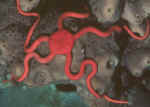
Ophioderma ensiferum, the Gaudy Brittle
Star, in an aquarium.
|
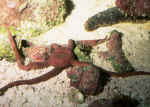
Ophioderma rubicundum, the
Ruby Brittle Star in St. Lucia out at night. |
A whole tank of Ruby Brittle Stars
awaiting shipping at a L.A. wholesaler's. |
Some Brittlestar Species:
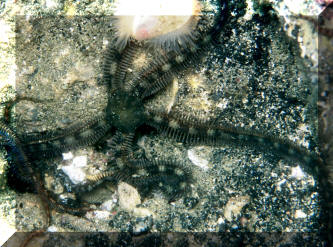
| Ophiocoma alexandri Lyman 1860,
Alexander's Brittle Star. Indo-Pacific. Disc size to 0.9 in.,
arms to 7.1 inches in length. Feed on detritus both day and night
by extending their arms from crevices, beneath rocks. Southern
California to Peru, including the Galapagos Islands. Galapagos
pic. |
|
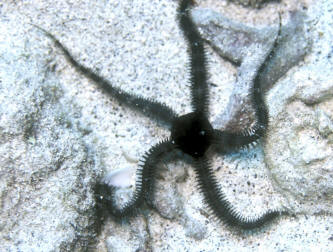
| Ophiocoma erinaceus Muller & Troschel
1842, the Spiny Brittle Star. Indo-Pacific. To 5.5 inches in
diameter. Dark by day, grayish bands by night. Found in association
with living corals. Hawai'i' pic at night. |
|
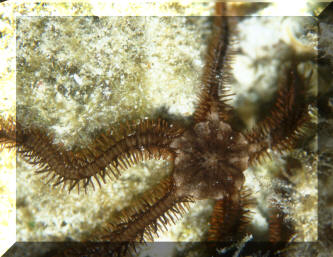
| Ophiocoma paucigranulata, the Spiny Brittle
Star. Tropical West Atlantic. 4-6 inches in diameter. Have pale
colored arms in their middles. Found in association with living
corals. Cozumel image at night. |
|
| Ophionereis annulata. A cool water
species, photographed here at the Birch Aq./SIO in 2012 |
%20MD.JPG) |
| Ophiomastix variabilis Koehler 1905. Black
bodied with long arms. All intermittently marked with yellow. Arms
bear some paddle like structures as modified spines. Found on
living corals in shallow water. Indo-West Pacific; Mozambique to
Noumea. N. Sulawesi pic. |
|
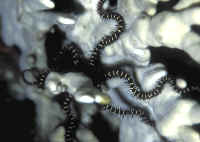
Ophiopsila riisei
Crevice Brittlestar. Thin arms, small spines... Light color banding.
Generally only seen at night. Roatan 2019 (at night).
|
|
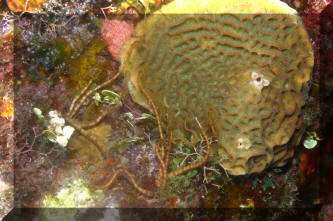
| Ophiotheia danae (Verrill 1869). Order
Ophiurae, family Ophiotrichidae. Indo-West Pacific; Red Sea,
eastern Africa to the South Pacific, Japan. Narrow armed sponges,
gorgonians and soft corals are substrates for this diminutive
Brittle Star. Banded arms come in blues, orange, red, yellow. This
image made in Pulau Redang, Malaysia on a sponge. |
|
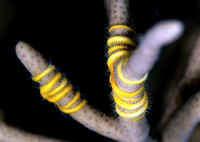
| Ophiothrix purpurea Martens 1867. Reddish
disk, alternating colors on arms, with a distinctive black stripe
running down the middle of each one, surrounded by yellow. KBR, Lembeh, N.
Sulawesi, Indo.
image. |
|
Bigger PIX:
The images in this table are linked
to large (desktop size) copies. Click on "framed" images
to go to the larger size. |
|
%20MD.JPG)
|
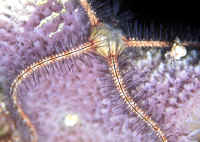
| Ophiothrix suensonii, the Sponge Brittle
Star. Tropical West Atlantic. 2 1/2- 3 1/2". Live principally
on sponges. Also found on fire coral and gorgonians. Arms bear a
dark line running down their mid-line. Cozumel pix. |
|
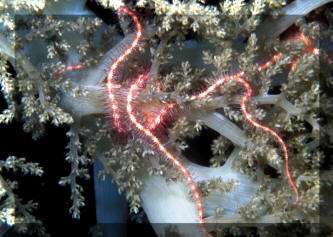
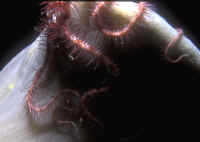
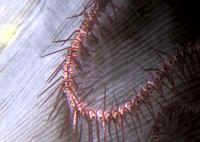
| Ophiothrix sp. 2. Similar to O.
purpurea, but with maroon spots in the middle of leg segments.
Indonesia. Here climbing over a toadstool soft coral at night in N.
Sulawesi. |
|
Bigger PIX:
The images in this table are linked
to large (desktop size) copies. Click on "framed" images
to go to the larger size. |
%20MD.JPG)
%20MD.jpg) |
Bigger PIX:
The images in this table are linked to large (desktop size) copies.
Click on "framed" images to go to the larger size. |
.JPG) |
| Amphiurids; here in S. Leyte 2013 in abundance. |
%20MD.JPG)
|
Basket Stars:
One fast mention of the bizarre Basket Stars. Though some folks have
reported reasonable success in their husbandry (see references below),
these nocturnal animals are by no means easy to keep in captive
conditions. They require specialized, large facilities, and diligence
in their food preparation and administration.
| Astroba nuda Up to a meter in tendril ended
branch-like arms. Hide during the day, opening up during dark to filter feed
on plankton. Red Sea 2019. |
%20MD.JPG)
|
Bigger PIX:
The images in this table are linked
to large (desktop size) copies. Click on "framed" images
to go to the larger size. |
|
%20MD.JPG)
|
|
|
|
|
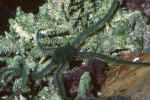
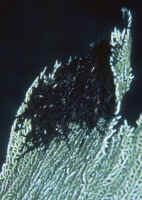
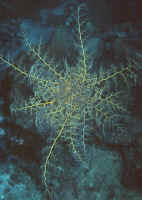
| The Basket Star Astrophyton
muricatum in the Bahamas. Here "sleeping" by day on a
gorgonian. |
The same species in a typical
daytime spot; curled up inside a brown sponge. This one in
Belize. |
Night time, and it's time to
unfurl your arms into the incoming current and strain out your
meal. Here in St. Lucia. |
Bigger PIX:
The images in this table are linked
to large (desktop size) copies. Click on "framed" images
to go to the larger size. |
|
%20MD.JPG)
|
Bibliography/Further Reading:
http://home.att.net/~ophiuroid Damone, Joe. 1999. The
Caribbean Basket Starfish (Astrophyton muricatum) in the home
aquarium: is it possible? Aquarium Frontiers Online 2/99.
Volkart, Bill. 1989. The beautiful Brittlestars. TFH 1/89.
|
|


%20MD.JPG)
%20MD.JPG)