|
FAQs about Brittlestar
Compatibility, Control
Related Articles: Brittlestars, Sea
Stars, An Introduction to the
Echinoderms: The Sea Stars, Sea Urchins, Sea Cucumbers and
More... By James W. Fatherree, M.Sc.
Related FAQs: Brittlestars 1, Brittlestars 2, Green Brittlestars, Brittlestar ID, Brittlestar Behavior, Brittlestar Compatibility, Brittlestar Selection, Brittlestar Systems, Brittlestar Feeding, Brittlestar Reproduction, Brittlestar Disease, Seastar Selection, Seastar Compatibility, Seastar Systems, Seastar Feeding, Seastar Reproduction, Seastar Disease,
|
|
|
Not many species of large
wrasses...
Nor some species with smaller fishes
period...
|
No, no, no
|
|
On Gorgonians/Sea Fans?
Largish Crustaceans, esp. crabs, shrimps
Smallish Crustaceans like little hermits
Bigger hermits?
|
Not a problem.
May be food, or predators!
Too likely eaten
Definitely eaten
|
|
Brittle Starfish Attacked by Giant Hermit
3/31/18
Hi,
<Kitty>
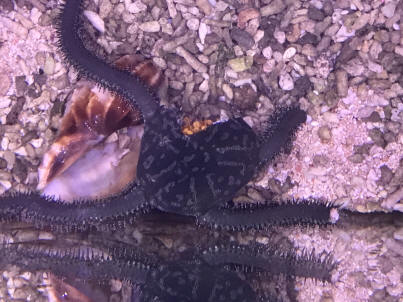
My large (14 inch plus) brittle starfish was brutally attacked by my giant red
hermit crab
<Oh, yes; large ones especially are opportunistic omnivores. Will consume most
anything they can get their claws on>
last night and during the incident lost the best part of three legs and the ends
of two legs, he had also gained a substantial cut from the top of his body round
and down to underneath, it has not touched his mouth but his orange insides are
on view, he is still moving around this morning and waving for food but I’m
worried he won’t survive for long, is there anything I can do to help or should
I let nature take its course?
<Mmm; some benefit from moving the animal to a sump, area where others can't get
to it, and overdosing (2-3 X) a useful iodide-ate supplement/solution. Am a fan
of SeaChem's line here>
I have removed the crab from the tank and I intend to take him bk to the local
fish shop as he has over grown my tank anyway. There are also 3 long pieces of
the star fishes legs in the tank, should I remove them or will they grow into
other stars lol.
<These I'd remove. Just keep the central disc part>
Thanks for your help
Kind regards
Kitty
<Welcome. Bob Fenner>
|
Re: Brittle Starfish Attacked by Giant Hermit
4/1/18
Hi Bob,
<Kitty>
Thank you for your quick response, it was much appreciated.
<... please people (it's not just you Kitty), ONLY send files in hundreds of
Kbytes... We/WWM doesn't have storage space sufficient for megs. THIS is
clearly stated on where you find to write us.>
I’ve had another look at the brittle and it seems that the hermit had
actually ripped a whole leg off, I can’t find any bits of leg with a part of
the disk still attached just a few bits of leg floating around, I’ll remove
them as suggested thank you.
<Good; their death, decomposition could prove deleterious to your other
livestock>
As he has had a leg removed and part of his body along with it do you think
there is any possibility of him surviving?
<Some; these are remarkably resilient creatures (Ophiuroids)>
I’m concerned about moving him to the sump, There seems to be silt etc on
the sump floor, will this irritate him?
<No; it will not>
If he does recover, do you think his cut will heal up and will he just be
one leg down or will could he have an opening wound forever or could his leg
grow back?
<All may, can grow back>
Sorry to bombard you with these questions but I’ve not seen anything like
this before and my LFS wasn’t that helpful!!
<PLEASE read on WWM re Brittlestar health. BobF>
I have attached the pictures properly this time!!
Thank you again
Kitty
Re: Brittle Starfish Attacked by Giant Hermit 4/1/18
Hope your able to open these ok?
<Ah yes; thank you>
|
Trigger question; stkg. Earl? Plus Brittlestar comp.
1/21/16
I emailed before and got Mr. Bob. I asked if I could keep a clown trigger in a
150. I think I got him mad :(Then again I am agoraphobic and leave my house 6
times a year so my social skills are rusty, lol I have since read a lot and ask
in forums. Problem with forums is just because somebody did it doesn't mean it
was right..so here I am again.
<As often the case as not, I've found. "Buyer beware" when it comes to forum
anecdotal advice and unsourced claims.>
I have a 150g. I love the look of clown triggers and Bluelines. I decided
against those.
<Good idea, too small for long-term habitation of these species.>
I know how it is to be closed in. It would be like me living in half of my
living room.
<Exactly the case and also why decor/layout is so important and often
overlooked.>
Would an undulated work?
<Undulated are one of meanest customers I have ever seen and also psychotically
unpredictable (model citizens for years
then suddenly blood-mad fiends. Beautiful and smart and interesting though.
I want to keep one myself but, well, see the preceding :) Max length per
Fishbase: 30.0 cm/11" or so>
Yes I read, but the health of my animals is paramount to me. I want to make
SURE! If not an undulated, would a pair of or single blue throat work?
<Better.>
While here one more question please. I have 2 clowns and a large brittle star. I
was going to 'trade' in. But the thought of losing fish I have had for 10 years
literally had me sobbing. My hubby bought me a 40 breeder, drilled with sump and
home made stand and canopy to put my fin friends in.
Now I am worried the 40g will be too small for the brittle star. I told Mr. Bob
she was about 19 inches. Hubs and I measured her today the best we could and she
is at a minimum 22 inches. Will she be ok in a 40 breeder with 2 clown fish, a
deep sand bed and clean up crew? Please advise The psychological and physical
health of my pets is important to me.
<Well, it's that whole "living in a small room" thing again. If I were sure the
star would be safe in the larger tank I'd do that if you must keep it (I
understand the attachment and also you'll be hard-pressed to find someone
willing to take a starfish of that type and size.) Bear in mind that these guys
can and will catch fish they can catch unawares (sleeping, ill) and also can be
preyed upon by the usual beaky fish like triggers and puffers. I had a large one
with a Humu trigger (my favorite fish) but since the star was only out in the
middle of the night and buried itself in deep piles of rockwork in the day, the
trigger never bothered it for a solid 7 years or so. Or maybe he knew it was
around but just didn't care, who knows the mind of a mercurial fish?>
|
Suspect Starfish 12/9/15
Greetings,
<Pen>
I've attached a picture of a hitchhiker starfish I suspect has bad behaviors in
a seahorse tank with small fish. Can you ID it from the attached picture & tell
me if its a harmless Brittle or something worse?
<Can't ID; but do think it will not cause trouble.... as long as it stays small
and is fed enough>
Body size is approx ¼ inch or larger.
<If it gets more than twice this diameter, I'd trap, remove>
Thanks so much in advance for your help.
Penny Harkins
AquaCorals - Saltwater Reef Aquariums
34 Currier Road, Fairfield, ME 04937
<Welcome! Bob Fenner>
|
 |
Dwarf lionfish food? Reading on WWM? Plus Ophiuroid comp.
Hey guys, first off great site. My name is Dave, and I have a 120 gallon
tank with a 60 gallon sump/fuge. It's a mixed reef (sps, lps and
softies).
As for fish, I have a pair of Ocellaris clownfish, bi-color blenny, starry
blenny, coral beauty angel fish, some green Chromis, a couple pj cardinals,
an engineer goby, a mimic lemon peel tang and a dwarf lionfish.
<The Lion can/will inhale many of these other fishes in time>
I realize
some of his tank mates can potentially be food for him but its been well
over a year
<Oh! Maybe not>
and aside from him eating the peppermint shrimp I haven't had
any issues yet, he even lets the cleaner shrimp clean him. I've had the
dwarf lionfish since he was less then 2 inches and now he's fully grown.
It
took about 8 months to finally get him to eat frozen food. Here's my
question, I've been feeding him frozen table shrimp that I thaw in some
Selcon. I know that it's important to provide more of a variety, but
what
are some other good choices? I recently bought a back of mixed frozen
seafood from trader Joes that has shrimp, squid and scallops.
<Ah good>
I haven't
given him any squid or scallops because I was unsure whether or not
those
were okay to feed him.
<They are... Please read here:
http://wetwebmedia.com/dwflionfdgfaqs.htm
He won't eat frozen mysis shrimp, I think it's
because they're to small so he doesn't even bother with them. I feed him
smaller meals every other night rather then bigger meals less often.
There
are times when he's hanging out under his overhang and I'll notice his
color kind of fades,
<Natural behavior; not to worry>
but it instantly brightens back up the second he
moves. Other then that he seems to be in good health. He's pretty
impatient, he comes up to the surface and spits water at me when it's
feeding time.
<Great>
I appreciate any info you guys give me and thank you for
taking the time to read my question.
<The reading>
Oh and another quick question. Which sea star is more aggressive a serpent
or a brittle?
<Depends on the species... and like newts and salamanders; all serpent stars are
Brittlestars, but not vice versa>
Which one is more likely to make a meal out of its tank
mates? I'll look on one website or forum and its says the serpent sea
star
is the aggressive one then another site or forum says no the brittle sea
star is the aggressive one. I have a pretty big brittle about 11"-12"
that
hasn't done anything yet I was just wondering if it could be an issue.
<Again; the species... need to determine first. Bob Fenner>
Fancy Knobby Seastar
(Ophiuroid) Compatibility 3/24/14
Good morning all!
<Brielle>
Would a fancy knobby Seastar (Ophiomastix annulosa) be reef safe and
coexist well with Nassarius snails, 2 ocellaris clownfish, 4 lyretail
Anthias, a melanurus wrasse, a black Combtooth blenny, small Seastars
that came with my live rock (about the size of a pinkie fingernail), a
regal tang, and an engineer goby in a 125 gallon tank? I'm planning to
add corals
later.
<These should all be safe; given this Brittlestar is fed. Do avoid
touching it with your bare hands; as it's known to have a toxic mucus>
Thank you for your feedback,
Brielle
<Ah, welcome. Little BobF>
thank you very much! It's so helpful to get input from you!
-Brielle
<Ahh, a pleasure to share. B>
|
Brown Brittle star, comp., using WWM
9/13/13
Hi Friends
Is there any risk to letting this critter into the main display tank?
Colour is brown and size around 2-3 inches tip to tip.
Looks same as the famous green brittle star but is brown colour.
Had let it be in the fuge with a live rock piece an inch or 2 long and
it stayed there for around 2 weeks.
Planning to convert my existing fuge compartment into a DSB so wanted to
clear out critters before I increased sand depth from current 3-4 inch
to become 7 inch
Cheers
Ranjith
<Not much risk... Such Ophiuroids are predaceous; so will consume some
life that you might otherwise...
Read here:
http://www.wetwebmedia.com/brittlestarcompfaqs.htm
Bob Fenner>
|
|
|
Sea star extraction, Oph. 1/30/12
Dear crew,
<Sam>
I recently removed a piece of live rock from my nano tank and noticed a
3" Ophiura protoeaster clinging on beneath. Like many people I had
thought
for months that the arms were simply some sort of Polychaete living in
the rock. My question is as to how I would remove them.
<Bait, trap would be my first approach... toward the night or early
AM (ahead of "lights on")>
There are around a dozen that I've been able to count and highly
doubt given their maximum size that they will be able to subsist in a
24 gallon tank for long. My LFS has offered $8 in store credit per
intact specimen so I have somewhere for them to go.
<Good>
Are you aware of any methods for removing these starfish from their
crevices? Thank you as always for your time.
<Narrow jar on side, suitable small, meaty bait...>
Best regards,
Sam Sutton
<And you, Bob Fenner>
|
Can You Help Identify these Brittle Starfish?
1/15/12
Hello,
<... four megs of pix... Careful, Bob, remember your blood
pressure>
I have done quite a bit of Googling, but I can't seem to find
these starfish to identify them. I would love to know what type
they are if possible, and how safe they are to keep with small
fish like Firefish and other small shrimp Gobies. We have a 72
gallon reef tank, with 3 Firefish (one regular, one purple, one
Helfrichi), and two different types of shrimp gobies living with
pistol shrimp. We used to have a male/female pair of gobies with
one of the shrimp, but the male disappeared. I cannot say if it
was the sally light foot crabs or the starfish who got him. We
removed the sally light foots after seeing one try to jump on a
healthy swimming Firefish.
<Ah yes>
We tried to add in a couple of Royal Grammas after the crabs were
gone (one fish at a time) but they both disappeared after only a
couple of days, so we did not buy another.
<Good>
The Stars:
The first is a maroon colored brittle star (at least I think it
is a brittle star - I don't really know how to tell the
difference between brittle and serpent stars, maybe you could
help me with that too?)
<Both common appellations are applied to a mix of
Ophiuroids... not a defined difference, though IMO serpent should
be more often used for longer arm species>
Its disc is about 1 1/2 to 2 inches across, and it is larger than
most I see in the LFS. The legs are thicker/darker than the small
ones for sale, so I am not sure if it is the same type. Up close
you can see bands/stripes on the legs that are either a dark
brown or black. It came in the tank we purchased about a year ago
on Craig's list so I don't know where it is from. Most
people I have described this starfish to believe it to at least
be a common form that usually costs about $5. I wonder if it is
actually safe or if it is known to eat small fish?
<Can't tell from your pic what this is>
The second is a much smaller and brighter colored starfish. It is
a pink-ish orange-ish with yellow. I have never seen anything
like it. The LFS had this one for sale at $36, and said they
actually stumbled across it being sold as a "neon colored
star" a year or two ago when it was much tinier, but the
customer who purchased it recently broke down their tank and
brought it back to them so they had it for sale again. They
stated also that since the time they stumbled on this one, they
have never found another one like it. Unfortunately, I did not
ask if she knew the scientific name, or if it was a serpent or
brittle star. She did say that she believed it to be safe around
my small fish.
<Mmm, my guess is that this is a color variant of Ophiomyxa
flaccida... a common hitchhiker on/with TWA (Trop. W. Atlantic,
sorry) live rock... commonly called the Slimy Brittle
Star>
Since I loved the unique color I bought it, and although she said
they are both safe to have together, she also said she would take
my other one off my hands if I decide not to keep both. I may
take the large maroon one to her and just keep the neon colored
one. I was thinking if they are equally safe/unsafe perhaps a
smaller one is even safer until it grows - and she said they take
a very long time to grow large (this one is already around 2
years and is still small).
Any info would be appreciated. Thanks for providing such a
wonderful site, I have read many posts and learned quite a
bit!
<Mmm, I don't know re the "safe-ness" of these
animals... other than the usual (for the Class) statements re
their "crossing the line" if hungry, opportunity
presents itself. It's my observation that in many, perhaps
most environments in the seas, that Ophiuroids are actually top
predators of smaller life; determinants of what lives on and near
the surface above and below substrates. They can be very active
predators by the dark of night.
Bob Fenner>
Thank You,
Rachel
|
|
 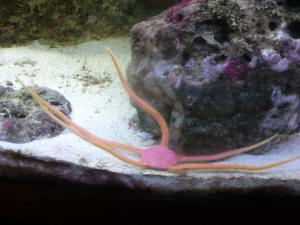
|
Red Serpent Star, pred. incomp. 10/26/11
A big Hello to all of you wonderful people of WWM!
<Hi Bill!>
I have a question that I think I already know the answer to but was
looking for confirmation. I have always gotten great advice from you in
the past and have used WWM as a primary resource for years. (and have
referred many to you as well)
A little background I have been keeping marine
aquaria for about 25 years.
My current systems are a 150g display tank with a 120g refugium
(DSB/Liverock/Chaetomorpha) and a 50g sump that uses a Reeflo DART as
its primary water mover, and a 60g cube that goes the old school route
using a Penguin Emperor dual BioWheel HOB and a Fluval 405, along with
liverock and 2 to 3+ inches of fine sand,
depending on where the powerheads (2x Koralia 4s)
have blown it. Both systems utilize VHO lighting and have carbon(24/7)
and GFO(as needed) reactors. Temps in both are ~78, pH 8.1, with 0
ammonia/Nitrite, barely detectable Nitrate and Phosphate. I don't
test for anything else. I figure regular water changes take care of
everything else. The newer of the 2 was set up in 1994.
Stocking:
60g � Soft (colt) corals, Zoanthids, both a Flame and
Pygmy Angel, a Yellow Watchman Goby, and a lawnmower Blenny. I also
have a Red Serpent Star - Ophioderma squamosissimus, I think, along
with several smaller serpent stars (and a bunch of micro brittles and
Asterinas), a variety of snails, and more amphipods and copepods than
can be counted.
150 system In the DT, a 4
Gymnothorax undulatus that I have had the pleasure of keeping for at
least the last 23 or 24 years is the only inhabitant. The refugium has
a Diamond Goby to stir the sand, and all the cool little things that
just seem to appear in a tank over the years.
On to the question (I know FINALLY)
I have had problems with Green Brittles and predation, but never with a
Serpent. A couple months ago, an Orange Back Fairy Wrasse that I had
had for many years died, and before I could get it out, the red serpent
had engulfed it. I didn't really see the need, at that point, of
depriving it of a meal, so I left it be. I decided to replace it with
another Fairy Wrasse a Tricolor (Cirrhilabrus
solorensis).
<Uhh...>
After a few weeks in QT, I introduced it to the 60g tank. As wrasses
do, it hid for a couple days.
Last night I found it halfway in the serpent star!
Do you think The Red Serpent has decided to follow in it's green
cousins footsteps? (arm steps didn't sound right) If it has taken a
liking to live food, it has to go but to where?
<Many Ophiuroids are opportunistic as you are learning>
I can put it in the 150, but worry that the Eel will eat it (his name
is Hannibal for a reason), or perhaps in the refugium, but would then
worry about a great little sand sifting goby becoming it's next
meal. I don't really want to trade it in either. I suppose I could
toss him in the sump (it has ~#30 LR/LR rubble) but it would be
invisible down there.
What would you do if it were yours?
<Decide on what is more valuable...>
Sorry for the long winded (and winding) question,
And
Thanks again for your help!
bill
<Welcome. Bob Fenner>
|
Brittle Star... Friend or Foe?
7/18/11
Hi Bob & Crew!
<Hello Roberto>
Thank you very much for your advice last month - the algae bloom
in my tank is now gone and all is good and parameters are
stable.
<Great.>
I am in the process of populating the refugium with macroalgae
and managed to find a local aquarist that graciously game me some
Chaetomorpha (LFS in the area only carry Caulerpa!). Being an
avid reader of WWM, I have learned to quarantine everything - so
in this case I placed it into a small 5G tank with light and
circulation. This was even more important in this case since my
friend told me his tank was still recovering from "some sort
of bug".
It has been in quarantine for six days now, how long would you
keep the Chaetomorpha in quarantine?
<I would not.>
Since I'm leaving on vacation later this week, my decision is
whether to place them in the refugium before leaving (total 1
week in quarantine) or after coming back (total 1 month in
quarantine... but it might not make it because of the inherent
instability of a 5G quarantine environment in the hands of the
pet sitter).
Question # 1: Move the Chaeto in now or not? If so, would you
give it a dip in freshwater or anything like that for extra
safety?
<Dip and move.>
Upon inspection over the last few days, I found the Chaeto
contained two types of hitchhikers (besides copepods): Bristle
worms and two mini-sea stars.
Question #2: I am removing the bristle worms I find as I
understand they are undesirable for a reef tank, correct?
<Actually, they are beneficial to the system but would trap
and remove large worms.>
Also, I needed your help in identifying and deciding what to do
with the sea stars (see attached picture). In looking through
many pictures, I am almost positive they are Brittle Stars (my
belief is that they are Ophiothrix, not sure if Ophiothrix
purpurea, suensonii or something else).
<Is an Ophiothrix species.>
The picture was taken up close... The actual size is about 0.7
inches with their arms spread out.
Question #3: These Ophiothrix (if that's what they
are)...friend or foe?
Any suggestions?
<This species is very desirable to have, nice color.>
As always, a big thank you for all the help you give all the
aquarist community!
<You're welcome. James (Salty Dog)>
Roberto
For background, here is my setup:
* Oceanic 175G (72"L x 19"W x 29"H)
* Precision Marine R36 Refugium/Sump (about 20G of water)
* Return pump is a Syncra 5.0 Aquarium Pump 132 (1320 GPH at
spec)
* In-tank powerhead: Tunze Turbelle Stream 6065 (1717 GPH at
spec)
* Protein skimmer: Precision Marine RL175
* Lights: Coralife Aqualight T5 HO Double Strip 72" (4x 10k,
4x Actinic)
* Auto-top off: Tunze Water Level Controller 5107
* 160 lbs of live sand (Caribbean aragonite) and 110 lbs of
Fiji/Pukani live rock
Water parameters are: SG 1.024, Alk at 200 ppm, pH 8.1, temp
78-79F
* Ammonia, nitrites and nitrates below detectable levels (using
Salifert test kits)
<A nice system!>
Livestock is currently (I plan on adding a few corals later):
* 1 Yellow Tang (Zebrasoma Flavescens)
* 1 Diamond Goby (Valenciennea puellaris)
* 1 Banded Coral Shrimp (Stenopus hispidus)
* 3 Turbo snails (Turbo fluctuosa)
* 1 Spotted Sweetlips (Plectorhinchus chaetodonoides) - I know, I
know, this was from before I read as much as I do today... In any
case he's been with me for a year now and doing great, so the
diet seems to be working...
<Great, considering the dismal survival rate of this fish. Be
aware that as this fish
grows, smaller fish may disappear from your system.>
Will come up with a plan when "Spots" outgrows the
175G...
|
|
![Description: D:\ArchiveWWM\EchinodermPIX\Ophiuroids\Brittle-Star[1] reef safe q.jpg](EchinodermPIX/Ophiuroids/clip_image001.jpg)
|
marine tank, Eel ill from Bristleworm
spawning event? 6-10-11
Dear WWM crew, I have 2 questions for you. I have had an Snowflake eel
for 6 1/2 years. He was the size of number pencil when I got him. He is
now 3 feet long and 1 1/2 inches thick.
<Nice>
He has been very lethargic lately and I was wondering how long do they
live?
<Mmm, at least ten-twelve years>
My 6 line wrasse has been missing for a week and I believe he ate
it.
<Possibly>
Would that make him sick?
<Could>
Second question. Two years ago I added Bristle Stars to the tank and
last week a very strange thing happened. Literally hundreds of Bristle
Stars all exited their hiding places at the same time. They climbed to
highest points in the tank. They each postured with the center of their
bodies elevated away from the rocks and released white mucus in large
amounts.
<Gametes>
They then went back into hiding. What was that? Thanks for your
help.
<Spawning... whatever triggered this, or these sex cells themselves
might also be the root cause of your Echidna's malaise. I'd be
changing out a good deal of the water, spiffing up (cleaning) your
skimmer contact chamber and collection cup, utilizing a bit of
activated carbon in your filter flow path. Bob
Fenner>
Brittle Stars with Clams/Brittle Starfish
Compatibility 4/11/2011
Hi WWM Crew,
<Hello Matt>
I have used your site for reference over the past 3 years or so, and
appreciate the effort you guys put in to help us out with
questions.
<Thank you.>
I usually find answers to my questions after reviewing your site,
however this time I am unable to find an answer to my specific
question. I have been searching to find if I can safely add a brittle
star to my reef tank which contains a clam. The clam I have in my tank
is Tridacna ( I believe) Crocea, and was possibly interested in adding
a brittle star to help as part of a clean up crew. I know that the
green brittle star is the one to stay away from, because I also do not
want to lose any fish to it.
<Among other animals as well.>
My tank is 50 gallon tall; and I have various types of hermit crabs
(lost count of how many), some Cerith snails, 4 cowry snails, 2
margarita snails, various SPS, LPS Corals, a small colony of Zoas, my
clam, and fish. The fish in the tank are a Mata Tang, a Coral Beauty
Angel, 6 Line Wrasse, Black Percula Clown, and a Yellowtail Blenny. I
know my tank is fairly heavily stocked for it size, but have doing well
with my water param.s thus far. I do not know the exact species of
brittle star that I will be receiving, but the place I am considering
ordering from state that it will not get over an 8" max size.
Thanks in advance for your time in answering my questions.
<If the Brittle Starfish you are getting is an Ophiocoma specie, you
should be safe, although you may lose
a crab or two during the molting period. James (Salty Dog)>
Matt
Re Brittle Stars with Clams/Brittle Starfish Compatibility
4/11/2011
James thank you for your response.
<You're welcome, Matt.>
In doing my research over the past week I was unable to get much in the
way of specifics regarding brittle stars. I just looked and the species
of brittle star that I would be ordering is Ophiocoma
paucigranulata.
The research I did raised more concerns than answers, needless to say.
I found information that some brittle stars eat bivalves and others
that said they will eat snails and hermit crabs and possibly some other
inverts. In my last e-mail I forgot to mention that I also have a fire
cleaner shrimp in the tank, probably because he hid as soon as I put
him in the tank and rarely can be seen, accept when molting.
<In nature, this starfish filters out fine food particles with
it's spiny arms and scavenges the sea floor for bits of food. As
long as this animal is not starving, you should be fine. The 8"
size you mentioned earlier is a little exaggerated as they rarely
exceed 5.5". You may want to read the Brittle Starfish
compatibility FAQs found here.
http://www.wetwebmedia.com/brittlestarcompfaqs.htm>
Thanks again for your help and the great service you guys offer.
<You're welcome. James (Salty Dog)>
Matt
micro brittle star vs. red legged hermit
4/5/11
Hi folks. I have a 10 gallon reef that is 6 weeks old.
<"Small volumes are very hard to keep stable, optimized...
successfully for long">
I started with live sand and 10 lbs of live rock. Two weeks ago I added
1 turbo snail, 2 blue legged hermits, 1 red legged hermit, 2 Cerith
snails and 1 Nassarius snail and another piece of live rock, approx 1
½ pounds.
<I'd take (stocking) things a bit slower>
This latest addition of live rock came with about 3 or 4 micro brittle
stars. Tank param.s are: temp 78F, SG 1.024, Ammonia 0, nitrite 0,
nitrate 0, pH 8.2, calcium 360 ppm,
<A bit low... best to do water changes here...>
phosphates 0, Alk 9.
Two days ago the red legged hermit found a dark quiet spot in between
two small Syconoid sponges. Let's call him/her a him. This morning,
over a period of about 2 hours, he has been molting. Then he was
sitting on the outside of his shell for about 15 minutes. I noticed a
micro brittle star �moving in� and
�exploring� with its tentacles. As
the crab went back toward the shell opening, the brittle star followed
him and that was the end of my red legs. I wasn't aware that micro
brittle stars might go after a seemingly healthy crab. Is this
true?
<Yes, tis>
Because this is a relatively new tank, could the brittle star not be
getting enough to eat?
<Doubtful w/ all the LR>
(I did have the initial brief Cyano outbreak and diatoms and minor hair
algae but all has been taken care of by my
�crew.� I have not fed the tank at
all yet.).
Should I feed the brittle stars to protect my other crabs/snails?
<Not likely to work over time... With molting, the hermits will
likely be meals>
Thank you for all you do. Janet
<Welcome. Bob Fenner>
Brittle Starfish Questions
3/31/2011
Hi! <Hi Max, Misty here>
I have a 29 gallon bio cube which is about three weeks old and am
looking to stock it soon if the water is safe. I will not post all of
the info for the sake of time but have a question about
compatibility. I have
searched EVERYWHERE it seems and can't find any information on
how many gallons each type of Brittle Star needs to survive.
Please don't give me a link if possible, it would be very nice to
know what a trusted professional thinks. The tank is fowlr and nearly
cycled trust me I will make sure the quality is fine. Do you think that
this is a compatible stocking? 1 Black Brittle Starfish, 1 Purple Reef
Lobster (My lfs told me not to worry about him as in his experience, a
7 month old clown will be safe with them especially if they are bought
young which mine was (1 inch or less long), 2 Clownfish, 1 Turbo Snail,
and 1 Coral Banded Shrimp who actually kicked my lobster out of his
tennis ball diameter cave into a golf ball size one on the other side
of the tank where he stays in a buried out cave. Do you think these
will be compatible? <Based on the size of your tank, it is my
opinion that these selections are generally fine, but may require
refinement once they become territorial/larger. I'm actually
speaking more about the three clowns...I am of the thought that the
7-month old clown might need to be rescued from the other two, but
without species specifics cannot be sure. The starfish will likely hang
out under one or two rocks, so constant tank parameters are more
important than size (same thought applies to the other inverts, which
can be very sensitive to parameter swings. I'd actually make sure
that your Banded Coral Shrimp is smaller, because they have been known
to eat small fish (as have larger brittle stars, but have heard more
about the green ones with a disc size diameter of 1" plus.; I
don't have experience with the purple lobsters, but have always
thought they were pretty cool. Keep 'em all fed, smaller in size
(or equivalent), and healthy! Oh, and if you added many critters at
once, check the cycle at least DAILY, as an increase in bioload can
spike a cycle, especially in a smaller water volume.>
Please help me out I have looked all over almost 3 hours of skimming
useless websites for lessons on everything about the animals except for
there compatibility and tank size recommendations and am hoping you all
can help. Love the website by the way very helpful which is why I came
here. sorry for the longer message <no worries, more information
helps us a lot!>
<Cheers, Misty>.
Red serpent starfish... pred. beh.
3/12/11
I have baby red banded Serpent Starfish in my tank. Do they pose a
threat to fish down the road?
<Ophiocoma species? Not as far as I'm aware no>
At least they look like Serpent Stars. I don't see bristles like on
a Brittle Star. Plus they have the red bands on them.
<Describes quite a few species>
Thanks
Tommy
<Welcome. BobF>
Red banded starfish... sm. Ophiuroid
comp. 3/11/11
I have know for a while now, that there are baby starfish in my tank
that originated in the liverock I bought.
<Not babies, more likely Asterina or micro-brittle stars that stay
small.
http://www.wetwebmedia.com/asterinafaqs.htm
.>
I have noticed there are little grey red banded starfish. They are
about an inch in diameter. So they are still quite small.
<They will likely stay small.>
Will they become a problem down the road?
<Doubtful.>
Can I trap them somehow if so?
<Glass jar traps would probably work well if needed, which I doubt
they will be.>
Thanks
Tommy
<Just some of the critters common on live rock. Enjoy.>
<Synthetic James, AKA Chris>
Brittle star fish compatibility,
2/5/11
Hello Crew,
<Hi>
I have a 250 gallon RR with an 80 gallon refugium, and a DSB. I have
read that I should add a few medium sized brittle starfish to clean the
sand rather than sand sifting starfish.
<Neither of these really clean the sandbed, at least not in the way
you want them to.>
When I began researching Brittle Starfish, I found quite a few
resources stating that they eat fish.
<Yep>
I have read through all the material on your site that I can find, and
it looks like the only one that eats fish is the Green Brittle
Starfish.
<Most all will if they can capture a small enough fish, the Green is
perhaps more of an aggressive hunter than some of the other
species.>
I am just looking for some reassurance before I make any purchases. My
major concern is that I have a yellow Coris wrasse, a yellow headed
sleeper goby, and a blue spot Jawfish that are all sand dwelling (at
least at night), and I don't want them to become a meal.
<Definitely stay way from the Green, other species are less
aggressive hunters, but if the fish are small they all could be a
danger.>
I have attached a picture of the starfish I am considering. The only
description for him is Black Brittle Starfish.
<I didn't see an attachment.>
Thank you for such an informative site. I spend a lot of time here.
<Great!>
<Chris>
Missing fish, Saltwater 1/19/11
Hi WWM staff!
<Hello>
I have on occasion written via email to the WWM staff over the last 8
years of my saltwater tank hobby. This time I am missing 2 fish.
First, I have 2 saltwater tanks. The main tank is 75 gal reef tank
which is doing just fine. I added fish after much encouragement from
WWM staff. I had back surgery and hired someone to take care of my tank
who gave ideas for more colorful fish and I have now my favorite fish!
Midas Blenny, blue/green Chromis as we saw these in real life
snorkeling in Tahiti and my lovely sweet yellow Tang. Guess who is my
favorite!
<Hopefully more than 1 Chromis, they do best in fairly large groups.
I don't think you included your favorite fish in the email, which
must be Dogfish Fenner.><<Haa!>>
Anyway, onto my missing fish. A couple years ago I set up a 30 gallon
reef tank. I have some small green striped mushrooms, some branching
frogspawn, some xenia and polyps which grew from a rock I had for 5
years.
I have a serpent star who was living for the past year with my 2 inch
yellow Watchman Goby and a Purple Fire Fish. I also have a few
Nassarius snails.
We do have a crab that lives in the tank of unknown origin. I don't
know if my son who started this hobby with the 75 gallon tank years ago
put this crab into the tank or it came with a piece of live rock. In
any case, this little fellow has red striped legs, back pincher and the
body is flat about the size of my small finger nail.
<Probably too small to be a threat to all but the smallest
fish.>
One day our purple fire fish who was very healthy in a tank that is
doing very well disappeared. I waited a couple months and then added to
Bengali cardinals that are quite small, tank raised and I am hoping
male and female.
At this time I noticed my yellow Watchman Goby was missing. He has not
come out to eat as his usual pattern for a week. I have 1 large rock
with various nooks and crannies for fish and critters to live in. The
tank now has 4 smaller rock with 4 inches sand bed. To encourage and
assure my Bengali Cardinals are eating I was feeding more often and
watching to see my new fish were eating. My Watchman Goby did not come
out to eat the past 3 days which is highly unusual for him/her.
I did a water change and moved the rocks around so I could lift the
large rock, placing it so now the is rock standing vertical with just a
2 inch portion into the sand for support. I moved the other rocks away,
and located Crabby the crab. I removed the crab with his rock
containing my polyps. I was waiting to see if my Watchman Goby would
come out from the large rock if he is in there. I set up a smaller
group of rocks for him to hang out amongst but few enough so I could
see him. I also have visual around the entire large rock.
I planned to get rid of Crabby the crab but after several years of
enjoying just him in the tank and having reverence for life I cannot
grab him with a tweezers and get him out of his rock.
<I doubt he is the problem.>
That was when I wondered if the serpent star could have grabbed my fish
during the night and ate them.
<That would be my guess.>
Although he would have eaten the Purple Fire Fish even though he was
burrowing with the Watchman Goby and for 2 months afterwards. The
serpent star we have had for years, he has a center size of a silver
dollar and is brown in color.
<Mine is about the same size, and never bothered anything till I
tried to add a couple of mollies, he grabbed them right out in the open
as they small by. Stupid tasty mollies.>
I am looking for advise, information and knowledge from your experience
and background with these wonderful animals.
<Assuming he did not die from other causes and was cleaned up by the
crab and other critters which can happen very quickly I would put my
money on the serpent star.>
I haven't said much regarding the parameters of the water as they
are fine.
I do test, and also do frequent water changes especially on the 30
gallon!
I have read much over the years on WWM and know my parameters are not
the cause of fish missing when no parts could be found and they had
been healthy, eating and swimming well the day before. I can provide
this information if you think it will be a benefit.
Susie
<Odds are it was the starfish, and you may have to decide if you
want to keep him with small, rock-loving, easily catchable fish or find
him a new home without the temptations.>
<Chris>
Re: Missing fish, Saltwater 1/20/11
Chris,
<Hi>
You confirmed my thoughts. I will keep Crabby as he is my husband's
pet so to speak. For now I am out of rock loving fish but wonder would
the serpent star be able to catch my Bengali Cardinals?
<He might.>
These are my favorite fish--only ones- in this tank. But, the fish I
love the most now is the Yellow Tang who just is so sweet.
<They are very nice fish.>
My Chromis are a odd bunch. I purchased on line 9 fish. They were very,
very small to start with 3 died shortly after getting them they were
very inexpensive and I was reimbursed. The remaining 6 are 5 or 6. 3
grew fairly fast and most certainly there is one leader in this pack. 3
will swim the tank the other 2-3 are hiding mostly in my huge amount of
branching frogspawn or on the other side in the rocks. I thought they
would want to stay as a group also.
<Usually but not always.>
1 or 2 is not much larger than when I purchased them and I try to go
out of my way to feed small food, extra to the area where he hangs out.
Because they hide so well in the frogspawn or behind a rock I am not
sure if I have 5 or 6. Hopefully, the other 2-3 will grow to the same
size and just perhaps they can all hang out together.
When we were snorkeling we were surrounded by a crowd of over 500
Green/Blue Chromis. In the wild they are so beautiful!
<It is something to see.>
So my question is:
Do you think my Bengali Cardinals are safe from the Serpent Star?
<Hard to say, definitely target feed the star which will hopefully
help.>
For color I though I might add a tank raised Clown Fish who could
possibly enjoy the Frogspawn in the 30 gal tank.--or is this not a good
idea?
<It will probably be fine.>
And, would the Clown Fish be safe from the menace of the tank--the
serpent or crab?
<Same chance as the cardinals.>
And, I was just reviewing all the Clown Fish now available at Live
Aquaria--I would choose a peaceful Clown Fish but it seems that Live
Aquaria recommend more than 1 Clown Fish indicating they should be kept
in a group.
What do you think?
<One or two, but not more. They do best in pairs, but fine alone
too.>
I have only seen 1 Clown Fish in the wild, not in groups.
<They will group with 1 male, 1 female, and juveniles in 1 anemone
in the wild, but once they juveniles mature they get thrown
out.>
If they will not be safe I can take the chubby meat eating Serpent Star
to the LFS or offer him to the local Saltwater Reef Society.
<Mine has never bothered my clowns, but they are full grown, so it
is hard to predict what it's future behavior will be.>
Susie
<Chris>
Brittle Star questions, comp., repro.
7/24/10
Hi WWM
<Howdy Malcolm>
A couple of questions re Brittle Stars-
Are Brittle Stars better off in the fuge or display?
<Mmmm, tricky. Well, some species are better off for all concerns
(ornamental, functional, safety-wise) in either place, and some
species, due to size, predatory tendencies... in neither!>
The display is a 5x2x2 community tank with lots of rock. Fuge space is
about 1.5x1.5ft coral rubble and macro.
About 2 months ago I bought a lot of livestock from a friend whose tank
ruptured. Included was a large Brittle Star (approx 9-10") which I
placed in my fuge as a temporary measure.
<Good move>
When I tried to get him out again it proved impossible without
dismantling the fuge so I left him alone. During this I thought I might
have snapped off a leg but couldn't be certain.
For various reasons I'm dismantling the fuge this weekend so have
the opportunity to put him in the display, or back in the fuge when
I'm done. What's considered the best place for these?
<What species is this?>
Also how do these things multiply.
<Sexually, asexually... Please read here:
http://wetwebmedia.com/HighInvertInd.htm
toward the bottom of the page...>
I'm 95% sure I only had one when I put him in there a couple of
months ago but there's now two of them. Smaller one looks to be
about 4". Can they grow from a broken leg like other
starfish?...
<Yes>
It could be that the leg I thought had broken off might have been this
second star but I'm so sure there was only one although it could
have come in on some macro from the same ruptured tank...
cheers
Malcom
<And you, Bob Fenner>
Re: Brittle Star questions 7/24/10
Thanks for all the info Bob.
I've no idea what species it is but seems fairly common around
Australian aquariums. Here's a picture of one (not mine but same
animal)
http://joshday.com/blog/IMG_0396.JPG
From your page http://wetwebmedia.com/brittlestaridfaqs.htm it looks
very much like a *Ophiarachna* Green Brittlestar
<Mmm, the pic is of a different species than this>
which I gather is of concern so I guess its best to play safe and leave
him in the fuge.
Mines not green though, rather a black/grey & very close to the
tone in your picture.
regards
Malcom
<Well, up to you to move or remove... BobF>
Help!
Nano Stocking / Hitchhiker 6/13/10, Ophiuroids
Hello,
< Hello >
I am brand new to saltwater tanks. I just set up a 14 gallon Bio-Cube
for cycling. I discovered a tiny little red-banded brittle sea star
last night. I suppose he is a rider from the live rock.
< A common hitchhiker on live rock >
I have been reading some of the back and forth questions and answers
under the brittle sea star section, but now I am getting scared of the
little brittle sea star, as I see some people's fish and shrimp
ended up being attacked and eaten.
< Can be a problem with larger brittle stars. Especially the Green
brittle star (Ophiarachna incrassata) or as its called in the hobby,
"The Green Death".>
I am looking forward to having simply a Starry Blenny, clownfish and a
fire shrimp for my new tank.
<Clownfish and fire shrimp should do fine. If by Starry blenny you
are referring to the Starry Dragonet (Synchiropus stellatus) you should
reconsider. Starry dragonets are VERY difficult to feed and should only
be
kept by the most advanced aquarist in much larger tanks than what you
are currently running. Most slowly starve over a period of months. For
your size tank, I would stick with the clownfish and the fire
shrimp.>
Should I be concerned this little critter may devour my Blenny, etc?
The brittle sea star is pretty small. Maybe a little bigger than a
dime. Love the red bands on him. He looks a little like a candy
cane.
< I don't see him as being a problem. There are a number of
small stars found in and around live rock and sand. Most don't get
to be much bigger than the one under your care. >
Thanks, Celia.
< Your very welcome GA Jenkins >
Re: Help!
Re : Nano Stocking / Hitchhiker 6/13/10
Thanks so much for the fast response!
< You're welcome! >
I am relived that it shouldn't be a problem. The live rock was
imported from Fiji according to the aquarium
shop. The critter sure has a will to live.
Also, I found the scientific name for the starry blenny: Salarias
ramosus,
which is different than the Dragonet. I understand the starry blenny is
peaceful, easy for a beginner like me, and good at eating algae.
Hopefully, it will not be a snack for the brittle sea star. Your
thoughts or opinions on the starry blenny would certainly be
welcome.
< Very different but still not an appropriate critter for your set
up. Salarias ramosus grow to large and can be aggressive with age. I
really wouldn't add anything more than the clown and fire shrimp.
Aquariums the size of your can go bad quickly so I would keep my
stocking levels to a minimum. For a tank your size I personally would
recommend scrapping the clown and fire shrimp and going with some type
of goby. The Orangespot would make a nice choice. GA Jenkins >
Thanks again, your website is fantastic!!
R2: Fish Compatibility Question
Actually 'now Ophiuroid comp.- 04/18/10
Off the charts creepiness factor aside Eric,
<<Ha! I'll take it then you've never 'handled'
one [big grin] >>
- you don't think a brittle star would be a danger to my 2 small
neon gobies then?
<<There's always a 'risk' with these critters that
they will turn their attentions to their piscine
tankmates'¦with some species of Serpent/Brittle Star more
likely to do so than others (e.g. -- the Green Brittle Star of the
genus Ophiarachna). Speaking for myself'¦ I have kept a range
of both the 'Serpent' and 'Brittle' variety with all
manner/size of fishes for decades without such incident (that I am
aware of). But I also feed my systems 'very' well with
attention to all inhabitants as I think this is key to tempering
aggression AND predation in captive systems. It's not a panacea re
as there are certain combinations that just don't work, and certain
'common' organisms I don't keep in a reef system regardless
(I haven't kept Hermit Crabs for almost ten years)'¦but I
do strongly believe it helps in many situations. It's up to you to
decide, but I think one of the commonly available 'brown'
Brittle Stars would likely be of more benefit than harm to your system.
EricR>>
Ophioderma ensiferum 2/1/2010
Just learned something new today, Jorie is shutting down her brackish
tank so I took her mollies for my FOWLR, and learned the hard way
Ophioderma ensiferum is a fish eater.
<Yes>
It took 2 1"+ mollies right out of midwater.
<Dang!>
Kind of gruesome to watch, but quick, could not even get my net before
the second one was gone. Guess I'm still learning, but that's
the way it goes.
Chris
<Thank goodness we're not Mollienesia.
BobF>
Re Astrea sp starfish, control and
Ophiuroids as well -- 11/27/09
I have these in large quantities in my reef tank. The tank is a 50
gallon reef tank approx 25kg of live rock. Stocked with 5 Chromis a
convict blenny
<Social animals Pholodichthys>
arrow crab and cleaner shrimp. The rock is full of brittle stars and
bristle worms. The Astrea star fish are eating my coral xenia colt and
finger leather. My question is could i add a C. valentini puffer to
feed on the starfish?
<I wouldn't, no>
and would it effect my other inverts/corals?
thanks in advance Andrew (UK)
<Best to go the physical removal for Asterina and baiting route for
Ophiuroids. See WWM re... Oh, the search tool... Bob
Fenner>
Brown Serpent Starfish ate Cleaner Shrimp
-- 11/17/2009
Hi, I've been reading your site for awhile now and I'm
fascinated by all the information. I browsed through and searched but
couldn't find the answer to my query.
<Lets see if we can't help!>
I came home from work yesterday to find my brown serpent starfish
eating one of my cleaner shrimp. The shrimp was still alive and I tried
to stop it but it wrapped it up in its arms and almost inhaled it.
<Yes, is always a possibility with these scavengers.>
I have a 38 gallon tank with a 3" regal tang and a 3" Foxface
fish. I'm already working on a bigger tank for these 2 as I know
they will outgrow this tank quickly.
<Indeed -- I'll spare you the typical rundown here then
:)>
Anyways, I had 1 cleaner shrimp, 1 camel shrimp, 1 emerald crab and
various hermit crabs with the sea star for 4-5 months now and never had
any problems. Then this week I added the 2nd cleaner shrimp. Do you
think maybe
this shrimp was already sick or dying and the starfish took advantage
or should I be worried about my other shrimp and crabs at this
point?
<I would be worried about anything the star could potentially wrap
up and consume, yes.>
My P.H. is 8.3, Ammonia 0, Nitrite 0, Nitrate 0. Should I start target
feeding the starfish or take him back to the LFS?
<Target feeding may help some, but will not provide a guarantee that
it won't happen later... Best bet would likely be a return, in my
humble opinion.>
Thanks for any help you can provide.
Jeff Smith
<Glad to provide it! -JustinN>
|
Brittle Starfish Invasion? --
11/10/2009
Dear Crew,
<Hey Richard! JustinN here!>
I've had my 75 Gallon saltwater tank for more years than I
can count. I am plagued with these tiny animals that look just
like brittle starfish.
<Agreed, does appear that way to me as well.>
Their tentacles protrude from every inch of my live rock and they
are even congregating around my power heads.
<I see this!>
I am afraid they are taking control of my tank!
<It does appear that way..>
Are they starfish or pests?
<Perhaps both!>
And how do I get rid of them? I have attached a few pictures I
hope will aid in identifying these creatures.
<A proliferation such as this could be brought on by excess
waste availability in the tank -- this is what typically occurs
when Asterina stars grow to pest-sized populations. Manual
removal and reduction of
nitrogenous wastes from the water should go a long way
here.>
Thanks,
Richard Wirz
<I'm not as attuned as Bob or many of the other members of
the crew on invert identifications, so I will leave that portion
to Bob when posting. I can verify that your assumptions do appear
correct, and due to the scavenging nature of the creatures in
question, I would tend to believe this is a nutrient export issue
at the core. Let us know if you have any further questions!
-JustinN>
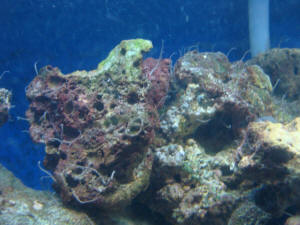
|
|
|
Brittle Stars Living Inside Decorator
Crab -- 10/19/2009
Hey WWM
<Hey Allison!>
A decorator crab that I have has a few holes in its exoskeleton on its
legs. I assumed it was from another crab or fish picking on it. Then
yesterday I took a closer look and saw there was several tiny white
brittle stars crawling from out of the holes as if they have taken up
house.
<Mmm, not good...>
Do you think they are eating the crab inside out?
<Yes.>
Is there a way to get ride of the stars without killing the crab?
<He is likely on the way out already, unfortunately.>
Would the crab be OK if I just left him be? Any info would be greatly
appreciated.
Thanks Allison
<Well Allison, brittle stars are a common part of an
'unpurchased clean-up crew' -- if you're seeing them
invading the crab already, its likely already too late. Does the crab
still move? If its becoming more and more lethargic, I would definitely
remove it before it fouls the water...
-JustinN>
Are my hitchhiker sea stars dangerous?
7/3/09
Good Evening WWM Crew,
<Hello,>
I have never written you before because I have almost always been able
to find an answer myself, but this time I am not sure, even after
extensive research, and I'd like some advice from the experts. I
have a four year old 72 gallon soft coral and SPS reef, and I seem to
have quite a number of hitchhiker sea stars (of which I have been
unable to get a decent photo as they are very small and are usually
buried in the rocks). I'd estimate that there are at least 50 at
this point, but it is difficult to say given that almost all I ever see
of them is tiny legs coming out of the rocks, waving about in the
current. I can't tell if they are serpent stars or brittle stars
since they are so small and I rarely see them, but they do appear to
have tiny bristles on the sides of their white and brown ringed legs. I
don't expect you to be able to ID them from that description, but I
thought it might give you some idea of what they are.
<They're likely standard issue Ophiactis and other small
"micro" Brittlestars (technically known as Ophiuroids). The
vast majority of Brittlestars feed on very small prey, lacking the
eversible jaws that allow
starfish to be such effective, if slow, predators.>
Anyway, at first I considered myself blessed as I find them
interesting, and as your FAQs mentioned they can be good detritivores.
However, tonight as I was feeding my fish I saw something disturbing. I
found one of the larger stars (a good 2.5 inches in diameter) arched up
on the side of a rock, presumably waiting for some morsel of food to
drift by. I had never considered these tiny stars a threat to my fish,
but now I'm wondering given what I saw. I have read about the green
brittle stars doing this to catch fish, and I'm guessing that they
are not the only type of star that do this (just the most prevalent in
the hobby).
<The Green Brittlestars are members of the genus Ophiarachna, most
commonly Ophiarachna incrassata. They are very opportunistic, and
exceptionally for Brittlestars, can and will catch fairly large prey,
including (small) fish.
That said, they're terrific fun, and the one that lived in my
dad's reef tank some twenty-odd years ago was almost a pet in its
own right, readily coming out when offered small pieces of meat such as
prawn and even cooked chicken. It always seem to me to be a rather good
"poor man's octopus"! So I'm averse to condemning
these fascinating invertebrates outright; in the right tank, with big
but peaceful fish, they're hardy and attractive pets well worth
keeping.>
I wouldn't worry too much except that I do have a number of small
fish in this tank. I have two clownfish, a yellowtail blue damsel, a
green Chromis, a mandarin dragonet (healthy and plump by the way, and
I've had her for several years), and a coral beauty angel. With the
exceptions of the angel and mandarin, all the fish are under two inches
long. I'm pretty sure they would not be at risk right now, but if
these stars get bigger, I am concerned my lovely fish may be on the
menu.
<Ophiarachna incrassata is dangerous because it gets so big: arms
each 25 cm (10 inches) long and a body disc around 5 cm (two
inches).>
So here come all the questions. Am I overreacting, or should I be
trying to find a way to remove as many of these potential menaces as
possible?
<Don't worry about them.>
If I should be removing them, can you give me any hints on doing
so?
<Largely impossible, though echinoderm-eating fish will of course
eat them, but puffers and triggers are hardly suitable for your
tank!>
Even if they are not dangerous, are they a potential sign that I am
overfeeding or not doing proper maintenance?
<Well, they are opportunistic, so will consume whatever food they
find and multiply accordingly. But that said, I'd hardly call them
reliable bioindicators; like other invertebrates, they need good
conditions to
thrive, so they aren't usable in the same way as, for example,
blue-green algae.>
Any answers or advice you can offer would be very much appreciated, and
thank you for your time and effort. You have truly put together one of
the best aquarist resources on the Internet, and I hope that my
question and your answer may serve to help others as so many of the
ones already posted on your site have helped me.
Thank you, Hailey
<Cheers, Neale.>
Re: Are my hitchhiker sea stars
dangerous? - 07/03/09
Thank you Neale for your response. It was very good news and a weight
off of my mind.
Thanks Again,
Hailey
<Happy to have helped! Cheers, Neale.>
Serpent Star Arm Tips Missing: Stars and
crabs do not mix well. 6/18/2009
Dear Sirs,
<Hi Denise, just call me Mike, and there are a number of female crew
members as well.>
I am a science teacher with a marine touch tank that I have moved home
for the summer.
<OK>
It has been 2 weeks and all was well until today when I noticed that
the tip of every arm on the serpent star is missing and their is a cut
mark near the base of one arm.
<You can read more about them here:
http://www.wetwebmedia.com/brittlestars.htm>
Last night it was fine.
<A late night snack for someone I would imagine, but some more
details about the tank would be helpful: how big, water chemistry,
etc.>
The tank has a false percula, a marine hermit crab which has grown
considerably this year, 2 turbo snails, a sea urchin, and a host of
amphipods.
<A few possibilities here...I will say that an Urchin is a poor
choice for a touch tank - some species are venomous. Further, Clownfish
can bite, and are capable of drawing blood, especially if they feel
their territory is being violated.>
<Please read here: http://www.wetwebmedia.com/urchins.htm and
here:
http://www.google.com/custom?hl=en&safe=off&cof=&sitesearch=www.WetWebMedia.
com&q=clownfish+bites&btnG=Search >
I have kept an eye on the tank since moving it home, concerned about
shock and wondering about the hermit crab and if it is too large to
safely keep in this tank.
<Setting possible environmental causes (water quality) aside, I am
inclined to believe the hermit crab is the likely culprit. Crabs, being
scavengers, are never to be trusted completely in a tank.
http://www.wetwebmedia.com/marine/inverts/arthropoda/crabs/hermitcrabs.htm
>
When school resumes, the tank will go back to school and be restocked
and I will set up a second tank for this pet crab if needed. Could the
hermit crab be the problem, or is something else going on here?
Thank you,
<My pleasure>
Denise
<MikeV>
Re: Serpent Star Arm Tips Missing: Stars
and crabs do not mix well. - Water Quality 6/18/2009
<Hi Denise>
Thank you, The touch tank from Wards Scientific hold 25 gallons and the
water is testing out within parameters with close to 0 ammonia,
nitrates and nitrites and a pH of about 8.3.
<Ahh. OK, That said, ammonia needs to be zero - anything above zero
is toxic. How often are you doing water changes?>
The creatures (except for the clown fish) were all from a touch tank
set from Ward's scientific and have been handled without problem
since last October, including the sea urchin.
<Fair enough>
The serpent star has handled being picked up hundreds of times (always
kept under water) and eaten well. This is the first time he has had any
problems and now has 5 short, stubby arms (pieces kept coming off all
day).
<Signs that it is starting to break down. You will want to do a big
(30%) water change.>
I will move the hermit crab out into it's own home and see if I can
keep everything else healthy for the summer. When I moved the tank I
drained the water and kept it, returned it to the tank and let the
system clear before reintroducing everyone. Nothing like having the
science teacher kill everything during the summer. The high school
students I teach have never seen an ocean and this tank means a great
deal to them. You can probably guess why we have the clown fish.
<Heee... Nemo..>
Thanks again,
<My pleasure, do write back if you need further assistance.>
Denise
<MikeV>
Brittle Star Compatibility
06/03/09
Hello,
<Good morning.>
I wanted to ask you, if the Pink Brittle Star Fish is safe to house
with:
hermit crabs, shrimps, snails, lettuce leaf sea slug, blue Linckia star
fish, corals and fish?
<It sure is.>
I know that the green brittle stars have a reputation for eating other
tank mates on occasions, and the pink one is omnivorous, so I wanted to
be sure that all of the other life in my aquarium will be safe with a
pink brittle star before going ahead and purchasing one.
<The green brittle star is actual a completely different genus. Have
no fear, the pink brittle star is likely a great addition to your
aquarium.>
Thank you.
Maidie.
<Your welcome
Josh Solomon>
Brittle Star Toxin? 4/3/09
<Hi Patsy, Adam Jenkins here>
I have a green finger coral in my 55 gal tank. I also had a brittle
starfish. I took the starfish out of the tank, and the coral started to
look wilted. Does the starfish give off any toxins when frighten?
<To my knowledge, brittle starfish release no toxins.>
I changed about six gallons of water
<A good idea when the water quality is in question>
and still the coral doesn't look any better...can you please help?
Give me any info on what I should do?
< I am assuming by "green finger coral" you are referring
to the Sinularia sp. in which case the "wilted look" you are
experiencing could be a natural shedding of its mucus coating.
Unfortunately without lighting info, tank mates, tank age, and recent
tank parameters that is all I can give you. Hope this
helps!>
Trapping a Brittle Star?
3/18/2009
Hi
<Hello Fishnu>
I moved a live rock into my refugium to populate it with pods.
Unfortunately I did not know that my brittle star had taken up
residence in the rock. After not finding it for a couple of days, I
found it in the (narrow) baffles of my sump, merrily feasting on the
detritus there.
<Not a bad thing.>
I would like to move it back to the DT but my space is very confined,
and I can't reach in. Do you have any recommendations in
"starfish fishing" or trapping?
<Mmm, lure with food.>
I was thinking of tying a piece of shrimp to a thread and gradually
teasing it out,
<Yes, this would be my suggestion.>
but I would like any other ideas as well.
<When I originally read this I though the star was stuck in the rock
and I did have a suggestion for that. As far as the baffles go, I think
the best you can do is lure it out with food, perhaps in the dark and
use light to
encourage it to move in the direction you desire.>
Thanks in advance!
<Welcome!
Mich>
Fishnu
Re: Trapping a Brittle Star?
3/18/09
Thanks Mich. When you say to use light is it your assumption the star
will move away from light or toward it? I assume the former, not the
latter.
<Heehee! Yes. Sorry for the vagueness!>
Do I have a killer brittle star?
Fish Eating Brittle Star 1/28/09
I've been reading your site all day looking for something that
might come close to my situation and haven't really found it. I
think that my brittle star (I'm not quite sure what the species is,
but the closest looking example I could find on the web was Ophioplocus
imbricatus) has made a meal of some fairly large fish. The star is
about 14" with a center disk of about 1 3/4" to 2",
<Yikes!>
which seems quite large from what I've been reading. Over the
course of the past 3 months I've had a string of very mysterious
fish deaths including a coral beauty angel, a yellow tang, an Annularis
angel, and a Longnose butterfly all of which were around 3" -
4". Each time the dead fish was found in the grasp of the brittle
star which at the time I chalked up to scavenging after the fish died,
but I couldn't for the life of me figure out what would cause a
perfectly happy, actively swimming, voraciously feeding fish to die in
the 6 or 7 hours no one was watching the tank. The other fish (which
are all still living) in there are 2 pajama cardinals, 1 ocellaris
clown, a solar wrasse and the scissortail Dartfish. The Annularis
wasn't housed with the coral beauty so there was no angel fighting.
The only common denominator among the fish lost was that they all spent
the night "sleeping" in caves at the bottom of the tank.
The
remaining fish all seem to spend the night up in the water column or,
in the case of the solar wrasse, in a cave much higher off the bottom
with the scissortail Dartfish being the exception. He sleeps and hides
in the cave with the star. The fish lost just seem like they'd be
too large to fall prey to the star, and, if he is the piscicidal
maniac, why is my Dartfish still darting?
<A lucky fish.>
I certainly want to remove him if there's sufficient cause for
alarm...
<Mark, I would remove this animal. I'm pretty sure what you have
is the Green Brittle Star of the genus Ophiarachna. This animal is a
predatory fish eater. Time to go.><<There are other predatory
Ophiuroids. RMF>>
Thanks for taking the time to read, and thanks again for providing such
a treasure trove of information on this site.
You're welcome. James (Salty Dog)>
Mark
Tiger Serpent Star -- Bad Citizen? --
07/21/08
I got one of these:
http://LiveAquaria.com/product/prod_display.cfm?c=497+528+735&pcatid=735&N=0>&pcatid=735&N0from
an area hobbyist exiting the hobby. Very well known on RC, standup guy.
He reports never having had a problem and I have zero reason to doubt
him.
<<Okay>>
I added the star to my display on the 4th. I noticed the last couple
days that it has been aggressive in the extreme.
<<Oh?>>
I witnessed it take out a medium Mexican turbo snail, and last night a
Tongan Nassarius snail.
<<Hmm'¦I have not witnessed/would not have thought
'snails' to be a preferred food item for a Serpent Star. I
wonder how it extracts the snail form the shell'¦perhaps in
the same manner an Asteriidae starfish weakens the muscle of a
bi-valve>>
They were clearly not dead animals it was eating. The Nassarius popped
up out of the sand, unfortunately for it the emergence was near one of
the star's legs. The star caught the shell with the tip of one leg,
which seemed to attach to the shell, and it then pulled the snail in,
coiling the leg around the shell. The snail was trying to flip itself
free, but failed. Lunch.
<<Interesting>>
There are many large-ish empty shells near the rockwork where the
starfish seems to hang out.
<<Certainly incriminating>>
I worry for my fish ...
<<I would too'¦especially if this animal is
large>>
radiant wrasse, green wrasse (both very large, over 5 inches), 2
solorensis wrasses, and a new blue spot Jawfish. The latter has not
been seen since added, a couple days before I noticed this star's
behavior.
<<Is suspicious'¦>>
Is this at all normal for the star?
<<While often employed by hobbyists as detritivores, Serpent
Stars are quite predaceous and have the potential to be a serious
threat to inverts and fishes (though I've never known one to prey
on snails until now)>>
Are my fish safe?
<<Can't say>>
Anything I can do (no idea how to catch it to remove from the display
if I had to....)
Help!
<<Try purposely feeding it'¦keeping it well fed may keep
it off your snails and fishes. I find these creatures 'love'
shrimp pellets. The dense aromatic pellets sink easily and will
certainly get the attention of the Serpent Star. Just drop a few near
its 'lair''¦very easy to feed with little
waste/pollution>>
Thanks,
Joel
<<Happy to assist. EricR>>
|
Lunar Wrasse -- 6/17/08
We just
(2 months) inherited a 95 gallon saltwater tank with a 30 gallon
sump, Clarkii clown, 3 striped damsel, 6" Lunar Wrasse, a
lawnmower blenny, lavender tang, maroon clown and a 1 1/2"
lemon wrasse..
<How nice! Talk about jumping in (all the way!) feet
first!>
We have a protein skimmer and all in all, the tank is doing very
nicely. The live rock we have is in an isolation tank for a few
months with peppermint shrimp, who are removing the aiptasia
nicely. After quarantining, we put the brittle star that came
with the live rock into the big tank. next morning we came down
and the Lunar Wrasse had pulled almost all his legs off.
<What they do>
That was a big lesson in don't just look up the starfish,
look up info on all the other inhabitants.
<Ahh! Yes>
he's back in the other tank and seems to be feeling and
acting normally, just has a shorter "wingspan". We had
also put a dozen or more hermit crabs and snails in the big tank
and now have empty shells. Wrasse, I'm sure. I've listed
this carnivore on craigslist trying to find him a new home, but
no takers.
<There will be>
But the question I have is this - are there any snails or crabs
we can add to the tank that the wrasse will not eat?
<Mmm, none that you'd likely want to have... I am not much
of a fan of using mollusks as cleaner-uppers...>
thanks in advance.
<Welcome... and want to say, an old friend/acquaintance, Lee
Phelps, used to be a professor at San Diego State U., and a fine
petfish person as well... Don't know if he is/was a close
relation. Bob Fenner>
Re: Lunar Wrasse -- 6/17/08
Thanks so much for answering me! If you don't mind me asking,
if you're not a fan of using mollusks for clean-up, what do
you recommend? And - PS, the LFS said they'd trade the wrasse
in for us, but catching him is a whole another issue!
live and be well,
Christy
<Thank you. Please read here:
http://wetwebmedia.com/marine/maintenance/index.htm
the second tray down. BobF>
|
Red Brittle Star. Comp.
5/1/08
Hi how are you?
<Fine, thank you>
My husband just brought home a mammoth Red brittle star, it has the
spiny legs. I had a green brittle star that was bad news, dwindled my
fish population into nothing, I donated him but I am wondering if it is
just the green or will I have this problem with the red?
<Some species, individuals are predaceous...>
When my husband purchased the star, it had a leg that fell off and was
living, she threw that in as well so now I have 2 red brittle stars and
the whole one has legs around 4 inches long, am I going to have the
same problem with the red as I did the green?
<Should be less... but I would keep an eye on it... and your fish
livestock!>
Any words would be great. Thanks in advance. Jessica
~Jessica
<Please read here:
http://wetwebmedia.com/brittlestarcompfaqs.htm
Bob Fenner>
CBS and brittle stars
Disappearing Starfish? 3/6/08
Evening crew:
<Scott F. with you tonight!>
I have read much on your site and contributed several times. Thanks to
your entire team for this great resource. I have a 300 gallon reef
aquarium that has been stable and growing for about three years.
Recently, two brittle stars have gone missing. I have about 400 pounds
of live rock so hiding spots are abundant, but am usually able to find
the stars during the every-other-night meat drop. Have read much about
the predatory nature of CBS, but is there a chance my 4" bodied,
6" claw tip-to-tip coral banded shrimp has been taking out my
brittle stars?
Thanks again,
Chris
<Well, Chris, I have a hard time believing that the Banded Coral
Shrimp has taken out the two Brittle Stars. In fact, I'd think it
more possible for large Brittle Stars to pose a threat to the shrimp!
In all likelihood, these cryptic starfish are probably hiding somewhere
under the rocks or substrate, and will resurface in time. Keep a sharp
eye out for them! Regards, Scott F.>
Hungry Serpent Star, comp.
2-12-08
Hi Crew,
<Good Afternoon. Yunachin here.>
This is a 28 Gallon cube with about 30 lbs of liverock.
<Ok.>
Last weekend I added a very small (1" or less) gold and black
chromis, that is what the LFS called it anyway.
<Very pretty specimen.>
After I drip acclimated it started swimming and eating right away. The
next day I could not find any trace of this little fish. I am positive
he is no longer in the tank. I have looked in every nook and cranny I
can and have not seen him at all.
<Did you look in the areas around the tank on the floor?>
He was very active the day I put him in there, hard to imagine he could
be hiding for that long without being seen at all. The only other
mobile animals are one 2" Percula,
<Also a type of damsel fish, which could have scared your other
friend into hiding.>
1 peppermint shrimp, one cleaner shrimp, various snails, 4 Scarlett
hermits, and one banded serpent star (Ophiolepis superb). Is this star
known to eat small fish?
<Absolutely.>
I cannot think of anything else that could have happened to this
fish.
<It is not unlikely that your chromis became dinner for the serpent
star especially if you found no carcass. I would keep an eye on him if
and when you add new fish. For more information on Serpent Stars:
http://www.wetwebmedia.com/brittlestars.htm;>
Thanks,
<No problem at all. --Yunachin>
Jeff
Serpent Star
explosion'¦ No 10/12/07
Hi, Thanks in advance
for your help, past, present and future.
<On be half of Bob and the crew, you're quite welcome!>
I'll try to keep it brief, but still give you all the info that may
be pertinent. I have a 90 gal. with a Mandarin I 'd like to keep
healthy (6months so far so good). There is about 100lbs. of live rock
between main tank and 55 gal. refugium with 6"DSB.
<This will help.>
Now to the question, 3-4 months ago I was happy to see a pure white
serpent star on a piece of sea lettuce, and now there are 100's if
not a 1000 mostly the size of a dime to a quarter. They are mostly
visible at night climbing all over glass,
<You should see them on the reefs!>
but don't seem to be causing any problem
<No and likely won't.>
and everything I read implies they are beneficial.
<This is so.>
I'm just worried about pod production. Do they eat pods or pod
larva?
<No, micro-brittle stars are harmless filter feeders.><<...
I would NOT go this far. RMF. Ophiuroids in many places in the
world's oceans are determinant predatory species... RMF>>
or compete for the same food source?
<unlikely a concern... do enjoy them... they are a hardworking part
of your clean up crew!>
Thanks, Joel
<Welcome! Mich>
|
Fish & Serpent Star
Compatibility... Not! 9/12/07
I have a brown
serpent star in a 125 gal FOWLR.
<Because of your concern, I am assuming you mean a Green
Brittle stars, (Ophiarachna incrassata). Does yours look like the
guy on the top of this page?
http://www.wetwebmedia.com/brittlestaridfaqs.htm
More here:
http://www.wetwebmedia.com/brittlestarcompfaqs.htm
>
I would like to get a radiant wrasse (Halichoeres iridis) , but
I'm concerned that the serpent star may go after a sand
dwelling fish.
<Highly likely if given the opportunity.>
I have never seen it stalking fish before, but I did witness it
attacking a cleaner shrimp!
<They can be quite predatory.>
The tuxedo urchins and star also leave each other alone. If it
would be too risky to house a wrasse with this star, would the
radiant wrasse be a good tank mate for seahorses?
<No. They have different system requirements. Seahorses
require specialized low flow systems. More here:
http://www.wetwebmedia.com/seahorsecare.htm
http://www.wetwebmedia.com/tube-mfi.htm
These two do not belong in the same system.>
Thank you for your insight.
<Welcome! Mich>
Re: Fish & Serpent Star
Compatibility... Not! Well a Better Genus 9/13/07
My star (Ophioderma) looks like the one attached.
<OH! Typically the best choice of all the brittle
stars!>
Its arms are smooth.
<Yes.>
I don't know if this makes any difference in
compatibility.
<Oh yes! Definitely preferable to the Ophiarachna! But as you
know can still be predatory.>
Thank you.
<Welcome! Mich>
|
|
|
The Mystery of the
Disappearing Fishes...Better Take a Closer Look at That Ophiuroid -
05/26/06
Hello Everyone,
<<Morning Barb!>>
I am writing out of desperation, in the hopes of finding some peace of
mind.
<<Uh-oh...well, let's hear your problem and see if I can
help>>
I have a 55-gallon saltwater setup with a 30-gallon refugium
<<Excellent>>
that has been up and running for about 3 years now. The livestock would
include:
2 Clown Fish/host Anemone
1 Mandarin
1 Brittle Starfish (spans about 6-8")
1 Cleaner Shrimp
1 Coral Banded Shrimp
1 Peppermint Shrimp
1 Green Chromis
And various corals.
My water parameters are all fine, and I do regular weekly water changes
to stay ahead of the algae problem. Here is my problem. Not even two
weeks ago, I thought I could add some more fish to liven up the tank.
So I purchased a Sixline Wrasse,
<<Nasty little buggers>>
a Royal Gramma Basslet,
<<And on the other side of the coin... These are wonderful little
aquarium fishes>>
and five Green Chromis.
<<Mmm..are "okay" as far as damsels go>>
Everyone looked fine for a few days and then I noticed the Wrasse
disappeared.
<<No quarantine, eh>>
By the way my tank has a cover to prevent a suicide jumping.
<<I understand the reasoning...but feel the advantage/benefit of
improved gas exchange to be worth the risk of keeping an open-top
tank>>
Then about 10 days after the purchase, a couple of the Chromis
disappeared, as well as the Basslet just yesterday.
<<Very troubling indeed>>
I am now down to just one Green Chromis of the original purchase. The
Wrasse and Basslet just disappeared without showing any signs of poor
health. As far as the Chromis go, I did notice some strange markings
that I later researched from your site that cannot be explained. The
markings were red blotches like a bruise on the skin and some scales
missing.
<<Mmm yes, a physical trauma...and a clue...>>
Also skin coloring looked like it was turning white. Only one of the
original Chromis showed these markings and eventually the rest did. I
definitely plan on talking to the fish store about replacing them.
<<I don't think the store is to blame here...at least not
directly...>>
However, I can't explain losing the Wrasse and Basslet.
<<I have an idea/suspicion>>
Did I try to put too many fish in my tank or is there a predator that
I'm not aware of?
<<The latter I believe...will explain below>>
Like I mentioned, they just disappeared overnight, and showing no signs
of distress. I really thought I had room to grow. And I find it very
strange that up until this last purchase, the other tank habitants had
been doing just fine. I'm really disappointed about this and
I'm afraid to put anything else in the tank. Maybe I should
mention, that I've had recent outbreak of glass anemones which
I've been trying to control with a Kalk solution, which I also
learned about from your site.
<<Not the problem here>>
It seems to working well since the Peppermint Shrimp isn't doing
it's job.
<<Ha! Yes, my experience with these as well>>
Could you guys help me with this problem and tell me what I did wrong?
It kills me to see what I thought were healthy fish (Wrasse and
Basslet) just disappear.
Thanks so much,
Barb
<<Well Barb, I think you need to look to that growing Brittle
Star as the culprit...especially if it happens to be "green"
(genus Ophiarachna)...have a look here: http://www.wetwebmedia.com/brittlestars.htm.
Even if not Ophiarachna, the more "fish safe" species
will sometimes turn to your fish for an "after-dark snack"
when they get large and/or are not kept well fed. From the fish species
taken/gone missing and the circumstances and markings/injuries you
describe, the Brittle Star rises as the prime suspect in my mind. I
suggest you move that Brittle Star to your refugium and see if the
situation improves for your fishes...I think it will. Regards, Eric
Russell>>
Menella Sea Fan with Ophiuroid/s... no prob. 5/8/07
Hi
<Hello Mich with you.>
I have brought a Menella sea fan gorgonian, I have had it a few days,
when I looked at it last night I noticed about seven tiny black and
white bristle <brittle> stars on it, will these harm the fan as
it is not opening today,
<No, the brittle stars should not bother the gorgonian.>
I have looked on your site but found nothing about this. Should I leave
them on it
<Yes.>
or try and get them off
<No.>
as they are very tiny.
<Gorgonians and brittle stars are often found in association in the
wild. It is not an unnatural situation. Please allow the brittle stars
to remain. -Mich>
Re: Tusk eating sea stars -- 5/4/07
I just happen to be reading
through your web pages as I do when something arises....(Thanks for the
great advice) when I read this :
Q. Will harlequin tusk eat starfish and serpent stars? if no, Any
chances of HT hurting the stars and serpents? <The chances are very
low to non-existent that a tusk would harm a sea star.>
<Cheers, J -- >
I thought I would add some of my experience here. I have had a
Harlequin tusk for around 4 years (and still do). He started out in my
reef along with a snowflake eel, these two had a love/hate relationship
from the start. The tusk would try to block the eel from moving out of
the rock work often locking himself upside-down between two rocks. They
really had a funny relationship.
Anyway, I am writing because I also had two serpent seastars which
after a short while were ripped out from under the rock work and eaten
by the tusk. This was a mature tusk around 7" in length. I guess
anything is possible, but I haven't put another one in his home
agian. I eventually removed the eel from the reef due to nutrient
issues. He now has his own home among the tong branch. Thanks again for
the great website.
Mike
<Thank you for this Mike. BobF, looking through all else's
in-folders>
Sudden death of a Damsel 4/21/07
Hi crew,
<Kwon>
Thanks for all the helpful info you've posted on your site.
Here's my situation:
I have a 55 gal fish only with LR. I have one damsel and one trigger
(small, 2-3 inch)...and yes, a bigger tank is in the works.
Today, I fed them with frozen trigger formula like I always do. I went
out for about 4 hours, when I return, I found my damsel dead. I
remember it was eating like a pig, as always, before I left the
house.
So I dug him up and did not notice any physical damage. All I've
notice was that the gill portion of his body looks a little bulged.
What do you think might have killed him in such short amount of
time?
<Mmm, impossible to say... perhaps a rupture in its blood/vascular
system... a "heart attack"... Fear of the trigger
tankmate...?>
I see him every day and there were no symptoms of any thing wrong.
My trigger seems to be fine for now. He is sleeping in the rocks.
Should I perform a water change?
<I would test the water for what you have kits for...>
Please advise.
Thanks.
Kwon.
<Do know that such rapid deaths in Damsels are not uncommon...
especially when small, good numbers of these fishes "do just
die" w/o apparent reason at times. Bob Fenner>
Re: sudden death, Damsel
4/26/07
Thanks for the feedback Bob. The story
continues.....after the sudden death of my damsel, I went to my local
fish store and got another one. After acclimation, it was placed into
the tank. It seemed to be healthy. I was watching it as it swam into
the cave where my brittle star is. For a few seconds, it swam out and
lay on the gravel breathing heavily. After about 10 minutes, the
brittle star came out from the back of the live rocks and grab the
dying damsel.
I did some research on your website and found that only the green
brittles are a threat to small fishes,
<Mmm, well, the most commonly predaceous species... others are also
a danger to small fishes>
what I have is, I believe, Ophiocoma erinaceus.
<Can be trouble as well>
I came home today, the star fish is still grabbing on a hold of the
dead damsel and feeding on it. Could a real hungry Ophiocoma erinaceus
hunt for fish? Could it be the cause of death with my previous
damsel?
<Yes, and yes>
Thanks as always.
Kwon.
<Bob Fenner, who would not trust this specimen with small fishes,
and would feed it directly>
Starfish comp.
4/14/07
<Hi Jared, Mich with you again.>
How's it going?
<Fine, yourself?
Are my two cleaner shrimp ok with a brittle starfish?
<Yes. Should be fine. -Mich> <<Mmm, not necessarily.
RMF>>
Puffer Eating Serpent Star
4/13/07
I may of missed something in the compatibility
area but Ill ask anyway. I have a puffer fish new to the tank and a
serpent star a big serpent star lovely tank cleaner. <Not for long
most likely.> Tonight we saw the serpent star crawling and noticed
the tips of his arms were missing or broken. Does the puffer usually do
this or is he just being aggressive or what. <The star is a nice
easy meal.> My main question is the puffer really doesn't seem
like he's all that interested we tapped on the glass and he kind of
strolled away calmly and then came back nipped and swam away slowly.
Any insight would be welcomed specifically on the decision of do the
brittle star and serpent star leave the tank all starfish leave or are
they fine. Thank you for your reply.
<The puffer will likely consume most/all invertebrates that it
finds. Is one of their food sources in the wild. Will likely need to be
separated if you want to save the stars.>
<Chris>
Sea Serpent and Haitian
Anemone 4/1/07
<Greetings! Mich here.>
My Haitian anemone reproduced by tearing a piece of body off.
<OK.>
This piece as changed daily and after about two weeks started to move
about the aquarium looking for a better spot to grow.
<This is exactly why I'm not a big fan of anemones.>
The mature anemone seemed to follow and protect this smaller version of
itself.
<So both were wandering around your tank? I do hope you overflows
and intakes are well covered.>
Unfortunately, the sea serpent starfish grabbed it and pulled it under
a rock today, I tried to lure it back out with a piece of shrimp but it
only grabbed onto the shrimp and pulled this under the rock as well. Is
the baby anemone a goner?
<Only time will tell. -Mich>
Starfish Compatibility
2/9/07 - 02/09/2007
I have a 25 gallon tank FOWLR tank
and wanted to get a Serpent or Brittle Star. The only thing is that I
have a Chocolate Chip Star and Purple Reef
Lobster. My question is do you think all 3 will get along?
<Should be no problems with the starfish, I'd be more concerned
with the lobster going after small and/or sleeping fish. James (Salty
Dog)> <<James... no... the Lobster is going to be a constant
question mark... the CCS could eat the Ophiuroid... RMF>>
Re: Octopus care/capture & Brittle Star comp. 1/29/07
Good Evening and thanks for the insight.
<Welcome, Jim.>
I am sure that it is an octopus.
<Have you had a chance to peruse the archives on octopi snaring
techniques?>
We have seen it 3 times but it hides very fast. It is about as big as
my hand if it is all spread out.
<Neat, but unfortunate.>
My concern is I can't figure what it is eating (or if it is
eating).
<What are it's options for motile invertebrates in your setup?
If there is not food, then it probably is starving.>
I would hate to have it die. I again tried to search every piece of
rock with no luck.
<I'm afraid that is going to stay the case until you: A) see
which rock he enters and remove it, or B) Try to "snare" it
using bait and a trap. The units I've seen are like the ones used
for mantis shrimp: A clear tube with a manual trap-door that you wait
patiently over. There may be more advanced designs available that I am
unaware of as yet, but...>
If it does die and I don't find it, won't that be a big
problem?
<Could help the cycling, but I'm going to stick with a firm
"Yep." Don't want that to happen.>
I have also left pieces of shrimp in over night but they have not been
touched.
<Hmm... how about a crab or urchin or something that moves? They are
very opportunistic feeders, and would probably love a crabby-snack. Put
one in a tube and you have a craburrito! Yum!>
Any advice would be appreciated. On another topic: There are many small
brittle stars. The largest is about the size of a half dollar
(including arms).
<These may or may not sustain your hitch-hiker...>
They are too small to bother anything I am sure but will they bother
polyps or other soft things when and if they grow?
<Not really. They will close up as the stars lumber around on
them.>
There are now 2 colonies of polyps as well as many small feather
dusters. I read that brittle stars can be destructive as they grow.
<Can be destructive, depends on the species. Have been told (by Rick
O.) of a green serpent star "tenting" in wait and when a
royal Gramma went near, the unlucky fish was caught and eaten.
Actually, maybe it wasn't a Gramma, but... you get the point. I
wouldn't worry about the corals' safety, though.>
We almost don't need a television anymore because the family all
congregate around the aquarium to watch
and see what's new.
<I know exactly what you mean!!! Best wishes!
-GrahamT>
Thanks again.
Jim
Red Serpent <Brittle>
Star Compatibility with Orange Legged <Not Reef Safe> Hermit Crab
1/29/07
Hi guys and gals,
<Hello Gordon, thanks for the inclusion! Mich with you this
evening.>
I bought a perfect looking red serpent star yesterday (about 6 inch
diameter) from the LFS.
<I presume you mean a Red Brittle Star (Ophioderma
squamosissimum).>
I acclimatized it over a few hours and then released it into my 55
gallon (fish and live rock with a couple of mushrooms and feather
dusters and many invertebrates -- cleaner shrimp, peppermint shrimp,
banded coral shrimp, Nassarius/turbo/Trochus/zebra snails, a number of
very small (3/8 inch) orangey stars, and a variety of hermit crabs).
Almost immediately after the red serpent star was released into the
tank, the largest of the hermit crabs (an orange legged fellow about
the size of a ping pong ball or golf ball) made a beeline for the star
and pounced on him, apparently trying to rip chunks off the poor
star.
<Yikes! That is a very big and most likely not reef safe hermit you
have there!>
I'm not sure, but I think perhaps the star exuded some kind of
chemical defense, because the crab ended up with a gooey substance
adhered to most of his legs and claws. I watched the duel for about a
minute, to see if perhaps the crab would beat a retreat. The star had
wrapped his legs all around the crab and his adopted shell, apparently
in an effort to fend the crab off. Not wanting any further harm to come
to my new friend the serpent star, I separated the two combatants and
sequestered the crab to a jail cell. The LFS of course had assured me
that there would be no compatibility issues.
<Most likely assumed the hermits you had were of a reef safe
variety.>
I have Googled the topic and searched WWM for similar queries for the
past couple of hours but haven't found any definitive answers. I
guess my question is -- Can this crab and this star live together
peacefully or will the crab continue to harass and pick on star until
he eventually (or quickly!) succumbs?
<Hmm, when I initially read this I missed the size of the hermit
crab, this is a big crab and I suspect that it is not reef safe. Most
larger hermit crabs will prey on smaller, and sometimes larger animals.
I do not think your other tank residents are safe in the presence of
this hermit. Do you have a refugium where he might reside? I think it
may be time to find your hermit a new home.>
And will my other tank inhabitants (community fish, a goby and the
invertebrates mentioned above) be safe and compatible with the serpent
star?
<Should be with the star, but I question the safety of all with this
hermit.>
Any advice would be much appreciated! Thank you for your response.
<Welcome! -Mich>
Gordon
Brittle star id, worries
- 1/18/07
Hi guys and gals,
<Hey Scott, JustinN with you today.>
I've been burning the midnight oil trying to ease/confirm my
worries about my brittle star. Here's the story:
I bought a used 60 gallon tank 10 months ago, and I'm still
in the early stages of stocking and upgrading it, so that I can
eventually call it a reef tank. It came with an ocellaris clown,
yellow damsel, royal Gramma, a sea cucumber, and a brittle star
(and lots of live rock). In the last couple months I added a neon
goby, yellow streak fairy wrasse, and flame angel. The flame
angel hid in the rockwork immediately, and I only saw glimpses of
him for the first two days, after which I didn't see him at
all for another 4 days. I took most of the live rock out to try
to find him, and found that the brittle star had obviously eaten
him.
<Mmm...>
I know it's possible/likely that he died first from the
stress of shipping or disease (my girlfriend bought him as a
surprise gift without really knowing what to look for--an
innocent but probably costly mistake)
<And I hope you explained to her the rationale and reasoning
for conscientiousness as an aquarist...>
but now I'm concerned that the brittle star could be
predatory.
<Mmm, all too likely>
I figured he was safe because he's not the infamous green
brittle star your site warns about, but further investigation
(endless google image searching) makes me think he might be in
the same genus, Ophiarachna.
<I would agree with this>
The closest resemblance I've seen is a picture on
marinedepotlive.com of a "bubble tip brittle 'fancy'
sea star, Ophiarachna sp." Any idea from the blurry pics?
He's definitely big enough to pose a threat to my small
fishes (~14 in. diameter with about a 1.3 in. body).
<Yes, quite large... definitely a predatory threat. Although,
I'm not too hip on specific identifications, so I can't
help you any further than I have here, perhaps RMF will chime in
here?>
I'm worried to the point of wanting to give him away, but I
do like his scavenging ability and would want to replace him with
another detritivore (a "safe" echinoderm?).
<Do consider so-called serpent stars for this task.>
Or, would he be okay if I transferred him to the refugium/sump?
It's a 20 gallon with a large skimmer and pump, some live
rock, and Chaetomorpha algae, alternating light cycle with the
main tank.
Any help at all would be appreciated.
<Mmm, too likely that the echinoderm will consume any
beneficial benthic life in the refuge.>
On another topic I might as well bring up, my Gramma has become
much more shy over the last 2 months, only darting out to eat and
hiding again. He's been with the same tankmates for the last
5 months (and the damsel for 2 years) and his hiding constantly
is pretty new. He looks perfectly healthy to me. Do you think the
damsel is intimidating him? I haven't seen any overt
hostility. It actually seems like he's also scared of me. Do
you think giving away the damsel would make him more
comfortable?
<Its possible that the damsel is causing some aggression
you're not noticing, however this seems to be a fairly common
behavior for royal grammas. I wouldn't be too overtly
concerned here.>
Sorry for the long email and thanks for a great website.
Scott
<No problems, Scott, the details help us. Hope I've helped
you! -JustinN>
|
|
|
Green (not always) Brittle
Star...Yummy tankmates! 1/3/07
<Hi James, Mich with out today.>
You're website is great and you are all smarter and better looking
than I will ever be and if you can help me I will send you $5 in the
mail...
<Heeheee! Flattery will get you everywhere!>
Today I woke up and found half my sally light foot crab sticking out of
the mouth of one of my brittle stars.
<Sorry for your loss.>
Looking at your website I have since determined that although dark
brown in color, it is indeed a green brittlestar.
<Yes, Green Brittle stars, (Ophiarachna incrassata), may not always
appear green. Though the base color is usually light green to olive,
there is often a contrasting pattern of varying colors which can alter
the overall appearance.>
I have another brittle star that looks almost exactly like this one but
it is smaller and light tan. Is it possible that this too is a
'green' brittle star? Is it that simple or should I send a
photo (which may be difficult since they avoid light.)
<It is possible. As a general statement, brittle stars, are not the
safest of tankmates. Serpent stars are much more docile and I think
preferable. My personal fav is the Ruby Red Serpent Star (Ophioderma
rubicundum).>
Also, if I do have to get rid of the two stars should I find other
animals to 'sift' my sand or is the likelihood that these two
stars were filling that niche low anyways?
<Low likelihood.>
I have a half a dozen Cerith snails, a dozen Nassarius snails, and a
dozen little hermits to do that for me already (in a 29 g
tank).
<Mmm, more or less.>
Lastly, what is the best method to capture these brittle stars so I can
return them to the LFS?
<Usually can be lured from their hiding places by offering a tasty
morsel or two by hand.
Thanks,
<Welcome! -Mich>
James
Green Brittle Star
11/26/07
Hey Crew,
<Hello Kirk, Mich here.>
Just a quick question. I recently bought a green brittle star because
of their reputation as janitors. <They are good janitors, so good in
fact, that they will clean up your livestock as well.> I did my
research first and was fully aware of their predatory nature. <Good,
they have also been called "The Green Death".> I have a
135gal FO system with a Humu, a Blue Angel, Majestic Angel, Yellow
Tang, Coral Beauty, and a Blue Damsel. I wasn't too worried about
the safety of any of my fish but I forgot all about my last fish...a
little Hawaiian Cleaner Wrasse. <Poor survival rates, should not be
not be kept in captivity.> I really don't know how I did it but
I actually forgot all about him until I but the star in the tank and
saw the wrasse swim past it. So... my question is, what is the
likelihood that he will be eaten by the star? <Can you say:
"Tastes like chicken".> I have had him for about six
months now and he is actually doing very well in the system. I had big
hesitations when I purchased him due to their low mortality rate in
captivity. <...but you purchased him anyway?> But my son really
wanted him so I caved. <Would have been better to use the situation
to teach your son about conservation and responsibility.> Truthfully
I didn't expect him to do this well. <...Yet you purchased him
anyway?> He is a really good eater and follows the trigger around
all day and whenever the trigger scoops up a mouthful of sand, the
wrasse seems to pick at little whatever's that get stirred up with
it. He also stays right next to the trigger at feeding time and eats
the tiny pieces the messy trigger spits out. The angels and tang also
really like the services the wrasse provides and open up their gills
several times a day for a good once over. I don't really know where
the cleaner beds down at night but I am pretty sure its one of the many
holes/caves in the rock. So I am a little worried about his safety.
<And you should be.> Do these stars actually stalk fish <Like
paparazzi.> or are they more opportunity feeders that will take
advantage of a sick/weak victim. I will more than likely take the star
back if you guys feel there is a real threat to the cleaner. <Take
him back, put him in he sump, get him out of the main tank...if you
don't want to loose your wrasse.> Sorry it got so winded...as
always, I appreciate the help. <You seem like you know the info, you
just need to stick by what you know and not be pressured at your
LFS.>
Kirk
The mystery of the
disappearing Colini Angel 11/19/06
Hi crew,
I have really enjoyed reading through your website- which has provided
a huge host of information for us relative newcomers to the hobby. So a
big thank you for all you do.
<Welcome>
I have a 6-month old reef system:
450litres (120galUS)
70kg (154lbs) live rock with a reasonable amount of growth of stuff on
them.
3 x 150Watt MH 14000K bulbs
2 x actinic blue tubes
V2Skim 1200 Protein skimmer
Large canister filter with ceramic discs
Heater
(calcium reactor on its way)
Parameters:
SG 1.023
Temp 25degC
Ammonia/nitrites nil
Nitrates 5ppm
Ph 8.0-8.1
Calcium 375ppm
The tank contains:
2 x Percula Clowns and a poorly but alive BT Anemone (rescued from LFS
tank- probably a mistake)
1 x Copper Band Butterfly fish that eats anything and is really a
character
1 x Powder Brown Tang
A few Emerald Crabs
7-8 Scarlet Hermits
5 x Cleaner Shrimps
Turbo Snails
Various softies and a few LPS and my trial SPS
12cm Maxima Clam (which is very cool)
Derasa Clam
2 x Serpent Stars
<Mmm... the chief suspects here>
On Monday I saw a 3 1/2" Colini Angel at the LFS and the owner was
a little concerned it wasn't eating.
<Is a large specimen... too big for collection if I had been in the
water>
I went home, read up what I could about this rare and difficult fish,
then went back to the LFS, took pity on it and took it home. To cut a
long story short, I stupidly put it straight into my main tank in the
hope it would eat off the LR, which it appeared to do, taking up
residence in a small rock cave
<Another clue>
near the substrate. It was very shy and didn't come out to feed but
I thought just give it time and it might become bolder.
Anyway, it didn't really explore much. The Copperband was a bit
nosey, but didn't hassle it. The Clowns and Tang left it alone
completely. I fed it a little with target feeding of a mixture of
mysis, enriched brine shrimp, fresh Nori and angel mix frozen, each
morning and evening. I saw it eat some of the food. Unfortunately, the
cave then filled up with hermit crabs and the emeralds looking for an
easy feed!
<Likely so>
And now it has completely disappeared. I have dismantled as much of the
LR as I can without causing too much damage and stressing the other
fish, but it is absolutely nowhere to be seen. I've looked around
the tank in case it has jumped.
<Good>
I've used a torch/flashlight to explore the caves and other hiding
places, and it has just gone. Weird and scary. I've never had a
disappearing fish before.
So, the questions...
1. Do you think it might just be hiding very, very well?
<Not likely, but a small possibility>
2. If so, do I need to try to find it, to coax it out to feed?
<Mmm, no, I would not... if it's still in there, it will come
out when/if it wants to>
3. Could I have a hitchhiker, such as a mantis (if so, it would be the
first fish take- but we've had some turbo snails taken- probably by
the crabs)?
<Yes... though I suspect the Brittlestar/s>
4. If it has died, how essential is it to remove the body from the
tank, or will the clean up crew, well, clear it up?
<This latter... it's very likely already gone... you might
discern a slight "blip" in your measures of nitrogenous
metabolites... might not...>
Dismantling the LR will be a real
drag, as the corals are all Milliputted in.
<Like this term>
Thanks so much for all you do for us hobbyists!
Best wishes,
Steve Spicer
Milton Keynes, UK
<Mmm, please do read here: http://wetwebmedia.com/brittlestarcompfaqs.htm
This Centropyge might have perished from "stress" alone...
and the consequences would be about the same as you relate... the
opportunistic piscivorous invertebrates would consume it, the
decomposing microbes in your system do the rest... readily/quickly...
Not to worry re chemical, physical consequences in a system of this
volume, gear-make-up, maintenance. Bob Fenner>
Sea star (Choc. Chip) Health...
Ophiuroid comp. 10/3/06
Hi there, I was
wondering if you could help me out. a few days ago I bought a
brittle star and he's doing great he's about 8-10 inches
from leg to leg and his body is about an inch in diameter. my
question is is there a great chance that he will eat any of my
fish.
<Mmm...>
I know that large green brittle stars eat fish and I'm hoping
that this guy won't be quite so dangerous. my fish are pretty
small 2 yellow damsels, a blue damsel, and a blue mandarin.
I've attached a picture he's brown with white spots.
<Think this is a relative safe species in terms of fish
predation>
also this is completely unrelated but happened just days after
purchasing my brittle star. my chocolate chip star, which has
surprisingly been reef safe for about a year, had one of it's
legs eaten by my tongue coral. about half his leg has been
stripped to his skeleton and I'm wondering how long it might
take for his leg to heal, if it doesn't get infected, and is
there anything I can do to help him along. thanks.
<... Though it's highly unlikely this Star will recover...
If possible, I'd place it in a separate system for
observation, and to avoid pollution in its probable demise. Bob
Fenner>
|
|
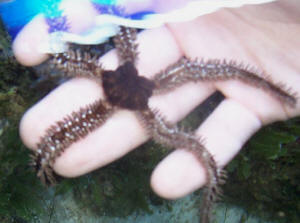
|
Invert ID/Diseased Cardinal
Fish - 09/09/06
Crew,
<<Alex>>
Thanks for all the help, both by answering my specific questions and
having all kinds of answers to everything almost!
<<Indeed...and you're quite welcome>>
My question is really three. First: I know that green brittle stars, O.
incrassata, are bad with fish small enough to eat.
<<Very often so>>
I have a full-grown A. ocellaris in a mixed garden reef tank, and
picked up a brittle star as a detritivore. Any idea how large of a star
could potentially catch a fish the size of an ocellaris?
<<Hmm, the "other" species of brittle stars are
generally quite safe with fish (there could always be the
"exception"), but I would say any Ophiuroid the size of your
hand and up could capture and consume small fish if it chose to do
so>>
Also, are there any other species that look similar to incrassata, and
any idea how to differentiate them to tell which is which?
<<Not really...but if you stick to the "brown" brittle
stars you'll be fine>>
He's only been in there a couple days, and I can pretty easily
return him (I know where he spends most of his time, so an ambush
shouldn't be too hard).
<<If the star is not O. incrassata I wouldn't be
concerned...else yes, do remove it>>
Next: I'm thinking it might be tough without a picture, but I have
a mystery worm of some sort that I can see only at night in the same
tank. It lives in one spot and can be seen every night. I have a gap in
the rockwork where it comes out. If I go in and look at it after the
lights have been out for a couple hours, I can see maybe a 4-inch
section of the worm. It's flexible, not hard at all (or at least so
it looks). I can only see it if I
just use the very edge of a flashlight beam: anything brighter, it
retreats into the rock gap. When I do use just the dim section of the
beam, I can see the section sticking out to the ground. I can't see
anything coming out of the end, like a medusa worm. The body looks a
little similar to that of a Featherduster, but it isn't. When it
does retreat, it looks like it retracts into itself and rolls up, but I
can't tell very well if that's what
it is actually doing. I'm thinking it's probably some sort of
benign scavenger, but more just curious as to what it is.
<<No idea Alex (can you get a pic?)...but like you, I too expect
it to be harmless if not beneficial>>
Last: This might be an invert ID, but not like the others. I have a
Banggai Cardinal that had shared the tank with the ocellaris until I
noticed something on his gills. I have a 10 gallon tank set up for a
mantis shrimp, but at that moment all it had were a few snails, live
rock, and live sand.
It's cycled through the diatom bloom stage, and I think I have
enough circulation now to avoid a big Cyanobacteria outbreak. I moved
the cardinal over to this tank to watch him and wait until I had an
idea what was on him. His behavior hasn't changed at all: still
spends some time in his caves, eats voraciously, doesn't act
nervous or stressed.
<<All reassuring signs>>
The things in question are only on his gills. Especially looking from
behind him, the gill covers look to be sticking out a little bit, but
they're not sticking out with open space underneath. The space in
between the cover and body looks almost like some sort of egg.
They're white spots, about 1+ mm in diameter, with several on each
side.
<<Hmm...cysts/tumors I wonder?>>
Looking from either side, there are bulging spots on the top of the
gill slit. One side looks like it has one of the same spots in it, the
other is more like a small (2-4mm) bulge with a fleshy white color at
the very top of the gill slit. The other is about the same size, just
with the spot. I've watched his gill movement, and it looks
completely normal, not labored or fast at all. From what I can tell, it
doesn't look like any sort of fungus, Dinoflagellate, or anything
else I can tell. I'm worried that it's something communicable,
but can't tell.
<<Neither can I>>
I have a couple other 10 gallons available if it is something that
needs treated. If needed I can get some pictures to help with the
ID.
<<Pictures may help. I would try a temperature and pH adjusted
freshwater dip. You can also dose the hospital tank with Epsom salts
(1-teaspoon per ten gallons actual water volume) and iodine. And do
read through our articles/FAQs on marine diseases/parasitic
infestation>>
Thanks very much in advance for your help!
Alex
<<Quite welcome. EricR>>
Lionfish vs. brittle star 7/18/06
Hi there just a quick one
would a zebra lion fish eat/attack a brittle star fish. Many thanks for
all your help J.C.
<Highly unlikely a Lion would try to ingest a Ophiuroid... not
palatable... Bob Fenner>
Star(fish) Wars 6/30/06
HI: <Hi> I live in Florida and I
bought at first a greenish brittle star which have not given me any
problems. <Often predatory> I also have 3 sand sifting stars. I
have a 180 gal. tank. Then I saw this brittle star that its orange, and
then the disk on top is orange and it has spots like a cheetah or
something like that. I had not turn on the lights of the tanks the last
3 days, but sun light comes in through the window. The problem is that
this morning I caught the orange brittle star eating one of my sand
sifting stars, well I don't know how long it was eating it because
it had one of its legs completely inside the mouth, but I separated it
from the brittle star and the leg was complete, although a bit stiff,
so the sand sifting star left and immediately I fed the brittle star
some pellets. I could not believe that one star was eating another one.
The day that I bought the orange brittle star I fed it a dead small
feeder that I had with my other live feeders and it ate it quick.
<Wouldn't use feeders, causes digestive problems and can
transmit disease.> Could you help? I don't know if I should
return the star or not. <I would.> I like it because it adds
color to the tank but if its going to eat my other stars, I don't
know what to do. Help please thanks.
<While most stars are not predatory, this one seems to be. Hard to
tell you what type it is but its actions seem to indicate a carnivorous
tendency.>
<Chris>
Star(fish) Wars Part II
6/30/06
Thank you very much. <Sure> I'll
return it. <Good move.> Now my sand sifting star is losing her
leg. <Watch closely for infection.> Well the orange brittle star
is kind of handicap anyways, but I guess I'll return it because I
am not going to jeopardize the other stars. <Can't change their
nature unfortunately.> If I could send you a picture I would but my
mother in law has the camera for her vacation. Any who, thank you so
much for your advice and I guess I'll return it.
Thanks.
<Sure>
<Chris>
Brittle Star/Compatibility...No Caps Needed In His Text 6/28/06
Hi,
<Hello Craig>
I got one of these from my LFS a week ago and am now worried about my
livestock.
<Should learn about what you are buying beforehand.>
I have 2 Percula Clowns, one Yellow Tang, red starfish, 4 hermit crabs,
and 4 turbo snails. My tank is 38"x20"x20". Are all
these ok with the green brittle or not. My smallest percula is about
1" and the brittle has about 1" disk and say 3-4" arms.
I now target feed him cockle mussel weekly. Will this stop him eating
stock or am I best removing him. Would he be ok to live in sump which
is 30x15x15"?
<I'd remove the star and place in the sump where he will be
fine. This info is easily found on the Wet Web. Do learn to use the
Google tool, and please, do a spelling/grammar check before sending.
I've corrected 32 errors in this four line query. We do not have
the time to do this and it has to be done before being posted on the
dailies.>
Hope you help soon.
<Do read here, and related links. http://www.wetwebmedia.com/brittlestars.htm>
Thanks in advance,
<You're welcome. James (Salty Dog)
Craig
Stars and Shrimp
6/17/06
Hi guys...
<Hi>
My clean up crew comprises of 2 skunk cleaner shrimp, 2 blood shrimp, 2
brittle stars and about 10 hermit crabs and 5 turbo snails.
Additionally, I have 1 arrow crab because I like how they look.
<<Opportunistic omnivores... RMF>>
My LFS sold me the brittle stars saying they were good for cleaning the
back of the tank and the live rock that I couldn't get to, which I
admit is true. However, today I watched a brittle star grab one of the
skunk cleaner shrimp, snap its back and then munch it down.
<Yikes.> Is this normal? <For some species.> And how can I
prevent the same fate happening to the other three shrimp in my tank?
<Remove the brittle star or the shrimp, otherwise the shrimp's
fates are sealed.>
I know there are many types of brittle star and that the green variety
can by dangerous to fish, I'm not sure what type my stars are...one
is grey in colour and the larger one is brown. <Could be many
different types.> If I need to replace the stars with less dangerous
ones, is the brittle reef safe?
<Many different ones available. There are several articles on
WetWebMedia worth reading on the subject. They can be found under the
marine heading on the main page.>
Thanks in advance,
Ewan
<Chris>
Harlequin Serpent Star
Concerns - 06/07/06
I was hoping I might impose on you
for a little information.
<<Impose away! <grin> >>
A few weeks ago I got a beautiful harlequin serpent star - to whom I
have become quite attached after he wrapped one of his arms around my
finger when I was working in my tank.
<<Have kept these before myself...neat and attractive
critters>>
Granted, he was probably trying to eat me, but still...
<<Hee!>>
Anyway, also in my tank I have a blue-banded coral shrimp. I have heard
that the regular banded coral shrimp have been known to eat fish, but
mine is one of the blue ones, quite small and secretive -and seriously
lacking information about on the internet.
<<Indeed...would expect behavior to be quite similar to their
larger brethren...just on a smaller scale>>
Last night while peeking in between the rocks, I saw my geometric pygmy
hawk perched smack-dab in the middle between the shrimp and the serpent
star and neither one of them bothered him.
<<Not uncommon really. These stars are mostly detritus feeders
and usually won't attack a "healthy" fish unless
starving. Keep the star and the shrimp well fed and you likely
won't have any issues>>
However, my purple firefish has been MIA for several days, and I assume
he has been eaten.
<<Agreed...but probably post-mortem. Firefish are always
"touch and go" in my opinion. I find them very
sensitive/susceptible to stress from just about everything...and likely
to go "missing" at any time>>
I had the firefish and the shrimp for quite a while together before
adding the serpent star. I also did what I thought was good research on
the serpent start before putting it in my tank. Would he have eaten my
firefish?
<<Is always possible, but I doubt it...unless it found it
dead/dying already...is what they "do">>
I see him pulling in Mysis shrimp and eating them, should I supplement
him with bigger pieces of shrimp?
<<Probably not necessary if you are feeding a couple times a day,
but it wouldn't hurt to supplement the star's diet (the fish
and shrimp too!) with a quality pelleted food (New Life Spectrum gets
my vote), if you wish>>
Thanks for any help you can give me on him. He's beautiful and I
don't want to have to remove him, but I would also like to keep a
purple firefish in my tank as well.
<<You can try the firefish again if you wish, I don't think
this serpent star is a large risk>>
Thanks, as usual, for your infinite wisdom.
<<Mmm, if only that were true! <grin>. Regards,
EricR>>
Harlequin Serpent Star
Concerns II - 06/07/06
Eric,
<<Rebecca>>
Thanks for your help, but I have great news to report! Last night I
reached into the chamber of my nano that I have converted into a mini
refugium (underwater fountain light and a handful of Chaeto) to shake
some pods into the tank, and I heard some wild flipping noises.
<<Ahh...>>
Guess who was in my refugium?!
<<Um, little purple dude?>>
So I guess he was in there since Sunday when I did a water change.
<<Indeed>>
He seems OK, other than some tissue loss on the front half of his anal
fin (I'm hoping that will grow back quickly).
<<Will likely be fine>>
I'm sure he had plenty to eat in there!
<<Agreed>>
I hope I have some pods left. This is the least neurotic firefish
I've ever had.
<<Lucky>>
I scooped him back into the tank and he went into his cave for a few
minutes, then he was back out in full view, ready to eat!
<<Must feel quite comfortable in your setup>>
I'm so glad he didn't get eaten!
<<Me too!>>
Thanks again for your help!
Rebecca L. Dishman
<<Always welcome. Regards, Eric Russell>>
Serpent Star and Jawfish
compatibility - 05/22/2006
Hello, I've perused the
site for a definitive answer, but have only come up with 1) brittle
stars and Jawfish can be problems, since both are benthic, but 2) most
brittle stars, except the green brittle star are safe with fish.
<Some useful generalizations>
I have 2 tanks, the smaller is a 46G reef tank with several corals
(Acropora, Goniopora, Frogspawn, green mushroom, a couple of polyp
colonies, Xenia), 2 peppermint shrimp (wurdemanni) named Bubba and
Gump,
<Good names>
2 Mithrax
crabs (pinchy & sandy),
<Keep your eye/s on these...>
assorted snails and blue leg hermits, 2 green-blue Chromis, and 1 black
banded serpent star named Twinkle (Ophioderma longicaudum, I think).
Names are courtesy of the kids.
Since setting up the tank, I have wanted to add a Jawfish. I have a
4" fine sandbed and am planning to raise it with courser
materials. But I just read of the concerns about keeping with my
starfish.
<Mmm...>
Please verify if it is inappropriate to add Jawfish with the star
fish?
<Your system is more than "full up" livestock wise... if
it were much larger... by a few times, I would not hesitate to add an
Opistognathid>
Another question: when I got the tank there was a large number of small
white feather dusters (maybe Bispira brunnea) on the rock. They
proliferated all over, on the glass, some of the corals, even in the
overflow until....I got the peppermint shrimp. The shrimp were acquired
to tackle a growing Aiptasia infestation.
<... don't always stick to assigned tasks...>
They tackled that problem with due speed. But when done with the
Aiptasia, I started noticing a decline, then nearly total disappearance
of my feather duster population! Is it known that these shrimp eat
feather dusters? All of them, or just this particular species? Any
other explanation?
<"They come and they go"... could be predation at play
here, or senescence alone, a lack of food stuffs... Bob Fenner>
Tiny star 5/8/06
WWM,
Hi, <Hello>
I need a help in possibly identifying a Brittle Star. <ok> The
best description I can give you is that it looks just like a Green or
Black Brittle; however it is white and fully extended it is about the
diameter of a penny. I'm thinking it is just a baby, <Most
likely just a small species.> and maybe has not assumed its adult
color. I found this guy hiding under a rock when I was doing a little
maintenance. I think it is safe to assume that it came with the rock
and survived the collection, shipping, & curing, only because I did
not purchase it. <Fairly common in quality LR.> I know they are
great scavengers, but not knowing its type, I don't know what is
the compatibility is with other sea stars. I have a 3.5" Orange
Linckia Star in the same tank, and I am not looking for a fight. Any
ideas?
Thank you
Bryan
<Should be no problem, fairly common LR hitchhiker. Their numbers
tend to wax and wane over time, but are neat little critters and will
not hurt anything>
<Chris>
Micro Brittle Stars
4/16/06
I found what looks like about a dozen baby
brittle stars hiding in the green algae in my seahorse tank. I had 2
yellow with green banded brittle stars in
the tank for a short while, but moved the larger one to another tank.
Should I move the babies to another tank / someplace safer?
<I think it may be a mistake to jump to the conclusion that these
are offspring, they may what most aquarists call 'micro'
brittle stars, smaller versions of the big cousins that rarely reach
over an 1', quite common and good
detritivores'¦'¦..leave them be.>
They are about 1 cm across (tip to tip of legs), so I don't think
the seahorses will eat them,
<It is possible but they reproduce quite quickly, I really
wouldn't worry either way, just enjoy.>
but there is a fire shrimp in there as well, although I've never
seen him in the algae. What should I be feeding them?
<They will eat detritus and leftovers, if there is a fair amount of
them they likely have a food source.>
Would the two starfish reproduce again if they are together, or is this
a fluke?
<Likely not a reproduction but another much smaller species.>
Thanks for any advice.
Kim
<Adam J.>
Serpent Star/Murder Rap
4/14/06
What is the probability that a recent string
of disappearances in my tanks (which has no other possible predators)
are the result of my serpent star
(definitely not a brittle)? I first lost a cherub angelfish followed
weeks later by both a firefish and a royal gamma on the same night. The
fish are
always healthy and acting normal the day before and then gone the
following morning. I first thought they were succumbing to some illness
and the
serpent star was eating them but now I'm not so convinced. <Good
reason to think this as large serpent stars are known to capture/eat
small fish. How large is your star? James (Salty Dog)>
Derek
Re: Serpent Star/Murder Rap
- 04/14/2006
James <Derek>
I have some good news - I found the firefish this afternoon, it would
have been odd even if the serpent star was the culprit to have eaten
two fish in a
single night. <Yes.> To answer your question he is probably about
eight inches in diameter with his central disc at about 1.5 inches.
He's definitely large
enough to have gobbled up the royal gamma but my cherub angel was full
size 3.2 inches and it seemed a stretch. If you think he may be a
danger I'll
remove him, but what kind of detritivore would be a safer bet to
replace him?
<Brittle Stars are good. Your dealer may possibly take the large
serpent star in trade. Would be beneficial in tanks with larger fish.
Do read here for more insight on clean up crews. http://www.wetwebmedia.com/marscavart.htm
Thanks <You're welcome. James (Salty Dog)>
- Derek
Brittle stars, purple Gorgonia and tangs
Crew
Are any of these brittle stars (O. alexandri, erinaceus, or
paucigranulata) known to eat small fish?
<Mmm, not well-known for such, no... but many fishes do predate
Ophiothrix species>
My population of green Chromis seem to be decreasing.
Some mornings a couple look stressed with damaged fins, while looking
fine the day before. I have several species of Gorgonia and a
collection of tangs
(1 purple, 1 unicorn, 1 sailfin, 4 yellow, 2 regal and 1 Atlantic
blue). I've noticed that small chunks of the thick rind (or
whatever you call it) are
missing off of the branches of the purple Gorgonia. Some spots are
almost to the center of the branches, exposing the gorgonin or stick.
My question is,
do the fish like Gorgonia or are they trying to clean off algae,
<Perhaps the latter>
or just hungry? Would it okay to supply them throughout the day with
seaweed on a clip?
<Yes, certainly>
I feed these fish a lot everyday besides seaweed. Or should I eliminate
the culprit (which I think is the purple or Atlantic blue tang mostly).
My
tank is 500 gallons which allows enough room for their space. they
don't appear stressed, but at times will veer each other out of
their territory. I
thought these tangs are supposed to be reef safe. thanks.
<Mmm, all a matter of "relativism"... Do look into/try
Spectrum foods as well with your tangs... very nutritious and
well-received. Bob Fenner>
Serpent Star Eating Porcelain Crabs? - 12/02/05
Hi!
<<Hello>>
I have bought a nice serpent star two weeks ago. I was not able to ID
the species. It is of a "typical" size (about 4" arms
extended) and pale gray with darker gray rings on the arms.
<<Possibly Ophiolepis superba>>
I thought it would be completely safe for other inverts.
<<As a rule...yes.>>
I bought it to help stirring the DSB, but it does not seem to go into
the sand.
<<No, not a "sand stirrer" as such...but a helpful
detritivore all the same.>>
It's hiding more in the rockwork.
<<Tis normal/expected.>>
My two porcelain anemone crabs disappeared since the star is in the
tank.
<<Likely a coincidence.>>
I see exo-skeleton parts in a corner of the tank were I often see the
star. I thought the crabs maybe just molted, but I start to doubt it...
My questions: -Is it possible that the serpent star got them for
lunch?
<<Not likely>>
Are they normally crustacean safe?
<<Normally, yes.>>
Is it possible that large brittle star are more into sand than serpent
star?
<<Nope...these starfish are not sand-stirrers. A Bullet goby
(Phalaena dragon <<Amblygobius phalaena>>) will help
with this.>>
And are they safer with crustaceans?
<<Brittle stars are a favorite of mine.>>
Thanks!
Dominique
<<Regards, EricR>>
Stocking a 30 Gallon Marine
and the Homicidal Brittle Star 10/30/05
I have a 30
gallon reef setup and am looking for an active and colorful fish that
can survive my brittle star.
<If you do indeed have a homicidal brittle star there are not many
fish suitable to this tank size that can avoid him. A fish that can fit
in a 30 gallon will have to be small and not need a lot of swimming
room'¦.in other words an easy target.> Currently I have two
percula clowns and a sixline
<You've reached the limit for a 30-gallon already with this
load, the wrasse may be quick enough to avoid the star but the clowns
are at risk for sure.>
<<These stars hunt by stealth, usually while fishes are
sleeping. For most there is no escape. MH>>
along with the star fish and a fire shrimp. I have lost two cardinals
and a watchman goby to the bastard already.
<Sounds vicious.>
I would take him out but don't want to empty the tank to do so.
<Maybe coax him out with something that has a strong smell to it
like squid, then net him, he needs to be removed.>
Would a bicolor blenny be safe?
<No.>
<Adam J.>
Brittlestars and Dwarf
Seahorses 9/29/05
Can Small dwarf seahorses be kept
with Brittle Star fish <Yes. James (Salty Dog)> <<... not
all species. RMF>>
Re: Small Star Problem
8/12/05
Thanks for the info...one more thing though;
I'm quite certain that my starfish problem is a problem with
serpent stars. There are many in
the live rock and aside from physically removing them, is there any
natural predators that you know of? Thanks again!
Darryl
<Depends on the species... likely predation is not a practical
solution... and even more likely this large population will
self-correct. Again, I would not be concerned at this point. Bob
Fenner>
Are banded serpent stars
fish eaters? Sometimes 8/11/05
I recently bought 2
starfish, a red and white brittle star (Ophiomastix annulosa), and a
banded serpent star listed as Ophioderma appressum/ brevispinum for my
2 year old reef/fish tank. They stay on opposite sides of the tank. I
had a purple firefish who lived in the rock where the banded
serpent took up residence. A week after purchasing the stars, I noticed
some scrapes on the firefish, but he was healing them nicely. About
2
weeks after purchase, the firefish has gone missing, likely dead and
eaten based on how long he's been missing. He disappeared over one
night, and
hasn't jumped (tank is covered, no body).
So the question is, could a banded serpent star be a fish eater?
<Could be, yes>
Before purchase (and after) I've searched your site and others, and
everything seems to suggest that they are perfectly reef and fish
safe.
<Mmm, most specimens, settings, with feeding, this is so>
It's only the green brittle stars that seem to be known as fish
eaters,
<Most notoriously... but there is a slippery slide scale of degrees
of likely reef-safeness... Ophiuroids are determinate predators on many
of the world's reefs... will eat most anything they can
secure>
and I was careful not to get one of them. It's possible it's
coincidence and that the firefish just died, but he was in perfect
health, and I'd rather take
out the $6 starfish rather than risk more fish, if the starfish is a
likely culprit.
<Me too>
Thanks for any insights.
Scott Bennett
<Wish I could relate more. Have other second-hand accounts of others
having "missing fish" problems with other Serpentstars... Bob
Fenner>
Brittlestar...Shrimp
Killer? - 06/04/05
I have a 29gal reef tank that
houses 2 percula clowns, a sixline wrasse, three green Chromis and a
fire shrimp. Corals include candies, a red brain, an Alveopora, several
buttons, polyps, mushrooms and a Tridacna maxima. I know that I am
pushing the stocking limits...but I do 10% water changes every 4-5 days
to maintain water quality. Is this ok?
<<Very good to hear...but I wouldn't add any more fish to
this tank.>>
Lighting consists of a 65 watt true actinic blue and a 65 watt 10000k
day lamp. I have a 400gph Skilter filter. I recently moved most of this
from a ten gallon that was becoming full. The 10 now houses my brittle
star. I have not moved him over because while in the 10gal he ate my
peppermint shrimp (it was the coolest thing I have ever seen).
<<The shrimp?...or the eating event?>>
Do you think it would be safe to move him? Was this most likely an
isolated incident or is he likely to cause harm to my other
creatures?
<<Did you see the brittlestar attack the live shrimp? While
possible the starfish preyed on the live shrimp, I suspect it's
more likely the starfish was just seen scavenging on a dead carcass and
the shrimp expired from something else. Brittlestars are very efficient
detritivores/scavengers and serve a vital role in reef tanks. They
serve more good than harm in most cases...I would move it and maybe
keep a watchful eye.>>
Thank you in advance for your help.
<<Regards, Eric R.>>
Serpent Star Ate Shrimp? -
05/01/05
Hi crew,
< Hello Linda >
I have a black brittle star and a banded serpent star in my 75 gal. I
know that a green brittle star will eat shrimp and fish, but the LFS
said the serpent star I bought was reef-safe. He is tan/brown with
blackish bands on arms.
< Generally speaking, yes, I would agree with the LFS. >
I found a dead blood shrimp a couple of weeks ago with no explanation
to his death. Tonight I added a small cleaner shrimp and about 1 hour
later (the lights were off) I saw the banded serpent dragging the dead
shrimp back to his cave. Did he kill the shrimp or had the shrimp died
for some other reason and he was simply eating the carcass? What's
your take on it?
< While it is possible for a serpent star to prey upon live
organisms, I think in this instance it was just doing its job as a
scavenger. If it had attacked the live shrimp, it would have ensnared
and engulfed it on the spot. More likely what you saw was the result of
the star encountering the already deceased carcass. Many reasons why
the shrimp could be dying... If both came from the same place try a
different source... Check your water parameters for anomalies (are you
performing frequent partial water changes?)... Review your acclimation
procedures (shrimp can be very susceptible to salinity shock). >
Thanks - you guys are great!
Linda
< Regards, Eric R. >
Tiny serpent stars out of
control
Hi,
<Hello Christine>
I cannot find any reference to anyone else having the problem I have
with my tank. All references to tiny serpent stars indicate that they
aren't a problem, but....6 months ago 3 tiny white serpent stars
hitchhiked into my tank with some Caulerpa. They remain small when
fully grown (maximum of 2 inches tip of arm to tip of opposite arm,
tiny bodies). They reproduce like rabbits. I have 2 captive bred
seahorses, 1 red thorny starfish, snails, several types of worms, live
rock, and live sand in a 30 gallon tank.
The serpent stars remain tiny, but have multiplied out of control
without a predator. I regularly suck them out with a turkey baster, and
pull the fake plants/corals they like to hang out on, and rinse them in
fresh water before returning them to the tank. All to no avail. The
serpent stars are imbedded in the live rock and the population does not
seem to diminish despite my efforts. Tonight, one went for a ride on a
seahorse (it actually woke up the seahorse when the seahorse was
already asleep) which seemed to make the seahorse itch (she was trying
to rub the serpent star off). I helped get it off by using a turkey
baster to agitate the water near the seahorse.
I don't mind having some small serpent stars because they are cute
and funny and make a good cleanup crew, but this is too many. I am
trying to limit the food supply by target feeding my seahorses larger
PE Mysis shrimp in the water column and removing
the excess (any that falls to the sand) immediately. I started this 1
week ago. Before this I used Hikari Mysis which had so many small
pieces that the serpent stars could find Mysis that had fallen to the
tank bottom. The seahorses only ate the whole Mysis, leaving the
serpent stars with a good food supply. If limiting the food supply will
work to thin out the serpent star population, how long will it take?
What else can I do, especially to the live rock where they hide, that
won't kill the Caulerpa or the beneficial bacteria. One rock has a
feather duster worm I would like to keep. I'm considering arranging
all live rock at one end of the tank, and only feeding seahorses at the
other end. Would that help deprive the serpent stars of food?
<Not really, it will end up in the water column somewhere.>
I would appreciate any advice you have. (By the way-water quality
parameters are good, so is dissolved oxygen-I'm careful about
that).
<Christine, I think you have the perfect habitat for the harlequin
shrimp. The feed exclusively on seastars. You may want to give one of
these guys a try, keeping in mind that the harlequin does not feed on
all seastars, just certain species, but if it were me, I'd give it
a try. James (Salty Dog)>
Red Brittle Star
Is this Brittle Star safe for a 90gal Reef Set-up? I have l00 lbs
of LR. I read that the Green Brittle Star is the predator. I have a
scooter blenny and some Firefishes that I worry would be eaten if I
bought this Brittlestar. The LFS said this particular brittle star
would not cause a problem. I'm worried.
<Patty, if it's the Red (Bahama) or Harlequin Serpent Star, it
is reef safe feeding on fish feces, dead organisms and uneaten food.
James (Salty Dog)>
Thank you for assistance.
<You're welcome>
Brittle Star
Follow-up
Dear James,
Thank you for such a quick response.
<You're welcome, Patty>
This is not the Bahama or Harlequin Red Serpent Star. The name is
Ophiomastix annulosa from Indonesia. I am having a hard time getting
correct information from the LFS and don't want to put this
Brittlestar in my 90gal reef if he will dine on my fishes. I'm not
sure I've been given the correct information. Is this Brittlestar a
predator? He definitely has spiny legs.
<Patty, in my reference book it states these guys will trap and dine
on small fish during the night. So, if you don't want any of your
gobies, etc to become a midnight snack...... James (Salty Dog)>
Thanks for your help.
<You're welcome>
Shrimp and (Ophiarachna)
starfish
I recently got a small green serpent starfish
for my 20g saltwater tank which includes a blue damsel, Lemonpeel angel
and coral banded shrimp.
<Way too much fish life for this volume...>
When I put him in, the shrimp was very interested in him, and at first
I thought seemed to be attacking him with his claws, and even had a
tentacle in his
mouth. Later though, I notice he sometimes picks stuff off of the star
and eats it. Well, since I put him in (about a week), I have not seen
him eat,
and I have tried feeding him small bits of shrimp, even putting it
right on him but he doesn't seem to acknowledge it at all, and it
is always there the
next day. My first question is, should I be worried?
Or is this normal behavior at first?
<Not atypical>
My other question is about my shrimp. A few days after adding the star,
he has stopped roaming the tank as he usually does, and he
mostly sits on the back of my rock formation all of the time. He will
eat though, if I drop food back there, but he doesn't seem to do
much else. He
seemed to do this before he molted, but that was only a few weeks
ago.
Thanks for your time.
Ryan Antonio
<I take it you don't know re the predaceous habits of Green
Brittlestars... Please read here re: http://www.wetwebmedia.com/brittlestars.htm
I'd be removing this animal. Bob Fenner>
|
Small five-legged White Star - Good
or Bad for a reef tank??
Hello Bob.
<Greetings Ted>
I am hoping you can help me with an identification of the
creature in the photos below. It is smaller than the diameter of
a dime.
<Nice pic>
It has 5 legs and it is white. I have a good number of them on
the floor of my sump tank and additionally they are in the sand
bed of my 120G reef. They don't seem to be a problem but I
don't know if they are a good thing or a bad thing for the
tank. They move around a lot in the tank moving through the sand.
I don't see them anywhere but in the sand. My reef tank is
about 26 month in operation now and I have 4 tangs, 2 clowns and
7 Chromis, 4 shrimp snails crabs and some soft corals, button
polyps, colt coral, toad stools mushrooms and green star.
Everything is doing well but I am concerned with these star
critters. I would appreciate any assistance you can provide.
PS I did a search on the forum and found some references to small
white serpent star back on 12/9/04 but they don't discuss if
they are good or bad.
<This is no doubt some species of Brittlestar, Ophiuroid...
and actually very beneficial and indicative of your good
husbandry. The echinoderms (the phylum inclusive here) dominate
many benthic marine environments and these small stars are a
large part of many benthos environments... good for cleaning up,
aerating the substrate, providing food... Bob Fenner>
|
|
|
Hungry serpent
star
I have a serpent star that I have had for just
over a year now. He is a green color with brown bands. Recently I have
been losing quite a few snails. (Turbo and Astrea) Last night I saw the
serpent star wrapping it's legs around one of the turbo snails
foot. It appeared as though he was trying to eat the snail. He moved
his oral disc over the snails foot. I removed the serpent star from the
snail immediately. He is not one of the green brittle stars that are
mentioned on your site so frequently. Could he be eating my snails?
<Yes. Ophiuroids are "big bosses" (and small) of tropical
reefs to abyssal depths... some more predatory, specialized in their
feeding mode, prey... others less discerning. Bob Fenner>
Green brittle on the prowl
- 3/7/05
Hello... I'm afraid I have a dilemma.
<OK. Let's see what we can do about helping the
situation>
I recently purchased a green brittle star...
<Uh oh>
... at the pet store in our town. The shop owner assured me there would
be no problem in my tank unless any fish got sick or weak.
<All I can say here is research before purchasing....I know you know
this now.>
All was fine for the first few days, he and our mandarin seemed to be
getting along well, even hanging out in little areas together.
<Hangin' out is not the word I would use>
My husband and I kept a close watch on them because we were concerned
about the safety of our fish.
<I can only recommend that again, research before purchase. This
starfish is well documented on our website.>
Just when we thought things were alright, we caught our brittle star
hovering over our mandarin and lowering down as if to eat her!
<Very likely so>
It even spit out the food it had been given about and hour earlier! I
had originally wanted a chocolate chip star, but again, the shop owner
advised that it would not be a good addition to a reef tank (I only
have a pink tip anemone and a mandarin in with the star)
<Well, a chocolate chip star is not a good reef tank addition but
with the lack of corals it would likely be fine. Chocolate Chip species
are hardy but aggressive feeders, more than happy to mount and consume
sessile clams, oysters and all manner of corals, soft and
stony.>
My questions to you are: Is this normal behavior for a brittle
star?
<Not any brittle star but Ophiarachna. See here: http://www.wetwebmedia.com/brittlestars.htm.
There are many attractive and useful brittle stars. You just happened
upon one of the exceptions to the family.>
Should we be concerned for the life of our Mandarin?
<Yes. The brittle star is only the beginning of issues for the
Mandarin fish. They need to either be trained to take frozen food
preparations or you need to have plenty of live foods either available
to you or in the aquarium where the mandarin is housed. A mandarin can
decimate a population of amphipods in a small tank in no time.>
And would a chocolate chip have been a better choice?
<Really depends on your long-term vision for your tank keeping. Do
your research and then determine your preferred choice of
animal>
Thank you so much for your help.
<Our pleasure. Thanks for being part of it all. ~Paul>
Serpent Star
ID/Compatibility
WWM Crew,
First of all, thanks for a tremendous resource. Your site is always
first when I read up on a new topic.
<You're welcome>
I'm about to acquire a new 60 gallon tank. My plan is to merge the
contents with my existing 18 gallon tank, but I'm a bit worried
about compatibility.
The existing tank hosts my 2 Perculas. Let's be clear, it is their
tank. The new tank has a coral banded shrimp and a Brittlestar (picture
attached).
<Marina searches folders for picture..>
Down the road, when things are stable, I plan to add a bubble tip
anemone for the clowns. I've read thru the ID and compatibility
pages on the Brittlestar, but I'm unsure if I might encounter a
problem. Although he's not green, I'm unsure of his
genus/species and I don't want to take the risk if he might
threaten the clowns. Help! As for the coral banded shrimp, your
collection seemed to suggest that they *might* go after fish in some
cases as well.
<Quite safe with fish, feeds on small bristle worms.> <<...
Stenopids do eat fishes, other shrimp, snails... RMF>>
Given that there are no fish in the new tank, I wonder if the previous
owner had a problem. Perhaps it isn't worth the risk? I really
don't want any trouble makers! If I decided not to keep them, any
ideas?
<I do not foresee any problems and the brittle star you have I
believe is in the Ophionereis group. James (Salty
Dog)>
Brittle Star- Fishy Friend
or Foe?
I have a green brittle star, a clownfish, and
a Yellowtailed Blue damsel. Do I have to worry about the green brittle
eating my fish the smallest fish is 1 1/2" long?
Thank you for any advice you can give.
Joshua Malone
<Well, Joshua- I suppose that it is possible that the Brittle Star
could consume the little fish while they are resting, but I would not
be overly concerned about it. This is not to say that the starfish
can't consume your fish, but I have never had this happen in my
experience. I'd just keep a close eye on the fish, provide plenty
of hiding places for them, and keep everyone well fed. Best of luck to
you! Regards, Scott F.>
Death of a Jawfish
Blundell
Re Mr. Jaws
Thank you for your response
One critter that might have attacked Mr. Jaws was a brittle star. I
have two protein skimmers on the system, a 36g w/ lots of live rock
that dumps into a 12g sump with macro algae/deep sand bed that dumps
into a wet dry filter/skimmer and a 12g small tank with a deep sand bed
and corals were the jaw fish was. With two skimmers and a wet dry I
would hope that the water has O2 in it, but I'll get a test kit for
that anyway. Oh, I moved the brittle star to its own house. The 12g has
a nano refugium on it (an old Skilter with parts removed, great for
nano systems refugium-terrible for skimming:)
<< I don't think brittle stars really attack fish. They will
clean them up and eat them after they are dead, but I have a difficult
time picturing them attacking a fish. >>
My main concern is to find the most likely cause of death so I
don't harm other fish that might go into the system. I try to do my
best by the critters in my care.
<< Noble questions. In this case, I hate to say it but maybe he
just died? There may not have been anything you could have done for it.
>>
Martin Garrison
<< Blundell >> <RMF has seen Brittlestars consume fishes
in captivity and the wild>
Are These Fish Going to Be Brittlestar Food? (10/27/04)
Hi....Ok.. Here I go again. I don't have a sick fish, anemone or a
starfish. I have 1 neon damsel ( if that how u spell it ) about an inch
long, 2 blue damsel about an 1 1/2 long, 4 clownfish 2 r like Nemo
& 2 got them 2 stripes on them about an inch long, 2 anemones, the
little 1's Whisper & the bigger 1's Hush & 1
Swamp thing, the Green starfish. Will Swamp thing eat the fish when he
gets bigger????? <These are pretty active fish, all of which will
grow big enough that being eaten is not particularly likely, but cannot
promise. I would feed the star chunks of marine meat a few times per
week. You may have a bigger problem with aggression as these highly
territorial fish grow in you tank. I seem to recall that it is around
30 gallons, no? Keep an eye on the.> I got the tank going where I
want it to go. The Nitrates & so R good. I just started that tank
around July. It's my 1st tank. Thank-u a whole lot, Valerie
<Sounds great, just be watchful for damsel/clown aggression. Steve
Allen.>
Steve Allen, Re: Are These
Fish Going to Be Brittlestar Food?
<Mmm,
Steve's out till mid-month...>
The damsel was not visibly injured, but who knows about sick. He was
trapped in a "box canyon" formation of live rock, but
although at first he
clearly had space to move between the brittlestar's legs, he just
froze, barely even moving his fins, much less trying to escape. As the
star's legs
closed, its underside opened to surround the fish, which once enclosed,
struggled for about 3 minutes.
<Yowzah!>
It was an amazing slice of life on the reef that I kick myself for not
having at least some pictures to post as my digital camera was broken.
It occurred at about 12:30am and I woke my very reluctant fiancé To
watch. After it was over, she agreed I was right to wake her, but the
raw spectacle did not engender a collateral benefit.
<Wow, a keeper!>
On another note, I want to again commend the folks at Wet Web for
providing the accurate, accessible and timely information source that
makes
reefkeeping possible for people like me. While the protein skimmer is
the physical technology that makes saltwater chemistry work for
hobbyists, the
Internet allows the exchange of information and experience needed to
enjoy and succeed at this fascinating endeavor. Your site is my daily
source.
Please pass along these thanks to Bob Fenner.
Dan Pellissier
<Agreed and thank you! Bob Fenner>
Brittle star eating
Nudibranchs
Mr. Blundell,
<< Please no Mr. Just Blundell, or Adam or hey you >>
While I am thankful for your advice & experience, I have to inform
you that I have caught my culprit in the act of attempted lettucide--
it was my spiny brittle star.
<< Seriously? Really? >>
I was watching my remaining Nudibranch on one of the live rocks, &
noticed that he was inching his way closer toward the brittle star. I
allowed this for a
few minutes to see what would unfold. The brittle star's arms were
feeling around the Nudibranchs general vicinity, & at 1st I
didn't think anything would happen because when he touched the
Nudibranch it would seemingly recoil away. Despite this, however, his
arms kept returning & touching the Nudibranch.
<< Not too surprising, but if ends up eating him I'll be
surprised. I'm reading your email with suspense. >>
I was then distracted by the phone, & left the tank for only a
minute, but then I returned, the brittle was all over the Nudibranch.
He had pulled it down
from where it was munching algae, & had completed wrapped his arms
all around it. << Well that indeed sounds like he is eating them.
>> I was able to remove the brittle from the Nudibranch, &
although it had secreted a large amount of mucous, seemed more or less
alright. I temporarily relocated him to my refugium, where he did fine
for the night & following day.
<< That is surprising, after being munched on. >>
The following day, I traded in my brittle for a new Nudibranch. Even my
LFS was surprised, but not too much so. My thinking is that brittles
are scavengers, & scavengers are typically opportunists in nature
& cannot pass up an easily caught meal.
<< True, but Nudibranch aren't the most tasty food for them.
>>
I'm also thinking that Crispata, not being true Nudibranchs, may
not have the same toxicity as true Nudibranchs. << Could be so.
>> They seem to have more of a camouflage coloration than the
bright, "leave me alone, I'm toxic!" warning colors as
well.
<< True. Want to sound smart. We call those
"aposomatic" colors. Use that in a sentence with your friends
and you'll sound really smart.... or really nerdy. >>
Thank you anyway for your response, & I hope that you can benefit
from my experience as I most certainly
have from WWM Crew's as well. << Indeed, I know what to
answer next time I receive this same question. Thanks for your input.
>>
Take Care,
Pete
<< Blundell >>
> My 1st suspect is the brittle star-- I'm thinking that with
his long searching arms it may have come across it & probably could
have caught it pretty easily. I don't think this guy is actively
predacious, but could be opportunistic? << Doubtful. I
wouldn't think of him as the problem. >>
Predatory Brittle Star
Hi!
Thank you for getting back to me the last time I wrote to you. I now
have a new question. It is regarding Ophiomastix variabilis. I have a
110 gallon
reef tank and would like to purchase one of these starfish and was
wondering if it would be compatible with small fish such as Chromis,
Firefish and other
starfish such as a small red sea star, snails and crabs. If so do you
know where I could obtain one?
Thank you once again.
Jim Hoffman
>>>Hey Jim,
Great name by the way! :)
Brittle stars of this order (Ophiuridae), including the better known
green brittle star, Ophiarachna incrassata are known fish eaters. I
would steer clear of them if I were you. Instead, go with one of the
red or brown serpent stars. I have several of them, and they are just
fine with small fish.
Cheers
Jim<<<
Tiny Brittlestars, Friend
or Foe? (8/30/04)
I have recently noticed 4 or 5 very
tiny starfish in my 120 gallon tank. <Lucky you!> I have only
seen their legs penetrating out of some of my live rock. They seem to
be white with dark bands! <cool> Any idea of what type of
starfish this could be? <No. Mini Brittlestars for sure. Almost
certainly not babies of bigger brittle/serpent stars. There are so many
of these in the sea that there is little in the way of taxonomic
classification that has been done on them.> I haven't been able
to get any pictures as they are fairly small. <Yes> Recently when
my flower pot coral retracted I saw 3 starfish legs sticking out of a
piece of the coral. Is this starfish eating my flower pot or has it
just found a home of a part that was already dead? <Found a home.
BTW >95% of all flowerpot corals are dead within months of being put
in the tank. I'd suggest you read about Goniopora on WWM. I had one
once. I'll not try them again until experts have found a way to
keep them alive. Personally, I think they should not be offered for
sale to unwary aquarists (as I was when I bought mine).> I also
wanted to let you know that I have found another type of starfish. It
is definitely white. Not banded. At least the size of a nickel. It has
4 short legs and 3 long ones. Yes 7 in total. <Probably Asterina
species. Not thin-legged like Brittlestars. They reproduce by fission
and often are misshapen. Like Brittlestars, they are beneficial
scavengers, but can become too numerous (many hundreds) under certain
conditions.> I have a picture of this one if you would like to see
it. <Check the pictures of Asterina on WWM or in books for
comparison.> Thanks for all of your help. Lisa <Glad to be of
service. Hope this is helpful, Steve Allen.>
Anemone-Eating Brittlestar?
(6/23/04)
Hello Bob - <Steve Allen taking
echinoderm queries tonight.>
I feel like an idiot because I do not know nor can I find anywhere help
on this question. <Sometimes there are no answers.> I have a 2
y/o 30 gallon mixed reef tank, lovely, stable, (except for mysterious
Anthelia die-off happening currently) - 3 fish, many corals and
inverts.
I waited x 2 yrs to be sure lighting, etc was proper before purchasing
a tiny (2") rose BTA - purchased last week - LOVELY! <Your
patience is admirable and wise. I wish everyone thought that way.>
Ate immediately, bubble tips in profusion, the most glorious thing in
the tank. It settled into a crevice the 2nd day, as if on command,
right in the front and center of the tank and remained there. This AM
its gone and my brittle star is distended. <Is it possible the
anemone hid somewhere?>
No ID on the brittle star, nor can find pic similar to it - totally
blah colored (very dark gray) with subtle lighter gray banding on the
arms. <How big? Many Brittlestar genera have never been
classified/named down to the species level.> I know green brittle
stars can be predatory - can others?? <Brittlestars are omnivores
and eat anything edible that doesn't fight back (such as sleeping
fish) or is too big. Hard to imagine your star could have fit a 2"
anemone, but there's not much left after the water is squeezed out.
I would have thought the stings would make it inedible to the star and
I am not aware of reports of Brittlestars eating anemones. You might
want to post a thread under "Marine Invertebrates at the
wetwebfotos.com board to see if anyone has seen this happen.>
Am so sad about the anemone. <understood> Brittle star going on
vacation elsewhere as soon as I can catch him. <Not a simple task,
but you can often lure them out with food. Hard to say if it's the
problem though.> Thanks - Nita Irby <Hope this helps. You
certainly should consider trying again.>
Echinoderm Aggression
(6/23/04)
Hello again kind Sirs, <Steve Allen
here.>
Yesterday I added a Tiger tail Cucumber to my 45 gallon tank (50 lb LR,
5' DSB). Initially he seemed to settle in just fine. I got up a
little while ago and took a quick look into the tank. My 2 brittle
stars (6''and 8' mottled brown in color) looked like they
were trying to pull the Tiger tail Cucumber to pieces. <They
probably were trying to eat it. Perhaps they're not getting enough
food.> I have never seen this kind of aggression from them and
I've had them well over a year. <It does seem odd.> I see no
visible damage (yet) to the cucumber but he was definitely having a
rough night and it looks like he might have released a little bit of
innards. <Uh-oh> I pulled the Brittle stars off and removed the
cucumber then placed him into a 5 gallon quarantine tank, <smart>
which just has some LR rubble in it. Tomorrow I plan to do a 20% (6
gal.) water change and also change out some of my carbon. <Wise.
Polyfilter is useful for removing contaminants too.> How toxic are
Tiger tail Cucumbers? <Hard to say. Less than say, sea apples.>
Should I be more aggressive with the amount of the water I change?
<If everything in there looks good, I doubt you need to get too
aggressive as I would have expected a rapid negative effect right after
the event. These toxins are fast-acting.> The
next thing is I have to figure out what to do with the cucumber. I was
planning to install a hang on refugium tomorrow would keeping him in
there be an option, I know I'm reaching, but I thought he was
pretty cool. <Nurse him back to health in the QT. See if feeding
your brittle stars small chunks of shrimp or squid keeps them away from
him. I suspect there was something wrong with him in the first place
that led them to "attack." I would not expect your average
Brittlestar to try to eat a healthy sea cucumber.>
Do you have any recommendations on 'stocking' the hang on
refugium (19'x 12' x 4 ?'). Based on the picture in Reef
Inverts (page 66) I was thinking of 1 inch crushed coral plus 3 inches
of Carib special grade sand, some LR rubble and then ordering some
macro algae (not Caulerpa). <Don't mix sand grades. I'd
suggest 3-4 inches of sand and some LR chunk. Chaetomorpha would be
your best bet, but I have successfully grown Gracilaria in my AquaFuge.
Check www.inlandaquatics.com for an excellent selection and great
service. This will make a great environment for 'pods &
mysids.>
I also have 10 lbs of LS coming in tomorrow (great timing huh) from
Walt Smith which I was going to split up between the refugium and the
display tank. I was also planning to add a couple of Ceriths and
Nassarius snails to the refugium, thoughts? <Small Strombus snails
are nice as well and will reproduce. Check www.ipsf.com> Once again,
thanks in advance for the guidance.
Chuck <Hope this helps.>
Insidious Ophiarachna incrassata Strikes Again?
>Hello
WWC,
>>Hello Neal.
>I am passing this question on to you because I am stumped and
don't know what to tell this customer...
>>Alright. Should I have on oven mitts?
>He has a stable 125 with no fish additions recently. A month ago he
had a large yellow tang, large Naso tang, a Tomato clown and an
Imperator angel. He also has a decent amount of live rock and some
damsels and a green brittle star.
>>D'OH! Seriously? A green brittle star? Ummm! Uh oh!
>Recently he has lost all of the large fish (all but the damsels(!)
and the brittle star have disappeared) one every day or so. He claims
that the highest ammonia level he has tested is 0.25 mg/L and no
nitrite.
>>Get the brittle star (and ALL other brittle stars) OUT of that
tank, ASAP. Ophiarachna incrassata is a KNOWN fish eater. (Note the
"arachna" part of its genus) There are many other brittles
that are suspect, but genus and species have not been as
well-documented. I know of one person right now who's got a large
"tan" brittle that's at LEAST 16" across, and his
Carpenter flasher wrasses are gone, one at a time.
>I told him he must disassemble the rock formation and find the
carcasses but I couldn't put my finger on the cause of the
deaths.
>>There ARE no carcasses, my friend. There is only the Death
Star. He must meet with Yoda, listen to Yoda. Yoda says, "The star
trap you must! To remove, sump, tank other, it must go!" May the
force be with you both. Live long, and prosper. Grok.
>He claims the fish eat until the day of they are missing, are
social with each other and show no signs of disease. I showed him
pictures of deadly Cyano and Dinoflagellate algae and he claims that he
hasn't seen anything like it in the tank. We even discussed the
possibility of a mantis shrimp but I was really just guessing at that
point.
>>Still are, but I'm not. He'd have other signs, and a
mantis would be going for the little fish, who are likely far more
vigilant than those big, safe in their sheer confident big-arse selves
in their bigness, and the safety of that bigness. Too bad, too
late.
>I know all of this info is second hand and incomplete, but if you
have any ideas I would appreciate it.
>>You got 'em! Get that star out, put it in its own tank or
sump. Don't sell brittles as "good scavengers", they MUST
be fed directly for most fishes to have a hope of not falling prey, and
even then.. Let's put it this way, the MANTIS is in danger if
housed with the green brittle star.
>Thanks in advance, Neal Isaacs - Aquatica
>>You're welcome, and please do a search here as well as a
general Google. I believe another well-known fish-eater is Ophiothrix
purpurea.
>>P.S. See here to read the saga of my friend..
http://www.reefs.org/phpBB2/viewtopic.php?t=49666
(you'll have to register to see pix). Marina
Caught in the Act!!!
Feeding a Killer Brittle Star (two in one)
>Hello,
>>Hello.
>I had an interesting sight (which has brought up a few questions)
in my 60g tank I thought you guys might like to hear. I have been
hearing cracking noises in my tank and have been trying to catch what I
thought was a mantis shrimp.
>>Or in some instances a pistol shrimp.
>I had no luck but a new occupant brought in with some new LR did.
It was an obviously large brittle star (it looked similar to a
Ophiothrix suensonii, maybe slightly darker), I have seen 4 inches of
arms on occasion. It was soon after lights out one night and I had a
look to see if the brittle star would show itself, many of its arms
were out and it seemed quite excited. I soon realized it was battling a
sizable pistol shrimp(2.5 inches), they were both fighting quite
violently but the brittle star came out on top, literally tearing the
shrimp's head off.
>>Oy! Made for National Geographic, the battle of the year!
Wowee, must have been quite the sight to witness. And mad props to you
for catching in on tape (even more if the shots are really clear)!
>I think I scared the brittle star when I taped their action (with
the camera's light on) and it left the shrimp at the mouth of its
hole.
>>Oh me, I'd love to see this (and so would at least several
thousand other reefers).
>When I pulled what was left of the shrimp out in the morning it had
been sucked dry, even its claws, which were unbroken. I know they are
supposed to be scavengers but I was wondering if I should feed him and
how much.
>>All brittle stars? Nay, my friend, they're all to be
WATCHED, and carefully at that. There is currently one well-known
culprit, Ophiarachna incrassata (the nefarious Green Brittle star) for
taking livestock, but it is also very commonly accepted that, in
general, ALL brittles must be watched carefully for a propensity to go
fishing (or in your case, shrimping). This animal will require its own
dedicated system.
>The next day I dropped a chunk of seafood mix into his hole and it
was soon gone so I thought he might need a decent amount. Also I was
planning to add a pair coral banded shrimp some time and I was
wondering if it would be safe with my shrimp killing brittle star.
>>NOT at all, <giggle>, nor would I trust that spiny beast
with any vertebrate life, either. As a matter of fact, I wouldn't
even consider it safe with mantis shrimps.
>Thanks for your time and brilliant site and sorry for rambling on -
Ryan
>>Not at all! But, if you'd be willing to send along some of
the more exciting individual shots, I'm sure we could find a place
for them on the site (maybe, Bob willing, their own page? Quite worthy
in my opinion). Great story, Ryan! Marina
- Part Deux -
>I wrote to you earlier in the day about a
brittle star which took out a pistol shrimp and have found more info
which may affect your answer to the previous questions. After dropping
some food into his hole tonight I got quite a surprise when I saw some
un-brittle star appendages feeding in unison with the brittle star.
This 'thing' was using multiply string like tentacles to grab
the food and drag it into the hole. After dropping more food in I got a
better look at the 'thing' which turned out to be quite a large
lobster like shrimp, it was a greeny-blue colour and had one large claw
and one small. I've been musing they may have double-teamed the
pistol shrimp but have no proof. Do lobsters usually grab food with
tentacle things and have you ever heard of lobsters and brittle stars
living in the same hole and even sharing food?
>>The tentacles may very well be part of the star's feeding
mechanism, as many of them quite literally eviscerate themselves (turn
their stomachs inside out) in order to feed. If you can get a shot of
the tentacles, it would be more helpful. I'm also thinking along
the lines of something like a Terebellid worm (lord, I hope I've
got that one right) which sends out long tentacles with which they pick
up foodstuffs, often just detritus, but I'd expect that if they get
scent of a good feed they'll go for that as well. As for
double-teaming, I personally know of no such symbiosis, but I'm
hardly an expert, either.
>I have been trying to organize a digital camera to send a pic of
this strange relationship (if you were interested), I have it on video
camera but I'm not sure if you would accept it and haven't
joined the camera to the computer yet. Sorry to trouble you but I
thought you guys might like to hear about the development - Ryan.
>>Absolutely, and I will BCC this to Bob and Anthony, see what
they think of the whole thing. I think that this is fascinating, and
most folks aren't able to capture on tape, film, or digital media.
Marina
Did the star eat them?
(3/6/04)
I know that green brittle starfish are known
to eat small fish, but what about red brittle? <What species?> I
have a red brittle that is 14in. <Sounds nice.> across and
I'm suspecting him to be eating my fish....in the past 7 months
I've attempted to keep a Firefish and a baby Banggai (the Banggai
was about 1/2") both fish did great....then mysteriously over
night they would disappear. I can't think of any other
possibilities for what happened other than my red brittle...I also have
a tomato clown in the tank which I've had for over 8 months
(he's a lot bigger than the other fish I tried to keep though).
<First off. Please capitalize the noun "I", use
apostrophes in your contractions and spell-check your e-mails in the
future. We post these inquiries and replies on the web forever and like
them to be as readable as possible. Our volunteers will have a lot more
time to provide helpful answers to queries if they don't have to
spend time fixing them. Thanks.
Now, on to the question at hand. Although I like "innocent until
proven guilty," I think your suspicions are well-founded. Any
large, hungry Brittlestar will take the opportunity to devour a hapless
fish that is small enough and unable to escape. Usually it happens when
the fish is sleeping at night, which is when Brittlestars are most
active. Stars of the genus Ophiarachna are notorious for this. On the
other hand, the fish may have died on their own and been consumed
post-mortem by. Another possibility would be a Mantis Shrimp lurking in
the live rock. Those caveats aside, I'd err on the side of caution.
Either start with bigger fish if you want to keep the Brittlestar, or
find it another home.>
Thanks <You're welcome, Steve Allen.>
Serpent/brittle star in
danger!!!!
Hi, crew thanks for the great web site. <You're welcome. A labor
of love for all.> I purchased a successful reef aquarium from a
friend about a year ago and have become hooked on the hobby, I have had
FW tanks forever and always assumed SW was too difficult. This tank has
been up and running for almost ten years!!! <impressive>
Now for my mistake(?) I have started experimenting with different
fish/inverts etc. My reef has approx 75 lbs of LR covered in green
mushroom anemones, sponges etc. I also have what looks to be colt coral
or some type of Xmas tree coral that seems to grow like a weed.
(haven't been able to identify it yet but cuttings have so far
financed my tank for a year!) <free enterprise is great>
LR sits on a 2-3 inch bed of sand/crushed coral. Original inhabitants
were a true <percula> clown, a few blue leg hermit crabs,
assorted snails, two short spine urchins(?), red lobster, two
serpent/brittle stars (not sure of the difference) and a small Cuke.
The urchins and lobster have since died, not sure why, water is
excellent <tested?>. (age?) One of my stars had a falling rock
incident and was crushed. (Novice rock placement, oops) <If your
rock is on top of the sand rather than being based directly on the
bottom of the tank, collapse is always a risk.>
My question involves my remaining star. I found him in the front of my
tank one day with an arm severed, and wriggling. I'm not sure what
happened so I let it go. That was a couple of weeks ago. Last night I
noticed what appeared to be a white hole in his main body, today the
hole seems to have spread down an arm (necrosis?) <Yes. Almost
certainly fatal.> and there is exposed "skeleton". I am
concerned that one of my recent additions is not compatible with him
despite all my research.
I have added a yellow tang (6mos ago), blue damsel <a definite
meanie> (6mos ago), domino damsel <even meaner> (4mos ago),
pajama cardinal (4mos ago). Also added a few more hermits, lost a few
of them too (have seen carcasses) <tend to die easily.>, two
turbo snails, a coral banded shrimp, bristle serpent star, peppermint
shrimp (thanks for that idea, not a trace of Aiptasia now), a few
feather dusters, small amount of Caulerpa <yuck. messy in main
tank.> and a orange Linckia star. (Linckia has only been with us a
day or two) <I'd be surprised if it lives two weeks. Very high
mortality.>
Today I saw my peppermint on top of my star cleaning/eating him? I hope
he is just acting natural, I read one of your FAQs about this that
suggests that he is. I have observed the hermits on him a time or two
but they are very active so I'm assuming that they are just moving
over him. <Both the crabs and the shrimp are taking the opportunity
for a free meal from a helpless target.>
My water quality is excellent <what parameters do you measure?>,
wet/dry trickle filter, protein skimmer, mechanical filtration etc all
in tip top shape. Any ideas about what may be wrong/eating him?
<Initially wounded by something. Now in the process of being eaten
by bacteria & scavengers.> I don't have a QT but was
wondering if it would be ok to put him in the sump for recovery and if
so how to care for him there? (lights, food etc) Please help!!! Thanks.
<You can try the sump with a piece of LR for hiding, but the chance
of it surviving with spreading rot is virtually nil. A QT with
antibiotic may help, but again most unlikely to survive. Sorry.>
P.S. For Bob F. I have been using your book as a guideline for my reef
care, wonderful help thanks. <I'll pass this along as he's
in the next room.> I am in the process of planning my next aquarium
and have decided to go with a refugium/LR/sand bed set up despite the
obvious success of the wet/dry trickle in my tank. <You'll like
the refugium method better, especially for a reef--keeps the nitrates
down.> I am intrigued by the mangrove swamp refugium (for decoration
as well as filtration) in addition to utilizing a main under tank
refugium. Where can I find information/sources for set up, stocking
etc.? <Some stuff on WWM. Also in Bob & Anthony's Reef
Invertebrates book. The latest FAMA magazine has a few paragraphs in an
overview article about various types of refugium.> I mail ordered
"creating a natural aquarium" by Peter Hiscock, but it is a
bit lacking in the mangrove section.
Gobies MIA -- Did the
Brittle Star Get Them? (2/23/04)
I have green
Brittlestar with arms about 12 inches across. I bought 2 yellow
Watchman Gobies, one small one and one pretty good size. The big one I
had for 2 days--now can't find them. Is it possible the brittle ate
them? <Indeed, rather likely. This species (Ophiarachna incrassata)
can and will eat gobies. The one you have is quite large--shouldn't
have much trouble sneaking up and ingesting a "pretty good
sized" Yellow Watchman, the maximum length of which is not more
than 3 inches. On the other hand, they may simply have burrowed
somewhere out of sight. If they don't turn up soon, then I'd
write them off as expensive brittle star food. If you want any sort of
small or Gobioid fish, I'd give the star to someone who only has
nice big fish rather than what this brittle star takes for piscine
Little Smokies. Perhaps your LFS will take it.> thanks for help
<You're welcome. Steve Allen>
Just wanted to share...
Shrinking Shrimp, predatory Brittlestar?
This weekend
I purchased four small peppermint shrimp hoping they would clean up
some pesky Aiptasia in my tank. I read all that I could find to try to
make sure they would be safe, but alas, they became the most expensive
food I've ever put in my tank! I believe the green brittle star is
the culprit. All of the shrimp were gone within a few hours. They were
fairly small shrimp, but all of my fish are smaller than 3 inches long,
so I'm pretty sure the brittle star got them. My husband keeps
trying to convince me that maybe the shrimp are hiding, but my tank is
only 55 gallons and I would expect to see at least one of them around
feeding time. Anyway,
I just thought that I would share with other hobbyists that small
shrimp are not necessarily safe with a medium to large size brittle
star, regardless of what the LFS tells you! Keep up the good work WWM
crew!
<Thanks for the encouragement! It is always possible that the shrimp
are hiding. I put a very expensive fire shrimp in my tank on
Saturday...haven't seen him since. Shrimp are experts at hiding.
Keep watching around feeding time. Best of luck!
David>
Mini-brittles and SPS
coral
I've had an Acro that seems to be slowly
bleaching. It's been confusing because none of the others have this
problem, and the tank parameters are perfect.
<perfect for what?>
So I wrote it off as "one of those things".
<OK>
Then this weekend, the LFS, which has a rather large selection of Acro
frags and colonies, cleaned out one of their Acro tanks almost
completely, apparently chucking a large amount of stock. When I asked
what had happened, they said they had tons of mini brittles in the
tank, and had seen them going after and eating polyps on the Acros.
<what a load of crap. Ahhh...no. I assure you that no Ophiuroid
starfish you and I will ever see eats healthy coral tissue>
The infestation was so bad that they decided to chuck any pieces that
had brittles hidden in them.
<wow... amazing>
And last night, I saw several mini brittles around the base of the
withering Acro, and none on the other Acros (yet).
<no worries... you found treasure :) >
I've decided to dump them, but is there any "good" way to
get them out?
<they are beneficial... do send a picture and I'll
confirm>
I can't take them out by hand, since they hide rather well.
I've heard that a harlequin will eat them, and I don't have any
other starfish right now -
<huh?!?! Please... don't dare put a harlequin shrimp in this
tank unless you plan to farm starfish for an endless supply of echinoid
tube-feet>
I originally had some green brittles,
<they are the only predatory Ophiuroid in the trade and even they do
not eat coral tissue>
but caught one arching and eating a fish a few months back and got them
out a few weeks ago; haven't replaced them with red or brown ones
yet. I suppose I could get the harlequin, let it work for a few weeks,
then get it out.
<and send it where? Such behavior/buying decisions hurt are hobby by
creating a demand for inappropriate livestock. Few people, like
yourself, are prepared to keep such shrimp properly for a full captive
lifespan.>
Any other ideas? Thanks for any help...Arthur
<no worries bud... the starfish are non-predatory. The worst thing
you have to fear is that the LFS simply had sick coral. The stars were
scavenging the dying tissue and the lack of QT for the new coral has
infected you tank. Else, all will likely be fine. Do QT all livestock
(plants, algae, live rock, sand, corals, etc) in the future to prevent
these problems. Regards, Anthony>
Brittle Star Fish Good or
Bad?
I have a 44 gallon pentagon tank with a number of polyps and a few soft
corals. I also have a few fish which include 1. a fairy wrasse that I
can't identify, a coral beauty dwarf angel fish, a purple Firefish,
and a blenny that is dark grey with yellow side fins (note that the
blenny when excited gets almost a camouflage look to body with light
and dark patches of grey), and a yellowtail damsel (who is a hellion)
The tank has been up and running for 4 months (it has been cycled
completely). PH is 8.3, ammonia, nitrites, and nitrates stay almost
immeasurable. Salinity stays at around 1.023 to 1.024. I have a cleaner
shrimp, and a camel back shrimp. I also forgot to mention my snails and
hermits. I have 4 red leg hermits, and 3 blue leg hermits, 4 large
turbo snails, 2 or 3 bumblebee snails, and 2 margarita snails. I have
around 70 lbs of live rock. Anyway back to my question. Two days ago I
saw what appeared to be a brittle star on the front glass. This was
white with spines on it's legs, and it was smaller then a dime with
it's arms all the way spread out. It appeared rather quickly and
with the same speed that it was noticed about (2 minutes) it was gone
out of sight. Is this one of those miniature brittle stars that
scavenges for food? I also am going to be getting a brittle star from a
friend who tells me it is not a green brittle star but doesn't want
to risk keeping it with his recently purchased epaulet shark egg. He
told me that before the shark egg was all the way in the water the
starfish had come out of the sand as if it were coming after the shark
egg. Should I get this brittle star from my friend or have him trade it
in at the LFS for something else? My main concern on this is will my
snails and soft corals be ok with a brittle star? Would it be a big
risk adding one of these to my tank or would it be worth a try? I know
I have posed a large number of questions but I just want some really
solid advice before I put this star in my main tank. The star is in a
quarantine tank at my friends place awaiting my decision. I know that I
will qt the star before he goes in my main tank but am wondering
whether it is worth all the effort or if the star would be better off
getting traded at the LFS. Thanks again for any advice. John O
Glendening III
<Hi, John, Don here today. I don't recognize the starfish you
describe, but here is a link to a starfish that has been identified as
an SPS eater: http://www.garf.org/STAR/starfish.html.
Hope this helps. As far as what to keep/not keep, I would say, if
in doubt, leave it out. Just not worth taking the risk.
Don>
Starfish
Compatibility
Hi,<Hey there!>
I was wondering about the suitability of adding a brittle star to my
tank. I have a 125g fish only with over 100lbs of live rock. The
concern I have is due to two tank occupants: a couple of Heniochus
singularius, about 3-4" each. I saw them visibly picking on
(sampling) my sand-sifting star. Sadly, he was not able to withstand
their continued assault. His demise was 3-4 months ago. I'd like to
add another starfish of some sort. Am I right in thinking that Fromia
& Linckia are both susceptible to similar treatment? What about a
brittle star? They appear to hide during the daytime and scavenge
detritus at night, right? How safe do you think a brittle (non-green)
star would be with two Henis? Before buying one, I want to make sure
I'm not giving him a death sentence. :-)
Thanks! I look forward to your input,
John
<Well John.... I really think that adding another starfish will be a
death sentence. In the wild this fish does feed on inverts, so any
invert in this tank is a possible meal! Hope this helps!
Phil>
Detritivores -
2/12/03
Oh boy - "Detritivores" now I have
to go back wetweb and find out what THESE things are!
<be sure to place serpent and brittle starfish (Ophiuroids) at the
top of the list (excluding O. incrassata with invertebrates... all
others are completely reef safe). Anthony><<Mmm, no, not
all... RMF>>
- Brittle Star -- friend or
foe? -
Hi Guys,
<Good morning, JasonC here...>
I have a question about the 2 brittle stars in my tank that I have as
part of my cleanup crew. I have a 100 gal FOWLR tank that I set up
about 2 months ago (upgraded my old 55 gal tank to this one). I have 2
brittle stars that normally hide in the live rock. They have black
bodies and dark red hair-like bristles. Their arms are about 2 inches
long. They're usually very shy until they sense food. Then they get
pretty aggressive. The other day I lost one of my small green Chromis
when he got into the sump and sent back into the tank in 4 pieces
through the pump (bummer, good thing my 4yr old daughter wasn't
watching that!). One of the stars found the largest piece in about 10
minutes and took it back into his crevice with him. Within a half hour
everything was cleaned up. My 3 inch purple tang seems afraid of the
brittle stars. Whenever he sees them he freaks out. This time his body
went pale and he started darting back and forth in the tank. He calmed
down after about 10 minutes. This isn't the first time he's
freaked out when he sees the stars. Are these brittle stars OK?
<Yes, it's the green ones that are suspect.> Are they really
safe for my live fish or is my tang trying to tell me something?
<Your tang is trying to tell you something, but I'm not sure
that this is it... I'd look for other factors, perhaps the color
shirt you are wearing... I had a Tuskfish once who would react badly to
a bright yellow shirt I had.>
Thanks,
Kris
Laguna Niguel, CA
<Cheers, J -- >
Did a worm kill my
starfish
>Hi my name is Bill and I have had my 40 gal reef setup for 6 mo
now.
>>Hi, Bill. Marina this morning.
>Last week I noticed a pink caterpillar looking worm in my live
rock. It was about 2 inches long and went back into the rock.
>>Sounds like a bristleworm from this initial description. They
are eaters of detritus and leftover foodstuffs. Not harmful at all,
except to you should you be so unfortunate as to let yourself be stuck
by one (yep, I've been there, done that, ain't fun).
>A couple of days ago I saw one eating some of the Tetra tips I feed
to my green serpent star. They were kind of sharing. A day later I saw
one small one which I caught and killed and a big one around 5 in
long.
>>Do be VERY careful doing this! We are as yet still unfamiliar
with all the possible residents in our tanks, and I'll relay two
stories revolving around the ubiquitous Zoanthid. One man was doing
some rearranging of his tank, removed a bit of live rock with zoanthids
and his poor beagle licked it. The dog was dead by that evening, and
nothing could be done. The other was a man who keeps a nanoreef at
work, found some nudibranchs he didn't want eating his zoanthids so
he squished it, with his thumb (no cuts, either). In less than 15mins
his heart was racing and he was not able to breath, and soon after
began to lose feeling in his extremities. Please, don't just go
squishing things, you really could end up in the emergency room, and
most doc's know NOTHING about the toxins found in much of what we
keep. Sorry so long, but it's quite necessary. Let's do
continue..
>My problem is this. When my tank was 1 mo old after cycling I put a
brittle star in and one week later it started losing tips
from his arms first, a little then down to the body and he died. It
happened over a two day period. I thought it was my emerald crabs so I
removed them.
>>No, it wasn't the crabs. Have you got any books? If not,
please begin building a library. Sea stars are among the most delicate
of inverts to keep, and you should not have made them among your first
additions. Your sea stars died because of improper water conditions
(much of what makes or breaks it for a sea star we, as hobbyists,
simply CANNOT test for--heavy metals and the like, for instance). I
believe that you are too new to the hobby to take on delicate inverts,
and a few good books will help you through this and help you sort what
you can keep and expect to live.
>Then I had about 3 other stars that all of a sudden would have
wounds then die or I removed them the latest of which being a burgundy
star who looked great for 5 mo but after the worm sighting he got bit
up and died also.
>>If these are bristleworms, they just come and clean up after
the fact. I believe that it is more likely than not that conditions are
not quite right to keep sea stars.
>If the worm was the reason what can I do about it?
>>I really do not believe the worm(s) is the cause of the
trouble. Let your tank be for a bit, don't add anymore sea stars at
this point, get yourself some really good books and move on from there.
The possibilities are so vast that I cannot make a dent in what there
is to know via email. (Yes, they can be even more sensitive than
corals!) I hope this helps somewhat. Marina
40 gal 60 lb LR 2 55 pc on 12 hrs timed Astrea snails blue and red
hermit crabs Gr serpent star hammer coral frogspawn star polyps, plate
coral mad goby 2 percula clowns and one large feather
duster.
Sleeper Goby (Valenciennea puellaris)
eating Serpent Star?
>Good day Mr. Fenner.
>>Greetings, Josh, Marina this morning.
>After losing a wrasse in my system, I did some reading and came to the
conclusion an Orange Spotted Sleeper Goby would be a good addition to my
system when considering current inhabitants and other factors. Within a
day of placing him in my tank I noticed a small chunk missing from the
top of my Red Serpent Star, which had been otherwise healthy for a few
weeks now. Thinking he might have just torn himself against a rock or
some other accident not caused by another inhabitant, I didn't see any
need to isolate him. Today I witnessed the goby, who to my surprise was
eating from the water column from day one rather than needing to be
coaxed into it and thus something I would like to keep, in the act of
tearing a new hole in the star and promptly isolated the star in hopes
of getting him to heal up over the next few weeks. My question lies in
if these two are in fact inhospitable together as nothing I've read
indicated such (aside from gobies sometimes being light nibblers of the
leg tips of some stars, but not doing any damage). Is this a common
occurrence between the two species or did I just get very unlucky?
>>This is something entirely new to me, Josh. As yet, I am unable to
find a single reference to these fish eating sea stars. I must wonder if
the timing was simply such that, upon addition of the fish (or for some
other as yet to be determined reason) the star was already somewhat
stressed, and was pushed over just enough to begin degradation. Animals
such as the sea stars are very sensitive to basic issues such as
specific gravity. They can be treated if it appears to be a bacterial
invasion, but this absolutely requires NSW (near sea water) quality
parameters. If you've got that, and want to try, I suggest using
Spectrogram in the q/t tank. So, no, I don't think the cause of the sea
star's demise was the goby. Best of luck! Marina
Thank you in advance,
Josh
The Death Star? (Is His
Brittle Star A Killer?)
I've got a 72gal FOWLR
tank that I am currently stocking. I purchased a red (with black spots)
brittle starfish a few months ago and I suspect that he caught and
killed one of the three Chromis in the tank. The star is about
3/4" in diameter with arms about 3" long.
<Well, I suppose it's possible, but I've never had that
happen, in my experience...Usually, they will consume a dead fish or
invert...but I have not observed outright predatory behavior
before.>
I was looking in the tank this evening and saw the starfish and three
of my hermit crabs munching on him. Is there anything I can do to
prevent another one being eaten? Should I extract the starfish or is
there something I could feed him (other then four
week old quarantined Chromis) to keep him from hunting?
Jim
<Well, Jim- I'd start by just observing this guy for a while.
Again, typically, you'll see them consume dead animals, so see what
this starfish is up to. I'll bet that the Chromis was already dead
when he was eaten...Again- it's not impossible that the starfish
could "hunt", but is seems a bit unlikely to me...Keep
observing! I wouldn't just yank the starfish out yet....Regards,
Scott F>
- Headline: Brittle star
eats Greek Goddess! -
Hi,
My beautiful Greek Goddess nudibranch has disappeared overnight. I have
had it for several weeks, and it is not one to hide, so I am worried.
Is it possible that my red brittle star got it?
<Could be, more likely that it simply died of natural causes (most
Nudis only live a year, yours may have been 50 weeks old!), or even
more likely starved to death. Nudis are specialized feeders, and
I'm not familiar with the common name of "Greek
Goddess".>
(I had a good size camel shrimp disappear a couple of weeks ago, right
after we got the new star, so I am a little suspicious of the
critter.)
<Could have been the star, although a full range of water tests are
in order, as well as a review of your acclimation procedures.>
Aren't nudibranchs supposed to be too bad tasting for
predators?
<Yeah, as in TOXIC. Gonna need more than Pepto to calm your stomach
after one of those! -Kevin>
Thanks,
Eve Towns
-Seahorse
compatibility-
Lol...I just got done writing you about
my blue/green Chromis in with my erectus seahorses! But, alas, I need
your help once more... <That's what we're here for, fire
away!> I went to a marine store near where I live in Ohio today (was
supposed to buy some small crabs and such for both my 30 gallon tank of
seahorses and for my 5 gallon of dwarf seahorses). Well, when I was in
there I picked up a nudibranch ...Phyllidia arabica I realized tonight
from reading on here. I am wondering now if I should not have bought
this little bugger! <Well, do you know what it eats? Unfortunately,
these things are incredibly hard to identify, and if you didn't
collect it yourself, you have no way of knowing what it ate in the wild
(they are usually specific feeders). Nudi's similar or the same as
this one have been know to release toxins when damaged. All that said,
it probably was not a smart buy.> I talked to the owner of the store
and he told me it would do just fine in my tank with the seahorses. I
also went in looking for a chocolate chip starfish, which I thought
would make a wonderful addition, well....sigh...I let not only the
owner, but my friend as well, talk me out of the chocolate chip and in
to purchasing a green brittle star instead. <Hehe, come armed w/
info!> Again, the owner of the store said that it would do well in
with the seahorses and I had nothing to worry about. <Green brittle
stars are notorious for chowing on unsuspecting fish at night, I doubt
that your seahorse would be immune from this.> I am now shaking my
head and embarrassed to say that after reading up on both of my new
purchases that it seems neither is right for my tank! <Hehe,
unfortunately it happens to everybody. Try to learn from these mistakes
and come into the store knowing what you want and how to keep it. If
something is really cool and you're not sure about it, put it on
hold and research it.> Am I just over reacting? I LOVE my seahorses
and do not want to introduce them into harms way because of my lack of
knowledge on these two specific species. Will my guys be okay with
these two new additions, or should I remove them pronto? Any help on
this quandary I have made for myself at the risk of my seahorses
(wondering if I should start kicking myself now) would be gratefully
appreciated! <If your LFS guy is cool, he may let you return what
you've just bought. If you LOVE :) your seahorses, you'll want
to remove them. Good luck! -Kevin> Thank you again,
Jena
Brittle Star
Hello Crew, I picked up a used aquarium setup yesterday and
noticed that there was a red brittle star in the sump which I wanted to
throw in my main tank but I'm a little concerned since I've
heard of these brittle worms eating fish. I thought it was only the
green one's that would hunt and eat fish but just want to make
sure. The brittle star is about 6 - 7".<I have heard of very
large brittle starfish eating small fish, but its not very likely to
occur, I would not be too concerned unless you have small 1" fish.
Good luck, IanB>
Brittlestar control
12/5/03
Hey crew,
<cheers>
I have noticed that my population of Brittlestars is getting to a
fairly high level.
<harmless... and a clear indication of excess particulates/food from
overfeeding... or simply inadequate water flow>
I have heard that to lower the numbers you should try lowering the
feeding level, but if I go any lower my fish will die from
starvation.
<understood... in such cases when feeding is low, it indicates that
the water flow is too weak and/or sand sifting is inadequate (perhaps
you have too coarse of substrate, or it is of a challenging
intermediate depth of 1-3".. in which case you need to gravel
siphon or sand stir weekly)>
Do you know of a fish that controls bristle worms that would be ok with
the current inhabitants?
<larger wrasses... although they can be aggressive and are not
usually reef safe>
Current inhabitants are a false percula clown (male) and a
scissortail goby.
<hmmm... perhaps instead you can bait them with a sunken jay (a bit
of food inside) and give them away to a LFS or aquarium club. Wonderful
creatures. Anthony>
Shrimp/Serpent Star
Deaths
Help me, Bob!
Three days ago, I purchased from my trusted LFS three cleaner shrimp
(all large, two carrying eggs) and one beautiful red serpent star. All
were
carefully acclimated. Water parameters perfect. Have other thriving
serpent stars. The following morning, I found the newly-added red
serpent laying
still. I allowed several hours to pass before reaching in to try to see
if I could coax movement, to no avail. I put him on a rock so I could
gauge his
movement. Waited a few more hours to see what happened, and he just
hung there - definitely deceased. I removed the poor soul.
Later that day, I noticed that my three new cleaner shrimp were
missing. It has now been several days and not a trace. The only fish in
the tank that
may have done them some harm would be my flame hawk, but I didn't
actually see him do anything.
Is this a case of I did something wrong, or bad stock from the LFS? I
should add that I also bought a small arrow crab at the same time, but
he is doing
just fine. What do you think the culprit is?
Thanks for your advice, as always. Marilyn
>>
Yikes, though I love a mystery, I do not like to see anomalous animal
losses or hobbyist-friends suffering. Unfortunately, I'd almost bet
anything that the culprits) are your existing (green) serpent stars.
This, in the middle of the night missing livestock, script is there MO
for sure. Yes, the hawk might eat one small shrimp, and the Arrow Crab
can/will grow to bothering/bothersome proportions... and, yes, maybe
the LFS had some bad livestock... but all these losses? No, it's
the stars. Either remove and trade them in, or reconcile yourself to
only larger, aggressive or non-tasty tankmates.
Bob Fenner
Banded sea star
Hey Bob,
Just a quick question about the diet of banded sea stars. The guy at
the LFS told me the scavenge stuff off rocks, so I bought one.
Unfortunately,
I saw him attack one of my Astrea snails the other day and yesterday
when I added some hermits and Trochus snail he came after them until I
shoved
him away. So what is the deal? Will he decimate my clean up crew?
thanks, Kevin
<<Hmm, yes, this Brittle Star will eat... most everything... in
your tank, given time, opportunity... even your fishes...
Bob Fenner>>
Real Serpents for
Stars
I recently purchase two coral banded serpent
stars and a colt coral to add to my 75 gallon reef tank. the other
night I saw the serpents star grab the colt
coral and start to drag it away. I grabbed the coral and put it back in
its spot. This morning I noticed that the colt coral is missing. will
serpent stars
eat these or any other corals, and if so how do I get them out of the
tank without dismantling all my rock?
>>
Yes, some (way too many) Serpent Star species have proven to be
"eater uppers" rather than "cleaner uppers"...
You've stated an extreme case!
You should have success with baiting them out with something large,
meaty, near the inside, bottom, front of the tank after turning out the
lights... finally a use for that Y2K flashlight!
Bob Fenner
Flower Anemone for
Lunch
Hi Bob,
First off, I want to thank you for your response to my last question
regarding the Tiger Tail Cucumber I had gotten. He's alive and well
in the
tank and seems to have grown quite a bit.
I recently (about three weeks ago) got a Flower Anemone from a friend
of mine who works at a fish store. He was doing fine and even took a
shrimp
pellet on occasion. That is until he wandered around to the bottom and
got to know my powerhead. I found him partially sucked into a Rio 200.
I
didn't want to damage him by forcing him out, so I turned it off,
and detached the plate on the intake to see if he would extract
himself.
Anemone and plate were put on a high area on my rocks. Towards the
evening, he extracted himself. By the next morning, he had again made
his
way to the bottom and was pulled into the other powerhead. Same
scenario here, but this time, I caught my Six-lined wrasse pick on him
once or
twice. For lack of a quarantine tank, or any better idea, I moved the
anemone over a bit, kept both of the lower powerheads off, and turned
the
lights off, in order to trick the wrasse into going to sleep.
Looking into the tank later, I notice the anemone had moved down the
rockwork a bit and that one of my serpent stars was nearby. This did
give
me pause, but I didn't want to handle the anemone any more after
what he'd been through. He was alive but not at all open, and I
figured he needed to
settle in. Since that night (2 nights ago) I haven't seen the
anemone.
What I noticed this morning is that one of my three serpent stars
appears extremely fat.
So, I guess my question boils down to this. Do you think there is any
hope of the anemone re-emerging, or do you believe the serpent star
treated
himself to an opportune meal? If the serpent star did eat him, just how
predatory are they? Should I be concerned about future victims? And
if
the anemone does re-emerge, do you have any recommendations to avoid
this type of thing recurring? (My only thought at this point is to
raise my
powerheads an inch or so higher.)
Thanks for you time and help. Rich
>>
Very interesting e-mail... and lots of room for pontificating... which
us pet-fishionados love to do... (as you will know soon if not
already). Yes, alas the anemone is gone, we knew him not well... and
no, just moving the powerheads up and away doesn't really help.
These animals seem to wander about, even floating, into any (or in your
case, all) conceivable intakes... And yes, if the Pseudocheilinus
wrasse wasn't bad enough, the Serpent Stars certainly did consume
the anemone... and yes, these seemingly unlikely "cleaner
uppers" are really "eater uppers" who will/do consume
even sizeable fishes at night when they are "sleeping" on the
bottom... I wouldn't put in another anemone, and I'd be
selective about what sorts of fishes I place in the tank...
Bob Fenner
Flower Anemone eaten by
stealthy echinoderms, news at 11:00
Hi Bob,
Thanks for the quick response, and sorry to be a nag here. But if you
have a minute or three, I want to squeeze in a follow up here.
Currently I have 2 Ocellaris Clowns, 2 Yellow Tail Blue Damsels, the
Six Lined Wrasse, 3 peppermint shrimp (Lysmata wurdemanni), the 3
serpent
stars, that cucumber, and an assortment of hermits/snails.
Eventually, I plan to add a Yellow Tang, an orchid Dottyback (P.
fridmani), 2 cleaner shrimp, and down the line a selection of hard and
soft
corals when I finally upgrade my lighting.
Would you suggest that I try to trade in those serpent stars? The
clowns "sleep" in the upper reaches of the tank, but the
damsels and wrasse hide
in the rockwork (about 90lbs in my 55 gallon) I'd hate to have
anymore of my inhabitants, existing or future, fall victim to the
serpent stars.
Once again, I thank you for your time and patience. Rich
>>
Hey, no prob. Rich, this is why I'm here: Yes, I would try to trade
in those green pentaramous monsters. And the fishes that are already
there are fine, as are most likely the list of organisms you state you
want to add (though there may be Shrimp Wars... You might want to just
stick with the current Lysmata species)... The present and future
fishes are smart, fast species that know what those stars are up to...
Still, I wouldn't trust them... I read the last chapter of that
book, the stars win... fade to black.
Bob Fenner
Fish comp. letter
correction
Hi Bob,
Just emailed you question about Jawfish getting eaten by starfishes. I
stated it was a brittle star. Sorry. I just re-read the FAQ's, and
it was
a black banded serpent star. Is this common for them to eat
Jawfish?
Thank you so much,
Jana
<Not all that uncommon unfortunately... especially some of the
larger (particularly "the" Green) species. Bob Fenner>
Brittle Stars
Hello,
Let me start by saying that this site is great and thank you for
providing so much information for us hobbyists.
<A pleasure, and pleasant duty my friend>
I have a new 100 G. tank and am pondering what sort of clean up crew I
want to get. FFExpress has reef clean up crews
that include the Black Hawaiian Brittle Star and the Red or Black
Banded Serpent Star. The descriptions sound all well and good. However,
a friend
of mine got a brittle star (not sure of the exact kind) that is very
round in the middle with long arms and is black. The body is sort of
spiny or
prickly. This thing turned out to be quite a predator, racing around
her tank, eating up everything! She had to remove it. Is the creature
she ended
up with the a Black Hawaiian Brittle Star?
<There is at least one Brittle Star from Hawai'i that fits your
description... but many others that stay small/er and are far less
predatory>
I saw the one she got from a local fish store and I looked at the
picture of the BH Brittle Star on the
website and I can't tell if they are the same. I think hers was
more round in the middle. Are these things (the Black Hawaiian Brittle
Star) safe? How
do you tell the predatory ones from the safe ones apart?
<Really only by size, actual use... species identifications are
hard.>
Thank you in advance for taking the time to read and answer my
questions. Much appreciated! Cathy
<Be chatting. Bob Fenner>
Brittle stars
Hi Bob Fenner,
Jana here with the ichy sicky Ole the Kole Tang, who by the way is
doing fabulous ! He just loves his hospital tank, I don't think he
is going to
want to go back to the main tank ! Anyway, I am writing because I have
just discovered 3-5 or 6 or 7 (??) brittle stars in my tank. They are
pretty
small right now, about the size of quarter with their legs stretched
out.
Most of them are a creamy white color, the other few are green and
white striped. I have looked on the wetwebmedia and can't really
find pictures
that look like them.
<There are many species of Brittle, Serpent Stars.>
Do you possibly know if these little guys will get big enough to eat my
fish in the future?
<Doubtful.>
If so, they are so out of there !
Also, do Aiptasia attach themselves to the glass?
<Can, but almost always found attached to rock>
I have hundreds of polyps looking light brown "things"
hanging just on one side of the tank. They are soooo tiny you need a
magnifying glass just to make out their shape.
Possibly the beginning stage of Aiptasia?
<Not likely>
Alright, I've picked your brain enough for now. Thanks for any
advice you might have.
Peace,
Jana
<And to you my friend. Bob Fenner>
Brittle stars
Hello, I have a green brittle star, in my tank, and I am wanting
to buy a small snowflake eel, do you think they will get along ok
<Yes, these two should. This species of Moray doesn't eat
starfishes, and the Green Brittle Star should leave the Eel alone. Some
info. on the Snowflake can be found on our site here:
http://www.wetwebmedia.com/snowflakemoray.htm
and the Star here: http://www.wetwebmedia.com/brittlestars.htm
Be chatting. Bob Fenner>
Re: brittle
stars
Thanks for the links, I just had a pet store to
tell me I couldn't have an eel with my brittle star cause the eel
would eat it
<Mmm, no... this species mainly eats crustaceans in the wild. Take a
look under the species name, Echidna nebulosa, in the scientific
literature, e.g. fishbase.org. Bob
Fenner>
Marine questions, Shreemps,
brittle stars, goby diffs!
-Can I keep a pistol shrimp
which is living in a symbiosis together with a Cryptocentrus cinctus
(yellow goby) together with a peppermint shrimp, or will they start
fighting?
<My pistol shrimp have killed cleaner shrimp.>
-My brittle star have got a lot of small brittle star babies, will a
new brittle star eat them, and what shall I feed them?
<The small brittle starfish are probably a different species. These
mini brittle starfish are detritivores and do not need target
fed.>
-Do you know how I can see the difference on a yellow goby? -Arne
<I am guessing you mean "difference" in the sexes of the
fish. There are some subtle differences in size and girth of the belly
when you see an obvious pair together. Baensch "Marine Atlas:
Volume 1" was an in depth description. -Steven
Pro>
|
Green Brittle star and Coris
gaimard
Hi Bob, I have attached a photo of one
of my two what I believe are Green brittle stars.
<I think you're right>
I have a Coris gaimard in my quarantine tank and he is ready to
go into my 90 gallon with my Koran Angel (he's doing great)
and one of my green brittle's that I moved out of my 125g
Reef. Here's the question, since the Coris sleeps buried at
night will the green brittle attack him?
<It's a possibility... especially if the Coris is small
(just a few inches)>
I have heard that green brittle's are bad news, and maybe I
should remove both of them and donate to my LFS for maybe smaller
brittles (non green). What do you think? Thanks Larry
<Mmm, up to you re assessing the risk, taking it. Please read
here: http://wetwebmedia.com/brittlestarfaqs.htm
Bob Fenner>
|
|
Re: Green Brittle star and Coris
Gaimard
Thanks for the quick response. My Coris is 4 inches and has
switched colour to adult. However I am not willingly to take the
risk of a cheap brittle
star over the Coris.
<Me neither>
The green brittle stars are aggressive, if I feed my corals, say
my frogspawn with bits of silversides, they come out of
hiding
and take the pieces out of my corals. They are easy to catch this
way just put a large chunk of silversides in the front of the
tank and out they come.
Thanks again Larry
<Yikes. I say the heave-ho as well. Bob Fenner>
|
|
|
Brittle Star
Question
Hello Bob et al;
My 29 gallon tank is done cycling. Ammonia and Nitrite are 0. Nitrates
are 15 ppm and algae is starting to grow. I plan to keep a few
seahorse
plus a clean up crew.
<"A few"... do check on the needs of the species you have
in mind... a 29 is not very large...>
I have a couple of brittle stars that came with my live rock, that are
about the size of a dime. (this size is including their legs)
My question is, Will brittle stars be safe with my seahorses? I have
heard from some hobbyists that brittle stars can eat fish once they
get
big. I think they are safe. I rarely see them, and they always just
seem to be cleaning up the substrate, when I do see them.
<Mmm, likely to be okay... only the one big-green one is real
trouble in general... Do look into building/adding a refugium to grow
food for your Seahorses...>
Thanks for keeping a great web site for all of us that are
learning!!!
Kevin
<A pleasure, honor and duty my friend. Bob
Fenner>
Brittle star
Bob...I have yet another question for you. <<Well hello,
I'm not Bob, but I play one on TV.>> I have read things on
your site in the articles and FAQ concerning the green brittle star. I
added a green colored brittle star to my tank a while back before I
knew that species had a reputation for munching on fish. I have not had
any problems so far, but have a few questions. <<OK.>>
When you refer to the "green brittle star" that might eat
fish what species are you referring to? <<Ophiarachna
incrassata.>>
Are there green colored brittle stars of other species that are not a
danger to fish? <<Not that I am aware of, just this one... gets
pretty large.>>
If so how would you tell the difference?
The brittle star in question is about 1 inch dia. at the body with
about 4 inch arms. What size fish would this guy be a danger to?
<<At this size, something in the one to two inch range. These are
documented to arch themselves in the fish's sleeping space, and
then dropping down while the fish is resting.>>
Should I remove him from my tank? <<I would.>> If so how
the hell do I get him out without having to tear everything apart?
<<Easiest way is to offer some food, by hand, out in the open.
These seastars have a good sense of smell and will go right after food.
Continue to draw it out in the open, and then just pick it up by hand.
Have done this myself, and isn't really hard at all.>>
Thanks again for your insight and advise...Jeremy
<<Cheers, J -- >>
Gobies MIA -- Did the
Brittle Star Get Them? (2/23/04)
I have green
Brittlestar with arms about 12 inches across. I bought 2 yellow
Watchman Gobies, one small one and one pretty good size. The big one I
had for 2 days--now can't find them. Is it possible the brittle ate
them? <Indeed, rather likely. This species (Ophiarachna incrassata)
can and will eat gobies. The one you have is quite large--shouldn't
have much trouble sneaking up and ingesting a "pretty good
sized" Yellow Watchman, the maximum length of which is not more
than 3 inches. On the other hand, they may simply have burrowed
somewhere out of sight. If they don't turn up soon, then I'd
write them off as expensive brittle star food. If you want any sort of
small or Gobioid fish, I'd give the star to someone who only has
nice big fish rather than what this brittle star takes for piscine
Little Smokies. Perhaps your LFS will take it.> thanks for help
<You're welcome. Steve Allen>


