|
|
| Home | Marine Aquariums |
Freshwater Aquariums |
Planted Aquariums |
Brackish Systems |
Ponds,
lakes & fountains |
Turtles & Amphibians |
Aquatic Business |
Aquatic Science |
Ask the WWM Crew a Question |
| Please visit our Sponsors | ||||
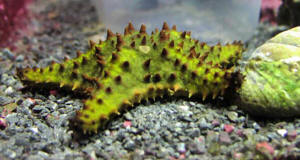
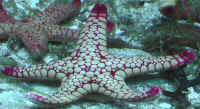
Echinaster sentus comp. w/ Scler.
5/12/16
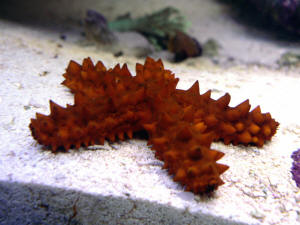
Question- Orange Knobby Starfish
4/15/12 baby
star fish, and Featherduster worms... missing, eaten?
7/10/11 Starfish and frogfish compatibility, using WWM -10/26/08 Hi, <Greetings> I have an African Knobbed Starfish (the large red and grey knobbly one), which I am keeping with a warty frogfish and some soft corals. I don't mind if it eats the coral, as they are younger bits that came from my main tank from larger corals that are doing well and reproducing lots and so can keep replacing them. <Mmmm, this species doesn't consume such> But I am worried the starfish may eat the frogfish as he is obviously quite slow moving and sits on rocks and/or the sandy bottom. <Nor Antennariiform fishes unless they're dead> We thought the starfish would be a good addition for the frogfish tank, as we are struggling to find something that is compatible with the frogfish as he eats anything! The frogfish's tank is a 1.5 foot <Too small...> long (but linked to the 5f foot main tank, to keep the water quality better), so we can't put big fish in there. So: 1. Do you think the starfish is likely to eat the frogfish? <No> 2. Do you have any suggestions of what could be put in with the frogfish and starfish (if safe). <See WWM re> 3. What are the best things to feed the starfish? I tried direct feeding some lance fish but it didn't eat it. Thanks, Cheryl <Ditto. Bob Fenner> Starfish and Grouper Compatibility – 03/13/08 Hi, I love your website and the effort you put in with helping people. I have a question, I have a 240 gallon tank with a Miniatus, vtail, and a saddleback grouper. I saw this beautiful orange starfish and was wondering if it was okay to put in tank. Will the groupers attack it? I have over 150lbs of rocks. My tank has been set up for a year. Thanks for your help? <Mmm, have never seen/witnessed an incident of a Serranid bothering, ingesting an asteroid. Bob Fenner>
Shrimp/Starfish Compatibility 02/14/2008 Hello WWM crew! <<Hello, Andrew today>> I had a question about compatibility between my starfish and a scarlet skunk cleaner shrimp. I actually have two starfish, a chocolate chip and also a red knobbed in my FOWLR tank. This morning, I couldn't find the cleaner shrimp. Using a long net, I (gently) lifted up both stars and sure enough my chocolate chip had him. The shrimp was whole (no bites anywhere) and the star had him in his grips but the shrimp was mangled by any means, it was just dead. I don't know if the shrimp simply died during the night and the star was passing by and came upon a free meal, or if the star actually killed him. <<These are quite good eaters really and will prey on slow moving inverts. It could be possible that the shrimp was injured and could not move, already dead or just caught un-awares>> I haven't been able to find anything about chocolate chips eating shrimp, but before I get another I just wanted to make sure I wouldn't be adding it in vain. <<Under normal circumstances, this is not an issue which would be common place with a cleaner shrimp in my opinion. The red knobbed starfish ( Protoreaster linckii ) is more likely to prey on inverts and corals and even other starfish as they get bigger>> I appreciate your thoughts. As always, thanks for the great information and help. Mike P. <<Thanks for the questions. A Nixon>> Bahama Star vs. Octopus 8/22/07 Hello, <Hi there> As a concerned aquarium keeper, I wanted to share an experience with you, so that it might be posted on your website and help others who do their research on your website. <Okay> I have been keeping a mid-sized Bahama Starfish, Oreaster Reticulatus for almost a year now, and he has been a valued member of my 75 gallons cleanup crew, until yesterday. I knew they were carnivorous, and inverted their stomachs so as to eat things in hard to reach places. Mine is about 7 inches across, so there aren't many cracks or crevices it can fit into. I had leaned on the side of caution, but unbelievably, still to this moment, my Bahama Star killed my Octopus filosus. <Yikes> I had only owned the octopus for 3 weeks, exactly, and I am completely heart-broken as the octopus was very active, and curious, and allowed me to hand feed her. Every time I fed her, however, I noticed the starfish, no matter where at in the tank, would very quickly appear climbing up the glass or rock or whatever surface the octopus was on, and try to climb on top of her as she ate. I always observed closely, for fear of the stars reputation, but the octopus always climbed or swam away to a "safe" place to eat its meal. Sometimes the octopus would climb around on the starfish, checking it out. I grew comfortable thinking there was no danger. Every day that I had come home from work, my octopus had come out of her den about 20-30 minutes later and perched on her favorite rock, or climbed up to the top front corner of the tank, where I fed her. Yesterday I waited, and waited, and no greeting. I assumed "maybe today is just a different day," and she was taking the day "off" so to speak. After hours of not seeing her, I decided something had to be wrong. I found the Bahama Star sitting near her den when I first looked for her, and it was still in the same spot, hours later. I raised it up, to discover my octopus, dead, with dead crab, wedged halfway underneath a rock. She had been trapped, and partially digested. Wanna know something neat? Bahama Stars make great Frisbees. <!> Just kidding. But I so wanted to use it as a dog chew toy. I was wondering if any of the crew at WWM had ever heard of such a thing happening? <I have not... Octopus are quite "smart" animals... and fast!> Sorry for the long drawn out detailed story. I had to set the mood. My octopus' name was Tuvalu, you can find video of her on YouTube if you search Octopus Filosus. She was quite the character. *cry* Dale Tyler PS - Bob, my Frogfish is still doing great! I think she is A. Multiocellatus though, not A. Commersoni, after much picture comparison of the lures. <Ahh! Thank you for this input, update... BobF>
Asterina eating a polyp 12/20/06 Hello Crew, <Hey Nick, JustinN with you today> Thanks for the awesome website! <Thanks for the kind words!> I was wondering if you could help me with a couple questions I couldn't find an answer to. <I can certainly try, can't I? *grin*> I have numerous little white starfish which I believe to be Asterina. <Likely so, very common> I have had them for well over a year with no problems. A few days ago I noticed that some of the polyps on one of my Zoanthid colonies were not looking very good, shriveled and discolored. Last night I looked at the colony and noticed one of the Asterina engulfing one of the polyps. <Scavenging, as they do...> Do you believe that this starfish was only eating the polyp because it was dead or dying? -or- Do you think it just attacked the polyp because it was hungry. (although I've never seen this happen for over a year since I've had the starfish population) <I think you answered your own question here *grin* You witnessed the degrading of the polyps before the incident happened, and as you stated, you are well over a year incident free. I personally believe these intriguing (and invariably free!) reef denizens have gained a bad rap in the Zoanthid fanatic circles. I've not seen anything beyond circumstantial at best information on this behavior from Asterina stars.> Worried, I peeled the starfish off and removed him from the tank. But now I wonder what would have happened if I had left him.... Do you think he just would have beneficially eaten the decaying part of the colony or would he have eaten the health polyps as well. <My thought is the former, not the latter.> So if I see this again should I just let the starfish do his work? <Yes, if you witness this again, I would just let it happen, is part of the biota balance.> One other quick question, I am giving some Chaetomorpha macroalgae to my brother for his refugium. I have a population of flatworms in my tank that I don't mind, but my brother might. I was curious if it would be ok to freshwater dip this algae to remove the worms.... I could just swish it in saltwater, but I'm afraid that it might not remove them all. <Why not just take the safety route and use both methods? Rinse in some saltwater first, then do a short freshwater dip before rerinsing in saltwater and bagging for your brother.> Thank you so much in advance for your help. Everyone have a happy Holiday! -Nick <Happy holidays to you and yours as well, Nick. Hope this helps you! -JustinN> Asterina Starfish compatibility 11/24/06 Hello, <Hello and a happy Thanksgiving to you, Rosemary! JustinN with you today.> I very much enjoyed reading the information you had posted on your web sight about Star Fishes. I am looking for information about a specific breed I did not see mentioned on your web sight. I was told it is called "Asterina Mini Star" I will email you the listing off eBay so you might see what they look like. <Mmm, not necessary, am very familiar with this species> I am interested in learning anything you know about this species. I especially wanted to know if they are coral safe? I currently have a pair of Erectus sea horses and a Bluestriped pipe fish in a 15 gallon tank. I wanted to make sure this is a peaceful type. According to the sellers listing this type is suppose to remain small so I thought it might be perfect for my tank. I would greatly appreciate to learn what you know about them. I would be extremely grateful for any help you could give me! Thank you so much for your time! Best Wishes Rosemary <While some people like to point fingers and blame Asterina stars for such things as polyps not extending, and of consuming Zoanthids, myself and many other reefers in my area have many of these in our tanks and have never seen any deleterious effects. These starfish have little to no affect on the overall bioload, and are excellent detritivores. The main reason that they seem to get accused of as much ill as they do, is because they do reproduce like weeds. If your tank is nutrient rich enough, they can grow to plague proportions, although it is typically easy to keep in check with manual extraction. Do you have any live rock in your aquarium? If so, you may already have some Asterina stars and not know it yet! Have a browse through our existing Asterina starfish FAQ's and decide for yourself if they sound right for you: http://www.wetwebmedia.com/asterinafaqs.htm Hope this helps you! -JustinN> Another "Good ol" Linckia question ... health, comp. 11/21/06 Hi Bob, Hope you don't mind being emailed directly, but I'm a bit desperate (and I do realize you must get a LOT of mail) <Mmm, some, some days> I have been reading your pages for years now, but have never actually asked a question before ( your FAQs are so comprehensive, I've always found what I'm looking for, thanks for the years of valuable passive assistance). However, I'm stuck this time and hope you can help. My Blue Linckia (WAIT!! ....please keep reading) <Heeeeee!> who I have had happy and healthy for about 2 and a half years now in a FOWLR 90 litre tank lost a leg last week after I added a Valentini Puffer, a Dragon Wrasse , and a turbo snail (yeah, I know.. I bought the Wrasse on a whim , with no research, just advice of LFS, stupid!), <A Novaculichthys will get too large for this volume... the Toby and it will easily pick the Linckia to bits...> a Domino also died with in 2 days, with a very minor abrasion on one side. The leg was quite mangled and half of it was in the bottom of the tank ( I suspect the puffer , but can't prove anything), I removed him and cleaned the leg up to a tidier cut just at the disc with a scalpel hoping he would grow it back, then put him back in. Then I noticed the puffer having a go at the "Manky bit" and don't know if it's because it is a tempting wound now , or if she was responsible in the first place. <Too likely this latter> So I upended a small 5 litre tank inside the main tank and put him in there with some live rock, because I was afraid she would not let him regenerate. <Not at all probable to happen...> He wandered around inside the little tank for about a week looking pretty good , but this morning I found him curled up and flaccid on the bottom, and another leg seems to be exuding the same white fibrous material from a new small wound that the original damaged leg had coming out of it, and the damaged limb is showing no sign of repairing itself, he looks in bad shape, staying rigid with few "feet" coming out or moving around, can't even feed him because he won't relax over the food , which disappears immediately to a fish . I was afraid he was starving in his small enclosure, so I have put him back in the main tank to "take his chances" with the puffer What should l I do, please help. can't bear to lose him? <... another tank...> My tank is something of a miracle anyway , since it has no skimmer , is only 90 litres with a basic trickle filter, but he has been so healthy for so many years , he obviously finds it ok, <Yes... much preferred to a too-sterile typical reef setting for this Asteroid> as does my clown . Pseudochromis bicolor and other anemones etc. <Other anemones?> The ammonia and nitrites are still nonexistent , PH is fine and so is salinity , only the temperature is varying by about 2 degrees daily at the moment as we are having a very hot spell ( any tips for cooling a tank?) <Posted on WWM> Thanks for the help in advance Cheers, Rama <This Linckia is very likely a goner... your "luck" with this sort of mixing is nearing an end. Bob Fenner> Knobbed Starfish Question 9/24/06 Hi guys <Hello> Hope everything is fine there! <Wonderful> I have a Red Knobbed Starfish - Protoreastor linckii (one of its feet’s are 1.5” in length). I think its kind of a small one. Last night he has consumed my Dancing Shrimp I think? Can they really do this? <Have been known to eat inverts, clams, corals and even other starfish the older they get> My dancing shrimp’s shell or the hard skin (whatever you call it) is just lying there. It’s like something sucked out its meat. <Sounds like the shrimp could have just shed his skin…I would look around for him> I only have 1 more dancing shrimp and the above mentioned Red Knobbed Star in my 80G with lots of live rocks (just to keep my nitrification cycle going until I add my fish). I really never thought starfish can consumer shrimps because the stars move pretty slowly compared to shrimps. Is there anyway I can stop this behavior? Is this particular starfish I have is a bad one for my tank (LFS told me it’s a good beginner star and it’s really hardy & peaceful)? Should I remove the other dancing shrimp? Will it consume slow moving fish such as blennies or clowns later when I add them to the tank? Will they eat feather dusters or bubble-tip anemone? Please help me I am lost and don’t know what to do. Thanks Akila < Akila – These starfish are definitely not reef safe and will eat feather dusters and anemones the older they get. The fish are generally safe with them. Although very beautiful, this particular specimen is not a good reef inhabitant. Cheers! – Dr. J> A few questions from someone new to anemones. Asteroid comp., BTA sel., Anemone incomp. 9/5/06 Hello guys! <And gals...> I love the website and have gained a lot of information from it. <Good> I've kept a 30 gallon marine tank for about a year now. About a month ago I purchased an 80 gallon tank to replace it and I plan on turning the 30 gallon into a refugium and plumbing the two together for obvious benefits :-)). <Great!> My current tank currently has: 1 Yellow Tang 1 Blue Damsel 1 Yellow Damsel who can be aggressive) 1 Velvet Damsel 1 Tomato Clown (I hope will host in the Anemone) 2 Fire Shrimps 1 Chocolate Starfish 1 Sandsifting Starfish And a few blue and red legged crabs and some turbo snails as well. <All this a thirty?> Live sand bed and about 30 lbs of live rock. (which were originally all in my 30 gallon, hence the upgrade to a larger tank) As for the setup itself I currently have: An emperor 400 w/BioWheel A Magnum 350 Canister filter A 40w single strip light. Question #1- I've been thinking about getting a bubble tip anemone. But I've heard that starfish/anemones are not a good match. Is this true? <Mmm, this is not a major issue... incompatibility twixt these groups> I've read that anemones will eat starfish and that starfish will eat anemones, <A few species are notably predaceous... most ignore each other... including the ones you list> but haven't found any definitive information on either of the two species that I have and the anemone that I'm getting. <Now you have...> Question#2- Is there anything else I should think about purchasing before I go out and buy a bubble tip anemone. the waste of 35 bucks doesn't concern me, it's the pointless killing of an animal by a novice) <Yes... please read here: http://www.wetwebmedia.com/btaselfaqs.htm re BTA Sel.> Question #3- If I'm running a refugium, is there any need for me to purchase a protein skimmer, <Yes> my nitrates are barely measurable (approximately .5 ppm when I change water) and ammonia and nitrite have been zero for almost as long as the tank has been set up. Ph and Alkalinity are normal and haven't fluctuated to a noticeable degree yet. I've decided on the bubble tip because in my research I've found that they are one of the easiest to keep, and also are known to host tomato clowns. Also, is there any reason why I shouldn't mix a sebae and a bubble tip anemone in this tank? <All sorts... please read on WWM re Anemone incomp...> I've read about anemones having "chemical warfare" on corals. But from my understanding of it, anemones and corals are mostly the same accept mobility in anemones. <Not so> I'm just trying to make sure that when I buy a bubble tip anemone that I don't end up feeding it to something in my tank, or something in my tank to it. Thanks for all your input and keep up the good work. Paul Kotlarz <Keep reading. Bob Fenner> Red general starfish comp. 8/12/06 Hi Bob, I have a tank that currently contains a snowflake eel, a volitans lion and two purple urchins. It will also have a Sargassum frogfish as soon as he finishes his stint in the quarantine tank. <A very interesting aquarium species> I'm considering adding a red general starfish, and probably moving the urchins to my other tank. I've read that a red general will sometimes eat slow or sleeping fish. <Rare...> Would it pose a substantial threat to the eel, the lion or the frogfish? Thanks. --Ahren Ceisel <I don't think so. The Angler will "hang out" in some surface/upper area (best for you to provide camouflage "weed-like" material for it), and the Lion and Eel are very aware of what does on near the bottom. I think they will all go together fine... as long as there is room enough. Bob Fenner> Sand Sifting and Orange General Starfish??? Star Problems, Predation 7/27/06 Hello and thanks for taking the time to read and answer my question. <Sure> I have both a sand sifter and an orange general starfish. <Protoreaster lincki?> I've had the sand sifter for about a month and just got the orange general a couple of days ago. Well here's the deal, I went into look at my tank this morning and noticed that my orange general starfish was in the process of eating my sand sifter. <Several species go by this common name, and for some this is not an uncommon behavior.> I know it was too late for the sand star because I could see half of it was already digested and the general was working on the other half. Keep this in mind that earlier that night the sand sifter was perfectly fine. I have FOWLR tank with a porcupine puffer, niger trigger, & maroon clown. <I would guess at some point either the puffer or trigger should have decided to snack on the star anyways.> Water Levels are all ok. I was wondering if this is normal for a general star to do. <Need a scientific name to be sure, but seems likely.> I knew this star wasn’t reef safe and thought that it be ok in my tank. Will it try and eat my fish? <Depends on the size of the fish, but I would bet that the problem will be the other way around.> Sorry if this is a stupid question, but my LFS is pretty reliable on the info he gives me, at least I thought he was, and he said this star would be ok in a fish only tank. <Not a fish only tank if there is another star in there, either way those sharp teeth the puffer and trigger have are there for a purpose, and will most likely make short work of any stars in the future.> Just hoping to get a better understanding of the situation. Thank you for your time and effort, James <Anytime> <Chris> Re: Sand Sifting and Orange General Starfish??? Star Problems, Aggressive tank 7/30/06 Hello again Chris and the Crew, <Hello> Thanks Again for answering my question. <Sure> As far as the Orange General Star goes, I do believe the scientific name is Protoreaster lincki. <Definitely some evidence that it is a potentially carnivorous species.> Sorry I didn't have it before. <No problem.> The fish I have not messed with the star fish so far, but the puffer likes to mess with my snails. This is my 1st aggressive tank, so I was wondering if you have any other recommendations a far as clean up goes for a Porcupine puffer, niger trigger, and maroon clown. <The cleanup crew in mostly going to be you, as most snails, crabs, and shrimp will be lunch for the niger and puffer. May be able to use burrowing snails but even this is doubtful.> Thanks Again, James <Chris> Read...Read...Read... Tridacnids, Seastars...and Lack of Research 07/04/06 Hi I have a few questions I hope you can answer <Okay.> I have ordered a Tridacna crocea how much light do they need <You should not have ordered such a delicate, and specific animals without first researching this...the fact that you have ordered it without being aware of its photosynthetic needs.. is VERY troubling to me...> I have a 45gal HEX with a 175watt halogen pendent light <The animal should be in the rock-work high in the tank.> What other supplements do they need just Phytoplankton & light? <General Tridacnid care is posted on WWM.> The light is 10" from the surface I was going to place the clam 8" down from the surface Do I need to add strontium and iodine and trace elements also ? <...Posted on WWM...you need to start reading my friend and researching.> I also ordered a Red Knob Sea Star (Asteroides sp.) South America are they compatible with the Tridacna crocea ? <Not at all!> I didn't realize they are Carnivores thought they were Omnivores Some people say there reef safe <Hardly.> some say they are not all I have are shrimps , crabs, snails & <All at risk!> Fridmani Pseudochromis If it is compatible what do I feed it and how .. <Also posted on WWM, also a question that should have been researched/asked BEFORE purchase!> Thanks a lot <Adam J.> Star(fish) Wars 6/30/06 HI: <Hi> I live in Florida and I bought at first a greenish brittle star which have not given me any problems. <Often predatory> I also have 3 sand sifting stars. I have a 180 gal. tank. Then I saw this brittle star that its orange, and then the disk on top is orange and it has spots like a cheetah or something like that. I had not turn on the lights of the tanks the last 3 days, but sun light comes in through the window. The problem is that this morning I caught the orange brittle star eating one of my sand sifting stars, well I don't know how long it was eating it because it had one of its legs completely inside the mouth, but I separated it from the brittle star and the leg was complete, although a bit stiff, so the sand sifting star left and immediately I fed the brittle star some pellets. I could not believe that one star was eating another one. The day that I bought the orange brittle star I fed it a dead small feeder that I had with my other live feeders and it ate it quick. <Wouldn't use feeders, causes digestive problems and can transmit disease.> Could you help? I don't know if I should return the star or not. <I would.> I like it because it adds color to the tank but if its going to eat my other stars, I don't know what to do. Help please thanks. <While most stars are not predatory, this one seems to be. Hard to tell you what type it is but its actions seem to indicate a carnivorous tendency.> <Chris> Star(fish) Wars Part II 6/30/06 Thank you very much. <Sure> I'll return it. <Good move.> Now my sand sifting star is losing her leg. <Watch closely for infection.> Well the orange brittle star is kind of handicap anyways, but I guess I'll return it because I am not going to jeopardize the other stars. <Can't change their nature unfortunately.> If I could send you a picture I would but my mother in law has the camera for her vacation. Any who, thank you so much for your advice and I guess I'll return it. Thanks. <Sure> <Chris> Star(fish) Wars Part III 7/03/06 So after my orange brittle star tried to eat one of my sand sifting stars, I told the aquarium shop if I could return it because it was being aggressive, they said I could but I would get no money or store credit for it. <That’s unfortunate.> It sucks so I decided to keep it. Since I have two other brittle stars, a greenish, an orange (the aggressive), and a black-reddish one. Well after that I noticed that my diamond watchman goby was not around, he would always come out of his cave for hours to eat, then yesterday I didn't notice him at all. I had my fiancé? move rocks today and try to find it and when he was checking the wet and dry, long and behold my beloved watchman goby was dry and toasty as a French fry under my dining room table which is next to the tank. I am just wondering why would he jump out of the tank. <Perhaps startled by something, running from something, water quality, and sometimes its just a mystery.> I did noticed when I was buying him at the aquarium shop that while the guy was trying to catch him with the net it seemed that he was going to jump out of the tank, he was swimming that fast and up towards the surface, so I am just wondering if it was that perhaps the brittle star tried to eat him or something and to escape, he jumped. <Possible, they are know as a bit of a jumper anyways.> I was so sad, it was a great addition to my 180 tank, it had character and really kept my sand super white, along with my sand sifting stars and yellow headed goby. Would you provide with some light here? I need to know if my thought is correct. He was like two inches and I thought that I was going to keep him for a long time. <There are many reasons why fish jump, escaping a predator is just one potential reason, hard to say with any confidence what happened.> <Chris> Starfish compatibility, and sel. 6/14/06 Dear Bob, <Hi, Chris with you tonight.> Is it possible to keep a blue starfish and a white sand sifting starfish with a redstar fish Fromia elegans which has black tips on the end of its arms and its arms are very dumpy and short. will these 3 starfishes get on well with each other and does the red starfish Fromia elegans eat mushroom corals? <No> I hope to get a reply from you soon. YOURS SINCERELY ALAN R. <Both the Blue Linckia star and sand sifting star have terrible survival records in captivity. No one really seems sure what the Linckias actually eat, and most die of starvation within a year. Sand sifters need very large tank to support themselves. Often it is recommended that there be 6 feet of tank space to support a single star, although I'm not completely convinced this is even always enough. Out of the three stars you name only the Fromia Elegans has a good track record in aquariums, but does require some supplemental feeding.> <Chris> Starfish/Reef Compatibility 4/28/06 Hello Crew - got another question: <Shoot> I have a red sea star who engulfs/feeds on my colony yellow and star polyps. It was doing this even when there is abundant algae that it normally eats. I thought this star fish is reef safe (according to LiveAquaria.com). <"red sea star"? That is like asking if anyone saw a brown dog. Please be specific in species name as there are many red sea stars with different feeding habits.> What and how do I spot feed it or take it out? I tried Nori seaweed but it let it go. <Anthony, please send us the species name so we have something to go on.> Thanks, <You're welcome. James (Salty Dog)> Anthony Bahama starfish, English nightmare 4/23/06 love the web site. very cool. My question is, I have a 125 gal tank been running for about 4 months. I don't have any coral yet but plan on it soon. I do have a blenny, a Firefish, Sixline rass, and 2 jaw heads. And of course small crabs . I have a Bahama star in another tank and was wondering if it can be put in this tank with these fish and soon to be corals. <Uhh... not likely... please take a read over on WWM re each of these species Compatibility, Systems, Feeding... and Disease. Bob Fenner> Red Knob Sea Star / African Sea Star 4/9/06 Hello, <Hi there> Great site! <Thanks> I am interested in getting a Red Knob Sea Star / African Sea Star / Red General Star...are these all the same star? <Both names are applied to a few animals, mostly Protoreastor lincki> Can I have shrimp and crabs with this star? <Yes... as long as they themselves are compatible... this Seastar will consume other sedentary, sessile invertebrates> Can I have a red Coris wrasse with this star? <Should be able to> Thanks a lot! This star is the best looking star I have seen so far. <Are gorgeous animals... for larger, stable/established marine systems. Bob Fenner> Twinkle, Twinkle Little Star……….Please Don’t Eat Me!!! 3/30/06 I have a 7"+ Chocolate star and a 3"+ Bahama star and once in awhile I'll catch the Bahama trying to get on top of the Chocolate. <They are quite cannibalistic at times.> I know that these types can be cannibals <Yup.> (my choc has eaten a Sand Sifting star and a Serpent star). <Quite common actually.> The Chocolate is twice the size of the Bahama but he's always been running from the Bahama (Choc is faster) since I put him in there. <Time to remove one or the other.> Plus I know the Bahama get 20"+ in the wild, but how big can he get in a tank <Can reach his potential size in appropriate conditions.> and how long does that take? <Depends on individual, metabolism and eating habits are factors.> Should I give back the Bahama to the LPS <…or the C.C., your choice.> or just watch them and hope for the best? <I would not do that.> There in a 200gal 7'Lx2'x2'. My other is a 90gal reef, I can't trust them in there. <You certainly can’t.> Thanks Matt Owens <Anytime Matt, Adam J.> Red Seastar and Anemone Compatibility 3/17/06 Thank you for your awesome website, I am on here almost every day.... I do have a question for you... When I looked in my aquarium yesterday, I noticed that my Red Seastar was on my Sebae Anemone. Today the Seastar is sitting at the top of the tank all curled up. Are these two compatible with each other? Thanks for your time, Steve K. <<Without knowing the exact kind of sea star, it is impossible to guess about the Compatibility, however it is most likely that the interaction between the two was just accidental and not really harmful to either one. However, there are some predatory sea stars, so I would observe it carefully. Best Regards. AdamC.>> Hardy Starfish/Star-Polyps - 02/14/06 Hello Mr. Fenner and the WWM Crew, <<Crew member EricR here today.>> I just finished The Conscientious Marine Aquarist and enjoyed it immensely. I'll try and keep this short. I currently have a 150 gallon tank with a 30 gallon sump, Berlin protein skimmer, 150 lbs live rock and coral skeleton with a 3" deep sand bed. Lighting consists of 2- 48" Coralife fixtures. <<Wattage? 40w? 110w?>> Plans are in the works for a 55 gallon sump and refugium combination. <<Excellent...much to benefit from...>> Tank species consist of: Regal Tang, Yellow Hawaiian Tang, 2 Clarkii Clowns, Flame Angel, Sailfin Blenny, and an assorted clean up crew. My wife would like to add a few starfishes and star polyps to the tank. Could you please give us some suitable candidates? Thank you for your time, Mark Gallan Monroe, Michigan <<Well Mark, the fact you wish to add sessile invertebrates restricts your sea star selection. Have a look at the genus Fromia for some attractive and suitable choices, and avoid those from the genus Linckia. Though the latter is considered "reef safe", they suffer from a dismal survival rate in captivity. As for the star-polyps, Pachyclavularia violacea or Briareum violacea are quite hardy...sometimes to the point of being invasive. For best color/vigor/health you may need to add more lighting to your existing setup. Regards, EricR >> Sea Star Compatibility 9/30/05 I am pretty sure that the purple starfish I have is a Tamaria stria. The starfish has been in the tank for four months and explored everything. In the last two weeks I've noticed the Mushroom coral thinning out. Then I realized the starfish at least once a day lately "hugging" the rock with the coral. When he moves away there is a dark purple, mangled, and stringy mass where there once was a coral. I do not believe the star is eating dead or dying coral. All parameters are good and the other corals, star polyp, candy, leather, and colt are all growing well. The mushroom were growing well also. The information I've found here and other places is that this star eats an algae film. Is he indeed eating the coral? > your description it sounds as if he is consuming them, though I have never observed this behavior. At the least it sounds like the Seastar is damaging the coral.> Does this mean the star is NOT who I believe him to be (Tamaria stria)? <Impossible to say without a photo. There are always exceptions.> Is there anything I can do to stop this? <Removal of the star is the only sure way.> Will he move on to the other coral (I can accept the loss of the mushroom in exchange for keeping the star, I like it but not other coral)? <Impossible to say, I would continue to observe.> Why the four months of peace and tranquility and now coral carnage? <Is it possible you are not meeting its dietary needs?.> Thank you, Sean Rork <Adam J.> Clown vs. Seastar 9/22/05 Mr. Fenner, some advice please? Would a clownfish attack/kill a sea star? I have one orange clownfish in an 80 gal tank * I introduced a blue Seastar, which died sometime within 48 hours. When I noticed it was dead, it had been chewed on by the clown. Before I put anything else in there, is there any chance the clown fish is responsible for the sea star's demise? What other creatures are a good match for this clownfish? Thanks in advance for your help. <Natural reaction for the clown as some stars do dine on their eggs in the wild. But we can't discount the fact that the star may have died first. Drip acclimation is almost a must when introducing Seastars as they are very sensitive to changes in water parameters.> James (Salty Dog)> Seastars live alone or in a group? 9/21/05 <Adam J responding.> Could you please tell me if sea stars live alone or in groups? <Sometimes they are found relatively close to each other, but often they are solitary, some should only be kept alone due to cannibalistic behavior. Also it is rare that a single system can provide for a group Seastars.> What challenges do sea stars have to deal with? <They range from “very-hardy” to “should be left in the ocean” No Seastar should be added to a new tank and they all are very sensitive to changes in water chemistry and should be acclimated to new environments very carefully, look into the WWM FAQ’s for more detail.> Thank you, Sammie <You are very welcome, Adam J> Dead starfish 8/25/05 I'm baffled... please help! I have
a 55 gallon tank that has been running successfully for almost two
years. In the last two months I have lost four starfish. They will be
thriving for a month or more, and then I'll get up one morning and
turn on the aquarium light, just to discover one has been totally
ripped apart. I gave away my hermit crab a month ago after a very large
blue starfish was torn apart. We thought he was the culprit. All that I
have in my tank now is: a Longnose Hawkfish, a Wrasse. 3 Pajama
Cardinals, Foxface, Neon Damsel, Flame Scallop, Sea Cucumber, small Red
Starfish and a Horseshoe Crab. Anybody have any idea as to what is
ripping apart my starfish? Please help! <Mmm, could be the wrasse
(what species?), the Horseshoe Crab... and lastly the Cuke... or a
"hidden" crustacean of some sort. Bob Fenner> Tiny stars 8/11/05 Hello WWM crew, I've got a bit of a starfish problem developing. There are dozens upon dozens of tiny starfish emerging from my live rock; at first, I thought they were bristleworms and I left them alone...but now a few of them creep out of the live rock from time to time. I have a yellow tang, percula clown, green reef Chromis, coral-banded shrimp, Serpentstar and brittle star, an emerald crab, urchin, and some hermits (in a 90G tank); how might I eliminate this potential starfish problem? Any advice would be greatly appreciated! Thanks, Darryl <Mmm, likely not a problem... please read here: http://www.wetwebmedia.com/asterinafaqs.htm Bob Fenner> Can Chocolate Chip Starfish be cannibals? Yep Thank you for everything you do for us hobbyists. Many of our aquatic friends would never have made it if it wasn't for your advice. My question today is in regards to my Chocolate Chip Star Fish. I have a 44 gallon tank that's been set up for about a year. Up until yesterday I had 2 chocolate chip starfish, 2 percula clownfish, and a cleaner shrimp. My wife and I fondly call our Stars, Chip and X. X being a 4 legged starfish. I cannot find Chip anywhere. I have looked everywhere I know and cannot find him. Both starfish were of about equal size and I have had them for a little over a year. I noticed last night that X was sitting on top of what looked to be white coral sand, but I don't have any coral sand, just live sand. The Substrate is nowhere near the size of these pieces. Could it be Chips exoskeleton? <Yes> Could X be a cannibal? <Possibly> I guess I'm trying to figure out if it's safe for my other habitants to keep X in the tank. All my levels are perfect, and Chip looked healthy the other day. Please write back, thanks Shawn Johnson <You can search on the Net re this Asteroid's propensity for eating other sessile invertebrates... Does happen. Bob Fenner> Hungry Stars (2/21/05) I just had a question as to what to do about my snail population. I have 4 chocolate chip starfish. <How big is your tank? Over 100G, I hope.> I never had a problem with feeding them. I guess they mostly ate the algae or whatever in the tank. <They cannot survive without being fed.> Lately they have been on a feeding binge. <That is to be expected. These carnivorous stars have big appetites and grow to 8+ inches in diameter.> One starfish ate my anemone right through the bottom of it. I had about 25 turbo snails in the tank and I might have about 5 left. <They'll eat pretty much any sessile (non-motile) or slow-moving animal they can.> They each eat one snail a day. Usually not the small ones but the big ones are eaten. What can I do? <Feed them or take them back. They are not reef-safe, BTW. They love to eat soft corals.> I don't know what to feed them. <Chunks of marine origin meats such as raw fish flesh, shrimp, mussels, squid, scallops or octopus, all of which can be purchased at the seafood counter of the local market. I get mine as a "gumbo mix" at Albertson's for about $3 per lb.> Its not that easy to feed them the frozen krill <Why not?> and even then, I think they prefer the snails. <Even if you feed them, they may eat your snails. I have no other invertebrates in my carnivorous star tank. I only have fish that leave stars alone and that are left alone by stars.> Please help. <There are two ways to feed them. Use a pair of plastic grabbers (See here for example: http://www.marinedepot.com/md_viewItem.asp?idproduct=HG11012 ) to place meaty food next to or under stars on the bottom. I often grab my stars, put the meat over their mouths and gently press them to the front glass. They will stick to the glass and eat--kind of cool to watch as they evert their stomachs around the food.> Thanks, Jen <Hope this helps, Steve Allen.> Puffers and starfish I recently purchased a sand sifting starfish without realizing that they are not compatible with puffers. I have a saddleback and was curious why these would be problematic to each other. I do realize that they will nip at other fish and invertebrates but did not think the sand sifter was in its fooooood chain. <Jose, most invertebrates are not safe with puffers. It's not worth taking the chance. James (Salty Dog)> Tamaria stria Questions (11/21/04) Hi, <Hi. Steve Allen tonight.> We have a purple Linckia (Tamaria stria) that we really, really enjoy! <Good for you. They can be difficulty to establish and maintain. Of course, the common reference to them as Linckias is incorrect because they are not of the genus Linckia.> We're moving him, several fish and corals to a new 200 gallon tank. The new tank will have a 5" deep sandbed. <Great.> We are thinking about purchasing a red serpent star. However, we want to make sure it will be compatible with the other starfish, corals and reef fish. I've read that some brittle stars sometimes eat small fish and possibly soft corals. <The green ones, Ophiarachna incrassata, eat fishes. As to whether any Brittlestars eat corals, there is little evidence that they eat healthy ones. Should be no worries with others, though no guarantees.> Don't want to take any chances, but if the Red Serpent is safe it might benefit the sandbed (and be interesting). <Consider also Nassarius snails, great sandbed cleaners that burrow and cruise under the surface like sand submarines.> We are also curious if orange or blue Linckias or another purple Tamaria would work (we know we have to limit the number so they won't starve - so we were trying to decide on only one more to add). <The mortality rate of genus Linckia between collection and tank is at least 95%. The vast majority of the ones at the store are already dying of being mishandled between collection and the store. They must be acclimated over a few hours by drip mechanism if you are to have any success. You should pick one that has no blemishes or any evidence of ill health. Personally, I (and others of the crew) recommend genus Fromia as much more hardy.> Also, how many Nassarius (and what other snails) would you recommend for a DSB in a 200? <I should have read all the way to the end before answering. I'd say there's not a set amount. Get 10 or 12 and see what they, in combination with the Brittlestars, accomplish. You an add more later if needed.> Thanks in advance! Doug <Hope this helps.> Who Ate My Star? (10/21/04) Greetings! <Hi. Steve Allen with you tonight.> First time question asker here. I have a thirty seven gallon hex with a lot of live rock, no corals, cleaner shrimp, fire shrimp, camelback shrimp, tank raised clown, Midas blenny, several small cleaner crabs and snails, and a Halloween hermit crab. Water parameters were good right before I added a red serpent star. The first day it was fine and moving around, eating well. The end of the second day I found him with one leg torn off at the joint, and two others clipped. <Probably something tore them off, but could be "melting" if you did not take a couple of hours to acclimate it when you put it in. Echinoderms are very sensitive to changes in salinity and pH when being moved.> The only thing I could imagine doing that much damage was the Halloween crab, which I immediately moved to my other tank. <Could be. Wise to move.> Do you think the crab was the culprit, or could it possibly be one of the shrimp? <Extremely unlikely.> I can't imagine the shrimp being strong or aggressive enough to do that. <Nothing to grab that firmly with either.> Second part of the question is the starfish has a good size hole in it's disc where the leg was removed and it seems to have gotten bigger. You can actually see his insides that look like a brown ball of worms. <Not likely to survive.> He was eating today, which I took to be a good sign. Watching him it appears he is using his other legs to pull skin away from the wound. Do you think he will survive, or is it hopeless? <Not entirely. If the hole keeps getting bigger, then it I surely doomed. Keep water conditions best possible. Consider removal to a quarantine tank to treat with broad-spectrum antibiotic--infection will be the killer.> Do you think it was the Hermit Crab? <Impossible to say. Key question--how did you acclimate the star to your tank.> Thank you <Hope this helps.> Another Chocolate Chip Star Question (10/21/04) Hello! <Hi. Steve Allen with you tonight.> I hope you can answer a question for me, I have recently bought a chocolate chip starfish which is doing great, but I would like to buy a large Featherduster. I am wondering if the starfish is going to end up with a late night snack? <I would be worried about this. Stars feed by everting their stomachs onto their prey and pre-digesting it outside of their bodies. I'd bet it can get its stomach down into the tube.> Does it matter at all that I feed the starfish well (clams, shrimp) a couple of times a week? <They are opportunistic eating machines--definitely a risky proposition.> Thanks for any info! Barb <Hope this helps.> Gobies, horseshoe crabs and Seastars Bob, please help. I had an orange-spotted goby (sand sifter) and decided to add a small horseshoe crab to assist the goby by burrowing deeper into my sandy substrate (2"-3" deep). Within days, the horseshoe crab ate the goby at night. <Yes> I've removed the crab and am replacing the goby. Would a Seastar (Archaster typicus) be a welcome addition to the goby? Or will it also feast on the goby? My tank is 39 gallons. Thanks for your help. Patty <Archaster will not eat fishes... they do consume small slow motile invertebrates however that live in the sand. Bob Fenner> Which Stars Eat Fish? (9/10/04) Will a sand sifting star fish eat fish? <Only dead ones on the bottom.> I had a brittle star eat m Naso tang! <Are you sure of this? Only a very large Ophiarachna incrassata might be able to do this, and only to a Naso of less than 3" or so. OTOH, any Brittlestar (and many other scavengers) will munch on a fish that died of other causes.> I got rid of it but I have a sand sifter. Any chance he will eat my fish? <I'd say virtually zero.> Also my clam died last night. <Sorry to hear.> It was a Crocea, He was fine but then he got pale and then shrank down in the shell and the shell stayed open with him withered inside.:( <Any theories as to why? I'd check all water parameters and review the needs of this species (temp, lighting, pH, SG, etc) to see if something was off. Steve Allen.> Do Amphipods Eat Seastars? (6/8/04) Hi Guys and Gals, <Steve Allen today> I was wondering if you had ever come across a case of amphipods attacking a starfish? <I have neither heard nor read of such, but one never knows for sure.> I have a Fromia sp starfish (milleporella I think) which has been in my reef tank for about 6 weeks, and seems to have been fine until a couple of days ago. Then, over the last two days, the ends of three of its legs have become injured, with the red skin removed and the inside of the legs showing... yuck! I moved the starfish to the refugium just in case it was being attacked by a hermit crab or something, but when I checked on it after an hour or so there was an amphipod at the end of each injured leg, clearly eating it alive. Do you think that the amphipods in the main tank could have been responsible for causing the injuries in the first place? Or are they just being opportunistic and feeding on the already injured starfish? <This latter explanation is far more likely. I highly doubt that amphipods could break through the thick skin of an echinoderm, but ones it's broken down by something else, they'll definitely go for the free lunch.> My tank has been running fishless for the last 4 weeks due to an outbreak of ich, and during that time the 'pod population has exploded. I have moved the starfish into my saltwater mixing container, which is heated and aerated but has no filtration. <consider an inexpensive sponge filter.> (The QT is out of the question as it is currently housing my fish and no doubt still has traces of copper medication). Do you have any further advice on how to treat its injuries / give it the best chance of recovery? <Clean, pure water is your best bet. If deterioration persists or spreads, you might consider adding an antibiotic.> Water parameters are all good - Ammonia 0, Nitrite 0, Nitrate 0 - 2ppm, Temp 27 - 28C (summer has finally arrived here in the UK) <Hope it doesn't get too hot. I'm sure you won't enjoy breaking 100F again.> , SG 1.024. <Excellent, this is just what it needs. pH? Keep this and salinity very stable.> Thanks for your help! - Rob <I certainly hope your Fromia recovers. Keeping it away from things that will eat its exposed flesh before it gets a chance to heal will help greatly.> Fromia milleporella (5/2/04) I recently purchased a starfish I am pretty sure is Fromia milleporella. <A beautiful and fairly hardy star.> I am really worried that it may prey on the soft corals I have in the same 12 gallon NanoCube (Ricordea floridae, Zoanthus sp., Actinodiscus sp., Clavularia sp.) My LFS assured me it was reef safe but I had to identify the species myself, so I'm not sure I really trust them. <Truth be told, you can never be 100% certain of hat will or not sample what in an aquarium. That said, Fromia are not know to eat corals and you will almost certainly not have problems.> I read here that they eat mostly detritus, do I need to feed it supplementally (which foods?) and do I need to worry about my corals and coralline algae? <Most Fromia can fend for themselves, but it might be a good idea to do some target-feeding with small chunks of meaty food (e.g. shrimp) placed in its path once or twice a week.> I also have several unidentified sessile bivalves growing on my live rock, as well as three or four different species of Fanworms, should i worry about those as well? <No> I usually don't purchase anything before I research it carefully, but I was pressured by my ex-girlfriend because it looked so "cute." <Was that before she became an "ex?"> Thanks in advance, Drew Holm <Hope this helps, Steve Allen.> -Reef safe star?- My one friend recently (About 2 hours ago) brought me back some starfish, sponges, anemones, 2 strange polyp thingies, 2 dogfish, 1 goby looking fish and 2 little silver fish with white and black stripes on their tails from the coast (I live in South Africa, he brought them back from the east coast which is the Indian ocean). <Oh, interesting.> I'm worried about the starfish, they always seem to want to cling to the sponges and the polyp thingies, they are about 1cm in diameter and are a dark bluish to a purple-black colour. Do u know what kind of starfish these are and if they'll eat the corals or do they just like clinging to them? <Hmmm, they don't seem to ring any bells in my head, but it sounds like they may be predatory. Just watch for any missing tissue on the sponge and polyps.> Might u also know what the little silver fishies are and the polyp thingies are. The polyps thingies are in a purple tube and when the tubes open a metallic green center with tentacles around the edge and a very small tube in the middle of it all. <Sounds like green star polyps (Pachyclavularia sp.). Would need pictures for the fish id.> I've got an entire family of Metallic green and Blue Mushrooms in my tank and if the starfish pose any threat to my colony I'll be happy to give them to the local aquarium and if possible send them back to the ocean. If pictures will help I may be able to take a few and scan them in. <Pictures of the stars and fish would help for an ID. I'd just keep an eye on the stars, if they were going to do any damage, they'd be doing it now and it should be noticeable. Man, I wish I could just go to the ocean and come back w/ star polyps!!! Hope this helps, Kevin> Thanks, Steve Reef-Safe Star? ... or Not! (4/27/04) Hi everyone. <Steve Allen here. For future reference, please capitalize the first word of sentences and the proper noun "I." We post all queries and replies on our site permanently an want them as readable as possible. Our volunteer crew will have a lot more time to answer queries if they don't have to proofread them. Thanks.> Please can you help me I have bought this starfish and was told it was a golden nugget. The LFS could not tell me the full name but said it was reef friendly. <Totally incorrect!> I have placed it in my quarantine tank but wish to place it in my reef (if possible) <not> What family of star is it? And is it safe to go in my reef or should I place it in fish only tank? The photo is quite bad I am afraid but it is light beige with dark brown patterns and very slightly raised orange bumps which almost look flat. I hope you can help me thanks Laina <Although faded for some reason, the picture is adequate for advising you. This is a large omnivorous star, most likely of the genus Pentaceraster or a very similar genus. Quite lovely and interesting to be sure. I have one myself. I keep it in a 180 G FOWLR and hand feed it chunks of meaty marine (shrimp, squid, etc) food 3-4 times per week. They are voracious in appetite and would very much enjoy eating your corals. They an grow to as large as 12-15 inches in diameter. Mine is about 8 right now. Again, keep it in a large FOWLR tank--this star is most certainly not reef safe.> Mushroom Eaters? (3/29/04) Dear Crew: <Steve Allen tonight> My 80 gal. reef tank is full of green mushroom anemones. I started with just one polyp on a piece of live rock and now have thousands. I would like to kill off most of them. The local fish store suggested the following: Purchase a "General Star." Take a mushroom encrusted rock from my main tank and put it in my 55 gal quarantine tank. Put the sea star in the 55 gal tank. They say it will demolish the anemones. <Probably.> Remove the rock when it is cleaned off, put it back in the main tank and repeat with the other encrusted rocks until the anemones are down to a manageable level. <And will the buy the star (Protoreastor linckia) when the mushrooms are all eaten? You have to have somewhere for it to go after the job is done.> In addition to the anemones, I have a variety of hard coral and pulsing xenia in my big tank so I would be afraid to let this sea star lose in there. <Be very afraid. The carnage from this voracious eater would be devastating indeed. They're lovely and interesting, though. I have one in my 180G FOWLR and hand feed it.> Using the 55 gal tank would give me a controlled setting and would not destroy the other organisms that live in the rock. <Well, it will eat everything on the rock you put into the QT. Is this sea star a true mushroom anemone lawnmower, and do you think this plan will work? <No guarantees, but it should eat just about anything. However, manually prying the mushrooms off might be a better, quicker option. If you want to do so, wear gloves.> Thank you. <Hope this helps.> -Puffer checks to see of those are actual chocolate chips...- My dog-faced puffer recently attacked two chocolate chip starfish. They have numerous bite wounds, are lethargic, and not eating. Is there anything I can do for them? <Besides finding another home for the puffer? I would just leave them be, try feeding them in a few days, keep the water parameters in check, and hopefully they'll regenerate the lost body mass. Good luck! -Kevin> Shrimp and starfish Does a red shrimp and a pink and brown basket starfish get along the shrimp keeps going up to the starfish and picking at it and I am not sure if it is hurting him or not. Thank you.<I couldn't tell you from the info you have gave me here, what are their scientific names for stars. There are some shrimp that eat starfish so it is a possibility that the shrimp is causing damage. You can find tons of info at our site: www.wetwebmedia.com. Cody> Jessie Starfish Eating Shells 2 (1/25/04) My tank is only a ten gallon, so it's pretty easy to keep track of the different things in there, which is how I could tell he swallowed one of the shells. Amazingly, he seems to be perfectly normal now! <Glad to hear it.> Thank you for your quick response! Sincerely, LeeAnne Strohmann <I hope all remains well, Steve Allen> Starfish-Eating Anemone (1/22/04) Howdy crew, <Steve Allen today> Have you ever heard of a Bubble Tip Anemone eating a Linckia starfish? <Can happen> I just assumed that a starfish would touch part of the anemone and then pull away. I guess it is possible that one could "fall" into it, then it would be history. So anyways, I go to feed my fish and I notice something orange in my Green BTA. Weird, the body is not that color....sure enough, it was the starfish! He only had a leg or two sticking out, the rest was in his mouth. Don't know how long he had been in there. I tried blowing water at the BTA with my trusty turkey baster so that I could be a better look, but no help, I couldn't see anything. About 15 minutes later, I see him sticking out again, more so than when I first noticed him in there. It looked like the BTA was spitting him out. So I reached in and pulled it out, but alas, he was dead. I didn't think the BTA could eat something that big. <You'd be surprised.> The BTA is about 10" - 12" across, but the starfish was about 5". I certainly don't want that to happen again, so I am leery about getting another one. Is this common? <Hard to say. Anemones will try to eat pretty much anything edible that they can get. Can't rule it out. How long had you had the Linckia to start with? It may have already been dying. They're not very hardy.> Thanks, Paul <Sorry to hear of your Linckia loss. I lost several of them before giving up on the genus.> - This is the End of My Pets and the Tank - All starfishes and worms appears to be dead, and all begins to decay. :( :( :( :( :cry. And so well.. I should tell back the first storyline why this is can happened. I have a 3 gallon tanks (I guess; it was 60 x 30 x 36) and the inhabitants were living with harmony and living happily. The water was so clear, never polluted and nitrates were very low. But... When I want a horned starfish (Protoreastor) I see in the aquaria, I just foolishly selected it and without any guesswork and considers what could be happened. The seller were so clumsy and looked not so smart (did you know how he put the stars in the transport bags?? He took them out from the water and expose them to the air!! <Next time, don't buy them if the store clerk bags them up that way - refuse to pay for them and tell them why; Seastars should not be exposed to the air.> and I'd be sure they became stressed) And, when I opened the bag in my home, milky saturation exists replacing the water. I ignoring it, and started to put the stars in my aquaria (sorry, this ones without acclimatization and I just put them into the small tank because of the heavy bag to put floating in aquarium.) and they starts to exudes the rotting secretion to water, and next day the vision was totally obscured. So, I went to the second aquaria marketplace (with my mother began shouting to me) to buy two gallons of saltwater (hey.. in this country no salt mixes available for this; Bob Fenner maybe had been here, for diving in Bunaken and Bali) and using water changes for this. I change it, and waiting to Monday. Next day, all stars die (they as prominently exuding slime and ossicles were falling apart), worms sheds the crown and die. The only survivors is the semi-terrestrial mangrove Ceriths and they now hanging creeping above water surface. And I am fully aware and sure the water were boosting to high-ammonia, nitrites, nitrates.* sob, sob, waahhh !!!!* Mercifully, my mother did, tolerant this likely unforgivable event and I promised to be more careful in selection and care. So, I planned to restart all of this. I started with Archasters, and some others. Can you give me a recommendation for tankmates for Archasters? <Unless space is a real issue for you, can I convince you to get a slightly larger tank? Three gallons is smaller than small, and as you've now seen things can go badly very fast in a tank of this size. Even so, if you must keep this small system, I really wouldn't put much in it - perhaps one Seastar, one Featherduster, and maybe one shrimp, but that's all. If you put too much life in this tank, you'll have a repeat of this bad experience.> (I would be happy if I can put some other starfish species and Brittlestars) and can I use the old sand (I scared if it was contaminated) for the new setting? <You should be able to use the old sand - just let the tank run for a week or so with nothing else in it.> Thanks a lot!!! Anargha. <Cheers, J -- > - Harlequin Tusk and Seastars - I have a harlequin tusk and I would like to replace my crushed coral with live sand. The only thing is that the sand needs to be shifted. Can I put sand shifting stars and or other stars in with the harlequin? <I think the harlequin tusk would be fine with these Seastars, but I'm not really a fan of them as they can deplete the live part of a live sand bed - the sand-sifting stars that is.> I have put hermit crab in with him before but one by one he picks them off. <Different case - these are easy food-prey for a Tuskfish. Seastars don't really make for good eating unless you're a harlequin shrimp.> What could I put in the tank that would shift the sand and not get eaten? <How about a goatfish?> The harlequin is a wrasse so will he shift the sand enough himself? <Uhh... probably not at all. Harlequin Tuskfish aren't really buriers - they might flip over large pieces of substrate looking for food but that's about it. > Thank you very much, Andy <Cheers, J -- > Starfish Question >I have a 45 gallon SW setup with among other things...2 Chocolate Chip stars. I just ordered the Reef Tank Tune-Up from Indo-Pacific. This package contains: 6 Hawaiian Trochus Grazers, 1 Hawaiian Turbo Grazers, 12 Nerites grazers, 12 Micro hermits, 12 Strombus Grazers. Should I be concerned with my 2 stars eating any of these critters? Thanks in advance, Steve >>I wouldn't trust these sea stars, as they could be considered "opportunistic omnivores", and in no way could be considered reef safe. Marina Pondering corals 8/4/03 Currently I have a 45gal FOWLR system set up with 96W VHO 50/50 actinic blue and 10,000K tubes in it. I also have 2 medium chocolate chip stars... amongst other things not pertaining to this subject. <on the contrary... they are quite pertinent to your subject line. They will randomly prey on corals in time. Chocolate chips may work for weeks/months... or merely days. But rest assured they will eat coral in time> Lately I have pondered corals. Actually I pondered them from the start... but I stumbled onto these stars... and cut back on my original lighting needs for the lack of corals and anemones in the system. <do know that mixing anemones and corals is never proper. Sessile stinging animals versus motile ones... a recipe for trouble in time> First off, are there any corals available that would tolerate the chocolate chip stars? <some... large Alcyoniid leathers like Sarcophyton or Lobophytum perhaps. Many more choices likely... but still a risk> If so, at a minimum... what would I have to bump the lightning needs back up to...including my current lightning? <the lighting needs to be doubled to get anywhere near the ballpark for keeping average corals. Else you will be severely limited to deep water polyps which are quite delicious to your predatory sea stars. Do read all about them in our new book "Reef Invertebrates" (Calfo/Fenner) <G>>> Thanks Steve <best regards, Anthony> Starfish with octopus? - 7/14/03 Hi, <cheers> I have a 72 gallon aquarium chilled to 68F with a bimac octopus <very good... and truly one of the very best octopuses (Greek root... not Latin - Octopi) for captivity> and I would like to add a starfish to the tank for cleanup. <seems reasonable... Octopuses will generally leave the Echinoderms alone> Do you know if there is a starfish that will live with an octopus and in colder water? Thanks, Matt <yep... and inexpensive too. Seek specimens from the Northern Sea of Cortez or California coast. Will take some hunting to find... but likely worthwhile. Do research the starfish first too (adult size, feeding needs, etc). One per 100 galls for some species in mature aquaria only (algae covered live rock, live sand, etc). Best regards, Anthony> Angels And The Star... Hello can I keep a sand sifting sea star with a Blueface angel or a emperor angel? Thanks. <Should be fine. The angels may occasionally take a little nip at the starfish from time to time, but this is not a common occurrence. I wouldn't worry about it. I'm sure that the angels will be much more interested in picking at your rocks for food items. Regards, Scott F> Re: great site!! (Asterina anxieties) Hi I'm wondering if you guys could help me out real fast. I have a small 7 gallon reef tank and this evening I noticed a very very small white star fish like creature in the tank. Looking further I have found a ton more hiding in the rocks and inside the green algae. Are these bad? What will chow down on them? I just now placed an emerald crab inside the tank to control more of the algae and was hoping he would dine on them as well. Any help you guys could give me would be great. I would also like to thank you for the countless articles of help I have already read for help in the past, Thank again, Brian S. <Mmm, not likely a problem with these little stars. You can read about others experiences with Asterina on WetWebMedia.com. I would use the Google search tool on the homepage and the genus name. Bob Fenner> Compatible starfish Hey Bob, Your never say die brother
in law here, looking into maybe adding a starfish or two to help with
maintenance. trying to determine the compatibility with snails and
hermit crabs. of the three - sand sifting, Linckia, and brittle, which
one might be best for the system. by the way no more mortality problem
<An Archaster sand sifter will go... but skip the others... the
Linckias are not a good choice and some of the Serpents can be
trouble... do look over the "Seastar" section on the
www.WetWebMedia.com site... maybe a Fromia species with addition of
more live rock... Bob Fenner, in Singapore on the way to Lombok>
Is the Blue Linckia ( Linckia laevigata) reef safe? Yes, reef "safe" in so much as they don't generally try to eat organisms people purposely keep in such systems (they're detritus, micro-invertebrate feeders... best kept on sandy to rubble bottom systems that have a rich population of infauna...)... but not such good reef organisms in their propensity to die... most often soon after collection/shipping/installation... and pollute system water... If you try this Blue Linckia, get a smaller individual, and keep your eye on it... daily. Bob Fenner Blue Linckia starfish I am interested in adding a blue Linckia starfish to my 75 gallon reef tank. I do not no anything about them. Will they harm my corals, clams, or fish? Do they require special feeding? Are they difficult to keep? Will they sift my sand? Do they hide a lot? <<Thank you for asking ahead of purchasing your livestock... The Seastars of this genus will not harm corals, corals or fishes... the Blue, Linckia laevigata feeds on microbes and detritus... and some tablet foods... and hence, is best placed in a well-aged, not meticulously vacuumed system... with a fine(r) substrate. Historically these are difficult organisms to keep... more than half are dead within a couple of months of collection... but a good deal of these "incidental" losses are due to poor handling (from the wild to the end user) and improper husbandry (mainly starvation in too-clean systems)... Wait till your system is a good six months old, growing a steady mix of algae (desirable and a tolerable amount of pest forms)... Oh, and they do hide a great deal, and require plenty of places to do so. Bob Fenner>> Fromia milleporella with Hermits Dear WWM crew, My LFS has a red starfish, Fromia milleporella. Would this be suitable for my tank? <I don't know.> 180 liter tank, Eheim 2233, Juwel filter, and a powerhead giving 12X turnover. I have a Sander's Maxi-Skim skimmer and all my readings are fine. <If you say so.> I have plenty of L/R. The only problem is would he be compatible with my crabs? I have a Phimochirus holthuisi, Red-striped Hermit Crab who is about one inch wide. Would it eat it? <Possibly, I don't trust this species.> I have other smaller crabs, Paguristes cadenati and Clibanarius tricolor. <These guys are both safe. Neither would kill your starfish, but all would certainly scavenge a dead or dying one.> Best regards, James Matthams <Have a nice weekend. -Steven Pro> Sand-sifting Star Compatibility with Cleanup Crew? Hi guys, Haven't written to you in a while, but have been reading the emails everyday. Still amazing answers, just as ever!! <thanks kindly> Today I'd like to ask your take on the following. I have 1 of the common sand sifting stars in my 125g tank. Now before I continue I'd like to say, yes, I know they are not good for the DSB, <actually... I like them and recommend them. They serve the greater good in many displays for the sheer volume of diatoms they handle. Some other high profile, land-locked aquarists espouse to the contrary although their experience with large, mature reef aquaria seems to be limited> but as I said my tank is a 125g, and I have a refuge plumbed in that supplies lots of refresher buggy life to the main tank constantly, and my DSB has not diminished in performance. <agreed and not surprised as one who used such stars in about 2,000 gallons of culture pools in my coral greenhouse> What I'd like to know is if they are compatible with various smaller cleaners like say Nassarius snails, or Cerith snails, <definitely> or either a fighting or queen conch? <hmmm... some concern about adequate food hear as the gastropods mature> I'm wondering especially about the small ones like the Nassarius, which I know can stand their ground against things, <no worries> but is the star fast enough to catch them, or am I completely wrong, as the stars only eat micro-life and such? <exactly... this sea star is very low risk as an opportunistic omnivore... very "reef-safe" with all including the Nassarius. Best Regards, Anthony> Starfish & Anemones I am fairly new to the saltwater tank hobby and have a very simple 29 gallon tank with a few pieces of live rock, 3 turbo snails, half a dozen bumble bee snails and small hermit crabs, 3 baby horseshoe crabs, <You should read up of the horseshoe crabs here http://www.wetwebmedia.com/marine/inverts/arthropoda/crustfaq.htm > and 3 chocolate chip stars which get fed clam bits about once a week. Would any of these have problems if I also introduced a small anemone and a small clown fish. <The starfish are not to be trusted with the anemones.> So far everything in the tank seems to be leaving everything else alone, and are all happy. Your help on this would be greatly appreciated. Thank You, Shelly <You are welcome. -Steven Pro> Inverts Hello Bob, first I would like to thank you for the great website and for your previous help. Thanks to you my 30 gallon fish/invert tank looks great. BUT, I think I might have run into a problem. I've had an arrow crab, hermit crab, and a flame scallop together for a while now with no problems. <Not yet. Please read here regarding the flame scallop, http://www.wetwebmedia.com/bivalvia.htm> I added a chocolate starfish today and then started to read your FAQ's and found out that crabs like starfish, and starfish like clams. <The chocolate chip starfish is toxic, so no one should attempt to eat him, but he might attempt to eat your scallop.> What should I do. <Read before you buy.> Respectfully yours, John <Sincerely, Steven Pro> Starfish or gone fish Great site thanks for all the info. I just recently bought some cured live rock (10pounds). I have a 30 gallon tank, 50/50 lighting, skimmer, and Fluval filter. My question is, should I get rid of the chocolate chip starfish or will it be ok to keep? <Depends on what you want to grow. Chocolate chip starfish are capable of consuming some desirable life forms.> Secondly what growth should I expect to see on the live rock? <Depends on the initial condition of the liverock, your lighting, feeding, water quality, etc. -Steven Pro> A Different Chocolate Chip Starfish Question Hi All, My 3 year old son is a starfish nut. I've indulged him with brittles, Linckia and Fromia. My LFS has some very nice chocolate chip starfish with red edges that I was considering for my seahorse tank. I just have a Trachyphyllia and a gorgonian in there (refugees from my angels). Otherwise, there is a ton of a Caulerpa, snails, hermits, sea cucumbers, a coral banded shrimp and, of course, a Brazilian seahorse, 3 pipefish, and 2 mandarins. I can live with feeding the starfish occasional snails and hermits crabs. I can also take the corals into the LFS if necessary. Is anything else at risk from this starfish? My son really wants one of these "bad" starfish ;-) <I have just seen them eat things like mushroom anemones and the like. I would think the most at risk are the Trachyphyllia and Gorgonian. -Steven Pro> Thanks, Marc Chocolate Chip Starfish Hi Bob- I just purchased two Chocolate chip starfish and I notice on your site that they are considered less desirable. I was wondering if you could elaborate on why. <They are not "reef safe" and are capable of eating desirable inverts.> Also, I am acclimating them to my brackish water tank do you have any recommendations or suggestions. <Yes, do not do it.> Thank you, Ashley <You are welcome. -Steven Pro> Sand Sifting Star Detrimental to
Plenum Setup? I have 40 gallon with a small sump (10 gallon
aquarium) that has a 1" plenum and 3" of aragonite sand. Is
it possible that the sand sifting star that is in sump could be
removing the beneficial bacteria absorbing/eating it)? Or is it doing
more help than bad by stirring it up and removing detritus? Are there
better creatures for this? (stirring the substrate that is) <Good
questions... the Archaster star is doing more good than harm. There are
other organisms you could use instead, in addition. Please use the
search tool, or marine index to read about "Sand Sifters"...
on www.WetWebMedia.com Bob Fenner>
Skimmer and starfish Hey, hope the surfs up where ever you maybe! <I'm in the Carolinas for the holidays. It's a little cool right now!> I've got 2 questions. 1.) I've got 2 skimmers (SeaClone 100 and red sea Prizm) <If they work, keep using them> working on my 65gal which I am curing 45lbs of live rock in; on week 3. I'm not sure if its "tweaking" they need, but they don't seem to be pulling much "waste" out of the water. Some days they do, and other days not. Just curious if maybe I should take one off or what? <No way! Leave both of these working and tweak as often as necessary to keep these things in tip-top shape> I've had the SeaClone on my 18gal reef and it fills the cup full of black crud but doesn't really seem to be working at full capacity on my 65g. Any ideas? <SeaClones aren't known for their quality> Question 2.) my girlfriend wants me to get a chocolate chip star fish once my tank is stable for plans on naming it "chips ahoy".. (haha...she's a cute one.) anyways, just wondering if this thing is worth getting? <I love the chocolate chips. They are ravenous eaters of almost anything and will grow quickly> I'm not to excited about getting one and kind of leery on purchasing one. <As long as you don't have a reek tank a chip will do. If you are starting a new tank, please be sure the tank has been cycled AND stable for SEVERAL months before adding ANY inverts. Dead critters are no fun!> thanks, Jason PS. Can't thank you guys enough for the endless FAQs!! <Our honor and pleasure! Thanks for writing! David Dowless> Asteroid Starfish ID 2/13/03 I try not to bother you guys when I can find information myself but I'm having a hard time with this one. <No worries> I am looking for any information on a star fish that's generally known as the General's Star? <No such common name for any Asteroid sea star... as an importer for a decade, I can tell you that is a permutation of "general" sea star on trans-shipment manifests in reference to a random and unidentified species> I have found nothing on it anywhere, nor can I find any pictures, scientific names or anything else. I'm trying to determine what this is, and if it will get along in my own tank. <Not likely to either from us without a picture, my friend... could be anything> This is a 5 armed critter with thick arms and a large central disk. <An Asteroid > The base coloring ranges from dark blue to dark grey to dark brown. On top of that base coloring are lighter marks that remind me of a leopards spots. Running down each arm are a series of small "spines" that tend to be orange to yellow in color. At the base of each arm is a large spine (similar to that of a Chocolate Chip star) that are also orange to yellow in color. <All indications of its omnivorous or even predatory nature. Not reef safe FWIW> The feet tend to be a bright red color. I've seen them at about 5 to 6 inches in diameter but I can't be sure that's an adult size or just a young animal. The shape of this star is very similar to that of a African Red Knob Sea Star (Protoreastor linckii) but I'm not sure that it is related. I've tried to get a picture at the LFS but she's kind of opposed to that idea. <Not a very cool LFS. Does she actually want to sell animals to customers that are sincerely trying to keep these things alive and healthy? If she can't ID it, why is she punishing your for trying? Pitch that to her> I have a 90 gallon FOWLR tank with one larger chocolate chip star already. <Do be careful... many of these types of stars prey on each other (thorny backs)> I'm aware that two stars might not get along but I can't find ANY information on this guy. At this point it's just purely educational and determined stubbornness that I'm perusing this this far. David Rencher <Without a picture for us, let me suggest you do a keyword search on the net with the common genera names (Pentaster and Protoreastor) to find picture galleries from divers and taxonomists with hope of gleaning a species name. Best regards, Anthony> Re: Blue Linckia 2/6/03 Well, interesting developments never cease with this hobby.... The innards "disappeared" (drawn back in? expelled and munched by crabs?) <all possible, indeed> Then the Linckia started to move and made his way to the back wall where he stayed for a day and now I found a piece of one of his legs on the substrate. <that part sucks> A chocolate chip starfish had been hanging around nearby - <uh-oh> do they inflict damage on one another? <rather a one-way street. Chocolate chip stars like many (the rule is "thorny-backed" are omnivorous or predatory) are indeed meat eaters. Often put in coral tanks where they sometimes behave and other times forage for flesh. Its the very thing that makes them so hardy- they are indiscriminate feeders> I was under the impression that most sea stars are OK together. <quite the contrary... other than Linckia, Fromia, Tamaria, and a handful of other "reef stars", most Asteroids are at least omnivorous... some specifically prey on other echinoderms> He looks better, frankly, despite the missing leg bit. <good to hear... that may be true. Do you now have some very mature/algae covered rock for it to graze? Feeding on natural benthic/deposit life forms will save this stars life> He looks more "turgid" if that makes any sense. Could it be that my buddy is on the mend? <possibly, my friend. I do hope for the very best> Ana M. Saavedra <kindly, Anthony> Re: Blue Linckia 2/6/03 Anthony, Thanks for the speedy response. Yes, this tank is about 7 months old and there are a lot of goodies in the form of algae on the live rock and on the back glass. <excellent to hear... Indeed helpful and reason to hope> Fingers crossed. Should I toss the leg or can it regenerate a starfish?! Good question. If the leg has enough matter from the central disk, it can very well regenerate a whole new starfish. Leave it in peace for a day or two... perhaps more. If it does not rot promptly and you see even slight tube foot activity say 48 hours from now... that would be a very good sign> Ana M. Saavedra <best regards, Anthony> Star Destroyer! Hi Wet Web Crew, My Juvenile (1-2") tank raised Map Angel (Pomacanthus maculosus) just tore apart my orange Linckia star, two legs are now missing. <Bummer) Now I have the star in plastic container inside the tank. They are both in my 80 gal reef and have been together for about a month. I have noticed the Angel picking at some other corals (leathers) but not doing much damage but now he needs to be moved. <It's just going to get worse, in most cases. Good idea to relocate him before more damage is incurred> I was wondering if I could put him in my 75 gal FOWLR, the current inhabitants are a 2' zebra moray 18" snowflake moray and a 2" fuzzy dwarf lion (Dendrochirus brachypterus). They have been with smaller fish before and have been fine (1" blue tang). Thank you for your reply and providing this great website. <I think that he will be okay for a while in that tank. However, this tank is getting to be on the crowded side. The fishes in that tank are messy, voracious eaters that can degrade the water quality in even the best-maintained aquariums in relatively short time. Plus, the size that the angelfish will ultimately attain dictates a much larger aquarium (150gal plus) if you want him to live a long, healthy life. Good luck! regards, Scott F> |
|

|
Features: |
|
| Featured Sponsors: |
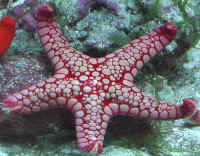
 crop
crop