|
|
| Home | Marine Aquariums |
Freshwater Aquariums |
Planted Aquariums |
Brackish Systems |
Ponds,
lakes & fountains |
Turtles & Amphibians |
Aquatic Business |
Aquatic Science |
Ask the WWM Crew a Question |
| Please visit our Sponsors | ||||
sea star regeneration 8/18/08 My daughter is doing a science project on the regeneration of arms of Seastars. We have a lot of Seastars from the Great South Bay of Long Island. She wants to see if the rate of regeneration has anything to do with the size of the Seastar. Also, there are several very small Seastars. What do they eat? <Mmm, need to know the species involved to be sure... use your search tool/s re... with the words Seastar identification (and the general geographical) location> Can they open up a mussel or clam? <Maybe small ones, but... can likely be fed a prep./mix of meaty seafood you can make buying, cutting up, freezing a bag of "mixed frozen seafood", offering small bits of this every few days> Is there a safe way to tag or mark the Seastars so she can identify them? <Mmm, don't know... can/do remove everything from their surfaces... I would use a digital camera, flash to identify individuals from the markings near their madreporites> Thanks for any help you can give. Cindy <Welcome. Bob Fenner>
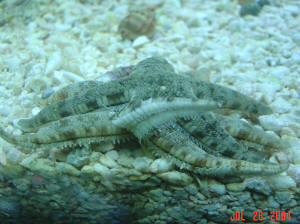
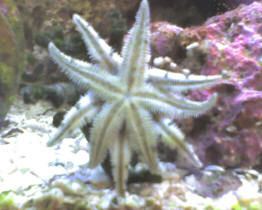
"Baby Starfish" 7/12/06 Hello WWM Crew, I am a Marine Hobbyist. I have a 75 gallon reef tank. Learning things all the time. Loving it. Tried to search the web on this new issue, but can't find my answer. Did find you, and I'm hoping you have the answer. I'll only mention in this e-mail what I think is relevant to keep this short for you. I have a relatively big (hopefully fully grown) gray (with stripes) serpent starfish, and also an orange starfish (don't know the species off hand--slow moving, smaller). Anyway, this evening I saw a tiny baby starfish in the tank. It moved fast like the serpent. Looked like somebody had tried to take a bite out of a couple legs. It didn't have any color though--just white. I was trying to figure out how the starfish reproduce. Everything I found on reproduction talked about splitting, which didn't happen here. Is it possible my single starfish laid eggs and fertilized itself? They don't cross breed, right? And are they "born" white and color up as they age? And while I'm writing. <No mystery here! The tiny brittle stars are a separate species and were probably introduced with live rock or corals. They often reproduce prolifically in reef tanks. The reproduce by splitting and by direct development (brooding) of young. The are a joyful and beneficial addition!> I lost my very large (7 or 8 inches) Mr. Goby. And then I lost my cleaner shrimp. My daughter thinks the serpent star ate them. Although the coral banded shrimp may have taken the latter. Do you think that is possible that the serpent star ate my fishes? <It is possible, but not likely. Generally, smooth armed (serpent) starfish are considered safe while spiky armed (brittle) starfish, especially the green ones are considered at least risky to small fish and inverts.> I have not been feeding him frozen fish because I was afraid of how much bigger he could get, but maybe I should feed him frozen to keep him from eating everything else. What do you think about that? Thanks in advance for your wisdom. Vickie <As these animals get larger, it gets harder for them to get enough food. Feeding it small bits of food will not only help prevent it from resorting to predation, but will more simply save it from starving. If it eventually outgrows your system, you can either trade it or use it as an excuse to get a bigger tank! Best Regards, AdamC.> Starfish Regeneration (5/9/05) Hello Bob. <Steve Allen covering Echinoderms tonight.> I know that starfish are great at regeneration and can become whole animals from being cut apart but I never thought I would watch one split itself in half! These are the starfish that came with the live rock and I have no idea what kind they are. <Are we talking about the tiny ones that never get bigger than a penny? These are genus Asterina. They often have an unusual number of limbs or irregular limb length. The often reproduce by fission.> I thought it was dead until I saw the two parts move away from each other. No, flying will probably never get better for me as a work related accident, shortly after high school, did some damage to my back, neck and knee. <Sorry to hear. As one who flies 12,000 miles per month, I'm sure flying is even more uncomfortable with the lingering effects of injury.> Now that we are getting to know how to use the camera we will take some pictures of the tank. I should have some good stuff over the weekend. <Cool. Do consider joining our chat forum and posting them there for all to enjoy.> I hope you have a great weekend. <I don't know about Bob, but I sure did--I got to be home.> Sexual Dimorphism of Chocolate Chip Stars (11/17/04) Difference in male and female chocolate chip sea stars. <I am not aware of any visible external differences between the two. Steve Allen.> Archaster Babies?....Or Asterina? (11/1/04) Believe it or not, MORE Archaster craziness! Anthony, you are a patient man for answering all my questions. Bless you indeed! :) <I will pass this on. Steve Allen responding since Anthony is out.> To add to the insanity, one of the Archaster's had BABIES. I've got a few, literally, the size of an eraser head. I tried to take a picture, but it was incredibly difficult as it was far back in the tank, glass distortion, very small, etc. So everything around it looks HUGE. Here's the pic: http://65.124.75.190/babystarfish.jpg I'm not really sure how many I have as only two were visible, now only one. Hopefully some of these guys will survive and won't suffer from predators so I can pass them on. :) <Looked at the picture. Sorry to rain on the parade, but I doubt that this is a baby Archaster. Looks more like an Asterina to me. These common hitchhiker mini stars seldom exceed 1 cm in diameter. Look at some pix on our site and elsewhere to compare and be more certain.> Starfish Asexual reproduction My sand sifting starfish recently looked like it was in a molting stage. Its legs were deteriorating off and she was still alive so I was giving her a chance to prove herself worthy of staying in my tank. Guess what, she disappeared and now I have over 50 baby starfish in my tank. <Are you sure its the same kind of starfish? Often there are little tiny star that appear in fish tanks that can become nuisances.> I’ve never had a daddy in the tank. And I’ve had this starfish for about 6 months. Do you know what the reproduction cycle is as to maybe she was pregnant when we received her or did she a-sexually repro in my tank. <Sounds like asexual if they are indeed from her. A picture of some of the babies would help.> My 55 gallon tank won’t support this many stars, so if any one wants to make a purchase, just contact me. <Sorry we can't help you with the selling part but I'm sure if you want to post them on some of the multiple web sites you'll have much success> A Star Is Born...Well- Several Stars! Hi, <Hi there! Scott F. here today!> My name is Nanci and I have 2 sand sifting star fish which have successfully reproduced. I saw the first babies about 1 1/2 weeks ago. <Very cool!> I have no idea how many are in the tank, due to the fact they are so small (1/8” – ?” in diameter) and are the same color as the sand. They seem to be at various stages of growth. Some are still oval in shape while others have already started growing their arms. Does this indicate they have reproduced more than once or just different growth rates? <Hard to say. Probably different growth rates in different individuals...> The “parents” are about 4”-5” in diameter. What is the time line for growth? <Growth rates vary by species, but I imagine that you'd be looking at several months at the least.> Do I need to add anything to my tank to help these little ones survive? Should I move them to another tank, and if so, at what stage? <I'd leave everything as is- and I'd let them remain in the same tank> My 55 gallon tank is pretty self sufficient at this time, it’s only been running for about 9 months. I have 1 Kauderni Cardinalfish, 1 White-Tailed Damsel, 1 Orange-Spotted Watchman goby, 1 Kole Tang, 1 Ocellaris Clown, 1 Fridmani Pseudochromis, 1 Blue Damsel, 1 Condylactis anemone (nuisance, but cool), Finger Leather, Button Polyps, Xenias, Yellow Polyps, Green Polyps, hermit crabs, Turbo snails, Bumblebee Snails and 1 Blood Red Fire Shrimp. Will any of these harm the babies? Will the babies harm any of these? <Depending upon the species that you have, there will probably be little danger to the corals. If the adults are leaving 'em alone- chances are that the babies will, too!> The babies do climb the live rock, unlike the parents. Any and all advice would be helpful. I haven’t been able to find any info on the net. Thanks a lot and have a great night! Nanci <Nancy- if we could get a good picture, we could make a reasonable attempt at an ID, and give you some more definitive answers. Best of luck with your little stars! Regards, Scott F>
Starfish Couple? (3/17/04) Bob, <Steve Allen tonight> I have a pair of sand sifting starfish that I purchased from the same tank. After I first introduced them to my tank they did a great job sifting around. Now they have found each other and the one just lays on top of the other and they don't seem to do much but lay in one spot all day. They are both still alive. Are they breeding? <Hard to say. Starfish are known to be rather still at times. You could always separate them & see how they react. If your water is good, there is food available, and they don't show any signs of decay, they're probably fine. Thanks, Rob <Hope this helps.> Attack of the Star People! >Hey everybody! >>Hey you! >Hope your holiday was fun. I have a question about my starfish, he is gray with burgundy spots and blue tips at the end of his arms. >>Sounds purty. >It seems that someone bit off one of his arms and the arm is on the live rock. >>Mm.. kinda like that one old movie with Michael Caine, "The Hand", yeah? (The one where he's driving with his hand hanging out the window and a truck comes along too close and kinda.. whacks it off? I was pretty little when I saw it..) >My question is, have you ever seen an arm survive on its own? >>Only in the movies.. Oh wait! You mean a starfish arm, doncha? Yeah, sure have. Needs to have just a bit of the central disk and yeah, it'll regenerate. Pretty strong weirdness vibe thing going on there. >It appears to be getting longer and not changing colors as if it were dead! >>Oh yeah, you've got a star-ltergeist. >I've left it there to see what would happen. >>Watch out if it starts throwing things and moving furniture. You may need an exorcist. >I really thought that someone would come along and eat it, but it seems to be growing. Any clues what's going on? >>Yeah, funky nature in action! >Weird science! >>Big time. >Thanks, Valerie >>Welcome, Marina Urgent!!! Starfish Spawning To Bob Fenner, and other great WWM team, Just few hours ago, I bought two Protoreastor nodosus to my aquarium (my aquarium is so small, only 60 x 30 x 36) and surprised when I see the transport bag fulfilled with milky solution with two big stars in it. So, I just thought it's only former water quality, but I remembered the former was as normal as yours. So, I move the stars to my aquarium, and I noticed one of them having a typical body secretion between arm's joint. It seems to be a sperm batch, and now it clouds my aquarium. He was still emits the unpleasant concoction to the water, and I only hopes the filter can eliminates every sperm cell. And other starfishes like my four Archasters, two Fromias, and six Sabellastartid worms are unknown in condition. But, three of the four Archasters looked very nervous and stressed when the new "housemates" come. Very unusual, they climbs the aquarium wall and moving with a fast coordinated motion. And their skin was exuding slime, a clue for invertebrate's stressed condition. Did the aquarium should to be cleaned or it will cleaned itself? Did the sperm will poisoned and toxified other inhabitants? Did they will eat other starfishes too? And how to stop this? Thank you very much, Anargha. <I would keep a close eye on your water quality (testing for nitrogenous wastes at least daily for a while). If the other livestock appear to be stressed, I would initiate a considerable water change (25%) and have more pre-made water on hand for further changes. No way I know to "stop it"... conditions are likely "so good" in your system that spawnings are induced. Bob Fenner> - What Are They Doing? - hey gurus- <Hello to you, JasonC here...> i have 2 sand sifting stars. one has been draped on top of the other for about 24 hrs. now. the one on the bottom has moved around the tank, so i know he's not dead. is this a mating ritual or what? thanks Justin <Perhaps, but hard to say for certain. Cheers, J -- > Re: question on starfish Hello again i read up on breeding starfish and wondered if my sand sifting star splits or lays eggs? <Can actually do both. Split asexually and produce either eggs or sperm> i have one that loves my tank thanks JM. Also could you direct me two the decorator crab facts on your page I've typed it in google and nothing has came up? thanks again JM <Sure. Please see here: http://www.wetwebmedia.com/marine/inverts/arthropoda/crabs/swcrabs.htm and the Related FAQs (linked in blue at top). Bob Fenner> Starfish breeding Hey Bob: I have been wanting to breed starfish. I was able to do this once before with a red Fromias but due to a lack of proper maintenance (lazy me) had a nitrate blow up and lost them all saved everything else though. I know you do not recommend blue Linckias but how about the purple Linckias? <Gorgeous creatures... Tamaria stria... just look something like the genus Linckia... can be quite hardy in fully established reef systems of size> Or should I just go back to the cheaper Fromias? I would like to raise the starfish that would be more popular but also way more hardier. <Go with the Fromias> Needs to be soft coral safe, I do so like my xenias and leathers. And would you recommend foods? <Hmm, yes... a little joke here. Tablets likely... as are easy, nutritious, sink...> Also do not much care for the brittle and serpent stars. <Not appropriate technology in many cases, settings> And what about the crabs? Should they all come out? I have 1 sally lightfoot, several left handed hermits, and a unidentified stowaway (kinda looks like a shamefaced, I'll send pics once it is caught). Please advice and once again thanks for all the help. <Would keep eye on any, all crabs...> If not for your advice I would have already scratched this hobby and went back to the old tinker-toys and play-dough. <Ahh, glad to have helped... and glad you're "still with us". Bob Fenner> Kevin Johnson Sand Sifting Star Wow, you're quite a versatile person. When I first started keeping a shark I contacted you, and thank you for your response. It so happens that I have a couple of sand sifting stars, Archaster typicus in my tank right now, and they seem to be doing what pseudocopulating starfish do when you have a male and a female (who knew??!!). Anyway, according to what I've read so far, she's going to dump about 2 million eggs into my 125 gallon aquarium, and he'll successfully fertilize, I don't six of them. Anyway, I have pretty good circulation and filtration on the tank, including UV filtration. I am also, apparently, host to some bristle worms (remind me to get a trap). I have a medium sized cat shark, and three four very brave and smart damsels, a very large cowry, some turbo snails and about 4 blue legged small hermit crabs. So, am I going to have baby starfish in two months? <Not likely... Seastars reproduce asexually in captivity at times... and there are brooding types that produce young in aquariums, but the sexual type... requires long enough planktonic stages, feeding... that the filtration, other life in a contained space take all out> Should I break out the cigars? Or, am I just going to have to cut down on the brine shrimp for a while because the damsels will eat them all?? There is literally zero information on the Internet about breeding starfish in captivity. Can it happen? If so, what can I do to improve success? If I have 2 million of them at $11 a piece I could retire. I now know more about Archaster typicus than I ever wanted to know, including the placement of all its major organs. I know what the larvae looks like in all of its stages, but am I the first to see the miracle of life happen in my home aquarium? Is my tank that dirty? :-) Thanks, Ted Coombs |
|

|
Features: |
|
| Featured Sponsors: |