|
|
| Home | Marine Aquariums |
Freshwater Aquariums |
Planted Aquariums |
Brackish Systems |
Ponds,
lakes & fountains |
Turtles & Amphibians |
Aquatic Business |
Aquatic Science |
Ask the WWM Crew a Question |
| Please visit our Sponsors | ||||
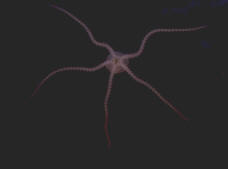
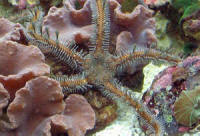
Basket stars, ID 7/16/06 Hi Bob; <Howdy Cliff> I have been trying to find out what kind of an animal I recently caught while fishing, and found an excellent article you wrote about basket stars, and think maybe that's what it is. <Neat!> I live and sport fish for salmon, in the Pacific, along the west coast of British Columbia, Canada, and found this creature attached to my downrigger cable which must have inadvertently came very close to the bottom, while fishing in approximately 200 feet of water. It is approximately 12 to 14 inches in diameter, from tip to tip of it's arms. It has 10 arms, which branch many times, to very small diameter. All of the arms and branches are made up of short segmented sections, which have small hooks on each side of the bottom of each section, and are very brittle. The arms are light tan in color. The top of the body is approximately 2 inches in diameter and is light brown in color, with tan colored rays radiating from the center to the start of each arm. The underside of the body, is similar to the top, except that the arms extend to a mouth, which has 5 (teeth?) The ray extending from the edge of the body to the mouth, has the same hooks on the bottom of the sections I hope this explains in enough detail, what I may have. Thank you in advance for your help. Cliff Hall Parksville, B.C. Canada. <Is/was definitely at least an Ophiuroid for sure from your description. Could well have been a Basketstar. Bob Fenner>
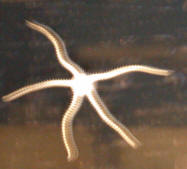
Tiny star 5/8/06 WWM, Hi, <Hello> I need a help in possibly identifying a Brittle Star. <ok> The best description I can give you is that it looks just like a Green or Black Brittle; however it is white and fully extended it is about the diameter of a penny. I'm thinking it is just a baby, <Most likely just a small species.> and maybe has not assumed its adult color. I found this guy hiding under a rock when I was doing a little maintenance. I think it is safe to assume that it came with the rock and survived the collection, shipping, & curing, only because I did not purchase it. <Fairly common in quality LR.> I know they are great scavengers, but not knowing its type, I don't know what is the compatibility is with other sea stars. I have a 3.5" Orange Linckia Star in the same tank, and I am not looking for a fight. Any ideas? Thank you Bryan <Should be no problem, fairly common LR hitchhiker. Their numbers tend to wax and wane over time, but are neat little critters and will not hurt anything> <Chris>
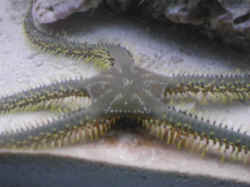
Sea/brittle star identification 11/25/2005
Hello again, <Good Morning> I have just been given a most
unusual star fish. It's got 5 legs, approximately 20 cm in diameter
(from leg to leg) / 10 cm long legs, 3 cm centre body with dark brown
circle (a bit like a flower marking), cappuccino coloured with dark
brown rings on legs. Body is ridged and rigid. I cannot id it from pics
on your site. It seems to be too skinny to be a sea star but too fat to
be a brittle star. Would you have any rough ideas what it could be or
alternatively direct me to another site with more photos??? I only need
to id it to ensure it does not eat my seahorses :>. <By your
description I'm thinking it is a Harlequin Serpent Star (Ophiolepis
superba). Arm spans can reach lengths of 16 inches, a rather
large starfish. It feeds on fish feces, dead organisms and
uneaten food and is reef safe. James (Salty Dog)> Thank
you :>. Katja <You're welcome>
Micro serpent stars Well, I do thank you for the wealth of info. However there is SUCH a wealth of it, and nowhere in it did I see a serpent star (with any name) described in this size range. I guess I should explain my tanks are all nanos, I would not wish to improperly house some poor little critter and I know that most of the commonly avail, serpent's get to be somewhat large (requiring at least 30 to 40 gals.) I did find reference to my lovely Asterina stars and it was nice to find that I was correct, several of them can live in any one of my tanks. What I am hoping for is that there is a smaller serpent star (no more than 1 or 2 inch's) that can also live in such a simple system as this : 5 gal Eclipse with bio wheel, 10 watt pc fluorescent, plenum, Seaflor aragonite 3? lbs live rock (I know I need at least a bit more). Live rock in place of the filter pad, sponge on the intake, temp/sal. well within suggested parameters, cycled with live brine shrimp and now home to 20 or so of the small grayish white Asterina "micro stars". Is there a hopefully 1inch version of the serpent star? And if so is it as hardy as most serpents? Is there a known Latin/common/pet shop, fakey fakey, name? You see I ask all of this because, there is very little info about the Asterinas online. And unless you the know the right book, or know the right LFS ( and let me tell you NO ONE has them on their order lists you just have to look for them in a tank and then ask the clerk, and usually they will just give you some) so ANY info would be greatly appreciated P.S. It would also be good to know if they are commonly available. Thanks so much, Ed <Asterina spp. stars are commonly imported hitchhiking on live rock, and will live perfectly in a nano (I've dozens in mine). They are scavengers, feeding on anything they can get their arms on. They will do fine in your system, and will probably multiply quickly. The only place I know to directly purchase them is www.floridapets.com, but other places offer them from time to time, under the name "micro" or "mini" serpent star. They are hardy and fun to watch. They attain up to about 2". If you're afraid they're not getting enough food, throw in anything into the tank that sinks after lights off, and watch them cluster on it within minutes. Hope this helps - M. Maddox> Micro Serpent Stars Are there smaller serpent's? I recently saw a post somewhere making reference to "micro-serpent starfish" is there such a thing? If not is there a serpent star commonly available that gets no larger than say about 1 or 2 in. across? I already have Asterinas (LFS gave me I think 20 or so?) hoping to find a serpent star in the same size range, and with the same ease of care. Any info (Latin/common name) would be much appreciated. <Ed, I've posted a link with some info on these. http://www.google.com/custom?q=micro+serpent+stars&sitesearch=wetwebmedia.com You should find something there. James (Salty Dog)>
Barred Brittlestars (10/21/04) Bob, <Steve Allen, covering echinoderms tonight.> I'm writing you because you seem to have the best website with information on the brittle starfish. <Thanks. Fascinating creatures indeed.> A couple of days ago I placed a new piece of live rock in my tank which being purchased in Sydney Australia may have come from somewhere near the barrier reef with lots of holes in it for just such creatures to hide. <Yes, a fairly small rock on the reef may hold many of them.> So far I have seen 2-3 Brittle starfish "like" creatures whitish with blackish barring on their legs and around and their legs are up to an inch and a half long. <Either a small species or juveniles of a larger one.> However they appear to have 6 legs not 5 <some do have extras> and three of them appear to be far smaller ...possibly due to re-growth <quite possible--legs eaten off or damaged in harvest>....however I have seen this on at least 2 of them.....what are the chances of 2 being attacked the same way at the same time? <Quite possible that they were damages in the breaking of the rock.> Can you help me identify them? <Not without pictures. They may not even have a species name, as many do not.> I will endeavour to snapshot them if it helps next time one is out in the light (they seem to stay in the crevices and holes and are only seen moving from one to the other. <That is their nature. You may want to have a look at volume 4 of Foss?& Nielsen's "The Modern Reef Aquarium"--great info and lots of pictures.> And could they be harmful to the fish at all? <Not likely. The big green Brittlestar Ophiarachna incrassata is a notorious piscivore, the smaller species are not.> I actually got up this morning to find our Coral Beauty Angel dead on the coral sand.... <Other causes> Thanks a lot, Rodger Wearne <Hope this helps.>
Identification of Ophiuroidea (3/21/04) Dear Fenner, <Steve Allen filling in this evening.> My name is Isnanto. I am from Indonesia. My research is identification of brittle star and basket star (class Ophiuroidea). I have sent a letter to you about how do I get the key identification of brittle star and basket star (class Ophiuroidea). But, you did not sent to me again. <Uncertain where your original went.> I hope you will help me to get key identification of brittle star and basket star (class Ophiuroidea). Please. <Many species have actually never been classified. What you need is a good marine invertebrate zoology book from a university library. Another good source would be volume 4 of "The Modern Reef Aquarium" by Svein Fossa & Alf Nilsen. Here is a web site that might also be helpful: http://home.att.net/~ophiuroid/home.html It does not seem to be working tonight, so it may unfortunately be no more.> I think my letter is enough and forgive me please, because I am not from English department, so my English is not good. <It's just fine.> Thank you. 20 March 2004, yours faithfully, Isnanto Domer <Hope this helps.>
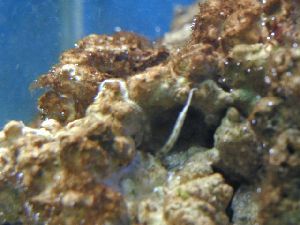
The Goby and The Mystery Star! Hello all! <Hi there! Scott F. here today!> I wrote a while ago about a golden headed goby that wasn't eating, and soon after that email (in an act of desperation, and in hopes of getting to keep the little guy) I bought some dried blood worms and whole frozen mysids. He loves them, he darts out of his hole every time I open the fridge to get out the mysids or pick up the bright red can of worms, he has filled out quite a bit since he started eating the things I put in, but he's still too skinny to stop worrying, will he fill out completely on this diet or is there something else I should start offering him that will fatten him up faster? <Well, I think frozen Mysis are one of the best all-around foods for many marine fishes. You can "enrich" the Mysis with additives, such as Selcon, which provides highly unsaturated fatty acids, or VitaChem, which (as it's name implies) provides extra vitamins. There is also brand of frozen Mysis by Piscine Energetics, that is already enriched. Other foods to try would be foods like Hikari "Mega Marine Angel", which does have some marine worms as part of it's formula, and is actually "extruded" during the manufacturing process so that it resembles worms. It's very high in vitamin content, and many fishes like it, despite its "Angel" title. > I was told to put him in a friend of mines more established tank, but I'm really fond of this character, with him eating like the other fish will he be ok now or should I still pass him on? <Well, I hate to give up on a fish, myself...Since he seems to be coming around now, I'd stand by this little guy and watch him begin to thrive!> I have one last question. I have a starfish that was labeled as a "sand shifting star" but my problem is that all the pictures I've seen of the sand shifting stars aren't pictures that look much like my guy, and unlike the descriptions that say they can't climb, he can. He has suckers and although he doesn't seem too interested in climbing, from time to time he'll camp out at the water line. I looked through one of your pages of starfish identification and he wasn't there either, he's cream colored with darker brown stripes, but he doesn't have those longer spines edging his rays that the sandsifting stars in the pictures have, his are very short. Do you know of any sites that have pretty complete lists of the species that are sold in pet stores? <Well, based on your description, it sounds like this might possibly be a brittle star (genus Ophioderma)...I have one that is cream colored with dark bands...On the other hand, if it does not have other characteristics of a brittle star, it might be any one of dozens of possible species. I'm not aware of a web site, off hand, that specializes in Echinoderms, but you could certainly do a search on one of the larger search engines on the 'net, to see what's out there. You also will definitely want to order a copy of Bob, Anthony, and Steve's upcoming book, "Reef Invertebrates", due out in March!> I was just curious, I didn't know if this guy is maybe different from the sand shifting species altogether and maybe he'd take a liking to a special diet instead of the leftovers he's getting now. Thanks for all your help! Sincerely, Rachael <Well, Rachel- I think it's great that you're hanging in there with the goby. Your tenacity has paid off for both the fish and you! And I love the fact that you're concerned enough to be researching the dietary requirements of your animals! What a great habit to get into! Keep up the good work! Regards, Scott F> A star by another name - 3/10/03 Gentleman: <Gentleman Paul here to assist> I have been reading up a bit on green stars, and have a question on mine <Go for it> - seem to be what you're describing anyway, his central body is about dime sized, with extended arms being about 4 inches… dark, dark green, almost black in color. Anyway here's my question: Is he a danger to my current livestock at that size? <Depends on what type of starfish we are talking about. Is it a common green brittle star that goes by the species name Ophiarachna radiata or a brittle/serpent star type with the name Ophiuroids (i.e. Ophiothrix sp.) Use the species name and do a search on your favorite search engine and gain a positive ID. In any event if it truly is a green brittle (Ophiarachna radiata) then I would keep an eye on it and your fish inhabitants. I have a very large specimen in one of my tanks (almost 3 years now) with no fish and he seems to leave all my hermits and few snails alone. (They are all accounted for) but that is not to say that he may decide he needs an extra snack in between feedings. That being the key, feed them directly! Frozen foods of choice here! If it is of the species Ophiuroids then they also should be fed directly, but they are much less likely to take on a more aggressive role for food> Livestock being: 2 Perculas (2 inches long each) (Which are NEVER below the halfway mark in the tank.) <Regardless, a large Ophiarachna will wait out a fish if hungry enough, not to mention they are quite resourceful and fast when they need to be!> A Hippo tang (about 3.5 inches long) a yellow tang (about 5 inches long) 2 cleaner shrimp and about 25 Nassarius snails. <The shrimp may be in trouble here with most any starfish in the brittle/serpent star class. There is always a chance they will see them as a meaty in between meals snack. <VBG> Keep an eye on them.> Tank is a 55g FOWLR. <Keep an eye but worth experimenting as I get the most response from visitors who see this large green brittle star moving about the tank. Fascinating to watch! Good luck. Pablo> Thanks! <Thank you.> Brittle star and coralline algae question... I've poured over your site and the net for a little bit o brittle star ID. i was hoping you could direct me to a website that has a nice thumbnail listing with pictures. I've tried http://home.att.net/~ophiuroid/home.html, but that didn't work either. <I suppose you've checked here: http://www.wetwebmedia.com/brittlestars.htm. Although I had no luck locating a site either, the Modern Coral Reef Aquarium volume 4 has excellent information and species descriptions w/ pictures.> i have 3 brittle stars all black or grey colored. one was sold to me as a midnight crawler. i plopped em in before i became a daily reader of your site as i am now 'enlightened'. I'm lucky enough to have a job where I'm online 90% of the day (and i still can't find that precious ID site) I've spent the last 2 weeks trying to read all your faq's (I'm beginning to think it's impossible to read them all). i pulled my green brittle star (damned assassin took a sally lightfoot crab and an emerald crab). he paid a heavy penalty. I'll spare you the details. <I hope that means you returned him to your LFS, otherwise there's no reason to kill it for your mistake.> ok, one more easy question for you, o great and mighty aqua gods! <lol> what are the benefits of coralline algae. does it soak up nitrates and/or phosphates? <Not to any practical extent.> does it release much needed oxygen into the water column?? <Well, it is an algae so it would.> are there any other benefits that you know of?? <It's really purdy. It is harder for hair algae to get a foothold on it, so it is an excellent thing to have your rocks covered with.> i can't imagine there are any detriments, are there? <Well, if you have enough growing it will deplete your calcium and alkalinity levels. This could be a problem if you don't test for them.> I thank you in advance for your replies and for previous replies welcoming me into the brotherhood (and sisterhood???) that is....aquaria...my new love. <Haha, enjoy! -Kevin> hopefully i won't need too much therapy later. - Brittle Star ID - Hello, My question is, the other day I bought a piece of live rock and there was a star fish inside. It's yellow smooth, soft skin on top with a little white horn/spine on top of body. It has lots of tiny little feet on the under body and moves fast, and it seems to like the dark. I think it's a type of brittle star. <Does sound like a brittle star.> I was wandering if you could help me in naming this species and also what is that little horn used for? <I have to admit that I don't know on both counts - any possibility you could send in a picture. It would help a little bit.> And if you could what does it eat? <Probably anything it can get its arms on - brittle stars typically will eat meaty foods when they can.> Thank you so much for your time and this Web site, Tara C. <Cheers, J -- > Sea Stars & Brittle Stars Classes Asteroidea and Ophiuroidea Hello Robert, my name is John. I really enjoy your articles on WetWebMedia. I also enjoyed your book "The Conscientious Marine Aquarist", I often look for advice from this book! <Ah, good to read they're of use> I am a little confused about brittle stars. I purchased one today for my 55G reef. The fish stores tank said black brittle stars, they looked black, about 4 - 5" or so from arm to arm. <Okay> After acclimating him (in near darkness) I couldn't really see his color. Once he was in the tank, (still dark) I noticed he looked greenish? Maybe it was because the lights were off, and I didn't want to turn on the lights and stress it. I will look tomorrow and see. <Can look very different when stressed, in different lighting... most avoid daylight exposure> What I would like to know is are the green and black brittle stars noticeably different in color? The black should have no green right? I have heard horror stories about the greens. If I check tomorrow and he's all green he's gone! They grow to about 5" or so right? (black) <Should look decidedly darkish... not bright or light green> Are the black's fish eaters? Any really good or in depth articles on brittle stars you know of? Thanks for all the help! <I'd look on the Net using your search engines> Keep them books coming! <Will do so my friend. Be chatting. Bob Fenner> Serpent Star? Iodide/Lugol's I have a few questions about a variety of aquarium subjects. First, I received some rock from Marine Depot Live (a very good company in my opinion) <Yes, friends> that was covered in Caulerpa algae. In the midst of the algae I noticed what appeared to be four + arms. These arms appear about .5 mm in diameter, and they are banded maroon or red and white or light blue. The arms seem to radiate from a central vicinity but I cannot locate the exact center. These thin arms are long and stretch out and contract. They seem to move slowly forward and ?feel? in front of them before they grab on (the arms appear to be at least 10 cm long when stretched out). What I was wondering is if this is a serpent star (Ophioderma rubicundum possibly). If no, what would you identify this as? How could I help to keep this alive? <Should be able to keep alive... might actually be a polychaete worm of some sort alternatively...> Now onto other questions about additives/medications: Would you recommend Lugol's Solution or the commercially available coral dips to do a protective dip for soft corals and/or other invertebrates? <I do recommend such dips... generally not with Lugol's but simple potassium iodide solution. Please read here: http://www.athiel.com/html/iodinerivers.html> I lost my old e-mails so I need to ask you this again: How would I make citrated copper sulfate solution (percentages, etc.)? <About ten percent (by weight) citric acid, copper sulfate pentahydrate (you can work out percent/weight composition), and distilled, DI or RO water> How would I make a potassium iodide solution to dose a saltwater aquarium (I have some KI crystals ? I just need to know measurements)? <See the above reference. Bob Fenner> Thank you, Kevin Hitchhiker ID Hi, I have been reading with great
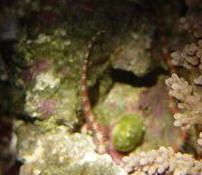
interest most of the info on this web site, it has opened my eyes
substantially. I have just purchased a small piece of rock that had a
couple of mushroom polyps on it, however I did not buy the rock for
these, but the two little creatures (things!) that are also there. Each
creature has 4 tentacles that poke out of a hole. I cannot see what is
in the hole just the tentacles that protrude out, they move in the
manner a snake would (it kind of reminds me of the old Greek mythology,
Medusa's hair). They are about 1 inch long with hairs running down
the tentacle. I have seen food particles be passed from one hair to the
other until it disappears into the hole where the animal (something)
is. The tentacles are black and white bands from top to bottom, no one
in the shop knows what these are as they were just selling a piece of
rock with a mushroom polyp on it. Can you help? <My best guess is a
miniature serpent starfish. Please work your way through Dr.
Shimek's key to positively ID your animals located here
http://www.rshimek.com/Invertebrate%20Key%20to%20Major%20Taxa.htm>
Thanks, Haydn |
|

|
Features: |
|
| Featured Sponsors: |