|
FAQs about Brittlestar Identification
3
Related Articles: Brittlestars, Sea
Stars,
Related FAQs: Brittlestar ID 1, Brittlestar ID 2, & Green Brittlestars, Brittlestars 1, Brittlestars 2, Brittlestars 3, Brittlestar Behavior, Brittlestar Compatibility, Brittlestar Selection, Brittlestar Systems, Brittlestar Feeding, Brittlestar Reproduction, Brittlestar Disease, Seastar Selection, Seastar Compatibility, Seastar Systems, Seastar Feeding, Seastar Reproduction, Seastar Disease,
|
 |
|
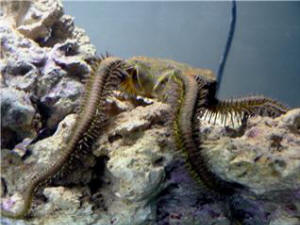
Hiker on a Kenya Tree frag 8/25/16
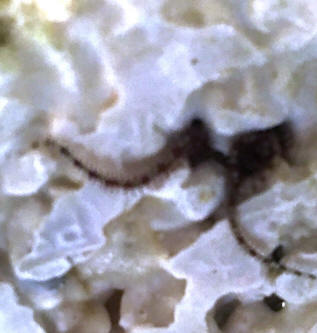
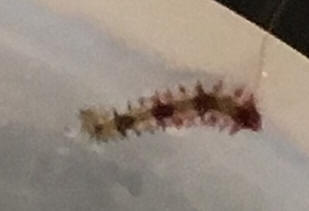
Hello, I have something sticking out of my Kenya Tree base. I am afraid to
put it into my tank. People in forums think it is a brittle sea star.
I am not sure. Can you help?
<Yes to this being an Ophiuroid>
One picture is of a piece that fell off when we tried to remove it (thinking
it was a worm). The other is the undersigned of the rock base.
The others are various views of leg-like things.
Thanks!
<See WWM re. Bob Fenner>
|
 |
|
Re: Hiker on a Kenya Tree frag
8/25/16
Thank you. Are the beneficial? Should I be afraid to put in the tank?
<Keep reading! BobF>
|
|
Pictures ... Echino ID?
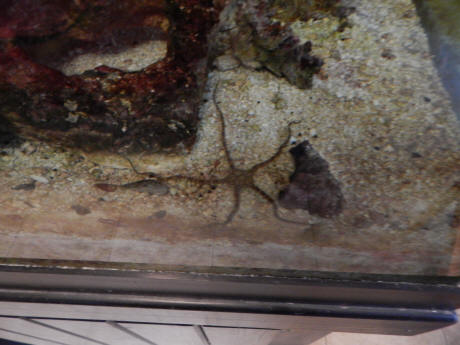
I have some of these guys in my 220 tank and they seem to be getting
pretty big. Are they safe for my reef tank ?
<Maybe>
What are they ?
<The Ophiuroids? Brittlestars... definitive
predators on the worlds reefs to abyssal depths of oceans>
They have shown up as hitch hikers and started pretty small. Penny @
AquaCorals here in Maine has not seen any of these .
<What? No... Penny has seen MANY Ophiuroids... is that what you're
referring to in your too-large files/pix? Bob Fenner>
Thank You, Gene
|
 |
|
Hitchhiker in my live rock
1/28/13
Crew,
<Hi Paul>
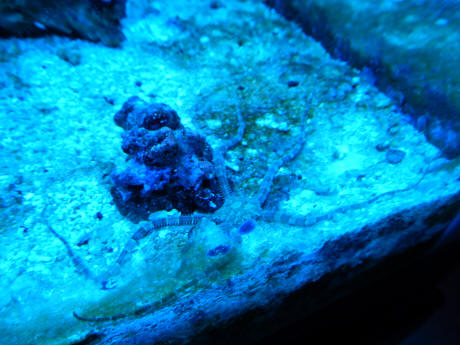
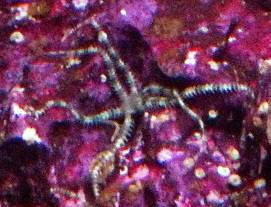
Below is a pic of my very first piece of live rock. It has been in the tank
for about 2 weeks now and up until today it hasn't been very interesting,
you know what they say you can't teach an old rock new tricks. Anyway when I
turned the light on in the tank this morning I found my first hitchhiker!!!!
I'm still pretty new to saltwater and all the creatures one might find
hiding in such rocks. Would you happen to know what this little guy is?
<Micro brittle star. Beneficial detritivore that max out around an inch in
diameter.>
I also saw a little insect looking critter but it was to fast to get a
photo of it was about 1/8" long, brown and mighty fast. Not much to go on
but if anyone had some ideas I could look it up and see if I find a match.
<Likely a Gammarid amphipod. Beneficial detritivores which double as fish
food.>
Thanks in advance!!
<Quite welcome
Paul
<Jordan>
|
 |
|
Can You Help Identify these Brittle Starfish?
1/15/12
Hello,
<... four megs of pix... Careful, Bob, remember your blood
pressure>
I have done quite a bit of Googling, but I can't seem to find
these starfish to identify them. I would love to know what type
they are if possible, and how safe they are to keep with small
fish like Firefish and other small shrimp Gobies. We have a 72
gallon reef tank, with 3 Firefish (one regular, one purple, one
Helfrichi), and two different types of shrimp gobies living with
pistol shrimp. We used to have a male/female pair of gobies with
one of the shrimp, but the male disappeared. I cannot say if it
was the sally light foot crabs or the starfish who got him. We
removed the sally light foots after seeing one try to jump on a
healthy swimming Firefish.
<Ah yes>
We tried to add in a couple of Royal Grammas after the crabs were
gone (one fish at a time) but they both disappeared after only a
couple of days, so we did not buy another.
<Good>
The Stars:
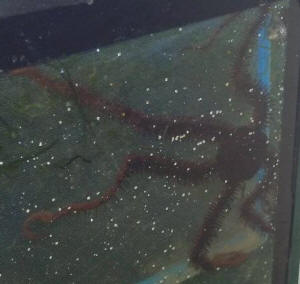
The first is a maroon colored brittle star (at least I think it
is a brittle star - I don't really know how to tell the
difference between brittle and serpent stars, maybe you could
help me with that too?)
<Both common appellations are applied to a mix of
Ophiuroids... not a defined difference, though IMO serpent should
be more often used for longer arm species>
Its disc is about 1 1/2 to 2 inches across, and it is larger than
most I see in the LFS. The legs are thicker/darker than the small
ones for sale, so I am not sure if it is the same type. Up close
you can see bands/stripes on the legs that are either a dark
brown or black. It came in the tank we purchased about a year ago
on Craig's list so I don't know where it is from. Most
people I have described this starfish to believe it to at least
be a common form that usually costs about $5. I wonder if it is
actually safe or if it is known to eat small fish?
<Can't tell from your pic what this is>
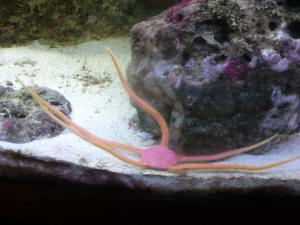
The second is a much smaller and brighter colored starfish. It is
a pink-ish orange-ish with yellow. I have never seen anything
like it. The LFS had this one for sale at $36, and said they
actually stumbled across it being sold as a "neon colored
star" a year or two ago when it was much tinier, but the
customer who purchased it recently broke down their tank and
brought it back to them so they had it for sale again. They
stated also that since the time they stumbled on this one, they
have never found another one like it. Unfortunately, I did not
ask if she knew the scientific name, or if it was a serpent or
brittle star. She did say that she believed it to be safe around
my small fish.
<Mmm, my guess is that this is a color variant of Ophiomyxa
flaccida... a common hitchhiker on/with TWA (Trop. W. Atlantic,
sorry) live rock... commonly called the Slimy Brittle
Star>
Since I loved the unique color I bought it, and although she said
they are both safe to have together, she also said she would take
my other one off my hands if I decide not to keep both. I may
take the large maroon one to her and just keep the neon colored
one. I was thinking if they are equally safe/unsafe perhaps a
smaller one is even safer until it grows - and she said they take
a very long time to grow large (this one is already around 2
years and is still small).
Any info would be appreciated. Thanks for providing such a
wonderful site, I have read many posts and learned quite a
bit!
<Mmm, I don't know re the "safe-ness" of these
animals... other than the usual (for the Class) statements re
their "crossing the line" if hungry, opportunity
presents itself. It's my observation that in many, perhaps
most environments in the seas, that Ophiuroids are actually top
predators of smaller life; determinants of what lives on and near
the surface above and below substrates. They can be very active
predators by the dark of night.
Bob Fenner>
Thank You,
Rachel
|
|
|
|
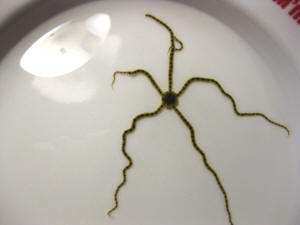
Brittle Starfish ID 12/10/10
Hello,
<Hello Amanda>
I have a 72 gallon saltwater reef aquarium that is about 2 years
old. It has soft and stony corals as well as several tangs, a
Maroon Clown, a Pajama Cardinal, 2 cleaner shrimp, and a long
spine black sea urchin.
Several months ago, we bought some additional live rock from a
nearby fish store. A few days after we had it in the tank, I
noticed a skinny black and white striped hairy tentacle or leg
that would come out of one of the new rocks every once in a
while. I haven't seen it for a long time until this morning.
My mom was cleaning the tank and when she moved a pipe organ
coral, this creature wiggled out from under it. She caught it and
it's now in a small floating tank until we can find out if it
is reef safe or if we should donate it to the fish store. The
best I can tell from researching it on your site and Google, I
think it might be a black brittle star. Some of the pictures of
those online appear to be black and white striped, but I
can't find anything to make me sure that's what it is.
From the things I read about them, it says some of them
(especially the green ones) can eat all of the creatures in your
tank including fish! What kind of brittle star do you think this
is? Is it reef safe or should I donate it? I have attached a
picture my mom took of it.
<Amanda, the monster of the midway is the Green Brittle
Starfish (Ophiarachna incrassata) which is a known predatory fish
eater. What you have should be relatively safe in your system
with its present inhabitants.
I will ask Bob to provide his input if needed. A nice looking
specimen I might add.>
Thanks,
<You're welcome. James (Salty Dog)>
Amanda
|
|
|
|
?? -- 09/03/09
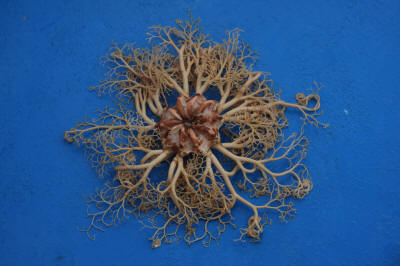
What is this? It was caught and released in Alaskan waters, about
175' deep. It is about 14" in diameter, but was
unfolding when we released it. Very interesting.
<Ah, yes... a basket star; likely Gorgonocephalus eucnemis
Thank you for sharing, Bob Fenner>
--
Dave Gassel
|
 |
Goniopora Worms --
5/26/09
All,
<Hello, Lynn here this afternoon.>
I have searched and searched but I am not finding anything on this. I
apologize for the stupid question.
<Not to worry, we're here to help. Besides, trust me - this is
not a stupid question. Now if you'd asked me if it was a good idea
to clean the walls of a glass tank with a hammer and chisel -- that
would have been a stupid question! This is not!>
I have a Goniopora Flower Pot Coral.
<Ok>
I noticed today that there are at least two long, thin, striped looking
worms on it.
<Hmmm, do the stripes run the length of the body or do they wrap
around the body like bands?>
Do I need to be concerned?
<I doubt it. If the stripes are actually bands around what looks
like a worm body, you might be seeing a harmless mini brittle
star/Ophiuroid. Take a look at the examples at the following links and
see if anything looks familiar. By the way, it's very common to see
just one or two arms sticking out of the rock/coral and none of the
central disk: http://www.melevsreef.com/id/baby_brittles.html
More examples here: http://www.wetwebmedia.com/brittlestaridfaqs.htm
>
I did try and remove one, but as soon as I touch anything with my tongs
is closes up and I can no longer see the worms.
<Yep, it's an unfortunate reality that aquatic critters seem
have a universal fear of tongs. It's like a cat and a vacuum
cleaner -- when the vacuum approacheth, the cat taketh offeth!
<G> By the way, if what you're seeing is not a brittle star,
do try to get a photo of it - possibly through the tank glass since
capture would be such a challenge. Like I said, I sincerely doubt that
it's anything to be concerned about but if you'd like to pursue
an ID, it would be the next step.>
I am looking forward to any assistance you can provide.
<Just let us know if we can be of any more assistance. Take care,
LynnZ>
Re: Goniopora Worms: Possible
Mini-Brittle Stars - 5/26/09
Lynn,
<Hi!>
It is banded around the body like bands.
<Ok, good>
I did see some on the links that look very familiar. A bit hard to tell
in that my flower pot seems very healthy and active and hard to see the
worm down at the base when it is almost the same color as the coral
itself - an off white/pearl color. This would appear to be harmless -
wouldn't you think?
<I would think so, since you haven't noticed any signs of damage
or stress. The most common hitchhiking mini-stars appear in colors
ranging from a solid white/off-white to light gray, or combinations of
one of those colors and bands in shades of gray or a salmon/pinkish
color. These stars are very common, harmless, beneficial, and stay
small.>
I don't believe my camera would pick up a picture, but I could try
if you think it is necessary.
<Nah, as long as the coral's doing fine, I wouldn't worry
about it. Just keep an eye out, like you would any other
corals/livestock.>
I never see it leave that coral and the coral seems happy, just wanted
to know if I needed to worry!
<Nope, I wouldn't worry. Most of the things that hitchhike into
our tanks are beneficial or at least fairly innocuous, so chances are
this is just one more example.>
Thanks Again!
<It was a pleasure! Take care, LynnZ>
|
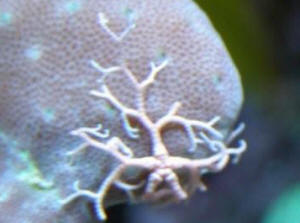
Star ID? Basket Star - 2/14/09 Hello Crew,
<Hi there, Luke.> This little fellow came on some live
rock... see attachment. <Neat> Do you know this one?
<Yep, it's a little Basket Star.> Should I be worried
about this creature in my 60 gal system with soft and LPS corals?
At present it is about an inch across in size. <I wouldn't
be concerned. Basket Stars are mostly nocturnal creatures that
feed on zooplankton and organic particulate matter. At night,
they find a perch in an area of strong current, extend their
arms, and wait for bits of food to drift by. Unfortunately, they
don't have a great survival rate in home aquaria because of
how much food they require. You can increase the odds however,
with direct/target feeding (turkey basters are great for this).
As far as what to feed, you could try frozen baby Mysis, frozen
zooplankton, enriched baby brine shrimp, etc. For more
information, please see these two links:
http://www.wetwebmedia.com/brittlestars.htm Good information at
this link regarding feeding:
http://www.reefs.org/library/article/r_toonen17.html > Any
info would be appreciated. Thanks Luke
<You're very welcome. Take care, Lynn>
|
 |
|
Unidentified Growth -sponge 11/21/08 Hi Crew!
I'm attaching a picture of a white sack that is growing on
the side of my live rock. <That, my friend, is what we
fish-folk call a sponge.> I don't know what it is but it
seems to be getting bigger. <Cool... sponges are fun,
attractive, and beneficial.> It may be hard to see on the
picture, but there is a little hole with a spout near the top of
the sack. Is this a nest? Should I be concerned? I thank you for
your time and expertise. As always, you guys are the best!
<Thanks... please see here:
http://www.wetwebmedia.com/sponges.htm
http://www.wetwebmedia.com/spongeidfaqs.htm -OneCoolFish
<Enjoy your sponge! Sara M.>
|
 |
Unidentified inhabitant...
Microbrittle star 11/20/08 Hi everyone, <Hi Robert, Mich
here.> I have an unidentified inhabitant in my aquarium. <An IRI
(unidentified reef inhabitant)? Heehee!> I used to have corals in it
but now only fish and live rock. <OK.> One of the large rocks is
very porous <Hopefully all your rocks are!> and when the lights
go out this little guy comes out to play. <Cool!> There are five
or six, two to three inch "arms" that extend from various
holes in this large rock. They are a light color with reddish brown
rings that go the entire length. If I saw a body I would say serpent
star but then the whole rock would have to be hollow. What would be
your best guess? <Likely a Microbrittle star, you can see images
here: http://www.wetwebmedia.com/brittlestaridfaqs.htm
http://www.wetwebmedia.com/britstaridf2.htm
http://www.wetwebmedia.com/britstaridf3.htm Let me know if this is what
you've got.> Thanks Robert <Welcome, Mich>
Re: Unidentified Inhabitant...
Microbrittle star 11/21/2008 YEP!! That's him!
<YAY!> Since he only comes out in the dark and then just the arms
I couldn't decide if he was a star or some other URI. <They are
quite common... and beneficial... enjoy your new URI> Thanks for the
pics and info. <Welcome!> Robert <Mich>
|
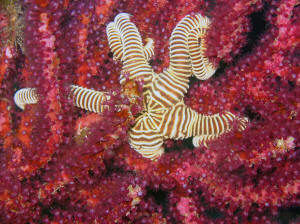
Brittle Star: Asteroporpa annulata - 4/1/08
Mr. Fenner, <Hi Lee, Lynn filling in today -sorry!> I live
in North Carolina and I see this type of brittle star on almost
every wreck. I can not find it in any book. Do you know the name
of this brittle star? <Yep. It's most likely Asteroporpa
annulata, in the family Gorgonocephalidae which includes basket
stars, as well as some less ornately branched varieties. These
Ophiuroids are usually associated with gorgonians, Oculina
corals, crinoids, and...drum roll please. shipwrecks. Their range
is from North Carolina to Brazil, including the Gulf of Mexico,
Caribbean and Bermuda. They also tend to be in a bit deeper water
at around 100'/30m+. Size-wise, they get up to around 15'
or so, tip to tip and feed with their arms extended up into the
water column to catch copepods/microplankton. Here's another
photo of this species for comparison:
http://www.dnr.sc.gov/marine/sertc/images/photo%20gallery/Astroporpa%20annulata%2050%20dpi%20.jpg
There's not a lot of information out there on these stars,
but if you have the book: Sea Stars, Sea Urchins, and Their
Allies by G. Hendler, J. Miller, D. Pawson, and P. Kier, take a
look at pages 100-101.> Sincerely, Lee Moore <Thank you for
writing in and sharing such a beautiful photo! Take care,
Lynn>
|
|
|
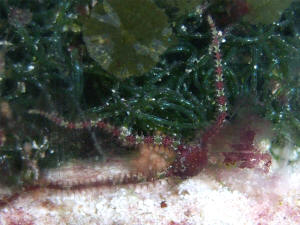
Brittle Star Identification? Ophiactis spp. --
03/20/08 Hey WWM Crew, <Hi Jeremy, Mich here.> I
frequently use your website for all things marine related (I think
I actually know more than my LFS owner). <Heehee! Always
possible!> Anyways this brings me to my question, I started a
refugium on a 55g FOWLR system and got a nice wad of Chaetomorpha
and other macros, but to my surprise not only did I get a bunch of
various copepods I got two new brittle stars. I have attached an
image because I have been unable to identify them. The closest I
can match is Grey brittle star (Ophiura lutkeni). <Is a
micro-brittle star, (Ophiactis spp.) More here:
http://www.wetwebmedia.com/britstaridf2.htm It is disk is roughly
6mm and its arms are around 2 - 3 inches in diameter. <I see,
good picture.> Thanks for any suggestions. (Check out him eating
that wad of shrimp pellet, had to coax him out of hiding ;-)
<Cool! They are beneficial scavengers in your system. Enjoy this
beneficial addition!> - Jeremy
<Cheers, Mich> |
|
|
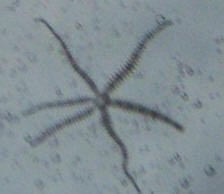
| Baby Starfish? What type? 02/06/2008 Hello
Bob & Crew! <<Hello, Andrew today>> Thank you all
so much for all of the wonderful help you have given me and the
great info you provide. <<Thank you for being a part of
producing the information>> This morning, when my wife turned
on the lights of our 56g tank, she saw a new addition". It
appears to be some sort of baby starfish. I have attached two pics,
and sorry for the clarity but this thing is tiny, about the size of
the nail on my pinky finger. He was on the front glass and I was
afraid he would get eaten by one of our fish or crabs, so I
(carefully) let him climb right into a floating breeder container I
have on standby for injured/pregnant fish. My questions are, what
exactly is it? We have 1 chocolate chip starfish and one red
knobbed starfish. This one appears to have 6 legs as opposed to the
5 of our existing starfish. Can these two cross-breed? Is it
possible this simply "hatched" from our live rock or live
sand? <<This is brittle star. They are actually a good
addition to reef as they spend time cleaning area's which are
not accessible by us, and they spend time stirring the
sandbed>> I know these may be silly questions, they sound a
little far fetched to me too, but we're just not sure how or
where he/she/it could have come from? <<Its quite common for
them to be hidden away in the live rock, and only occasionally
sticking an arm out to catch food. Its very possible its been in
your tank a while and is an off-spring by the sounds of it. If you
have added any live rock or coral recently, it could easily of
hitched a ride in on that>> My next question is, what should
we do? Should we leave him in the floating breeder box to allow it
to grow before releasing back into the main tank? We have added a
VERY small amount of OSI Spirulina flake to the box to at least
give it something in there. The box has very small vents on both
sides and gets some water flow through, but it seems the vents are
too small for it to get through and get out (it has tried already).
<<It will be fine to release back into the tank. Set it free
on some live rock and it will crawl away and setup home there. Not
to worry about feeding, as this will scavenge from the tank>>
I'd appreciate any input on what we have here and how we should
go about caring for it at the moment. Thanks again for the
wonderful help & info, as always, it is much appreciated. Mike
P. <<Thank you for the questions Mike. Hope this helps. A
Nixon>> |
|
 .jpg)
|
| Starfish???? -- 1/26/08 Ok now this is the
second time I've actually seen one of these guys out of the
rocks. The other one, no doubt it was a star fish. This one, well,
I don't know what to think. VEEEEEEEEEERRRRYY strange looking
dude.. http://www.drekster.com/myrescues/starfish.htm Thank you
Bridget <Is an Ophiuroid... with developing madreporite... See
here: http://wetwebmedia.com/britstaridf3.htm and the linked ID
folders above. BobF> |
|
|
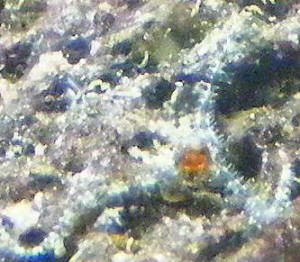
Photo to share... Ophiuroid ID f' - 1/17/08
<Hi Bridget> Just sharing
http://www.drekster.com/myrescues/salttank.htm I know we've
discussed the hermit crab and the baby starfish. Starting to notice
more and more of the starfish, not real sure if I have more than I
thought that have come in on the live rock or if they're breeding.
Doubt they're breeding? <Might very well be.> I can think of
6 that I've spotted of various sizes, this is one of the littler
ones and I have seen one, one time that was out, it had 6 legs and was
about 2". <Neat! Unfortunately, I can't see/find it in the
photo, but thank you for sharing!> Take care Bridget <You too,
Bridget. -Lynn>
Re: Photo to share - 1/17/08 <Hi Bridget!>
You can see the tips of two legs in this photo. <Ah yes, I think I
can just see them poking out.> This is normal for these guys, they
spend most of their time hiding in the rock with little legs sticking
out catching floating particles. <Yes, they do indeed! Many people
mistake those for worms, but they're actually neat little
Brittlestars (Ophiuroids)! All of them are black and white ringed.
<That's pretty standard with these guys - black/white,
gray/white, or even a pretty salmon and white!> Bridget <Thanks
again! Take care -Lynn>
Brittle Sea Star?...Sounds like it
1/12/2008 Greetings and Happy New Year! <And to you and yours!
Mich here apologizing for the lengthy delay.> About 8 months ago I
procured a few coral specimens that were loaded with hitch hikers...
<OK.> I noticed what I thought was a mini brittle sea star on the
glass early in the morning before the light turned on about six months
ago. It was about the size of a dime including legs. <Sounds like a
mini brittle star.> I've seen it once or twice since then, a shy
little thing. Tonight I saw a mass of legs poking out of my live rock.
Each leg was probably 1" long. (definitely not green though! :))
It also had in its grasp some of the Mysis shrimp I was feeding my
corals. I didn't think the mini stars got that large or ate Mysis;
was I mistaken in my ID? <Nope. All sounds consistent with mini
brittle stars.> Thanks, <Welcome, Mich>
Susan
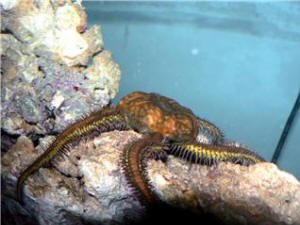
| Re: Halichoeres trispilus 11/21/07 12/11/07.
Peggy, FYI... Now Ophiarachna ID Hi Bob, <Hello Peg>
Thanks for the id on the H. leucoxanthus. I concur on this
identification after even a cursory look. I have one more for you.
Came in on LR and is a big boy. Probably about 10" across leg
tip to leg tip. <A beauty> Have him in the rock tank until I
identify him. He appears to be an Ophiarachna judging by the
pattern on the top of his central disc and the disc shape itself.
<I concur> Does not appear to be O. incrassata to me.
It's body is yellow/brown unlike the O. incrassata which has a
very distinct green body. Would you care to opine? If he's not
predatory, I'll add him to a large display. If he is, he'll
have to stay in the rock tank. Just looking at him he appears to be
predatory to me. I've attached a couple pics for you. Thanks
again Bob. Peggy <No definitive ID... but the child taxa are
listed here: http://
www.marinespecies.org/ophiuroidea/aphia.php?p=taxdetails&id=206179
Cheers, Bob Fenner> |
|
|
Serpent Star Question 11/08/07 Reading tons of
FAQ's and reading the RC forums I found myself confused. I
understood brittle stars and serpent stars to be very different
creatures. <Um, not necessarily. And this is the problem with common
names. "Serpent" and "brittle" could be used to
describe different animals or they could be used to describe the same
animal. Please see here:
http://www.wetwebmedia.com/brittlestars.htm> I also understood green
brittle stars to be very dangerous inhabitants to have in a reef tank,
but I had never heard anything negative about green serpent stars. In
my tank I have assorted SPS, 2 hammer corals (separate near an
overflow), assorted Zoanthids, 2 blue/green Chromis, 2 pajama cardinal,
2 black Ocellaris (1.5"), 2 peppermint shrimp, and 2 skunk shrimp,
and also a 5"red and 5"green serpent star) The tank is a 120G
containing about 150lbs of LR, with a 25G sump, and 35G rock, Chaeto
and DSB Fuge. About 1 week ago 1 blue/green Chromis, and 1 peppermint
shrimp disappeared. I had previously wondered if there was any
aggression in between fish, and in order to watch I set up a mirror and
watched from the next room for several hours while surfing the web.
<cool idea> There was no aggression I could see. Now after
reading some posts from people about "dangerous green serpent
stars" I wonder whether my green serpent star is the offender
(there was no body found), or if someone was just mistaken and meant to
right green brittle star. <Maybe they weren't
"mistaken" per se but simply had a different idea of how to
use the name(s).> To sum this all up, is the green serpent star
dangerous, or does "green death" only apply to green brittle
stars? <I think that the names "green serpent" and
"green brittle" are often used interchangeably. I've seen
Ophioarachna incrassata called by either name. Again, this is the
tragedy of common names. So, my friend, I'm sorry to say it sounds
like you may likely have the dreaded "Green Death" star (yet
another common name--though one a bit more specific in this case).>
Thank you so much in advance, you folks were a wonderful resources
helping me get started. Joshua <Thank you and de nada, Sara
M.>
Brittle Star? 9/9/07 <Hi Bellinda, Mich
here.> We purchased a large piece of coral today and this little
guy came out after we had placed it. What is it? There was also
another one that was green with brown stripes that never came out
enough to get a picture. <These are micro brittle stars.
Beneficial scavengers. Hopefully they brought their family with
them! You can read more here:
http://www.wetwebmedia.com/brittlestaridfaqs.htm
http://www.wetwebmedia.com/brittlestars.htm > Is this something
to be concerned about? <Nope.> Thanks for all your help,
<Welcome! Mich>
Bellinda |
|
|
|
|


