|
FAQs About Goldfish Systems:
Thermal Control
Related Articles: Goldfish Systems, Goldfish 101: Goldfish May Be
Popular, And They May Be Cheap, But That Doesn't Make Them
Easy Aquarium Fish by Neale Monks, Goldfish Disease, Goldfish Nutrition, Goldfish, Goldfish Varieties, Goldfish Mal-Nutrition,
Related FAQs: Goldfish Systems 1, Goldfish Systems 2, Goldfish Systems 3, Goldfish Systems 4, Goldfish Systems 5, Goldfish Systems 6, Goldfish Systems 7, Goldfish Systems 8, Goldfish Systems 9, & FAQs on Goldfish
System: Tanks (Size, Shape...),
Lighting/Tops, Decor, Gravel, Plantings, Aeration/Circulation, Filtration, Water
Quality (Algae, Smell, Cloudiness... Ammonia, Nitrite,
Nitrate, Nitrogen Cycling), Maintenance, Trouble/Fixing, & Goldfish 1, Goldfish Behavior, Goldfish Compatibility, Goldfish Feeding, Goldfish Disease, Goldfish
Breeding/Reproduction,
|
Goldfish are temperate water
animals... NOT tropical. Though they can tolerate higher thermal
regimes, being in hot water lowers their resistance to disease and
greatly shortens their lifespans. This being stated, it's
better that temperature not fluctuate too much/too fast, rather
than be at any given point. Ideally... 60-75 F.... with only
a few degrees change diurnally. Yes; they can live at near freezing and for
periods of times (days, weeks w/ aeration) up into the high 80's F. |
Goldfish tank ideal temperature
1/14/16
Hi WWM.
<Hey Tiff>
I looked here
http://www.wetwebmedia.com/FWSubWebIndex/goldfishfaqs.htm
But could find any statements about ideal temperatures for goldfish. The tank is
registering 61.5 F and I want to know if I should get a heater.
<Much more important than any given temperature is that this doesn't vacillate;
change a great deal over short periods of time. Better by far to have a heater
here; and set it to about 65 F.>
Thanks,
Tiffany
<Welcome. BobF>
Question regarding water temp. and Goldfish
8/21/13
Hi- I have four fantails in a 55 gal. Including their
tails, they range from about 2-1/2 to 4 inches long. I’ve had the
2 largest ones maybe 2 or 3 years, and the smaller ones a year or two.
(I also keep tropical fish in 2 other separate tanks, but haven’t had
any issues with either of those tanks for several years, knock on wood.)
I check Ammonia and Nitrate about every month or two—latest readings
(for a couple days ago) were Ammonia 0 ppm and Nitrates 10ppm. Our
water tends to be slightly hard, but I don’t mess with it since it’s not
too off.
<Good>
At this time, I don’t have live plants in the tank, so I have some
plastic ones (It’s hard for me to find good plants—That is—ones that are
actually aquatic plants— at the pet stores in my area) When the
fish don’t have access to live plants (which they devour), I usually
either grow leaf lettuces (summer time) or buy “spring mix” lettuce for
them to eat, as well as feed them several different brands of pelleted,
flake, and frozen (Mysis shrimp, brine shrimp, and blood worms) foods,
as well as dry Nori seaweed. (I like to soak the seaweed and
pelleted foods before feeding.)
<I'm a giant fan of Spectrum pellets as a staple for goldfish>
Of course I don’t feed them ALL these foods every day!—But I do feed them
twice a day most days (now and then only once), what they can eat in a
few minutes (except for the lettuces, which I allow to float, removing
them if they don’t get eaten before they start looking past their
prime.)—Oh—I’ve also put in peeled grapes and softened (slightly cooked)
peas and squash/zucchini as well. (I used to put in orange slices
because they do this at my pet store, but when I couldn’t find any
reference to this online as being good for the fish, I stopped doing it
about a year ago.)
I try to clean the tank (roughly a minimum of 20%, never more than about
40 or 45%) once a week... Now and then when I get really busy, it will
be every other week. I rinse the filter media each water change in
the old tank water.
<Good>
There is the background for my question...
I live in Wisconsin (Mid-west USA, near the great lakes) and we’ve been
having a wide temperature range the last month or so—but overall, it has
been somewhat cool—So my fish tanks have stayed at “happy”
temperatures—never exceeding about 74 or 75, at most and even having the
heaters pop on during a couple very cool nights (My Goldies heater is
set to about 72).
<Fine>
This week, we’ve had a hot streak and in about 2 days time, my Goldies
tank went from around 74 or 75 up to about 80 or 81 (unfortunately for
us all, we don’t have air-conditioning) Of course, when outdoor
temperatures are in the mid/upper 70’s, I stop using the fluorescent
lighting, hoping to prevent the water from heating too much.
<Periodic forays into the low 80's F are not a problem for fancy
goldfish>
Anyway—I’ve had the tank lights out for about 3 days because it has been
staggeringly hot (and humid) and overall horrible. Today was
tank-cleaning day for the Goldies, and when I popped the light on for
the first time in a couple days, I noticed my smallest, newest (but
still has been with us over a year—perhaps closer to 2 years) had a red
spot on it’s belly. She (no idea if it’s a she, but you
understand) seems to be acting normal, is eating normal, is swimming
normal, but has this red – what appears to be—pooling of blood (?)
beneath her skin beginning between her fins, right below her gills,
and running to the fins on her belly. It is a narrow stripe right
on her underside. (If you picture her laying on the bottom—which
she hasn’t done—but it would be the area that would be touching the
sand.)
<Likely a physical trauma. Not to worry or treat>
It isn’t noticeable until she turns up toward you to eat or swim to the
surface, which I think is why I hadn’t noticed it because I’ve been
feeding them without the light. While the room is pretty light
most of the day, it still is a lot darker in the tank.
Can you tell me what you think may have caused this?
<A run/swim into something solid>
Could it be the stress of the sudden temperature change?
<Not likely>
(A 4 or 5 days ago, we were having about 40 at night as a low, and now
it hasn’t been going below 70 at night and has been upper 80’s (even low
90’s) during the day—so we’ve had quite a change—though I do still have
all the tank heaters plugged in for those cold nights.) Does this
sound like septicemia? Her fins are totally clear—no red streaks
or red veins—nothing else unusual anywhere on her body or
face/eyes/mouth.
<Not septicemia, or other fishes would show>
My first reaction was to put another tank cleaning on my to-do list for
tomorrow or the day after (I changed roughly 40-45% tonight after
discovering this issue), but I was wondering if I should do more at this
point, or just wait and see what happens, since the fish is still acting
completely normal and still eating? The only thing I can think of
that has been different in the last week is our temperatures
fluctuations.
The other 3 fish all look and act totally normal and have no spots, of
any color or type, anywhere on them.
Any information or advice greatly appreciated. (I searched and
read other posts, but nothing seemed quite the same as this... Or there
were obvious factors involved which I don’t think apply here.)
Thanks so much—You guys (“guys” used in such a way as to include girls
as well) are fabulous—Always putting the fish (and getting the correct
info out there) first!
Lara ( another girl)
<Ahh! Thank you for your thorough writing. Again, I would do nothing
treatment-wise here. This red-spot will heal on its own in time. I do
concur re your leaving the lights off (even the hood/top) on very warm
days; even a fan blowing across the top will lower temp. a few degrees
F. Bob Fenner>
Re: Question regarding water temp. and Goldfish
8/21/13
Wow-- Lightening fast reply! You are amazing--
Thanks so much-- Very reassuring! So glad I wrote!
Thank you again-
Lara
<Am glad to set your mind to ease, w/ useful information. BobF>
Freshwater heating query (FAO Neale if
possible - thanks!) 2/19/11
Dear WWM Crew Member,
I have a quick question on heaters, which I'm hoping you can help
me with.
<Will try!>
I'm presently looking for a new heater for my freshwater
goldfish tank (120l), because the one that came with the tank
only goes down to 20 degree Celsius and I'd prefer something that
has the capacity to heat to 18. Over the years I've noticed a few
remarks (mostly by Neale) recommending or warning against particular
brands, but these have proven very hard to find with the search
function because I regrettably didn't keep a note of the names.
<I see.>
The freshwater heater FAQs didn't have what I was looking for
either, and the search function did provide me with a very helpful
article on recommended tropical tank heaters but not with a counterpart
for cooler tanks.
<Unless your room temperature gets below 18 C, you probably
won't need a heater to keep subtropical or coldwater fish happy.
Indeed, such tanks may work best if the heater is only switched on in
wintertime, and the rest of the time the tank is allowed to heat up and
cool down with the room.>
I was therefore wondering if you might kindly provide me with a
recommendation for a brand(s) and perhaps also a note of which should
be avoided, based on your experience.
<Generally, you get what you pay for. While I'll buy cheap
heaters if funds are tight, I do accept that these may only last 5
years or so. For whatever reason, cheap heaters do seem prone to
problems after a certain length of time. In any case, probably the best
heaters come from companies like Eheim, who produce the Eheim Jager
aquarium heater line. If you want a laugh, take a look at this
video:
http://www.youtube.com/watch?v=dbDFbcd8kA0
Does give you an indication of the difference in build quality between
the Eheim and the generic heater, though you should NEVER, EVER place a
hot heater in an aquarium. Besides the Eheim units, heaters from other
well-known names such as Fluval, Tetra, etc. should be fine too.
I've used Juwel heaters and like them, and the Hydor ETH external
heater is a nice unit if you have an external canister filter.>
Thank you very much for your time, and thank you as ever for the
fantastic site. I can't tell you how much I appreciate your help
(direct and indirect) over the years.
Kind regards,
Sarah
<Thanks for the kind words. Cheers, Neale.>
Re: Freshwater heating query (FAO Neale if possible -
thanks!) 2/19/11
Hi Neale,
Many thanks for your help, that was ideal (and one scary video!).
Unfortunately my living room is often below 18C - downside of being a
student in a northern latitude - so I think I'll check out the
Eheim range. Hope you enjoy your weekend!
All the best,
Sarah
<Hmm'¦ Sarah, how cold is your home? I'm in England,
and coldwater fish are routinely kept in unheated tanks here, including
things like weather loaches, dwarf Mosquitofish, bitterling, and so on,
not just goldfish. Subtropical fish do need a heater, even if it only
comes on when the weather gets cold, but most homes should be no colder
than 18 C during the day (a degree or two colder at night will do no
harm). In any event, a good, reliable heater is a wise investment.
Cheers, Neale.>
How low can you go, GF, temp.
9/27/09
Hello
I have a black moor and a golden apple snail in a 20 gallon tank. My
questions is related to temperature.
<Fire away.>
I see on your sight that it says that goldfish are cold water fish, but
it still seems you think they will be happiest at a low temp of 65
degrees from a range perspective.
<They actually have a very broad temperature range. Standard
Goldfish (the regular, non-fancy kind without fantails) like Comets and
Shubunkins will tolerate 25 C/77 F in summer, down to 4 C/39 F in
winter. In the UK, such Goldfish are routinely overwintered outdoors,
and provided the pond doesn't freeze solid, they're fine. As
you recall from science at school, ice forms and floats to the top of a
pond, forms an insulating layer, and so keeps the water underneath
relatively insulated and warmer than the ice itself. You need to take
some precautions before overwintering Goldfish, such as not feeding
them as they cool to 10 C/50 F and downwards, but otherwise they're
very tough. Fancy Goldfish though are entirely different...>
However, it also says they can tolerate lower than this when outside in
ponds. How much lower, and for how long?
<Non-fancy Goldfish can survive outdoors in the temperate zone
provided the water temperature doesn't get below 4 C/39 F for more
than 2-3 months.>
For the golden apples, it seems 65 is also a kind of low end of the
range, but they will die when it gets colder much easier than the
goldfish.
<Indeed. Pomacea snails are subtropical animals and need an
alternating tropical period under water and then 2-3 months out of the
water where they can aestivate (a summer resting phase). The reason so
few people keep Pomacea spp. successfully for more than a year is
because they ignore this, and the snails "burn up".
There's a good web site, here:
www.applesnail.net
There is lots of information on these snails and what they need to
survive in captivity.>
It seems at 50 degrees they will reliably die, but the goldfish will
just be 'unhappy'.
<Certainly too cold for Pomacea, and yes, suboptimal for Fancy
Goldfish, though Standard Goldfish are fine at this temperature, though
they should be fed very little, if anything.>
My tank is in my basement, which is partially heated but gets much
colder than the rest of the house in winter. I have not had the tank
for a winter yet, so I don't know how cold the water will get in
the basement, so I am monitoring it. It was at about 67 degrees over
the summer, is now closer to 65 degrees. I would prefer NOT to have to
get a heater, even if it means taking the snail upstairs for the
season.
My questions are:
How low can I go for the black moor this winter in terms of temperature
and still be a "good" fish owner?
<I'd put 10 C/50 F at the low end for Fancy Goldfish. The issue
isn't so much the fact their digestive system stops working, since
you can avoid that problem simply by not feeding them anything (or at
most, letting them eat aquarium plants). The issue is that Fancy
Goldfish are prone to blood clots at low temperatures, and these cause
particular problems in their fins, and this in turn leads to
Finrot.>
At what level is it cruel, and at what point may it die? Even if I do
get a heater, I want to keep it relatively cool, and only heat as much
as I need to.
<There is nothing wrong with letting them cool down to 10 C/50 F,
but if it got much colder than that, you'd want to add a heater. In
general though, aim for 15 C/59 F as the optimal wintertime temperature
for Fancy Goldfish.>
How low can I go for the snail before it will be truly bad.
<Anything below 18 C/68 F would cause problems. Much better to have
the thing aestivate in a damp peat/sand mixture somewhere in a suitably
warm spot in the house.>
They say it will die at 50 degrees, but would say 55 degrees still be
OK for a few months over the winter?
<Too cold. What is harmless for a few days can be lethal across
weeks or months. Think about where an animal comes from, and act
accordingly.
Pomacea spp. snails come from places like Florida: that's the
climate they're used too.>
If I let the water get colder than 65 degrees, do I need to feed the
black moor less, more, or the same amount of food?
<When the water gets cold, feed less, and at or below 10 C/50 F,
don't feed at all.>
I realize they are not mammals, but still thought I would ask to see if
I should adjust feeding based on the temperature.
<Precisely so. Cold-blooded animals need much less food when
they're in their winter resting phase, so their energy requirements
are usually met by fat reserves, a handy thing in winter when
there's no food anyway. But also remember their enzymes and
digestive tract muscles aren't working much either, and food that
sits in the gut unprocessed will rot and cause infections.>
Thank you so much
<Cheers, Neale.>
Re: How low can you go 9/27/09
Wow, thanks, the longer I own these fishes the more I feel like a
scientist in training.
<Like should be one long science class. Kinda, sort of, anyway. If
you're learning new stuff about the world around you, that's a
good thing.>
I sometimes feel caring for my cat is less complex than my
goldfish;)
<In some ways yes, in other ways no. Fish are more
"different" to us than cats, so there are more differences to
consider. On the other hand, fish are essentially tougher and longer
lived than mammals of similar body mass, and provided their basic needs
are met, they don't get ill and they're much easier to look
after through vacations.>
I'll checkout the snail sight as well. I doubt I would get a snail
for my goldfish tank again knowing what I know now.
<I actually don't recommend people mix Apple/Mystery snails
(Pomacea spp.) with Goldfish for a number of reasons, and this is
one.>
It sounds like your advice for the black moor is that if it is in a
range between 51-59 degrees in the winter I should not feed it much,
but continuing to feed normally it if 60 degrees and above.
<Correct. During the winter, leave some green plants (like
Elodea/Pondweed) in the tank, and if it gets hungry, it'll eat.
Couldn't be simpler.>
At 50 and below it would be bad for the moor, but I should not feed it
at all if it slips down to that range until I can heat the water
higher.
<Certainly, don't add any flake or pellets.>
Can you define not feeding it much? Lets say it is at 55 degrees for 3
months.
<At that temperature, feeding flakes or pellets 2-3 times per week
would be fine, but the rest of the time just Pondweed. If in doubt,
feed less rather than more. Pondweed can keep a Goldfish happy for
months on end, if replaced as required. Given how cheap this stuff is,
it's really very easy to look after them this way, and the mystery
is why people don't bother!>
Would I feed once a week? Once a month? Any kind of food better than
another for any special winter feedings?
<Plants! Cheap aquarium plants are safe foods for the 3 months when
its cold. Here in England, pond fish are essentially only given flakes
or pellets from about March or October. The rest of the time Goldfish
eat whatever algae and plants they find under the ice, should they want
to eat at all. When cold, they're in a semi "suspended
animation" state, and really don't get hungry. If it warms up
a little in winter, they'll eat some algae or whatever, but
that's about it. So, in a cold, basement tank, be very cautious
with food, and once the water gets very cold, don't offer flake at
all, just Pondweed. Cheers, Neale.>
Goldfish and water quality 5/28/2009
Hi Neale,
First some background we have two goldfishes in 20 g tank, one red head
Oranda (1.5 inches long w/o tail) named Luna and the other is red
Oranda (nearly 1.75 inches long) named Goldie. Two filters, one HOB for
20g and one in tank filter for 10g with aerator, two decoration rocks
with caves and one plant left now (goldfishes ate all the other ones).
The water parameters are
Ammonia=0.0,
Nitrites=0.0,
Nitrate=b/w 0-10,
pH=8.0, kH=80ppm,
GH=180ppm.
<Sounds good.>
Water changes of 30% with gravel vacuuming are done every week. The
goldfishes get Spirulina flakes and veggies to eat. Tap water
parameters
Ammonia=0.25,
Nitrite=0.0,
Nitrate=0.0,
pH=8.2,
kH=120ppm,
GH=120ppm.
1). My first question is about our goldfish Luna, she has a darker red
spot on her head for past one week. I did the water change as soon as I
found it, put some 1Ts/20g aquarium salt and 1Ts/20g of Epsom salt in
the water. She has also developed two fine pinkish veins in her
caudal fins and is passing transparent poo with bubbles attached to it.
She is getting peas for it. She has developed some new habits. She is
very active during the morning till 1 o'clock and then will start
going to the surface of and eating bubbles, she goes up take them in
her mouth, comes down, some times spit them out and some times swallow
them up and you can see her bloat in front of your eyes and then end up
in top hand corner of the tank and if some body comes close to the tank
she swims down or otherwise stays there till 5 o'clock. Then she
will start burping out those bubbles and will be swimming fine through
out the evening. She is eating fine and has erect fins and other than
turning golden her colors are very bright. Is she
coming down with Septicemia or is it water quality issue (explained in
the next question).
<Doesn't sound like septicaemia, which is very specifically
blood poisoning; septicaemia usually appears as bloody sores across the
body, most obviously on the body, especially the joints between the
body and fins. Septicaemia most usually follows from Finrot.>
2). My second question is about water quality, the buffering capacity
of our tank keeps on falling through out the week. It starts from
120ppm and
falls to 40ppm in one week. I am using Seachem's Neutral Regulator
to keep it buffered but, with it also, it falls to 40ppm. My question
is, is there
a natural way to keep my water buffered against pH changes?
<Yes; would consider incorporating substantial amounts of crushed
coral into one of the filters. Place in a "media bag" and
clean every month or so. Cheap, usually quite effective. Allow a cup
per 20 gallons to start with, and see what happens.>
For now I have been successful in keeping the pH changes at bay by
doing regular water changes and using Seachem but, it is just a matter
of time
when I am unable to do a water change and have a sudden drop in pH. I
also would like to stop using Seachem (under use since January) as it
is making the algae out breaks very bad in the tank, algae is covering
my whole plant and I haven't put in any new ones for this
reason.
<Do also see here:
http://www.wetwebmedia.com/FWSubWebIndex/fwh2oquality.htm
The "Rift Valley Cichlid Salt Mix" should work well, and
cheaply.>
3). My third question is about algae, since Seachem uses phosphate
based buffers it causes algae out breaks. Can you please let me know
what kind of algae is purple in color, is like a stain and is very hard
to remove, has to be rigorously scrubbed off from the glass and
decorations using either credit card or tooth brush, I couldn't
find any reference to such kind algae for fresh water.
<If slimy, then it's blue-green algae; if like paint sprayed
onto the glass, then probably some type of red algae.>
I have reduced the amount of light in the tank from 13 hours to 9-10
hours per day.
<Stable water quality and water chemistry, plus fast-growing plants
(e.g., floating plants), should help control algae.>
Sorry it has become such a long email. I have been looking for the
answers for my question for some time. Your website is amazing. Thank
you for
providing us with such a huge amount of information on this topic.
Thank you very much for all your past and future help.
Best Regards,
Midhat.
<Cheers, Neale.>
|
Beginner Chiller Questions,
FW, and GF sys. 4/28/08 Hello Crew, How are you today? <I'm fine, thanks>
I think I've come to the conclusion that I may need a
chiller. <Okay> I currently own a 75 gallon FW tank. It
houses two comet goldfish and a Pleco. I know the comets can
accept a wide range of temps, but much higher than 80 will
probably be bad for all involved. <Mmm, not if permanently too
high, or too vacillating... Let's see> I like to keep the
temperature around 73 degrees Fahrenheit/23 degrees Celsius. This
is because this is on the upper scale for the comets and the
lower end for the Pleco. All seem happy with this temp.
<Yes> Since I just recently upgraded to the 75 gallon (last
October), I wanted to make sure I purchased the max I could
afford. I bought the glass lids instead of the plastic hood, and
I bought a triple-tube fluorescent light since I wanted to make
some algae for my Pleco (and he does a good job of keeping things
clean). I also purchased a Rena XP 4 filter. I'm looking into
getting a new one, but if I do need a chiller, I'll have to
wait on that. The lights are 32W per tube, so that's roughly
96W of heat assuming no losses (I know, very simple assumption).
I have a hang-in refugium that has a small 7W powerhead for the
Anacharis I purchased to try to help with Nitrates. <Good>
They are doing well and this was only purchased to stop the fish
from eating the plants to death. It hangs just below the water
line so the plants receive a great deal of light. Also, the
filter runs at 31W, so assuming 100% heat dump from both (another
simple assumption) I now have about 140W of heat dump into the
system. <Mmm, as you say, minus losses> Here's the
problem. When I run the lights during the day and the apartment
heats up (we're talking up to 75-76 degrees F, if you call
that heating up), the aquarium can easily reach upwards of 78-79
degrees F. I tried to remedy the situation over the past few days
by raising up the lights on about a 1" shim, putting a
12" fan running against the side and front of the aquarium,
removing a tube from the fixture to reduce heat, and then finally
by raising both glass access flaps to help aid in evaporation
cooling (see, I am reading the FAQs!!! ;) ). <Heeeee!
You're ready to start writing them!> Nothing seemed to
work. Even with ambient air temperatures around 72 degrees and
all the "fixes" in place, the temp in the tank still
rises to around 76-77 degrees F. <No big deal> So I went on
to my next idea which I haven't finished yet. I plan on
putting three 120mm fans connected up to a converter that I
purchased at Radio Shack, and then implementing those into the
left side of my aquarium to blow down on the water, and on the
other side put just a screen mesh so that air can get out, but
fish can't. <Good> But, here's the catch. I'm a
meteorologist, so I know a little bit about thermodynamics and
air temperatures. I live in Philadelphia. The summers here are
pretty humid most times. Strike one on evaporation cooling.
Second, I know that even with the fans going and the humidity
low, the water can only be cooled down to ambient air
temperature. The air exiting the tank theoretically could get
lower (wet bulb temp), but even then, the humidity inside the
apartment will quickly rise leaving an equilibrium of eventually
air temperature when ambient reaches wet bulb, or 100% humid.
Strike two against air cooling. Finally, when I leave my
apartment, I turn the A/C up to 82F to save energy and money. I
don't like $250 electric bills, and that's what it costs
around here if I keep the A/C at a friendly 75F during the
morning and night when I'm here. I could only imagine the
price if it was that temp 24/7. I also plan to go on vacation
during the summer for around 10 days, and this combined with the
thermostat at 82F will definitely not keep the tank cool,
regardless if I turn off the lights or not. Strike three, no?
<Again... I think you'll be fine...> So I started to
take another look at the chillers. Man, are they pricey. On top
of that, there is no unique guide to sizing the things. Some
sites say 1/10 HP goes up to 130 gallons, where some say only 50
gallons. <There are differences in efficiency... and
insulation...> I have looked at the JBJ Arctica and the
Current USA Prime coolers. I was looking at the 1/10 HP models
since that's what the JBJ site sized out for me. but I wanted
to ask you guys to make sure this sounds ok. I could go up to the
1/5 HP from JBJ (I want quiet, and you guys said in one of the
chiller FAQs that was high on the list) if you think that's
what I need, but I'd hate to buy a V12 when a V6 can do the
job more efficiently and still have room to grow if needed. I
also don't want to short-cycle the compressor or cause rapid
spikes in temperatures for the fish. <Mmm, yes... these
devices consume electricity as well...> I wanted to do inline
instead of drop-in since I read here that drop-ins are very
inefficient. <Agreed. They're inappropriate tech. for most
all applications> I wanted to connect the chiller up right
after my XP4 since then I wouldn't have to purchase a new
pump or anything. The XP4 says it has a 450GPH flow, and I bet
that's probably without any media inside. My only reservation
with that was that I didn't see any kind of flow curve or
documentation on how restrictive the chillers are. I've
water-cooled computers before so reading those charts does give
an idea of flow rates and pump needs. The last thing I want to do
is kill my filter pump. <Yes... and this may well do it. The
small head magnetic drive pumps for these filters are not meant
to encounter any/much induced drag> The JBJ says that it can
handle up to 960 GPH through it - great considering I may end up
getting a second filter anyway in the long run and pairing both
filters into a Y tube that goes into the chiller, then splitting
back out of a Y tube to two outputs. That would give roughly a
max 900 GPH flow through the chiller. <A bit less in actual
practice... like half> Anyway, sorry to make a short story
long. But I hope you have some insight for me. I'm really
confused on what to do since not a whole lot of people seem to be
in my position. Most have metal halide lighting, sumps, etc. I
don't. My setup is pretty simple, and I keep it that way
since I know the more complicated I make it, the more I'm
going to mess something up and potentially kill my fish (i.e. the
reason I don't have a sump is because I don't know how to
keep it from siphoning my tank out, and what happens in a power
failure?!?). Maybe one day I will start to use a sump since I do
have a spare 20 gallon that I moved up from. I'd like a
de-nitrate tank and I know I could get one with either a planted
sump or a deep sand bed. just gotta figure out the whole
water-draining scenarios first. <Neat! Sounds like a worthy
project> It scares me to get a call from apartment management
telling me my 75 gallons all drained into the apartment below and
that my fish are now gone. I know they were only 70 cent feeder
fish. but I still can't fathom such an inhumane death. Weird,
I know. Anyway, let me know if you can help, and if you can I
greatly appreciate it. And so does my wallet. John Lindsay
<John, I would maybe shift your lighting schedule, with one or
more on-off cycles per day... have the lights come on (and maybe
go off) till later in the day, eve, when it's cooler... Is
what I do for my fancy goldfish here in S. Cal. (where it was 90
F. ayer)... Not a problem, really... In the volume you have, the
species you care for, all this will work out... Keep doing those
20-25% water changes every week and no worries. Bob
Fenner>
Re: Beginner Chiller
Questions 4/29/08 Bob,
<John> Thank you for the reply. <Welcome> I tend to
agree with you about the fact that as long as it isn't a
continuous situation, I'd be ok. However, my idea with the
fans didn't work as well as I thought. They don't fit,
and I don't have the tools necessary (I am just out of
college in my first job with an apartment - no time to have
purchased the right equipment, plus the right equipment to do so,
like just a rip saw or table saw, is about at much as a chiller)
to implement the right design. <Understood> So, if my air
temperature still stays at 82F for the week and a half I'm
gone, with the fact that no cool-down will occur at night since I
won't be home to monitor the temps, and the same for during
the day when I keep the A/C on at 82F... are you recommending the
chiller or not? I don't know if I got a true answer, but
perhaps you were leaving it up for me to decide since it is my
purchase!!! :) <Am advising against such purchase, use. I
don't use one...> I know that 77 isn't a worry for
temps... but the fact that when the apartment is at 72 the temp
is at 77, and when I have the apartment at 75 I know the tank
will heat up to around 79, I can only imagine when the air in the
apartment is at 82... the tank will rise to around 85+ which I
know is too hot for any fish... <Not really... if one
thinks/considers that the back-up, redundancy
processes/mechanisms on a space shuttle or submarine are
impressive, they should take a look at the capability of shifting
biochemical pathways in biotic systems... MUCH more
impressive> I'm just trying to make sure I don't come
home to dinner one day. <Not to worry, I assure you> Thank
you so much for your help. I know it has been time consuming with
my last e-mail! John Lindsay <A pleasure to share.
BobF>
|
Water Temp Info, goldfish sys. -- 07/16/08 Dear Crew,
Hello again, this is Pierre. I have a question about my goldfish tank.
The water temperature always ranges from 78 degrees F to 82 degrees F.
The goldfish is happy like always, eats like a little piggy, is
energetic, and displays vibrant colors. However, I know goldfish like
cooler water and I want to know a safe way to lower the temperature of
the water without giving the fish temperature shock. I don't know
if Ice Cubes are the way to go. Thanks again! <Hello Pierre. For a
few weeks, such high temperatures will do no harm at all. Increase the
water circulation if you can, perhaps by turning the filter to its
highest setting or by adding an airstone. This way, oxygen will be more
effectively distributed in the water. But provided water quality
remains good, your Goldfish will be fine. Cheers, Neale.>
|
Goldfish Transfer... systems
mostly 8/15/07 This is the first time
I've ever written a query here but i have read many of your
answers and so I figured I'd see what, if any, helpful advice
you might have. Just to warn you, this is the longest Ich
question you will ever get (LOL) <Lo dudo> I've been
keeping Goldies (and tropicals in other tanks... had Neons for a
long time and now I'm getting some sort of livebearers) for
about 10 years (with a three year break to have a baby !) I had
always kept them in a 60 gallon tank in my Florida room. In the
summer the water temp would get up to about 85-86 F but the
winters were about 50 F.... in a way, mimicking the natural
hot/cold of seasonal change (in Japan, the ponds routinely get
that hot in summer... as long as they had shade the were fine
with this <Agreed... the temp. in such large volumes does NOT
change soon/quickly day to day though...> (this was about 5-6
years ago). I had some comets get to 7-8 inches and Chinese
fantails that reached 6 inches.. Then we had a baby and I ended
up giving the fish to a hotel with a large lobby pond, since with
a new baby I simply did not have time or energy to take proper
care of them. <Good to understand ones options, priorities and
act on them responsibly> Now it's five years later, my
baby is going to school soon so i began my "urban pond"
again.... 2 calico Ryukins (Speedy and Wally) , 1 redcap Oranda
(Oranda... not real original), 1 black moor ( Joe 2.0. Joe the
first had a bad accident inside the filter... the cap over the
inlet tube fell off and he was too tiny. ) and 1 gold fantail
(Murray). The started out at about a half inch long, they were
little babies... now all 5 are about 2 1/2-3 inches long. Let me
tell you, Global Warming has gotten way worse than most ppl
think... my "urban pond" started to get into the lower
90's !!!!!! We're talking Instant Stress Disease... one
nipping fish (since removed to a new home) caused 4 out of 5 fish
to develop tail rot... i don't know if fungal or bacterial
but i was not about to wait until it became completely obvious
(i.e. advanced) I treated them with MarOxy to prevent fungus,
Maracyn 2 against bacteria and CopperSafe for parasites... I add
MelaFix mostly for prevention of bacteria (not to treat) and it
does help tissue regenerate faster... in 3 days they re-grew all
the finnage. I know it was the heat... ph was 7.2, ammonia 0,
nitrites 0 and nitrates a low 10 ppm. The antibiotics ate up the
remaining oxygen in the water, which was heavily aerated by a
HUGE filter (AquaClear 110) and a Penguin power jet; gasping on
surface still ensued. So off i went to the store and blew all my
birthday cash on a new indoor setup.... 35 gal and a new filter (
AquaClear 50) to seed so I can use the big filter in its original
tank. Both filters are running together and i have split some of
the old bacteria-full sponge into the new one... any advice as to
how long until the new filter media is seeded? <With this move
it may have been instantaneous... just do keep an eye (testing)
for nitrogenous metabolites, and light feeding...> Instead of
putting already stressed fish through even more of an ordeal, i
set up my new tank using my old seasoned outside filter and their
own tank water and decoration... only new addition were
Myriophyllum and some Water Sprite plants to go with existing
Ludwigia and elodeas... <Nice!> the reasoning here was
putting them in same temp and letting it gradually cool inside
with no other changes. The transfer has been a huge success so
far, absolutely no problems or shock or anything. They seem much
happier... so far, over four days they've gone from 93 F (YES
I KNOW) to a nice 78... i imagine in another day or two we'll
get them to about 75-74 (summer in Florida... this is how cold i
can get the inside of the house. It being summer, I know they can
take a little heat. In the winter the house gets to about
58-65... i know they will like this too. I realize the common
wisdom is to keep them at 65 year-round.... but that is as
artificial as a plastic plant. No pond in Japan is kept at 65
year round; they do not breed if there is no seasonal variation.
<Agreed> Now, the water is even cleaner than it was before
( Ammonia Nitrites at 0, nitrates 5 ppm, ph 7.2), only my husband
(who absolutely should have known better) put carbon in there
without realizing it would remove some if not all of the
CopperSafe. The Black Moor (only fish with this) has 2 Ich
grains. I re-dosed with CopperSafe (to safe levels; there was
some left over so i only put in half) Other than hoping this all
works out, do you have any advice for me? Is there anything I
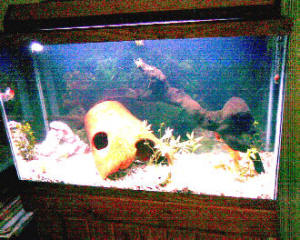
have not already done? <Mmm, no...> I attached a picture of
my set-up, before i planted the Myriophyllum and water sprite,
only 64 Kb. Thank you very much, Carol L. <Very nice indeed.
Thank you for sharing... Bob Fenner, who also keeps clay
flowerpots in with his goldfish>
|
|
|
Water Temps/Goldfish 2/13/06 Dear
"Crew" I just want a simple answer. I would like
to know the proper water temp for a 55 gallons Goldfish
tank. Also, why would they all of a sudden start hanging
around the bottom of the tank? (have recently changed out
the water). Likely your problem here is environmental and/or
nutritional. Please read here: http://wetwebmedia.com/FWSubWebIndex/gldfshsystems.htm and
the linked files at top.> The weather in our area has be very
strange. It has been unusually warm and then has suddenly
tuned cold. Does this matter a great deal?
<Can, yes... if the fish, system is "challenged"
already> Searching the web has gotten me no where. I keep
getting several different answers. Thank You, Shawn <"Room
temperature" in such a larger volume is fine for goldfish in a
heated residential setting... likely in the mid-sixties to lower
70's F. Bob Fenner>
The Temperature of the Ideal Goldfish (He's Right
On!)... 11/29/05 Hi Guys, <Girl, this time! I'm
Catherine.> I have asked this question at a lot of forums but have
been unable to get a convincing answer. Goldfish are classified as
coldwater fishes temp range 15-25C, and this is given as primary reason
why they cannot be kept with other tropical fishes as tropical fishes
need warmer water at around 30C. Now I live in a warm country, India,
where throughout the year average temp is 28-30C except for 2-3 winter
months. There are a lot of people in this country who keep goldfish.
Goldfish is one of the most popular fishes. This means that this fish
not only survives but breeds like hell in average water temperatures of
around 30C. I don't think that anybody uses chillers in their
aquariums or ponds. In light of above I have following questions: What
is the ideal temp for goldfish? <Goldfish like temperatures around
20C. However, higher or lower temperatures can be tolerated for periods
of time. If you keep goldfish at higher temperatures, they often have
shortened lifespans and are more likely to get diseases. As the
goldfish hobby becomes more popular in India, breeders may select for
fish that are more tolerant to warmer temperatures.> Why can't
goldfish be kept with other tropical fishes if goldfish can thrive at
30C? <If you are keeping goldfish at 30C, they can be kept with
tropical fish. However, goldfish tend to grow quickly and may eat
smaller fish. They are also very messy fish (that is, they poop a lot).
That means they need a large tank and care must be taken to keep their
water in good conditions (lots of water changes).> Sandeep
Raghuvanshi <Hope this helps. Catherine>
Lots Of Goldfish, Webmail - II - 09/12/2005 Thanks for your
prompt reply. <Sure thing.> I would like to add more plants in
place of plastic plants, I have read that they help in stabilizing the
system. <They can/do, to an extent.> To raise plants would it
help if I placed tank near a glass closed window so that they can get
sunlight? would it harm the fishes? <Direct sunlight would actually
be more likely to cause algae problems than help your
plants.... Start reading here: http://www.wetwebmedia.com/PlantedTksSubWebIndex/AquariumGardenSubWebIndex.html
.> I live in India where temp. range from 30-38 C in summer &
18-25 C in winters. <As long as you can keep the tank roughly
between 21 and 30 C, you should be fine.> Thanks for everything.
<Glad to be of service! -Sabrina>
Color changing goldfish Howdy all,
<Hello. Sabrina today.> I have enjoyed the site for
over 8 months now. <Good to hear!> Anyways my
question: I have a 40 gallon tank with 5 gold fish (I know very messy
fish and I do regular weekly water changes). I have had all
of these gold fish since they were the 7 cent feeder size and now are
well over 5 inches and more. I have one that has been
changing color to all white (smallest fish at 3 inches) while 3 others
are somewhere in between white and orange (medium between 3 and 5
inches) and the largest of all is a bright deep orange (closer to 7
inches). I was wondering if this is normal or is this due to
nutrition? <Absolutely normal. Might possibly
be due to pH, nutrition, temperature.... In any case,
perfectly normal, and no cause for concern.> The white fish also has
one cloudy eye but eats regularly. Water temp is 78 degrees
<Whoa! I assume the goldfish are the only fish in the
tank?? Drop that temperature! Somewhere in the
neighborhood of 68 degrees Fahrenheit is reasonable for goldfish - drop
it a couple degrees a day until you're somewhere down there.>
and water quality is 0/0/0 across the board. <Great.> Your help
is always appreciated, Vince <Do please also make use of the
goldfish FAQs for more info. -Sabrina>
Goldfish Tank temperature Hey Thanks for
all the help for my previous queries :) I have 2 red cap Orandas in a
10 gallon tank. I never realized this problem would arise since
it's the first summer I would have a fish tank in the house. But
I started noticing that as summer's coming, my tank's
temperature also is going up. I usually maintain the tank
temperature at 76 and now it's gone up to 80. I tried to cool
it by changing about 10% or less water at frequent intervals (just
the last 2 days that is) but it's of little help. And it's
just the beginning of summer!! Although we have air conditioning in the
apt it becomes hot. Any tips for keeping the tank cooler in the coming
months?? Any alternative to using the air conditioner? <
Keeping the tank lower and out of direct sunlight will help some. Try
and get some additional aeration in the tank by using an airstone.
Water carries less oxygen the warmer it gets. Leave the lights off the
tank too until it cools down.> Also I would like to know what the
feeding schedule and how much to feed the fish in summer? Whenever I
feed peas to my fish, one of them eats more than the other. Is
it going to be bad if he eats more peas?? Thanks and I really
appreciate your help! < As the summer weather increases the water
temperature, the fish's metabolism will increase too. They will be
hungrier, eat more and generate more waste. You will probably have to
service the filter more and increase the amount of water you change
too. Try not to overfeed either fish. Make sure all the food is gone in
a few minutes. Leftover food will cause serious problems. The stress on
the fish with increased temperatures and over feeding may lead to
bloat.-Chuck.> Sweta
|
|

