|
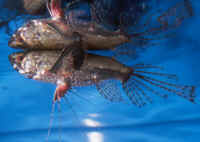
FAQs on Pantodon
buchholzi, the African Butterflyfish
Related Articles: Bony Tongue Fishes, Arowanas, Arapaima,
African Butterflyfish, Featherback Knifes, Mormyrids, Elephantfishes,
Related FAQs: Bony Tongue Fishes,
Aba Aba Knifefish,
Arapaimas, Arowanas, Featherfin Knives, Mormyrids, New World Knifefishes,
|
|
African butterfly fish 9/19/18
You previously said about a fish losing its colour being bad my ABF
occasionally loses some of its, about 2 months ago I had a problem while
on holiday with an auto feeder over feeding my tank and not working
properly.
<Yikes! They're a bit of a menace, to be honest. If you're gone less
than two weeks, best simply not to feed your fish. Anything over that,
have a friend add a tiny bit of food once or twice a week. Large fish
(big catfish for example) can go 4-6 weeks without food without any
health problems at all.>
My ABF now seems to be very skittish it was grumpy before a bit but just
seemed like it’s personality as was eating aggressively from the food
hole where I drop it in but it now seems scared and runs when I put food
in or take the lid off, if the lights are off and the aquarium is closed
it will eat a bit but is hard to monitor how much it is eating is there
any solution to maybe why the fish is so scared, hope this is clear
thank you for the help
<Sometimes fish become skittish if their environment has changed. Check
water quality in particular, as non-zero ammonia and nitrite levels will
certainly be registered as 'threats' by your fish (a bit like the smell
of burning to humans) and they become more anxious and won't eat. Do
also check the pH hasn't suddenly changed, as that will also cause fish
to become nervous. African Butterflyfish are jumpy fish, particularly in
small tanks or tanks with bright lights and no shade, so review and act
accordingly. Do also check diet: while a varied diet of frozen foods or
good quality pellets/flake should provide all the right nutrients, a
monotonous diet or one including live feeders can introduce health
problems, including thiamine deficiency and parasites of various kinds.
Finally, look how any tankmates are behaving, including at night. While
some barbs and tetras will nip at African Butterflyfish during the day,
there are some nocturnal species, notably Synodontis, that can
occasionally nibble at their fins during the night. So again, review and
act accordingly.>
From Josh
<From Neale.>
Re: African butterfly fish 9/21/18
There is nothing nipping at the fish as I can sea I am going to increase
water changed to make sure 0 nitrates and ammonia the tests have said it
is very low.
<Low is not zero; review, and act accordingly.>
When feeding should I keep to feeding it in the dark or get it back used
to normal feedings.
<They are visual hunters, and active by day, but do prefer shade, so
that should help you understand when and how best to feed them.>
Thank you
From Josh
<Cheers, Neale.>
African butterfly fish; fdg., gen.
6/12/18
I have a young African butterfly fish 1 inch long
<Tiny! Might be tricky to feed. These fish need quite a lot of food.
Wingless fruit flies ideal; sometimes they take flake, but don't bank on
it.>
seems to be ok mostly active when feeding or someone is at the tank.
<Cool.>
At the fish store I was told by 2 of the employees that an African
butterfly fish would be ok in 70L so I got it. I feel though the tank
maybe in the future will get to small so is there any way of improving
the fish’s life in the tank or should 70L be ok?
<You're right. These fish can grow quite big, 10 cm/4 inches in length
under aquarium conditions. While the water depth is immaterial, the tank
needs plenty of surface area. I'd be thinking about a tank with, say, 3
square feet of space at the top. A traditional 30-gallon breeder tank
would be about right (i.e., 36" x 18" x 12") but a standard 29-gallon
tank (30" x 12" x 18") would be fine too. Nothing very much smaller
makes sense in the long term, particularly if you're keeping them
alongside other types of fish.>
Thank you
From Josh
<Most welcome. Neale.>
Re: African butterfly fish 6/13/18
Thank you
Luckily I have managed to get mine on flake, dry blood worms and small
Cichlid pellets.
<Nice!>
When u mean wingless fruit flies is that catching them wild or bought
from pet stores.
<Either. But sure, you can buy wingless fruit flies and (sparingly) very
small crickets from pet stores that cater to owners of reptiles and
frogs.
On the other hand, if you happen to have a lot of house flies or fruit
flies in your home, there's probably no harm in catching these and
feeding them to your African Butterflyfish now and again. House Flies
are pretty mucky beasts for sure, but the chances of them carrying
something likely to infect a tropical fish has to be close to zero.
Fruit flies should be entirely safe, since they're not eating carrion
but mostly nectar, decaying fruit, and other plant foods.>
Thank you
From Josh
<Most welcome, Neale.>
Pantodon buchholzi 3/23/13
Hello crew,
I have been using your site for many years now, what a wonderful job you
are doing.
<Thanks for the kind words.>
I am interested in Pantodon buchholzi.
<An excellent fish. Not especially difficult to keep, provided you plan
around its feeding requirements and your water isn't too hard.>
I have been going through your site for several days now, and I am left
with a few questions. I learned from your site that they prefer soft
water.
I read a response from Neal who said soft had a dGH of 5-15. So my first
question is, could this fish be kept in water with a dGH of 8?
<That would be fine. Use your water test kit, and provided the result is
"soft" or "moderately hard" you'll be fine; while African Butterflyfish
can live in "very hard" water, it's less than ideal, and you may find
they some specimens fail to adapt and simply die after a few months. The
pH is less critical, but anything between 6 and 7.5 will be fine.>
That is the hardness of my well. I also learned from this site that
these fish are relatives of the Arowana.
<Yes, they are members of the group Osteoglossiformes.>
I have heard that a small Arowana will die if it is put in a large tank.
Is this true?
<Somewhat true, yes; Arowanas are big fish that inhabit rivers, and do
poorly if they feel cramped.>
If so does the same apply to the African Butterfly fish?
<Likely so, but it's true for any fish. They all have certain space
requirements.>
I have a 150gal tank That I am looking to use.
<Ample space.>
It measures 24 inches by 48 inches by 31 inches. 31 being top to bottom.
My question is would the large amount of floating plants they need
provide enough security in a large tank?
<Yes.>
Is the depth an issue?
<Not really, but they do have long fins and won't be happy in tanks
shallower than, say, six inches because they'll find themselves dragging
their fins along the gravel!>
If so could you recommend an appropriate set of dimensions?
<If you allow about a cubic foot per specimen, you won't go wrong. Your
tank will be fine.>
I have not yet purchased the fish, and I expect it would be 1-1.5
inches.
<Oddly enough, they're often imported to the UK quite a bit bigger than
this, around the 2.5 to 3-inch mark being typical. Smaller specimens may
be more delicate, so do ask to see any prospective specimens feeding
before purchase. Healthy specimens eat heartily, and it's a very good
sign if the ones in the shop are feeding.>
I have done some window shopping, and that seems to be what is available
locally. I am willing to start with a small tank and move him up as he
grows.
<Not a bad idea at all. Getting some youngsters in a 20 or 30 gallon
tank, rearing them together, getting them feeding away from any other
midwater fish (catfish would be fine) will make it easier for you to
wean them off live food and onto flake and pellets. In the short term,
things like wingless fruit flies make good foods for them, but you
really want them taking frozen or flake foods as soon as possible. After
a few weeks you'll be confident that they're eating well and could move
them into a community tank. If your community tank contains very
peaceful fish that won't steal food from the surface, then you could put
newly purchased specimens in the community tank straight away.>
I have a standard 10gal, 20gal, 30gal, 55gal, and 75gal not in use
presently. Thank you very much, I look forward to hearing from you.
Kevin
<Hope this helps, Neale.>
African Butterfly Fish, Bamboo Shrimp, and ????
6/23/12
I love to read your solutions to aquarium questions. Here is mine. I
have a well-planted 37 gallon aquarium with sand substrate. It’s been
established for about a year and. I just moved everything out of it to
my 55 gallon. While shopping at Petco today for a dog door (I can hear
all the booing already) we found some bamboo shrimp and thought they
were awesome, so we bought 5 for the empty 37.
<Okay.>
I do my research, but I want to see what you think of my plan.
<Will do.>
I would like to add my African Butterfly Fish to the 37. He’s in our 125
gallon right now, but the black skirts are snagging many of his crickets
before he can get them, not to mention that our school of 6 Red Irian
Rainbows are learning how tasty they are. I have to put in about 6
crickets to get one to him.
<I see. They do eat floating foods, including good quality flake -- try
something like New Spectrum or Hikari.>
Right now, I have two Aquaclear 50 filters running on the 37. My mantra
is ‘over filter’.
<Not necessarily a good thing. Pantodon live in still water, and will
normally find spots away from water current. Once optimal water quality
is reached, any additional water turnover (movement) is merely water
current, which is appreciated by some fish, disliked by others. As in
real life, mantras and dogmas may make sense at face value, but a few
words can't ever reflect the complexity of the world as it is, so be
flexible.>
I would like to drop the water level about an inch, remove one of the
filters, and add my Butterfly Fish. I have floating Anacharis for him to
hang out in, and I’m hoping that removing one filter will make a nice
calm space for the Butterfly and still supply enough current below for
the shrimp to feed in the water column.
<Ah, yes, good plan.>
I would like to add a school of large, non-nippy tetras like 6 Congo
tetras or Head and Tail Lights.
<Doable.>
What do you think of my plan, and are there any other fish that you can
think of to fill midwater that won’t harass/become food for the
Butterfly or dismember my shrimp?
<Pretty much anything too big to be eaten, not too big to be scary, and
of course placid and non-nippy. Among the less familiar species from the
same part of the world, the non-aggressive Ctenopoma are very good
choices, especially Ctenopoma acutirostre and Ctenopoma fasciolatum,
both of which exhibit nice colours, and the second species comes in a
nice steel blue rather different to many other aquarium fish. African
Knifefish can work well too, as should small Synodontis species like
Synodontis nigriventris. Polypterus palmas and its allies are about the
right size and temperament, too.>
Perhaps there are some species that are not live bearers that I have
overlooked. For some reason, I have problems with livebearers here, but
no problem with egg laying species.
<Is your water too soft? Livebearers need hard water.>
Thank you in advance for your opinion. I’m sure it will be helpful.
Thank you, also, for helping so many people solve their aquarium
problems.
Stephanie
<Most welcome, Neale.>
Questions/interesting observations about FW livestock, Af.
BF, Ctenopoma comp.s 5/14/12
Hi crew,
<Duncan>
I haven't written in a while but am still keeping up with the site - my
queries have been solved using the search tool in the interim.
<Ahh!>
I've a couple of questions if that's O.K., and then what I think is an
interesting observation, about some FW livestock.
1) Will an African Butterfly Fish eat Cardinal Tetras?
<Yes; for sure>
I've done a fair bit of research, have matched what I think will be a
good tank environment and tank-mates to a single individual, and I'm
guessing the butterfly fish won't go near the cardinals given the strata
they occupy (though I'm sure a butterfly fish could fit a cardinal in
its mouth easily!). I just don't want to go ahead and mix the two
species without WWM's sign-off!
2) I have had 2 juvenile (say 3-4cm) Ctenopoma acutirostre and 2
juvenile (4-5cm) Colisa fasciata in an under-stocked community tank
(4ft/250L, ph 7.2, 0 ammonia/nitrite, <20 ppm nitrates, KH 3) for well
over 6 months now.
Food is prepared granules, wet-frozen daphnia/brine shrimp/bloodworms,
algae wafers and the occasional squished frozen pea. Tank-mates are 4x
true Siamese Algae Eaters, 6x Lemon Tetras and 2x Common Kribs. The SAEs
are also juvenile but growing well, while the lemon tetras and Kribs are
more or less adult (Kribs have bred 3 times and counting). C.
acutirostre are target-fed brine shrimp and bloodworms (they don't go
for any of the other foods really) with a plastic pipette at one end of
the tank, while food dropped at the other end of the tank distracts the
others. The bushfish and gouramis are very active and vigourous eaters,
but I'll swear they've barely increased in size since I got them! They
don't get fed on the weekends (tank is
at the school where I teach), and they've had two stints where they were
only fed once in a fortnight (school holidays). Is this the reason they
haven't really grown (I am aware the bushfish are a slow-growing
species), or am I not doing something correctly?
<Ctenopomas are slow growers... unless fed (really over-fed) on boosted
live foods... very slow>
3) Now, my interesting observation. Being a bit of an African fish nut,
I recently acquired a M. angsorgii for my 63-litre home tank. I believe
it's a fin-nipper!
<They are>
Never while I was watching mind, at least half of my 10x Cardinal tetras
it was put in with were missing chunks of their caudal fins, one almost
completely gone! I know they're predatory, but I thought M.
ansorgii were supposed to be shy, retiring types! The offender
has now been moved to a 68-litre tank in my son's bedroom, which hold 6x
Emperor tetras and 1x Bristlenose catfish, where it more than holds its
own during feeding time.
The cardinals' caudal fins are all growing back nicely. An atypical
individual of the species do you think?
<Not atypical>
Cheers all, keep up the awesome work.
Duncan.
<And you, yours. Bob Fenner>
3 fish questions, Pantodon repro., Koi
color change, Fiddler crab sys. stkg. 1/16/12
Dear WWM
<Aaron>
I got a butterfly fish (freshwater) the other day . recently I noticed
a group of bubbles on a bamboo leaf ,the next day there were tons in my
tank (bamboo plants and surface) what is going on?
<Pantodon... is a bubble nest builder, spawner...>
should I get him/her a mate?
<Mmm, up to you. Do see the brief notes here re sexing,
reproduction, rearing the young. And elsewhere re raising food/s:
http://animal-world.com/encyclo/fresh/miscellaneous/butterfly.php#Breeding/Reproduction:>
In my outdoor pond (12ft wide 6ft deep)
I had a 2 foot Koi in my pond (I live in MD).he started out orange and
white but over 3-4 years he changed to all white to orangish pink to
sort of transparent to white with a orangish pink head is this
normal?
<Happens... due to genetics, foods/feeding and water quality mostly.
Best to not allow such stock to reproduce>
And last I would like to set up a ten gallon vivarium
with 1-2 fiddler crabs . is it okay to put a small fish in the water
half?
Like a Betta or something?
<Not generally, no... water quality too variable, crabs too
predaceous... Bob Fenner>
African butterfly fish not eating
5/12/10
Hi Crew,
<Hello,>
Thanks again for your great site! I'm having a bit of a conundrum
with my African butterfly fish. I purchased him (I'm guessing on
sex) about a month and a half ago. From the moment I put him in the 55
gallon tank he was doing fine, eating regularly. In fact he had a huge
appetite. I was feeding him live crickets, mealworms, flake, and frozen
bloodworms. All was fine until about a week and a half ago when I moved
him to my 90 gallon tank. I thought he would be happy with a little
more surface room to swim. Apparently I was wrong because he has since
stopped eating entirely. He now just hangs in the floating plants and
will occasionally swim out but only to go back to floating in the
plants.
<I see.>
The water levels are: 0 nitrite, 0 nitrate, 0 ammonia, 7.4 pH and the
temp is about 78-79 degrees. He is housed with 4 juvenile angelfish
(about 6 months old), 2 Bolivian rams (4 months old, 6 Rainbowfish and
a Bristlenose Pleco. No one seems to be bothering him and he shows no
signs of illness, except for the fact that he will not eat.
<...>
I was wondering a couple of things, could it be the lights are too
bright or is he just acclimating himself to the tank still?
<Could be either. Remember these fish inhabit still/sluggish
habitats and cannot bear strong water currents. They dislike bright
light and open water. If the tank has slow water flow, at least in the
region with the floating plants, and you're using floating plants
to block the light, he should settle down. Otherwise, in the average
bright tank with medium to strong water current, Pantodon buchholzi
rarely does well for long.>
Also how long can he go without eating?
<Couple of weeks, maybe a bit longer won't do any harm. After
that...>
I would really hate to lose him. Do you have any suggestions to
encourage him to eat? It would be greatly appreciated.
<If conditions are right, anything he ate before should be accepted
again. If conditions are wrong, nothing you do with diet will change
things.>
Also if it's not too much of a bother I have a stocking question
regarding the 90 gallon tank. Would it be OK to add 4 cockatoo Apisto
dwarf cichlids (3 females and 1 male) and also add a pair of red
breasted Acaras?
<Apistogramma cacatuoides and Laetacara dorsigera are compatible,
but it will depend on the size of the tank and especially the
availability of nesting sites. Apistogramma appreciate things like
half-coconut shells, while Laetacara are more open water, and defend
areas around flat rocks or the base of sturdy plants. So if the tank is
intelligently decorated, both should be happy.>
The tank is heavily planted with about 8 caves and I am using plants to
create tank divisions. I am running a Fluval 404 canister filter and a
whisper 60 hang on filter. Thank you so much for your help,
Kary
<Cheers, Neale.>
African Butterfly Fish
4/9/2010
Crew,
Hello again friends. It was not a Waspfish that I saw, it was an
African Butterfly fish. That explains why he was at the top of tank,
right side up by the way, not upside down.
<Indeed. Pantodon buchholzi, a difficult but fascinating fish. Do
read here:
http://www.wetwebmedia.com/FWsubwebindex/afbflyfshfaqs.htm
>
I absolutely love this thing now and would like to get one. My question
is would he do OK in my 55 gallon tank with a Spiny eel, Midnight
catfish, sun catfish, whiptail Pleco and an algae eater?
<In theory, yes, but your problem is feeding it. Pantodon feed
exclusively on food on the surface, and initially at least live foods
are usually required, such as small crickets or wingless
Drosophila.>
The only thing that ever ventures towards the top of the tank is the
midnight catfish after the moon lights go on or when fully dark. My
water is changed every week, the tank is fully cycled and maintains a
PH around neutral. sometimes it creeps higher. Temperature is around
77-79, nitrite and nitrate are 0. It has a few fake plants but none
that touch the top of the water. What do you think?
<You will need some floating plants or something similar. These fish
get very stressed unless they have suitable shade. Cheers,
Neale.>
Tire track eel (sys., fdg. reading),
Trichogaster microlepis questions -- 01/30/10
Hello, I've recently purchased a Tire track eel (Mastacembelus
armatus) and a very large (quite beautiful) Moonlight Gourami
(Trichogaster microlepis) from my LFS, and added them to my main tank,
which currently has six small silver dollars, a Black ghost knife, a
Leopard Ctenopoma, a large Rhino Pleco and two Botia Kubotai inhabiting
it. After adding them, they all seem to be getting along very well, the
Botias chasing the eel a few times, but nothing more than that. Since
the Gourami is the only inhabitant of the upper regions of my tank,
it's not being bothered by anyone. The eel is wonderful, swimming
around the tank, looking though thru glass at us, and so on. The only
problem is, he likes to play in the filter. He swims up into the
filters
<? The intake/s and discharge are not screened?>
that hook on to the back of the tank, stays there for a while, and then
slowly swims out when he decides to. Now, since he doesn't seem to
be getting hurt, I don't mind-- I'm just worried that he might
think he's ging
<?>
into the filter, but really be going over the back of the tank. I'm
trying to find something to cover the back of it, but until then,
he's at risk of climbing out
<A very common issue/problem with captive Mastacembelids>
(I should have eel-proofed my tank before I got him).
<Yes. Cover all openings now>
What I'm actually asking though, is what diet is best for them--
Would a diet of frozen bloodworms, flake, shrimp pellets, and
occasionally live brine shrimp/guppy fry suffice?
<Read here:
http://wetwebmedia.com/FWSubWebIndex/spinyeelfdgfaqs.htm>
I know they can be timid while feeding around more aggressive fish, so
I I'll be using the turkey baster. Also,
will the Gourami get along with a Butterfly fish?
<Maybe... depends mainly on the size of the system>
The surface area of my tank is quite large, with ample floating plants,
and the Gourami doesn't usually stay at the very top of the tank
where the Butterfly fish would be (would have got the butterfly
instead, but my reserved specimen at my LFS had a fungal infection
yesterday, waiting for a new shipment...). Thanks! -Jack
<Welcome. Bob Fenner>
African Butterfly fish Compatibility
1/25/2009
First of all, thank you for the superb information you have on your
site!
<Thanks.>
I have a well established 125 gallon (US) tank with an average Ph (I
haven't tested it in a while, but everyone seems to tolerate it),
housing 6 small silver dollars, a 4 inch Black ghost Knife, a 2 inch
Leopard Ctenopoma, an 8-9 Rhino Pleco, two Botia Kubotai, and two Kuhli
loaches (I would move them to a tank where they were less bite sized,
but catching them in my well planted tank full of driftwood is near
impossible). They usually all stay near the bottom and middle of the
tank.
<OK.>
Recently, while browsing my local fish store, I noticed that they had
an African butterfly fish in one of their tanks. I'm wondering if
the Butterfly fish would be suitable for my tank.
<Possibly, but Silver Dollars may harass it. Pantodon buchholzi is
also somewhat fussy about its habitat. It prefers shady tanks and will
normally hang about at the surface where the flow of water is minimal.
Tall or floating plants are a must.>
I feed the tank flake, shrimp pellets and "bottom feeder
wafers" in the day, and at night they get a very small bit of
flake and frozen bloodworms (I plan to get live brine shrimp for the
Knife when my LFS has them in-stock). I have some floating plants that
provide shade (and some security for the Ctenopoma) that cover about
1/4 of the surface of my tank.
My tank lid is glass and relatively heavy, so jumping should not be a
problem. Plus, if I get the Butterfly fish, should I get them in a
pair?
<They are mutually territorial and so far as I know, don't form
stable pairs. Allow about a square foot of space per specimen, assuming
each square food has one suitable resting place.>
Thanks! -Jack.
<Cheers, Neale.>
Re: African Butterfly fish Compatibility
First of all, thank you for your quick response. I don't think the
silver dollars are a problem for the Butterfly fish, since they tend to
be a bit timid, swimming in and out of the driftwood and low plants,
and as far as I know, haven't harassed anyone.
<OK.>
As I said in my last message, I have a large mass of floating plants at
the top of my tank, which should be perfect for Pantodon buchholzi.
<Yes.>
The water in my tank is relatively slow-moving, with the water near the
sides a bit faster due to the filters.
<See, you need to be careful here: Apteronotus albifrons will not
live long in a tank with limited water current. These fish come from
rapids and such like habitats, and as they grow, their oxygen demands
go up. (Remember,
when a fish doubles in length, its mass increases 8-fold, so its oxygen
demand gets very much greater than you might imagine.)>
And, my silver dollars are only about 1-2 inches in diameter, do you
think that the butterfly fish could fit it's mouth around them?
<Likely not.>
also, Do you think it would require anything else than frozen
bloodworms daily and store bought crickets once or twice a week?
<Juvenile Pantodon are best fed on wingless Drosophila, easily
obtained from reptile pet stores. Crickets can be a bit big for them.
In any event, quarantine them first, and during that time, train them
to take carnivore flake and pellets. Once they're on a staple of
that sort, you're better assured good health.>
Thanks! -Jack
<Cheers, Neale.>
Re: African Butterfly fish Compatibility...
and BGKs - 1/25/10
Regarding the ghost knife and sufficient oxygen, I could add a bubbler
in the tank, near (or in, if that would be better) the piece of
driftwood the Knife fish resides in. Do you think adding a bubbler
could supply the knife
with sufficient oxygen,
<Wouldn't be my first plan of attack. Apteronotus needs crystal
clear, highly oxygenated water. Think of water splashing around rapids
or a small waterfall. That's the goal here. Keep reminding yourself
that most folks kill their specimens within a year or two of purchase,
and you rarely ever see 15-year old specimens a full 60 cm (over 2
feet) in length. Why? Because what works for standard community fish
doesn't work for Apteronotus albifrons. These are difficult fish
for advanced fishkeepers.>
while at the same time not disturb the Butterfly fish? I'm pretty
sure the tank is long enough so that the bubbler can be going on one
end, and the other side to remain mostly undisturbed. Oh, and one final
question: My Black ghost knife likes to "Play dead" during
the day, and then instantaneously start moving again when the light is
turned off. I assume this is normal behavior, being a highly nocturnal
fish?
<Yes; indeed, they seem to like to rest on their sides.>
Thanks again! -Jack
<Cheers, Neale.>
Black ghost knife and Butterfly fish
feeding -- 1/28/10
Hello Neale, I have finally been able to feed to black ghost knife on
frozen bloodworms! As I was rifling though a kitchen drawer, I found a
needle-less syringe, able to hold maybe half a glass of water at a
time.
I've simply sucked up frozen bloodworms thawed in water, and then
squirted it down to him...
<Ah yes, the old turkey baster trick. I often recommend these kinds
of tools to aquarists. They are useful in all kinds of ways.>
Of course, he usually missed everything that doesn't drift about
1/8th of an inch in front of him, so propelling it *at* his face
usually works... and my Ctenopoma ("Happy") is more than
generous to help clean up what he doesn't eat. I'm just glad
he's finally getting enough to eat... I'll be using this
technique with my Tyre track eel, as well. Oh, and a
quick question: I've recently been feeding my silver dollars peas
(the Ctenopoma tries them too), and was wondering how often I should
give them some?
<As often as you want. 2-3 times per week should be sufficient, but
you won't overdose them.>
Also, I'm purchasing a Butterfly fish soon, and bought
"cichlid staple" meant for Oscars and such. They float, and I
assume they are relatively nutritious... Along with frozen bloodworms,
frozen brine shrimp, and the small flies you recommended, would I be
able to feed these to it?
<Yes; indeed, once the Butterflyfish is settled, it is very wise to
make good quality floating foods (like Hikari Cichlid Gold) the staple
food.
These are very nutritious. You'll still want to use live and/or
wet-frozen foods occasionally, simply to provide some fibre and so
avoid bloating, but good pellet foods are a fine staple. Do review what
we've said about feeding Pantodon, here:
http://www.wetwebmedia.com/FWSubWebIndex/afbflyfshfaqs.htm
>
Thanks! -Jack
<Cheers, Neale.>
Regarding African Butterfly Fish, feeding,
"flying" beh.... -- 05/02/09
I've been studying from a neurobiological point of view vision and
visual processing in the African butterfly fish since 1988. I have a
comment that might be useful for your FAQ on this fish (Pantodon).
<A fascinating fish, and worthwhile of much study, I'm
sure!>
1. They prefer life prey that floats on the surface. In all the time I
have studied these fish, I have one instance of an individual feeding
in the water column and in that instance, the fish came on the prey
from below.
That behavior is because the fish ONLY feeds from within the ventral
(bottom) third (actually ~40%) of the retina. That part of the retina
sees the water surface.
<Would certainly agree with this. Usually when explaining to people
how to feed Pantodon, I try to explain that there's a sort of
arc-shaped kill zone about 90 degrees out from each eye, flat with the
surface of the water.
They seem to ignore stuff in front of them or behind them, or even much
more than a couple of inches beyond their eyes.>
2. Small crickets are great prey. They move. Targets should move. For
feed like freeze-dried bloodworms (not frozen that sink), if a fish
bumps into one, it'll take it. I've kept individuals for up to
2 years with a
combination of fish flakes, freeze-dried bloodworms and crickets (and
water changes, etc).
<Absolutely! While they certainly enjoy live foods (wingless
Drosophila work well, too) it seems to be more about stuff being in the
kill zone than actually what that stuff is. Most folks who fail with
this species seem not to be offering the food in the right way.>
3. I've fed them with mosquito larvae. When the larvae were on the
surface, they were great feed. When the larvae were in the water
column, they were ignored.
<Agreed. Interestingly, Halfbeaks (which I keep several species of)
are mostly the same, but the odd specimen will learn to take food from
the bottom, usually by rolling over onto its side so the 'beak'
isn't in the way. Even more oddly, it's only the females that
seem to experiment; perhaps the males are too busy watching their
"territory" for rival males?>
4. I suspect any fish that is a bottom feeder and stays at the bottom
will not be predated upon by Pantodon. Guppies at the surface are
clearly in danger.
<This would seem logical.>
On the other hand, I would be interested in any information from your
readers about how to breed these fish. There is a subtlety that eludes
my success in this venture.
<I haven't bred them, but there are reports in, for example,
Baensch volume 1. In brief: Baensch reports that the fish need soft,
acidic water (10 degrees dH, pH 6.5) at 25-28 C. Filtration through
peat apparently is required. Pairs will breed only if well fed. 3-7
eggs produced each pairing, and these eggs float; by the end of the day
up to 200 eggs are laid. They hatch in 36 hours, and the fry are
difficult to rear (doesn't
say why, but presumably very small, so need infusoria, rotifers or
whatever).>
By the way, many books call this species the fresh-water flying fish
because it leaves the water. The mechanism is by a single pectoral fin
down movement so the fish is more like a ballistic missile than a
flying fish or glider. They do not glide (see my paper in Fish Biology,
1004, v. 71, pp. 63-72).
<Along these lines, there was a story at the Natural History Museum
in London (where I used to work) of the late Humphrey Greenwood.
Supposedly, one of his party trick was to put Hatchetfish in a jar, and
then ping the side of the jar. The Hatchets would go flying out across
the room. No idea
if this is true or not (sounds pretty mean, really) but who knows? In
any case, I know there's been much discussion over the years about
which fish leap, which fish glide, and which fish actually fly; good to
know someone has done some experimental work to pin this down!>
Nice site.
<Kind of you to say so.>
Bill Saidel, Ph.D.
Assoc. Prof of Neurozoology
Dept. of Biology
Rutgers University
Camden campus
<Cheers, Neale.>
Re: Regarding African Butterfly Fish - FYI
-- 05/02/09
Their brains are wonderful. They have a structure that few other fish
have.
<Would like to hear more about this some time... see below.>
Two points here: Their lateral line system allows them to locate or at
least make a vector towards targets more than a few inches beyond their
eyes.
The second is that the arc-shaped zone you are talking about is called
Snell's window. It is the representation on the surface of the 3-d
aerial world that they see. The surface acts like a movie screen to
them (at least the arc-shaped area). They attack prey hung above the
water surface but miss all the time unless close to 90 degrees
overhead, i.e.,. the fish does not, like the archer fish, compensate for
refraction (took me 2 years of on-off videoing to show this).
<Fascinating stuff. I'd read that they leap from the water to
catch prey, like trout I suppose, but I had no idea they were so bad at
it!>
Halfbeaks have some of the same retinal adaptations as Pantodon (and
Arowana) only halfbeaks evolved them independently!
<This would make sense.>
Thanks for the info [on breeding].
<Happy to help.>
I can tell you more in this regard. When Pantodon pull their pectoral
fins down (adduct? some definition problems here), the spinal cord
sends one signal and then the spinal output to the adductor muscles
pulling the pectorals down shuts off for about 8-10 seconds, so a
Pantodon jumps once regardless of how many times one strikes the side
of the aquarium repetitively.
<Interesting.>
With hatchets, the spinal output does not shut off so hatchets look
like a ball bouncing up and down when one strikes the side of the tank
repetitively.
<Indeed!>
I believe your Greenwood story. I got some hatchets and sure enough
they will jump over and over until they leave the tank.
Best wishes,
Bill
<Bill, would you or perhaps one of your graduate students consider
writing something about Pantodon for 'Conscientious Aquarist'?
It's our online fish magazine. We pay at least as well as the print
magazines, and if American science is anything like British science,
you can put this down as "outreach"! The details are
here:
http://www.wetwebmedia.com/ca/volume_6/volume_6_2/Author_Inst.htm
We get quite a few messages about these fish, so something about how
you keep them in the lab, what you've learned about them, and how
that relates to their ecology would all be fascinating. Cheers,
Neale.>
Pantodon; feeding, compatibility
9/27/08 Hi, love the site its full of great
info. <Kind of you to say so!> This note is for the keepers of
African butterfly fish- If you have trouble feeding your African
butterfly, try Blood worms! <Yep, they certainly like these!> I
have been keeping these fish for years, the best way i find to feed a
finicky fish of this sort is to just crack a cube of frozen blood worms
into the water and the fish will do the rest ( it's quite the show
actually.) <The key thing with Pantodon buchholzi is that it only
feeds from the surface, and even then, only with relatively narrow
90-degree arcs around the eyes. Anything moving or tasty-looking in
that zone is dinner, but anything else is ignored. Hence people who
find these fish are starving are usually not putting any food where the
Pantodon will eat from.> I tend to keep a couple cichlids in the
tank with them. The cichlids tend to grab the excess worms as they fall
(a Pleco is another good cleaner fish, in addition to the cichlids.)
thus, keeping a cleaner tank all around. <Good advice, up to a
point. It's also important to remember that even with
"cleaners" in a tank, you still mustn't overfeed the
fish.> plenty of free floating plant life is needed because these
fish like to hang at the surface, they may not move for days, a lot of
people look at them like they are dead because they seem to be floating
belly up. <Yes, floating plants are indeed essential with these
fish.> They will eat live fish of the right size so i don't
recommend putting them in with guppies, but they are an interesting
fish to keep all the same. <Good advice. Guppies may well be eaten,
but most other fish, especially species that stay close to the bottom,
aren't at risk.> P.S. - don't worry about never seeing them
"poop", They do I'm sure. <Indeed. Thanks for writing!
Neale.>
|
Tiger barb [and African butterfly fish] deaths
:( 12/31/07 Hey there, I recently stumbled across
your website in a desperate bid for reasons for tropical fish
demise, and finding it both informative and relatively easy to
follow, I thought I could risk a question or two. <Go
ahead...> Our family are fairly new to fish ownership; my
younger brother has had tropical fish since September. He had
three green tiger barbs, one tiger barb, and then about a week
later he got two African butterfly fish and two Dalmatian
mollies. <A terrible combination of fish on so many levels.
Tiger barbs are schooling fish that MUST be kept in groups of six
upwards. They are also notorious fin-nippers, and will nip at
Butterflyfish. Butterflyfish are demanding animals not for
beginners because they are quite tricky to feed. They need mature
aquaria with excellent water quality and ideally soft/acid
conditions. Mollies, on the other hand, need hard and alkaline
water, preferably with salt added. Butterflies and barbs do not
like salt, so they can't be kept together. Mollies are really
fish for brackish water aquaria unless you are an expert
fishkeeper able to create alkaline, basic water with zero nitrate
on a constant basis. Please buy and read an aquarium book before
shopping.> For the first month or two the fish were absolutely
fine. Then one of the African butterfly fish showed strange
behaviour, swimming upside down, floating to the surface of the
water and appearing to lack control of its movement. It died
shortly afterwards [within a day or two.] <Most likely water
quality/chemistry issues. Test nitrite and pH. In a new tank, you
should be doing this every couple of days anyway.>
Approximately a couple of weeks went by. A lot more recently our
biggest green barb showed similar behaviour - swimming sideways
and upside down - and then also died within a few days of this
new behaviour. <Ditto.> Having noticed this similarity in
their behaviour patterns before their deaths, and upset to have
lost another fish, we began to investigate as to why they were
dying. This is when I came across your site. <Hmm...> I am
sad to say today [30 Dec] two more barbs have passed away - the
tiger barb and another green barb. The last green barb is
currently still alive but judging by the rate of passing
we're not sure how long this will be the case. <OK, this
is almost certainly water quality problems. Have you cycled the
tank before adding fish? How big is the tank? What sort of filter
are you using? What books did you read before starting the
hobby?> We wondered at first whether it was an aeration
problem - we had a filter already of course which functions fine,
but just to be safe we bought an aerator separately which is now
also functioning in the tank. <Aeration is a trivial issue in
most tanks, and a properly run aquarium doesn't need any
aeration. But filtration is something else: what is the nitrite
level in this tank?> There are fresh, live plants and the
temperature is about 25'C [which we understand to be a
suitable temperature.] The ph is 7 and we wondered whether this
would make a difference. <pH 7 is too low for Mollies; Mollies
must have not less than pH 7.5, which is of course incompatible
with Tiger Barbs and Butterflyfish, which prefer 6.5-7.5.> We
have been informed by our local aquarium [where we bought all
these tropical fish from] that the situation could be to do with
the nitrate level etc. and they are kindly testing a sample of
water tomorrow. <No no no... you need your own NITRITE (with
an "I") test kit at home. No-one starting the hobby
should be without this ESSENTIAL piece of kit. Think it's a
waste of money? Too bad... your fish died anyway, likely because
of nitrite poisoning. Test kits are NOT optional.> The
Dalmatian mollies seem as perky and inquisitive as ever. <Only
a matter of time...> I just wondered if there is any
additional information or advice you could provide about the
reasons for my brother's barbs and butterfly fish deaths and
if they are related. <Please read here:
http://www.wetwebmedia.com/FWSubWebIndex/fwset-up.htm
http://www.wetwebmedia.com/FWSubWebIndex/fwestcycling.htm
http://www.wetwebmedia.com/FWSubWebIndex/fwh2oquality.htm And
other related articles.> If you could make any suggestions
they would be greatly appreciated, Rhiannon <Read more and try
to understand what is happening in your tanks before adding any
more fish. Cheers, Neale.>
Re: Tiger barb [and African butterfly fish]
deaths :( 12/31/07 Hello Neale, Thank you for the quick
reply. <You're welcome.> I have taken into account
everything you've said very seriously. <Cool.> Although
I would like to say that I really don't appreciate the
implication that we don't care about the fish because that is
far from the case. <My mistake, and no offence meant.> Our
family didn't just go out and buy the fish. Before purchasing
the fish we owned A buyer's guide to tropical fish which
states that mollies should have ph7-7.4, and that barbs are
unfussy within normal parameters, and as for the necessity of the
nitrite testing kit at home - our aquarium failed to inform us of
this necessity as well as telling us that barbs, mollies and
butterfly fish were compatible. <Often the problem. These fish
basically AREN'T compatible for the reasons outlined. While
Barbs can certainly thrive in hard, alkaline water (lots of
people keep them in southern England for example) most barbs do
not tolerate salt well, and sooner or later Mollies end up
needing to be kept in salty water. Sure, some people keep them
without salt, but the simple fact is half the time Mollies are
sickly under such conditions, so why not make life easier for
them and for you and keep them in brackish water from the get-go.
Aquarium shops *can* be good sources of information, but it
depends a lot on who you talk to, and what the store specialises
in. There are some aquarium store owners I happily defer to when
discussing healthcare of certain types of livestock. But then
there are other stores where staff are far less
experienced/trained.> So as far as we had known everything was
fine and we had all the equipment we needed, and now maybe our
confusion is a little bit more understandable. <I hope so
to.> Well before your reply things got worse and we were left
with one green barb and two Dalmatian mollies. <OK.> We had
the water sample done and the aquarium said that the levels were
fine and that the deaths could have been caused by shock at the
disturbance of their tank when we added the aerator and could
have churned up too much dirt when cleaning their tank.
<Hmm... "levels were fine" covers a lot of ground.
So rather than telling me subjectively what the water
chemistry/quality is, how about some numbers? Or let me put
things this way: Both fish need zero ammonia and nitrite. Mollies
also need nitrate levels less than 20 mg/l when kept in
freshwater (in brackish/marine conditions they are less
sensitive). Barbs want a pH between 6.5 and 7.5, while Mollies
want something between 7.5 and 8.0. Hardness is also critical.
Mollies absolutely MUST NOT be kept in water with a general
hardness less than 20 degrees dH; Barbs prefer softer water,
around 5-15 degrees dH. In terms of salinity, I STRONGLY
recommend Mollies be kept at a salinity of at least 3-5 grammes
per litre; Tiger Barbs at least cannot tolerate this level of
salt for long (there are some brackish water barbs to be sure,
but they're mostly the larger species). As should be obvious,
there's no overlap in what Mollies and Barbs want, hence my
advice -- based on experience -- that these fish shouldn't be
mixed. By all means try to go against Nature, but you'll
lose...> Also, to answer your question our tank is 60 litres.
[That is the measurement we are aware of.] And unfortunately
three more mollies had been purchased before I read your email.
<OK, 60 litres is quite a small tank, and while adequate for
small community fish like Neons, it isn't really viable
long-term for any of the fish you've got. Depending on the
precise strain of Dalmatian Molly, adult females can get to
something around 8-10 cm in length, males a little less. Males
can be aggressively possessive of access to females, and a tank
this size is very definitely one male only! Black Mollies are
marginally smaller, around 7 cm or so when mature. While they
could be kept in a 60 litre tank, I'd recommend something a
bit bigger.> So, evidently it seems an increasing mess. We
have one green barb and three black mollies, and two Dalmatian
mollies. <Oh.> We were told that the conditions and
everything is fine. So it's hard to know where to go from
here. <Horses, stables, and bolting come to mind here. In any
case, I can only reiterate something that you probably understand
now anyway: fish need to be researched before purchase.
Here's the thing to do: First start off by figuring out your
precise water chemistry in terms of pH, hardness (the dH scale),
and if you can, carbonate hardness (the KH scale). Decide whether
you want to add salt to the tank or not. Then try and return the
fish you currently have, and exchange them for smaller fish
suited to the tank you have. Endler's Guppies, Neons, cherry barbs,
Sparkling Gouramis, Bumblebee gobies, Cherry Shrimp, dwarf
species of Corydoras, Kuhli loaches, and so on would all be
inexpensive, easy to keep animals ideally suited to 60 litre
tanks. Keep suitable numbers where required, i.e., trios (or
more) of the loaches and catfish, at least six Neons, etc.
Basically you want fish no more than 3-4 cm/1-1.5" in
length, except in the case of wormy things like Kuhli that
happily make do in small tanks since they wiggle about rather
than swim.> Thank you. <Cheers, Neale.>
Re: African Knife Problem and other questions
12/31/07 Hello again, <Hello for the first time...> I
hope you don't mind me asking you another question. I have a
65 gallon tank 48" by 13" and 24" tall (kinda odd
shape). I am currently just running an AquaClear 70 filter. I am
worried about the oxygen levels in the tank. <Oh? Well, the
two things to concentrate on are circulation (moving the water
from the bottom to the top) and supplementary aeration (basically
"splashing", anything that increases the surface area
at the top of the tank). Of course, if you aren't
overstocked, you won't have problems. The traditional
approach is to allow 10 square inches per 1 inch of small fish
like guppies and Dwarf Gouramis. Allow two, three, four times
more "square inchage" for bigger fish. So your tank,
with 624 square inches could support 62 and a bit inches of small
fish, and rather fewer bigger fish.> I plan on having a
African Knife, three Gouramis, 5 Congo tetras, couple Cory cats,
snails, and I'm going to try a full size Singapore Shrimp
(the AK seems pretty satisfied with his krill and blackworms at
the store, I think it will be fine). <Hmm... famous last
words. But do watch out with African Knives; though quite placid
when young, at least some specimens become rather mean as they
mature.> No live plants, only lots of fakes. I decided against
the peace lily idea. <Sounds wise. A dying plant will only
consume oxygen...> Do you think I need to supplement the
oxygen with a bubbler or something? <Maybe; but do remember
its circulation -- not bubbles -- that matter. So what you want
is something that pulls water from the bottom to the top of the
tank. A decent airstone will do this if weighted down to the
bottom of the tank, but so too will a filter or powerhead. Try
sprinkling some flake food at the bottom of the tank; if it sits
about or moves slowly, then you may need more circulation.> I
appreciate your time and advice. Julie <Happy to help.> PS
Happy New Year! <Likewise, happy new year! Neale.>
Re: Tiger barb [and African butterfly fish]
deaths :( 12/31/07 Hiya [Is yours an American site by the
way? Just curious] <The founder and queen bee of Wet Web
Media, Bob Fenner, certainly is a citizen of the Good Ole' US
of A, but yours truly is a Brit.> Thank you very much for all
the advice. <No problems.> It's very helpful and
hopefully now we can provide a better future for our fish.
<Glad to help.> Tetras were going to be the original choice
- shame [understatement really] that we didn't stick with
that. <Is always the way. Read first, plan second, buy
third.> We'll see what we can do <Cool. Enjoy your
fish, Neale.>
|
FW Butterfly fish eating time
11/28/2007 Hi, I have an African butterfly and I have a problem.
How do I feed it mealworms? This is because whenever I put floating
food pellet or flakes down, all my other fishes eat before he does. Are
African butterflies nocturnal? If so is it better for me to feed it at
night? And if I drop the mealworm in front of his face it sinks and it
doesn't have a chance to eat it. Should I hand-feed it? Will he
bite me if I hand-feed it? If they do happen to bite me what should I
do? Last, is African butterflies blind? Because when I put food
somewhat near them (by their tail) they don't eat it unless
it's right in front of their face. Also, he always hides in the
back of the tank, is this normal? Please write back asap. Thanks for
all your help I hope I wasn't annoying):( Thanks, Greg <Greg,
Pantodon buchholzi will only eat food within a "strike range"
about 2-3 cm from the head and in two 90-degree arcs stretching out
from each eye. Everything else is ignored, end of story. What they want
is small insects or livebearer fry. Things like wingless fruit-flies
work brilliantly and are cheap and easy to obtain from reptile-centric
pet stores. Or else scrabble about the house and garden and fins small
bugs. Flies, spiders, mosquito larvae and so on are all good. Once you
understand that they will only strike prey within this kill zone,
feeding them is easy. Yes, you can hand feed them, though use forceps
to hold the food near the head. If you use your fingers the fish will
be scared. No, he can't bite you! No, they're not blind: they
actually have extremely good eyesight. Yes, they are shy, and seem to
work best in tanks with plenty of floating plants. They hate open water
and strong water currents. What they like is shade. They sometimes do
better in groups than singly, though they are territorial, and this
isn't a good idea in a very small tank. Pantodon is one of my
favourite fishes. See here: http://www.wetwebmedia.com/FWSubWebIndex/almosperffshmonks.htm .
Cheers, Neale.>
FW Butterfly Fish Feeding Hi, I
was wondering, can I feed a African butterfly koi pellets, some
crickets and mealworms? Are they omnivores or carnivores? Also, when I
feed it, most of the other fishes always take his food. What should I
do? How much should I feed it and how many pellets or insects? Last,
are they nocturnal? If so is it better for me to feed it during the
night so that no fishes will eat it? Thanks for all for your help. <
This is a great little oddball fish from Africa. It eats insects that
have fallen into the water. It love mealworms and crickets. It cannot
compete with other fast swimming fish so it has to ambush its prey. Get
some floating plants and it will hang out in the plants for awhile.
Quietly feed him a couple insects by tossing them in front of him
before know that he is bring fed. Usually they will eat during the day
and usually don't eat commercial foods.-Chuck>
African butterfly, fdg.
11/29/07 Hiya, I was wondering, how often should I feed my African
butterfly? Every day, every other day or so on? Also, how many crickets
or mealworms should I feed it? Last, do you know any good floating
plants I can buy for a cheap price and is very common to find at a pet
store like PetCo or PetSmart? Thanks for all your help. <Ideally,
feed African Butterflyfish (Pantodon buchholzi) should be fed a modest
amount each day. As with any fish, the idea is not to stuff the fish so
that it looks bloated, but to provide a reasonable amount that keeps
the fish healthy without compromising water quality. Just make sure
that the belly is gently convex. An adult specimen probably needs 1-2
small (~5 mm body length) crickets per day. Not feeding the fish one
day per week will do no harm at all. Mealworms need to be very small:
large mealworms are often indigestible when given to small fish.
I'd personally go with other foods; wingless Drosophila (fruit
flies) can be picked up at any reptile store and make an ideal staple.
I would encourage you to train your specimens to take flake/pellet
foods; these provide a convenient and balanced diet. Crickets, unless
gut-loaded, do not make a good staple for any fish; their nutrient
content is all wrong. Hand-feeding frozen bloodworms using forceps and
patience can also work very well. As for floating plants, it's
always a bad idea to buy plants simply on the price. Plants will either
thrive in your aquarium or not, so you need to establish your
conditions first. Pantodon buchholzi likes soft, acidic water
conditions and not too much strong lighting. Given that, your best bets
are probably Ceratophyllum species ("hornwort") and Limnobium
laevigatum ("Amazon Frogbit"). You can also never go wrong
with Ceratopteris cornuta ("Indian floating fern") so
that's always an option. Floating plants grow rapidly, so if money
is tight, simply buy less of them! If you have adequate light and the
proper water chemistry, they will grow very rapidly. Cheers,
Neale.>
Feeding regime for Pantodon buchholzi Hello! <Hi
there!> I must first say how much I love this site and enjoy the
forum, there is a wealth of knowledge here. Thanks to all involved with
it. <Thank you for the kind words!!> Now, on to my question (it
can't ever be just a thanks, can it ;) ?). About four
days ago, I added the first one of three African
Butterflyfish to be placed in my 72 gallon plant tank; this one is
female, I plan on another female and a male. I know these
fish require meaty, and preferably live, foods. I have heard
/ read that crickets and other insects, frozen meaty foods, small
earthworms (I'm not sure how to keep 'em from sinking, but
I'll find a way!), and beef heart are good food options for these
fish. So far, I've been feeding with only small (1/2 to
3/8 inch) crickets. <Sounds like you've done your research!>
The biggest piece of info I can't find on these guys is how much
and how often to feed them. I know I'll get it through
trial and error, but would like more details, if
possible. The first night, I fed her two
crickets. After the second, I could quite clearly see the
bulge of her stomach, so I've been feeding only one cricket daily
for the other three days I've had her. She seems to be
in great health, and gladly snaps up the little bugs. Is
this a proper amount of food? Should I be feeding
more? Less? <I would go with a piece of meaty food every
other day and flake food on the days meat isn't offered. This will
provide her with other things she needs besides the meat.> And a
second part to this question (can't get off that easily,
eh?). I have a proliferation of little house spiders in my
house. Some of them are not so little, but smaller than the
crickets I've been feeding. I'm a softie, so my
husband, the spiders, and I all live peacefully- unless I can feed them
to something ;). <Ugh! I'm terrified of spiders so you've
really given me the creeps!> You see where this is
going. Can I safely feed spiders to my
butterfly? Is there any chance of her getting harmed by
them? I won't do anything to jeopardize her, but it
would sure be nice to thin down the spiders. If I really
look, I can probably find a dozen of them. It would also be
nice just to know I have something for her to eat, should I run out of
crickets and not have time to run to the store that day. Any thoughts?
<Some websites say houseflies and small spiders are safe foods for
these fish but I don't know for sure. I would assume that in the
wild they eat any bug that gets onto the waters surface so you're
probably safe.> And thanks a million! -Sabrina Fullhart
<You're welcome! Ronni>
Re: freshwater butterfly fish Hey Bob, My wife was checking
out a freshwater butterfly fish, I looked them up pretty cool its a
Pantodon buchholzi . Would they be compatible with my Bichirs
(Polypterus senegalus) they appear to be from the same general regions?
<A great choice... the Bichirs on the bottom, your African
Butterflyfish at the surface...> Oh 1 more thing I found 2 different
Ph recommendations for my Bichirs 1 was 7.2-6.8 the other was 7.0-8.0
which is more accurate. <The former> They don't seem to be in
any danger they re very active and eating like great whites hahaha
Thanks Dave Siecinski <Good. Bob Fenner>
African Butterfly Hello all at WWM, I recently purchased an
African Butterflyfish (Pantodon buchholzi) I've had him for 2 days
now and have been trying to get him to eat flakes or frozen food. So
far nothing. I don't know what else to try to feed this guy. Will
it eventually eat the flake or frozen or pellets I feed it?
<Probably, no.> Or will this guy really starve himself to death?
<Much more likely.> Thanks for all your help. <If you had
typed Pantodon buchholzi into the Google search engine on
www.WetWebMedia.com prior to purchasing, you would have found this,
"While we're at mentioning Bony Tongue fishes used by
aquarists, let's mention the African or Freshwater Butterflyfish,
Pantodon buchholzi, Peters 1877. A great favorite, and fabulous
jumper... To four inches in length. Feeds on live crustaceans, insects
and fishes." -Steven Pro>
Pantodon buchholzi Hello - <Hi.> I can't find any
info on what the "African Butterfly" (Pantodon buchholzi)
uses the twin sets of lower, frontal spines for. <I'm pretty
certain I saw a response to this by crewmember Chuck Rambo, but just in
case, I'll toss in my $0.02. Heh, these are one of my
favorite fishes, anyway!> Can you help me figure out what
function(s) they serve, and how important they are to the fish? Are
they feelers, stabilizers, defenses? Do you know if they are nerve-rich
sensors, or primarily just spines? <These are the spines of the
ventral fins. They are very elongated, and are specialized
to help them know if there's someone below them that poses a
threat. Because they are so flexible, like little threads,
they are quite good for this purpose. I also agree with
Chuck's opinion that they are a great camouflage with floating
plants. My two Pantodon are in a tank with a whole lot of
floating plants, and I must say, it can be quite a task to find
them. The ventral spines really do look just like dangling
roots.> I've seen African Butterflies with these spines nipped
off by aggressive tankmates, and wonder what effects this has on the
fish. <Well, besides being painful, it reduces their ability to tell
what's around/below them - kinda like covering up your peripheral
vision, in a way. It will also weaken the fish by opening
the door for disease - any site of damage can allow bacterial or fungal
infection to set in. And, as we all know, once one fish is
sick, illness is easier to transmit to other tankmates. It
is my opinion that Pantodon should not ever be kept with aggressive or
nippy tankmates for these reasons.> Thanks, Gabriel
<You betcha. Wishing you
well, -Sabrina>
African butterfly question Hello - I can't find any info
on what the "African Butterfly" (Pantodon buchholzi) uses the
twin sets of lower, frontal spines for. Can you help me figure out what
function(s) they serve, and how important they are to the fish? Are
they feelers, stabilizers, defenses? Do you know if they are nerve-rich
sensors, or primarily just spines? I've seen African Butterflies
with these spines nipped off by aggressive tankmates, and wonder what
effects this has on the fish. < These "Spines" are
extended stiff rays from the ventral fins. The fish is a surface feeder
and is constantly looking up for a insect to fall into the water. These
fish love mealworms or small crickets. So these rays are sensors
telling the fish when something is coming up from underneath. If they
are getting nipped off then the fishes warning system is being reduced.
This would make them more likely to jump. I also think there is bit of
camouflage involved too. These rays look just like the roots of some
floating plants. If I can find someone who has personally collected
these I would love to know myself.-Chuck> Thanks, Gabriel
2 more African Butterfly questions Thanks for the reply.
I've been watching mine a lot (love this fish), and in addition to
the other uses those ventral fin spines no doubt have, my butterfly
seems to primarily use them to stay in place among the plants floating
just beneath the surface, in the slight current from the filter. In
this way he stays in a place where bugs might come floating by him, but
can do so without wasting energy or drawing attention to himself by
swimming in place. New question - is there any truth at all to the
reports of these fish flying or gliding or jumping up to 6 feet above
the water? I have my doubts. < It is so funny that you bring this up
because a friend of mine and I were just talking about that last
weekend. Apparently the collectors years ago noticed them
"flying" out of the water while trying to catch them., I know
at the wholesaler that I frequent often that they talk about finding
then in other tanks as far as 12 feet away. They may simply jump out of
the water and glide some distances away. There may even be some
movement of the pectoral fins too. Currently no scientist is working on
it but it could be down with all the modern photography technology that
exists today.> I just don't see how they can get up the required
speeds with that long flowing tail - I wonder if the appearance of
"wings" on the fishes' sides have given credence to tall
tales. It seems to me that the fishes' design and behavior are much
more consistent with the less glamorous activity of imitating a leaf,
than about aerodynamics. Those "wings" don't seem flight
worthy, but they sure help conceal that it's a fish! I don't
know if this is common, but my Butterfly is even darker on one side of
the body than the other - from above, this rare bilateral asymmetry
really enhances the appearance of a dead leaf floating partly in and
out of the water - at first, I was totally fooled into thinking that
the fish was sticking half out of the water! The dead-leaf illusion is
aided by the transparent patches found on the wings and sideways
through the body (visible when looking up at the fish with the light
above). Second new question - the African Butterfly is classified as a
"bony-tongued fish" - so does it have such a tongue? < yes
it does.> Are there "teeth" on it? < It is more likely
used to plug up the mouth of the fish and force water back over the
gills.> Does it use it to chew up live prey before swallowing?
<Not really. It usually uses it's mouth to position the food and
swallow it ASAP.> Mine won't cooperate and chew with his mouth
open, and the internet is full of the same old aquarium info, plus a
whole lot of scientific papers on their eyesight ... Can't find a
thing on their tongues. < Without people taking an interest in the
fish then there will be not serious work done.>-Chuck> Thanks for
the quality info. Gabriel
Pantodon buchholzi, Behaviour - 08/07/2004 My butterfly fish
is timid. It's always hiding in the corners and under the flow of
the filter. I don't think it's eating either. Is it sick?
<Not sick, no. Probably hungry - but more on that
later. African butterflies are very specialized fish, that
require a nice, hidden spot with little (or no) water movement where
they can hang out, preferably in hanging plants. These fish
are very, very active at night - sneak out an hour or so after lights
out with a very dim flashlight and watch the butterfly - notice the
extreme difference in color from night to day, and its swimming
behaviour differences. If African butterflies are given
proper care, they are very exciting animals, both to feed and to watch
at night!> I read that butterfly fish are known for jumping out of
the tank, but mine is always hiding. <Not at night, I'll wager -
if the fish is healthy, it will be *very* active after dark, cruising
around all over the tank, jumping and playing.> I tried feeding it
live food, flakes, frozen and dried, and haven't seen it eat
anything. <What live foods have you tried? This fish is
an extremely specialized insectivore - many individuals will not accept
any foods at all other than live insects. My female Pantodon
is this way; she will not accept *anything* other than live bugs,
dropped at the surface near her. If I stop feeding her for a
while, she'll start picking off small fish and invertebrates in the
tank at night. My male, on the other hand, will
eat just about anything, as long as it's at the
surface. I'd recommend that you immediately offer the
fish some live crickets (you can get them from most stores that sell
reptiles, even chains like Petco and PetSmart). You can keep
the crickets in a container and feed them a high-quality flake food for
a couple days to make them more nutritious for the
butterfly. When you feed, turn off your filtration if it
makes the surface of the tank very turbulent, or the fish won't be
able to feel the insects' movements to tell where the bug
is. I use a straw to hold the bug in one spot near the
Butterflyfish; sometimes this is not at all necessary, if the fish can
tell where the bug is very easily.> Is it possible that the other
fish are in it's way? <This is entirely
possible. What size tank is it in? What other
fish are there? Do you have any floating plants for the
butterfly to hide in? If the fish doesn't have
sufficient places to feel secure, it will become stressed out and may
decline in health.> I haven't had it that long, is it possible
that it isn't established in the tank yet? Do you have any advise,
or is it just an odd fish. <It *IS* an odd fish,
that's for sure. And one of my absolute favorites, I
might add. Provided the tank is large enough (I wouldn't
keep one in any less than a 20g tank - and that's really pushing
it), and the tank is not overstocked or have inappropriate tankmates, I
think you will find this to be a very interesting
animal. Wishing you and your Pantodon
well, -Sabrina>
Pantodon buchholzi, Behaviour - II - 08/11/2004 I found out
the other night that my fish is nocturnal, I was glad to see it move
around. <Ah, glad to hear it. These are fascinating fish,
if you take the time to appreciate them.> The tank is 55g and the
other fish aren't really at the top much so I don't think that
was the problem, I think it was me more than the fish. I just had to
learn it's habits. <That you are learning about it is very
commendable - thank you for taking the time to research your
animals' needs.> I'm going to try night feeding tonight, I
think it will be successful. <I feed my butterflies day or night,
they don't mind either way. But really, I would bet that
your fish won't accept anything but live floating insects for the
time being. You really must get the fish eating - who knows
when its last meal was. Mosquitoes, houseflies, crickets
(store-bought or caught), just about anything live and wigglin'
will do to get the fish to realize there is food there. If
for some reason you are unable to feed live insects, at the very least
try something high-protein that will float and use a straw to wiggle it
as though it were alive. Alas, even these tricks won't
convince my Athena to bite, but my male, Snare, will take even floating
prepared foods (flake, pellet, whatever) that I offer to the rest of
the tank. It's hit-or-miss with whether they will take
dead food or not.> I don't have any floating plants either,
(what a butterfly amateur I am, the poor fish) <Hey, you're
learning! That's what counts.> I'm getting some
though. <Ahh, good to hear it. The fish will appreciate
it immensely. Some floating plants I use are Riccia
fluitans, Hydrocotyle sp., Ceratopteris sp./water
sprite.... Oh, who knows what's all in that tank
now. The fish will *definitely* enjoy some cover.> Thanks
for the help. <And thank you for your interest in this amazing
little insectivore. Wishing you and your Pantodon
well, -Sabrina>
My question wasn't answered. Would a Freshwater
Butterflyfish eat Blue Rams if I were to get them? <
The key to compatibility is size. The FW Butterflyfish and rams have
pretty similar water conditions. The Butterflyfish loves mealworms and
small crickets floundering around on the surface of the water. If the
Butterflyfish are well fed and the rams are too big to fit into their
mouths then they should get along just fine. If you are gone for a
while and the Butterflyfish gets hungry it may attempt to take a nip at
one of the rams but they will really need to be hungry to try
that.-Chuck> Jahner Are African Butterflies Brackish? No Hi
Everyone! I had a run in with a snotty fish
'expert' at my LFS. He claimed that African Butterflies
(Pantodon buchholzi) were brackish and would only live about a year in
a freshwater tank. I did a lot of research on all of my fish before I
got them (while I was planning the layout of my new tank). No where did
I read that Pantodons were brackish. I'm just wondering who was
right and if I need to take them out and build a brackish tank. He also
claimed that my Senegalus polypterus were brackish as well. Thanks for
any info you can provide! Josh <Mmm, Pantodon is a freshwater
species... see here on fishbase.org: http://www.fishbase.org/Summary/SpeciesSummary.cfm?ID=2075&genusname=Pantodon&speciesname=buchholzi
Don't know where salts would come from where this fish occurs...
And I kept them for years in just straight fresh (though hard and
alkaline tap...). Polypterids are also freshwater... though they will
"tolerate" some salt content (often used on arrival from
wild-import to whack at their Owees, external parasite fauna)... Please
share this input with your retail clerk and manager. Bob Fenner>