|
FAQs on
Arowanas
1
Related Articles: Arowanas, Bony Tongue Fishes, Arowanas, Arapaima,
African Butterflyfish, Featherback Knifes, Mormyrids, Elephantfishes,
Related FAQs: Arowanas 2, & FAQs on: Arowanas Identification, Arowanas Behavior, Arowanas Compatibility, Arowanas Selection, Arowanas Systems, Arowanas Feeding, Arowanas Disease, Arowanas Reproduction, &
Bony Tongue
Fishes, Aba
Aba Knifefish, African
Butterflyfish, Arapaimas,
Featherfin Knives, Mormyrids, New World Knifefishes,
My
Arowana Tank (.com)
|
|
Arowana Grow out
2/12/20
Good Morning Crew!
<Ian>
I had a quick question regarding baby Arowana compatibility.
<Okay>
Recently I was given the opportunity to own two of my favorite types of
Arowana, a leucistic silver Arowana and a jardini Arowana. I am fully
aware of the jardini's tendency to be rather temperamental once they
reach adulthood, and am building large aquariums as we speak, but
unfortunately they will not be ready for about 6 months- 1 year, in
which they will be separated into different systems completely. Each
system is 8 feet long, by 3.5 feet wide by 3 feet tall.
<With complete, heavy/secure tops to prevent their jumping out>
I am currently building my house, and they are being built into the
ground floor with cement, but I cannot move the fish in, until they are
big enough and the house is finished, which could be anywhere between 6
months to a year.
The jardini arrived earlier than expected and came in on the 7th. it is
about 4 inches long and is currently in a 10 gallon by itself so I can
ensure it is eating, and closely monitor it, as well as target feed it
so
it can put on some size until it can safely go with a tiger shovelnose I
have in a 75, which is about 6".
<Be careful w/ the Pseudoplatystoma/Pimelodid. That big mouth can inhale
arowanas small enough to fit in it>
The leucistic Arowana should be arriving next week on Friday, and will
be approximately 5". I wish to add him into the same 10 gallon as the
jardini, both to put a little more size on him, and to make sure he is
eating.
Since they are both eating the same foods, this makes sense for me.
<Mmm>
My question is will I be ok in doing this while they are both young like
this? My jardini has not shown any aggression to the dither fish I have
in this system, and I do not expect he will until he matures around 8"
in which he will most likely be off on his own anyways in a different
system.
Will they be ok being quarantined off together like this?
<If these were my fishes, I'd spend the small sum of money to have
another system, likely something larger for the duration... like a 20
long or bigger; and keep them separated. Too likely to fight, compete
for food>
I expect they would be together no more 1.5-2 months in the 10 gallon
(depending on how quickly they grow), and then between 4-8 months in the
75 before being separated off into their respective enclosures for life.
I apologize for the length of the email, I just wanted to make sure I
was being thorough.
<No worries; clarity, completeness is necessary>
Thanks!
--
-Ian Jablonka
<Welcome. Bob Fenner>
Arowana Grow out Neale's go
2/12/20
Good Morning Crew!
I had a quick question regarding baby Arowana compatibility.
Recently I was given the opportunity to own two of my favorite types of
Arowana, a leucistic silver Arowana and a jardini Arowana. I am fully
aware of the jardini's tendency to be rather temperamental once they
reach adulthood, and am building large aquariums as we speak, but
unfortunately they will not be ready for about 6 months- 1 year, in
which they will be separated into different systems completely. Each
system is 8 feet long, by 3.5 feet wide by 3 feet tall. I am currently
building my house, and they
are being built into the ground floor with cement, but I cannot move the
fish in, until they are big enough and the house is finished, which
could be anywhere between 6 months to a year.
The jardini arrived earlier than expected and came in on the 7th. it is
about 4 inches long and is currently in a 10 gallon by itself so I can
ensure it is eating, and closely monitor it, as well as target feed it
so
it can put on some size until it can safely go with a tiger shovelnose I
have in a 75, which is about 6".
The leucistic Arowana should be arriving next week on Friday, and will
be approximately 5". I wish to add him into the same 10 gallon as the
jardini, both to put a little more size on him, and to make sure he is
eating. Since they are both eating the same foods, this makes sense for
me.
My question is will I be ok in doing this while they are both young like
this? My jardini has not shown any aggression to the dither fish I have
in this system, and I do not expect he will until he matures around 8"
in which he will most likely be off on his own anyways in a different
system.
Will they be ok being quarantined off together like this? I expect they
would be together no more 1.5-2 months in the 10 gallon (depending on
how quickly they grow), and then between 4-8 months in the 75 before
being separated off into their respective enclosures for life.
I apologize for the length of the email, I just wanted to make sure I
was being thorough.
Thanks!
-Ian
<Ian, the short answer is that Scleropages jardinii will (likely) be
aggressive towards any other Arowana species, but generally ignore
dissimilar fish like catfish and stingrays. Schooling fish will either
be
viewed as food or ignored as the case may be. If you have two arowanas
that you need to keep in a single tank, I would suggest using plastic
egg crate or similar to create a divider, at least initially, so you can
see how they react. Placing them in a small tank (which a 75 gallon tank
is, when talking about arowanas) is asking for trouble. You might get
lucky, and it may well be females are less territorial than males, but
certainly combining two specimens of any Arowana species is risky.
Cheers, Neale.>
|
Gill curl in Arowana fish and curing methods
11/18/19
Hi, I have a silver arowana fish of size about 55cm.
<How big is its aquarium? A half-grown specimen like yours should be in a tank
around 1000 litres (220 Imperial gallons) in size, and even bigger specimens
will need even more space. I mention this because Gill Curl is almost always
caused by being kept in a tank that is too small. One problem with small tanks
is that the Arowana can't turn around easily, and that seems to be one factor.
But more probably, it's to do with insufficient oxygen dissolved in small tanks,
as well as poor water quality (i.e., nitrate levels too high between water
changes). Hard to say exactly, but really, aquarium size is the key.>
Now it has got gill curl. Its gill covers has been curled and it’s gills
are exposed in the water.
<Indeed.>
Its hard cover gill plates has also been curled. Could you please
suggest me a method to cure this.
<There really isn't one. In the early stages (where just the soft part
of the very edges of the gill flaps are curled) moving the Arowana to better
conditions may cause the gills to get better by themselves. Some vets will
remove this damaged tissue, and healthy soft tissue will grow back. But the
operation is very difficult to do, as Arowanas do not handle this sort of
treatment well. However, once the gill flaps are firmly curled over,
with the bony parts of the gill covers deformed, there is no treatment. It's
done. Too late to fix it.>
I’m waiting for your response eagerly....I’m quite tensed about this condition
<I would imagine. Do read about the needs of Arowanas, especially the Silver
Arowana, which will get to at least twice the size your specimen is now. These
are very expensive fish to keep properly, and sadly, most are not kept well at
all. Cheers, Neale.>
|
 |
|
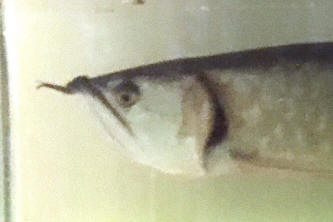
Arowana with gill curl 11/18/19
The bony portion has also been affected by this girl curling problem.
<So, that's that then.>
Is it curable with surgery.
<Not really. Bone doesn't grow back. Once damaged or deformed, the bone is that
way for life.>
Could you please suggest me
<Next time, use a bigger tank.>
Anything about this.
<Nope.>
Waiting for your reply....I consumes regular food daily.
<Good stuff. Arowanas with Gill Curl aren't seriously harmed, but they will find
it more difficult to pump water through their gills. So ensuring the oxygenation
of the water is top notch becomes even more critical. This is because the gill
covers normally form a pressurised seal that allows the fish to inhale each
fresh gulp of water. With the gill covers damaged, that pressurised seal is
lost, and the ability to suck in fresh water becomes compromised.>
I feed him live foods and chicken liver.
<Not sure about chicken liver to be honest, because of the risk of Salmonella
and other bacterial infections. Beef heart or lamb heart would be much safer.
These fish are primarily insect and small fish eaters. So the best foods are
small insects of various kinds, and as they get bigger, safe (i.e., not live)
fish, ideally saltwater fish. Tilapia fillet is safe too. As always, never use
live feeder fish, and minimise the use of foods with thiaminase (cyprinids,
shrimps, mussels).>
He is kept in a 5 feet length aquarium.
<Ah, much too small! Problem solved.>
One 30 Watts internal filter and air filter with sponge are provided.
<Likely under-filtered, too. You need something like 8-10 times the volume of
the tank in turnover per hour. So if you have 1000 litres, the filter needs a
turnover rate of 4000 litres per hour. Most likely this will be a number of
filters added together, but you get the idea, hopefully!>
Before buying this aquarium, it was in 2.8 feet aquarium. I think this limited
space may be the problem for this current condition...
<Yes.>
please suggest me anything..please..
<This is one of those situations where the ONLY cure is prevention. Once it's
happened, it's happened. You can't fix this. Sure, people will try and sell you
products or tricks, but they either don't work or are too unsafe. Anything
involving surgical intervention is unlikely to work, and will be very stressful
to your fish. Cheers, Neale.>
Arowana with gill curl 11/18/19
If this condition is not curable,
<Indeed not.>
how long will it live and survive.
<As long as a healthy Arowana, but do see previous message.>
It takes regular food every day. One 30 watts internal filter and air filter
with sponge are provided in the tank.. Can it survive for a long duration...
<Yes, with care. Cheers, Neale.>
Arowana with gill curl 11/18/19
So will my Arrowana live as long as a healthy one..?
<All else being good, yes. It will need a good environment (including swimming
space) and plenty of oxygen, but apart from that, it isn't at risk of premature
death.>
Will it grow up bigger than this..
<Silver Arowanas, Osteoglossum bicirrhosum, get to about 90 cm in length.
Occasional specimens may well be even bigger. But they do need an aquarium (or
pond) suitable for very large fish. 1000s of litres, really.>
Now it is in 5 feet aquarium and it is taking regular food daily..... Can I hope
for the best..
<Yes.>
Is this condition a serious problem to its health...
<Yes and no. Read my previous replies: Gill Curl affects their ability to pump
water across the gills, so additional aeration of the water may be needed. But
beyond that, Gill Curl doesn't cause any major health issues.
Cheers, Neale.>
|
Arowana Behavior; fdg. 9/25/19
Hello,
<Hello,>
I recently bought a Green Arowana (small guy) from my LFS.
<Hope you have a big tank!>
I also got a pack of freeze dried shrimps for feeding him. I have had
him for a week now.
<Shrimp is fine for a while, but contains thiaminase, so use sparingly.
Better foods are insects (such as mealworms and crickets) together with
small bits of white fish fillet (such as tilapia).>
One thing that I have observed from his behavior that he swims up
searching for food at particular times. I break a piece of shrimp into
two and he then eats the pieces. Once after he has had may be around
three to four pieces, he goes back down again and sits at the bottom of
the tank as if resting and swims at the bottom.
<Not normal.>
Is this a known behavior?
<How big is the tank? How strong is the filter? Arowanas will misbehave
in cramped conditions or still water.>
He looks healthy and doesn't seen to be looking weak or ill. When
checked with my lfs, they suggest to give feeder live fish during the
weekends and shrimp during the week.
<Terrible advice. Never use live feeder fish, unless you want a sick
fish!>
Can you please advise what would be a good feeding pattern (if any) and
also on the behaviour of the fish.
<See above. Wild Arowana mostly eat insects when young, so that should
be your start point.>
Thanks and regards,
Shriram
<Cheers, Neale.>
Jardinii Arowana 2/24/16
Howdy crew
I have found a steal on a jardinii Arowana and wanted to consult with the experts
here before I got it. I have kept many a large and aggressive fish before and
have adequate knowledge and space for such a beast.
<Fortunate, because these fish aren't easy. Usually kept singly, if for
no other reason than they tend to be aggressively territorial. Sometimes this
comes out of the blue, the fish tolerate a catfish or Oscar for years, then
overnight killing that tankmate. Their maximum length is around a metre, so a
gigantic tank is necessary for a fish that size; high hundreds to thousands of
gallons, that sort of size. That said, 70, 80 cm is more typical in captivity,
and you might get away with 500 gallons in that case. But do read up on Droop
Eye, Gill Curl, and various other problems caused by Arowanas in too-small a
tank.>
First off since I cannot keep an Asian Arowana as they are illegal, I want to
know how to encourage red coloring in this Arowana. Carotenoids in food and
anything else that will help?
<Carotenoids are the thing, but within a balanced diet generally. With
carnivores, the trick is getting the equivalent of gut contents (chyme) into
them. In the wild, this'd be partially digested plant material inside their
prey, and because they'd be eating a range of prey species, they'd consume a
wide range of plant material. Gut-loaded shrimps and earthworms
are one way, but ideally, you'd be using a top-quality pellet food or
alternatively a marine aquarium vitamin supplement.>
Secondly how true is their aggression? Are they as bad as people say?
<See above. Russian Roulette. One day nice; next day kills everything.
Might be nice for years. This species is notoriously unpredictable. Size of the
tank surely an issue, and whether or not the tankmates are perceived as threats
probably makes a difference. Stingrays perhaps less threatening than a midwater
Pacu or Oscar. But really, it's a crap shoot.>
I'd be getting the Arowana at 6-10" and the best tank I have for it is a indoor
pond containing lots of full grown pond comets and decent size koi.
If needed I can grow it up separately. I'm not worried about the koi or golds
hurting it or pestering it just don't want the jardinii assaulting the fish to
the point of death.
<Indeed. Because Arowana are so sensitive to poor water quality, and being
riverine fish appreciate strong water currents, it's hard to see how they'd like
the same conditions as Goldfish, which are pollution-tolerant and prefer
sluggish water.>
Thanks
<Cheers, Neale.>
re: Jardinii Arowana 2/24/16
Would any of this be different with a liechardti? In terms of
aggressive behavior. Not a lot of information on them that I can find
<Scleropages leichardti is usually a bit smaller and markedly less aggressive.
They normally ignore dissimilar tankmates: large Plecs, Thorny Catfish, etc.
Nonetheless, in simple practical terms Arowanas are best kept singly. Easier to
manage water quality, avoid physical trauma, etc. Cheers, Neale.>
Re: Jardinii Arowana 2/24/16
Ok thanks crew (Neale)
Ian
<Glad to help. Neale.>
silver Arowana
9/19/14
hi I have two baby silver Arowana...
<And a huge aquarium, I hope!>
the one is perfectly fine. the other little sick, he tends to swim for awhile,
quite fast if I may add, he then sinks down to the bottom of bed,
grasping for air, when done resting, then starts swimming, sometimes bringing
his head out above water, for air,
<Yes, they can breathe air to some degree... usually when stressed.>
his breathing fairly heavy.....I've feeding them centipi,
<Centipedes do you mean?>
shrimps and calamari rings,
<Do vary the diet; would also include a good quality pellet food... Hikari
Tropical Food Sticks for example are specifically formulated for
Arowanas.>
I've already did operation, gills
<???>
and I've already drop a few bladder tablets into water thinking he has infection
his bladder,
<Almost certainly not the problem.>
but still he remains the same, I haven't being feeding them for a few days, did
so today he didn't eat..... please advise thank you. 000 oh his a few cm in
length
<How big is the Arowana? How big is the aquarium?>
Kind Regards,
Thobaan
<Let's recap. Silver Arowanas are very large, easily getting to a metre (over 3
ft) in length. They are also quite delicate. "Gill Curl" and "Droop Eye" are two
classic symptoms of the unhappy Arowana. You need a massive aquarium, even for
young specimens. Assuming these are under a year old, say, 10 cm/4 inches long,
even a 100-gallon aquarium would be "small" by their standards. Water chemistry
should be soft and slightly acidic. They do not do well in hard water. Obviously
water quality must be excellent.
Lots of filtration with a strong water current is important. Arowanas are not
sociable. Single specimens are easiest to keep. They can also be kept in large
groups -- in public aquaria! -- but keeping 2 or 3 specimens in a home aquarium
will usually end up with the dominant specimen bullying the others. Bottom line,
my assumption would be living conditions are wrong (and unless you're a
millionaire, providing the right conditions at home will probably be impossible)
with social behaviour aggravating things. Do read Bob's review/s, here:
http://www.wetwebmedia.com/fwsubwebindex/osteoglossiforms.htm
http://www.wetwebmedia.com/fwsubwebindex/arowanafaqs.htm
If you're a rich, expert fish keeper -- then keeping a (single) Silver Arowana
is viable, in which case write back with some information on your aquarium,
filter, etc. But if you aren't a rich, expert fish keeper -- in all honesty,
rehoming both fish would be a very wise move.
Cheers, Neale.>
How big? Symphysodon/Arowana comp.... --
4/12/10
Hi crew,
<Hello,>
How big do you guys think my discus should be before I try to put them
in with my 14" silver Arowana?
<Oh, about 60 cm/2 feet across. Seriously. Keeping Discus with
Arowana is insane. Who told you that would be a good idea? That person
needs his bumps felt! Symphysodon and Osteoglossum spp. come very very
different
environments and have very different needs. Discus come from
slow-moving, very warm water; Arowana come from big river channels with
strong water currents and moderate temperature. Silver Arowana are
fairly peaceful, but they vary enormously, and some specimens can be
extremely aggressive.
Rehoming a subadult Arowana that's been battering your Discus will
be easier said than done. On top of that you need to feed a lot of food
to an Arowana to keep it healthy. But you also need to get food down to
the Discus without the Arowana eating it all. Given Angelfish steal
food from Discus, heaven knows how hard it'll be for the Discus to
compete with an Arowana! Regardless, the resulting high nitrate levels
from all this feeding will cause real problems for Symphysodon. I
can't see any sensible way of keeping the two species together in
the long term.>
Currently I have 5 clown loaches in the tank that measure from 1
3/4" to 2 1/2". The Aro looks at them occasionally but has
never shown any aggression that I've noticed.
<So far. Silver Arowana are not viable home aquarium pets.
Osteoglossum bicirrhosum gets to 120 cm (about 4 feet) long in the
wild, though around 100 cm (3.3 feet) is more typical in aquaria. The
minimum aquarium for one
of these monsters is 2500 litres (660 US gallons). Given how big they
are, that tank will need to be at least three times the length of the
adult fish and at least as wide front to back as the fish is long;
that's about 3 metres (10 feet) long and more than a metre (3.3 ft)
broad. Osteoglossum can be highly aggressive and will eat anything they
can swallow. Adult Clown Loaches might be okay, though the usual
tankmates are large Loricariidae, such as Acanthicus and Panaque spp.
Most Osteoglossum end up stunted and damaged by being kept in too-small
aquaria. Shame really, because they're lovely fish.>
My discus are 3 1/2" tall.
<Arowana food.>
Please tell me what you think.
<I hope you have a REALLY big aquarium.>
Thank you.
Pat
<Cheers, Neale.>
Many questions concerning Cycling, Floating Plants,
Acclimating Fish, etc, Arowana sys.,
FW 3/28/10
Hello WWM crew -
<Hi Raymond! Melinda with you here tonight!>
I have spent many an hour browsing through your articles online, and
before I start asking questions I would just like to thank you for all
the effort you guys have put into compiling such a large amount of
content about so many different subjects related to fishkeeping. Keep
up the good work!
<You're certainly welcome, and also thanks from the crew and
me!>
Now, onto my (numerous) questions:
- The water that I have at my house is naturally at a pH of 6.0. I like
to keep my pH at around 7.0 as it seems to be a good all around pH that
many different fish can adapt to. Is using baking soda to raise the pH
of the water a good idea? Will it help the buffering capacity of the
water as well?
<Yep. In fact, there's a great mix that will do this exact
job... I also have very, very soft water, and I treat about 1600
gallons of freshwater with it... different tanks, as well as an indoor
pond... all are at a steady 7.2, with a KH of 4! How's that for
consistency? Here's a link to the article which not only helped me
understand the relationship between KH and pH, but fixed my soft water
woes for good:
http://www.wetwebmedia.com/FWsubwebindex/fwh2oquality.htm
I cannot recommend this mix enough. It makes my life so easy, and
it's a cheap mix to make, and easy to measure, and... well,
you'll see.>
- Since the water that I get is well water, I never really thought that
I needed to let it sit (no chlorine type stuff in there). However, it
does pass through fairly old copper piping. Is that something that I
have to worry about, since some of the fish I plan on getting are
sensitive to copper (i.e. Clown Knife)? In order to ameliorate this
possible problem, is letting the water sit for a few days enough or do
I have to do more?
<Your local fish store should sell a test for copper, or may even
have a test on hand to run for you if you'll bring in a water
sample. This would answer the question as to whether copper is present
and at what amount.
Copper doesn't evaporate, as chlorine does, so letting it sit
won't help.
Poly-Filter will remove copper, though, if you've got a really high
concentration of copper in your tap water (yet to be determined!),
I'd really look at the costs of purchasing an RO/DI system versus
purchasing Poly-Filter in the long run. It could end up being a better
deal, especially for a large tank. It all starts with determining if
copper is present, though.>
- Does having plants in your aquarium at the start of the cycling
process make it faster? If so, at what stage should the plants be added
in (I'm mainly interested in the hardier, floating varieties of
plants here, such as water sprites, liverwort, etc)?
<Plants will absorb some ammonia, but I wouldn't expect them to
do the job completely, especially if they're just settling into the
system and not growing as well as they would once established. You can
add plants at any time, but I would cycle the tank using the fishless
cycling method, and just use your test kits to determine when
you're ready to add fish.>
- During the cycling process, should I change the water in the tank at
all?
And if I clean the clean the gravel of my already established 55 gallon
tropical tank and dump the "gunk" into the new tank the
cycling will be much faster correct?
<You can do water changes during cycling, but if you use the
fishless cycling method, you won't have to. This is really a better
method overall.
I can't tell you (but you have no doubt seen, with even a quick
perusal of the site) what problems come when folks try to cycle with
fish. As for the "gunk," it does contain beneficial bacteria;
however, I am much more in favor of using cycled, or seeded, filter
media instead -- more water flow through the media is beneficial.
Please read here on cycling:
http://www.wetwebmedia.com/FWsubwebindex/fwestcycling.htm>
- Would it be better to start a small (4-6 inches) Silver (or Jardinei)
Arowana and a Clown Knife in a smaller tank and then move them to their
larger tank as they grow or just have them start in the larger tank? I
was mainly worried about the ease of feeding, although a smaller tank
could be subject to wider swings in water chemistry.
<What is the "larger tank?" These fish all grow very, very
large (three to four feet for the Silver Arowana and the Clown Knife),
and though the Jardinei grows to a smaller size (Two feet or so), it
can quickly make life hell for other tank inhabitants. Jardinei
aren't at the top of the list for Miss (or Mr.) Congeniality...
please read here:
http://www.wetwebmedia.com/FWSubWebIndex/osteoglossiforms.htm
I would hope a tank for any of these fish would range in the
four-hundred gallon size, with beefy filtration... a big task, indeed.
I in no way mean to offend, but only to make you aware, if you are not
already, of what you're getting into with these fish. If you
properly establish the "smaller" tank, and use the mix
mentioned above to keep pH and KH steady and elevated, then chemistry
swings will not be an issue.>
- Would the floating plants liverwort, water lettuce, Amazon Frogbit,
or water sprites serve as adequate cover for Arowanas and Clown
Knife's to help prevent them from jumping? How would the floating
plants get along with a HOB filter?
<Arowanas will jump, no matter what is on the water's surface.
Clown Knifes aren't as big of a worry with jumping, and would do
fine with your standard glass tops. But, please do take my word here:
many Arowana owners have lost their three-feet long beauties to
jumping, and sturdy, sturdy covers is all that will keep them in the
tank. Think big, and heavy. More than a glass top. As for an HOB
filter, honestly, I'm not sure what place it has here. You're
talking about fish who need a turnover of eight to ten times per hour,
which, with the necessary tank size, is one heck of an HOB filter.
Filtration for these fish is often accomplished with huge wet-dry
systems, a ridiculous number of large canister filters, or some DIY
concoction. I keep large fish (3 Pacu and a S.A. Red Tailed Catfish, to
be exact!), and I find it incredibly enjoyable, so please do not think
I'm trying to discourage you. It just sounds as if you may not have
completely thought this one out! As for the plants with an HOB,
I've tried this one.
I found it annoying that the plants were constantly being
"sunken" by the output of the HOB... they float back up, but
it looks kind of funny. And they're sucked over to where it is, due
to the suction from the intake, so it's kind of hard to keep them
where you want them!>
- In terms of acclimating fish, I read somewhere that it is less
stressful for fish to adapt to a change in temp and pH than sitting in
a bag full of their ammonia / fish waste. This thing I read essentially
advocated dumping the bag onto a strainer of some sort and then dumping
the fish into tank water (not necessarily the tank), and then moving
the fish into the tank.
Would this be better than the drip method? Does this have any merit to
it?
<No. It would certainly stress them more. The drip method, or some
version thereof, would be better here.>
- Finally (!), a general question about fish eating other fish. I know
not to feed "feeders" bought from a pet store, and I saw that
you advocated not feeding things like baby convicts (amongst other
foods, such as krill) to fish for fear of the spines penetrating their
stomachs. If this is the case, how do fish that eat other fish in the
wild survive? Just a curious question.
<Fish in the wild enjoy a variety unmatched by what aquarists can,
or do, provide. Often, the fish fed to predatory fish in captivity are
coming from the most readily-available source, such as the pet store,
which carries, probably, minnows and goldfish. Therefore, there's
no variety being provided. It is the equivalent of a human eating steak
for every single meal -- that could, obviously, become an issue.
It's the concentration of thiaminase provided to most predatory
fish that becomes an issue -- that it's present in every single
meal. I have several predatory fish, only one of which refuses prepared
foods. I cannot stress the size difference in the two Florida Gars
which consume pellets, fish filets, squid pieces, and other tasty
delicacies to the fish which will only accept feeder fish. They are
fifty percent longer than him, and twice as big around, though they all
started at the same size! There is no doubt that variety is the key to
fish health when it comes to feeding, which is why fish do so well in
the wild, and why aquarium fish, when fed properly, do much better than
those that aren't. My advice is always that if your fish will eat
other foods, don't feed it feeder fish. It's just better for
everyone. For instance, have you even thought about how much effort,
space, electricity it takes to quarantine enough feeders for a
four-foot Arowana? Argh.>
Thanks for taking the time to read all my questions, and keep up the
great work!
<I've tried to be thorough here, because I absolutely don't
want to scare you off from keeping big fish. I just want you to know
what you're getting into! Please write back if you have any more
questions after reading.>
Sincerely,
Raymond
<--Melinda>
Re: Many questions concerning Cycling, Floating Plants,
Acclimating Fish, etc. Arowana sys., -- 3/31/10
Hi Melinda (or whoever ends up responding to this email) -
<Hi, Raymond!>
Before I begin, thanks for your very quick reply. I am also very
envious of your indoor pond .... someday, when I win the lottery
perhaps!
<Can be done cheaply... or I couldn't have done it!>
First off - yes, I am aware of how large Arowanas can get (and their
jumping predilection).
<Oh, good.>
The larger tank is a standard 300 gallon aquarium (a little narrow,
but...).
<Yes, this is where I would look into a possible pond... You could
build something very sturdy for the price of a 300 gallon aquarium,
especially if you're going with the whole kit-n-caboodle... stand,
canopy, and all can get quite expensive. This would allow you to really
take liberties with some heavy-duty DIY filtration, which you could
design to work with your pond design. There are message boards, sites
online for folks who keep big fish, and there are a lot of ideas out
there for ponds. This would allow you to control the shape, making it
plenty wide for your fish.>
In fact, I lost a 2-foot silver after he barged through my
weighted-down glass covers! Never again will I underestimate their
jumping ability.
<I'm sorry to hear this... as I said earlier, this is
all-too-common. At least you're not only not giving up, but using
acquired knowledge to improve, right?>
Any suggestions on how best to secure the lids? That being said, I
thought having plants on the surface would calm the Arowana down a bit,
encourage the Arowana not to jump (similar to lowering the water level
somewhat), and at worst serve as a sort of cushion if one does jump
into the lids.
<Ah, yes. Knowing more about your experience and your potential
set-up makes me feel a little better about answering here, "Yes.
They would be helpful." Haha! Floating plants plus sturdy cover is
better than what I was thinking before, which is that you hoped to rule
out jumping just with the plants. They can also help with giving him
some shade from the bright lighting we typically use in aquariums, what
with Arowanas being top-dwellers... could be a little bright for him.
As for securing lids,
I've honestly seen everything from tie-down straps (like you use in
moving) holding lids on, which isn't very pretty, to homemade heavy
wood lids coated in a waterproof epoxy or some other protective
coating, complete with an epoxy-coated frame around the top of the tank
to tank to secure or latch the lids to, which can look quite nice.
There's just not much out there, to my knowledge, that's sold
pre-made and will keep these fish where they belong!>
I also realize that Jardinei's are potentially very nasty fish. If
I chose to go the jardinei route I would keep it by itself.
<Is really the only way. It's sort of a Catch-22, because,
compared to the Silver Arowana, the Jardinei is a little easier to
accommodate at its adult size, but its presence often rules out any
other tankmates. For the 300 gallon you mention above, I think a
Jardinei would be a better option, seeing as how you'd probably end
up keeping the Silver Aro solo, or at least with very few tankmates,
due to the bioload his presence will have on the system,
anyway.>
Regarding the filtering question - the HOB's would not be, and were
not, the only filters - I was merely under the impression that they
provided pretty good biological filtration.
<Well, for biological filtration, you can't beat a canister
filter filled with biological media, simply due to how much media
(surface area for bacteria growth) it offers. I would skip HOBs here
altogether, and even if you do end up with a DIY filter or a wet/dry,
I'd still use a canister as redundant biological
filtration.>
I have been looking at setting up a wet/dry filtration system, as I am
tired of dealing with canisters. Are they less labor intensive than
canisters?
<I have not found my canisters to be labor-intensive at all! In
fact, I don't mess with them much, and I buy the filter pads in big
sheets and cut them to fit what canister I want them to go into, so
they're fairly cheap to maintain. I've run a wet/dry on a
freshwater tank once, before my catfish moved to his pond. I found it
fairly easy, but you do have to remember that we don't have the
ability to eliminate Nitrate in freshwater systems that marine
aquariums benefit from. So, extra attention has to be paid to ensuring
there's not a lot of excess waste on the bottom of the
wet/dry, and that, if bio-balls are used, they're not trapping a
lot of waste and allowing Nitrate to build up. I found this to be an
issue simply because the big, bulky sump wasn't as easy to move
around as the canisters, which sort of made it more of a pain to clean.
Obviously, though, you can make a sump as large as you want it to be,
and choose pump sizes to meet your filtration goals, so that sort of
indispensable in your situation! I guess there are pros and cons to
both types of filters, but when you're looking for the turnover
you're going to need for this fish, a combination of both would be
a good way to go. Plans are readily available online for DIY wet/dry
filters, so that could save you some cash in start-up costs, rather
than purchasing new, if you are so inclined. Have you ever used the
discussion board here on WetWeb? It would be a good place to start and
possibly get some ideas, and a good old Google search would probably
turn up more than you ever wanted to know about constructing/keeping
systems for these fish. Please do write back if you have any
questions!>
Thanks,
Raymond
<--Melinda>
Arowana Tank size 11/26/09
Hi Neale
<Hello again,>
I have silver Arowana of 7inches.
<Okay.>
Presently it is in 30inches X 15 inches X 18inches (height).
I am getting a new aquarium made for this silver Aro future
purpose.
<Excellent!>
I have a chance for 8ft in length. What are the advised dimensions?
<Wow, that'll be a perfect tank. Plenty of space for a catfish
and an Oscar, if you wanted them. Okay, in terms of size, the ideal
would be 8 foot long by 3 foot broad. You see, the aim is to keep the
fish in a tank as broad (from front to back) as the fish is long. Since
this species gets to about 3 feet in length in captivity, that's
the minimum breadth. Depth doesn't matter too much, since the
Arowana stays at the top. But a 3 foot depth would be good.
Realistically, a 6 x 2 x 2 foot aquarium is too small for Silver
Arowana, while an 8 x 3 x 3 aquarium would be excellent.
Anything in between would be okay, provided the breadth was closer to 3
feet than 2 feet. Make sense?>
Secondly what all I can keep inside for decoration such as which type
of live plants?
<I'd recommend floating plants since these stop the fish
jumping. Good plants for the middle of the tank would be plants
attached to bogwood, for example Anubias and Java fern. Since these
fish are messy, it helps that these plants can be moved about when you
are cleaning the tank. You can even remove them from the aquarium
without causing them harm, so that thoroughly cleaning the tank is
easy. They don't need any gravel at all, leaving more space for
water. If you did have a couple of inches of gravel, you could plant
some Vallisneria along the edges of the tank. These help prevent the
fish bumping into the glass.>
what type of gravel is advised?
<If you go with just floating plants and plants attached to bogwood,
you need very little gravel. Plain gravel to a depth of 1 cm or so will
be fine. Doesn't matter what kind you use, so long as it [a]
isn't brightly coloured and [b] is lime-free (so it doesn't
raise the pH).>
what type of other articles which can be kept inside which does not
disturb the Aro?
<Best not to add anything that fills the top half of the water
column.
Arowana want swimming space! A few pieces of bogwood on the bottom look
nice, and will provide a home for a suitable catfish such as Panaque
nigrolineatus. But otherwise, don't worry about decoration.>
Thank you in advance.
Asha
<Happy to help. Cheers, Neale.>
Re: Arowana Tank size 11/26/09
Dear Neale,
Thank you very much for the reply.
<My pleasure.>
But...but...with reply you added one doubt in my mind. You spelt out
names of catfish and Oscars? Do you mean I can keep them along with
Arowana?
<Yes. They get along well with Osteoglossum species.>
Or do you mean to say keep only catfish and Oscars in such a big
tank?
<No. You could keep your Arowana, an Oscar, and a Panaque catfish in
the same big aquarium.>
Asha
<Cheers, Neale.>
Please Advice... Arowana sys., fdg.
11/21/09
Dear Sir,
<Hello,>
I have 7 inches Silver Arowana. When I got it , it was of 6 inches
only. It is about one month with me.
<Still very much a baby.>
The aquarium size is 2.5 ft X 1 ft X 1.5 ft (height).
<Much too small.>
I have another aquarium of 42 inch X 18 inch X 24 inch (height) ready
to shift this Arowana when it grows.
<Good. But even this tank is marginal. Silver Arowana get to around
90 cm (~3 feet) long, and it's hard to keep them in anything less
than tanks 2 metres (about 6 feet) in length.>
I have been feeding him with guppies and Mollies. Can I continue this
or not?
<I would not be feeding them live fish at all. Are you breeding
these Mollies at home, or do you buy them from a pet shop? If you breed
your own feeders, that's relatively safe. But buying cheap fish
from a pet shop is very unwise. Since Arowanas eat all sorts of foods,
including pellets, it is safer and more nutritious to use these.
Crickets, mealworms, earthworms and river shrimps make safe live foods.
Wet-frozen foods like lancefish, prawns and mussels are good. Companies
like Sera make Arowana pellet foods.
I wouldn't use them all the time because dried foods tend to cause
constipation, but for about 50% of their diet, such pellets would be
ideal.>
I have not added any salt to the water.
<Good.>
It is doing very good.
<Nice to know.>
Do I need to add salt to the water?
<No.>
Murali
<Cheers, Neale.>
Re: Please Advice. Silver Arowana sys., fdg.
11/21/09
Dear Mr. Neale,
<It's just Neale. Or Dr. Monks. But between friends, let's
just stick with Neale!>
Thanks a lot for your inline reply.
<Happy to help.>
I will shift to the feed as advised by you.
<Great.>
But when I got it, I tried to give the feed of shrimps, pallets, dried
warms ...But it was not taking them.
<Often happens.>
They were lying till next day morning. Then I tried with Mollies and
guppies for which it was happy and eating. How can I migrate the baby
Arowana to the advised diet?
<Since he's eating these foods, "wean" him off them.
This means one day next week, offer him something else, maybe some
crickets or an earthworm.
Insects are the natural food of Arowana in the wild, and a perfect food
for them. If he doesn't take them, remove the uneaten food within a
few minutes -- and let him starve that day. Try again the next day. It
may take 2-3 days before he eats new foods -- but he will! Big fish can
go two weeks without food, so this isn't dangerous. Anyway, once
you have him taking other live foods (like mealworms, crickets and
earthworms) try him with frozen foods. A small piece of prawn or white
fish fillet is ideal. Use long forceps or a wooden satay stick to hold
the food. Wiggle the food to make it look alive. Hopefully, he will
come and bite the food. The idea is to teach him to eat anything you
offer. Eventually, predatory fish will eat all sorts of foods, because
they learn anything you give them is tasty and nutritious! Once that
happens, your Arowana will take pellet foods.>
Please advice me.
In an year how long the Arowana will grow?
<The usual estimate is one inch per month for the first year (in
metric,
that's about 2.5 cm per month). So you can expect a Silver Arowana
to be at least 12 inches/30 cm after the first year. In good
conditions, they can grow faster than this. So take this as the
MINIMUM.>
So that I can prepare for the advised size of aquarium.
<Plan ahead! 200 gallons/750 litres is often quoted as the minimum
tank size for this species, but honestly, they probably need more than
this to do well.>
Thanks in advance Mr. Neale.
<You are most welcome.>
Murali
<Cheers, Neale.>
Re: Please Advice, Arowana fdg., Oscar sys.
-- 12/08/09
Dear Neale,
Good Morning.
<Hello again,>
Now my Arowana is eating the food that I provide except for shrimp food
of Taiyo company. Some how it did not like this particular brand's
food.
<Give it time. "Hunger makes the best sauce" is an
expression we say in England; if you skip a meal or two, your Arowana
will eat this food!>
Well. Goo news is that my 6ftX3ftX3ft is getting ready. I want to keep
my silver Aro along with 2 copper and 2 tiger Oscars in that. They are
all together in the present small aquarium. I plan to shift them on
11th of this month.
<OK.>
Please advice me on the following things.
1. What type of stones/gravel should I fill in the bottom?
<Minimal. The Oscars dig, and the Arowana doesn't care. So use a
thin layer (2 cm maybe) just to cover the glass and stop reflections.
I'd go with smooth gravel of some sort.>
2. What type of filtration system is advised.
<Certainly some type of heavy duty canister filter will be required.
Given how sensitive Arowanas are, and how messy Oscars are, don't
take chances here! I'd go with at least two big canister filters,
so if one breaks down
or needs servicing, the other will still be running. The Fluval FX5
(900 gallons/hour) is a good budget option for really big tanks, and
has had quite good reviews. You might also consider using a small pond
filter instead. Aim for at least 6, and ideally 8-10, times the volume
of the tank in turnover per hour. Your tank is about 400 US gallons, so
aim for 2,400 gallons/hour, minimum.>
3. How much lighting will be advised. Either in luminous or size of the
tube light.
<Couldn't matter less. If you want some floating plants and Java
ferns to decorate the tank, then you'll need at least 2
watts/gallon given the depth of this tank. If you don't plan on
using live plants, then use whatever lights you think make the fish
look pretty. Gro-Lux tubes are nice.>
4. What kind of internal decorative advised?
<Minimal. The Arowana needs open swimming space. The Oscars will
need a few caves; terracotta flower pots and similar such things work
great.>
Thank you in advance.
Murali
<Cheers, Neale.>
Easy beef heart recipe 10/5/09
how can I make a beef heart mixture in home?
<You don't. You freeze the beef heart, cut off small amounts
when required, and then feed small pieces to your fish.>
how can I preserve it in normal temperature?
<You can't.>
is it a proper food for my Flowerhorn, Arowana and Oscars?
<It's an acceptable treat once or twice a week. Not a staple
food.
Flowerhorn cichlids should be getting a mixture of quality pellets plus
small invertebrates (such as mosquito larvae). Arowanas appreciate good
quality pellets plus insects, particularly crickets, mealworms,
beetles,
houseflies, and so on. Oscars will also take good quality pellets, but
they also enjoy "crunchy" foods including unshelled shrimps
and snails. All this information is on this web site: try exploring the
site to get the information you want. Cheers, Neale.>
|
Arowana pricing, anyone live in India?
Correction, addition 10/5/09
Dear CREW
<TIRTHA>
, I want to know the price of a normal Juvenile of 2 to 3 inch
Asiatic Golden Arowana in Indian Currency.
Is it a Jardinei Arowana? Is it male or female? Here is the pic.
Is it as costly as Asiatic Arowanas?
<This is pretty hard to convert. Looks like a Scleropages
formosa (Asian Arowana) to me, although
I'm not terribly experienced with Osteoglossiformes. Perhaps
another crewmember will chime in here. Regardless of species,
I'd expect to pay a pretty penny for an Arowana. Something
along the lines of 75 USD plus. According to Google, this is
about 3,570 rupees.
Will N.>
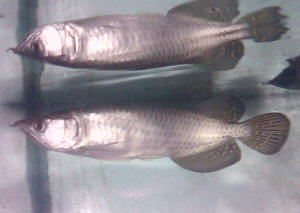
Is it a Jardinei Arowana? Is it male or female? Here is the pic.
Is it as costly as Asiatic Arowanas?
<<Tirtha, I do think this is a Scleropages jardinei Please read here: http://wetwebmedia.com/FWSubWebIndex/osteoglossiforms.htm
and the linked files above. Can't sex at this size, from this
image. Bob Fenner>>
What is the price of a 12inch
Jardinei Arowana in India and what is the price of a 24 to 30inch
-- 10/22/09
Hi Crew,
pls give me a info what is the price of a 12inch Australian
Golden Pearl Jardinei Arowana and what is the price of 24 to 30
inch??
<No idea. We can't offer valuations on fish.>
What is the final size of a Flowerhorn?
<Typically 30-45 cm. Cheers, Neale.>
is jardinei Arowana costly as Asiatic
Arowana? I have a jardinei
here I am posting the pic pls tell me is it a male or
female?
Dear crew, it is my 11 inch jardinei I bought it at the size of 2
inch.
<A nice looking fish.>
now what should be the price of it? is it as costly as a normal
Asian golden Arowana?
<No, Scleropages jardinei is generally not expensive.
There's not much demand for them because they are incredibly
aggressive and not particularly colourful.>
is it male or female?
<You can't sex Scleropages spp with external features.
Females with eggs may well be stockier than the males, and mature
males may well be more aggressive, but that's about it.
Cheers, Neale.>
where can I get a juvenile of 2 to 3
inch Asiatic golden Arowana in Kolkata, West Bengal,
India?? 10/5/09
<No idea. Try finding an online fish forum for aquarists in
your part of the world. Or perhaps a tropical fish club in your
city. They might be able to help. Cheers, Neale.>
|
 |
|
Re: Arowana pricing, anyone live in
India? Correction, addition
Arowana pricing, anyone live in India? - 10/05/2009
Dear CREW
<TIRTHA>
, I want to know the price of a normal Juvenile of 2 to 3 inch
Asiatic
Golden Arowana in Indian Currency.
<This is pretty hard to convert. Looks like a Scleropages
formosa (Asian Arowana) to me, although
I'm not terribly experienced with Osteoglossiformes. Perhaps
another crewmember will chime in here. Regardless of species,
I'd expect to pay a pretty penny for an Arowana. Something
along the lines of 75 USD plus.
According to Google, this is about 3,570 rupees.
Will N.>
Is it a Jardinei Arowana? Is it male or female? Here is the pic.
Is it as costly as Asiatic Arowanas?
<<Tirtha, I do think this is a Scleropages jardinei Please
read here:
http://wetwebmedia.com/FWSubWebIndex/osteoglossiforms.htm
and the linked files above. Can't sex at this size, from this
image. Bob Fenner>>
<<<Ahh, my bad. I apologize, Tirtha and
Bob.>>><<<Will N>>>
No worries Will. Please do write out your responses on
"new" lines... Makes it easier to read (and not to get
lost!). BobF
Will do. I was getting a bit confused myself, good advice.
<Thank you Will. B>
|
Enhancing the gold colour in Asian Arowana --
09/03/09
Dear WWM Crew,
I am interested in learning how to enhance the gold colouration in the
Asian Arowana, in particular the golden variety. I would appreciate if
you could point to relevant literatures in this respect, if any.
Many thanks and best regards
Seow Lim
<Colour in Asian Arowana is largely genetic, and you "get what
you pay for". As with any fish though, the best colours depend on
environmental factors and a good diet. Most fish should their best
colours in a dark
tank, in particular things like a dark substrate (black sand for
example) and overhead shade provided by floating plants. A stressed
fish won't show its best colours, so you need to ensure an Arowana
has plenty of swimming space and excellent water quality. Tankmates, if
any, shouldn't be aggressive or nippy. Diet is central, since at
least some fish colours can only be produced when the fish eats the
right things. In particular, algae and crustaceans seem to be
influential. In terms of algae, pellets may work best, either directly,
or stuffed inside frozen fish or prawns. For crustaceans, things like
*unshelled* shrimps and krill work well. On the other hand, a bad diet
will mean an unhealthy fish, so a loss of colour.
Live feeder fish would be the obvious, most foolish way to feed an
Arowana since these have a very high risk of introducing parasites.
Furthermore, carp family fish (such as Goldfish and Minnows) contain a
lot of fat, and there's ample evidence this caused problems in
predatory fish. Similarly,
thiaminase is an issue, so you want to restrict foods that contain this
substance to once or twice per week. Goldfish and Minnows (and
seemingly all carp) contain this stuff, another reason not to use
feeder fish. But
numerous seafoods contain it too, including shrimps.
http://www.wetwebmedia.com/ca/volume_6/volume_6_1/thiaminase.htm
So, in short, you can't add colour to an Arowana beyond what its
genes allow, but you can ensure you get the very best colours your fish
can have by providing the right habitat and the right diet. Cheers,
Neale.>
Re: Enhancing the gold colour in Asian Arowana --
09/03/09
Dear Neale,
Many thanks for your almost instantaneous reply.
<My pleasure.>
Whilst I recognise that the colour of the Asian Arowana is largely
genetic, I was wondering whether the use of certain colour enhancing
substance such as Astaxanthin would help to bring out the best of the
gold colour in the golden Arowana.
<Not substantially. If you could feed an Arowana and make it look
like a more expensive one, then that's what people would be doing!
Why buy a $5000 Arowana when you can just feed a $50 one and get the
same results! While there's plenty of "colour enhancing
foods" out there, none of them make a huge difference.>
This usually involves two processes. The first is to reduce the dark
colouration on the back of the golden Arowana which I understand is due
to the effect of counter shading so that the back colour will be
lightened
exposing the shine of the fish.
<Not sure I quite understand this. Fish generally make their backs
darker to match a dark substrate. The idea is to become less visible to
predators (like birds) above them. Bright lights above them (like the
sky) makes them lighten the colours of their bellies, so that
they're less visible to predators underneath them (such as bigger
fish). Whether or not Arowana do this is debatable, particularly in the
case of farmed, artificial forms.>
The second is the attempt to bring out the gold colour of the fish
which I understand is done in a number of ways including the use of
lights in what some refer to as "tanning" as well as the use
of colour enhancing foods or supplements.
<The food supplements specifically mimic the chemicals in
crustaceans and algae mentioned earlier, for example carotene. Regular
fish foods often lack these chemicals. Colour-enhancing foods have
extra amounts of them, so that the fish can produce their best colours.
Only specific colours are enhanced; e.g., carotene improves reds.
Carotene is found in crustacean shells, hence my suggestion to use
whole, unshelled crustaceans. If you're feeding a diet that already
includes algae and whole crustaceans,
colour-enhancing foods will have little/no effect.>
I would appreciate if you could share some of your knowledge with
us.
<By all means experiment, but don't expect dramatic results.
Most of the colour on an Arowana comes from its genes, and to some
degree how well these are displayed depends on its environment. A
varied diet will enhance those colours, but it won't dramatically
change them.>
Many thanks and best regards
<An interesting topic worth discussing. Thanks for writing.>
Seow Lim
<Cheers, Neale.>
Smuggling Arowanas This is my first email to you fine folks,
though I am a loyal reader. Heard about this story on the local news,
thought you might be interested. <Thank you for sending this along
Joe. Will share. Bob Fenner>
http://www.buffalonews.com/cityregion/niagaracounty/story/377129.html
LEWISTON -- An officer at the Lewiston-Queenston Bridge thought there
was something fishy about two men from Long Island who tried to cross
the bridge into the United States over the weekend. And after the
officer questioned the two men for a while and searched their vehicle,
he arrested them on charges of smuggling four Asian dragon fish -- an
endangered species -- over the border. Robert Battaglia, 40, and
Richard Feustel, 59, are accused of illegal importation of wildlife.
They were arrested by U. S. Customs & Border Protection officers
Saturday and appeared in federal court Monday. Officers said the live
Asian Arowana fish were found in bags of water, hidden in the spare
tire well of the car. Authorities said Battaglia told officers he paid
$1,000 each for the fish in a Toronto pet store and was planning to
take them to New York City. Authorities said the long, slender fish are
considered lucky by some Chinese people because of their resemblance to
a Chinese dragon. The fish were turned over to the U. S. Fish &
Wildlife Service to be used as evidence by federal prosecutors. Customs
& Border Protection officials said the fish are considered an
endangered species and cannot be possessed in the U. S. without a
permit.
Future Housing for Arowana, Clown Knife, Bichir
05/23/08 Hi WWM Crew, <Ray> Before anything, I just want
to compliment you guys on the great job you guys do. I've spent
many an hour browsing through all the articles on your website and
I've found it very helpful to my own fish keeping experiences. In
any case, let's get on to the question! <Okay!> I currently
have a 135 gallon tank with a ~18 inch silver Arowana, ~8 inch pike
cichlid and about a foot long Bichir in it (not sure what species
though - definitely not ornate and not Senegal Bichir though). I also
have a 125 gallon tank with a foot long clown knife in there with a 6
inch sun catfish and 2 ~3 inch sun cats. I know that I have to upgrade
to keep these beautiful fish for life. My question is three fold.
First, can a tank measuring 8 ft long by 2 ft wide by 30.5 inches high
(that's around 300 gallons) hold all these fish for life, or if
not, for quite a while? <Yes... likely so... the Arowana... if it
doesn't "jump out"... the rest for sure> Secondly, can
the pike cichlid coexist with the clown knife? <Yes... unless the
Notopterid gets much larger, faster... and consumes the Cichlid>
It's already fairly territorial, though it doesn't seem to
bother the Arowana or Bichir too much. I'm worried about mixing the
pike with the clown knife though. <Oh! It very likely will
know/knows to leave the Knife be> Finally, before my Arowana downed
thawed, previously frozen shrimp like none other, oftentimes eating 4
or so with no problem. However, ever since I've come back from
college, he refuses to eat any shrimp at all, and totally ignores them.
The Bichir still eats them so it's not a problem if they fall. My
parents assured me that while I was away the only thing they fed him
were newts and earthworms, as well as floating cichlid pellets, that
were caught from my yard (we don't use any pesticides / fertilizers
at all). Do you have any idea why this is so? <Mmm, why your parents
fed what they did? Or the Arowanas new preference? The last likely from
practice, distinction> Thanks in advance, <Bob Fenner>
|
Arowana and Silver dollars in a big planted
tank, sys. 2/29/08 Hi, I have a question that has many
different angles to be looked at. I have been reading your
website for the past 2 or 3 years and have scoured about 50% of
the freshwater info as I have found it invaluable. First off, I
have a pretty big L shaped aquarium, 8 ft long, 45 degree angle
of 4 feet, then another 45 degree angle of 8 feet with the tank
being 2 feet deep and 2.5 feet tall acrylic tank (about 900
gallons +/- 50 from evaporation etc.). Ammonia and nitrites are
of course zero, nitrates are between 20 and 40ppm (attributed to
nitrate factory type trickle Bioball sump), pH at a steady 6.8
attributed to the large pieces of driftwood I have in their and
their tannin releasing ways, hardness is at 80ppm. Temperature
ranges from 74 to 76F in the mid to upper levels, 72-75F in the
lower levels, due to lighting I guess. Filtration turns the tank
over about 5-6 times an hour, though with cloggy filters, maybe
only 3 times an hour. <Does sound like you need to upgrade the
filtration a bit; in all honesty jumbo fish need all the turnover
you can get. I'd be looking at 6x turnover minimum, and
likely 8-10. If water quality is basically sound, you can perhaps
get away with just adding a powerhead or two into the tank to
keep the circulation of the water even.> It currently houses a
foot long silver Arowana and a school of 11 silver dollars (the
smaller 5-6" ones, not the red hooks). I also have 4 fairly
young (only 1 foot tall, about 20 leaves) Amazon swords planted
in 2 inches of gravel, and a whole bunch of Anacharis that's
growing like a weed (for the silver dollars munching pleasures)
though it is growing much faster than the fish are eating them.
<Sounds great!> I also have some powerful full spectrum
lighting across the two 8 foot lengths of the tank, nothing in
the middle of the L. My more concerning question, or more likely,
situation, is that my Arowana (I've had it since it was
around 5") recently started taking dives at my silver
dollars as they swim on their merry way beneath him. Is this a
show of territoriality or is he trying to eat the silver dollars
or both? <Either. Both. Arowanas are territorial and object to
anything in "their" zone of operations. This varies
with species, and Silver Arowanas are very much at the mild end
compared with, say, Scleropages jardinei. But on the other hand
that doesn't make them friendly community fish! If the
Arowana is sufficiently big, it may be trying to eat them, or at
least "sample" them to see if they're edible. A
6" Silver Dollar is borderline when it comes to safety with
an adult Arowana. Some people have mixed them fine, I know; but
look at how big the mouth of an Arowana can get! I wouldn't
be 100% comfortable with this combo.> The silver dollars are
way faster than him though so I have not yet scene what happens
when he catches them. He is usually just silently sitting beneath
a carpet of Anacharis during the day and only moves when fed
(Hikari Arowana pellets plus weekly beef heart, plus whatever
flakes, crumbles, bloodworms I feed the silver dollars) or when
the lights are off. Also, I read that Arowanas generally
leisurely patrol the aquarium all day and I figured now that I
finally built my uber aquarium (oh that's right, self made...
20% of the retailers price... plus several cases of beer and
pizza for friends who assisted in heavy lifting. <Ha!> Is
it possible that my lights are too bright and the Arowana
doesn't feel safe or its hurting his eyes, though he did just
swim around normally for about a month until he started to
"hide"? They are power compact fluorescents, 525 watts
per light fixture, 4 total fixtures. This is a major concern to
me as I have been keeping fish for the better part of a decade
wanting an Arowana but refusing to get one until I could house it
properly and now he just sits there. At night I have moonlighting
and he does then move around quite a bit, this is why I suspect
the lighting, but I never thought they were nocturnal... more
diurnal from what I read. <Difficult to say on this one.
Arowanas are noted for being photophobic, though most fish prefer
shade to bright light. Do all the lights come on at the same
time? Sometimes fish get alarmed by that, and having the lights
come on across an hour makes a big difference. It does sound like
he doesn't like the light. Is adding an understory of plastic
plants (there are some great 3' plastic plants available now)
an option? Something that could drape across the surface and cast
some more shade? I suppose the experiment would be to unplug one
light fixture for a day or two, and see if the Arowana prefers
that end of the tank.> My next question has to do with the
silver dollars and them seeming to enjoy eating the Amazon swords
more so than the Anacharis. Is there some other large show plant
that does well under high lighting that the silver dollars wont
want to eat? <I'd perhaps look at Crinum spp., e.g., C.
calamistratum, as these do seem to be left alone by herbivores.
They're big and generally hardy. Java fern will do great
under bright light, though it does tend to become an algae
magnet. Anubias even more so.> Also, my swords aren't
exactly growing as well as they had in past tanks with 4-5 inches
of gravel. Does the gravel depth make that much of a difference?
<Yes; also the quality/composition of the substrate.> I
have something like a thousand Malaysian trumpet snails aerating
the gravel and what not but am concerned that if I add more, the
snails just wont be able to irrigate and aerate all that gravel,
and the last thing I want is some anaerobic environment
unreachable by plant roots or snail burrowing releasing poisonous
hydrogen sulfide and the likes into my tank, plus stinking up my
fish room. <Just doesn't happen. The "anaerobic
decay" thing is largely a myth. Happens naturally in ponds
and in marine tanks (inside living rock) and no-one fusses. So by
all means ramp up the depth of substrate to what worked before.
Do also check first that the substrate is adequate though --
Amazon swords want a nice rich soil or laterite enriched
substrate, and plain washed gravel just won't work for
them.> Should I consider ditching the silver dollars for a
school of tinfoil barbs? They don't eat plants at all do
they? <Tinfoil Barbs can, will eat plants.> And lastly, as
you may have guessed it, I want to add more fish to this tank as
it seems fairly empty... I'm thinking black ghost knife?
<In theory fine, but you'll be hard pressed finding an
adult large enough for this community. Mostly you only see baby
Apteronotus for sale.> I first filled up the tank about 8
months ago, filling it with something like 100 Malaysian trumpet
snails and about 20 mystery snails for my tank cycling. I over
fed the snails for 3 months in order to obtain the current
population explosion of snails I now have, <Consider adding a
group of Clown Loaches or thorny catfishes (Doradidae). These
will eat the snails, if sufficiently hungry.> at the end of
month one I added the sword plants, then I added the silver
dollars at the end of month 3, all at about the size of, well,
silver dollars. They mostly hid in the center decor castles of my
tank for the first two weeks but then began to sprint (if you
will) from one end of the tank to the center and back (they
seemed to never travel into the leftward portion). After having
them in there for 2 months, they had grown to about 3" in
diameter each and I added my Arowana at 5". After only
another 3 months the Arowana (from what I could tell) doubled in
size, which I attributed to it having so much space to swim.
<Or simply good maintenance. Arowanas grow quickly if kept
well.> Now I added the Anacharis about 2 weeks after the
Arowana was added and it was generally ignored by all but a
couple of snails. Then a month ago (beginning of month 7) is when
the Arowana began to just sit under the Anacharis. So yeah, back
to the black ghost knife... I want to buy two of these guys (I
figure the tanks big enough) and I put two PVC condos with 15
pipes of 2" diameter and 1' length in there, one in each
8' portion. Should I be concerned about the Arowana eating
them as I often find the knife fish around 4-5 inches in length
max, and it will be some time before they grow to their 2'
potential where the Arowana wont (hopefully) eat them. Are the
black ghosts fast enough to evade the Arowana if pursued? <No;
sooner or later, if they're small enough to swallow,
they'll be eaten. The Arowana only has to get lucky once!>
And for the record, despite clown knives growing huge and not
being swallowable by my Arowana, they will probably eat my silver
dollars and knock over my plants, and just grow too big for my
taste, so that options out. <I agree.> Well, that's all
for now. I literally read all over the web for months and
abstained from just writing you guys since I know how annoying it
can be to be asked simple questions that have their answers
everywhere... but I just cannot find anything like this Arowana
diving at silver dollars thing while not swimming anywhere else.
I am a student of the sciences, my job being that of a
biochemist, therefore I was cocky, stubborn, and reluctant to ask
for help (a character flaw repeatedly pointed out by many over
the years)... but there are just some things you cannot learn in
books. I'll likely have another question or comment in a
couple of months after the knife fish are added... if they are
compatible. Thanks in advance for any advice you can provide.
With Best Regards, Matt <Hope this helps, Neale.>
Re: Arowana and Silver dollars in a big planted tank (RMF,
please comment) 2/29/08 Well It looks like
I'm going to be upgrading my sump pumps using some pond pumps
to get that water flowing up to the 10 times over level. I
currently have four overflow filters going into four 55 gallon
tanks... I guess I will just have 4 extra pumps to sell on
aquabid.com as I replace them with the pond pumps. The pumps I
have looked at are reporting 1800 gallons an hour (Danner Supreme
Mag Drive Aquatic pumps, I currently own the 1200 gph pumps)...
am I going to need larger sumps or will this push through the 55
gallon tanks just fine? <No idea; RMF, any
thoughts?><<I would definitely be reading, making
careful choices here... There is much to be saved in the way of
electrical cost, pump noise, waste heat, service life, by making
good decisions re pumps... The Sequence series/Baldor motored
lines are some faves for the size, application here. Other
fractional horsepower pumps are ably reviewed here on WWM:
http://wetwebmedia.com/pumpselmar.htm and the linked
files above. RMF>> This company also sells a 5000,
specifically designed for large ponds and waterfall displays
which reports 5000 an hour. Is that overkill or should I add one
or two of those in too? I guess two 1800 and two 5000 gives me
13600 gallons an hour claiming about 15 times an hour for the
whole tank... realistically maybe 11-12 times an hour turnover?
<Probably overkill. 8-10 times turnover should be
adequate.> As for the silver dollars not being fully
compatible, I will look into giving them a new home. I have just
been keeping silver dollars for 7 years now and figured I was
pretty good at it. My last batch of 7 didn't die, with the
oldest being 5 years old starting in a 55 gallon and moving up to
a 120 gallon for the remainder. I just gave them to the LFS
before I moved halfway across the country for the job that would
allow me to have such a lavish aquarium. What other fish come to
mind, that would be an attractive school of 15-20, that could be
raised in one 8 foot section (separated by a divider) until large
enough to not be eaten by the Arowana? I'm thinking Bala
sharks? <A good choice. But also Semaprochilodus taeniurus
look amazing in large groups, and are nice Amazonian fish.> I
read they get to 12-15" and from my limited experience, are
very fast. <Oh yes.> Do they eat plants because I cannot
find info saying that they do, but then again, I was wrong about
the tinfoil barbs. <Balantiocheilos melanopterus generally
ignores plants. It eats green algae and invertebrates, and may
nibble on tender shoots, but that's about it.> Maybe 6
months separated, grown to 7-8 inches then set to survive with
the Arowana? <You may also be able to get adults via Fish
Forums, fish clubs, etc. Lots of people buy them, and then have
to rehome them when they get too big.> Are their any other
fish you could recommend as I have limited experience with large
schooling fish. <There are a lot of nice big barbs. Severums
would also look quite nice, and occupy the midwater. They're
territorial when spawning, but your tank is big enough that
shouldn't be a problem. What about catfish? Sorubim lima is a
nice big (45 cm/18") schooling catfish. It's very
peaceful, pretty, and quite easy to obtain. It famously likes to
swim vertically leaning against plants and rocks, so is
definitely fun.> As for the lighting, the timer IS set to go
on all at once come 10am and turn off at 8pm. Some sunlight does
come through the one window and glass door to wake the fish up,
but I guess that is nothing compared to a full 2000+ watts
blazing into their eyes all at once. I can turn on the actinics
at 10 am, then 2 of the other full spectrums on at 11, and the
rest at 12... and then shut them off in the same manner (off to
Home depot again for more electric timers). I assume this will
still be ample light for the Anacharis and Amazon swords.
<Should be. Try it, and see what happens!> And I do have
two 3 foot plastic plants draping across the top of my tank which
cover an area of maybe 4-5 square feet each. They are located in
between the Amazon swords as to not rob them of light. I
don't really want to put much more over the plants, but there
are still many other places in the tank to add another 4 to 5 of
those 3 footers without disrupting light to the live plants. I
will give them a try since they are cheap and fairly realistic
looking. As for the other plants, I do have an Anubias growing on
a piece of driftwood, though the plant is 3 years old, started as
3 leaves, has maybe 30 now, and has only moved about 1 foot
across the driftwood (3 foot long driftwood). It used to be house
with a Pleco so perhaps his constant sucking of the driftwood
would constantly cull the Anubias... or maybe the thick film of
algae growing on its leaves is inhibiting it? <I've tried
Anubias with my Panaque, and it gets turned into a Swiss Cheese
Plant, so I agree with you here!> Ill try out the C.
calamistratum when I find it. If nothing else the LFS can order
it for me. <Mail order plant distributors abound, and this is
a fairly common species, at least here in the UK.> I do have a
Sailfin Pleco in there too. He's only about 8 inches long
though so he is having a problems stopping all the algae as of
yet, though I have faith in him (or her, I cant tell yet).
<Once they mature they aren't really algae eaters, so
don't hold too much store by this. Plecs generally are
omnivores, and algae is only a part of their diet.> As for my
substrate, it is just painted black artificial gravel. I add
trace minerals for the plants, but I guess that's just not
going to cut it. <Indeed.> It will take some time to clean
all 200+ lbs of gravel out, but I would say in half a years time
I should have 4 inches of laterite enriched substrate in there.
<Can't begin to tell you how much I sympathise! Anyone who
has grown aquarium plants (or tried, at least) will have been
through the mill of changing substrates.> I guess I wont be
getting the black ghost knife anytime soon, if ever, aw well.
<Again, look out for "second hand" specimens.>
Maybe I'll get some water in my 120 and raise him in there
until he's big enough for the show tank. <Quite.> And
perhaps I misspoke about the snails as a pest, as I want them in
their. I have never been able to keep a tank as clean as I do
when I have snails in their. <I wonder if Apple Snails would
help on the algae front?> I once had a tank with 4 yoyo
Loaches in there that cleaned out the snail population, there was
a gradual decline in water quality, and an increase in detritus
and algae that I fought for a year... I removed the loaches to
the LFS and my tank recovered to crystal clarity in 3 months
time. <Not impossible.> Therefore, largely based on this
single experience ( I know, that's poor scientific form) I
like to always have snails. And despite the appearance of (now
about 100 mystery snails) snails crawling all over my tank with
about 1 snail on every 4 square feet of glass (or I guess
acrylic), I find it more peaceful and artful than an eyesore.
<Indeed.> It looks to me as though your experience in the
trade has done it again. Thank you very much for your assistance.
Matt <Good luck, Neale.>
|
Baby silver Arowana constantly
terrified? 2/16/08 Hello, I am writing to you out
of concern for my silver Arowana. Guess I should start with the
details: 1 baby silver Arowana, 4 inches long (nose to tail-tip) 1 inch
"tall" Tank size: 55 gallons (long) currently, once he gets
larger he will be moved to a 200 gallon Tank mate: 1 Siamese algae
eater, 1.5 inches long (nose to tail-tip) Temp.: 75 - 80F Ammonia: 0
Nitrite: 0 Nitrate: usually <10 I add a bit of aquarium salt (the
marine salt variety, not the cheap boxed stuff at Wal-Mart) with each
water change (10-20% at the end of each week) <Arowanas don't
need salt, and in fact few species naturally occur in brackish water.
So unless you have some overwhelming reason to add salt, I'd tend
to skip this.> I have had my Arowana for about a month and a half
(The tank used to contain gouramis and has been fully cycled for a
year.) About a week ago, when I woke up, I found my Arowana, Percival,
darting frantically against the side of the tank, like he was trying to
swim through the glass. The tank has a hood, of course, and a light
which I don't really use at all (sunlight during the day, no light
at night.) He looked absolutely terrified, but he was not
"gasping" or breathing any faster than normal. He kept
swimming at the glass, darting up and down, trying to get
"through." He has not stopped since that morning a week ago.
He darts up and down the same side of the tank, wearing himself out.
Sometimes he rests on the gravel at the bottom of the tank, hiding in
his fake plants. This is very scary to see, since Arowanas are supposed
to glide gracefully at the surface. Since his snout has been rubbing
against the glass for so long, he's got a white "scab"
built up. It's not a fungal infection, since it's not
strand-like or fuzzy. It only appears on his snout where he has been
rubbing it against the tank. I am adding the aquarium salt and a little
Melafix to hopefully prevent any infection, though the wound isn't
open. <Not a big fan of Melafix, though perhaps useful enough as a
preventative. If the wound does go bad, do turn to a "proper"
medication.> What could be causing this behavior? He swims like
he's terrified, like something is chasing him. I don't know
what to do for him, I've tried covering the tank for a day to block
out any light, but this hasn't helped. I tried to do more frequent
water changes, but he only becomes more terrified and I'm afraid
he'll have a heart attack or knock himself unconscious! I hate to
see my once majestic baby so utterly frantic for no apparent reason.
Please help, and thank you so much for your time. -Amber <There are
two likely issues. The first is the size of the tank. Arowanas are open
water fish, and they can be easily spooked in small tanks. They will
often try to jump, and in doing so, damage their snouts, which is
likely the cause of the physical damage you're seeing. The second
issue could be the placement of the tank. Things like loud TV sets,
banging doors, or simply people constantly moving past the tank can
make fish nervous. This varies of course, and some fish settle down
quickly, but others do not. In any case, I'd think about whether
the tank is in the best place in your home. Do also add some big
floating plants to create shade. This will help inhibit its jumping
behaviour. Do also review water chemistry; while Arowanas are
definitely adaptable, extremely hard or soft water won't be
appreciated. Fish tend to be nervous when water quality or chemistry
aren't in their "comfort zone". Check water quality an
hour or two after feeding, just to make sure that the zero
ammonia/nitrite levels you report actually hold 24/7. Cheers,
Neale.>
Re: My story and questions... Arowanas, CITES &
Ammonia 11/22/07 Neale, <Andy,> Thank you very
much for the quick reply. That's what I really like about you guys.
Quick and straight forward. Some people may take your advice the wrong
way, but you're just being honest and I take it as constructive
criticism. <Good oh.> Your reply really gave me a wake up call. I
should really stop bringing home fish that attract me from the LFS and
start planning a goal for the tank. <Exactly.> That's not
something many others would say. <Perhaps not.> I always had the
mentally of aggressive fish with other aggressive fish would be a
balance but I guess not. <Doesn't work like that.> I will be
trying to find good homes for my fellow friends since I am not capable
of providing tanks for all the different individuals. I really hate to
see them go, but it must be done. <Quite possibly.> Just a few
more quick questions, and I'll try to stay out of your hair as much
as possible. As of current, do you know if/are freshwater stingrays and
Asian Arowanas still illegal in CA/USA. I'm getting contradicting
information on this issue and can't find it in Department of Fish
and Game web site. <They are NOT legal in the United States. The
situation is this: Scleropages species (Asian Arowanas) are listed on
the CITES appendix 1. This allows for trade only if the animal in
question is captive-bred or otherwise certified to not be reducing wild
populations by its sale. So in Europe, you certainly can buy Asian
Arowanas. It costs thousands of dollars, and there's paperwork to
sign and electronic chips in the fish, but there is at least a trade in
captive-bred fish. In the US, Scleropages are further controlled by the
Endangered Species Act in addition to CITES, and this prohibits any
sale of any listed species regardless of whether captive-bred or
wild-caught. Until such time as the ESA is amended to exclude
captive-bred specimens of listed species, Asian Arowanas will not be
legal within the United States. You can read an FAQ on the topic of
pets here: http://www.fws.gov/international/permits/pets.html and
specifically on Scleropages here:
http://www.fws.gov/permits/faqs/FaqB.shtml#bonytongue > As for the
170 gallon tank, does one Jardinei or Flowerhorn and a Scarlet Pleco
(L-25 Pseudacanthicus sp.) sound reasonable to you? <Sounds fine. If
you find this works and all your fish are happy, you might well be able
to add another catfish, just not a Plec. Arowana tend to be more
tolerant of bottom dwellers than midwater or upper-level fish. In any
event, start with a few fish, see how things work in terms of nitrates
and social behaviour, and then act accordingly.> As for the 55er,
what's my best way to correct the circulation issue. Due to it
being a concealed tank with pre-cut slots on the top, I am unable to
add another hang on filter or external power filter. Should I just
modify the Emperor 400 with extended intake tubes to the side corners?
<I'd simply add two or three marine aquarium powerheads. There
are some nice units with magnetic holders so you can attach them
wherever you want in the tank. A friend of mine has some of these
called 'Hydor Koralia' in her reef tank and they seem to work
very well.> I suppose internal power filters or Wavemakers/water
pumps might work, but are very distracting when viewing the tank.
Another step would be to do some cutting/drilling work, but I want to
leave that as a last resort due to the disturbance it would do to the
tank. <Indeed.> What's your recommendation here? <If all
else fails, add another canister filter. No single addition to your
hardware will have so many benefits: water quality, aeration,
circulation, and current for fish to swim into. Powerheads and
airstones make viable alternatives, but they don't improve
filtration.> Another question is for human ingestion of
ammonia in drinking water. Reading many FAQ's from WWM crew
(mainly BF) dislikes the idea of ammonia in our tap water. <Ammonia
is toxic and we certainly don't need to consume it, and adding it
to aquaria is obviously A Bad Thing. On the other hand, as with
everything, it's the dose that matters. Trace amounts won't do
humans any harm.> Yet, recently I received another e-mail from my
water company stating, "There are no current standards for
California for Ammonia. Health Implications Ingestion of large doses of
ammonium chloride has been shown to cause headache, nausea, diarrhea
and failure in glucose tolerance. However, ammonia is not an immediate
health concern, and there appears to be little risk to humans from the
ingestion of ammonia in drinking water. There is no evidence that
ammonia is carcinogenic. However, ammonia is a source of nitrates and
may compromise disinfection efficiency and filter performance. Ammonia
is not currently regulated by USEPA. Canada has no guideline for
ammonia. WHO has a non-health-based guideline based on avoiding
consumer complaints." <Standard answer really. What they're
saying is since there's no provable connection between low ammonia
concentration and health problems, they aren't going to get sued,
and so aren't bothered either way. Given the other problems
California has to deal with in terms of water (i.e., actually getting
enough to serve the population) I'm certainly sympathetic to them
not sweating over the small stuff.> From what I get of this, our
water if fine for ingestion? What do you think? <I'm not a
doctor (well, I am, a PhD, but what I mean is I'm not an MD!) so I
can't really give advice here beyond saying ammonia isn't a
good thing to have in water at least from a fishkeeper's
perspective. Ammonia is definitely toxic to fish and has been
comprehensively proven to be so in laboratory conditions. Even as
little as 0.5 mg/l causes death in some species and weakens others to
the extent of reducing resistance to diseases such as Finrot. On the
other hand, if you have human health worries about your water supply,
that's something to discuss with a medical practitioner rather than
an aquarist!> Welp that's it for now. Thanks a lot for your
time. Reply is greatly appreciated. Andy. <I hope this helps,
Neale.>
|
Very Sick Arowana! HELP! Hello WWM crew.
First off, your time is greatly appreciated! I have searched all
over your website and all over the web and can't seem to find
what I am looking for. Hopefully one of you will have an answer.
One of my silver Arowanas is very sick. First here are some of
the details of the tank, setup, and water parameters. I have a
website for my tank on myarowanatank.googlepages.com so you can
check out the basics of my tank. 4 months ago I received 7 baby
Arowanas. 4 Jardinei's and 3 silvers. They are currently
range from 5 inches for the smallest jardinei to 11inches for the
biggest silver. They are in a 150 gallon tank <... not
altogether...> with a sump operating volume of 42 gallons. I
know it is small but that is for a reason. I am keeping them in
that small of a tank so they do not get territorial. <This
won't happen...> I have had zero fights because of it. I
have 430 gallon tank ready for them when they get a little
bigger. <I would move them now... at least all the
silvers...> I will eventually have an even larger tank for
them when they need it. So despite the size it is setup to handle
the bio load for all of them right now. I am OCD about my tank
water. I do 10% water changes by gravel vacuuming daily which is
automatically replaced by the RO/DI and auto fill system. I
maintain KH with baking soda. There is also a 36W UV before the
input into the tank. Ok so the water during the day is at. pH =
6.8 - 7.0 Ammonia = 0 always Nitrite = 0 always Nitrate = always
less than 5, usually zero GH = 60 always KH = maintained between
20 - 40 PO4 = 0 -.5 <All look good> Now one of my silvers
is very sick. 3 weeks ago I noticed white scratches on is head
and white around his lips. It looked like damage from hitting
stuff which they occasionally do and not like cotton mouth.? I
added a little salt and the head mark went away in about 4-5
days. However after a few more days the lips were still not
healed and I noticed his appetite dropping off. (All 7 eat 1000
crickets a week right now!) <Need more nutrition than this>
I hand feed them and pet them so I knew something was wrong. He
would only take food if I held it in front of his mouth for
awhile and was very slow and not aggressive when he would finally
eat it. But appetite dropped from 20 to maybe 4 crickets a day.
He is know pretty skinny and still has white lips and has lost
all of his appetite yesterday. Last night I caught him vertical
tail on bottom head straight up. I took him out of main tank and
put him in the plant refugium. Added aeration, salt, stress coat,
and some extra minerals to the water. After an hour he was back
horizontal and is also ok this morning. But still weak and no
appetite + plus is breathing a little slow still. Now I have
carefully inspected him from head to tail. There are no white
lice or spots anywhere on his body. His head itself is healed and
looks good. But his lips are still white both lower and upper.
However the lips are not hairy or fuzzy. It doesn't look like
cotton mouth or ich but I am no expert. Any ideas? I usually feed
crickets but occasionally give them feeders. I believe it came
from a batch of Rosie minnows several weeks ago. Although they
were quarantined for a week with no deaths or apparent problems
first. So any recommended medications or treatments? Also none of
the other fish have shown any problems after 3 weeks now. I want
this fish to live at all costs! I can take pictures if needed.
PLEASE HELP! Sincerely, Robert Bledsoe <Again... better, wider
nutrition and move the Osteoglossum bicirrhosum to the larger
system... they will fight there in time as well... the real
issues here are diet and stress. Bob Fenner>
Very Sick Arowana PLEASE HELP! Neale's much more
thorough go 11/11/07 Hello WWM crew. First
off, your time is greatly appreciated! <You're
welcome.> I have searched all over your website and all over
the web and can't seem to find what I am looking for.
<Ok.> Hopefully one of you will have an answer. One of my
silver Arowanas is very sick. First here are some of the details
of the tank, setup, and water parameters. I have a website for my
tank on myarowanatank.googlepages.com so you can check out the
basics of my tank. <I'd sooner you summarised this here.
Kind of a pain to have to open up another browser window and
trawl through a whole bunch of stuff to find what I wanted. All I
really care about is water chemistry, tank volume, filtration and
diet. But nice tank though.> 4 months ago I received 7 baby
Arowanas. 4 Jardinei's and 3 silvers. <You do realise the
Jardinei's will pulverize the poor South American
Arowanas?> They are currently range from 5 inches for the
smallest jardinei to 11 inches for the biggest silver. <Quite
a selection. There are, as I hope you know, territorial,
non-schooling fish. Unless the tank is the size of a pond,
it's one to a tank.> They are in a 150 gallon tank with a
sump operating volume of 42 gallons. <Way too small for this
number of Arowana. Two compatible South Americans might coexist,
but even a single Jardinei is going to own that space, and treat
anything else in there as either [a] dinner or [b] target
practise.> I know it is small but that is for a reason.
<Indeed...?> I am keeping them in that small of a tank so
they do not get territorial. <You're joking, right? These
aren't Mbuna or mudskippers, where this sort of idea makes
sense. Each of these fish gets to around a metre in length, and
most of that is solid muscle. The sheer bio-load on the filter
alone is reason enough NOT to keep them all in a tank this size.
If you want to stock multiple South American Arowana, it's
something around 150-200 gallons per fish. With Jardinei, it just
isn't viable because of their incredible aggression.> I
have had zero fights because of it. <No, you've had no
fights because they're babies. Give 'em a few more
months. Once the Jardinei are half-grown, the males will be
causing a LOT of problems.> I have 430 gallon tank ready for
them when they get a little bigger. <Ah, that tank will house
two, maybe three South Americans. Or one Jardinei. Your
choice.> I will eventually have an even larger tank for them
when they need it. <I hope so. The seven South American
Arowanas are going to want something like 1000-1500 gallons. And
one Jardinei will take over that tank all by itself given the
chance.> So despite the size it is setup to handle the bio
load for all of them right now. <Well, they're not
"all right" at all. You have one dying Arowana. This is
what happens when you have too many mutually aggressive fish.
I've seen it with Archerfish, halfbeaks, angelfish, Mbuna,
and so on ad nauseum. One fish gets sick, and dies thanks to
stress and an inability to get enough food. A few weeks or months
later, another fish dies. And then another. And then another.
Until there is one left, the dominant male.> I am OCD about my
tank water. <Good.> I do 10% water changes by gravel
vacuuming daily which is automatically replaced by the RO/DI and
auto fill system. I maintain KH with baking soda. There is also a
36W UV before the input into the tank. Ok so the water during the
day is at. pH = 6.8 - 7.0 Ammonia = 0 always Nitrite = 0 always
Nitrate = always less than 5, usually zero GH = 60 always KH =
maintained between 20 - 40 PO4 = 0 -.5 <All seems fine.>
Now one of my silvers is very sick. 3 weeks ago I noticed white
scratches on is head and white around his lips. <Skin damage.
From fighting or jumping. Quelle surprise.> It looked like
damage from hitting stuff which they occasionally do and not like
cotton mouth.? <Treat as per Finrot.> I added a little salt
and the head mark went away in about 4-5 days. However after a
few more days the lips were still not healed and I noticed his
appetite dropping off. (All 7 eat 1000 crickets a week right
now!) I hand feed them and pet them so I knew something was
wrong. He would only take food if I held it in front of his mouth
for awhile and was very slow and not aggressive when he would
finally eat it. <Likely stress. This is what happens when fish
are stressed. They go into a "retiring" modus to avoid
contact with aggressive fish, I suppose. In any case, the best
(only) cure is to remove the fish to another tank and allow it to
rest and feed peacefully.> But appetite dropped from 20 to
maybe 4 crickets a day. He is know pretty skinny and still has
white lips and has lost all of his appetite yesterday. Last night
I caught him vertical tail on bottom head straight up. <Nichts
gut.> I took him out of main tank and put him in the plant
refugium. Added aeration, salt, stress coat, and some extra
minerals to the water. <Wasn't aware that salt was
beneficial to Arowana. They naturally inhabit fairly soft water.
I'd be looking for more specific treatments here, in
particular to deal with secondary bacterial infections, which are
likely the cause of the skin problem.> After an hour he was
back horizontal and is also ok this morning. But still weak and
no appetite + plus is breathing a little slow still. Now I have
carefully inspected him from head to tail. There are no white
lice or spots anywhere on his body. His head itself is healed and
looks good. But his lips are still white both lower and upper.
However it lips do look like they are getting fuzzy or hairy so
it could be cotton mouth but I am no expert. <It's just
secondary infections setting in. As I say, treat as you would
Finrot and/or Fungus and be done with it. Salt isn't really
helpful, and neither is Melafix-type stuff.> Any ideas? I
usually feed crickets but occasionally give them feeders.
<Crickets are fine, but they are pretty monotonous and unless
you are gut-loading them then hardly a balanced diet. Mix it up,
and use either a range of insects or a mix of crickets with
carnivore pellets. Feeder fish are an incredibly bad idea with
Arowanas. Goldfish and other Cyprinidae are right out, because of
their fat content and Thiaminase, but any feeders you didn't
personally breed yourself should be treated as parasite/bacteria
time bombs. I'm not sure why so many fishkeepers can't
grasp this: they spend $1000 on an prize Arowana, and then feed
it a 10 cent goldfish taken from a tank with billions of other
goldfish many of which are quite obviously sick and all of which
are nutritionally incredibly bad for most predatory fish.
It's insane.> I believe it came from a batch of Rosie
minnows several weeks ago. <Even better. Did you breed those
Minnows yourself? And gut-load them? And de-worm them? And treat
them with a systemic antibiotic? If the answer is "No"
to any of those questions, why on earth were you feeding them to
fish you purport to care about? Feeder fish -- unless you breed
livebearers or something safe yourself -- are nothing more than
disease time bombs. Don't use them.> Although they were
quarantined for a week with no deaths or apparent problems first.
<Indeed.> What would be the best thing to do for treatment?
<Finrot/fungus medication of a type safe for use with Arowana.
Quite possibly their is an internal bacterial infection as well,
given the odd behaviour of this fish. An antibiotic or
antibacterial may help.> Any specific medications or
treatments? Also none of the other fish have shown any problems
after 3 weeks now. I want this fish to live at all costs! <In
which case, consult a vet. Largish fish like Arowana can respond
quite well to prescription medications better than those offered
by pet stores.> I can take pictures if needed. PLEASE HELP!
<Certainly, a photo of the head of this fish would help pin
down the precise infection. But I'm fairly sure it's some
sort of secondary infection caused by [a] being bitten by a more
aggressive fish (they fight jaw-to-jaw and jaw-to-tail) or [b]
hitting its head on the roof of the tank while trying to escape
from something. My money would be on one of the Jardinei throwing
its weight around. While your plan might work with South American
Arowanas, and maybe even some of the Asian Scleropages, in my
opinion Jardinei are just too mean.> Sincerely, Robert <I
hope this helps Robert. Your project looks fascinating and I
entirely understand your love of these superb fish. But I suspect
you have taken on rather more than would be wise. Sincerely,
Neale>
|
|
Re: Disease Identification On Arowana 11/12/07 Hi
Crew, <Alan> Possible to identify the disease (see attached
pic.) that's on my Arowana's head. Currently it's in
a hospital tank with aquarium salt and heater set to
32°C. Will this do? It's already a week and
doesn't shows any sign of improvement. Any other remedy
that'll speed up the cure? Thks. In advance. Regards. Alan
<... is the physical trauma Neale and I have told you about...
No "treatment" recommended... other than what's
been stated re the dire need to separate these fishes. Please
read here: http://wetwebmedia.com/FWSubWebIndex/bonytongfaqs.htm
Bob Fenner>
Re:... Disease Identification On Arowana...
still not understanding... 11/13/07 Hi Crew,
Thks. for the reply. Sorry for being in doubt, but it looks
fungus (whitish film over certain top scales) to me. Will adding
of antibiotics helps? If it's really caused by physical
trauma, then is it advisable to put it back into the main tank
with the rest of the fishes? Thks. in advance. Regards. Alan
<... not worth treating... can't be put back in...
RMF>
|
|
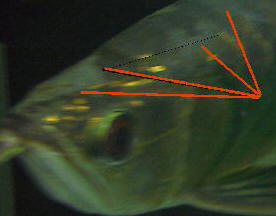
|
| Re: Very Sick Arowana update! 11/16/07
Thanks for the response! First off let me say I am taking your
advice and all the Jardinei's are going! The largest Jardinei
is getting very aggressive and herding the 3 smaller ones to the
bottom of the tank. <Indeed. This is what they do.> The
largest jardinei is being sold to the owner of a LFS in 3 days.
<Good. They're lovely animals -- but one to a tank!> The
others I will get rid of ASAP with care of course. <Good. You
will find that the largest male left behind will become aggressive,
and so on as you remove them.> Then the silvers (hopefully 3 not
2) are going to be moved to the 430 gallon until they grow a little
bigger. <OK.> Now as for the sick silver. I isolated him for
5 days in the plant refuge and treated him per instructions with 2
packets of 200mg Erythromycin, aeration, and a daily 25% water
change before each daily redose. The mouth wound or infection has
healed considerably and has lost its fuzziness and just left the
slight erosion on the end of the lip. <This will heal in due
course, but some scarring may remain. Often the "new"
skin has a different colour to what was there before. This is
particularly commonly seen in fins, but can happen on the body as
well.> He appeared to be swimming fine and a lot more active but
will not take food. <Not a problem in the short term. More
important he heals.> So I placed him back in the main tank
hoping it would encourage him to eat. <Which he won't if
he's being bullied there. I'd keep a sick Arowana on its
own. Really, they're best kept alone anyway, and if you going
to mix them, they all need to be healthy.> He has not eaten for
about 7 or 8 days now. How long can they go without eating?
<Several weeks. Do try alternate foods. South American Arowanas
have a great fondness for insects, so try offering a variety of
different insects. Beetles are apparently their favourite food.
River shrimps, if you can get them, are also excellent, and few
predatory fish ignore earthworms. Don't worry too much though.
When the fish is healthy, it will eat.> Now back in the main
tank I watched him closely for several hours. During the day he was
horizontal and swimming with a slight waddle. After the lights
turned off at night I found him vertical again. He would curve or
coil his tail up and try to touch his body. At one point he was
swimming in a out of control spiral. After a while he would be back
up top swimming normal. Then back on the bottom head up again. I
have looked him over very closely. His fins look perfect! The only
thing I can see is a small red tinted spot approx 1/8 -3/16"
in diameter which u can barely see. When he was still I looked
closely at it with a flash light. It appears to have a pin head
little spot in the middle of it. This is the only thing I can see
on his body. I have attached a few large pictures now if that
helps. <Please next time send smaller photos -- it takes forever
to download 14 MB of photos via an e-mail client. We do explicitly
ask for photos no larger than a few hundred KB each.> The first
picture is when I placed him in refuge for treatment. The other
night time photos where just taken (last 2 show red spot on lower
jaw / gill area. What do you think?? Should I treat for fungal,
parasites, or different bacteria? Again thanks for your time.
Sincerely, Robert <He needs to be moved back to his own tank and
kept there, end of story. Get the fish settled down and healed. I
don't think there's any seriously wrong with your fish.
It's noticeably underweight, yes, but that's easy enough to
fix with a mixture of live invertebrates and good quality pellets.
The antibiotics or antibacterials will take care of the secondary
infections. My guess would be this fish is at the bottom of the
pecking order, and putting it into the big tank is simply futile.
It's a fish that needs its own tank where it can swim about and
feed naturally. Ultimately you can't medicate this problem away
-- it's a question of husbandry. Arowanas are not schooling
fish in the wild and they are not sociable fish in aquaria. They
are territorial loners, and the males especially are pretty nasty
towards one another. What you're trying to do is fight against
nature, and that's a battle I don't think you can win. If
you happen to get a few specimens that coexist, that's great,
but there will likely be specimens that will not coexist, and they
will HAVE to be re-homed. Cheers, Neale.> |
|
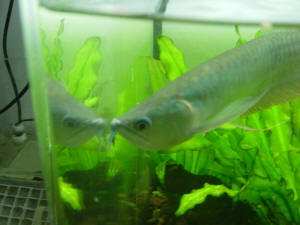
|
Swimming Problem... need info.
10/23/07 Hi Crew, <Alan> One of my fish can't seem to
"dive down" no matter how hard she try and the back is always
expose above the water level. She's swimming in a horizontal
position and not those with head tilted downwards. What's the
cause? Should I start to isolate and medicate her or will most likely
recover on its own? Pls. advise and thanks in advance. Regards. Alan
<Mmm, is this saltwater, fresh? What species of fish? Such
disorientation can be the result of trauma, poor nutritional
conditioning, diseases of various sorts... And their resolution a
reflection of cause... If a goldfish... a good guess... Please read
here: http://www.wetwebmedia.com/FWSubWebIndex/gldfshmalnut.htm and the
linked files above. Bob Fenner>
Re: Swimming Problem, Osteoglossid
10/24/07 Hi Crew, <Alan> Sorry for missing out the type of
fish, it's an Arowana. Should I take her out and into the hospital
tank with medication? Pls. advise and Thks. Regards. Alan <I would
NOT move this fish... much more likely trouble in doing so than not.
Likely the root cause here is either a physical trauma (highly likely
from jumping) or "trapped gas" inside from a blockage... In
time this should pass. I would leave this fish where it is, be careful
re feeding only small amounts of cut up food. Bob Fenner>
Scleropages jardinei, repro. info./input --
06/18/07 Mr. Fenner, <Well, it's Neale.> I have owned a
jardinei for two years now. <Very good.> I would like to know if
there is a definitive way to sex my fish. <No. Hobbyists sometimes
refer to "longer fins" and "brighter colours" but
there's no evidence at all that this is valid. Australian fish
scientists simply maintain these fish have no reliable sex
differences.> I learned the female of the species carries the
fertilized eggs unlike the other types of Arowanas where the male is
the one that does so. <Didn't know that. Thanks for sharing.>
If this is the case, is the female jardinei the one with a more
protruding lower jaw (is that a valid way of sexing)? <Apparently
not.> Your assistance is appreciated. <It's a bit academic
really, because these are by far the most territorial Arowanas, and
you'd need a gigantic (i.e., public) aquarium to keep more than one
specimen. Nice fish though.> Thank you, Adrian Espiritu <Cheers,
Neale>
Arowana with Anchor Worms 3/16/2007 Hello Crew,
I
tried to email you thru the website but it would not go thru. I have a
5 inch Silver Arowana and I noticed it had a few Anchor Worms on him.
Well I looked it up on the internet and found several ways to treat
Anchor Worms, and I am not sure of the best way to go. So I was
wondering if you could help? <Gladly>
I
have him in a 55 gallon tank with 2 Leopard Plecos (3 inches each) and
2 Sun Catfish (3 inches each). The Plecos and Cats look fine. I do have
a Hospital tank set up and running as I type (35 gallon long), but I am
not sure what to do. What treatment method should I use and what
Medication? Do I have to treat the 55 gallon even if I move him? <I
would treat this main tank, either in addition, or leave the Arowana in
place, and treat it there as well> I am just lost right now and do
not want to lose my Aro. If you have any ideas on how I should handle
this issue please let me know. <Do get some help... as I suggest you
carefully net out and hold this fish down (gently) and use tweezers to
remove the adult worms/crustaceans from the Arowana (pull near their
points of insertion, away from the fish (toward the tail)... daub the
area where they're removed with a Mercurical (e.g. Mercurochrome)
on a cotton swab (e.g. "Q-Tip")... and treat the water for
intermediate forms with an Organophosphate... (e.g. Fluke Taps, Dylox,
Masoten...) Please read here: http://www.wetwebmedia.com/PondSubWebIndex/contrpdparasit.htm
and the linked files above. Bob
Fenner> Thanks
in advance, Sara N.
Arowana compatibility, sys. 12/28/06 Hello
there, and happy holidays! <And to you and yours> My family
currently has a lovely Arowana at about 19" in length. He's
been living in a 46g tank, <!> but we're getting a 100-125g
tank soon. <And larger soon afterward I hope/trust> It's
about 60" in length, would that be a suitable length for him,
since he's the only Arowana? <Not really... may/might I ask,
would you like to live in a world that is four times your length?>
I've read in other sources that they may develop eyes that turn
downwards from being overfed. Is that true? <Mmm, not really from
being overfed, but more as a consequence of captivity period... living
in small containers, looking downward... running into objects...> He
does have a slightly bulging eye (his other eye was damaged &
it's blind), <...> but I don't believe we overfeed him.
He's on a diet of Hikari Food Sticks, a random assortment of flake
foods, bloodworms, and random bugs/earthworms. <ditto...> As far
as other fish for the new tank goes, we're a bit uncertain as to
what he'd take kindly to. Our local retailer says that teacup rays
are suitable (we'd buy only one), <... well... found in S.
America... this is... a start... and do tolerate/appreciate similar
water quality> and since they're both from the same region,
their preferences for water types and everything are similar. Is this
true? <Truth? Scarce can I name but fearful thunder echoes in mine
ears...> What kind of gravel/sand substrate should we use, is there
a recommended type? <Most anything that fosters biological
filtration... Covered on WWM> Also, for the simple fact that they
have barbs... how likely is it that they might injure the Arowana or
us? <Barbs? Osteoglossid fishes? Mmm... not to worry> And also,
how much should we expect to pay for a teacup stingray in NJ, USA?
<Perhaps a few tens of dolares per unit> Another fish we
considered was the Silver Dollar (a group of 6, at about 4-5").
Though I think they seem a bit small because of the Arowana's
presence, <Agreed> the store owner assured us that because
they're so round and fast, they're safe. <Getting past time
to look for/at other LFS's> However, if they are so fast, would
they stress the Arowana out? <Yes> And wouldn't he still bite
at them, perhaps not to kill, but still causing a sufficient amount of
damage? <Too likely in a small volume> As for the tank itself, I
tend to stock mine heavily with plants. Would the ray uproot it all,
and the silver dollars devour them that quickly? <Very much
so...> What sort of balance should we aim for? <My friend! That
is beyond me... perhaps yourself!> Thank you, Christina <Thank
you, Bob Fenner>
Jack Dempsey vs. Arowana 9/19/06 Hello, Best site
I've come across!!! < Thanks for your kind words.> I'm a
new aquarist, so this may seem like a silly question. I have a 30g
freshwater tank with a 6 in. Jack D. that is quite interesting. I feed
him all sorts of food & he is aggressive when feeding. I really
want an Arowana, but have read how aggressive they are. I plan to start
a 150g in about 6 months. Do you think this might work? Thanks for any
info-Joe < Am afraid the Jack Dempsey may not
tolerate the Arowana and may harm him. This will be up to the
individual temperament of the Jack Dempsey.-Chuck>
Greetings Halo Mr. Fenner Robert, <Greetings> I would
like to introduce myself, my name is Dendi Sjafriadi, I live in Jakarta
Indonesia. <Ah, I have been to many parts of your country and am
visiting there (the Gilis, Lombok) this May...> I've been
keeping animal mostly fish for about 15 years. I do this for hobby.
After I seen your writing here I would like to know more about Asiatic
Arowana ( Scleropages formosus ). At the moment I have 3 Asiatic
Arowana which in Indonesia we called it Arowana. The colour is still
dark gold ( maybe if it is older it will become red ). <How
nice!> I raise it hoping I can breed them. <A worthy goal> But
until know I don't have a writings which tell the different sex.
<A bit hard to judge in Scleropages... but the "dissimilar
jaws" measure still holds... go look at some mature individuals
with an expert to help you.> In your writing above I don't get
it clear. And for the picture you put above is the Silver Arowana.
<I will check this, thank you> Thank you for the attention.
Regards, Dendi <Bob Fenner>
Asian Arowana mouthbrooding I found a webpage that said that
male Arowanas mouth brood. I was not aware of this. <This is
so.> Would it be possible for you to send me a couple of references
that describe the parental habits of Arowanas (scientific journals if
possible)? Thank You S. Daly <Hmm, all I have on Bony Tongue fishes
is cited (mainly "pet-fish") on the section of that name on
the Freshwater part of the site: www.WetWebMedia.com... But there are
also works on the site that detail how to "do" computer
searches for bibliographic work (like Fishbase.org, BIOSIS, The
Zoological Record...). Do read these over and seek help with a
Reference Librarian in the Life Science section of a college library.
Bob Fenner>
Arowanas? Hey, I'm trying to help my mom out because she
wants to put an Arowana or two into her 400 gallon tank as a show fish
for her restaurant. I would like to know if you could give me any links
to good breeders or retailers of Arowanas. <Mmm, I know of some
breeders of Scleropages in the orient... but there are none in the U.S.
as far as I'm aware... If you have the time, patience, it's
better to grow one up yourself... or barring this, make an exhaustive
search through local to not-so-local fish stores in your area...
leaving your business card for them to call you should someone come in
looking to trade theirs> Please send me an e-mail back soon, she
would like to get started as soon as possible. Also, is it possible to
keep more than 1 male and 1 female Arowana together in a 400 gallon
tank? Thank You. <They can be kept together... but getting them to
do when they're larger... is tough at times. Lastly, for sure do
make sure the top is completely covered... great jumpers. Please read
here: http://www.wetwebmedia.com/FWSubWebIndex/osteoglossiforms.htm
Bob Fenner>
Arowana and Ray Biotope Tank Hi, I'm setting up a 225
gallon Arowana tank with Rays. <Even though 225 gallons in rather
large, it is still a rather small tank in comparison to the fish you
selected. I do not think you could safely stock more than two of
each.> I would like to use a few live plants to make them a little
more comfortable. <I think the Rays would wreck any live plants.>
If I am only using a few plants how much fluorite should be used <I
would stick to a sand bottom for the comfort of the Rays.> and what
kind of plants. <Perhaps you could grow some Java Fern attached to
something. There would be little danger in it becoming up rooted.>
Thanks, Dave <Good luck! -Steven Pro>
Re: Arowana and Ray Biotope Tank Thanks for the info and the
225 is only for 2 years until we build our dome home where there new
tank will be the circumference of 30' by 3' wide 4' tall
with a main tank connected at one end 10' x 4' x 4'
<Wow! Truly impressive concept. Do send us pictures when done.
-Steven Pro>
Arowana with a Moray Eel I have recently purchased an Arowana
and a Fresh Water Moray Eel( looks just like the one in the picture).
<Not a good choice to mix these two very different fish from very
different environments.> After reading through the articles on the
Eel, I understand that it prefers a brackish water more. Right now I
have a 55 gallon fresh water tank. <The 55 is way too small for the
Arowana, my friend. Your LFS did you a disservice by selling you a fish
that needs a standard 180 as an absolute minimum.> PH is between
7.6- 8.0, Nitrate is fine and the there is no Ammonia, at a temp. of
about 80 degrees. What should I do, will adding some salt water to
accommodate the Eel effect the Arowana? <You are not going to be
able to strike a happy balance for these two. My best recommendation is
to return the Arowana and turn your 55 into a brackish tank.> For
this tank what would you recommend everything should be at. Thanks for
your time. <Further info can be found here
http://www.wetwebmedia.com/FWSubWebIndex/osteoglossiforms.htm here
http://www.wetwebmedia.com/fwmorayeels.htm and here
http://www.wetwebmedia.com/bracsetup.htm -Steven Pro>
STI News: Fish farmers going all out to stop thieves (Arowana
Rustling) This message was forwarded to you from Straits Times
Interactive (http://straitstimes.asia1.com.sg) by
perrychong@hotmail.com <Thanks Perry. Will post for our Arowana
keepers. Bob F> Comments from sender: Pet fish trade in Singapore
Fish farmers going all out to stop thieves by Ginnie Teo SOMETHING
fishy's going on in the ornamental fish scene, and fish farmers
here are not taking any more chances. One fish farmer who lost $20,000
worth of Arowana recently is installing a $5,000 security system.
Another is putting up a surveillance camera that enables him to keep an
eye on his prized fish even while he is at home, via his computer.
Other farmers are also beefing up security by carrying out more patrols
of their farms or keeping a closer watch on suspicious characters who
enter their shops. This comes after a recent spate of thefts which saw
over $140,000 worth of ornamental fish being stolen. Arowana specialist
Goh Kok Gan was one of the unlucky victims. He lost seven of his
precious charges on March 22 when thieves walked out of his Jalan Bukit
Ho Swee shop, Dragon's Home, with them while the attendant was busy
talking to customers. The fish were worth close to $20,000. Mr. Goh has
since installed surveillance cameras. He said: 'We already have a
security system in place at night to detect intruders, but we
didn't have one to watch over shoppers. 'This should help deter
thieves. Hopefully, we won't become victims again.' Mr. David
How, 50, of D'Koi Universe at Farmart Centre in Choa Chu Kang, has
linked his surveillance camera to his home computer. He couldn't
have timed it better. Just last week, he caught a student stealing an
expensive guppy from his shop. He said: 'He took the fish from my
shop and was already at another shop trying to steal again. Luckily, my
brother caught him.' The 14-year-old boy was released with a
warning. Over at Qian Hu Fish Farm in Jurong, over $100,000 was spent
on hiring security guards, training guard dogs and installing a
surveillance system before it opened in 2000. And it is not a one-time
cost. The system costs $2,000 to $3,000 a month to maintain. Qian Hu
has also embedded microchips into its Arowanas. These contain
electronically-coded information such as the farm producing them. This
means that stolen Arowanas can be tracked down. But some fish sellers
say that, sometimes, simple precautions are the best. Mr. Benjamin Wee,
26, who runs PetMart at Serangoon North, suggests keeping expensive
fish out of people's reach. He said: 'Just put the expensive
ones higher up so that people can't reach them. 'Or install
covers over the tanks. That should keep thieves away.' On where the
stolen fish were ending up, Mr. Kenny Yap, executive chairman and
managing director of Qian Hu Corporation, believes a black market for
ornamental fish has emerged. He said: 'There are more thefts now
because the ornamental-fish business is a booming industry at the
moment. There are people out there who will pay for the best fish.
'The thieves know this. They are opportunists cashing in on the
times.' The export of ornamental fish, which includes guppies,
goldfish and the iridescent dragon fish, was worth more than $70
million for Singapore last year. IP Address:192.169.41.36
Freshwater link Hi, Would be grateful if you could put a link
to us on your freshwater links page... to http://www.arofanatics.com .
It's an Arowana community for Arowana collectors from around the
world, with forums, galleries and much more! Useful help and advice on
all types of Arowana (from S. American and Australian to highly prized
Asian Arowanas). Your link is already up on the site :) Thanks.
<Will do. Bob Fenner, back from "the land down
under">
Arowana rubbing on things own jardinei Arowana that is about
10 inches, right now my fish didn't eat anything for a whole week,
it's skin begin scratch and all the skin lost its color, can you
help me some ways to prevent this problem, thank! <Arowanas are
often times quick to turn off of food. Usually it's
because of declining water conditions or illness. Since you
mentioned it's scratching, then it most likely has a skin infection
which will need to be treated immediately. If you have a
large enough tank to separate it and medicate it than please do
so. It most likely has a parasite like Ich, and is rubbing
on things to help remove the parasite from it's body. I
would suggest medicating the fish with something like Maracide from
Mardel. That should help the fish. Good luck.
-Magnus>
Arowana problems Hi, I am wondering if anyone can help me, I
have two Arowanas. One has started to swim with his head up with his
rest of his body vertically down. I waited for a while thinking he had
died but realized that he was still alive? He is swimming normally now,
but has done this a few times! What is he doing?? Thank you for your
time and I hope to hear from you soon. Hello John. You will need to
give us a bit more information. What size tank is he in? What
filtration do you use? Do you add any products, and if so, which ones?
How often do you do partial water changes? Do you know your ammonia,
nitrite, nitrate levels, and what are you feeding your Arowanas?
Arowanas are prone to Internal gas bubble disease. Make sure your tank
has good circulation and surface movement. Here are some links which
may help you understand what gas bubble disease is: http://www.seahorse.org/library/articles/GBD.shtml
and http://www.thekrib.com/Diseases/gas-bubble.html -Gwen
Will this work for my Arowana setup? Hi, I have a few
questions I would like to ask today. (again) First off, I
currently have a 75 DAS aquarium
<I'm not familiar w/that>
for a 9 inch black Arowana to live in for "a
while." I understand that DAS have very poor filtration
systems, so I recently purchased a magnum 350 canister filter to aide
in the filtration. But I hear that the magnum 350
doesn't have biological filtration. <Biological filtration is
exactly what a canister filter is for.>
(also I have bare bottom tank so no substrate bacteria)
<Why? I would definitely put some substrate in
there. In addition to the huge surface area for bacteria,
the Arowana will not feel comfortable w/o it & may get freaked out
by this.> So I wonder, will this suffice as far as filtration
goes? Another question regarding equipment setup is....the
magnum 350 pumps around 300 gallons per hour back to the tank, (I
think) will this be enough for circulation for
Arowanas? Because as of now, I am having the DAS system
return the water at 600 gph plus the 300 gph the magnum is returning,
is this to much for black Arowanas? <no> is to much circulation
bad? <no> should I lower the water return on my DAS?
<no> <I would add a HOB filter, like an Aquaclear
500 to act as mechanical & extra biological
filtration. I like to stack them: (bottom to top) sponge,
1" filter floss (polishes water) & Bio Blox. I
rinse the sponge & floss at every water change, leaving the Blox
& canister to do the biological thing.> My last question is
regarding the black Arowana itself. At what pH level should
I have it live in? is 7.5-8.0 ok? <Not really a
concern> and are there any special concerns I need to know about
keeping them? Please advise... <As you know, they need
lots of horizontal swimming room & a good sturdy cover, as they are
excellent jumpers. Try not to feed them feeder goldfish, as
they are usually starved & very crowded in holding which causes
them to be diseased & not very nutritious.> Thank you
<You're welcome & good luck--Pufferpunk> Thank you.
Arowana tank: Crushed coral substrate? No substrate?
(11/10/03) Hi crew of WWM, thank you for having so much resources
to learn from. <Hi! Ananda here tonight...I'm going to answer
both of your emails in this message.> No doubt in a year or two the
tropical fish business will bloom more than it already has in part
because of you guys. <Hmmm, likely to keep going, anyway, but not
necessarily due to us...> Well today I just have one quick question
that I can't seem to find any where else. I plan to care
for two silver Arowanas in a 100 freshwater tank and I wonder if I can
use crush coral substrate because I have a lot left after setting up my
180 gallon marine tank. <Two problems with this. One, a
100g tank is too small, long-term, for most Arowanas, some of which can
get up to 40" long. Even the "small" ones can reach
28". Either way, they deserve a full-blown indoor pond. The second
problem is that these fish prefer slightly acidic conditions, and
crushed coral is going to raise the pH to something quite alkaline.>
Will it effect the water hardness to suit the Arowanas'
life? What about other fishes? Can I have other fishes with
crush coral substrate? <While definitely not suitable for Arowanas,
there are fish that will happily accept crushed coral as a substrate.
African cichlids and most brackish fish come to mind.> Thank you
very much for your assistance <On to part 2> Hi, I have a really
quick question today. I plan to have two silver Arowanas in
a 180 gallon tank and I wonder if it's best I don't use any
substrate? <Hmmm... Even in a 180, I wouldn't want
to keep one Arowana, let alone two. It's akin to living your entire
life in something the size of a jail cell.> Would having a bare
bottom better than having gravel? <It might be, and you
get a mirror effect from the bottom glass.> Will that effect that
biological filtration of any kind? <Maybe, but
you're going to need a lot of filtration for Arowanas anyhow...
think pond-level filtration for an indoor pond.> Because I hear that
having a deep substrate produce nitrifying bacteria which is
beneficial. <Well, the substrate itself doesn't produce
bacteria; rather, it can be a place for bacteria to live.> But I
also hear that having bare bottom will be easier to clean the
water. <Definitely easier to clean the tank when it has
a bare bottom.> What is the best way to go? Please
advise. <I vote for an indoor pond of one to several
thousand gallons.> Thank you very much. -PHT- <You're
welcome. --Ananda>
Arowana Problem Greetings! We have an Arowana. He
has been swimming real low to the bottom of the tank and he is not
eating. We have cleaned out the tank, done water treatments
with Ick disease medicine. Some days he is more active than
others, but he is still not eating. What can we
do? Please respond as soon as you can. Much
Appreciation, Lisa <<Dear Lisa; How long have you had him? I
recommend putting the carbon back into your filter to remove any
leftover medication for the time being. Because unless he actually has
external parasites (which you will see as small white spots that look
like salt on his body) you are just stressing him for no reason, meds
can be very hard on sensitive fish like Arowanas. Also, you will need
to take a sample of your tank water to your local pet store and have
them test it for ammonia, nitrite, and nitrates. Make sure they test
all three, and make sure they explain what the results mean...your
Arowana is probably needing more frequent partial water changes. What
are you feeding him? Perhaps you can try an alternate food, like dried
bloodworms, Tubifex, or anything else that floats. Some Arows can be
trained to take floating pellets. Make sure he gets a varied diet for
the best health, but avoid feeder goldfish. -Gwen>>
Arowana Problem Our Arowana had cotton mouth disease. We got
medication for it and followed all instructions. He
always eats feeder fish, but lately since the cotton mouth disease he
has stopped eating. What should we do? Please
respond. <<Hello. Exactly which medication are you using? What is
the name of it? You said you were treating with an ich
medication, this will not cure your fish of cottonmouth
disease! You need a good antibiotic for Mouth rot. Go to your local
fish store and ask for one. While you are there, is there any way you
can get your water tested? Please test your water and email me the
results for the following: ammonia, nitrite, and nitrates. Thank you.
Also please note that "cleaning out the tank" can cause more
problems than regular PARTIAL water changes done weekly, which is what
you should be doing. -Gwen>>
Arowana Problem III Thank you so much for your immediate
response. The medicine we gave Barnabas, our Arowana, was
FURAN 2. FURAN 2 for the treatment of cotton mouth
disease. Today he is swimming around more and this weekend
we will try some dried worms or some of the other foods you
suggested. Thankfully, he is appearing to be more
active. Do you have any more suggestions? Are
they're drops we can put in the water that will give him some
nutrients until his appetite comes back? What about
vitamins? Please respond. Once again, THANK YOU
for all of your help. Lisa Sanchez <<Hi Lisa;
yes, there are vitamins you can add to the food he is eating, you can
find Selcon at your local fish store, also VitaChem will do the trick.
Just follow directions on the packaging. The Furan 2 should help as
well, just remember to test your water! Sounds like things are looking
better! :) Good luck, -Gwen>>
Arowana Setup Hi There, I already have a 125 gallon fish tank
for my 6 inch Australian Arowana (jardinei). I have 2 emperor 400 power
filter, two 250 watt titanium heaters, and two 15 inch bubble wand at
each end of the fish tank. I replaced the activated carbon of the
cartridges...with Marineland's diamond crystal for removal of
ammonia and the extra cartridges now contain SeaChem's matrix bio.
The heaters are set at 85 degrees Fahrenheit. <Loose the white
diamond and allow a natural bio filtration to become established on
those four big bio-wheels. That's what they're for. Far more
effective and no need to replace. Do water changes to correct spikes
until you are cycled. You are testing, I hope. If not, please start>
My questions are: 1.) Any comments with my set-up? All the
stuff I mentioned adequate enough for a healthy and safe environment of
my baby Arowana? <Will be OK while he's a baby and alone in the
tank> 2.) Are the power filters enough? Or I need to add another
emperor 400? Because I read an article that the flow of the filters
should have a total of 10 times the amount of gallons of the aquarium
per hour? Since I have 125 gallons....I need to have around
12000 of water flowing thru my power filters? Is two enough
right now. since only one fish is in the tank. and it is still small?
<Fine for now> 3.) Does those water agitation on the
surface caused by the power filter will be bad for the Arowana
....since supposed to be on the surface of the water all the
time......and the water agitation might annoy my Arowana? <He might
get blown around a little. But IMO he can handle it>
4.) if changing water, ...can I use tap water...and go
straight to my tank....then I add salt, and Amquel plus , and
NovAqua.....safe? or do I need to age my water
first? I am just worried about the chlorine that goes to my
tank........they might harm my Arowana.....before the Amquel plus and
NovAqua.....gets the chance to completely eliminate
them. What do you recommend to my problem? thanks,
Antonio <Hi Antonio, Don here. For my water changes I use only
dechlorinator. I have several 5 gallons bucket which are each treated,
but not aged any longer than it takes to draw out the old water. But
then I'm blessed with soft, pH 7.0 water. And I stocked with fish
that like, or can adapt, to my conditions. I would suggest the same for
you. The more your conditions are chemically dependant, the more chance
for mistakes/problems. BTW, all this is based on your Arowana being
only six inches. He's going to end up over 3 feet long. At some
point he will need a bigger tank and a lot more filtration. Do not give
him feeders! At some point you will introduce Ick, at least. This
tank/fish will be a "bear" to treat>
Cramped Aussie Hi there, this will be my set-up in a month: 1
golden jardinei (five inches) 1 Pleco (four inches) 30 gallon tank (36
inches long) bare bottom air pump 8 inch air bubble band 250 watt
digital titanium heater w/ thermometer emperor 400 power filter do I
still need the following to have a healthier tank? 1.) UV sterilizer
2.) protein skimmer 3.) power head what are pros and cons of these?
thanks, Antonio >>>Antonio, Are we talking Scleropages
jardinei here? This fish gets to be 3 feet long, and REQUIRES a tank of
*AT LEAST* 135 gallons. Forget UV sterilizers and protein skimmers (the
latter of which we don't use on freshwater tanks anyway) you need
to get rid of the fish, or get a MUCH larger tank. If you mean a
different species, please clarify. Jim<<<
Cramped Aussie - part 2 Hi there, thanks for your reply.
yes....it is a Scleropages jardinei. It is still very
small (5 inches). I am just wondering why you were suggesting that I
should get rid of my fish??? It is my pet...and I love him.
Anyways.....I really don't think that putting a 5 inch
Arowana....into a 135 gallon at the moment is wise. A small
Arowana will not be very comfortable when placed into a very big
container. Maybe once the Arowana becomes 12 inches.....is a
better time to transfer to a 135 gallon. sincerely, Antonio
>>>Antonio, Most of the time when someone puts a fish such as
this in a small tank, it's because they are completely ignorant of
the fish's needs, either now or down the road. This fish
grows fairly fast, so unless you plan on providing larger quarters VERY
SOON, then you will need to get rid of him. There are lots of
"loved" pets that are abused, neglected and by extension
killed every day. I hope you plan on providing him with the home he
needs. Keeping him in such a tank too long will stunt his growth. Also,
an Arowana will NOT be uncomfortable in a large tank, this is silly.
They don't occur naturally in small glass boxes, but in spacious
rivers much larger than 135 gallons. Best of luck to you with your
fish! Regards Jim<<<
Red Algae, DIY skimmer, and Beautiful black Arowana Hi,
<Hi back, MikeD here>
I am some what new to this site but I really enjoy it so
far. Couple questions if you can help. I have a
75 gallon reef tank and just lately its starting to get over taken by
the bad bubbly red algae I think it is. Any suggestions on
how to get rid of it quickly?<IMO "quickly" is always a
red flag trouble word. There are many things that will make it go away
including 1)increased circulation, 2) RO/DI water,3) increased partial
water changes, 4) eliminating "oily" foods and 5) siphoning
it off while doing partial water changes. There ARE products available
to kill it as well, but use with caution as each has a definite
disadvantage to be considered.> I have had it set up
about a year. Also I have 2 aggressive salt water fish I am
moving to a smaller tank anything you can suggest or a site I can look
at for a DIY skimmer that's cheap since I only have 2 fish in the
tank?
<sure...check the DIY forum here or at
Reefcentral.com>
One last question, in the 125 gallon I am getting a large black Arowana
and a white Oscar not sure what else if anything, (dorado (doratto?
catfish, sting ray) anything you can suggest?
<Arowanas grow to almost 3 ft and are huge PLUS they are acrobatic
jumpers. One will fill a 125 by itself and they commonly kill
themselves leaping into the hood/lid....they can jump almost 3'
straight up after insects, small frogs and even small birds. their
mouth has been compared to a landing barge and their genus name,
Osteoglossum, means teeth on the tongue and they consume HUGE amounts
of food as they grow.>.
These fish are paternal mouth brooders would the bright red gravel take
away from his beautiful look or what can you suggest for his aquarium
to be set up as.
<Almost anything you'd like. The black Arowanas end up silver
and almost identical to the silvers. Tankmates can be tricky do to
their large size and gaping maws, so I'd suggest caution here....I
kept my last one with a Tiger shovelnose catfish as a tank buddy, that
way anything that dodged one was eaten by the other, with NEITHER up
nor down safe.>
I would rather not have it plain. Thank you in advance for
your help. Tim and Kim.
<Hope this helps. Use caution if you get a little one and raise it.
I lost a small baby by feeding it a live spider. The head shaking was
evident that it had been bit inside the mouth and it gradually wasted
away from the venom over a period of 10 days or so. This IS rare, but
it CAN happen, with most spiders cheerfully just considered more
food.>
Arowana foods 12/18/05 Hi, I was just wondering what
would be some good live fish to feed a 13" Silver Arowana? <Not
live. Cut fish muscle/fillet, crickets and other insects and their
larvae, night crawlers and other worms...> I also heard that feeding
Arowanas live fish is bad for them, is this true? <Yes... can bring
in disease, some cause gut blockage, behavioral anomalies...> I hear
it can make their eyes go down instead of up. <Actually, this is
more a matter of physical damage (in part from pursuing the live food I
guess), but the animal jumping, bumping its head but good... Bob
Fenner>
Discus with Arowana 10/18/05 Hey, I was just wondering if you
could mix Discus's and an Arowana together in a 100gal tank.
thanks. >> You can, if the Arowana is still young. Once the
Arowana reaches around 16 inches in length it will have to be moved.
For that matter, a 100 gallon tank is too small for an Arowana at that
size. Good Luck, Oliver<<
Arowana fish Hullo Robert, This is Ingrid Again!!!! Could you
give me the details about Arowana Fish e.g.:- Tank temp.
Vicious/docile ?? <Can be, is a bit of both...
More like Sid when hungry/feeding, most of the time passive... easily
picked on by more aggressive tankmates> What type of water do they
like PH??? <Prefer softer, more acidic, but can/do tolerate wide
conditions> What do they eat? <Most meaty foods, offered near, on
the surface> Can you put other fish with them? <Yes> How big
can they grow? <Two to four feet or so...> How do they breed.?
and are they good parents.? <Mouthbrooders... yes> Could you tell
me the same for the African Knife Fish? <Please see WWM and
fishbase.org re> A million thanks for your time! Best Wishes. Ingrid
Armstrong - -------------[wanted to
purchase these fish on Wednesday-[ SA time] if you could reply soonest!
<Do read on WWM... Bob Fenner>
Arowana fish Hullo Robert, Yep, this is Ingrid ! Hoping you
are well. George, my son, has a question for you. How can you tell the
difference between the male and the female Arowana? <Ahh, the males
jaws don't meet up evenly... it is the mouthbrooder of the two>
By the way. His Arowana - doing flourishing. Many Thanks Best Wishes.
Ingrid HAVE A LOVELY DAY! <Ah, good. Will endeavor, allow. Bob
Fenner>
Silver Arowana tank size? My LFS has a very active and nice
looking 6" Silver Arowana. The biggest tank they can get for me is
a 180 gallon measuring 72"x24"x24". They have assured me
that a 180 would be big enough to house this single fish when fully
grown, is this true? >> When it is fully grown, no. The fish will
grow to 60" in length. But in a tank of 180 gallons it will grow
only to a somewhat smaller size, and it could be ok to live in a tank
that size for a good while. At its full size Arowanas are really fish
for the public aquarium. Both Black, Australian and African Arowanas
are smaller fish and would be better suited to live in a tank that
size. Good Luck, Oliver
Compatibility questions & miscellany... Mainly Aruanas...
sys. - 06/30/06 Hey there, thank you for the reply last time,
it was really helpful. <Welcome> Bob had previously helped me
identify my Knifefish as Sternarchella schotti, which seemed dead on
correct. However, he has continued to grow past the 8" mark;
he's about 11" now... is there perhaps another species that he
could possibly be, or is he just an abnormally large example? <Could
be... either possibility> We also used to feed him various foods,
ranging from bloodworms to shrimp and everything in between. However,
I've been busy this year (blahh, junior year of high school is
evillll) <Correction my young friend. Only certain acts are evil...
not individuals, school time frames... Though...> , and my
father's rather lax about fancy feeding... <Careful here...>
so we hadn't given him live food in ages. When we did start putting
in live food again, he showed no interest at all... is there any way we
can get him to start again? <Mix some in with the prepared foods...
over time...> My father also purchased an Arowana (silver) while I
was away at school. Since they both like softer, slightly lower pHs, so
I left them together; they haven't fought once. The Arowana is
about 13" now. What are the chances of him bullying the Knifefish,
or vice versa? <Very small... Perhaps if/when the Arowana is large
enough to ingest the knife...> We also have a gold Gourami and Pleco
in the tank, both about 5" long or so. <Oh, the Gourami will be
inhaled first> Recently, the Gourami's been somewhat subdued and
injured... Nothing serious, but there's missing scales and slight
dents along his back. <Oh, it's time is coming> Somehow, an
Arowana attack doesn't seem like it would leave those marks, and
neither does a Pleco or Knifefish. The water conditions are the same as
always (pH about 6.5, soft water, well planted and shady), and are
holding steady. We have a few cichlids in another tank that are about
5" now, and were wondering if they could get along with the
Arowana/Knifefish. <... depends on species, the size of the
tank...> I think (though I'm not sure) that the salinity and pH
and everything are quite different though; would they be able to
coexist healthily/peacefully? <See above> Our Arowana has a few
unfortunate things, though. He's been blinded in one eye (which has
made him more docile but slightly jumpier) after smacking into the
floor before we learned to clamp down the top. <... happens... all
the time> He doesn't swim noticeably different, but most of the
time when he lunges for food, he'll just barely catch it or miss.
He hasn't lost condition though... he's still a fat and
constantly hungry pig. But...How should we help him compensate for
this, if at all? <Mmm, bigger/est tank, careful feeding of cut foods
offered on/with a dedicated "feeding stick"... good
maintenance otherwise> The other thing is that the person who sold
us the fish told my dad that he would grow to fit his tank. <...
uh... no> Disillusioned, my dad thought he'd be fine to stick in
a 46gallon tank for the rest of his life, <Not a very good or long
one...> especially since he was only about 6" long when he
bought him. However... I'd like to know my options for him, just in
case. We don't really have the resources for a larger tank, maybe
60g at the most. <... needs hundreds of gallons minimum...>
I'd be willing to try and sell him back, or send him to another
place, but I'm not sure if his eye will affect his ability to do
well there, and I've grown somewhat attached. ^^" If we need
to send him elsewhere, are there facilities that we can do so?
<Maybe> Are there Arowana species that would be able to fit in a
46 gallon tank comfortably? <No. Please read here: http://www.wetwebmedia.com/FWSubWebIndex/osteoglossiforms.htm
and the linked files above. Bob Fenner> Thank youuuu, Christina
Re: Compatibility questions & miscellany - 06/30/06
Eep! I'm sorry, for the 2nd to last question... I live in NJ, USA,
if that helps at all. I'm not aware of any public aquariums or
NON-commercial pet stores around here, though I'd be more then
willing to drive a bit more for him, heh. <Mmm, give the large/r
stores and Service Companies in the "Aquarium" section of
your local Yellow Pages a ring re... perhaps they'll know someone
with facilities, interest. Bob Fenner>
Wormy Arowana - 02/27/06 I have a 12" Arowana that
had a lump on his right side. I tried to treat it with Prazi-pro, and
salt but to no avail. I thought he may have developed dropsy but that
was his only symptom, so I treated him with Maracyn II after the Prazi
and salt but that didn't work either. So, I decided to perform
surgery. I used Eugenol as the anesthetic (clove bud oil) then made a
small incision under the scale at the backside of the lump. I
couldn't believe what I saw. I removed a 3-4" pink worm with a
white head all curled up in a ball. He is doing fine know and I am
using the Maracyn II as an antibiotic. I was wondering if you could
identify the worm and give me some tips on how to prevent this again?
My water is perfect and I also have a very healthy teacup ray and clown
knife. Thanks Mark Galary < These fish are always wild caught and
could have picked up all kinds of intestinal critters like flatworms or
tapeworms. Use a medication with Praziquantel in it like
Parasite clear, or PraziPro to prevent further
problems.-Chuck>
|
|

