Become a Sponsor

Home
Information Pages:
Freshwater Aquarium
Articles/ FAQs
(enter words you'd like highlighted in this page)
Marine Aquarium
Articles/ FAQs
Planted Aquarium
Articles/ FAQs
Brackish Systems
Articles/ FAQs
Popular Pages:
Features:
FW Daily FAQs
SW Pix of the Day
FW Pix of the Day
New On WWM
Hobbyist Forum bb.WetWebMedia
Ask the WWM Crew a Question
Calendars
Search Feature
Admin Index
Cover Images


FAQs on African Cichlid Identification 2

Related Articles: African Cichlids, Malawian Cichlids: The Mbuna and their Allies By Neale Monks, The Blue Followers: the Placidochromis of Lake Malawi by Daniella Rizzo,

Related FAQs: African Cichlid ID 1, African Cichlids, African Cichlid Selection, African Cichlid Behavior, African Cichlid Compatibility, African Cichlid Systems, African Cichlid Feeding, African Cichlid Reproduction, African Cichlid Disease, Cichlids of the WorldCichlid Systems, Cichlid Identification, Cichlid Behavior, Cichlid Compatibility, Cichlid Selection, Cichlid Feeding, Cichlid DiseaseCichlid Reproduction, & Malawi Cichlid Systems, Tanganyikan Systems

Cichlid Identification
Malawi Cichlid ID – 11/07/09

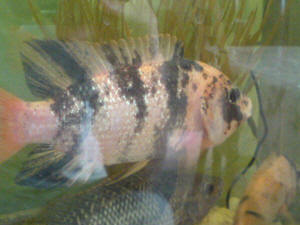
Hello Crew, I was wondering if you could confirm the species of Cichlid in the attached photos. I purchased them as juvenile Rusty Cichlids (Iodotropheus sprengerae). Everything I had read about them indicated they were relatively peaceful (for Mbuna), and would do well with Labidochromis caeruleus and Pseudotropheus acei. However, before I even let them out of the bag they were fighting amongst themselves; several months later as young adults (one male/two females), the largest male and female wreak havoc in my 50-gallon Mbuna tank (the other female Rusty is an inoffensive creature who has remained much smaller than her colleagues). The large female Rusty (who is much more orange in colour than the other two) was dominant until she had a terrific fight with the male -- scales flying, mouths white. Then they spawned a couple of weeks later and the male harassed her until she swallowed her eggs, and constantly beats her up (you can see her tattered fins in the photos). He has now begun tormenting every other fish in the tank, even those much bigger than he. When I temporarily removed him, the female took up where he left off; especially targeting the Labidochromis caeruleus. I plan on removing these two rogues, but I was wondering if these really are Iodotropheus sprengerae, or if I have a couple of impostors in my tank.
Tank parameters:
50 gallon breeder
pH: 8.0 - 8.2
Ammonia: 0
Nitrite: 0
Nitrate: 10
kH: 9 dH
gH: 13 dH
Weekly water change: 40%
Filtration: Eheim 2213 Classic; Aquaclear 70
Lots of rockwork and live plants (Hornwort, Anubias, Rotala rotundifolia, Vallisneria), so there are lots of hiding places.
Tankmates: Labidochromis caeruleus (1M/3F) and Pseudotropheus acei (1M/3F).
Thanks so much! Carla
< The fish in the photos is neither a rusty or a yellow lab. I suspect they were trade-ins. They look like a cross. This is very common in mixed species tanks where fish are allowed to bred with dominant fish in the tank.-Chuck>

Re: Cichlid Identification
Malawi Cichlid Cross  11/8/09

Thanks very much, Chuck, I suppose that explains the unpredictable behaviour. It's all very strange; my LFS supposedly ordered them in for me as Rusty Cichlids (Iodotropheus sprengerae), which I specifically wanted for my tank to *avoid* hybridization (since they are the only species in that genus and unable to hybridize with other Cichlids). I will show this e-mail to my LFS and try to return them (even though several months have passed), and perhaps peace will reign in my tank at last. I suppose this is a prime example of why hybrids are so detrimental to the hobby!
Thanks again, Carla
< Don't use the genus name on a cichlid to determine its potential to cross. The names given to cichlids usually have nothing to do with their DNA but are named due to physical differences like in their teeth. Many different Malawi cichlid genera are quite capable of crossing in artificial conditions like an aquarium.-Chuck>

Malawi Cichlid ID  8/13/2009
Hi, I recently purchase 2 new cichlids to put into my tank. I was curious as to whether you could tell me what species it is. I attached a photo
Thank you, Mike Shatswell
< You have a Melanochromis johanni male.-Chuck>

id of cichlid  8/3/09
Malawi Cichlid ID's

I was trying to ID this cichlid of mine.
The other head in pic I believe is a bumble bee cichlid
Thanks Dave
< The head shot is a Pseudotropheus crabro, commonly called the Bumble Bee cichlid due to its immature and female coloration resembling a bumble bee. The larger yellow cichlid is a male Pseudotropheus lombardoi or commonly called Kenyi in the hobby. Females and young ones are a light blue color.-Chuck>

Red Top Cobalt ID – 7/18/09
Dear Crew Member,
I'm having a "moment," somewhat like an argument with myself. After so much confusion and finding I can provide no clear answer, I turn to my friends at WWW. This issue will also serve as a classic example why taxonomic nomenclature should be used exclusively when referring to living organisms.
I recently got back to keeping Malawian Cichlids (already have two reef tanks). I purchased two individuals a few days ago tagged as Mbunas commonly referred to as Red Top Cobalt Zebras, formerly Pseudotropheus zebra, now reclassified as Metriaclima sp. Fine...my problem deals with the "sp." In the genus Metriaclima I find several species that could possibly match the fish I purchased. There is Metriaclima callainos, sometimes commonly called the Cobalt Zebra, but without the red-orange dorsal. However, M. pyrsonotos
is referred to as a Red Top Zebra and is a visual match, red-orange dorsal and all. However, since these have been identified as two distinct species I must assume that the "Red Top" is not just a variant of the Cobalt, correct? Then, I also find an individual described taxonomically as M. emmiltos and commonly called a Red Top Zebra, although this designation was somewhat harder to uncover. Pictures I find of this species also match my specimen. To confuse matters further, I also have one individual commonly referred to as an Albino Red Top Cobalt Zebra, also purchased as Metriaclima
sp. (I'll send along helpful pix once I find the camera to PC cable.
My questions are these:
1) Can a Red Top Cobalt Zebra be matched to M. callainos, M. pyrsonotos, M. emmiltos, or some other scientific name?
< You have a Metraclima pyrsonotus.>
2) Does the red-orange finnage alone comprise enough of a physiological difference to demand a separate species classification?
< Not usually. Morphological differences in teeth and mouth structure are the usual indicators of different species.>
3) Would the albino simply be a variant of one of these or is it a separate and distinctly classified species? Or, what is it?
< Albinism is simply the genetic lack of pigment and can possibly be found in any species.>
As always, thanks for your dedication and support. Regards, from
David Bell
< Thank you for your kind words.-Chuck>

Cichlid question
Cichlid ID 5-7-09

I am very sorry to disturb you, I have had a particular cichlid about 3 inches whose name I cannot find..
I've tried google, yahoo and even aquahobby.com but I'm still unsuccessful in finding the name of this African Cichlid...
Can you please identify and give me information on the cichlid?
Thank you for your co-operation..
< Looks like a Placidochromis miloto or more commonly called a VC-10. It is either a young male or a female. It may turn blue if it is a male. In the wild they get big lips. In the aquarium this doesn't happen too often.-Chuck>

Cichlid ID & tank (Chuck, cichlid ID?) 4/7/09
Neale, it's me again!
<Hello Summer,>
I've been researching the Pseudotropheus demasoni, and I love the look of this dwarf cichlid. I've read a few online recommendations that they should be kept in a minimum of 6 or 12. What's your view on the minimum number I should add to my tank?
<Does rather depend on the size of the tank. But assuming a reasonable amount of space, like all Mbuna, colonies are the ideal. Strictly speaking, you want at least one male per 2-3 females, since the males are primarily aggressive to one another, whereas the females are basically peaceful.>
Also, I said I have yellow-tail acei, but when I was in Aquatic Design Centre yesterday, I saw their labels and now am not sure what my fish are!
<I must confess to occasionally having seen mislabeled and hybrid fish in this store, so be careful.>
I've attached a photo. Can you please let me know what type of fish I have?
<Could be a rather dull-coloured Pseudotropheus acei, but could equally easily be some sort of hybrid. For African cichlids, the best place in London is probably Wildwoods out in Enfield (Zone 6, Crews Hill train
station).>
Muchas Gracias,
Summer
<Do remember you can't mix different Pseudotropheus in one tank safely:
they will certainly fight and usually hybridise. Despite their wide availability, I consistently recommend people against buying Pseudotropheus, at least initially. Cheers, Neale.>

Re: Cichlid ID & tank
Malawi Cichlid ID and Questions... Chuck's bit    4/9/09

Neale, it's me again! I've been researching the Pseudotropheus demasoni, and I love the look of this dwarf cichlid. I've read a few online recommendations that they should be kept in a minimum of 6 or 12. What's your view on the minimum number I should add to my tank?
<This little cichlid carries a big stick. For its size it is very aggressive and a group of at least 6 is recommended. Assuming a 50/50 sex ratio, this will leave you with 3 females and 3 males. One dominant male will chase or kill the other males if they are not removed. This will leave you with one dominant male and three females. The harem will keep the male from continually chasing a single female and will spread the aggression out among the others. More will give you a good chance of successful breeding.>
Also, I said I have yellow-tail acei, but when I was in Aquatic Design Centre yesterday, I saw their labels and now am not sure what my fish are!
I've attached a photo. Can you please let me know what type of fish I have?
< It could be an acei. This is one of the least aggressive of the Mbuna types so they don't always color up to their best potential while being dominated by other more aggressive cichlids.-Chuck>
Muchas Gracias, Summer

Re: Cichlid ID & tank   4/9/09
<Chuck, any idea what the fish in this photo might be? I suggested possibly a poor quality Ps. acei, but just as likely a hybrid. Can you do any better? Cheers, Neale.>
< Neale, I totally agree with your conclusion. When kept with other more aggressive cichlids they don't color up much. The Florida fish farmers rarely select for color. My guess would be a poor quality acei in a tank where he is not the dominant fish in the tank. Since it sounds like he just got him it is unlikely the fish is going to show any color for awhile.-Chuck>
<Thank you for this Chuck. Cheers, Neale.>

Re: Cichlid ID & tank
Ps. DeMasoni Questions 4/11/2009

Chuck, thanks for your follow up information! So if I add 6 Pseudotropheus demasoni (which I keep calling demon-osi for some reason, maybe because I have Satan), and assuming a 50/50 male to female ratio, I could expect two male deaths?
< Ps. demasoni is actually named after a Friend of mine, Laif DeMason, owner of Cichlid News magazine and Old World Exotic Fish farm. The dominant male will pick and chase the other males. They can soon be found with torn fins and can be removed before there is any more bloodshed.>
Oh how sad that would be. I've read that it's difficult to sex them. Do you think I could determine sexes, and identify the dominant male in hopes of returning the other two males to the LFS?
< Males are darker than the females. Their black bars are wider and they can get slightly larger than the females.-Chuck>>
The 'possible' acei cichlids in my tank are the most peaceful, even more so than the Yellow Labs.
Neale, my garden and vegetables are growing like crazy! I attribute their proliferation to my aquarium "super juice". My neighbour agrees and thanks me for a constant supply. Kind regards,
Summer

Need help identifying cichlid 11/23/08
Hi, I was wondering if you guys could help me identify this Cichlid.
Sorry for the bad photo quality, as I was only using my cell phone to take the picture.
I'll do my best to describe the fish to you though;
It's body is mostly a somewhat dull yellow, with thick, dark black stripes on it, and black covering most of it's head.
It's head also has a slight bluish color around the black on it's face.
The fin's all have dark black stripes on the tops of them, with yellow in between.
I know it's from Lake Malawi, but I can't remember the actual name of the
fish, since the guy at the retailer was telling me so many Latin names, I had a hard time keeping up.
I hope this description is enough for you to help me identify the fish.
Best Regards,
Patrick
<Mmm, might be a male Pseudotropheus saulosi... the yellow though... perhaps this is a (all too common) hybrid Mbuna. Bob Fenner>

Need help identifying cichlid 10/23/08
Cichlid ID From Lake Malawi
Hi, I was wondering if you guys could help me identify this Cichlid.
Sorry for the bad photo quality, as I was only using my cell phone to take the picture.
I'll do my best to describe the fish to you though;
It's body is mostly a somewhat dull yellow, with thick, dark black stripes on it, and black covering most of it's head.
It's head also has a slight bluish color around the black on it's face.
The fin's all have dark black stripes on the tops of them, with yellow in between.
I know it's from Lake Malawi, but I can't remember the actual name of the fish, since the guy at the retailer was telling me so many Latin names, I had a hard time keeping up. I hope this description is enough for you to help me identify the fish.
Best Regards, Patrick
< Do a Goggle image search on Pseudotropheus flavus and see if the images match you fish.-Chuck>


Re: Need help identifying cichlid   11/25/08
Cichlid ID From Lake Malawi II
Thanks a lot, I'm not 100% sure that's what my fish is, but that is definitely the closest I've seen to what my fish looks like. Although Mine has a little more black in it, and the yellow isn't quite as prominent, from the looks of it, that's probably the breed of fish I have.
Thanks for the help,
Patrick
< The amount of black can be quite variable from fish to fish. The yellow coloration can be enhanced with diet, water quality and lighting. Glad we could help out.-Chuck>

What kind of Cichlid is this? – 10/02/08
Cichlid ID
Greetings (pass my hello on to Neale if he's around)
I was wondering what kind of cichlid I have. Attached is a photo.
If this picture is not good enough, I will try to take another. Thank you!
Skye
< The cichlid in the photo you provided is definitely from Lake Malawi. It is called an Mbuna by the locals for all rock dwelling cichlids from that lake. It looks like it could be in the genus Pseudotropheus/Metriaclima. But looking at the large mouth makes me think it could be Petrotilapia. The later gets pretty big and gets very aggressive. With a better picture I might be able to further define the species.-Chuck>

Re: What kind of Cichlid is this? 10/2/08
Cichlid ID II, With Much Better Picture

Thanks. Attached is another picture of him (I'm assuming it's a him - I have no idea how to tell gender on this type of fish yet). He is about 5" long and around two years old. I rescued him from a friends tank, as a more dominant fish was picking on this beautiful one. His color has become more vibrant in the two weeks I've had him. Not much else is know about him. My friend thinks this fish is a "mutt/Heinz 57" variety. Your thoughts with this new picture?
< The new picture is much better. You have what is commonly called a Cobalt Blue, Metraclima callainos. Probably the original founder stock came from Nkhata Bay.-Chuck>

Hello, I was wondering if you could identify this fish...
This fish was sold to me at PetSmart as a "yellow lab". – 7/30/08
<It isn't.>
When these fish were small, I thought I was getting two female yellow Labidochromis caeruleus,
but the two have spawned.
<Oh dear.>
I thought yellow labs only came with black stripes on the top fin, and this fish appears to be yellow-orange. I have not seen these fish on any other website, so I was wondering if you could help me identify it.
<These are some sort of Maylandia, perhaps Maylandia estherae or an orange form of Maylandia zebra... or for that matter some sort of hybrid. One should never, ever by Mbuna that aren't clearly identified.>
Thank you so much for your help. They also have produced a few offspring with black stripes along the top fin.
<Mbuna hybridise very readily unless you take care to keep species that won't hybridise (e.g., by choosing species from different genera, i.e., one species of Labidochromis, one species of Iodotropheus, and so on). Please please please do not give away or sell fry you suspect may be hybrids -- this is a blight on the hobby and one of the most irresponsible things any aquarist can do. The problem is hybrid fish are by their nature unpredictable in terms of behaviour, size and colouration, making it impossible to create a tank with sensible, carefully considered choices of species. If you have excess fish, please destroy them painlessly (see the Euthanasia FAQ here at WWM for tips). Cheers, Neale.>

Hello, I was wondering if you could identify this fish... 7/30/08
Cichlid ID
This fish was sold to me at PetSmart as a "yellow lab". When these fish were small, I thought I was getting two female yellow Labidochromis caeruleus, but the two have spawned. I thought yellow labs only came with black stripes on the top fin, and this fish appears to be yellow-orange. I have not seen these fish on any other website, so I was wondering if you could help me identify it. Thank you so much for your help. They also have produced a few offspring with black stripes along the top fin.
<The is a Pseudotropheus species of some sort. It could be a cross between a couple different species. Because of the color I believe it is some sort of cross developed in Asia and is not a true species found in the wild. These cichlids are capable of crossing with almost any other mbuna type from Lake Malawi. This makes them excellent candidates for making "designer cichlids".-Chuck>

About that Maylandia...I do believe Neale is correct!   8/1/08
Hello there! I just thought I would add this little note.
<Hello again Nicole!>
I was up reading the FAQs early this morn after having missed a few days, and I saw Neale's answer to the query about the fish that was sold to someone, mistakenly, as a yellow lab.
<Yep, I think we're agreed on this!>
I found this article:
http://www.gcca.net/fom/Maylandia_estherae.htm
And do believe that the picture on it shows a fish that looks spot on like the picture provided.
<Certainly my gut feeling. But the problem is that there are so many hybrids that unless you buy from a reputable retailer, you don't always know what you're getting.>
I just thought I would add that I have a brood of African cichlids that crossed (a yellow Labidochromis caeruleus and a blue Pseudotropheus socolofi) and, except for the deep orange, this fish looks very similar to mine.
<Not encountered this hybrid. Thanks for the heads-up.>
So it could possibly be a mix of a yellow lab and a blue Pseudotropheus, but the Maylandia seems much more likely.
<I would tend to agree.>
I had never heard of this fish before...thanks for introducing this species to me, Neale!
<It's a nice fish.>
Rest assured my fish are never being given away or traded in, I am embarrassed enough that I allowed this to happen when I was less experienced.
<We all make mistakes like this. The problem is that so many people don't care anymore, and the market is flooded with hybrids. That's undermined the Malawi cichlid hobby. When you think about Malawi cichlids, they include some of the most amazing fish with the brightest colours -- even compared with marine fish! That's why I get sad when I see hybrids -- I know that lots of aquarists are going to end up with muddy-coloured, unpredictable fish and wonder why people like me enthuse about Mbuna.>
Take care, and have a lovely weekend.
Nicole
<Likewise Nicole and thanks for writing. Cheers, Neale.>

Red Zebra and a Kenyi I think... Af. cichlid ID... 5/17/08
Hello all at WWM... I hope all is well for you today...
<Thank you>
I once wrote in about Jewel cichlids and for a quick update on them, all is well... I have a bunch of babies swimming around eating flake food and seeming happy and the momma just laid a bunch of eggs again. I don't guess I lowered the water temp. enough :) but oh well I will take care of it lol...
Since I spoke to u last, I had 2 unknown cichlids die in my 55 gallon tank. I set up my little 10 gallon tank for a hospital tank and tried to survive the 2 with no luck... I suspected aggression since the other fish seemed fine. That left my 55 almost empty, it had and still has a large Electric Yellow, and a Nimbochromis ( the giraffe looking one) I don't think the 2 are really supposed to be good tank mates, but all seem well with them right now. Here's the problem... I purchased 2 new "African Cichlids" at Wal-Mart, well that's all that they list them as here and I get to play detective to see what I have when I get them home... I think I have correctly identified the first as a Red Zebra and the other as the Kenyi.
<Or, too likely, crosses...>
The Kenyi is really pretty golden yellow with a hint of pinkish purple on its back area with its black stripes. I love this fish and he's extremely active...The Red Zebra fish is fairly active but I since I got him I have noticed him beginning to bounce off the
tank decor. Water chemistry is set up as hard/alkaline water and the nitrates, nitrite and ammonia are all good... 10, 0,and 0 ... I may have that backwards since I am not looking at my cards... The Zebra is also showing signs of red gills... I moved him to hospital tank and gave him a parasite treatment. Gills still red. He eats well and seems active still but he kinda swims a bit funny at times, kinda like he's gonna turn and go back the other way and then whips back around and stays on same path he was traveling... Don't know much about this...any advice? Fish has no spots or visual anything to help with diagnosis, but I definitely don't think all is well with him for some reason.
Also when I purchase new fish (if I ever do again, since I have so many Jewel babies) how long do u suggest that I keep new fish from old fish before risking infecting my whole tank.
<Posted... a good two-three weeks is about right>
And if you recommend I treat this Red Zebra again should I go ahead and treat the whole 55 gallon tank even though they seem fine at this point? Any thing u can tell me is greatly appreciated about this and any pointers on the Kenyi will also be welcomed!
<Read on WWM... African Cichlids, Disease...>
OH and one last question, how long until my Jewel babies begin to get any color?
<A few weeks to a couple of months>
Just curious about that, not drastically important. I would really like to know what color they are gonna be, so I can pick which ones will become feeder fish... I know sounds terrible but I am over flowing in babies and running outta homes for them...Have a great day and many thanks for such a great site!
~ JerrieSue ~
<Keep reading JS... you'll do fine. Bob Fenner>

Cichlid ID  01/14/2008
Hi Crew, I have a person selling some Cichlids and does not know what type they are and me either. Can you help me please? He needs to get rid of all 9 fish ASAP and will give them all up for US$24, what do you think about the price? I want to also add around 10-20 small (around 1 inch) Pseudotropheus saulosi in a few weeks when I get my shipment, do you think its safe to add them after these other unidentified cichlids are added first? My tank is 200 Gallons.
Thanks in advance
Ghulam
<Hello Ghulam. The fish with the orange/brown patches and yellow spots on the anal fin is some sort of Pseudotropheus, likely Pseudotropheus zebra. But do bear in mind standard stock is often hopeless messed up in terms of genetics, and this fish may well be a hybrid. So fine as a pet, but unless you can 100% guarantee it is one particular species, not recommended for a breeding project, and DEFINITELY do not pass on any fry produced by this fish to other hobbyists. There's too many hybrid Pseudotropheus in the hobby already. The big orange fish with the huge mouth is some sort of "Tilapia", possibly Oreochromis mossambicus but equally likely one of the hybrids such as "Golden Tilapia" widely used in the aquaculture business. A nice enough fish, but big, messy, and fairly aggressive. Also potentially huge (20-30 cm) and very, very messy. No-one in their right mind PAYS for a tilapia for a fish tank -- that's a fish you take off someone's hands as a favour! As for your other question: NO, you NEVER, EVER mix two different Pseudotropheus species. Only a lunatic would do that. The problem is you'll end up with masses of hybrid fry that SHOULD NOT be passed on into the hobby. Furthermore, the levels of aggression in the genus are high but variable, and punchy species like Pseudotropheus zebra will often kill males from less aggressive species. When stocking Pseudotropheus, you choose a SINGLE species appropriate for your community, and then choose species from other genera that it WILL NOT hybridise with, such as Labidochromis, Labeotropheus, Cyrtocara, etc. Obviously do not mix Pseudotropheus with fish from closely related (possibly identical) genera such as Maylandia or Metriaclima; taxonomists may argue about the differences here, but Pseudotropheus, Maylandia, and Metriaclima all think they're the same thing and will freely fight/breed with one another. Cheers, Neale.>

Labidochromis caeruleus in a complete orange color? 11/9/07
How are you? Have you ever seen a Labidochromis caeruleus in a complete orange color? I have looked all over the net and in the forums on WWM and couldn't find any info on it. It's almost like a yellow/orange but favoring the orange....was this a special breed/morph?
Thanks
<Labidochromis caeruleus naturally occur in (rare) yellow and (common) blue morphs. Some yellow fish are variable and come in a sandy colour form at one extreme and a more orange-yellow or brownish-yellow version at the other. But the fish that have a reddish-yellow shade of orange have been fed with colour-enhancing foods. Eventually they return to some other shade of yellow. There are also many, many hybrids in the trade, and unless your retailer specialises in Mbuna sourced from decent breeders or the wild, you can reasonably assume that any "odd" Mbuna that don't perfectly match the type description are likely to be either hybrids or colour-enhanced fish. With Mbuna, you get precisely what you pay for. Cheers, Neale>

Re: orange Labidochromis
Thanks for replying, the fish is actually yellow/orange not really red at all. At least I know now though.
<Ah, I see. Well, it's up to you. If you have a photo, we can try and be more discriminating, and figure out whether it's the real deal or a fake. I wish there weren't so many hybrid Mbuna in the trade. But there are, and because of that, you just can't give categorical answers about "mystery fish". That's why it pays to make friends with a decent retailer who specialises in African cichlids. They'll keep you well supplied with true-bred or wild-caught fish, many of which will make your mouth water they are so gorgeous! But the mixed-up stuff you see in generic pet stores has made the African cichlid side of the fishkeeping hobby very difficult in terms of identifying and selecting livestock. Cheers, Neale>

Distinguishing between blue-colored Mbunas  9/20/07
Hi Crew,
I have been doing research on the internet regarding keeping Malawi cichlids, especially their temperament & compatibility. I purchased several Labidochromis caeruleus & peacocks, a couple of unknown blue hap-type fish and a single Placidochromis Milomo. Non-cichlids include 3 Synodontis, 1 common Pleco & an Asian climbing perch. They are doing well together & aggression is kept at a minimum. Now I am looking for some blue-colored Mbuna cichlids to add more color to the aquarium.
The problem is that I can't distinguish between the various blue-colored cichlids available. I thought that the Metriaclima callainos would be ideal as it isn't too aggressive. However, the problem is that I don't know how to distinguish it from the Metriaclima estherae, which is said to be extremely aggressive. On the other hand, another candidate I was considering was the Metriaclima saulosi, which is also said to be not too aggressive, but looks very similar to the much more aggressive Metriaclima lombardoi.
The problem is compounded by the fact that the LFS near my house usually sell mixed African cichlids in the same tank instead of single species, so I would really have a hard distinguishing which is which. Any recommendations on less-aggressive blue-colored Mbunas or other cichlids that are easy to identify?
If I were to end up buying aggressive cichlids by mistake, would they end up either tearing up the other fishes to shreds or stressing them to death?
Regards,
Visoth
<Greetings. In all honesty, the prevalence of hybrid Pseudotropheus-type cichlids in the hobby is so widespread that you cannot guarantee getting a "true" species from any store that doesn't specialise in African cichlids. The only safe approaches are to either find a store with a good reputation for African cichlids or else contact your local cichlid club and get in touch with breeders through them. Wild-caught stock are usually the best fish in terms of purity, because even within a species there are lots of regional types and these often get mixed after a few generations in captivity. I'd also mention that mixing Pseudotropheus-type cichlids with, say, Labidochromis or Aulonocara isn't a brilliant idea because of differences in aggression levels. Pseudotropheus-type things are better with Labeotropheus, Cynotilapia and so on. With Labidochromis and Aulonocara, you want the more placid Mbuna, like Iodotropheus and of course the beautifully blue Cyrtocara. Mixing Mbuna of the wrong aggression level can indeed result in death! So take great care when selecting species. Cheers, Neale>

Less-aggressive blue-colored haps, sel.   7/21/07
Hi crew,
Thanks for the earlier reply on blue-colored Mbunas. Both the recommended species are hard to find in the LFS around my area.
Are there any less-aggressive blue-colored haps to recommend for a tank that currently houses electric yellow labs and peacocks? From my knowledge, the electric blue ahli isn't too aggressive, but is there any way to distinguish it from blue species of peacocks? I find that the color and body shape quite similar, although the peacocks have greater likelihood of coming in more than 1 color. Is it possible or common for electric blue ahlis to come in more than one color, or for peacocks to be pure blue?
Thank you.
<Greetings. I find it hard to imagine you *can't* find Cyrtocara moori -- it is known as the Malawi Blue Dolphin and among the most widely traded Malawian Haplochromines in the trade. If all else fails, ask your retailer to get some in for you. Although big (around 20 cm) it is a gentle giant, provided you only have a single male specimen. The problem for you is that Aulonocara and Labidochromis are both at the low end of Malawian cichlid aggression. If you add significantly more aggressive species to the tank, they stand a very good chance of being killed. It's as simple as that. Pseudotropheus zebra for example will usually dominate any Labidochromis caeruleus in the tank. Pseudotropheus demasoni is *sometimes* kept in communities with more placid cichlids because, while highly aggressive, it is [a] small (~8 cm) and [b] tends to be only aggressive towards fish that are blue. Pseudotropheus demasoni is light blue with dark blue vertical bands, so very pretty. So that's one species you might want to take a gamble with, assuming your tank was sufficiently large (not less than 150 litres). Sciaenochromis ahli is another fish that *tends* to be violent towards other blue fish while largely ignoring other types of fish, but again, this depends on the aquarium. Given the large adult size of this species (~20 cm) and its piscivorous habits, it isn't a fish for every tank. Allow at least 200 litres for this species. Both Sciaenochromis ahli and Aulonocara spp. do have a somewhat similar shape and both come in a wide variety of colours. But as a rule Aulonocara have a smaller, more dainty mouth reflecting their niche as micropredators, whereas Sciaenochromis have much bigger mouths better suited to their niche as piscivores. But any halfway decent aquarium store will keep them apart and properly identified anyway, so this shouldn't really be an issue. Hope this helps, Neale>

African Cichlid Questions... ID, gen. care   7/13/07
Hey, I love your site; it has gotten me through many rough spots. I have three African Cichlids (at least that is what Wal-Mart said) in a 10 gallon tank. I have had them between 5 and 8 months (depending on the fish). While I was at school they were with other cichlids in a 20 gallon tank, but with the summer I bought them a tank of my own. They are three different species of fish, but I don't know what they are (remember Wal-mart fish). I promise I will not send any future babies to a pet store because of cross-breeding, but I have a few questions.
1) What kind of cichlids are they?
< The usual African cichlids sold at Wal-Mart are usually cichlids from Lake Malawi in Africa. They are usually the rock dwelling cichlids called Mbuna..
> Where are they from?
< Initially from Lake Malawi but they are very easy to breed and currently are probably from a fish farm in Florida.>
How large will they get?
< Usually around 4 inches depending on the species.>
One is a bright yellow, about 2 1/2 inches at the moment, with a stripe on its dorsal fin that was black when I got him but is grey right now. He is the smallest of the fish, but I think he is the oldest.
< Probably a Labidochromis caeruleus or "yellow lab" from Lion's Cove.>
The second is light blue and about three inches long. She or he can get as light as almost white with a very light blue color to a darker sky blue color and for spots on the anal fin. This fish likes to dig tunnels in the rocks under the hiding spot.
< Probably a Ps. zebra or "cobalt blue".>
The third is the largest at 4 inches the last time I measured him, maybe a month ago. When I bought him he was a yellow gold with large black spots. Sometimes his spots are so large and dark that you almost can't see that they have any color around them. Right now the spots are so faded that he looks gold. The spots are almost not visible. I will try to attach pictures, but I don't know if it will work.
< Sounds like a Nimbochromis venustus. A large predatory cichlid.>
2) Is my tank large enough or do I need to invest in a larger one?
<A ten gallon tank is too small for this group of fish. The yellow lab with get a little over four inches. The cobalt blue will get up to 4 to 5 inches. The venustus will be the biggest one at about eight inches but could get up to a foot if it is a male. Think about a 40 to 55 gallon if you intend to grow these fish to adult size.>
I went for ten gallon because of finances and space in a dorm room. I do have space for a larger one if I need it.
3) Moving back and forth from college frequently is difficult. What is the best way to transport my fish?
Thanks a ton! Melissa
< Get large plastic bags from the fish store for each of the fish. Don't feed the fish at least a day before the move. Place just enough water in the bag to make up about 1/3 of the bag. Leave the rest for air. Place one fish in each bag. Twist the end of the bag and secure with a rubber band. Place the second bag over the first bag in the opposite direction to pinch off the corners of the bag. Rubber band the second bag. Place the bags in an insolated ice chest. Should be good for 24 hours. If the move is going to be longer then you need to use oxygen from a fish store. Then the bags will be good for up to 48-72 hours or longer.-Chuck>

African Cichlid  6/6/07
Maybe you can help me.
<Greetings.>
I have a female African Cichlid, not sure of her species, but just released about 30 fry 5 days ago (she was in a separate tank).
<Very good. One thing though. Please, try and ensure any fry you produce are a single species. The African Cichlid side of the hobby is plagued with hybrids, and these have little to no real value, being unpredictable in behaviour and indifferent in colouration. Many of the Pseudotropheus-type fishes (of which the African Zebra, Pseudotropheus zebra, is the best known) are notorious for hybridising. The reason I mention this is that a lot of the African cichlids people buy but cannot identify by looking in books are these hybrids. You can't name the species because they *aren't* a species!>
She has been doing great, a little thin but last night when we came in she was swimming erratically up and down the tank.
<They do lose weight after mouthbrooding. A month on her own to "fatten up" will do her plenty of good. Don't forget to give her greens as well as meaty foods, because the essential vitamins she needs will be in algae-based foods.>
Now she fights to swim to the top but her tail sinks her to the bottom of the tank. She isn't bloated, no skin irritations, nothing too strange.
<Very odd. Usually, when cichlids suddenly lose poise or swimming ability the problem is a sudden change in conditions. Adding, for example, too-cold water to a cichlid tank will send them into apparent convulsions. They recover as they warm up. Cichlids are among the most highly strung fishes, so anything like changes in temperature, pH, hardness, and salinity have to be observed carefully.>
She seems as if she's gasping for air so we put her into a tank by herself and added salt to see if that would help. Do you have any clue what her problem might be?
<Tonic salt (NaCl) won't help. Quite the reverse. There's fairly solid agreement among aquarists and vets that salt is one factor that leads to Malawi Bloat, a situation a bit like dropsy caused by organ failure. So without exception, salt should never be added to a tank with Malawi or Tanganyikan cichlids. (By contrast, Central American and Asian cichlids often have phenomenally high salt tolerance, to the point where some species will breed in seawater!) So, remove the salt by performing water changes through the week. Check the pH and hardness are appropriate. For Rift Valley cichlids something around 20 degrees GH ("hard" to "very hard" on your test kit) and a pH between 7.5 and 8.0 will do nicely. Ensure the water quality os optimal, of course. Tanganyikan cichlids are especially intolerant of nitrites and ammonia, but given yours is a mouthbrooder it is probably a Malawi cichlid of some type.>
Thank you,
Allison
<Hope this helps. Neale>

Re: African Cichlid – 06/07/07
Thank you, our cichlid is orange and I can identify her and the others in the tank from a book but I can never remember the technical name. I believe she bred with an electric blue cichlid that has an orange stripe on its fin.
<Ah, that's the problem. Almost certainly at least a cross-breeding between varieties of one species or else a hybrid between species. Please, unless you are sure the species has blue males and orange females, and so the breeding was between a single variety and a single species, destroy the fry at once using a humane method. Passing on hybrid cichlids to retailers and other hobbyists is one of the least ethical things any hobbyist can do. Besides ruining the hobby by dumping no-name hybrids on the market, it also causes conservation issues. Many of the African cichlids are under intense pressure from collectors in the wild. In some cases, they are commercially extinct, i.e., so rare, collectors can't find them any more. I learned about this a few days ago speaking with a fish scientist out in Tanganyika. By dumping tank-bred hybrids on the market, serious aquarists are forced to buy wild-caught fish if they want quality stock. It is this demand that causes the pressure on wild populations. So please, if you are not 100% sure the fry are a true species and a single variety, destroy them.>
It's odd to hear problems with salt. We treated our tank in the past for disease by way of salt and all our fish were cured and still well.
<It isn't a 1:1 thing, i.e., every time you use salt, the fish get Malawi Bloat. But when Malawi Bloat does occur, one of the factors common to many cases is the use of tonic salt. Conversely, salt doesn't deliver any tangible benefits that cannot be acquired using safer methods.>
Thank you,
Allison
<Cheers, Neale>


Quick IDs, Af. cichlids   3/18/07
Hi,
    Do you mind ID-ing a cichlid for me? I sort of  inherited it (it's a long story) and want to be sure I am caring for it properly  and I wanted to see about breeding it (why I want to know what it is) Here is  the 1st one:
(javascript:void(0);)
Sorry that it is blurry- new camera phone :D
<Looks like a female Melanochromis auratus to me: http://fishbase.sinica.edu.tw/Summary/speciesSummary.php?ID=2343&genusname=Melanochromis&speciesname=auratus>
And the other one that I inherited, which is isolated by itself by egg  crate:
<Maybe a Maylandia zebra male... http://fishbase.sinica.edu.tw/Summary/speciesSummary.php?ID=8345&genusname=Maylandia&speciesname=zebra>
Thanks, I appreciate your help!
Anthony
P. S. I wouldn't have this awesome discus if it weren't for your excellent advice! She lives with another female discus of the same size in a 125 gallon tank, and I wish to add 2-3 more in a few months and get them breeding  again!
(I had a major die out- from 8 discus to 2)  
<A very nice specimen. Bob Fenner>

Cichlid ID  3/6/07
Just out of curiosity, if any of you have the April TFH magazine on hand, what is the general and scientific name of the fish (I believe it is a cichlid) to the left of the guppies in the right hand corner of the advertisement for Southland Aquatics Inc. on page 99. Any info would be nice too. Thanks again!
< This is an aquarium strain of peacock cichlid. They are not found in the wild. They have various trade names like German Red Peacock or Ruben Red Peacock. They can be kept like any other Lake Malawi cichlid , but they tend to less aggressive and get bullied by the other cichlids.-Chuck>

Fish ID, Af. cichlids    2/4/07
I have what I thought was a Melanochromis Johanni (m), how do I know its not a Melanochromis  cyaneorhabdos?  From what I can see, the males of both look EXACTLY the same.  Same lines over bridge of face, same lines across body, same coloring.  I am looking at a pic of both right now and I can't see any difference.  The only difference I have seen in this particular species is the females look totally different.  I am going to purchase females for my fish this week and need to know which one's I am getting as my male is becoming very aggressive.  Please help. Rohnda of AZ
<  Melanochromis is a group of rock dwelling Lake Malawi cichlids that have horizontal stripes. The females and fry are very easy to tell apart from one another. The johanni fry and females are a bright orange-yellow color. The M. cyaneorhabdos females look very similar to the males except not to be as dark. The M. cyan. males have wider blue stripes, a diagonal ribbed pattern on the flanks and a dark blotch in the middle of the tail.-Chuck>

Re: Fish ID Update II   2/4/07
Sorry, I just wanted to send you addresses of two websites that contradict each other on the topic of determining species for the Melanochromis cyaneorhabdos and the Melanochromis johanni.
website    http://www.timstropicals.com/Inventory/African/JohanniInfo.asp
says, "Blue Johanni are African Cichlids originating in Lake Malawi.  They are classified as Melanochromis Johannii, but are also known by the scientific name Melanochromis cyaneorhabdos Maingano.  The Johanni males have light blue on a black background, while the Maingano males are light blue against a darker blue background.  The females and juveniles are a bright yellow/orange."
website    http://www.cichlidforum.com/articles/m_cyaneorhabdos.php                             says, " Melanochromis cyaneorhabdos (formerly known as Melanochromis "Maingano".  This species is endemic to a small region on the northeast shore of Likoma Island from Mbako Point to Membe Point.  Difference between males and females would be that the females have a light-colored belly with relatively shorter pelvic fins, while the males have dark bellies and longer pelvic fins."
In both articles, they are called the same scientific name however, they originate from two different places and their females don't match.  I have pics of both females and the one in the second quote looks very similar to the male, slight differences.  Whereas in the first quote the female is yellow.  So this is why I sent you the first email about figuring out which fish I have so I can buy females.  How am I supposed to make a choice with contradicting info.  It's like that all over the web as well.  Everyone says something different.  Thank You Rohnda from AZ
<The Melanochromis johanni has orange yellow-fry and females. The Melanochromis cyaneorhabdos "Maingano" is a different species that has females that closely resemble the males in coloration. They are not the same fish!-Chuck>

Cichlid Brown Not Red  - 12/29/06
Ok thanks.  I have another question regarding a Copadichromis  borleyi.  I just purchased one and his body is more orange/brown than  bright red like the rest that I see on the internet.  If I feed him color  enhancement and give a great diet with pristine water quality, will he get this  bright red coloration also?  Not sure why mine is kind of dirt brown  instead of red. Thanks
< Many things determine the coloration on adult Lake Malawi cichlids. Environment is very important. These fish require hard alkaline water with a water temp in the mid to upper 70's. The water must also be very clean. Zero ammonia and nitrites and the nitrates should be under 2o ppm. The food must be fresh and have lots of vitamins and minerals. I recommend Spectrum by New Life and make some of my own fish food using a formula found in a book called "Enjoying Cichlids" by Ad Konings. Genetics is very important. Not all fish look alike. In fact I have personally seen many wild C. borleyi while diving in Lake Malawi and there is a range of colors found in these fish. Many of the photos published are of the most attractive males. You almost really have to see the adults to know what the fry are going to turn out like. The males need to be the dominant fish in the tank. Everything else could be right on , but if another fish is picking on them then they will never color up.-Chuck>

Fish mischief and misbehavior... Af. cichlid beh., comp., ID    11/29/06
Dear Esteemed* *Ichthyologists at WWM,
(Or a simple good afternoon, if you prefer!)
<Mmm, pet-fish types perhaps>
Since you don't appear to be especially swamped with queries right now (or maybe you are, and you have just gotten an influx of especially helpful and diligent volunteer staff persons!) I thought I would ask you a few of questions regarding my cichlid tank.
<Okay>
A little background:
I have a 30 gallon tank that houses 3 African cichlids. I am quite sure one of them is a Yellow Lab but have never been able to identify the other two (pictured) as they were in a tank of just "assorted Africans."
<Am hopeful Chuck Rambo will chip in here and make a suggestion re these two apparent Mbuna>
For about a year they were very boisterous and always busy digging. Their activities
seemed to engross them enough to keep them from squabbling too much.
The tank became sloped all over with most of the decorations submerged in gravel.
<Best to re- "even this out" during weekly water changes>
It seemed like they finished "carving out" their territories and when this happened, the blue (perhaps male?)
<Maybe... do see a bit prominent "egg-dummies" on its anal fin>
cichlid chased the striped one around like crazy, making splashing noises in the water a few times an hour, even at night! I added a log to try and introduce new territory and break up the bad behavior,
<Good idea>
which helped for a few months. The striped fish would retreat into the log when chased.
Then the blue fish decided HE wanted the log, so the striped fish hid among plastic plants near the heater while the blue fish hung out in the log during his rest periods. Upon every venture out of the corner, the striped fish would get chased by the blue fish. I tried netting and suspending him, dropping the temp 2 degrees to 76F, but nothing seemed to put a permanent end to the chasing.
<Mmm, good efforts>
Last week I noticed the striped fish has a few nipped fins, so have paid extra attention to water parameters (ammonia & nitrite 0, nitrates ~15 ppm) and am feeding First Flake by Omega One.
My car is being serviced so I couldn't go out and buy decor this week. I made do with what I had and put two ceramic cups (a gift from a friend who made them in pottery class, handle less cups that are not very useful for drinking out of) in there along with a bunch of plants. This seems to have intrigued the yellow fish who is always in and out of that area now, and the blue fish is similarly interested, although no one actually hides in the cups yet. Here are my questions:
1. Do you think these cups are safe for long term use?
<Likely so... if they were "fired">
My plan was to remove them as soon as I bought new lava rocks or some such, but I have grown to like how they look in there and wonder if I can leave them in, especially if they help curve the nipping and chasing.
2. I am thinking of trading in the blue fish, but am wondering if this will up the aggressiveness of the striped fish?
<This is a possibility... there is a general relationship between crowding and over aggression in this group of fishes... under or over can work out... in-between... not generally in the long/er term>
I don't want the yellow fish to start getting bullied instead.
3. Do you know what the scientific names of the two pictured cichlids are?
<Mmm, will give it a go... my best guesses: Pseudotropheus crabro, a Bumblebee and a P. socolofi... Socolof's African Cichlid...>
I would like to avoid getting another cichlid like the blue fish in the future. He's very handsome, but too darn mean.
<Agreed. Might be best to trade this one specimen out>
I run two Penguin 150 filters in this tank - one with Chemi-Pure, one with bio media and sponges. I service them weekly and alternately. 10% and 20% water changes on Tuesday and Saturday. This regimen so far has kept my water quite clear and clean. Thanks very much for your time!
Not to flatter, but WWM is hands down my favorite website.
Nicole
P.S. Sorry for the compression on the .jpg but MS Paint is my only editing program, and I figured you'd rather the pic be a smaller size.
<Thank you for this. Bob Fenner>
Re: Misspelling! sorry    11/29/06
Dear Crew,
I meant ammonia of course, not ammonite, in the email I just sent a minute ago. Sorry!
Nicole
<No worries... I fixed this... thought you weren't likely referring to ancient/fossil mollusks! RMF>

Re: Fish mischief and misbehavior    11/29/06
Thank you so much for your reply, Bob!
<Welcome Nicole>
I read an online article about Pseudotropheus socolofi, the "Powder Blue Cichlid" and thought for a long time that must have been it. However, since the article featured how "peaceful" this species was and how they were a "perfect" cichlid for beginners, I thought...naah!
<Ah, yes... I could be wrong in this ID>
Of course, there can be an exception to every rule with fish (and most other things).
<Ditto>
What would you like for Xmas? I suspect you will reply: world peace,
<Whirled peas?>
an end to global warming... But how about some really nifty butter cookies with a dash of rum? My mother's recipe.
<Much better>
I can also just make a contribution to WWM, which has entertained and enlightened me for over a year now.
Nicole
<Ahh... "never turn down the cash"... Thank you for sharing. BobF>
Cichlid problems   11/7/06
Hi guys,
<Isn't that a male-only type reference... EricR says it's likely intended to be trans-gender>
Thanks for your help with my hillstream loach. I fixed everything up for them and they are doing great! I went into PetSmart to grab some decorative backing and some more plants for my tank and I saw this really beautiful fish...I don't normally buy fish from there but I just had to have it! I recently upgraded to a 20 gallon tank so my 10 gallon was all set up at home with no one living in it. The girl at the store called it a blue cichlid
<Mmm... an African?>
and said it like being solitary so I brought it home. I immediately started doing my research...I knew a little bit about cichlids but not nearly enough.
<Is the third largest family of fishes... more than 1k species...>
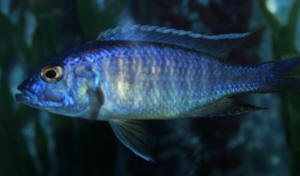
My problem is that they never have the correct names for fish at the stores...I think mine is a /Copadichromis azureus /but I'm not positive. Can you check out this picture and tell me what you think? Thanks!
Jennifer
<Could be... please see here: http://www.aquarist-classifieds.co.uk/directory/gallery_Copadichromis_0.php
Bob Fenner>

ID A Mixed Bag OF African Cichlids   9/19/06
Hi, I've had my fish for about a month now and no one knows what I have. I got them at a small pet shop they said that "they might be African  but no real names have been given to me. I have a pure white  Cichlid,
< Maybe a white zebra, (Metraclima callianos)>
a pure orange  cichlid ,
< Maybe an orange/red zebra (Metraclima esterae).
A yellow cichlid with black horizontal  stripes,
< Melanochromis auratus young or female.>
and 2 purplely blue  cichlids with black vertical strips (that almost look like triangles).
< Probably Pseudotropheus lombardoi or commonly known as Kenyi. Could be a Metraclima zebra striped variety but check out photos on the internet to be sure.>
Also can any of them breed together and how do I tell if they are male or female?
< The zebras can all definitely breed together. They are just geographic races of the same fish. males tend to be larger more aggressive with longer fins. When they are ready to breed the male will start to excavate pits to attract a female to the area to spawn.-Chuck> Thank you Cheryl


Featured Sponsors:
Google
 
Web www.WetWebMedia.com