|
FAQs on Callichthyid Catfish
Identification
Related Articles: Callichthyid Catfishes, Summer loving: cats in the garden, kittens in
the kitchen by Neale Monks,
Related Catfish FAQs: Callichthyids 1, Callichthyids 2, Callichthyid Behavior, Callichthyid Compatibility, Callichthyid Selection, Callichthyid Systems, Callichthyid Feeding, Callichthyid Disease, Callichthyid Reproduction, Catfish:
Identification, Behavior, Compatibility, Selection, Systems, Feeding, Disease, Reproduction,
Who am I?
|
|
|
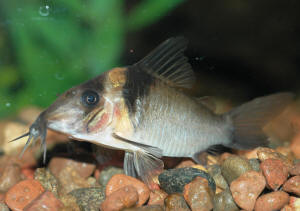
former Hoplosternum thoracatum 9/5/12
Bob and Crew,
When you have a moment, I would appreciate your assistance in tracking
down a particular color variety of a freshwater catfish, or determining
if it actually exists. LOL
Here is where you can find a picture of the fish: Dr. Warren
Burgess An atlas of Freshwater and Marine Catfishes Page 644 Plate 161
Right column 2nd picture down which is the former (Hoplosternum ) and
the picture shows a perfectly Black and White variety I haven't seen
anywhere.
I snapped a shot of it with my camera on my phone and will include:
Thanks for your time in advance,
Rick
<Juvenile Megalechis exhibit more defined markings, and that's what
you're seeing here. This fish isn't "black and white" at all, though the
ambient lighting and/or type of colour film used may suggest this. In
any case, I'm fairly sure this fish is Megalechis picta, distinguished
from Megalechis thoracata by the dark vertical band on the tail fin.
Cheers, Neale.>
|
 |
Re: re: former Hoplosternum
9/6/12
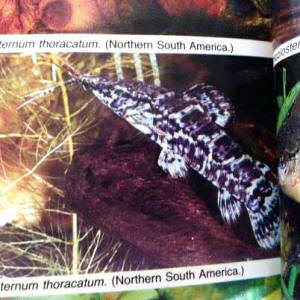
Neale, thank you for your response. This isn't the only picture
I've found of this color variant. There is a much older book I looked
through and found a similar photo. From the picture this doesn't
appear to be a smaller or juvenile fish, although pictures can be deceiving.
Thanks,
Rick
<There is much variation among juvenile Megalechis, and some can have very
striking colouration. Ditto for closely related genera Hoplosternum,
Callichthys and Lepthoplosternum. Nonetheless, I'm not aware of any pure
black/white varieties among any. Older books suffer from the less than
perfect translation of monochrome and colour film to paper, and the fact
many publishers (even today) tweak the colours of photos so that a given
fish looks more attractive. Much better to use sites like PlanetCatfish and
ScotCat to peruse recent photos of aquarium specimens, and use them to
identify the fish in your tanks or at your local retailer. Cheers, Neale.> |
|
Corydoras ID -11/18/07 Lord, I hate to bother you all
again. But I've spent several days at planetcatfish.com
trying to ID this little Corydoras catfish and can't seem to
find what he/she is. I ordered Corydoras trilineatus and 2 of
these came in the same batch. I'm putting them all in the 125
gal with the Severum (after 4 wks. quarantine). I'd like to
get a few more of this species because I noticed Corys seem to
hang out with their own species pretty often and I want them to
be comfortable. If you can ID him for me I'd certainly be
grateful and so would the little Cory. Thank you all, you're
the most wonderful group of volunteers I've ever encountered.
Mitzi <Hello Mitzi. Your catfish could well be Corydoras
trilineatus. As you perhaps realise, Corydoras trilineatus and
Corydoras julii are routinely mixed up. In fact many catfish
experts reckon that most of the fish sold as Corydoras julii are
actually Corydoras trilineatus. The give-away is the head:
Corydoras trilineatus has black worm-like markings on its head,
whereas Corydoras julii has discrete, approximately circular
spots. Because your fish doesn't seem to have those spots on
its head, I don't think it is Corydoras julii. I agree with
you that Corydoras are happiest in big groups. Six specimens
seems to be the minimum to really get the most from them. Kept
like that, they are less shy and more entertaining, as well as
easier to breed. Thanks for the kind words, and hope this helps.
Cheers, Neale.>
Corydoras ID/tank height -11/18/07 I have a PS to the
email below I just sent. I just read a quote from Neale at
WetWebMedia.com/FWSubWebIndex/callcatdisfaq2.htm saying
"<Circulation of the water is important. But also how
deep is the tank? Corydoras are obligate air breathers, and they
will literally drown in an aquarium too deep for them. For the
smaller species, around 30 cm is about right. Anything over 45 cm
is dodgy, in my opinion.>" This had occurred to me before
but now I'm extremely concerned. The 125 gal tank I planned
to put 12 Corydoras into is 22" tall (or 60 cm). Is that
going to be too tall for them?? If it is I'll just buy them a
40 gal long and put some Hatchet fish in with them. Just when I
think I'm done worrying I find out I'm not :-( I'd
love to hear your opinions. Mitzi <Hello Mitzi. In deep tanks,
small Corydoras may struggle to reach the surface. In a plain
aquarium, 45 cm may be taken as a safe depth of water for medium-
to large-sized species like Corydoras panda and Corydoras aeneus.
Smaller species, like Corydoras hastatus, shouldn't really be
kept at more than 30 cm depth. In deeper tanks, it's
generally recommended you go with Brochis rather than Corydoras
spp; Brochis are altogether stronger swimmers and naturally come
from relatively deep waters. Corydoras are very much shallow
water fish that inhabit creeks and streams rather than rivers. My
peppered Corydoras live in a tank where the water is about 40 cm
deep, and they seem fine. What I have noticed is they often rest
half-way on stiff plants such as Anubias. So, if your tank is
unusually deep, you might incorporate such resting places so that
their life isn't too difficult. Do note that I'm talking
about the depth of water rather than the depth of the tank; by
the time you allow for the depth of substrate and the air space
at the top of the tank, your 60 cm aquarium will likely only
contain around 50 cm of water depth. While still deeper than the
optimum, with a few robust plants, bogwood roots, or rocky
ledges, your catfish should be fine. Cheers, Neale.>
|
|
|
Platy - Gourami mix revisited: this time, +cats!
2/2/06 Hi crew! Thanks for your
quick+informative reply regarding my platies! The little guys look very
happy! I followed your advice and bought a test kit: all very good
readings: Ammonia: 0 Nitrate:0
Nitrite:25 - 50 <These last two are crossed-over... and
nitrate's a bit high. Do try to keep below 20 ppm... means covered
on WWM> Ph: not sure, as it was a funny light blue
colour, but I'm guessing it was about 7.5, and they told me not to
worry about it at my local fish store place. <Is
likely fine... also covered> I did not buy the Gouramis,
as planned, but instead bought 2 little cats. I hope to get the
Gouramis later. My question is about my
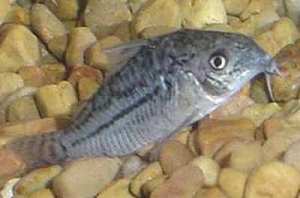
cats. In the shop, they were labeled as "speckled cats", but
when I got them home and looked in a fish book, there was a picture of
them... Labeled as peppered Corys! I can't send a pic. with this,
but I'm working on it! They seem very peaceful and fun loving,
could they be the peppered Corys? <Are very likely
a species of Corydoras... maybe paleatus... covered on WWM... fine
here> Thanks for replying to my email, and once again,
thanks for your great site! <Welcome. Bob Fenner>
Corydoras Correction on the FW Web Site I will pass along
your link request and ID correction. Thanks, Steven Pro Hello Steve, I
was just checking out the WWM web site, very nice. I would definitely
like to link with the site. Let me know if that would be possible or
how to go about it. Also, some helpful input, I noticed on the page
below: http://www.wetwebmedia.com/FWSubWebIndex/callichthyids.htm that
the Corydoras catfish captioned "Corydoras barbatus" at the
top of the page isn't correct. It appears to be a Corydoras
semiaquilus, nowhere near a C. barbatus. Hope that helps a bit, Thanks,
Eric <Thank you for this. Will check, re-label tomorrow. Bob
Fenner>
|
|

