|
FAQs on Callichthyid Catfish Disease/Health
1
Related Articles: Callichthyid Catfishes, Summer loving: cats in the garden, kittens in
the kitchen by Neale Monks,
Related Catfish FAQs: Callichthyid Cat Disease 2, Callichthyids 1, Callichthyids 2, Callichthyid Identification, Callichthyid Behavior, Callichthyid Compatibility, Callichthyid Selection, Callichthyid Systems, Callichthyid Feeding, Callichthyid Reproduction, Catfish:
Identification, Behavior, Compatibility, Selection, Systems, Feeding, Disease, Reproduction,
|
|
|
Have irreparably harmed my Cory? 3-5-09 Hi. I
moved some slate from my 20 gallon to my 40 gallon tank last
night. Later on, I noticed my 3 Peppered Corydoras were not
moving and my smallest was laying on his side. My other 3 Albino
Corydoras along with Platy and 2 fry seemed okay. Am and Nitrites
0. I did 40 percent water change prior to bed. Upon waking this
morning, all Corydoras were listless and I thought the smallest
one was dead at the top stuck in a floating plant. Am and nitrite
still 0. I scooped him out and tossed a good foot into a bucket.
He wasn't dead. I immediately tossed him back in the tank (so
I thought). I went and prepared some water for another change,
came back and found him on the side of the tank ( still
breathing). I panicked and put him in a bucket with some tank
water and a couple drops of Methylene blue and an airstone while
I changed the water and added a Eheim liberty 200 filter to
further help conditions in the main tank. All the other Corydoras
have perked up. The other is back in the tank floating at the top
on it's side, it did go back down to the bottom for a few
minutes and now it's back up top, barely breathing. I
don't want to make the mistake of considering it dead again,
but I don't want it to suffer. Should I euthanize this fish?
Wait a bit? I feel like I'm in a fish horror story and
I'm the bad guy which I guess I am. :( Gina <Hi Gina.
Adding Methylene Blue without good reason is never a good idea.
If you see unhappy fish, it's almost always an environmental
issue, possibly poisoning. The latter is often a problem if
you've been doing painting or anything else that releases
fumes into the air. Because Corydoras are air-breathers,
they're particularly prone to this type of poisoning.
Assuming water quality is good, I'd check the temperature,
pH, hardness, and that water circulation is adequate (i.e., the
filter isn't running slow), and that there's nothing
rotting in the tank that could be using up oxygen. Change 50% of
the water now, and 50% early the next morning. Essentially try
and flush through lots of clean water. Have you added anything
new? Plants? Fish? If so, consider Ick and Velvet as possible
stowaways, and act accordingly. Corydoras are pretty robust, and
I'd not count them out too soon, but do observe closely for
the next few hours. A photo would help us identify problems.
Cheers, Neale.>
|
 |
|
Re: Have irreparably harmed my Cory?
3-5-09-09-09 Hi Neale. The only thing I did was caulk up
some holes in my wall a few feet from the tank the Cory is in. I
don't know if that factors in. <Hmm... certainly possible
if any types of solvent were involved. By default, when doing
home repairs nearby your fish, keep windows wide open and a good
strong flow of air through the room. Obviously moving the fish to
another room is even better, but not always possible.>
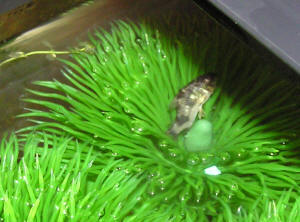
I've attached a picture, he seems worse today (not attempting
to move away). I've done the water changes as instructed and
all other fish in that tank seem okay. I did add some rock to the
Cory's tank that I had bought for a redo on my 10 gallon tank
that was left over. <What kind of rock? Some rocks are safe in
fish tanks, but many aren't.> It was in the 10 gallon for
a few hours before I moved it. <OK.> I mention the 10
gallon (in a different room) because I woke to find my six new
Kuhli Loaches (had about 3 days) were all dead. <Suspect these
were in bad shape before purchase: they are VERY underweight. If
you look at them, their heads are bigger and thicker than their
bodies. Since the skull doesn't shrink with starvation, but
the muscles around the body do, this is usually a sign the fish
is starving. In fact a healthy Kuhli will have a chunky body and
usually a distinct "shoulder" behind the head where its
body is obviously more robust that the head. So in this case, you
may have come home with weak fish, making things difficult.> I
had recently redid the tank for them (rocks, sand). I added a
Eheim Aquaball and kept the sponge filter in the tank. When I
came home from work last night, one was floating at the top in a
plant (usually stays on bottom during day) but eventually moved
down. I thought it was because I had put my Betta in with them
and he bullied him. So I removed the Betta. <Bettas and Kuhlis
normally get along fine.> Then at bedtime, turned off the
lights, threw in an algae wafer (new bag bought last night) and
checked on them before bed and they were swimming and doing
figure eights, very active. Then all dead this morning. Am 0
Nitrites 0 Nitrates 20 PH 6. I've been struggling with low PH
and had removed all driftwood from my tanks and all have had
several water changes, the PH doesn't seem to be moving.
<A sudden pH change certainly can kill fish. Is the pH 6 all
the time? Or does it go up and down? If you have a pH of 6,
it's likely you have soft water. I'd recommend fixing
that by raising the carbonate hardness. Various ways to do that:
commercial pH buffers (7.0 would be ideal); adding a small amount
of crushed coral to the filter; or adding a 1/4th to 1/2 dose of
Rift Valley cichlid salt mix (not normal salt!) to each bucket of
water. Do see here:
http://www.wetwebmedia.com/FWsubwebindex/fwsoftness.htm Oh, and
do make sure you aren't using water from a domestic water
softener; that's very bad for fish. Only use drinking-quality
water.> I just bought and set up the 40 gallon tank ( I
don't know if you remember our conversation last week ) and
now I'm thinking of chucking it all except the Betta and a 5
gallon. I don't understand what happened the last couple of
days at all and don't want to do anything until I do.
<I'm not 100% clear what's going on, though I suspect
the sick Corydoras and the dead Kuhli loaches are separate
issues. Now, do remember that the bigger the tank, the more
stable it will be, so keeping a 40 gallon tank will be miles
easier than a 5 gallon, all else being equal. So don't get
too disheartened! But please, go slowly, and do feel free to ask
as many questions as you want. I think once you understand the
issues behind soft water and pH changes, you'll be able to
see the dangers you need to avoid. Cheers, Neale.>
Re: Have irreparably harmed my Cory? (RMF, would
appreciate input)<<Ok>> 3/9/09 Hi Neale.
Thanks for all your help. <Most welcome.> The pH in my 20
gallon tank that has been running for 2.5 months is at 6. I added
Seachem's Neutral Regulator with a 25 % water change Sat
night and again Sun Morning. It doesn't seem to budge the pH.
<Hmm... this is a very low pH for a community tank. While not
in itself a disaster provided you stick with soft water fish
only, it would be the wrong place to keep hard water fish like
livebearers. My gut feeling would be that if you can't beat
'em, join 'em. Choose only fish that will enjoy these
conditions.> I'm reluctant to add it directly to the tank
as I wanted to raise the pH slowly. <Correct. You should never
add these chemicals directly to the tank. Instead, add them to
buckets of water. Alter the water in the bucket, and then use it
to replace a bucket of old water in the tank. Over the weeks, the
aquarium will gradually shift from whatever the conditions are in
the aquarium to the conditions you are creating in each bucket of
new water.> With the water changes, the pH will move up
towards 6.4, but within a few hours drops back to 6 (the lowest
my test goes). <Implies a variety of things, though most
likely a combination of high stocking (lowers pH via organic
acids, nitrate, etc) and lack of carbonate hardness in the water
(nothing to inhibit pH decline). Certain materials, notably
bogwood, will also lower pH.> I get the same readings and
results in the 5 gallon tank that has the Betta. <OK, does
sound as if you have very soft water. This is tap water, right?
Not from a domestic water softener? You should never use water
from the latter.> I purchased one of those test strips for
alkalinity. <OK.> Currently in the 20 gallon (which houses
3 Platies, 1 fry, 6 Corydoras (the sick one is swimming around
and looking for food a bit now) : pH 6 Hardness 120 (which reads
as moderate not soft? Also, I do have build-up around my faucets)
<<This could be salts, not of Ca, Mg... not contributing to
hardness... RMF>> Alkalinity 0 Nitrite and Nitrate 0
Ammonia 0 My tap water comes out (tested from inside and outside
sources, tested immediately after drawn and then after aerated
for 24 hours) pH 8 Hardness 120 Alkalinity 120 (sometimes looks
more like 180) Ammonia 2 + <<?!. RMF>> Currently in
the 40 gallon which was filled with conditioned water, pH 8, 4-5
days ago and has been running with Eheim filtration with
temperature set at 80 degrees. The Alkalinity in the 4 days has
dropped from 120 (180?) to 80. pH from 8 to 7.6. I added a full
dose of Seachem's Regulator on Saturday to this tank.
<I'm getting a
déjàvu feeling
here! For one thing, you're using strips, and these seem to
be less reliable than liquid test kits, so if possible have your
local aquarium shop test some water and compare it to the results
you get. But secondly, there seems to be a thing with the water
supplied to some (American?) households where the water chemistry
rapidly changes of its own volition within a few days. For
whatever reason, it isn't something I've come across in
the UK, so can't speak about from personal experience.
Essentially it means that there's a combination of additives
and minerals in the water that over a few days change
sufficiently that water chemistry alters dramatically. Take a
look here:
http://www.wetwebmedia.com/FWSubWebindex/fwhardnessfaqs.htm Go
specifically to the thread "pH/Ammonia Issue (RMF, never
come across this, any ideas?)" and you'll see than Bob
and I went over and over a similar issue with another a
fishkeeper.> <<I have re-read... and have encountered
such issues, vacillating GH, KH in tap/mains water supplies... As
stated in the cited string above, there are municipalities that
at times will run more of a few types of mainly
"flocculants" (though other chemicals can/do have this
and other "anomalous" effects)... And there are many
cases of "bad readings", particularly for strip-type
tests... and other endogenous factors can certainly cause wide
and rapid shifts in hardness and pH... as is gone over...
RMF>> I've read that certain conditioners for chlorine,
Chloramine and ammonia will pose false positives for ammonia
depending on the test kit used. <Correct. Test the tap water
prior to adding anything. Any traces of ammonia will be dealt
with via your additives, so shouldn't be an issue.> With
Kordon's AmQuel as I can get the ammonia down to 0 for water
changes (using twice the dosage amount, but reads for 1 ppm
removal, since my tap comes out at 2 ppm, I'm assuming this
is correct?). <Can't do any harm.> With Seachem's
product, which says it treats for all the same, I can't get
the level down to 0, in fact it doesn't budge the ammonia at
all. <Your ammonia test kit will detect "false
positives" from certain other chemicals, such as Chloramine
and apparently Nessler's reagent.> Nor does it seem to
adjust the pH based on my drip test (neither on water drawn and
conditioned and tested immediately nor tested 24 hours later
after being aerated). Another conditioner I tried this weekend
will drop the ammonia to .25, but no less, no matter how much I
add. Am I over dosing the conditioner? Am I correct to not add
any water to my tank unless it reads 0 for ammonia? <<Yes!
Best to treat, store "new" water outside the system...
for a week if you can. RMF>> Can you best advice on how to
stabilize my pH from here? Or ideas on to the cause and/or how to
further test to determine what is going on? I've recently
upgraded all filtration and moved the biological filtration to
the new. However, it seems useless since my pH is so low. <OK,
here would be my advice. Put the strip test kit to one side for
now. I'm assuming it's an all-in-one strip, right?
Let's assume these are mislead/unreliable when used with your
tap water. Leave them for checking nitrite/nitrate levels at
which they'll be fine and dandy. Good enough for making sure
your water changes and filtration are doing their thing! Buy a
carbonate hardness test kit and a pH test kit. These are the two
critical ones for water chemistry. The general hardness test kit,
though it sounds useful, actually has somewhat limited usefulness
despite being "general". It doesn't really tell you
anything about the ability of water to resist pH changes; only
how much non-carbonate "stuff" is in the water. Since
these minerals have near-zero impact on pH buffering, this
isn't informative. Now, your carbonate hardness kit will test
specifically for the carbonate and bicarbonate content of the
water, and THIS is the stuff that keeps pH from changing. The aim
for most freshwater fishkeeping is get a carbonate hardness of
around 5 degrees dH (about 90 mg/l calcium carbonate equivalent).
This amount should buffer against any reasonable amount of
acidification between weekly water changes. If you find you
don't have this amount of carbonate hardness, you'll need
to add some to each new bucket of water. A good Malawi Cichlid
salt mix will do the trick, though obviously there's no need
to use the full dose. The usual ratio is: 1 teaspoon baking soda
(sodium bicarbonate) 1 tablespoon Epsom salt (magnesium sulfate)
1 teaspoon marine salt mix (sodium chloride + trace elements) For
a Malawi aquarium you'd add this to each 5 gallons/20 litres,
but since we likely won't need nearly so much, try using
one-fourth the amount to begin with, and if that doesn't
work, one-half. So initially, 1/4th a teaspoon of baking soda,
1/4th tablespoon of Epsom salt, 1/4th teaspoon marine salt mix.
This is clearly not an expensive way to go! But it works really
well, and should fix the pH at around 7.5 plus or minus a little,
and get you a carbonate hardness around the level we want.
General hardness will be somewhere around 10 degrees dH, but it
really doesn't matter that much. Add these salts to buckets
of water prior to use, and ideally, leave the water overnight and
then test the water chemistry (pH, carbonate hardness) again the
first few times, just to see how things pan out. With luck, the
Malawi mix will compensate for any funniness in the water as
supplied by your water company. Problem solved.> The tanks
have river rock, sand, slate, gravel, but nothing that I
haven't bought at a LFS. <Cool.> Thanks again for any
insight or instruction you can provide. Gina <Hope this helps,
Neale.> <<I do agree with your "all fits"
advice above... Starting with most any/all source water, the
simple mix/addition should serve to bolster hardness, fix pH well
enough... RMF>>
Re: Have irreparably harmed my Cory? (RMF, would
appreciate input) 3/10/09
Thanks, both of you.
<Most welcome.>
I've treated 5 gallons of tap water with Amquel and 1/4 tsp
of each baking soda, Epsom salt and marine salt. I'll let it
sit overnight with an airstone before I do a water change.
<Quarter TABLESPOON of Epsom salt! Not teaspoon. No big deal
this time around, but try and get it right next time, eh? Oh, by
the way, one tablespoon is three teaspoons, so a quarter
tablespoon would be 3/4ths of a teaspoon.>
I got a carbonate hardness test as well. I already had liquid
tests for pH and all the others. Although the numbers are a bit
different, it seems to show the same trend as the strip test.
<Good.>
The 20 and 5 gallon tanks register a pH of 6, 0 mg/l.
<Low; biological filtration operates best around 7.5-8, and
below 6 stops altogether. So unless there's a darn good
reason, a pH of 7 or slightly above is the ideal for community
tanks.>
The 40 gallon tank that was conditioned with Amquel and has been
running fishless at 80 degrees with a pinch of food added daily,
registers 50 mg/l and a pH of 7.2. This is after 5 days. My tap
comes out 90 mg/l and a pH of 8. I have had a bucket of untouched
tap water running with an airstone for close to two days and it
still has the same readings. So I'm assuming around 4/5 days
my carbonate hardness drops by half? I'll guess I'll keep
testing the tap water and 40 gallon tank to see how fast it
continues to drop.
<If you add the carbonate hardness "recipe"
suggested, my prediction will be that water chemistry in terms of
pH will remain essentially stable between water changes. The
higher the carbonate hardness, the less pH will drop. Hard,
alkaline water (like in a hard freshwater aquarium) basically
doesn't change at all, or if it does, by tiny amounts. See
how the one-fourth dosage I've recommended works out; if it
doesn't work, up the dosages to one-half dosages per bucket
of water. Even at full dosage, it's would be ideal for things
like livebearers, though soft water fish such as tetras might
complain.>
I'm assuming I won't see a jump in the pH or carbonate
hardness with the Cichlid mix overnight ( in the treated change
water) as it takes several days for it to drop.
<Correct. And with increasing carbonate hardness, the rate at
which pH drops will slow down.>
Does that mean, it might be several days before I see a change in
my 20 gallon tank?
<Yes.>
Is a 20% water change with the new mix, every day, too quick a
change?
Should I go slower than that?
<This should be fine.>
Also, Bob, had put a ?! next to my tap water ammonia reading of
2+.
<This is for your tap water, right? Before treated with
dechlorinator? The _maximum_ allowable level in drinking water is
0.5 mg/l, in the United Kingdom at least. Ammonia usually gets
into drinking water via things like agricultural run-off. Do
check with your water supplier what the ammonia content of the
water supplied to you should be, and ask whether this reading is
normal. There could be a problem. If you're detecting the
ammonia AFTER adding dechlorinator, you're probably detecting
Chloramine after treatment with dechlorinator. Provided the
dechlorinator treats Chloramine, you can ignore this "false
positive" reading for ammonia.>
It's steadily at 2. Is this abnormal?
<Yes; check with your water supplier.>
I shower in the stuff and my dogs drink it.
<Ammonia isn't especially toxic to humans at low doses
(our bodies produce the stuff all the time) but it isn't
normal to get this amount in drinking water. If you add water
with ammonia at 2.0 mg/l to the aquarium, you're basically
dumping a lot of pollution in there. While the filter will fix
that problem reasonably quickly, for a short while at least the
fish will be exposed to a serious toxin.>
Eventually I would like to store water a week ahead as suggested,
I tried it at the beginning of all this but after week the tap
water still registered ammonia at 2. But at this point, I've
read so much, I feel like I have too much information and not
enough understanding.
<<Ahh! A beginning for enlightenment. RMF>>
<The addition of carbonate hardness to each batch of water
should make the water chemistry problem go away. Trust me on
this. As for the ammonia, that's a weird one. Some products
such as Kordon AmQuel will remove ammonia from tap water, making
it safe to use. Do see here:
http://www.novalek.com/kordon/amquel/index.htm
http://www.novalek.com/kordon/articles/insights_into_test_kits.htm
Once your water is hardened and then treated for chlorine,
Chloramine and ammonia, it should be ready to use. I can't
see any further problems with your fishkeeping, and hope it will
be a LOT SIMPLER after this.>
I'll keep you updated on if this works for my system. If it
does (fingers crossed) does this mean I should eliminate my
Corydoras from my tanks since I am using a salt mixture to steady
the chemistry? :(
<Nope. The amount of carbonate hardness is low enough not to
bother Corydoras, and the salinity trivially slow. To put this in
context, seawater has 35 grammes per litre salt, which is almost
6 teaspoons per litre, or about 22 teaspoons per US gallon. The
one-quarter teaspoon is as nothing by comparison.>
Thanks again,
Gina
<Cheers, Neale>
|
Bronze Catfish disease, reproduction 02/12/06 Hi. I have six
bronze cats which have are all happy and healthy. They play in groups
in the bubbles and are very active. One of them laid eggs a couple of
weeks ago and became very fat again looking like it was about to spawn
but died very mysteriously. It was starting to look quite swollen and
reddish around the lower belly. Has she died from not laying her eggs?
Sorry to bother you but have tried Google with no luck. Thanks very
much, Dave. <This fish might have been "egg-bound"... a
condition where the eggs don't pass for a few possible reasons...
or perhaps became infected in the area. Providing suitable water
quality, nutrition avoids many of these incidents, but not all. Bob
Fenner>
Corydoras panda are losing their eyes! 1/26/06 I
hope someone can help. Recently I noticed 4 of my young pandas have
lost their eyes. 2 have died so far. After they lose their eyes they
start to loss their color and turn whitish. They still feed and act
silly. I've had pandas for a few years and have managed to breed
them very successfully. I love my little guys and take good care. Could
this be a disease? <Not likely> or is someone attacking them?
<Yes> The only "new" addition is a very young Kribensis
Cichlid (about the same size as the pandas). I have a 60 gallon tank
with mostly tetra (cardinals and hatchets), 5 Platies, 2 small
angelfish, 2 yoyo loaches and 2 Plecos. <I suspect the Kribensis or
loaches... but could be an angel... only close observation or
systematic removal will reveal the culprit. Bob Fenner> Help me
please - Sabiha
Cory Quarantine Query (Now say it 5 times fast!)
12/26/05 Hello~ <Hi.> A newbie in the field, but have been
gleaning a lot of info from this site-very appreciative of all the
knowledge that is accessible. <Outstanding, glad to hear we have
been helpful.> I have a 12 gal going for about 3 months...all is
fine, but spotted a few panda Corys that I would like to buy and QT-
and all that I have running besides the 12gal is a 2 gal...would this
be big enough <Enough.> for the Pandas (3) to spend about 2-3
weeks in before putting them in the larger tank? <2 gallons is
pretty small, and I would be a lot more comfortable with something in
at least the 5 gallon range. However of you plan to go ahead with it,
the tank would need to be well filtered and have good surface area.
Daily water changes of 30 to 50% would be a must.> Thank You Very
Much, <Quite welcome.> Merry Christmas, <Ditto.> Judy
<Adam J.>
Sick Cory catfish 11/14/05 I have a 10 gallon tank
with 7 tetras and 3 Cory catfish. One of my catfish has been sick for 2
weeks. I expected him to die a while ago but he just keeps hanging on
so I was hoping someone could give me advice on how I could help him
get better. He swims around but then rests upside down. <Yikes,
bad> He also will swim straight up to the top of the water and then
float upside down back to the bottom. Its like he's lost his sense
of balance. <Yes> He doesn't have any other symptoms except
lying upside down. My water parameters are all normal. The temp. of the
tank is 80 degrees. I'm thinking that he might have a swim bladder
infection, <Likely some damage here, yes> but have no idea on how
to treat it. I want to stay away from medication if possible. Any
advice? Thanks! <I would at this point simply observe this fish and
hope for a spontaneous cure. Bob Fenner>
|
Panda Cory with Milky Film 10/13/05 Hello,
<Good morning. Sabrina with you.> This is my first fish
tank and your website has been tremendously valuable. I keep
making mistakes, though, and lost 4 panda Corys. Just when I
think I've figured out what I'm doing wrong, another
panda gets sick. <Yikes. Starting out, most folks make
mistakes, so do not beat yourself up on this. It is how we are
prompted to learn.> I now have two pandas. One seems healthy
and active, but the other has milky white clumps on one side of
his body. They started about 2 weeks ago and are spreading.
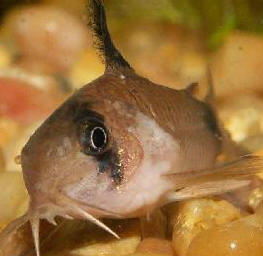
I'm attaching two photos...I hope you can open them. I
don't know if it's a fungus or bacterial infection. <A
tough question. I, personally, think this is Columnaris or some
other (severe) bacterial infection. Good photo, BTW.> I've
been treating the tank with Maracyn for 8 days now. Initially,
there was a small red spot in the white patch that's gone
now. The Cory hides but eats actively (sinking wafers and shrimp
pellets) and his breathing seems normal. Both seem to tolerate
the Maracyn. <I don't think Maracyn (Erythromycin) will
treat Columnaris; even if this is something else bacterial, I
doubt that Erythromycin is the way to go; it only treats
gram-positive bacteria (that's bacteria that have a cell
wall); there are few gram-positive bacteria responsible for
illness in fish.> <<This is incorrect: The difference
between "gram positive" bacteria and "gram
negative" bacteria has to do with how they take up (or
don't) a type of violet stain (re: peptidoglycan w/in cell
walls) . Try Googling, or view here
Marina>>
|
|
|
|
My tank and mistakes: -- 7 gal, power filter with
venturi tube, sponge filter, heater, light, live plants,
driftwood. -- 1 male Betta, 2 panda Corys (at most 4). -- temp
80F, ph 7.0, total ammonia < 0.1ppm (was zero before Maracyn),
nitrites 0ppm, nitrates 5ppm, dGH 2, dKH 2. -- 30-40% water
change and gravel vac every other day, Amquel, Nutrafin Cycle
every other change. Temp change 1-2 degrees after change.
<This is too much maintenance, once the tank's cycled.>
-- mistakes: --didn't cycle properly and overfed; lost 2
Corys due to high ammonia. --problems keeping temp and pH stable;
okay now. --initially fed Betta live tube worms <Tubifex
worms, perhaps? Try to avoid these; Blackworms are safer (as in,
less prone to passing along disease to your fish).> and now
some are living in the gravel. I vacuum but can't seem to get
rid of them. Maybe the substrate wasn't clean enough.
<This is okay. The worms in the substrate aren't of
significant concern unless they are very numerous.> --Two
other Corys gradually got sick. <Ammonia again? Or this
illness?> --one died after one dose of Maroxy; did quick water
change and stopped. --another died after one dose of Maracyn II,
same. I feel terrible about losing these fish. Is there anything
I can do if the Maracyn doesn't work? <I've shown this
to Bob, as well.... his recommendation is to treat with aquarium
salt and a furan compound.... might read here for more: http://www.wetwebmedia.com/furancpdfaqs.htm
.> I don't want to add another chemical or medicine that
might do more harm than good. <The Maracyn likely will not be
of help here.> I won't add new fish. Through all this, my
Betta has been very active, eating heartily, and seemingly
oblivious. <I would remove him from this system immediately,
lest he contract the illness as well. Normally I would recommend
the opposite, removing the infected fish to a separate
quarantine/hospital system, but I would be fearful for the Betta
right now.> Thanks for your expertise! --Anita <Wishing you
the best, -Sabrina>
|
|
Panda Cory with Milky Film - II - 10/21/2005
Hello Sabrina again, <Aloha.> Thank you for your advice on
treating my panda Cory with the bacterial infection. I set up a
small 2.5 gal tank with power filter, heater, new gravel, two new
live plants, and some decorations, then moved my Betta into it.
Since the tank isn't cycled (I didn't use gravel from my
main tank, due to the infection), I am monitoring the ammonia and
doing 50% water changes every other day. He is settled and
healthy, his normal self, though a bit cramped. <All sounds
good for now.> I am relieved he's safe. In my 7 gal main
tank with the two panda Corys, I added aquarium salt (dissolved
in water) and began treatment with Furan 2 (two courses for 8
days). Today is the last day. The tank parameters are still: temp
80F, pH 7.0, total ammonia 0ppm, nitrites 0ppm, nitrates 5ppm. I
have good news and bad news, plus more questions if you can help.
<Alright! Let's get started.> First the good: Both
Corys tolerated the treatment. The healthy one looks the same
with no sign of infection. The sick one still has energy, eats a
lot, and swims around. He has actually grown bigger in the three
weeks since the white patches appeared. <Wow.> (He is the
only Cory that developed these white patches.) Both seem to be
breathing normally with no redness around the gills. Now the bad:
The white patches don't seem to have reduced in size or
thickness. It's difficult to tell if they've spread, but
there might be a new patch on his right side. The past few days,
I've noticed he darts and jerks more when he swims and hides
more often. I looked at a close-up photo and was astonished to
find that his left pectoral fin is gone! It was definitely there
5 days ago.
|
|
Panda before Furan2
treatment.
|
|
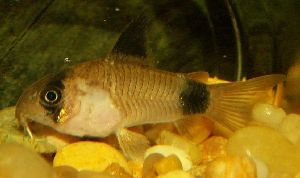 Panda
post-Furan2. Panda
post-Furan2.
|
|
<Did you start medicating with a Furan compound
yet?> I am attaching photos. Since this infection started, his
left side seemed to swell and bulge around the pectoral fin.
Since he's grown bigger, it's hard to tell if there's
still a bulge. I plan to do a partial water change and put back
the carbon filter as recommended on the Furan 2 package. <Mm,
you should remove the carbon when you start treating with the
Furan 2.> Should I keep the aquarium salt in the water or
gradually remove it with water changes? <Fine to leave the
salt in, as long as it is no more than 1 tablespoon per five or
ten gallons.... less is better with Corys.> Is there another
treatment I can try? <Have you started the Furan 2 yet? I
would give it a second go, if you're already done with the
first round.> Can his fin grow back? <Possibly, but also
possibly not. Not to worry, though, he can live without a
pectoral fin if it does not grow back.> Is it possible he can
make it or does this mean he will slowly get worse and suffer
more? What is the best and kindest thing I can do for him now?
<In all honesty, I don't know his chances. It's a
pretty bad infection. However, if he's still eating, I think
there's still hope. I would give it a second round with the
Furan 2, and if that still fails, I would consider going to
something "stronger", perhaps Oxytetracycline....>
Thanks for your help, --Anita <All the best to you and your
fish, -Sabrina>
Panda Cory with Milky Film - III - 10/22/2005 Hello
Sabrina, <Ahoy thar, matey!> <<Hey.. talk like a
pirate day was last week!>> Thanks so much for your
quick reply! <Sure thing.> To clarify, I ended 8 days of
treatment with Furan 2 yesterday. (The package says to use it for
4 days, then you may repeat if necessary, which I did. <Ah, I
see.> I cut open the capsules to get the right dosage for my 7
gal tank. I don't know if there's a better way. <Mm,
probably that was right to do.> <<Please note: this
stuff can stain clothes permanently. MH>> I washed my
hands immediately afterwards.) Three days after starting the
Furan 2, I took a photo that shows the pectoral fin. Five days
after that, another photo showed the fin was gone. (Without the
photos, it's hard to compare how he's doing since he
moves so fast.) <At least he's still acting well!> I
removed the carbon during the treatment and just put it back
yesterday. Today the water is clear again instead of greenish
from the Furan 2. Is it okay to continue the Furan for another 4
days (for 12 total days)? <Actually, I would not.> It's
hard to tell if it made a difference (except he's still
here!). Do you have a recommendation for an Oxytetracycline
product? I'll look for some today. <Having discussed this
with Bob, I wish to recommend that you use Acriflavine in the
water, instead.... Methylene Blue if you can't find
Acriflavine. In addition to this, a food medicated with
Oxytetracycline is a really, really good idea. Here is one place
to purchase such a product: http://flguppiesplus.safeshopper.com/29/cat29.htm?264
. Otherwise, you can make this yourself, if you can find
Oxytetracycline.... or could use tetracycline.... or other
antibiotic.... This article contains a passage about preparing
your own medicated foods: http://www.wetwebmedia.com/PondSubWebIndex/holedispd.htm
.> Thank you! -Anita <Sure thing. Wishing you well,
-Sabrina>
|
Doomed Corydoras Hi WWM crew . . . haven't emailed you in
a while (thankfully). My main problem is, that no matter how hard I
try, my Cory cats never seem to prosper. It's so frustrating since
Corys are my favorite fish. <Mine too> No matter what conditions
I keep them in, they eventually die, lose their barbels, or remain
stunted (never mature from 1 inch juveniles). I have acquired some
beautiful harder-to-get species, such as similis "violet",
xinguiensis, caudimaculatus, and trilineateus. I used to have six
xinguensis (now five? or four?), and have two similis, caudimaculatus,
and Trilineatus each. I assume that it is not for lack of company that
they are dying. They seemed to lose their barbels on a Fluorite
substrate, so I switched them to a bare-bottom tank. The current tank:
10 gallons, sponge-filtered, a few plastic plants, one female Betta,
rather warm (80-82 degrees). Every so often one of them, such as the
xingus, will die suddenly. I can transfer them to a currently empty 75
gallon tank . . . I just really really wish to breed them, see them
grow up and prosper . . . and live. My problems that I can see is the
warm water temp . . . the infrequent feeding . . . and the rather dirty
tank bottom. Thanks for your time and info! <Arghhh, your breaking
my heart. I love the little guys, their selfless devotion to cleaning
your gravel, the way they wink at you when you stare at them long
enough, ok I'm done. For starters, what are your water parameters?
If you are serious about breeding them you will need to set up a tank
for them, and them only. Like you said "warm water temp . . . the
infrequent feeding . . . and the rather dirty tank bottom" this
will cause problems. 82 is a little high, you will need to vary the
temp depending upon the type of Cory, but high 70's is a good
starting point. These guys love live worms, I feed mine shrimp/algae
wafers and left over frozen food, but I am not trying to breed them.
10gal is a little small, a 20gal long is a good start. With good water
quality and good food you should be ok. You might try starting with a
more common Cory instead of shelling out the cash for the rare ones.
Use the Google search tool on our site and google.com to find more
information on Cory care and breeding. Good luck, Gage>
Re: the doomed Corydoras ... Thanks for the speedy reply! I have a
few more questions to clarify, sorry. Will Corys be happy with members
of other species? Should I get more of each species? As I said, I have
several pairs of different species in my tank. This is because I bought
them at a local aquarium society auction. This is great as there are
many dedicated Cory breeders who can provide us with many healthy,
rarer, and more-or-less cheap (about $3 each) specimens. The 10 gallon
was intended to be a quarantine tank, but I don't want to move them
to the 75 gallon, as they look so small and delicate. Perhaps I should
add a small bio-wheel power filter? (I've got an extra one lying
around) My water parameters are: nitrites - 20, and pH 7.8 (with
"Amazon" buffer), KH 3, dh 2. My tap water is supposedly very
soft, with no fluoride and hardly any (if at all) chlorine/chloramines.
One of the perks of living in Hawaii! Of course the water is too warm
<If I recall you mentioned your water was around 82, this is not
terrible, but I would not go much higher> . . . Well I will do more
water changes, feed them twice a day, <They love worms!> add a
fan . . . and hopefully see them grow to 2 and 3 inch maturity. Thanks
for your help . . . Trisha. <Hey Trisha, great idea with the QT
tank, it's the only way to go. I would however add the filter (the
more the merrier), and keep up on water changes. Nitrates are really
high, they should be around 0 I am guessing that ammonia is high too.
How long has the QT tank been set up? Sounds like it is rather new. I
would still be sure to use some sort of water conditioner to remove
chlorine and chloramines, your Amazon buffer may do this, I am not
sure. What other fish do you have in the 75gal? These fish are pretty
tough for their size. Corys will get along with other species of Corys,
but would be happier with more of the same. In the wild they like to
hang out in shoals of about 50, not always easy to recreate in the home
aquarium. Gage>
Are my Corys stressed? Hi there, I'm new to tropical fish
having had a cold water system for a few years. I have a small setup of
about 8 (UK) gallons - yes I know it's odd! I'm currently
cycling my system with 4 Trilineatus Corys. I've had them for a
week now but I'm really worried that they're not happy. They
don't stay at the bottom of the tank; they swim in the middle and
up and down the sides of the tank and only go to the bottom when
they're hungry. Now I've noticed that their gills are going
pink. I've done ammonia tests and the levels are 0. What am I doing
wrong? I don't want to lose them -they're too cute! Can you
help please? Thanks, Sau <Hi Sau, Yes, if you are cycling your tank
it is producing Ammonia and then nitrites, both of which are deadly to
fish. Cycling means that the nitrogen cycle is establishing itself and
producing these wastes. You should be testing for ammonia/nitrites and
the final product nitrates. Please read more about the nitrogen cycle
at WetWebMedia.com and perform regular water changes to relieve your
fish from these wastes. This should help, Craig>
Re: are my Corys stressed? Hi Craig, Thanks for the advice,
I'll get reading. Since last emailing, I've tested for ammonia,
nitrite and Ph. Ammonia is 0 and Nitrite 0.1 and Ph is 8.6. Could the
alkaline water be bothering them? Their gills are still pink. <These
fish are sensitive to hard water. This may be your problem.> I also
wonder why they are so jumpy. They flinch and hide every time I lift
the hatch to feed them and swim up and down the front of the tank
constantly. Do you think they're scared at the moment because there
are not many fish in the tank? <No, I suspect nitrites, ammonia if
there is nitrite, and also hard water indicated by 8.6pH. I was going
to buy two more Corys this weekend so they had a bigger family to shoal
with and perhaps not be so scared. Do you think this is a good idea?
Thanks for helping, Sau <After addressing the current situation,
yes, but I wouldn't until then. Check out http://www.wetwebmedia.com/FWSubWebIndex/callichthyids.htm
There is lots of info you need there, especially health, source and
water issues. Craig>
Sick Corydoras Catfish Hi, I have a question about what I
think is a sick Corydoras cat fish. I have an eclipse six Marineland
aquarium, started it in Oct. 2002. Right now I have 2 white clouds, 2
harlequin Rasboras, and 1 Cory cat. <Corydoras catfish should be
kept in groups, and not in tanks this small. Do read here: http://www.wetwebmedia.com/FWSubWebIndex/callichthyids.htm>
Everyone was doing great since Nov., but these past two weeks the Cory
cat has been swimming erratically, gulping water at the top once a day
or so. <His going to the surface to gulp air is normal for Corydoras
species. If you have been at home more often than usual lately -- say,
due to the winter holidays and time off from work/school -- could it be
that you are simply watching the tank more often and thus noticing this
behavior that was present all along?> He was fine before, eating
every day, and almost never went to top to gulp for air, and would move
about bottom. Now he doesn't eat, and he hides out in corner of
tank, Very still, alive, but still. <What are you feeding him? These
fish need meaty foods twice a day.> I had gotten some plants in from
a place called aquabotics.com- <I'm not finding this
e-tailer...> and they didn't really last the week- 1 java fern,
1 African bulb lace, and a Boca Carolina plant. I had purchased a live
driftwood centerpiece the week before, and no problem. <I am
guessing that by "live driftwood" you mean a piece of
driftwood covered with plants? Did your Corydoras start acting oddly
before or after you added this driftwood?> Only the Cory cat
isn't doing well- After a weekly water change I got rid of all
plants, and the water is totally clear. I had been using a product
called Algone, which takes care of excess nitrite/nitrate and keeps
water clean. They have a webpage and a few people I know use the stuff-
just put packet in filter. I had some high nitrite/nitrate and used it,
from decaying plants, and the tank was clean in a week. <When did
you start using the Algone, compared to when the Corydoras started
going downhill?> I haven't had any trouble with water in past
2-3 weeks: I have no ammonia readings, 0 on nitrate and nitrite
readings. Ph is between 6.8-7.2 but Jersey water is hard. I had
readings of 20 or 25 on KH and about 15 on GH. I bought an AquaPharm.
tap water system, and now the KH is 11 and GH about 9. Water looks a
lot clearer too. <Good> Like I said the other fish are great- but
Cory, not so good. I don't know what else to test for. <Check
the pH of the water coming out of the tap water purifier.> Is there
any chance that the plants somehow affected the cat. <Perhaps not
the plants themselves, but something carried in with the plants or
driftwood.> Any other tests you can think of- he looks fine, no
color change, or Ick or anything I can see. Just sits still and
won't eat. I'm worried about him but don't know what else
to do. <I would suggest weekly water changes (perhaps a half gallon
or a gallon) to keep the water quality high.> thanks a lot Rosa
Haritos PS- if he gets over this and is better, do you think it would
help to get another Cory to keep him company? the clouds and Rasboras
get along great- Or would 6 fish be too much for a 6 gallon tank?
<Six fish would be too many for this tank. --Ananda >
Corydoras trilineatus losing colours Hello WWM Crew, I hope
you can help with my problem, as nobody else seems to be able to. This
is going to be a bit long, sorry. About two months ago I bought 5 c.
trilineatus fish in a shop. By the time I got home, even before I put
them in the tank, two of them were already half dead (sank to the
bottom and could only swim a few inches at a time). After a day of
realizing this was not only a shock of which they're going to
recover, I ended their misery. Then a third one developed the same
symptoms and I did the same. In a second visit to that same shop
I've noticed that many fish were ill, or dead (and left in the
tanks en masse) and so I never bought fish from them again. <Good
plan!> I bought two other c. trilineatus in another shop whose fish
look great, and they never had any problem. But that was just an
exposition to the real problem. After about a week of having the two
original surviving Corys, I noticed that one of them had a white patch
just behind his gill. I couldn't remember if he always had it or
whether it was something new so I decided to keep an eye on it. Now,
after about two month, he has the same spot behind his other gill
(which wasn't there before. The spot, not the gill. The gill was
always there) <One would hope!> and the first spot is getting
larger. He had a fin rot a while ago, which was treated with Melafix
and is now completely healed, but I don't think it has anything to
do with the spot as he had the spot first. Apart from the spot, he is
okay. He swims with the rest of the Corys, he is active and he eats
well. One more thing about him, which might be the clue to solve the
mystery. He is kept with some guppies and some of the female guppies
sometimes try to nibble on him. They don't really bite him, but the
act if food is stuck to his body. They sometimes do it to the other
Corys as well, but not as often, and while the other Corys just swim
away immediately, this one "freezes" and only swims after few
seconds. He has no wounds from those bites, but he seems to be shocked.
<The guppies are feeding on flakes of skin> As for the tank, it
is a 90 litres tank, with interior filter (Juwel compact), I change
about 20% and clean the filter media weekly. The other fish in the tank
are 6 guppies, one Betta male, and one Pleco. The water parameters are
Ammonia 0ppm, Nitrite 0ppm, Nitrate 10ppm, temp 25.7c, pH 7.4, 17 dGH
and 6 dKH. <All good> I know that the GH is too hard for Corys
and that's my next project, but I more inclined into thinking that
it's something that he got in the shop before I got him. <Maybe,
it's possible that the hard water is stressing the Cory and
lowering his immune system, but I think it's far more likely the
bad conditions at the shop did that before you got him.> I attach
two pictures of the fish so you can see exactly what I'm talking
about. I hope you can help me identify the problem and find a
treatment. Many thanks, Golan. <Hi Golan, Don here. Just a small
point before getting to your main concern. Unless you're planning
on breeding the Corys I wouldn't worry too much about your
hardness. You could start doing water changes with RO/DI or bottled
water, but that could change your pH. Not a bad thing, but it must be
done slowly and kept steady. Better to have the fish adapt to your
conditions then start tinkering with things, IMO. As to the white
patch. It could be a fungus. I remembered a thread on this in our forum
and found this.
http://wetwebfotos.com/talk/thread.jsp?forum=3&thread=22384&message=179838&q=22576869746520706174636822#179838
Get's a bit off track, but I think you'll find it worth the
time. Meds were recommended, but ended up not being needed in Gup's
case. Since your water seems in line but the patch is spreading, I
think medication is called for in your case. If you have a small tank
you could use as a QT, move him there to treat. If not, it would be a
good investment. If you treat your main, make sure you watch for
ammonia and nitrite spikes and do water changes to keep them at zero.
Don>
Cory melanistius Problems Hello WWM crew! Thanks again for
having such an informative website. Over the past few weeks I've
lost a total of 4 Corys. Three of the 4 that died lost all their black
spots and black coloring on their dorsal fin, making them completely
white...very strange. I'm guessing this happened once they already
died because every day I observe all my fishes behavior and nothing
seemed odd about any of their color. I've noticed on three of them
that their gills looked a bit red, not swollen or anything just red or
reddish. I was wondering if you could help me diagnose the problem.
Here are my stats: 30G tank with a Penguin 280 filter 1 male Betta 5
cherry barbs 7 neon tetras 2 Cory cats :( I have all live plants
w/approx 1 watt of light per gallon and 1 drop of Dupla plant 24
(fertilizer) every day: Green Cabomba (which was doing unbelievably
well in the beginning, but has recently started to "break" at
their stem segments leaving me half a stem floating in my tank, can
this be a sign of changing water conditions?) Wisteria (doing very
well, except I've noticed black algae with broad stringy arms on
some of the leaves) hairgrass Mayaca Echinodorus tenellus pH 7 Ammonia
0 Nitrite 0 Nitrate ?? (I know I should be testing for it, but the LFS
told me that my live plants would keep nitrates low to nil) GH 5 KH 1
Temp 29 C (I turned off my heater 2 weeks ago because I don't keep
the AC on in the lounge room regularly, so this is just
"room/water temp"). Maybe it's too warm for the cats? All
my other fish are doing well. I figured if anything was really that bad
my Neons would have been the first to react to it due to their
sensitivity. I do a 20% water change every week. I feed my fish tetra
flake food 1-2 times a day or I may substitute some frozen bloodworms
for 1 of the feedings. Once or twice a week I would feed the cats
Hikari sinking wafers to supplement. I'm not sure what I'm
doing wrong, so please help. Thanks, Chris <<Hello Chris. A
couple of things to consider. First, the LFS is wrong, plants will NOT
leave your nitrates LOW TO NIL. What a load of horse hockey. The fact
that your bio-load is low is the ONLY thing keeping your nitrates low.
That is, IF they are indeed low. Chances are, they are not quite as low
as you think they are. Buy yourself a NITRATE TEST KIT! The trick is in
the balance between tank size and stocking rates. A large tank, say
75g, fully planted, with a dozen Neons, for example, may not have any
trouble with nitrates. Yours will, if you don't already. Test your
water! Another thing is, just how long has this tank been set-up? How
often are you vacuuming the gravel? Try to do it at least twice a
month, more often if possible, and be as thorough as you can. This is
never easy in planted tanks. You might want to do a web search and read
up on "anoxic substrate" problems. Cory cats can be quite
sensitive to build-ups in planted tank anoxic substrates, normally they
develop barbel disintegration problems, but worse things CAN happen...
In which case, no, your Neons will not be the first to show a problem,
the Corys will. I suspect your Corys are going to need a bit of
intervention if you hope to keep any new additions alive. Always make
sure you are buying healthy fish (I begin to doubt the quality of the
LFS you are using...) Perhaps a quarantine tank will help. You can add
a bit of salt which may cure any gill fluke problems. Yes, Corys CAN
tolerate salt for short term medicinal purposes. Second, acclimate them
properly: you don't mention your pH, is it vastly different from
your LFS pH? And thirdly, if your tank is older than a few months, you
may want to reconsider keeping Corys in this tank unless you can verify
that the substrate isn't the problem. -Gwen>>
Cory melanistius Question Gwen, thank you for your response. I
bought my nitrate test kit as you asked and my readings are between 0
and 12.5mg/l according to the TetraTest kit. Based on the coloration,
my wife and I agree that it is probably about halfway or between
5-7mg/l. According to the instructions this measurement is acceptable,
what do you think? To answer your follow-up questions: 1-The tank has
been set-up for about 1.5 months 2-Along with my weekly 20% water
changes, I also vacuum the gravel. 3-My pH is 7.0. I really hope I can
keep Cory cats, they're so comical! Thanks again for your help.
Chris <<Dear Chris; The nitrate level does sound acceptable. As I
recall, the Corys you had were turning white and dying? Perhaps then,
the fish were from rather poor stock, or being kept in poor conditions
before you bought them. I am sure I mentioned a quarantine tank, I
usually do :P It might be a good idea to set up a little 5 gallon
q-tank for all new additions, that way you can treat them without
worry, and if they are sick, you don't risk your entire display
tank. Plus, it's WAY cheaper to medicate a five gallon than a
larger tank. When buying new stock, always ask the store folks how long
the Corys have been there, were they medicated for any reason, are they
eating well, general health, etc. Yes, some stores are not honest, but
many are. Again, the q-tank is your best insurance :) Check store Corys
for barbel erosion, they should have long, healthy barbels. Stumpy
snouts should be completely avoided. The fish should be energetic with
full finnage, good color, and normal respiration. Avoid fish that
continuously cruise up and down the glass, from the bottom of the tank
to the surface, over and over. Corys DO swim to the surface from time
to time for air, but fish that repeat the maneuver in a frenzied
fashion are usually ill. Also avoid Corys who hide from the rest of the
group, or seem in any way not overly strong. The clerk catching them
for you should have a pretty good time trying to net them, a healthy
Cory is a fast one :) Hope this helps. -Gwen>>
Cory Catfish problem Hi, I want to get some Cory catfish and
I read that they could not tolerate any salt in their aquarium, but I
also want to get Platies or mollies. < Cory cats come from the
Amazon river basin where the water is very soft and somewhat acidic.
The mollies and Platies come from Central America where the water has
more minerals and salts. > I read that Platies and mollies need some
salt, so is there any that I could have both in the same aquarium? <
I have found that Platies are pretty tolerant of a wide range of water
conditions and may be worth a try in your situation. Try and get half
grown ones as they may be able to adapt to a wider range of water
conditions. Mollies I have found truly do like some salt added to their
water or they end up "shimmying" in the tank. There are a
whole group of tetras worth looking at. Just try and get the ones that
don't get too big. Barbs are fast moving fish that are fairly hardy
but tend to be fin nippers, especially with your female Betta.> If
not, what are some other fish that would substitute the Platies and
mollies that would go well with female Bettas? Thanks for any
information. < Check out the Rasboras too. These fish are from Asia
and are attractive , don't get too big and will not bother the Cory
cats. -Chuck>
Cory Catfish Question Hello, I have an Albino Cory catfish in
a 42 gallon tank. It has been with the other fish for months, but this
week I noticed that it was not down at the bottom like usual. Instead
it is swimming at the top and floating around. It seems a bit sluggish
in its swimming, but otherwise looks alright. My husband and I did a
30% water change last weekend which is consistent with what we have
always done with this tank. > Do you have any ideas what might be up
with my little fishy? I don't know if it is related or not, but we
have had it for 4 or 5 months and it hasn't really gotten any
bigger. He is about an inch long. > Thank you for your time and
consideration. Anne > <<Dear Anne; In order to answer, I need
to ask for your water test results. Do you test your water for ammonia,
nitrite, and nitrate? I would need to know these levels. If you do not
own your own test kits, please take a sample of your tank water to your
LFS and have them test your water for the above. Please let me know the
results. This is always the first thing to do when you develop a health
problem in your tank. It does not matter which fish is affected, it has
to start somewhere. So, I always ask for water test results first. IF
all is well, it could be age, aggression, or some internal problem the
fish has developed over time due to diet deficiencies, etc. Please let
me know your test results first. Thank you, Gwen>> Hello Gwen, I
got the test kits you recommended and I tested everything this
afternoon. ph 6.4, ammonia 0, nitrite 0, nitrate ?? it was quite pink,
but it was brighter than ones on the chart. I am guessing 50 or higher,
but I am not quite sure. In any case, I guess I should do a water
change tonight, shouldn't I. Anne <<Hello Anne, thanks for
getting back to me. Yes, go ahead and do a water change. In fact, if
possible, try to do a 20% water change every second day, to bring those
nitrates down. Then you should test your water every other week to make
sure the levels are not going back up. Buy a nitrate test kit, and do
it yourself, it's really quite easy and saves you a trip to the
store. Also, your Cory should start feeling better within a few days,
and all your fish will live longer and healthier if you keep track of
your levels :) If there are any other problems, please feel free to
email me again. -Gwen>>
Cory Cat Thank you Gwen for all your advice. Unfortunately, the
Cory cat died today. I will continue to do the tests you recommended,
and get a few more Corys. Anne <<Hey, sorry to hear, Anne. I hope
you will get more Corys. They are fun to watch and a joy to keep. Try
not to be too bummed, though. You did a fine job trying to save him,
but sometimes we just lose them and there is nothing we can do about
it. I urge you to get some more, and try again. Best wishes
-Gwen>>
"Cory Catfish Question" Greetings - I read with interest
and anticipation Anne's question ( http://www.wetwebmedia.com/FWSubWebIndex/armoredcatfaqs.htm,
"Cory Catfish Question") as she described the current
behavior of one of my fish quite accurately. After weeks of wondering,
reading, medicating and worrying, I thought to myself "Finally!
The Answer!". Alas, it was not to be, as Anne's Cory expired
before a full examination could be conducted. :-( Like Anne's, my
fish is not staying down on the bottom as per usual. It is swimming,
upside down, at the top of the tank and diving down to the bottom every
once in a while. Until recently I thought it had trouble getting to the
bottom, when I noticed that it sleeps on the bottom of the tank, so
apparently not... Comparison with a like fish (I have two of the Albino
Corys) shows that the one acting strangely has dark blotches inside its
abdomen. Both fish seem to be a less active and less interested in food
than I remember them being. Neither fish has grown much since I bought
them.
|
|

