|
FAQs on the Flowerhorn Cichlid
Foods/Feeding/Nutrition
Related Articles: Flowerhorns by Ong, Blood Parrots & Flowerhorn
Cichlids: maintenance and healthcare of two popular hybrid
cichlids by Neale Monks, What do you think of
Flowerhorn Cichlids? By Neale Monks, Cichlid
Fishes,
Related FAQs: Flowerhorns, Flowerhorn Identification, Flowerhorn Behavior, Flowerhorn Compatibility, Flowerhorn Selection, Flowerhorn Systems, Flowerhorn Disease,
FAQs on Flowerhorn Cichlid Disease by Category:
Environmental,
Nutritional (e.g. HLLE),
Social,
Infectious (Virus, Bacterial, Fungal),
Parasitic (Ich, Velvet...), Genetic,
Treatments,
Flowerhorn Reproduction,
Cichlids,
Dwarf South American Cichlids, African Cichlids, Angelfishes, Discus, Chromides, Neotropical
Cichlids,
|
|
Jellybean Cichlid; foods, fdg.
3/30/17
We have a jellybean cichlid along with 2 jewel cichlids in a 55 gallon
tank. They all get along fine but my jellybean is always begging for
food.
We feed them the cichlid flakes since they never took to pellets. Is
there something else I should be feeding him so he's not always begging?
<Ah yes; need more sustenance, substance than flakes; I would train them
on nutritious, palatable types of pellets, possibly laced with
frozen/defrosted foods. Please read here:
http://www.wetwebmedia.com/fwsubwebindex/parrotcicfdgf.htm
Thank you
for any input.
LeeAnne Degler
<Welcome. Bob Fenner>
Holiday food for Flowerhorn 10/30/14
Hello,
I have Flowerhorn fish about 12 inches long, I wanted
to know if it is okay to feed him something called "holiday food" .
<Most vacation foods are garbage, but some brands are okay... Need to
know which you're referring to here>
Because i will be gone for 4 days and nobody's home to
take care of the fish. I just wanted to know if its safe for my fish to
feed the holiday food which we get here at the pet store, so the pet can
survive for days on that food.
<If it were me, mine, I'd skip feeding period for these four days. All
will be fine. Bob Fenner>
can i feed Spirulina to my red dragon Flowerhorn?
1/6/12
Yo
I am curious about feeding Spirulina to red fish!
<Yes, you can.>
I got a red dragon Flowerhorn and i saw a thread about feeding Spirulina
to Flowerhorns
I also heard of Spirulina enhance the blue color of Flowerhorn, can u
enlighten me about this please?
<Algae can, in some cases, make the existing blue colouration on a fish
even bluer. Same sort of way crustaceans tend to make the red
colouration redder.>
Thanks for the answer :)
<Welcome. Neale.>
FH, fdg., freeze-dried shrimp use
11/29/12
Hello..
is it ok to feed my Flowerhorn freeze dried shrimps on a daily basis?
<Due to Thiaminase issues and just too much fat content, no... Better to
use as a periodic (weekly) treat.
Bob Fenner>
Re: Hello.. FH fdg. 11/30/12
Cool...Thanks!
<Welcome!>
Flower Horn cichlid will not eat
9/6/12
Good Evening,
<TYG>
I recently purchased a Flower Horn cichlid about 3 days ago
and he's roughly around 2-2.5 inches. I have had many different kinds of
cichlids both South American and African so I am fairly knowledgeable
about them but this is my first Flower horn and he will not eat. I have
a 30 gallon long
<Will need something larger>
and my PH is at about 7.4-7.6 a little high but I have city water and it
is hard to keep down, but I do use Seachem's Neutral Regulator
<The mid 7's pH is fine for this neotropical cichlid cross. I would NOT
adjust it>
but wont seem to put the pH. at neutral even though all the decorations
(i.e. fake log, river gravel, plants, slate cave) are all for fresh
water and new. The only other fish in the tank are a few fast moving
tiger barbs
<Fine for these small minnows as well>
which pay him no mind and visa versa. He, as well as the barbs seem to
be just fine and not stressed or anything like that and both seem to
have good food drive, only the barbs will eat and he will not.
<Their presence, swimming activity may be annoying the FH... also; does
this tank have a background? Internal reflection may show the one fish
that there are "other" FHs present... I'd cover the back and one side w/
paper>
I have brand (Tetra) Cichlid Flakes as well as small dried shrimp which
i break up into small enough pieces to eat and he shows hunger right
away when i open the tank lid and he goes for the food and will grab it
and seem to swallow it but then either instantly spits it out or will
hold it in his closed mouth for 5-30 seconds and then will spit that out
and will retreat back to his previous spot. Im almost worried that
something possible could be blocking/stopping him from swallowing. That
is the thing that gets me is that he shows interest and isn't scared and
wants to eat but wont. I have been reading through your page (which by
the way is Great) and it says the pH. is with in range and it clearly
states that flower Horns are not picky eaters and will eat most foods.
So please any help or advise would be GREAT. Thanks so much in advance.
<Let's have you (re) read here:
http://www.wetwebmedia.com/FWSubWebIndex/flowerhornfdgfaq.htm
and the linked files above. Bob Fenner>
Re: Flower Horn cichlid will not eat
Thank you very much for the advise and such a quick response. And to
answer your question, I do have a background on the tank so i wouldn't
think that's the issue.
<Mmm, well, just a guess. I would place paper on one end as well... to
see>
And I forgot to add the water Temp in my last message, it stays between
75-79 degrees F
<Fine>
which after reading through all the stories from the link you gave me is
pretty good. And the tank has a great underground filter on it. After
reading all the stories a lot of them mentioned a new fish being
(imprinted) on a certain sort of food from previous owner/home. Would
you think that's the case and if so should i try and replicate that
food? Or should i just try a new short of food like peas, pellets etc.?
Thank you very much again.
<I would experiment w/ other foods, including earthworms of small size.
BobF>
Re: Flower Horn cichlid will not eat
Ok Thank You! I'll try it out!
|
Flowerhorn; system; diet 8/16/12
Hi there
<Hello Salai,>
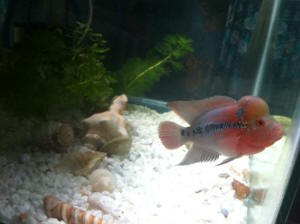
This is my new big head
It cost me 30$
I wonder is my 20 gal tank appropriate to pet him?
<For a few weeks or months, yes; but not in the long term. If you keep a
Flowerhorn in a small aquarium (anything smaller than 55 gallons for a
specimen 3-6 inches long, and 75 gallons for an adult 6+ inches long) it
will likely become stunted to some degree. Indeed, it may even get sick
and die because limited water volume (high nitrate, low oxygen) make
cichlids extremely prone to latent protozoan, bacterial infections (such
as Hexamita, Octomita). Either way, it won't be an attractive fish. Do
bear in mind Flowerhorn cichlids get their "looks" from a combination of
genetics
and good care. There are no magical foods that make up for poor care or
breeding.>
He is about 2 inches I guess.
<Will grow very rapidly.>
And i can only buy OceanFree pallets here is this food effective?
<Together with cooked peas and cooked spinach, yes (these are a source
of fibre, crucial to avoiding digestive tract problems).>
And I got earth worms in my yard can I feed them?
<Provided you do not use chemicals (insecticides, herbicides) in your
garden, yes; these chemicals are poisonous to your fish.>
I also plan to feed chicken heart
<I would not do this. These fish evolved from
omnivorous-to-herbivorous ancestors, and "meat" in the general sense is
not a necessary or perhaps even a healthy addition to their diet.
Instead concentrate on providing green foods; without green foods,
cichlids are prone to constipation and bloating, as well as vitamin
deficiencies that seem linked with Hole-in-the-Head and similar
syndromes.>
Will it b OK?
Thanks for your former answers I am Ivan Bob
<Read:
http://www.wetwebmedia.com/fwsubwebindex/FHParrotCichArtNeale.htm
There's nothing special about these hybrid cichlids that makes them
different to any other large cichlid. They need a big aquarium, a strong
filter, and regular water changes. A varied diet with some green foods
is essential. Cheers, Neale.>
|
 |
Help with new Flowerhorn please... fdg.
3/18/12
Hi WWM Crew,
<Nihal>
Firstly, thanks for the excellent resources on WWM. You have solved a
majority of my problems from Tank Setup to Cycling. Kudos to you!
<Thank you>
But every now and then, one comes up with that weird little problem and
I have something similar this time.
I have a ~ 67 Gallon aquarium (3 x 1.5 x 2). It was cycled and
yesterday, my LFS tested the water parameters and said it was safe to
add fish.
<Mmm, best to have your own basic test kits>
I immediately purchased a juvenile Flowerhorn that is about 2 inches
long (head to tail).
This is my first experience with Flowerhorns though I have previously
successfully kept Oscars and Bettas.
I acclimated the Flowerhorn to the new tank water and released him in
yesterday. He has been very active and playful, exploring the tank and
dancing in the filter current.
Though he was washed out yesterday, today he is almost back to his
normal color. He is not scared of me and always comes over to that side
of the tank to which I move!
*Now the problem:*
He was always fed live worms at the LFS right from birth I guess! I do
not
plan to do that as I think that it is unhealthy and unhygienic!
<Depending on the species of worms, I agree>
So, I offered him 2 baby pellets of Hikari Cichlid Gold today
afternoon.
He promptly gulped it only to spit it out immediately! He never tried
it again after that! I removed the uneaten food from the tank.
<Good>
I am pretty sure that he is hungry and would eat if I offered him live
food. I can say so coz he tries to eat his poop that is moving around
in the tank and looks like a tiny worm!
He has no symptoms of Ich/ick or of any intestinal infection (no
stringy poop) nor is he lethargic or lazy. In fact, I think he is super
active!
I believe he is just being picky about the food. My earlier fish
(Oscars and Bettas) have never taken more than 12 hours to start taking
pellets.
My LFS says that I should starve him for as long as it takes! I think
that it would be cruel to do so! Can you please guide me about this
issue?
<I would do as they suggest... try twice a day... this fish can go
w/o food for a few to several days>
How long can he survive without food? What are the chances of his
eating the Hikari pellets? Or will it be me eventually succumbing to
his food strike?
<In almost all cases, this and other Cichlids will take prepared
foods in time>
Thanks a lot in advance... Lots of Love and regards,
Keep Swimming!
- Nihal Adsul,
Mumbai, India.
<And you, Bob Fenner>
Re: Help with new Flowerhorn please... 3/18/12
Hey Bob,
<Nihal>
It's me again. I just wanted to inform you that my Flowerhorn has
started eating his pellets. I gave him 6 baby pellets (Hikari Cichlid
Gold) one by one and he ate all of them. I stopped at six though.
I guess I was freaking out unnecessarily. Sorry for the trouble caused.
I guess I should have waited a bit more before bugging you.
Thanks again...
- Nihal Adsul.
<Certainly welcome. BobF>
Flowerhorn diet 2/27/12
hi, i brought a 5 inch flower horn. I really want to know is it good to
feed it with Japanese cup fishes. Tq
<What is a "Japanese cup fish"? If you mean a live feeder
fish, then NO, it is not a good idea. EVER. Use a good quality pellet
food daily, with fresh green foods (to prevent bloating and
constipation) once or twice a week.
Read:
http://www.wetwebmedia.com/fwsubwebindex/FHParrotCichArtNeale.htm
And follow the links therein. Cheers, Neale.>
Re: Flowerhorn diet
hi, this are the pics of Japanese Koi carp that i fed the
Flowerhorn
<Do not use feeder fish. These cichlids are not fish-eaters, and
feeder fish will introduce parasites.>
but the fish that i fed is smaller of the same type. I too would like
to know yesterday i saw my Flowerhorn skin was slightly peeling and it
was slightly red. I would like to know is it normal?.
<Read where you were sent:
http://www.wetwebmedia.com/fwsubwebindex/FHParrotCichArtNeale.htm
And also read here, and the links at the top to other Flowerhorn
disease pages:
http://www.wetwebmedia.com/fwsubwebindex/FHDisF4.htm
Almost all problems with Flowerhorns come down to their environment. To
recap, you need at least 75 gallons, a very strong filter, weekly water
changes, a varied diet, and hard, alkaline water chemistry (10+ degrees
dH, pH 7.5-8.0). Look at what you're doing, and what you're not
doing is probably what's causing the trouble. Cheers,
Neale.>
weird question... FH,
fdg./beh. 1/12/12
hi, my Flowerhorn is a red dragon male of 3.5 inch as your crew said me
to feed him food only 2 times a day. so i gave him food in morning and
then after 3-4 hrs i have noticed that the color of flower horn became
white and her eye color i.e. orange circle became black. when fed him
it became normal. can you tell what happened ?
<Likely just the reflection of light... but could be a diurnal
behavioral (colour) change, due to mood...
Bob Fenner>
some questions about FH
Flowerhorn Questions, fdg., hump dev./beh.
1/10/12
Hi Crew,
I am from India, bought a Flowerhorn 2 days ago which is 60 days old
and it is a Red Dragon (male) and the size of my Flowerhorn is of 3-3.5
inch's. From this afternoon my Flowerhorn started eating xo humpy
head food which was referred by the seller. For now my flower horn is
doing fine but after some time it waits and watches the humpy head box
for a long time and then I feed him 2 pellets of humpy head but still
after 30 min.s it does the same. I don't want to over feed my fish.
Please tell me how many time's should I feed the fish in a day and
how many pellets in each feed ?
< Feed once or twice a day and only enough food so that it is
completely gone in a couple of minutes.>
There is also other question I want to ask is that the fish does
not have hump for now when inquired to the seller, he said that the
hump will be visible when the fish size grows to 4-4.5 inches and he
said that the father of the fish is red dragon and the mother is KOK as
I was confused that the Flowerhorn that I got is a kamfa. As I have
done lots of browsing its mentioned that the male gets the hump fast
compared to female so how to check that my fish is male or female?
<Flowerhorns are a cross between a few different cichlids but they
all have similar secondary sexual characteristics. Males are usually
larger and have longer unpaired fins. Mature males may get humps on
their forehead.>
Also the seller said that he shipped me a yellow red dragon but the
fish I got is a combination of white and
pink, when inquired he said it will change the color with in 2 days as
because of travailing the color has been changed to white and soon it
will change to yellow. I have attached the pic's of my Flowerhorn
please check it and let me know. Please tell me that my fish is a kamfa
or a red dragon and a friend said that red dragon hump growth is faster
than the kamfa hump growth. Sorry for such a huge mail as I am new to
this stuff I am confused btw things. Thanks Regards Ali
< Since the Flowerhorn is a cross there are many "types'
available. I would recommend getting photos of the pair to make some
determination of how the fry will turn out. Maybe the seller could
refer to online photos to what his fish look like.-Chuck>
Flowerhorn... hlth., nutr.
12/2/11
Hi,
Good Day.
<And you Binesh>
This is Binesh here from India.
1 week back i bought a male and female Flowerhorn. The male is 4-5
inches and the female 2-2.5 inches.
I kept them in a 200 ltr tank and separated them with a glass
partition. The female occupies 25% space and the male 75% space.
When i started feeding them ( XO Humpy head) the male was not taking
the food immediately and the female ate this very quickly.
The male fish used to take the pallets in his mouth and then spit it.
But after some 1 hour it starts chewing it and would spit all the food
which deposited in the bottom of tank.
This went on for 2 days. After 2 days i changed the water 100%. But
still the male is repeating the chewing and spitting practice and the
female eats it as usual.
<I would try other foods w/ both of them>
The male is not playing with us as Flowerhorn usually does, but the
female do plays a bit.
The male fish is moving around in the tank very freely and does some
exciting act towards the female but not to us. The earlier Flowerhorn i
had used to play with us very much.
I enquired about the same to the pet shop and they advised me to put
800 mg of Flagyl ( Metronidazole) into the water and change the water
50% on alternate day. I did it and still the male behaves the same
way.
<Mmm, this is a very powerful medication...>
Then one of my friend asked me not to put Flagyl and try 10 tablets of
tetracycline hydrochloride capsule along with half kg of salt and 10
drops of a medicine called rid all. I have put this yesterday. He
advised me to change 60% of water tomorrow and repeat the same
cycle.
<I wouldn't treat these fish with this antibiotic either>
Will my fish be cured of whatever disease it has and start being active
with humans and start taking food.
Please advise.
I have maintained the water temperature to 28 degrees.
With best regards,
Binesh
<Best to just be patient. I doubt that the one fish has a biological
disease here. Bob Fenner>
Re: Flower horn 12/2/11
Hi Mr. Fenner,
<Hello Binesh!>
Thanks for your quick response.
<Welcome>
I have done the second part of water change yesterday and repeated the
process of salt and tetracycline. Tomorrow i am again going to repeat
the same.
<Okay...>
Please advise what other food can be given
<Please read here: http://www.wetwebmedia.com/FWSubWebIndex/flowerhornfdgfaq.htm
and also advise what is biological disease. Is this curable?
<... ones caused by living agents... as opposed to nutrition,
environment.....>
Also please advise if you have any other medication to suggest.
<None>
I love the fish that i bought and don't want to loose it. Please
help.
Thanks in advance.
Best regards,
Binesh
<BobF>
Re: Flower horn, fdg. -- 12/5/11
Hi Bob,
<Bin>
I don't get such fast responses from my vendors, which i get from
you.
You were of great help in guiding me for the faster recovery of my
fish. Thanks a lot.
<Welcome>
I have got the fish food Hikari food sticks. My FH is eating this very
well.
<Ah, good>
The cover of the food reads ideal for top feeding carnivores.
But the shopkeeper told me that the food is for Arowanas only.
<... No...>
Please advise if I can continue this.
<You certainly can... B>
Rgds,
Binesh
Re: Flower horn
Hi Bob,
Thanks a lot for all your valuable advises.
I have zeroed in on the supplier of Hikari foods in India and he is
sending me Cichlid Bio Gold.
I hope this is fine?
<Oh yes>
Once again thanks for all your support.
<Welcome Binesh. B>
With Best Regards,
Binesh
6Re: Flower horn -- 12/6/11
Thanks Bob,
Thanks for all your help.
<Welcome Binesh>
Here in India the general conception is that Humpy head is the one and
only food which is good for FH.
People believe that it will increase head growth.
I was also under the same impression before i started reading articles
in your site.
<Ahh!>
Thanks for suggesting Hikari to me.
Once again thanks for your time and i hope i don't disturb you in
near future.
Cheers,
Binesh
<And you, B>
Re: Flower horn, hlth., nutr. -- 12/03/11
Hi Bob,
<Binesh>
I did a 100% water change today, removed all the medicines, put some
more rocks and stones, added one more filter.
<Good>
Changed the food to dry shrimps. He initially did not touch the
food.
But then suddenly he took all of them into his mouth.
I put one more and he ate it well.
<See WWM re Thiaminase>
Think the diet has improved. But the humpy head pallets remain
untouched.
<Throw it away>
Thanks for your advise of changing the food. Is it OK that in future i
feed him with only the shrimps.
<No... see above and where you were previously referred.
BobF>
Thanks
Binesh
Re: Flower horn -- 12/03/11
Hi Bob,
<Big B>
Thanks for the quick responses you give.
<Welcome>
As per your below mail, understand that i should not give more of
shrimps to my FH as it contains Thiaminase and can cause a deficiency
of vitamin B1.
Please correct me if I am wrong.
<You are correct... Did you read here:
http://www.wetwebmedia.com/FWSubWebIndex/flowerhornfdgfaq.htm>
So I should start giving peas and spinach to the FH. But is this enough
for FH?
<I would feed a staple... pelleted food. My fave is Spectrum... if
you can't get this where you are Hikari and Tetra also make
excellent dried-prepared foods for Cichlids>
Is there any specific tinned food you can suggest me? Need your help
here.
Rgds,
Binesh
<And you. BobF>
flower horn and Arowana not eating
9/26/11
Dear WWM Crew, we had bought a flower horn and a Arowana last week and
put then in a tank, we set the temperature is fixed at 28 deg. Celsius,
fitted a water filter and added salt in the water.
<Why? Salt is stressful to Arowanas. They are soft water fish. The
right way to keep them is in a big, spacious aquarium with a good
filter and regular water changes. Let's say you're keeping an
Asian Arowana, Scleropages formosus. These get to at least 60 cm in
captivity, and potentially 80-90 cm. So we're talking about a 200
US gallon/750 litre aquarium, minimum. 20-25% water changes weekly, and
a filter with a turnover rate of at least 6 times the volume of the
tank per hour, and ideally 8-10. Ammonia and nitrite must both be zero;
nitrate levels as low as possible, certainly less than 20 mg/l. Water
chemistry should be middling hardness for this combination of species;
around 10 degrees dH, pH 7-7.5.>
Our flower horn is almost 5'' inches and the Arowana is around
9" inches of length.
<Even if your Arowana is a youngster at 9 inches/22 cm, that fish
will still need a very large aquarium, 450 litres/120 US gallons. Such
a tank would be adequate for a few months, but why waste your money on
such a tank? It won't be useful for more than a year, at most.
Arowanas grow extremely quickly in the right conditions. Throw in a
cichlid as well, and the importance of aquarium size and filtration are
even more critical.>
Both the fishes are quite active and moving around the tank but Flower
horn use to hold a corner of the tank most of the time but both the
fishes don't eat anything , We gave them Tetrabits, shrimp and
humpy head and even chili red but doesn't work at all. We are very
much worried because we are very new with fishes and don't know
about them.
<These fish can take a few days to settle into their new home. But
they will only become settled if the aquarium is correct. How big is
the tank?
What sort of filtration are you using?>
Please suggest us how to maintain the aquarium and give them a better
habitat and make them healthy and start eating.
I will be very obliged if you can reply to my other queries. Awaiting a
response from your end.
<Can't really offer advice without knowing more about your
aquarium.>
Thank you
Abir.
<Hope this helps. Cheers, Neale.>
Re: flower horn and Arowana not eating
9/26/11
Thanks for your suggestion.
<You are welcome. Now, please don't write messages in ALL
CAPITALS again! I
changed this message for you because I'm a nice guy. Some of the
other folks here would simply ask you to resend your message.>
We are using a tank with 24",10",18" as length breadth
and height,
<Much, MUCH too small for an Arowana or a Flowerhorn, let alone kept
together!>
a water filter
<What sort? How much turnover?>
a oxygen pump
<An air bubbler?>
a heater with temperature is set on 28 deg.C.
<Fine.>
We put stones in the bottom but the water gets dirty as the fishes
doesn't eat anything,
<The water is dirty because the tank is too small for these
fish.>
we don't have anything to measure the ph level.
<pH isn't a critical issue provided extremes are avoided. But
you should test the pH of your tap water at least once just so you know
what it is.>
As we are using the same water in another tank with different fishes
like goldfish
<These are much tougher animals that Arowanas, so this experience is
irrelevant.>
and shark
<Shark? You mean a Shark-Minnow, like Epalzeorhynchos
bicolor?>
and they are very comfortable in that.
<Water chemistry may well be fine. But the tank is too small. These
animals will be stressed, sickened by their "world". You need
a much bigger home for them. Cheers, Neale.>
Re: flower horn and Arowana not eating 9/26/11
Thanks Neale for helping me and ignoring my mistakes.
<Always glad to help.>
I'll bought a bigger tank and I had separated both the fishes
(flower horn and Arowana) in different tanks individually.
<Wise.>
need a suggestion, will I replace the tank water with mineral water
(bisleri).
<No.>
will it works.
<Plain tap water, with water conditioner to remove chlorine and
chloramine, is usually best. Do understand that Flowerhorn cichlids
prefer somewhat hard water, and soft water will harm them. Arowanas
aren't too fussy, but dislike very hard water. Cheers,
Neale.>
Peas and Spinach for my Flowerhorn
9/15/11
Hi Crew, Neale to be specific,
Hi, this is Eric and I am wondering, I am going to start feeding my
Flowerhorn canned peas and canned spinach. Is this ok or do they need
to be fresh?
<Canned/tinned peas are best. They're nice and soft, and most
cichlids, if sufficiently hungry, eat them. Try squashing them first.
Canned spinach should work, too. Never tried it!>
The peas are sweet peas that contain water, salt and sugar, the spinach
contains water and salt. Will these be ok
<Yes.>
or should I use frozen peas and fresh spinach and just cook them? How
often should I feed these?
<As often as you want. Plant foods contain little protein, so have
little impact on water quality. In practise fish will stop eating them
because they feel full, so even a big cichlid may only eat 5 or 6 peas
in one
sitting.>
Thank
Eric
<Good luck, Neale.>
Flowerhorn Will Not Eat 9/12/11
Dear WWM Crew, We have a Flowerhorn fish for last 4 months. The fish
was doing fine and we used to feed it 'Starry" an occasional
live fish (rosy barb) brought from the local pet store. We did a total
water change about two weeks back and since then the Flowerhorn has
stopped eating anything. We tried changing to other fishes (molly) as
well but to no gain. Yesterday we noticed some white mucus/floppy like
substance also and changed the water again.
As we do not have facilities to check nitrate , etc contents of the
water we are not able to do so. The heater temperature is fixed at
28C.
We would be grateful for your advice on how to make our Flowerhorn
start eating?
< Live fishes used as food may carry diseases that might make your
Flowerhorn sick.>
For how long can the Flowerhorn live without eating?
< Probably a few weeks.>
Is there any medication which we can use? We have read your FAQs and
understand you have advised to treat with a combination of
Metronidazole and Nitrofuranace, or even use Epsom salt. But since
these are not as such available at our location can you suggest some
other easily available medication in India.
<You have no medications or test kits then keep the water clean with
water changes and you might try to add some salt to the water. This is
an old time remedy that might help. Add a little salt every day until
you fish looks stressed and breaths very heavy or changes color, then
start changing the water with fresh unsalted water.
You have also advised to feed cooked peas as a laxative. How do we feed
the Flowerhorn since if we just drop the cooked pea in the water like
any other feed the Flowerhorn does not bother to eat?
< When you fish starts to look hungry then add a couple cooked peas
and see if he eats them. If he is not eating then wait until he starts
to look for food-Chuck.>
We would be grateful for any advice you can send us. Thanking you, Best
Regards, Kumar Guwahati, India
Re: Flowerhorn Fish not Eating
Treating With Metronidazole 9/15/11
Dear Team members, Thanks a lot for your advice. This evening we could
hand feed our FH one boiled pea. We have also poured one
crushed Metronidazole (Flagyl) 200 mg tab in the aquarium water. The FH
is swimming a bit on the top surface with its mouth pouting at the
water surface. We have done about 30% water change twice today to keep
the nitrate etc (if any) level low. Please advice if we should give
metro every 8 hours and do water change at the same time. For how long
should we give this medicine. Do we feed the FH as long as the
medication is continued.
Thanks, Kumar
< Make sure the tank is clean because organic matter may absorb some
of the medication. I would treat on day one, three and five, while
doing a 50% water change on the second and fourth day. See if he eats
after that.-Chuck>
|
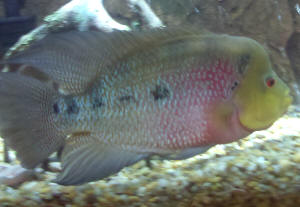
Any way to find out what the species of
this fish is?
Flowerhorn Cichlid Care 8/16/11
Hi Crew, My name is Eric and I live in Monroe Wisconsin, I
recently (8 months ago)
rescued a fish that I was told was a Flowerhorn Cichlid. I am
starting to wonder if this really is a Flowerhorn or if it is a
Trimac Cichlid. Is there really any way to determine what this
fish is?
< It is a Flowerhorn. Flowerhorns are a hybrid between a few
different species.>
He/She is about 5 years old, 10 inches long, housed in a 75
gallon aquarium at 82 degrees. I have two Magnum 350 canister
filters with bio wheels and two bubble curtains. I do a 25
percent water change every week adding aquarium salt and micro
bacteria with every water change. The nitrite level is 0 and the
pH is 8.4 and the ammonia level is 0.25. I am feeding him/her
Hikari Cichlid Gold and Hikari Cichlid Staple, I am also feeding
frozen beef heat and blood worms.
< I am not a big fan of beef heart or bloodworms.>
I really need to find out what species this is so if I need to I
can change the water parameters and the feeding. I appreciate the
help.
Eric
< Everything you are doing is fine for a central American
cichlid.-Chuck>
|
|
FH fdg/rdg.
8/16/11
Hi Crew
<Eric>
This is Eric King again in Monroe Wisconsin. Now that I know my
beautiful fish is indeed a Flowerhorn Cichlid I am wondering what
you guys and gals would recommend as a staple diet for the
fish.
<?... Please learn to/use the search tool/indices on
WWM...>
I am currently feeding Hikari Cichlid Gold and Hikari Cichlid
Staple. plus San Francisco Bay frozen beef heart and San
Francisco Bay frozen blood worms.
Any and all advice is greatly appreciated!!
Thanks again
Eric J King
<http://wetwebmedia.com/WWMAdminSubWebIndex/question_page.htm
... Bob Fenner>
|
Flower horn sick after feeding pork....Please
help! 5/1/11
Hi,
I am Suresh from India. I have a 1year old Flower horn. She is normally
very active & a voracious eater. But 3 days back I fed her pork
after which she does not eat at all & is not active. She sits at
the bottom of the tank most of the time. She also has developed a small
bulge in the abdomen. I came to know after referring the net that pork
is not suitable for flower horns'¦but what do I do now to make
her well. Please help as I don't want to lose her.
Thanks
Suresh
<Greetings, Suresh. Hope you've learned your lesson here! Do
not, Do Not, DO NOT give bird or mammal meat to aquarium fish -- EVER!
In short, mammal and bird meats congeal inside cold-blooded animals,
and in doing so, cause them varying degrees of harm. Of course some
cold-blooded animals are adapted to dealing with such prey, like
snakes, but not your cichlid. Your cichlid should be fed a mix of
pellet foods, cooked peas, spinach, and small invertebrates such as
earthworms. For now, you just have to wait and see what happens.
Don't feed her until her belly comes back to normal. When she does
start eating, give her just cooked peas (squashing the peas as well
sometimes helps) -- peas are excellent laxatives for fish. You can also
use Epsom salt (magnesium sulphate; not cooking salt, i.e., sodium
chloride!) at 1 tablespoon per 5 gallons will help a good deal by
loosening the muscles of the gut, reducing swelling. But that's
about all you can do. Cheers, Neale.>
Help needed for Flower horn, fdg., reading
1/1/11
Hi,
I bought a new flower horn which is 3 months old and is very active, I
wanted to know what kind of food should I feed so that it can be
healthy & active...I feed humpy head and live fish
<A VERY poor idea>
is that ok..please suggest, thanks
<... Read here: http://wetwebmedia.com/FWSubWebIndex/flowerhornfdgfaq.htm
and the linked files above. Bob Fenner>
My FH is not eating... no reading
9/21/10
help My Flowerhorn is not eating for a week or 2 now.
<... have you read on WWM re?>
His body deceased his size... I think he had swallow a big plastic
pebble because when I touch his belly its shape like the diamond pebble
in the tank.
<Inappropriate substrate for this and other such fishes. Read
here:
http://wetwebmedia.com/FWSubWebIndex/flowerhornsysfaq.htm
He's not active anymore.. before we used to feed him pellet Humpy
Head then we buy him pellet for his color he still not eating at all..
we try to feed him live fish still not eating it...he's just in the
bottom and not
swimming actively... unlike before he used to be an active eater and
swimmer.... My fish tank water is clean... I don't know what to do
with him anymore... I really love my fish... Please help....
<Help yourself. Read here:
http://wetwebmedia.com/FWSubWebIndex/FHParrotCichArtNeale.htm
and the linked files above. Bob Fenner>
FH, feeding as it relates to humpiness...
6/29/10
Hi,
<Hello,>
I just bought a new Flowerhorn. It has a very big head for a 5-6 inches
long. Someone told me to feed him chicken liver because chicken liver
is made up fat will increase his color and Nuchal hump.
<Rubbish. The size of the hump is almost entirely genetic. Since
Flowerhorns are hybrids, it is very difficult to predict how large the
hump will be.>
Will chicken liver kill my fish?
<Certainly is bad for them. Never, ever give mammal or bird meats to
fish.
The fats in these meats congeal inside the fish, causing damage to
their blood vessels. The exception is cardiac tissue, such as beef
heart, but this should be used very sparingly, perhaps once a
week.>
Do you know it will help the Nuchal hump to grow bigger?
<Nothing. It will get as big as its genes allow. Good water quality,
a big aquarium, regular water changes, the right water chemistry all
improve the chances of healthy development.
http://www.wetwebmedia.com/fwsubwebindex/FHParrotCichArtNeale.htm
There are NO wonder foods that make cichlid humps bigger. Any food that
says it will do that is a CON.>
Thanks
<Cheers, Neale.>
Re: re:
Thank you for your help. I appreciate for the information on my
Flowerhorn.
<A pleasure to help. Cheers, Neale.>
switching to new food
Cichlid Imprinted on Food 5/5/10
Hi guys, My Flowerhorn is used to eating XO Humpyhead, I saw Cyclops
food and wanted to try it out. I tried feeding it one but my fish keeps
spitting it out. How can I make my fish eat a new brand of pellets?
Thanks, Brian
< You cichlid is imprinted on a particle food. Do not feed him for
three days. When he comes to the front looking for food then offer the
new food. If it is not eaten in five minutes then remove it from the
tank. Do the same thing every day until he eats the new food.-Chuck
hi WetWebMedia crew!! just to let you know that... FH,
fdg...? 3/18/10
hi WetWebMedia crew!!
just to let you know that I'm from the uk and also that my
Flowerhorn hasn't been eating. thanks
<Do start by reading here:
http://www.wetwebmedia.com/FWsubwebindex/FHParrotCichArtNeale.htm
Without information on aquarium size, water chemistry, water quality
and temperature, we can't say anything at all helpful here. Check
you're providing the necessary conditions described in that
article. If you're not, then that's probably why your fish
isn't happy. Cheers, Neale.>
Flower horn Problem Plssss Help.....
Flowerhorn Won't Eat 12/20/09
Good day... Could you kindly help me... with regards to my FH. Its has
been 2 weeks and its belly is growing big and its affecting his
swimming.
He's not eating the pellets that I give him. He doesn't eat it.
.Please need help Thanks....
<Your FH has an internal infection caused from stress like poor
water quality or a bad diet. Check the water quality and treat with a
combination of Metronidazole and Nitrofuranace. A quick treatment is
the key to a full
recovery.-Chuck>
Flower horn doesn't eat pellets
12/11/09
Hi WWM Crew
<Hi Musa.>
My name is Musa, two weeks ago I bought two baby Flowerhorns of about
7cms from tip to toe.
<Haha I'd be most worried about the toe.>
When I tried to feed them with pellets (of tetra Luo Han company) they
did not eat them.
<Do you know what foods they were raised on? Sometimes it helps to
offer what they're used to; later, after they get used to you and
the new tank, you can begin to experiment.>
Later when I put some feeder fishes they ate them,
<Are you breeding these feeders, or quarantining them for a month
before feeding? The problem with feeders from pet stores is that
they're terribly filthy, and you really don't want them
anywhere near your prized Flowerhorns! Also, fish typically sold as
feeders, such as minnows and goldfish, are high in thiaminase, which
can also cause a lot of problems for your fish. Try reading here on
thiaminase:
http://www.wetwebmedia.com/ca/volume_6/volume_6_1/thiaminase.htm>
I also fed them once with a hen's heart they enjoyed eating the
heart, <I'd also avoid feeding this with any regularity;
it's fine as a treat, but it's going to cause problems with
water quality if used on a regular basis. Also, they can be tough for
your fish to digest.>
I want to know whether I should continue feeding them with feeder
fishes and later try feeding them pellets when they grow big?
<I'd first, if you can, try to figure out what they've been
eating in the store or the breeder's tanks. If you can figure that
out, go ahead and feed that food and then try other things. I'm
going to include a link here to a page of FAQs on Flowerhorn feeding so
you can peruse it and get some ideas. However, I've never known a
Cichlid (or any other fish, for that matter!) to refuse Bloodworms. You
can buy them frozen and thaw before feeding. Try and feed the
wet-frozen type, as too much dry food, when not mixed with wet-frozen,
can cause constipation/digestion issues. Also, you could try peas,
pieces of seafood (shrimp, clam, and squid are all available both at
the seafood counter and in the pet store), and, last but not least, try
offering a different pellet! Maybe the ones you're offering just
aren't stinky enough to be enticing... I prefer to feed my larger
Cichlid Hikari Cichlid Gold as a staple. He can't resist it! I hope
this information helps; and here's that link so that you can read
on your own and get some ideas that I may not have mentioned, as
well:
http://www.wetwebmedia.com/FWSubWebIndex/flowerhornfdgfaq.htm>
<Lastly, I'd run tests for Ammonia, Nitrite, and Nitrate, to
rule out any problems with water quality. If you find Ammonia and
Nitrite at 0, and Nitrate below 20, then you can assure yourself that
these little fish are just being picky, and move on to trying new
foods. If you test and find these levels above what is stated, then the
loss of appetite is most likely being caused by poor water quality, and
you'll need to fix those issues before the fish will get their
appetites back. This, obviously, may not be what's going on, but I
didn't want to neglect to mention it, only to find that they
won't eat anything else, either, because of water quality
issues.>
Thank you
<You're welcome! -- Melinda>
Flowerhorn Doesn't Eat 11/20/09
Hello, I have a 72 gallon bow front with a 10 inch FH and a common
plecostomus.
I have had the FH for about 4 months now. Up until about a week or 2
ago I noticed that he had not wanted to eat as much and now not at all.
I have 2 under gravel filters and a magnum 350 filter also, plenty of
oxygen (2-4 inch air stones, 1 large Volcano (air pump) I clean the
tank once per week (15% of the water) The water tests good, my water is
very hard. I have added aquarium salt to the water, and vitamins to
make sure he is getting nutrition. My Pleco eats like a pig (he loves
his zucchini, broccoli, cauliflower and algae wafers.) I noticed when I
went home last night that my FH has a raised bump on his head (under
the skin above the bridge of his nose on his kok) Otherwise he looks
good, but that did concern me and the fact that he is not eating.
Sometimes he hovers at the bottom of the tank or in the corner by a
plant, but
otherwise looks at the top of the tank for food. I feed him PE mysis
and he will not eat it now, he is a finicky eater, so this is what I
fed him. I offer him food and he looks at it and lets it go to the
bottom or
doesn't bother with it. He usual gets excited when he sees me and
comes to the top and I rub his head, but its getting to where he
isn't doing this as much and I haven't seen him rearrange his
tank in a few days.
Any advice or suggestions will be greatly appreciated. Thank you,
Dee Lopez
<One of two things is going on here. The first, your fish has been
imprinted on a certain food type and will not try anything else. Do not
offer food for three days. He should be pretty hungry by then. Offer a
quality food and leave it in the tank for five minutes, then remove any
uneaten food. Try this every day for a week. If he still does not eat
then there may be an internal infection. Treat with a combination of
Metronidazole and Nitrofuranace.-Chuck>
Re: Flowerhorn Cichlid
Finding Medications Online 11/21/09
Chuck, Thank you for your help. Do you know which website sells
Nitrofuranace?
I am having trouble finding it locally or on-line. Dee
< Most fish stores carry the medication. If you are having trouble I
know DrFoster&Smith carry it for sure.-Chuck>
Flowerhorn Food. 10/9/09
Hi WWM crew
Sir,
<Hello!>
I am having an Amphilophus trimac approx 5 mths old.
<Flowerhorn cichlids are *not* Amphilophus trimaculatus.>
I would like to know which is the pellet food which can be given to my
fish to develop good colour and also the food for developing diamonds
on the fish.
<None.>
Further how many times should I feed the fish and approximately how
many pellets at one time
<Like all cichlids, two small meals per day is better than one big
meal.
Don't overfeed, and provide a healthy, balanced diet avoiding
things like feeder fish, but including unshelled crustaceans and plant
foods such as cooked peas. Do read here:
http://www.wetwebmedia.com/FWSubWebIndex/FHParrotCichArtNeale.htm
No food will make the colours or the hump any different from what its
genes will allow. So, to get the best possible looks, you need to
provide a healthy environment. There's no point looking for a
"special food" if you aren't providing a big aquarium
with clean water.>
Hope you'll will answer this query.
Thanks in advance.
Amit
<Cheers, Neale.>
Some queries regarding Flowerhorn. 10/4/09
HI
Chuck / Neale
<Both apparently out. This is BobF, who "cleans up" all
"next day" unanswered queries>
I am having an Amphilophus trimaculatum about 3 and half months old. As
per your confirmation from my previous mails sent to you.
I have certain queries regarding the fish, hope you will do ur best to
try to solve them.
1. Do water temperature and Water PH aid in growth and colouration of
the fish. Secondly I am based in India and I am unable to acquire a PH
testing kit nearby . So in the absence of PH kit, is there any other
method from which we can come to know the approximate PH of the water
in the tank. How to maintain the PH to 7 in the absence of the testing
kit.
<There is no way to adjust pH w/o knowing where you're starting
from, going to, but doing regular water changes... a quarter every week
or so... Read
here: http://wetwebmedia.com/FWSubWebIndex/fwh2ochgs.htm>
2. As per your directions, I am feeding my fish with Chili super red
pellets, freeze dried blood worms etc. I am surprised to see the growth
of the fish. It is really satisfying. I wanted to ask u whether can I
feed
the fish with cooked beetroot, finely cut chicken heart(Raw). finely
cut raw fish and cooked soya chunks.
<I would avoid terrestrial animals... their fats are too hard to
digest, but the others are worth trying>
I will be very obliged if you can reply to my other queries.
Awaiting a response from your end.
Thank you
Amit S Ghosalkar
<Welcome Amit. Bob Fenner>
How can i identify Flowerhorn male and female... gen.
9/30/09
Is it possible to keep male and female FH in same tank?
<Depends how big the tank is. But normally, no, you cannot keep more
than one Flowerhorn cichlid per aquarium.>
I feed my Flowerhorn only XO HUMPY HEAD is it a proper diet for it?
<It's okay, but lacks fibre.>
If not then pls suggest me sum name of ready made food
<Cooked peas, spinach, and other green foods should be offered
regularly.
Live foods such as earthworms and river shrimps, but NOT live fish are
also helpful, once in a while. Cheers, Neale.>
FH... hlth... Fed "feeder fish"...
9/10/09
dear sir.
I am iqbal from India i have a FH of short body of 8 month from 3 days
he is not having any food period it was on feeding fish that is gold
fish and red cap and humpy head but today morning my FH is not able to
swimming any is lying down in tank so pls help me regards
<Hello Iqbal. I need information here. How big is the aquarium? What
sort of filter do you use? What is the water chemistry? At minimum,
tell me the pH. What is the water quality like? At minimum, I need the
nitrite level. Usually, when Flowerhorn cichlids stop eating, it's
because they are stressed by their environment. A Flowerhorn cichlid
needs a tank 55 gallons (about 210 litres) in size, and the tank needs
a big filter, ideally rated at a turnover 6 times the volume of the
tank or more, i.e., at least 6 x 55 = 330 gallons per hour for a 55
gallon tank. The pH should be 7 to 8, the hardness 10 degrees dH or
more, and temperature about 25 degrees C. There should be 0 ammonia and
0 nitrite. Nitrate level should be low, certainly less than 50 mg/l and
preferably less than 20 mg/l. So check all these things. Secondly, DO
NOT USE FEEDER FISH! Any fish cheap enough to use as food will not have
been cared for properly. Feeder fish are "parasite time
bombs" and the most stupid thing any aquarist can do is use them
to feed a valuable fish. Furthermore, Goldfish (and other cyprinids,
including minnows) contain lots of fat and a substance called
thiaminase. Thiaminase breaks down Vitamin B1, and over the long term
makes fish very very sick.
Fat also causes problems, and the use of fatty foods is a major cause
of mortality among carnivorous fish. Your Flowerhorn is a hybrid bred
from cichlids that ate invertebrates, organic detritus, and plant
material.
Offer it a varied diet of things like chopped seafood, insect larvae,
cooked peas, algae, and so on. Don't feed it if it is not hungry!
Healthy cichlids are ALWAYS hungry, so if a cichlid isn't eating,
it means something is WRONG. So go back and check your aquarium.
Cheers, Neale.>
help needed, FH fdg. 9/9/09
Hi, this is mansoor ali khan from India .
<Hello,>
I have a 4 month old FH and Everything was well until 2 days ago.
<Oh?>
I've been feeding him humpy head but he stop eating it and only
eating feeding fish.
<Don't use "feeder fish"! These are very dangerous.
The problems are these:
[a] feeder fish contain too much fat;
[b] feeder fish contain thiaminase, leading to vitamin-B1 deficiency;
and
[c] feeder fish are very likely to carry parasites and bacterial
infections.
If a fish is cheap enough to use as a feeder fish, it hasn't been
looked after very well. So why risk it? If your Flowerhorn doesn't
like Humpy Head pellets, then try something else!
These fish are omnivores, and should eat all kinds of things: chopped
seafood, cooked or tinned peas, algae, bloodworms, mosquito larvae,
earthworms, etc. There are numerous good quality dried foods too, such
as Hikari Cichlid Gold. There's nothing magical about Humpy Head,
and the size of the hump on the cichlid is largely genetic. If your
fish has the genes for a big hump, it will grow one. It's like how
tall a human being can get.
Provided a human has an adequate diet, he or she will get to a certain
height dictated by his or her genes. Likewise, if you give your
Flowerhorn cichlid a balanced diet, it will grow to its full
potential.>
The activity is the same though. Then just this morning I noted that
his feces, that was usually red in color became white and red in color.
Hope you could help me.
<Cheers, Neale.>
|
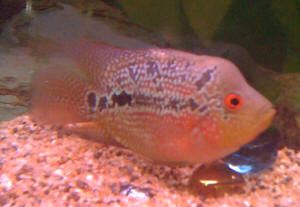
what breed is ma FH and why he's not eating....--
08/14/09
Flower Horn Not Eating
I've had my FH for 6days. I put him a two foot tank and its
big for him because he is small..Whenever I put a pellet in he
will not eat it. He will see the pellet and just swim away. Same
for the dried shrimp. Blood worm he will just eat a bit but then
spit it out..I give him ocean free humpy head. Can you advise me
accordingly. I've attached a pic of my fish.. Can you tell me
what breed is my fish?. He has blue lining all over, pink on his
chest and yellow below his mouth and tail. Thanks A lot
<..Your Flowerhorn may eat in a few days. Put the food in for
5 minutes. If he does not eat it then take it out. Try again the
next day. In a few days he will catch on that he has 5 minutes to
eat or he will go hungry. You definitely have a flower horn. What
type of flower horn I do not know.
Continue to check the internet under Google images and type in
Flowerhorn.-Chuck>
|
 |
Flowerhorn feeding 08/02/09
,hi! just a couple of questions.,,first have a juvenile FH., just
purchased last month.,when feeding, he seems not interested even though
im feeding it twice a day.,
<What are you feeding it? Most fish will get bored with one single
food, day after day. Moreover, you need to offer good quality food.
Hikari Cichlid Gold is probably the best pellet food, but this should
still be
augmented with other foods. Earthworms, frozen bloodworms, cooked peas,
chopped seafood all make good foods for large cichlids.>
and when he starts to eat (after an hour or if there's no one near
the tank), he's splitting it out.,is it ok?.,
<Depends how much he eats. Is your fish healthy? Is its body gently
rounded? If it eats enough to be healthy, but spits out the rest, then
give less food.>
second, he looks afraid if someone's near the tank, the FH stays on
the corner.,
<How big is this tank? Flowerhorn cichlids are typical large Central
American cichlids. In small tanks they will be nervous. They need
plenty of space, a cave, and preferably some floating plants. For a
Flowerhorn, the tank should be at least 210 litres/55 gallons, and
there must be a cave (like a flowerpot, for example) big enough for the
fish to hide in and feel secure. Add some floating plants, real or
plastic, as you prefer. Fish swim in the open when they feel secure.
There must also be good environmental conditions. Hard, alkaline water
is important, aim for pH 7.5-8, 10+ degrees dH; and there must be 0
ammonia and 0 nitrite. In poor
environmental conditions, fish become nervous.>
but looks ok if no one's around.,lastly.,when will it starts to
show colors? I've ask the sales attendant and she
<Flowerhorns are hybrids, not a true species, and you cannot really
guarantee anything about them. They were very popular for a while, and
in Asia especially, still are. Farms produce them to a price, not a
quality.
So you get what you pay for. If you pay a good price from a reputable
breeder you can trust, you have a good chance of getting a colourful
specimen. If you buy a cheap fish from a pet store -- well, maybe you
get a good fish, but maybe not. A varied diet that contains both
crustaceans and plant material will enhance whatever colouration your
fish has. Good water quality will ensure the fish shows its best
colours. A dark aquarium with plenty of shade and floating plants will
encourage your fish to show its richest colours. If you feed an
inadequate diet, keep the fish in a brightly lit tank, give it no
shade, and make no effort to ensure optimal water conditions, your fish
will never show good colours -- even if it has good genes! Cheers,
Neale.>
feeding... same... 08/02/09
hi..
just a couple of questions,,
first, I've purchased a juvenile FH last month.
i noticed that every time i fed him, he seems not interested in food
even though im feeding him twice a day, and when he starts to eat
(after an hour or if theirs no one near the tank) he split it out.,is
it normal?.,.,second,, he looks afraid and stays on the corner if some
one's near the tank.,,i thought FH likes to stay in an open
area.,lastly.,when will it normally starts to show colors?,,i noticed
some redness around its
fin..and the markings are shining like greenish pearl when the light
strikes on it.,,,hope for a quick response.,.,thanks in advance..
<Second question about Flowerhorns that won't eat in two days!
In brief, Flowerhorn cichlids need a big tank to feel settled; aim for
210 litres/55 gallons. Water should be clean: 0 ammonia, 0 nitrite, and
nitrate less than 20 mg/l. Like all Central American cichlids, the
water should be hard (10+ degrees dH) and basic (pH 7.5-8). Water
temperature should be middling, around 25 C/77 F. Like all cichlids, if
conditions aren't good, they'll become shy, nervous, and show
subdued colours. Next, their diet should be varied. There's no
point offering the same pellets day after day. They will get bored!
Provided a mixed diet alongside good quality pellets (such as Hikari
Cichlid Gold). Krill, cooked peas, bloodworms, chopped seafood will
all be readily accepted. Mixing crustacean and plant foods in their
diet is important for optimal colours. Finally, if you see redness on
the fins, this is often Finrot, and that's caused by poor water
quality. Check the
ammonia and nitrite; both should be zero. Correct the environmental
conditions, and treat with a suitable anti-Finrot medication. Cheers,
Neale.>
tnx
<Ah, you're welcome, I think! Neale.>
Want to no some problems about my flower horn
fish........
Getting A Flowerhorn To Eat A New Food 6/13/09
Sir / Mam, I brought a Flower Horn fish from a Aquarium shop. The
seller told me it's an 8 to 10 month old male fish. I have noticed
that it is a very lazy fish it doesn't eat ready made fish
food at all it wants to eat is live fishes. As per my knowledge, the
fish owner had brought the fish from the beginning feeding it live
fishes only because of this it is not taking ready made fish food. I
bought (Ocean Free Humpy Head Food) as per the advice of the fish
seller. I have left it in a 3 feet by 1 1/2 feet by 1 1/2 feet
tank.
It's not at all playing. I want the fish to be active as per the
Flower Horn fish should be so please help me what to do to make the
fish active & play full. The fish shop owner told to put an
antibiotic capsule (Amoxicillin 500 MG) in the tank. I did the same
thing but still it did not work, & he told me to starve the fish
for 1 or 2 weeks then it will eat the ready made fish food, but I am
afraid to do this he also told it can live with out food for 3 weeks. I
am feeding live goldfish. The fish eats the small gold feeding fishes
& rests in a corner again. When it's hungry it catches some
fish's eats & rests in a corner. Please help me I don't
want to give away the fish I liked it very much I want to see my fish
eating ready made fish food
I think I can get some good tips from you Sir / Mam.. Waiting For Your
Reply I Am P Manjunath Rao From Bengaluru
(INDIA)*
< Your fish is imprinted on small feeder fish. Check the water temp.
It should be up around 80 F. Your shop owner gave you some sound
advice. Do a 50% water change and clean the filters. Feed the new food
once each day.
After 5 minutes remove any uneaten food. You fish will be hungry and
begin to move around. He will learn to accept the new food and will not
starve.
The key is to remove the food after 5 minutes and never give him
feeders again.-Chuck>
Flower Horn not eating since last 2-3 days
11/24/08
Dear Sir/ Mam,
I have a 4 inch flower horn in a tank size of 24 x 15 x 15 inches.
Since last 2-3 days he has given up eating. No physical symptoms are
visible so as to come to any conclusion as to why he has given up
eating. I feed him Hi red, XO Humpy head and XO Red sync. Temperature
of the water is constant between 25 to 28 degrees. I Have added Rid All
General Aid and Anti Itch along with some salt. He is swimming as usual
but is a bit lazy in between for some time.
What could be the problem?
Please help. I am worried about him.
Rgds,
Amu.
<Amu, the tank is too small for this fish. Water quality is likely
not good, and consequently your fish is stressed. When cichlids stop
eating it is a very bad sign! These fish eat like pigs! Without
upgrading the tank substantially, there's not much point worrying
about what type of food you use, adding salt, or what medications. That
said, randomly adding
medication (as you have done) will make a bad situation first. Please
understand ALL medications are poisons, and have to be used
carefully.
Cheers, Neale.>
Need help! :o, FH... fdg., hlth. "feeder
goldfish"... 9/27/08 "Hi. Can you please
help me with my cichlid, commonly known as Flowerhorn locally. Our fish
has not been eating for 2 weeks already, or maybe even more. Since
then, his head lump decreased in size and even his body size decreased.
<Starving... maybe has parasitic worms. Often happens when people
use unclean live food, particularly live feeder fish, what I call
"parasite time bombs"...> We changed water every after 3
days, put salt after every change. And for the past days, we've
been dropping Methyl Blue and Melafix, since we've been suspecting
that the fish is sick. The gills have some black stuff, seems like
burns or bruise, a part of the tail has it too. <Salt irrelevant
here. Melafix useless. Methylene Blue is a treatment for Fungus; not
much use otherwise. Do attempt to ID the disease before randomly adding
stuff to the water.> We saw a white, sponge-y thing inside his tank.
And every time we remove it, some thing like it comes out again. A
relative told us that it's probably fungus. It looks like cotton in
the tank, but once removed, it feels like white-mucus. We're not
totally sure where it's coming from. <Fungus does indeed look
like cotton wool. Do also consider Finrot and Mouth Fungus, diseases
that often occur in the same context: typically poor water quality.>
Just today, we bought and submerged a water heater, <You were
keeping this fish in cold water before...? No wonder its sick. Cichlids
are extremely intolerant of cold water.> changed the water, dropped
Methyl Blue and Melafix, and placed salt again. We tried feeding him
but he didn't even touch the food. When we were removing the
wastes, we noticed a scale detached out of his body. <Hmm...>
He's usually playful and swims around the tank. But now, most of
the time, he's just at the bottom of the tank, in one area and
stays there for a long time. And seems like his mouth is almost always
open (though I'm not too sure if the mouth is always open).
<Have you done nitrite and pH tests?> Please do help. We're
actually running out of ideas on what to do already. And we're
hungry for answers already. And we really do feel bad for our pet.
<I bet. Please review the needs of these fish. Flowerhorn cichlids
are extremely demanding animals, and frankly cannot be considered
"newbie" fish. You need a big tank (55 gallons upwards); zero
ammonia/nitrite/ 20 mg/l or less nitrate; pH 7.5-8.0; and moderately
hard water. If you're failing on any of these -- that's your
problem!> The fish is actually a gift from a relative. He's been
with us for months already, and never encountered any problem since
then. <Hmm...> We've fed him fish food (pellets) and
bloodworms bought from our local fish store. We've suspected that
the bloodworms caused the disease, but we can't really point it
out. <Bloodworms unlikely to cause parasitic infections... look at
environment in particular...> I wanted to have the water checked for
ammonia, nitrites, nitrates, etc. since I've been reading that
mostly, but I just can't figure out where I can have the water
checked. <Where? At home: you go buy (minimum) nitrite and pH test
kits.> We placed Tetracycline powder in the tank yester eve. The
fish seems to be moving better, but he still doesn't want to eat.
What else can we do for him? <Many things: in particular read up on
Central American cichlids, review water quality and water
chemistry.> Please do help immediately. We're worried and
don't want the fish to die. We are even desperate for answers
already! <Oh.> Thanks and God bless! :)" <Well, the Fish
Gods will be expecting you to go test nitrite and pH, review water
quality/chemistry issues, and evaluate whether the environment you have
prepared for this fish matches its demands.> `Chrys <Cheers,
Neale.>
Re: Some more info (Need help! :o)...
9/27/08 Hi again. My Uncle told me just now, that the feeders
we were feeding him is not bloodworm, we just don't know what
it's called, but we got it from our local pet store. <Live food
is fine, provided it's safe and clean. To that end, the live foods
you should NEVER use are live fish or live Tubifex worms. Of the common
live foods, these are safe: Daphnia, River (estuarine) Shrimps,
Glassworms, Bloodworms, and Brine Shrimps. Earthworms collected from
"organic" terrain are also good, but do bear in mind that if
you spray pesticides in your garden, the earthworms can pick them up.
Do also understand though that Brine Shrimp especially are not
"complete" in the sense of having a range of nutrients. Fish
eat them happily enough, but then people eat all kinds of stuff that
isn't particularly nutritious as well. So live Brine Shrimp are
fine as a treat, hopeless as a staple. Most cichlids are at least
partially herbivorous, and some portion of their diet should be green
foods such as tinned peas or Sushi Nori. Without the vitamins from
green foods, they are more prone to nutritional problems and
constipation.> I really am not knowledgeable about fishes, since
it's my first time to really be hands-on with a fish. I checked on
him after reading your site's FAQ, from what I got from my nights
of researches, I am suspecting tail/fin/gill rot. Though I'm not
really sure if that's what it is. I also saw some white spots at
the bottom of his mouth. I think that it is a normal part of the
fish's structures. <Difficult to say without a photo. Finrot is
easily confused with Mouth Fungus (actually a bacterial infection,
despite the name) and Fungus. All can be treated with Maracyn and/or
eSHa 2000, so if in doubt, use them. Avoid medications based on
Tea-tree Oil (e.g., Melafix); these are not consistent, and despite
being cheap, aren't worth buying.> We bought a water heater,
(Sera Aquarium Heater Thermostat) and set it at 32. <32 Celsius is
WAY to hot for these fish. Do read, review the needs of these fish and
act accordingly. If in doubt, 25 C is safe for most tropical fish.>
We're planning on trying to feed him bloodworms and see if it will
increase his appetite. Do you think this would be of help? We have been
feeding him Ocean Free Super Red and Humpy Head interchangeably and
some worms occasionally. <There's no need to cram food into a
fish: it will eat everything you give it, but most will be egested as
waste. Indeed, excessive protein and especially fat do more than harm
than good. One or two small meals per day is ample for most fish.
Mammals (like us) have evolved over millions of years to eat huge
amounts of food relative to body weight, trading the effort involved in
collecting food against the benefit (in the case of our ancestors
especially) of being active at night when its cold. Fish don't work
that way, and instead leave their metabolism to fluctuate up and down
with the environment. They only need relatively tiny amounts of food
for growth and repair, and of course reproduction. In real terms, the
average fish gets by on 10% what a similar weight mammal would, and
furthermore lives many times longer. It's a very VERY common
mistake among newbie aquarists to overfeed their fish, compromising
water quality and potentially causing harm to the fish. Again, read
before doing random stuff.> Please do extend your help! We really
are desperate to help our Flowerhorn. <Hope this helps.> Thanks
very much for your time in advance. God bless, Chrys <Cheers,
Neale.>
Flowerhorn Not eating properly. 9/27/08 Dear
Sir, I m from Mumbai, India and I have a short body Flowerhorn fish
gifted to me by my uncle. I have kept him in a tank with a divider and
the other portion of the tank has a big parrot fish. <How big is
this tank? Both these (hybrid) cichlids are big fish: Blood Parrots can
get to 20 cm, and Flowerhorns to more than 30 cm. If this tank is not
AT LEAST 300 litres in size, it's not big enough. Almost always,
when cichlids go off their food it comes down to healthcare. If
you're lucky, the fish is merely stressed by some environmental
parameter such as water quality, water chemistry, or water temperature.
Correct these and your fish should recover. Just to summarise, both are
Central American cichlids (of a sort) and need water with zero ammonia,
zero nitrite, less than 20 mg/l nitrate, pH 7.5-8, hardness upwards of
10 degrees dH ("moderately hard" to "hard"). If you
are unlucky, the fish has gone past merely being stressed and is now
sick. Cichlids are notoriously sensitive to things like Hexamita
infections when stressed. Hexamita causes a number of very
characteristic symptoms, starting with loss of colour, loss of
appetite, and strong, white faeces caused by excess mucous in the gut.
With time, pits often appear on the face and lateral line. The only
reliable cure is Metronidazole:
http://www.wetwebmedia.com/metranidazole.htm > My Flowerhorn is not
eating food. I feed him before going to work but have never seen him
eating the food as usually it is said that they should gulp the same
within 2 minutes. The movements are slow and his discharges are white
in color. he just sits at the bottom of the tank for the whole
day...what might be the problem. I have treated the water with Rid-All
Anti Itch and Rid-All General Aid so as to avoid/clear any infection if
any. Will my Flowerhorn be fit and fine? <Almost certain this is
Hexamita, likely brought on by environmental triggers. Do understand
that Hexamita is likely ubiquitous among farmed cichlids, and it up to
the aquarist to provide optimal conditions to avoid disease.>
Regards, Amit <Cheers, Neale.>
Re: Flowerhorn Not eating properly. 9/27/08
Dear Sir, <Hello,> Where can i get Metronidazole in India.
<Absolutely no idea. From my vantage point in England it's
obviously difficult for me to make suggestions. You could also a vet or
even your own doctor. Otherwise do contact fish clubs in your area. I
will make the point that in many countries (including England)
Metronidazole (also known as Flagyl) is only available with a
prescription from either a vet (for animals) or from a doctor (for
humans). This is, in part, because of concerns over
metronidazole-resistant strains of bacteria.> Is it available at the
local chemist shop? <In the UK, yes, with a prescription.>
what's the dosage for the same... <Do read article previously
linked, and the FAQs linked to that, in particular:
http://www.wetwebmedia.com/flagylfaqs.htm Your vet or doctor will give
specific advice on dosages.> my fish tank is 30 inches x 15 inches x
15 inches <Your tank is a mere 30 US gallons, not nearly big enough
for either Blood Parrots or Flowerhorns, let alone one of each! Do
review environment; even the best cures won't stop these fish from
getting sick again and again.> Please help me to survive my
Flowerhorn...its too cute. <Being "cute" is nice, but
these are animals, and inbred, rather delicate ones as well. So you
need to provide them with the right conditions, as well as
medication.> Rgds, Amit <Cheers, Neale.>
Flowerhorn diet, maintenance, need for research
dear sir/madam i am Denver from Bangalore India i have a 146L tank i
have two pearl FH i had separated theme for the first two days in my
tank but then i removed the division for a little while they were lip
locked i would like to know if that is a sign of mating could you
please reply and tell me all the mating rituals of FH as i am new to
this hobby and am very interested in breeding FH the two of them
aren't fighting now they are getting along with each other and
swimming together i do not see any eggs as i don't know how the
eggs look or where the female would have laid them}. is it healthy to
feed them feeder goldfish i give them about five to six fish each a
day. the male and female both do not have any lump on their head but
the owner who i bought it from said that they were male and female how
do i tell the difference. could u please write and tell me everything
you know about FH if you don't mind. thanking you, Denver drooge
<Hello. For a start, 146 litres is too small for these fish! The
chances are they are fighting. If they persist in fighting, you will
likely end up with at least one dead fish. While you might be able to
keep a single specimen alive in 146 litres if you have good filtration
and do LOTS of water changes, really these are BIG fish that need BIG
tanks. Do see here: http://208.112.95.51/FWSubWebIndex/flowerhorns.htm
Mouth-pulling is how cichlids fight. It isn't "kissing".
It's a trial of strength. Sometimes potential mates do this, but so
will fish getting really mad at each other! NO, feeder goldfish are NOT
SAFE. Each goldfish is a chance of giving your cichlid an infection.
Moreover, goldfish contain too much fat/thiaminase, so long term, you
will have sick cichlids. These are basically hybrid Central American
cichlids, so you need a diet that comprises insect larvae, small
crustaceans, and a certain amount of plant material. I am not going to
write back everything I know about Flowerhorn cichlids! That
information is here at WWM. Use the search tool or follow the links.
And next time, please remember to use capital letters where they're
necessary! Cheers, Neale.>
Diet for my small Flowerhorns Feeding
Flowerhorns 1/3/08 What and which fish foods I should
feed to my small Flowerhorns? <Free swimming fry can start out
eating baby brine shrimp or micro worms. As they get a little older you
can add finely crushed flake food to their diet.> Should I feed them
with shrimps or feeder fishes? < Feeder fish are never a good idea.
They always have the potential to carry disease into the tank and make
the main fish sick.. How should I treat the feeder fishes before
feeding them? < If you must use feeder fish then you need to
quarantine them for a couple of weeks and treat them for any diseases.
Its just like adding any new fish to an established aquarium. They fish
will be relatively disease free and be healthier because you have fed
them well for that quarantine period.-Chuck> Please help me. Thanks
in advance.......
Re: Flowerhorn Questions, Fdg, cleaning feeder goldfish... not
likely 3/6/07 Hi Crew/Chuck, Your replies are awesome.
Thanks a lot buddy. I have few more doubts, I promise to keep them
short. 1)What are the treatments that I should give to feeder fish( I
feed feeder fish only once in a week ( I give them salt bath to remove
parasites and keep them in a bowl and add tetracycline) then feed them
to my FH the next day is this enough? < A salt bath is helpful to
remove some parasites like flukes and worms, but ich on an infected
fish is under the skin where the salt will not be able to reach it.
Some bacterial parasites will be affected by the tetracycline, but this
medication is really only effective in soft water unless it is heavily
overdosed. To be safe they should be held for two weeks, treated with
Clout and Nitrofurazone. They should also be fed a nutritious food.>
2)I feed High red/ Humpy Head pellets they are costly and I believe
imported is this ok? < Don't know anything about these
pellets.> 3)My tank gets direct sunlight in the early morning say
for 2hrs and then for few hours it gets sunlight which is reflected
from the flooring is this ok and I have algae problem. My tank walls
grow green in color is this dangerous to my FH? Please
advice. Thanking you, Arun <Algae is not a health problem for your
Flowerhorn.-Chuck.>
| Growing A Hump On A Flowerhorn
3/6/07 Hi Guys, This is Ramanan. Pls find the attachment of my
FH. I hope it is a male b'cos of its colour. Pls help me in
growing his hump. I am feeding him with XO HUMPY HEAD, E-SHRIMPS
and XO STARRY. Regards Ramanan < The hump on your male
Flowerhorn will increase as he ages. This is a fat storage device.
I am not familiar with the food items you are currently feeding
him.-Chuck> |
|
|
Flowerhorn Not Eating - 12/12/06 Hello, I'm Aatif
from Karachi, I brought this 4'' Flowerhorn some 2 months back.
She used to eat fine in the beginning, but now she's not accepting
any kind of food, but actually spitting food (I've tried
Breadworms, Bloodworms, Flakes) she liked to eat the bloodworms in the
beginning but now she eats nothing. Apparently, she seems fine, her
color is intact, fins are erect & she's swimming fine. I've
observed this white mucous feces so I did some research on the internet
and found that it was supposed to be Hexamita, I 've been treating
the tank with Metro for the last 5 days, but I don't see any
improvements.... Some inferred the spitting to gill flukes, but I
don't see typical Fluke symptoms...I'll be glad if you can
provide me with a solution. Many Thanks ! < I think you awe on the
right track with the Metronidazole. Do not feed the fish while
medicating. Keep the water very clean. Metronidazole gets absorbed by
organics in the water. Keep the tank dark. Light may break it down. I
would recommend treating with Nitrofuranace at the same time in case
the problem is bacterial. When the fish acts hungry and begs for food
he is on his way to recovery. Some aquarists have reported positive
results with Clout too.-Chuck>
Salt in FW systems, feeding FHs, worms that are larval
coleopterans 9/15/06 Hi, it's me. Again.
<<Well, hello again, Cecille.>> Thanks for the fast
response. And, yeah that will surely help. <<Glad to hear
it.>> But, I just have another question. I've been browsing
quite a lot in the net about aquarium maintenance and such and some
suggests to use salt. I have this 15 gallon tank. How much salt should
I put in it? And, what good would that give, actually? <<Good
question, Cecille. What you've read probably suggests one
tablespoon of salt per five gallons of water. In your case, I would
suggest a total solution of 2 1/2 tablespoons per volume of tank water.
If, for example, you remove three gallons of water for a water change,
dissolve 2 1/2 tablespoons of salt in the new water to achieve the
'recommended' solution rate. Obviously, you'll have to do
some calculations for subsequent water changes to maintain this ratio
properly. To be safe, err on the side of adding less salt than more
during your water changes. (Remember that salt will not evaporate with
water, which means that any evaporation that takes place effectively
increases the amount of salt per unit volume.) As to the 'good'
of adding salt, you'll find this debated among reliable sources.
Most freshwater pathogens don't tolerate salt well and salt helps
to keep these under control. It doesn't eradicate them but provides
them with less than desiraable breeding conditions which keeps them at
levels that the fish's own immune system can deal with. (Costia is
an example.) Salt has also been cited as increasing a fish's
ability to uptake oxygen from the water. This is true, particularly in
the presence of nitrites in the water. Nitrites deprive the hemoglobin
in the blood of oxygen and the sodium ions in salt (NaCl) combine with
nitrite to become sodium nitrite which increases blood flow and
provides oxygen to the oxygen-depleted areas of the body. Finally, salt
increases the specific gravity of the water. In the event of physical
trauma (injury) or, the like, swelling is caused by fluid build-up in
the affected area. This fluid (low specific gravity) in injured area is
released, via osmosis, to the surrounding water (higher specific
gravity) relieving the swelling and increasing beneficial blood flow to
the injury promoting healing. Now, is all of this enough to convince
you to add salt to your tank? Possibly. Live plants are adversely
affected by salt but, since Cichlids typically don't have these in
their tanks, you might be inclined to give it a try.>> Okay, I
have just another one more: I've been feeding my FH pellets for a
few months now and a few brine shrimps whenever I could find them. But,
the shrimps are really quite rare and a bit pricey, too. <<Your
Flowerhorn definitely needs a varied diet. Good for you for adding the
Brine Shrimp to its diet but I understand about price and availability.
Just keep in mind that too monotonous of a diet can lead to problems no
matter how high quality the food might be.>> A few days ago, my
friend gave me a couple of worms. <<I tried that with my wife but
she insisted on jewelry. :)>> Super worms, he said. Are those
good food? <<They're beetle larvae, as you probably know. The
exoskeletons of the 'Super Worm' (Zophobas morio) are
reportedly more easily digested than typical mealworms and they grow
larger. Beyond this, I have no specific knowledge of the food value
involved.>> I haven't tried feeding those to my
fishes. He said it will enhance the "characters" in the
fish's body. Is that true? <<I find that a debatable issue,
Cecille. In my opinion, it sounds like "hype" though, again,
I couldn't verify this for you, one way or the other.>> And,
what do I do with them once they turn into beetles? <<If you plan
on breeding them for more "worms", hang on to them. I've
run across several sites that describe how to breed these. A simple
'Google' search will lead you in the right direction.>>
Thanks in advance again. Cecille, <<Any time, Cecille. Glad to
help. Tom>>
Flowerhorn feeding 8/18/06 Hello
again. <<Hello, Jesse. Tom with you this time.>> I have
another problem with my Flowerhorn....SHE IS NOT EATING FOR ALMOST 5
DAYS!!! What will I do? And I saw white, thin worms swimming in my
aquarium. What's that? <<The worms (flatworms, actually) are
called Planaria. Harmless to your fish but indicate a problem, usually
a surplus of uneaten food in your substrate/gravel. In turn, this could
indicate poor water conditions, which might be leading to your
Flowerhorn's "hunger strike".>> Is that the reason
why my Flowerhorn is not eating? <<The Planaria aren't, no,
but they could be an indication as to why it's not eating. Give the
bottom of the tank a thorough cleaning with a gravel vacuum. In fact,
I'd recommend 10%-15% water changes (along with vacuuming the
gravel) over the next two, or three, days. Vacuum deeply, Jesse, all
the way to the bottom of the tank. Don't try to do this all at once
because it will stress your Flowerhorn. Better to do smaller changes
more frequently. Also, do this after you feed your pet. This way, food
that it isn't eating will be cleaned up. I think that with a good
cleaning, leading to better water conditions, your Flowerhorn will
start to get its appetite back. By the way, don't worry that your
fish will starve. Fish can go for days, even weeks, without eating. We
don't like to see this, of course, but I'm letting you know so
that you don't worry unnecessarily.>> Please help me...
Thanks again!!! <<Glad to help, Jesse. Good luck. Tom>>
Flower Horn Fish not eating 8/8/06
Hello Crew, Jessica from Singapore here. I am 13 years old. I have a
Flower Horn Fish and it's been with me for around four years
already. For the past four or five days, my fish hasn't been
eating. I feed it with pellets and not any other food. Both my sisters
had Flower Horn Fish too. And both of their fish died because their
stomach were bloated. But before that, their fish didn't eat too.
So, I am afraid that my fish would end up like theirs. So, I really
look forward to your reply. Thank You. <Mmm, when/where in doubt, do
water changes. Do you have water quality test kits? Is your nitrate
elevated? I would immediately vacuum about 25% of the water out while
vacuuming the gravel... Next, I would try a bit of live food... Earth
or other large worms or suitably large (mouth-size) insect larvae... Do
read here: http://www.wetwebmedia.com/FWSubWebIndex/flowerhornfdgfaq.htm
and the linked files above. Bob Fenner>
Flowerhorn Doesn't Eat 8/6/06 Hi
to all crews of WWM!! I had again a question about my Flowerhorn.
I'm just a beginner so I am very curious about the behavior of the
Flowerhorn. Last Tuesday I bought a baby Flowerhorn food, this are
small pellets with krill, I think my Flowerhorn likes it. But
yesterday, until know she doesn't eat it anymore. Please can you
help me. I hope you will reply soon! God bless.... < Usually
beginners over feed their fish. Wait a few days and then try again.
Feed him once a day and then only enough food so that all of it is gone
in a couple of minutes.-Chuck>
Flowerhorn Won't Eat II 8/6/06 Hi
again to all crews of WWM! I have a few questions about the behavior of
a Flowerhorn, because I'm just a new owner of this kind of fish.
Can you give me a list. Also, I have a problem about my Flowerhorn,
last Tuesday I bought a Flowerhorn small pellets food it contains
krill. She wants it so much. But yesterday, I notice that when I give
it to her, she ignored it and didn't eat it. Can you help me about
this, what other food can i give to my Flowerhorn?? I hope you reply
soon, thanks and GOD BLESS!!! < Flowerhorns are not too fussy when
it comes to being fed. They will accept almost any kind of food. A
varied diet is good so mix up different kinds of flake, pellets, frozen
and live foods will be great accepted.-Chuck>
Flower Horn Not Eating From 3 Months!
7/22/06 Hi ! This is Avinash Jaiswal from India. I have a
Flowerhorn about 1 feet. From 3 months he has stopped eating, he loves
to eat fresh prawn but at this times he never turns back to see those
prawns and his colour has also became dull and the size of his head has
also decreased. <A bad sign of starvation...> Please help me this
is not the first time I'm facing this problem 2-3 times this
problem has occurred. I'm getting scare if something happens to
him, he is my first Flowerhorn. Please reply soon I'll wait for
your reply. <Just guessing here, but this sounds like a part of one
of the prawns exoskeletons has become lodged in this fish's
"stomach"... You might have some luck in trying to pass this
with the addition of Epsom Salt (magnesium sulfate) at the rate of one
level teaspoon per five gallons of water... Surgery to extract this
mass might even be suggest-able... with the use of an anesthetic,
reaching into the buccal cavity with blunt forceps. Bob Fenner>
Re: Flowerhorn Not Eating For 3 Months
7/24/06 As you have mentioned that the exoskeletons
have in his stomach. Before feeding him prawns, I clean those prawns
and remove their hard shells and I feed him only their soft flesh in
which their seems to be no bones besides these I am feeding him OCEAN
FREE's FLOWERHORN KING Pellets & BRINE SHRIMP. <Ahh, I
see... it isn't the prawn skeletons then... These other foods
should be fine, provide complete nutrition, though I would try an
occasional earthworm or equivalent here. Bob Fenner>
Flowerhorn help Hi I've been addict in
Flowerhorn fish since 2000 when I saw the flower horn in my friend the
color is saw great and the hump is so big my question is what kind of
natural food or live food will I feed to my flower horn in order to
gain a giant and wonderful nuchal hump? <Try fresh washed
earthworms. The hump is a storage unit for fat. > my fish don't
like to eat a pellets of feeds like grandsumo. What diet will I Apply?
< Try spectrum pellets. They are a high quality food that will bring
out the color as well as encourage their growth of the hump. Fish seem
to like these pellets long after they get tired of other types of
pellets.-Chuck> My Flower horn is about 3-4 Months old Thank you and
hope for your apply soon
Flowerhorn questions from India Hi, my name is Rohan, I am an
aquarist from India. I have mailed a few times and have been fortunate
enough to receive quick and very good responses from you to which I am
very grateful and thank you. I have a pair of Flowerhorns. I have a few
enquires to ask you, concerning the about two. 1) When do I know that
the Flowerhorns are ready to breed? < The male and female will be
flaring at one another, their tubes from the anal region will become
more prominent and they will have cleaned an area to lay their
eggs.> 2) Whats the average size of the male & female when they
are ready to breed? < They can breed as small as 4 inches.> 3) I
have noticed that my female FH changes her body colour often (from pale
to dark green), is this a cause for concern? < Flowerhorns are an
artificial man-made fish. Their colors are a reflection of their mood,
food and genetics.> 4) when going out for the week end how much
should the fish be fed. < None. I never feed my fish while I am out
of town for a week or less. Fish are cold blooded so I lower the water
temp. to 75 degrees to cool them down and lower their metabolism so
they won't be as hungry and will not breed or tear each other up
while I am gone.> and lastly, 5) I read in a website (not yours)
that you can underfeed the FH not over feed is it true? < You can
always overfeed or underfeed your fish. I feed only enough food so that
all of it is consumed in a few minutes once a day. Over feeding creates
internal bacterial problems like bloat and dropsy. If you check out our
website often then you have seen these emails with people who have fish
like Oscars that are bloated and lethargic. These people thought that
they could not over feed their Oscar.-Chuck> Hoping to get a reply
soon. Thanking you, Rohan
Flowerhorn Diet 9/21/05 Thank you for your
reply. Now I am having a different problem. I even think it is worse
than the Flowerhorn not eating pellets. Now it is not eating at all. It
doesn't look sick, but sometimes I find it only in a corner of the
aquarium but most of the time it is swimming around. Another question.
is it ok to feed the Flowerhorn pig's fat? < If your Flowerhorn
won't eat then you need to feed him once a day. Try premoistened
pellets soaked in vitamins. Place the pellets in the tank and then
remove them after two minutes. Do this only once each day. If he is
still not eating after a few days he may have an internal bacterial
infection that will require a treatment of Metronidazole and
Nitrofuranace. Do a 30% water change, vacuum the gravel and
clean the filter. Heat the tank up to 80 F. Feed a high quality
pelleted fish designed for your fish and skip the pig's fat unless
you want your Flowerhorn to bloat up like a balloon and
die.-Chuck>
Re: Asking advice about my FHorn Dear Sir, I have some
question to ask you. The effect of Tetracycline and Nitrofuranace is
the same or not? < While they are both antibiotics, there
effectiveness is different depending on the water conditions and the
bacteria type you are trying to control.> How long do I need to keep
in my tank? < Depending on how far along the disease has persisted
maybe up to a week if the water is good.> Do I need to let him in
the pure water for 3 days before starting medication with the chemical
water you recommended as he is not still in anti-fungus water yet as
I'm a bit worried for whether he still has resistance for these
treatment or not? <No, Clean the tank as recommended and then treat
the tank right away. Don't worry about the other medication.>
Can they effect the coloration of my baby fish? <Flowerhorns are a
variable fish as far as color goes. Bacteria may leave scar tissue that
will be dark and may never color up like unaffected areas of the
fish.> How many amount shall I use? < Follow the directions on
the package. Look at the expiration date of the medication and make
sure it is still valid.> Nitrofuranace is the same as nitrofuration
or not? Is it a kind of Nitrate? < Nitrofuranace is an antibiotic
and nitrification is the process that breaks down fish waste like
ammonia to a less toxic nitrite and finally to an even less toxic
nitrate. There are no nitrates in Nitrofuranace.> I also feed my
FHorn very special dry food, not raw food but the hole in his head also
appeared. Thank you so much for your advice. Thanks a million, sir. I
really and truly appreciate your very genius advice. I hope my baby
fish will be fine soon. < These specialty foods are to enhance the
color of your fish and not to provide any optimum nutrients and
minerals. Clean water and a varied diet will help.-Chuck>
Flowerhorn Problems, Playing the Guilt Card? I kindly request
your help. Unless you help, my fish will be suffering this disease very
disappointedly for such a long time. The fish that I have is Flower
Horn, Red Texas. It's baby fish but the scales have just growing
during these day. The first time I'm aware of these black spots on
the skin of my fish is when I lighted the fluorescent lamp. It seemed
to be small black surface when they unite each other. With the ordinary
light, we can't see them. They all seemed to be formed under the
skin. So I think it's a kind of fungus inside the body. So, I
put some anti-fungus capsule and some salt. As soon as I put some
powder from the capsule, the water is turning green gradually. But, it
seemed to me that the fungus are not faded away till 5 days after I use
these capsule. Then, the fin of the fish become close and doesn't
seem to work very well like before I put them into my tank. Almost all
the time, he seemed to get itchy skin and he always rub his body with
the undersurface of the tank very harshly. Starting from this time on,
he can't even swim as much as he can and always stay calmly and
quietly in one place for a very long time. So, could you please
answer my question? < Sure> What kind of fungus did he have? <
I don't think he had a fungus but a bacterial infection instead.
Fungus usually only attack dead or dying tissue. Bacteria may have
initially attacked the fish and the fungus turned out to be a secondary
infection.> What kind of treatment shall I take? If you know some
way of curing this or some effective anti-fungus medicine, would you
please let me know? < Once again I think it is bacterial. I would
change 30% of the water and vacuum the gravel. then clean the filter.
Once the tank is clean I would treat it with Nitrofuranace as per the
directions on the package.> Is it a kind of fungus and how long it
will take to completely recover from this suffering? < Recovery
always depends on how quickly the fish is treated. Usually I think you
should see some improvement in three days or you have the wrong
medication.> Why has his fin been becoming close and close day by
day? < As the infection spreads along the skin the fish tries to
reduce its surface area to the bacteria.> I would be glad if I got
your very detail answer. I'm looking forward to hearing from you in
a near future. Can he died of fungus disease? Thank you so much. <
Absolutely. The bacteria will attack the gills and suffocate the
fish.-Chuck>
Feeding flower horn (non-native writer)
11/20/05 Hi WWM crew. An excellent site for aquarists. I have a
question. I have a flower horn that has been not eating. It has
been over a month. I fed it on chicken liver. <Mmm, I would
not do this> I performed a 25% water change but no luck. It
does not appear to be affected by any disease. What do I do? and
will the chicken liver help in the development of the hump and the
colour or should I feed it on chicken heart or mutton
heart/liver? Any advice will greatly be appreciated. Thank you
<Please read here: http://www.wetwebmedia.com/FWSubWebIndex/flowerhorns.htm
and the linked FAQs file... and on to cichlid feeding... Bob Fenner>
<<And feed ME the chicken livers.. yum!
Marina>>
Flowerhorn Not Eating 10/31/05 I recently bought a
young Red Dragon Flowerhorn probably around 2 inches in length. I
noticed that it is not eating the pellets that I'm putting into the
fish tank. I'm using a 10 gallon fish aquarium. Please help as
I'm afraid that the FH's failure to eat properly may cause it
to stop growing. Thanks! < Keep the water temp up around 80 F. fed
once a day. Place the food in the tank for only two minutes once each
day. Remove all uneaten food after two minutes with a siphon. Repeat
the next day. After a couple of days you should be see some feeding
while the food is in the tank. If not then there may be an internal
bacterial infection blocking the intestine and you will need to treat
with Metronidazole.-Chuck>
Flowerhorn Doesn't Eat Much 11/28/05 Hi
crew. I want to first thank you for your quick replies to my questions.
The replies have helped me a lot. Now here is my question. My
Flowerhorn has low appetite. It is not affected with any disease. What
do I do? < Increase the water temp to 80 to 82 F. Offer the food
once each day for two minutes. If it is not gone then remove the
uneaten food. If the fish doesn't eat after three days then it
probably has an internal bacterial infection and needs to be treated
with a combination of Nitrofurazone and Metronidazole.> My smaller
Flowerhorn has good shape and coloration but has no head. Even the
special FLOWERHORN foods have not helped much. Will feeding it on
shrimp meat help in the enlargement of hump? <The large hump on the
forehead of Flowerhorns is a fat storage device. It is usually larger
in males but I guess some females could have it too. The difference
between the two could just be heredity.-Chuck>
Request advice as My Flowerhorn is not eating, NNS- 2/28/2006
Dear WWM Crew, <Hello there> Greeting to you from Bangalore,
India. I bought a Flowerhorn ? FEMALE almost 6 months back age being
probably 2 to 3 years old. It was very active and used to play with us
the moment we went near the tank and would go after the live fish and
eat them instantly. Later almost 45 days back I cleaned the tank
<Not all the water I hope/trust. Best to retain a good 75% or so and
replace this if you have occasion to dump the whole system> and
filled in fresh water and later observed it was not active and was
hiding behind the filter most of the time and used to ignore the live
guppies or small gold fishes. Then on keen observation I saw hordes of
white minute dot like insects all over the tank. I put a locally
available Mr. White medicine around 25 drops. The next day they were
all over the tank like a white sheet. I separated the flower horn gave
a potassium permanganate dip as advised by my dealer, <Yikes... a
strong oxidizer. So dangerous that it's rarely sold for American
aquarist use> cleaned the tank thoroughly and reintroduced the
flower horn and put tetracycline 500 mg in the tank, She seemed to get
better but it is almost 2 week now her appetite has not improved does
not feed on live fish eats only the regular fish food that too only
after 2-4 hrs. Kindly advice. I do not want HER to die. I also observed
that of late She keeps jumping in the tank throwing most of the water
outside. Kindly advice. Regards. G. KRISHNAKUMAR. <Very likely all
you need to do is actually stop treating this fish. Leave off with
medicines, add activated carbon to the filter and in a few days it will
likely return to feeding. Bob Fenner>

