Reproduction FAQs on Loricariids, South and Central American Suckermouth Cats
Related Articles:
Loricariids,
Otocinclus,
From Pan-ack-ay to Pan-ack-zee, A Detailed Look at the Bizarre But Beautiful Panaque Catfishes by Neale Monks
Related Catfish FAQs: Loricariids 1, Loricariids 2, Otocinclus,
Other
Loricariid Genera:
FAQs on: Ancistrus, Baryancistrus, Genera Farlowella, Loricaria, Sturisoma,
Rhineloricaria: Twig Plecostomus, Genera Glyptoperichthys, Liposarcus, Pterygoplichthys, Sailfin Giants
among the Loricariids, The Zebra
Pleco, Hypancistrus zebra, Hypostomus, Peckoltia: Clown
Plecostomus, Lasiancistrus,
Panaque,
Pseudacanthicus, Scobanancistrus, L-number catfish,
Loricariid Identification, Loricariid Behavior, Loricariid Compatibility, Loricariid Selection, Loricariid Systems, Loricariid Feeding, Loricariid Disease, Catfish: Identification, Behavior, Compatibility, Selection, Systems, Feeding, Disease, Reproduction, Algae
Eaters,
|
.JPG)
Large "Pleco" species are best
bred, raised in (heated) ponds.
|
|
Egg-bound BN Pleco 2/8/17
Hello,
I have 3 Albino Bristle Nose Plecos (2 female 1 male all of breeding age) in a
30 gallon tank that has been running for over 6 months. A few days ago my 6"
long female plumped up with eggs. They have several suitable caves to breed in,
but they have been unwilling to seal the deal. I know she is plump with eggs as
she has dropped at least 5 over the last 24 hours. This evening she has stopped
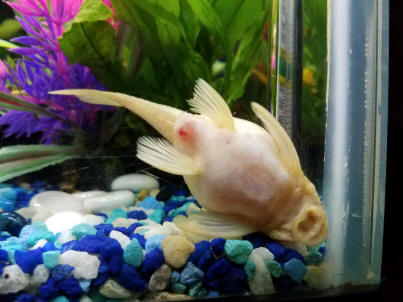
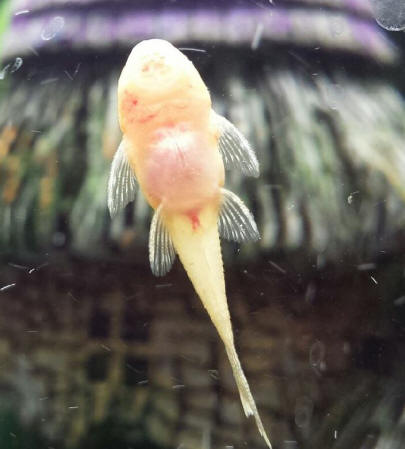
dropping eggs, and a large round bump has developed with a few bursting blood
vessels please see the attached picture. Is she egg bound? Will this kill her?
Is there something that I can do to help her
pass the eggs? The tank is planted with CO2 and lots of hiding places.
Running a Fluval canister filter. Ammonia 0, Nitrite 0, Nitrate 20, Copper 0,
Salt 0, GH 8, KH 5, pH 7.0. Other fish in tank are 7 Zebra Danios and 5 Mollies.
Thanks,
Andrew.
<I'd be treating as per Dropsy at this point; i.e., 1-3 teaspoons Epsom
Salt per 5 gallons/20 litres, raising the temperature by a degree or two as
well. While I don't think she has Dropsy as such, the laxative effect
of the Epsom Salt should help her pass out the eggs. I'd also optimise diet
(more fresh greens for example) and ensure water quality is appropriate
(relatively cool, 22-24 C/72-75 F is optimal for Ancistrus species across the
long term, but regardless, high levels of water movement and oxygenation are
essential). As you seem to realise, Ancistrus breed freely giving suitable
conditions, and assuming your have a fertile male, you'd expect spawning to
happen quite readily. Do review the types of caves on offer: long, hollow tubes
are preferred, while more open caves, such as coconut shells, are less favoured.
Cheers, Neale.>
|
 |
Moving Bristlenoses to another tank enquiry
3/11/14
Howdy,
<Tania>
I have been unable to view your FAQs as the web site is not loading the
pages and this is what happens:
<What? Try refreshing your view... The site is loading for us>
I suspect there may be some useful information about my enquiry on the
site, however I would have likely still emailed.
I have a 45 L tank with a large number of Albino bristlenoses- I
cannot count exactly how many but the number could be around 65 (with
about 50 under 3 cm.s) and the rest 5cms and above.
<Need more room than this...>
The water needs to be changed at least every 3 days to maintain no
nitrites and ammonia. Nitrates are at 40 prior to the water
changes.
<Much too high, by at least twice... See WWM re regulating>
The PH level appears to be around 6.8.
<About right>
I have decided that I would like to move the Bristlenoses to my other
tank, which is a well established 165 L tank with much better
filtration, this is an online image below, however I have sponges on
mine below the spray bar and directly under noodles and bio balls.
<Neat!>
The 165 L tank presently houses livebearers and we have a brackish water
set up (one teaspoon of salt per litre). Nitrates remain low at 10-20
and the Ph is about 7.4.
<... Loricariids don't "like" salts>
My query is about the methodology that would be best suited. I was
wondering whether I should simply take out the livebearers and drain the
165 Litre tank, take some water (15 L) from the 45 L tank and prepare
new water to make up the rest
<I would do this "adding of new water" over days' time... Perhaps
another 20 L per day>
and put a few Bristlenoses in to see how they settle, or if perhaps I
should gradually convert the 165 L tank into a freshwater tank by
reducing the amount of salt per water change whilst keeping the
livebearers in there.
<Up to you. Either could work>
I would prefer the first method as the Bristlenose tank is always
crowded and I would like to keep breeding them but in better conditions.
Also, the local aquarium prefers to purchase them at 4cms plus, so as
long as they breed there will be a lot of them in there.
<Understood>
I suspect that the second method would take quite some time and I would
not want to adversely affect the livebearers. Also, the PH level is
quite different.
<IF the tank is otherwise available, I'd move the livebearers out,
switch the water chemistry to that of the Ancistrus liking>
Any advice on methodology would be appreciated as I am keen to relocate
my brood.
Kind regards,
Tania
<And you; Bob Fenner>
Re: Moving Bristlenoses to another tank enquiry
3/17/14
Hi Bob,
<Hey Tania>
Thank you very much for your advice, apologies for the delay in thanking
you as I was unwell last week.
<No worries>
The loading issue must have been to do with my connection at the time.
<Ahh>
Now that I am on the mend I hope to relocate the Bristlenose brood this
week :)
<Good>
As the picture below shows, it's very crowded and I fear there could be
up upwards of 70 in there as I tried to count them a few days ago- this
is them at supper time. I also discovered a particularly albino looking
Bristlenose who seems healthy and competitive at dinner time, who I hope
stays that way as it would make a beautiful adult!
<Best to be chary of feeding, change out some conditioned water daily
till you make the big move... and when you do so; to move the bulk of
their water with them to the new setting>
Cheers and thanks again,
Tania
<And you, BobF>
|
Baby albino Bristlenose Plecs keep dying
12/13/13
Dear WWM team member,
<Abdullah>
First of all, thank you for a lovely and helpful site. I have been
having an issue with a family of Plecs that I got recently. The seller,
a fellow hobbyist I met online, sold me a breeding male and 2 female
albino bristle-nose (ABN) Plecs along with their entire previous brood
(about 50 or so Plecs at about 1-1.5 cm each) and batch of eggs. The
eggs were unhatched at the time. as I did not have an aquarium I could
accommodate these fish, he sold me an aquarium he said would be enough
for these fish (a none standard aquarium that measures 26x26x40cm).
<I see>
I had a small 5 gallon tank at home and it didn't feel right putting all
the fish into the one he gave so I placed the male and the eggs in this
one, the females in the 5 gallon and the babies (live brood) to the
aquariums I have at the work place (a 33 gallon community with 12 neons
and
2 Bettas that has an external canister filter (Eheim 2213, circulation
102 gph) and was cycled, and a 10 gallon shrimp tank with about 20
shrimp and sponge filter that was not cycled).
I guess my issues were four-fold (hope that is ok).
<Sure; descriptive>
1. The eggs hatched in about 10 days and I was super happy and excited.
only issue was for some reason, I could see them; they were either
kicked out by the male from the cylinder pot I placed the eggs in after
the transfer or the water flow just caught them somehow, I am not sure.
Anyway, they were wiggling about with their egg sacks attached to their
abdomens.
A couple days later, they stopped moving. The ones that were not dead
died within the next 2-3 days. I removed the dead ones to avoid spoiling
the water quality and did water changes once a week at about 25%. The
water got cloudy at one point, but has since cleared away.
So my first question is, why did the babies die and why were they out of
the pot so early; shouldn't they have stayed in until the sacs were
depleted?
<Yes to the last; though your day-count may be off, and the water
temperature so/too high as to hasten development... the cause of death
can only be speculated. From your pix it appears to be water quality
related; though nutrition could have played a role>
That's what all the information on the web seems to say and no one
mentions babies with egg sacks wriggling about the aquarium floor.
<They do so... for about four days at moderate temp.>
2. The females seem to be doing ok in the 5 gallon so far. The water
has, however, turned yellowish (I am guessing the ammonia they are
excreting and the Elodea
<Do check what, which species of Elodea/Egeria/Anacharis this is... some
are too cold water>
that they have munched on to its stem and is now turning brown has
something to do with it) and I do not know what I have to do beside
water changes to solve this issue.
<Some activated carbon in your filter/flow path...>
The 5 gallon has an internal filter, a heater, a goldfish,
<... misplaced with tropicals; should be removed>
a Betta, 2 cories, 1 baby ABN (1 cm), 1 baby spotted Plec (I do not know
the type and also 1 cm), one Plec (again unaware of the type about 4
cm), and the 2 female formerly breeding ABNs.
My second question is, will the 26x26x40 cm aquarium that the seller
said would be enough for them be really enough?
<No; this is too small>
I mean they are in a 46x20x25
and the water has turned yellow as I said above, so I am not sure what I
should/can do. I do want to breed them as that was the primary reason
why I bought them.
3. Since I took all the babies to work I divided them such that the
biggest of them (2 cm) went to the 33 gallon aquarium and the rest of
the babies (around 1 cm for the most part) went to the 10 gallon shrimp
tank. well, of the nearly 50 baby ABN's, I have lost 20 so far in that
tank, each time they were the smallest of the lot and were white in
color (as opposed to their usual gold). The bodies were stiff and rigid.
I removed the dead ones (usually they died in groups of about 3-4). I
did a water change weekly. I also moved the larger ones I could catch to
the 33 gallon tank (about 16 of them, each around 1.5 cm). Only the
smallest ones are left now. I am guessing that this is about the water
quality again and the sudden increase in bio-load (and perhaps a lack of
food in the new set-up aquarium) contributed to their demise (although I
did feed them cucumber medallions once every 2 days, it may have been
possible that the smallest ones didn't get a chance to eat it from the
larger ones. What are your thoughts?
<The same as yours stated above>
4. Just today, in the 33 gallon tank, I found one of the ABN's that I
recently put in there turned upside down at the bottom of the aquarium.
Its belly was huge and seemed to be full of green stuff from the JBL
Novo Pleco XL tablets I placed for their consumption (or perhaps
something else?). I do not understand why it died (the water parameters
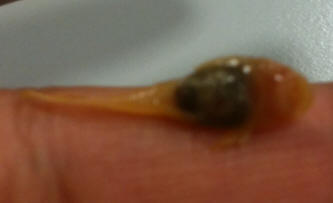
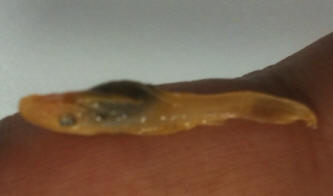
are stable). I took a picture of it (attached) and hope you can provide
some insight as to this.
Is death due to overfeeding an issue with Plecs or can they tell when to
stop? Should I remove uneaten tablets and if so, when?
<I would only feed such tablet food a few times daily; not leave in
place permanently>
Oh and on an interesting note, I noticed that a very small fraction of
the juvenile ABN's had black (or maybe blue?) eyes as opposed to the
regular albino red. Is this normal or a sign of something much worse?
<Just reflection; not a worry>
[image: image.jpeg]
[image: image.jpeg]
--
Sincerely,
Abdullah Bolat
<Larger system/s, better water quality (use of carbon) and only periodic
wafer feeding. Bob Fenner>
|
 |
|
re: Baby albino Bristlenose Plecs keep dying. Neale's
further input 12/13/13
<<As Bob Fenner has suggested, the main problem here is very likely
water quality. Rearing Ancistrus spp. fry is not difficult, but like all
catfish fry, they are especially sensitive to poor water movement along
the bottom of the tank. Adding extra airstones and/or sponge filters
will be extremely useful. Remove any/all substrate so the bottom of the
tank is plain glass. Siphon regularly (ideally: daily) to remove any
detritus (a turkey baster is extremely useful for spot cleaning). Change
some (10-20%) of the water every day or two. Ensure zero ammonia and
nitrite levels of course, but *also* keep nitrate as low as practical,
and certainly below 20 mg/l. Feed 4-6 times daily, but in small amounts.
Do not be tempted to overfeed.
Remove uneaten food after 10 minutes. Use sponge filters -- the fry will
come and feed on the sponges, consuming detritus and algae without you
needing to leave extra food for in between meals. Lack of oxygen is a
common killer of Ancistrus fry -- if the fry edge towards the top of the
tank, that's a bad sign, so increase aeration/circulation and/or provide
a bigger aquarium. Don't bother with tanks smaller than 10 gallons, and
for sure try and use tanks that are bigger -- the bigger the aquarium,
the easier it is to rear your fry. Cheers, Neale.>>
Re: Baby albino Bristlenose Plecs keep dying
12/21/13
Thank you for the replies.
<Welcome.>
Some progress with regards to water quality; I changed the water in the
tanks and one tank seems to be clear now. The other still has a yellow
taint (I guess I need an active carbon filter to get rid of this one, or
some fresh water clams)
<Carbon, yes, can help with yellowing of water. But freshwater clams are
useless in most/all aquaria... they don't clean the water, they need
specific feeding (see maintenance of marine clams for details) without
which they invariably die in freshwater tanks.>
while the third is still a blurry murky yellow. (picture attached)
<Images do not seem to be attached/viewable.>
I removed the last living fry (now about 1.5 cm) and moved them to the
tank with the adult female BN's. Since the water they were in was
originally murky (they were in no 3) I didn't realize it before but to
my shock and horror they all had yellow spots/dots on their bodies and
fins.
<Are you sure these are not the normal yellow spots seen on juvenile
Ancistrus? Do use the search engine of your choice using the terms
"Ancistrus" and "juvenile" for images.>
These dots did not appear to be part of their color pattern as the fry
that were already in this tank don't have them and these dots also seem
to be like something is on them (sticking on them). I am horrified now
and also worried that it will spread to the ready to spawn females (I
was just about to remove them from here to the male's tank; the murky
one). What are these dots? Ichthyo or bacteria/fungus?
<Whitespot/Ick tends to look like salt grains; Velvet tends to look like
golden dusting of very fine sugar. Do look at pictures online/in books
for more.>
What should I treat the tank with, "ick" medication or bacterial? Some
pictures attached.
<Your images simply aren't coming through.>
One last concern is I have noticed that many of the fry that are dying
all have one thing in common now; a green belly that seems to be full of
food (like last week's picture of the fish I sent you or slightly less
full). I noticed that both of my adult females also have green bellies
and when ı was inspecting one of them that was stuck to the glass facing
me a couple of days ago, I saw "something" move inside her belly (not
sure if it was a worm kinda thing or just her intestine/bowel
movements). I also read somewhere that these fish are susceptible
to something similar to "green belly disease" which is a
parasitic/bacterial infection of some sort. If that is the case I'd like
to know what I can do to treat this issue?
<Almost always Ancistrus deaths come from starvation, poor environment
at the bottom of the tank, and lack of supplemental oxygenation. Disease
is rarely, if ever, the prime cause of death except as an opportunistic
infection once the Ancistrus fry are stressed/damaged in some way.
Review the aquarium/maintenance and act accordingly. Consider buying a
relevant aquarium book; Kathy Jinkins excellent "Bristlenoses" book can
be bought inexpensively online and supplies much useful, relevant
information.>
Thanks again for your time
<Most welcome, Neale.>
|
Re: Baby albino Bristlenose Plecs keep dying
12/22/13
Hello,
<Hello,>
The baby bn's are dead, they seem to have passed away 6 hours after I wrote
to you.
<Sorry to hear this.>
I don't know why the pictures didn't go through
<
but the dots were like grains of sand (looked like chicken pox of sorts).
<I see. Some aquarists prefer to "strip down" tanks after unexplained
problems, giving everything including the filter a thorough clean. Very
dilute bleach can work for this, but rinse thoroughly after use;
alternatively use a strong brine solution, which is almost as good at
killing germs but much less likely to cause problem if you don't rinse it
away completely. Either way, this will of course mean you'll need to
re-cycle the filter (or at least stuff it with live biological media taken
from a mature aquarium). Other aquarists take a more gentle approach, but
will do their best to clean the tank, siphon out any detritus, rinse debris
from filter media, etc. so that the aquarium is much cleaner than it was.>
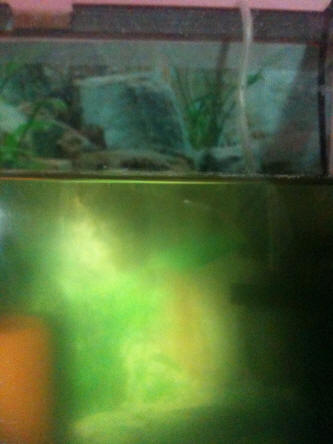
I am attaching the water picture though as it seems to be a problem I just
can't get rid of.
<Looks like "green water", which tends to mean too much heat and light, too
much nitrate, too few water changes, and not enough filtration. Review, and
act accordingly. Cheers, Neale.>
|
 |
|
|
Albino Bristlenose query; rearing young w/ parents in a
small volume 10/1/13
Howdy,
<Hello Tania,>
I have written to WetWebMedia before in relation to my tank, a
45 L tank with a breeding pair of Albino bristlenoses and their fry.
At present, the breeding pair and about 13 fry live in the tank.
<About the going rate when left with adults in a small aquarium.>
I have noticed a few of the smaller fry have died in the past week.
<Starvation, more than likely.>
Water tests are consistent and fine with a water change of 15 L every
4/5 days.
I have been stumped as to why some fry have died as the tankmates have
been healthy with the exception of one whom I wrote to your crew about a
while back who appeared bloated (who likely stabilised as I did not
notice any abnormalities in any of the many fry at that time shortly
thereafter and assume they that one lived on and returned to normal).
I saw the fry in the attached photo tonight sliding down the glass in a
manner whereby it appeared weakened and unable to support itself as
opposed to how they normally move their mouths when moving along the
glass. It then moved quickly diagonally and upwards before repeating the
sliding down movement.
Upon closer inspection I saw some red spots and a red colour appearing
to rest in it's belly almost as though being excreted, which appeared
slightly bloated.
Could you please advise me if you are aware of what the problem may be?
Cheers,
Tania
<In a nutshell, you'll get more fry surviving if they're removed as soon
as possible after hatching to their own aquarium (60 litres would be
ideal) and reared away from their parents. Provide ample food -- green
algae, and almost more than anything else, the "gunk" (= infusoria) that
grow on a sponge filter. Daily water changes are ideal, but certainly do
a decent (25-50%) water change weekly. It's the combination of ample
food and low nitrate that's the key to rearing most catfish fry.
Otherwise, if you aren't serious about rearing lots of fry, what you're
doing works well enough, and perhaps with a bit more spot feeding (e.g.,
with Liquifry or the installation of a sponge filter) you might even get
a few more surviving. Use of Methylene Blue can be useful too,
particularly at the egg stage, for minimising losses from fungal
infections. Cheers, Neale.>
|
 |
|
URGENT- Albino Bristlenose query- further
details 10/2/13
Hi Neale,
Thank you for your reply.
<Welcome.>
I should have provided further details.
On the weekend before this past weekend, I took 60 of the smallest fry
to the local aquarium.
<I see.>
They advised me that in the first few days about 50 died.
<Ah, not good. How big were the fry? If already 1.5 inches/3.75 cm in
length, they'd be ready to travel; any smaller and water
chemistry/temperature changes could easily have caused problems.>
They all looked very healthy and not bloated at all or ill when I took
them. By last weekend, 10 or so remained. I had noticed one fry die
before I removed the 60 and did not think much of it. A few of the
smaller fry have died since then (mainly in the last few days). They are
about 2-3 cm.s.
<I see. Probably a bit small for travelling, and still delicate.>
I have not experienced any problems like this with my tank before and am
perplexed that so many have died so suddenly- I thought as the 50 or so
that died were not in my tank water at the time that it was unrelated
and was advised by the aquarium that they have received whole batches of
Bristlenose fry that have died like mine had. They have always been
rabid eaters and I have mainly used Hikari mini wafers lately to spread
out the food and minimise leftovers (please see the email copied
below from my query to WetWebMedia in late June). They are fed every
second night.
<Ah, with baby fish, multiple feedings per day, though small portions,
is the key. Assuming of course you don't have fresh green algae
available too, e.g., a bright light over a flat rock. It's very easy to
starve baby fish.
Their digestive systems hold very little food, and many breeders will be
offering six meals per day.>
I did a water change on Monday and found about 4 dead fry and a few more
last nite. Today I found another. Most look like the have bloated
bellies and are struggling for air. The ones looking the worst have a
reddish tinge in parts of their body.
http://www.bristlenoseworld.com/t1592-bloat-desease
I am thinking of trying a medication to treat bloat after reading the
above article and I just saw one of the bloated fry doing a white
stringy poo.
I don't think Octozin is available in Australia from some online
searches I just did.
http://www.aquariumproducts.com.au/catalogue_products.php?prodID=6513&catID=37
This one is though.
Before I commence treatment, I just wanted to consult you and ask your
thoughts please.
My last email to you was at the end of June which explains the tank set
up properly. I have copied it below.
I have just done my water tests, and all is well, Ammonia=0, Nitrate=
20, PH just below 7.4 (the aquarium estimated 7) and Nitrite= 0.
Kind regards and thank you for your time and assistance on this occasion
and all the others! :)
Tania
<Let's be clear on breeding Ancistrus. On the one hand, they spawn
extremely readily, and the fathers are excellent parents, looking after
the eggs until they hatch. Unlike the adults, the fry are very sensitive
to old water (high nitrate) and to low oxygen levels. In their rearing
tank, they basically need a continual supply of food after they use up
their yolk sacs about 6 days after hatching. Usually that'll entail 6 or
more proper meals, together with a continual supply of green algae and
aufwuchs (a sponge filter is great for rearing algae and aufwuchs). Even
better is maturing a tank with an undergravel or sponge filter somewhere
it gets sunlight, so the bottom of the tank is nice and green. Anyway,
once the fry are active and feeding it is a good time to remove the male
from the breeding tank.
He'll use up food and oxygen, so isn't helpful anyway. If the tank
doesn't have adequate circulation and oxygen, you'll see the fry leave
the bottom of the tank and go towards the surface, which isn't normal at
all.
Invariably it's important to "thin the herd" if you have a small
breeding tank. Trying to rear all the fry may be impossible in a 50 or
80 litre tank, simply because they're so sensitive to water quality and
oxygenation.
Kathy Jinkings for example (in her excellent "Bristlenoses" book)
recommends a two-foot tank (about 80 litres) as sufficient for rearing
just 20 or so fry to a sellable size of a couple inches. Does this help?
Cheers, Neale.>
Re: URGENT- Albino Bristlenose query- further details
(repro.) 10/10/13
Thanks Neale.
The 50 that died at the aquarium were about 3cms and a few were closer
to 4cm.
<That is dad. I do suspect lack of food was the thing here, the tricky
bit for you will be providing ample food while keeping water quality
tip-top.
Unless you're deadly serious about breeding hundreds, you might want to
"rescue" twenty fry and leave the others with the adults. Some of those
left with the adults might survive. You might even tailor-make the
adults' aquarium so it's ideal for the fry too -- brisk filtration,
strong lighting over flat rocks (for green algae and aufwuchs), moderate
temperature (22-24 C probably ideal), and lots of oxygen. With the
twenty you pull, you can probably provide enough food for them without
too much fuss, and water quality management shouldn't be too hard.>
Thank you for your recommendations about fry rearing. I will have to
reconsider my set up as I can see it is not sustainable.
<Could well be. The thing with fish breeding is that if you want
hundreds of fry, then you have to set aside serious amounts of time and
money, even for Guppies. But if you don't mind rearing small numbers,
maybe even just getting a dozen big enough to sell, then you can do that
on a tight budget with little effort. But trying to get hundreds of fry
reared with just very
basic equipment and little money/time will be tricky, if not
impossible.>
I did use Myxazin for 5 days and did a water change yesterday. Nitrates
are down to 10-20. The fry survivors look healthy and I haven't found
any dead fry since last week.
<Sounds great.>
Thanks again for all your help and support :)
Cheers,
Tania
<Most welcome, Neale.>
|
|
Bristlenose Pleco Eggs 7/7/13
Hi guys and gals!
<Rhi>
Just after some egg advice. I have a pair of Bristlenose Plecos in a
community tank (mainly other angels, clown loaches and a female Opaline
gourami). I've had the female for about two years, and a few months ago
got a second baby Pleco. It's grown really quickly and is now a little
smaller than the original female. I thought it was also a female because
it only has a few stubby bristles -- turns out it must be a male because
tonight we discovered him guarding a clutch of eggs!
<Ahh!>
I had no intention of breeding any fish, and assumed since it was a
community tank that they would just eat each others eggs anyway. But now
they're there and now that daddy Pleco is doing his best to protect them
I'd like to do what I can to help them along.
So my question is, what course of action should I take?
<Mmm; two general lines of possibility... not much; to moving the other
livestock or the parents, eggs elsewhere>
This tank it the only set up I have, so removing them isn't an option.
Should I attempt to segregate them?
<Mmm, possibly... How large is this tank?>
Should I just leave him be and let nature take its course? The eggs are
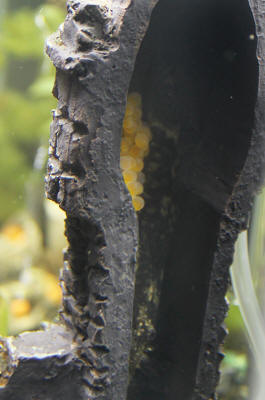
in the rear of an ornament [picture attached] where the two Plecos have
long since established their territory, and there are many hiding spots
around the tank. I've been Googling and read that daddy Plecos are
relatively good at defending their young so I'm thinking that it might
be better to not interfere, but on the other hand wonder if the angels
might gang up on him. I've also read that baby Plecos need driftwood,
which they have in the tank already -- is there any other essentials
[aside from what I already feed the adults] I should provide if the fry
do survive?
<Best to have you read here:
http://www.wetwebmedia.com/FWSubWebIndex/loricreprofaqs.htm
The adults get regular veggie off cuts (mostly carrot and eggplant as
they seem to love it the most) and algae pellets. They also tend to chow
on the loaches shrimp pellets.
Thanks in advance for any advice,
Rhiannon.
<If you want to raise some of the young, placing a separator in this
system (if it's large enough) can be made to work. Going forward, for
other batches of eggs, young, another system can maximize the number of
young surviving. A further note; you may want to contact your local
stores to see if they will buy/sell your excess stock. Bob Fenner>
|
 |
|
Re: Bristlenose Pleco Eggs 7/8/13
Hi Bob,
<Ms. R.>
Thank you kindly for your reply and the info.
<Welcome>
My tank is 3ft/150 litres. I'm planning on swapping it for a 4ft tank in
the immediate future (my tank stand is made for a 4ft tank hence the
minor upgrade).
<I see>
Duly noted regarding contacting local stores. It is another concern of
mine as all the places I buy stock from in the past have told me they
only buy from breeders.
<Well; you've just become one>
My system is not large enough to house the babies if a few survive (and
I'm aware that male Plecos can be quite territorial). I plan on getting
a much larger system (upwards of 1000 litres) in future, but can only do
so when finances permit so it's not an option right now. I'm hoping
I can find someone to take the offspring - I don't care if I have to
give them away, as long as they can go somewhere they'll be looked
after,
<Ah good; perhaps "Craig's List" or such...>
As an aside, thus far the angel fish haven't touched the eggs. When I go
over to check them out the angels usually follow me and hang around
where the eggs are, and two of them regularly hang out in that area of
the tank.
They act like they can't even see the eggs. Do you think they just
haven't noticed that they're there, or is the male doing a good job at
defending them?
<Much more likely the latter; Plecos are very outgoing/defensive
where/when reproducing>
The angels usually have no problem pushing the Plecos out of the way when
there's food involved (they'll peck at whatever the Pleco is eating, the
Pleco will give up the food and swim off, then the angel will realise it
can't eat whatever the Pleco was eating and leave the food for the Pleco
to finish).
Many thanks once more,
Rhiannon.
<Thank you for sharing; the further input. Cheers, BobF>
|
can you move bristle nose Pleco eggs?
6/6/13
<It's not easy, but if the eggs have been laid in something moveable
like a flowerpot, then yes, you can move that "nest" to another tank to
rear the catfish kittens. But the males make excellent fathers, so
unless you have a compelling reason to move the eggs, it's best to leave
them put. Even in community tanks, males are often able to rear a few
offspring successfully!
Cheers, Neale.>
Re: Bristlenose Pleco, repro.
4-16-09
Thank you. Can you tell me how to sex them?
<Mature males tend to have much longer, numerous bristles on the
head than females. Juveniles are essentially impossible to tell
apart.>
And does it matter the ratio of male/female?
<Not really, provided each male has his own territory.>
Also, will the Corys eat the Pleco's food or vice versa?
<Yes, Corydoras will eat algae wafers and bloodworms given the
chance.
Corydoras tend to ignore the soft vegetables though. So provided you
add enough food for everyone, and that the Corydoras and Ancistrus are
of similar size when introduced, they should get along fine.>
Thanks again.
<Happy to help, Neale.>
Re: Algae Eaters, Loricariid, Ancistrus
sexing... repro. f' 03/11/09
Hello again, I have read that these Bristlenose are hard to sex
<Mmm, not too so... if you can get them out, into clear view>
so if I unknowingly put more than one male in my tank will there be a
problem?
<Not if there's sufficient room, habitat for all>
Also, I have read that they breed easily. If I found myself with babies
what are alternatives to keeping them in my tank? Maybe taking to a
LFS?
<Certainly so... there are even internet sales sites... Bob
Fenner>
Thank you again.
James
Mystery baby plecosumus... I'll say!
9/24/08
Hi,
<Lori>
I have a 44 gallon tank with one large 6 inch dark brown spotted
plecostomus, who has been with me for 2 ys. Two siclids yellow and blue
who have been with me for 11 mo, and one small Chinese algae eater, and
two tetras for 3 yrs. I suddenly have a suddenly noted a small tan
Pleco looking fellow in his body shape.
<?>
He also has stripes more like my Chinese algae eater. I have no clue
where he came from, since my newest additions are the siclids 11 mo.s
ago. Can my Chinese algae eater and my Pleco mate, and have a viable
offspring?
<No>
Thanks
Lori
<Two very disparate families of fishes. Bob Fenner>
Re: mystery baby plecosumus 9/24/08 Ok,
but where did he come from? Could it have been an egg in the water of
my last purchase 11 mo.s ago? Lori <Mmm, likely someone bought it
and placed it in your tank. B>
Re: Native fishkeeping; Ancistrus repro
8/11/08 Hi Neale, <Silvia,> So, you live in the UK. For some
reason I thought you live in America. Probably because WetWebMedia is
an American site, or is it? At least I thought so. <I am not a
citizen of Athens or of Greece, but of the world!> I know that
Britain has some nice places with nearly Mediterranean climate.
<"Nearly" being the operative word! It's perhaps
better to say the UK has a climate that doesn't change much,
between about 5 C in winter to about 25 C in summer, but rarely much
above or below those values. So we don't tend to be as cold as
Northern Europe or most of the continental USA, but neither do we get
the long hot summers of, say, Australia or Southern Europe.> When I
was at Uni I went there with a group of friends. It was a holiday with
all sorts of weather and climates, from rain and cold to sunny and hot
but we really enjoyed it. <Ah, yes, the weather is notoriously
changeable. This is a factor of the "battle" between the warm
Atlantic oceanic weather system (the Gulf Stream) and the cold Arctic
weather system. Neither "wins" for long, and at a moments
notice it can change from dry to wet. Air temperature tends not to vary
much, though windy and wet weather can add a certain chill to the
climate. I've lived for a few years in the American Midwest where
the climate in winter was much much colder. And yet, despite
temperatures of -10 C or less, it never felt as "miserable"
because the air was dry and the precipitation was snow rather than
rain. English winters are incredibly depressing, made worse by the
short day lengths, in December barely 8 hours!> Regarding to the
keeping, here you have it again. the native species are not attractive
enough, or is it the exotic side of it? <Oh, we do have some lovely
native fish. I have sticklebacks in my pond, and the males turn
metallic green with sapphire blue eyes and bright red bellies. At
university I kept coldwater marines, including a blenny known as the
Shanny, and it's like a mudskipper, coming onto land when it gets
too warm or just feels like a change. The problem is that there's a
lack of information re: keeping Natives.> What a shame! I don't
know what we have in Germany, but certainly not such a diversity in
marine life. <Mainland Europe actually isn't bad. There are lots
of cyprinids, many of which make excellent pets being tolerant of room
temperature and relatively small bodies of water. I have some Carassius
carassius in a fry-rearing tank and they're fun. Sticklebacks,
killifish, small minnows, loaches, etc. can all make good pets.> And
I don't know much about the freshwater side either but I remember
that friends at school told me they were going to the local creeks and
catching sticklebacks to keep in jars. That would be the equivalent to
our rainbows here. <Pretty much, except Sticklebacks are very
aggressive! Much used in behavioural experiments. Do read 'King
Solomon's Ring' by Konrad Lorenz. He's the "father of
animal behaviour studies" and a great fan of fish, writing at
length on cichlids and sticklebacks.> I had a busy week which ended
with a nice weekend. Friday night was another one of our ANGFA meetings
which was again very interesting. We have such a wonderful wintertime.
Sunny and warm, like 22 degrees Celsius/72 Fahrenheit (do you use
Celsius or Fahrenheit in the UK?) during the day and no cloud on the
sky. <Anyone below the age of 40 uses Celsius.> That always
amazes me, even after 10 years. Nights are cold with only 5 degrees
Celsius/41 Fahrenheit. It is such a treat to walk along the beach in
the morning. Next weekend we are going up the North Coast, about 3
hours drive from our place, to fish for rainbows and such. I am not
very sure about the water temperature but it seems to me we will end up
with cold feet. <Sounds fun!> So far the Bristlenose has done a
marvelous job. The youngsters are coming out now. The Corys laid eggs
again on Friday. I did a water change on Thursday. I still use water
from outside. I have a big water tank under the sails. Original it was
our outdoor eating area until we build the big pavilion. Now one of the
tanks is underneath and catches the rain water. It is more like a big
500 litre/125 gallon bucket with a removable lid. I get very clean
water there and use it for water changes till I run out. Than I have to
switch to tap water. <I also use rainwater, 50:50 with tap water to
get medium hard water ideal for most tropical fish.> That is often
the case in winter. The surface of the water was 22 degrees, which is
the same as in the tank inside, due to the sun but further down the
temperature was down to 19. For the fish it must have seem like rainy
season and promptly laid eggs the day after. <Correct. Corydoras in
particular use sudden changes in temperature as an indication the rainy
season has started, and then spawn.> It works all the time :)
<Yep. Ditto with Danios and quite a few other fish.> I didn't
intend to harvest the eggs but my daughter couldn't help it. She
noticed my "funny" looking female. What happened was that she
hadn't closed the fins properly while laying the eggs and two were
attached to a little pebble which she lifted when she took off to
deposit them. The pebble stuck to the glass as well. I don't worry
much about the eggs. I am sure many will not make it. But the other
little kittens are all good and very busy during the day. I hope I can
keep them long enough in the container and than tip them into the net
with the Bristlenose kittens once I removed daddy. <Should work
fine.> I am not sure that inbreeding is the only reason for the
angelfish's bad parenting skills. Learning or the lack of it might
be another one. Many of them are "hand-reared" on farms. I
think the parenting skills are partly learned skills and partly
instinct. <It's a topic of discussion among Angelfish keepers,
and likely a mix of both factors. Certainly hand rearing the fry
removes the selection pressure in favour of good parenting, so that
dimwit parents produce just as many healthy fry as well behaved
parents. So over the generations, Angelfish have lost their good
parenting skills. Some aquarists do maintain that letting them
"practise" a few times does the trick, but that was not my
experience at all. And most other cichlids (wild caught at least) seem
to get it right first time, or at least very quickly. A lot of tank
bred cichlids (Kribs and convicts, for example) are also very reliable.
So it's complex. May well be Angels were never that smart or that
good at parenting to begin with! How often do you find beauty and
brains in the same body!> Cheers Silvia <Cheers, Neale.>
What do I do with extra Otocinclus? 5/30/07 I have a 5
gal. Eclipse Corner Tank on my desk at work. There were 2 Betta's
(with a divider) in it, but when I added 3 Oto's from PetSmart soon
after the Betta's died of tail/fin rot. I moved them to separate
bowls, and treated them but they died. I figured it was the addition of
the Oto's so I expected them to die as well. That didn't
happen. They cleaned my tank of all algae, and I feared they would have
nothing to eat because it seems they won't eat the algae flakes.
So, I went to my buddy's Cichlid tank and traded all the ornaments
(no, I don't know if this was a smart thing to do or not, but I did
it anyway). It seemed, that this brought new life to the Oto's, as
very soon after I spotted little white things on the front of the tank.
When I realized it was fry, I shut off the filter. I counted about 12
fry stuck the glass. I turned to the internet for advice and found
little. I put a baby sock rubber banded over the filter intake and
turned that back on. Added an air pump for them. I fed them boiled
spinach leaves. Well, a spinach leaf from a coworkers salad stuffed in
a cup of hot water. They ate little holes in that overnight. I do a 50%
water change weekly, and slowly suck out the leftover food every few
days to keep the substrate somewhat clean. Now I keep exchanging plants
with my buddy's Cichlid tank for food and they clean it overnight.
There are now 4 or 5 baby's left and they are half the size of the
adults and seem to be doing fine. My question is, what can I do with
these extra Oto's? Can they go in the Cichlid tank? Isn't that
too much hardness for a Cichlid? Or can I support 7 to 8 Oto's in a
5 gal tank? PetSmart told me that they stock the same sex in the same
tank and sell them that way so this wouldn't happen. Well they
screwed up and now I have these new guy's. What do people do with
their new fish when they didn't mean or even know they would spawn?
<Wow. This is quite an amazing tale! On the one hand, a 5 gallon
tank is really too small for Otocinclus. As a group, Otocinclus are
considered "delicate" because they need good water quality
and lots of oxygen. In most community tanks, they tend to be short
lived. But yours are doing well, so well done! Anyway, as to where to
put the Otocinclus. I personally wouldn't mix them with anything
other than, perhaps, South American or West African dwarf cichlids. The
problems are multiple. Firstly, yes, they will not do well in Lake
Malawi/Lake Tanganyika type aquaria. Such hard and alkaline water
conditions will not suit them at all. Secondly, when kept with slow
moving things like angelfish and discus they tend to suck the sides of
the bigger fish, scraping off the mucous. I've seen this in my own
tanks, with the Otocinclus rasping away on large gobies, creating nasty
blisters. Aggressive fish like convict cichlids will simply hammer them
to death. So ideally, give them to someone with a peaceful community of
other small fish such as barbs and tetras. PetSmart cannot possibly sex
Otocinclus so their advice there was nonsense. In fact, breeding
Otocinclus is quite uncommon, so you've actually done rather
well.> Tom <Cheers, Neale>
Spawning Rio de para Pleco 11/19/06
Hi. I've heard that the Rio de para Pleco (L75) has not
been spawned in captivity yet. Is this true? Thanks,
Kelly <Mmm, am not that "up" on such matters with
Loricariids... Would seek out your answer through "Planet
Catfish", other FW BB's that have a good number of Siluriiform
members. Bob Fenner>
Breeding Otocinclus ... Neat!
6/22/06 Greetings, and thank you for your site, it has a wealth of
information. I was particularly excited to see a letter from Andrea
Hall entitled "Tiny White Bugs in a FW Set Up -
03/25/2006" in the "FAQs on
Otocinclus". I don't have a question for you,
but rather I'd like to make a comment about that letter and relate
an experience of my own. Andrea expressed concern over some little
white specks she had discovered in her tank when examining her
Otocinclus which "was more than just plump, it was huge" and
had submitted photo's of her Oto and the
specks. One reply from Chuck suggested they were
probably a form of daphnia, RMF suggested that they indeed were likely
to have been fry. I had an experience with my two
Otocinclus this past weekend which would confirm that they are indeed
fry. This past Saturday my wife mentioned to me that she had noticed
the previous evening that the Oto's appeared to be spawning, I took
a look and found that it seemed they were, the female's belly was
extremely distended - probably two to three times its normal size. The
male who normally paid little to no attention to her was frantically
following her around the aquarium. As she seemed to stop and clean a
spot of glass or a plant leaf he would cling to her or next to her,
sometimes wrapping his body around the top of her head so the two of
them formed a "T" shape, and sometimes clinging to her back
or side. Searching the internet I found precious
little in regards to Otocinclus spawning, but I did find that the
behaviour was supposed to be a fairly common mating routine among their
relatives. So I assumed that they were breeding. The behaviour
continued for many hours. The following day the
females belly was back to her normal size and the two were back to
their normal routine - eating, resting, and pretty much ignoring each
other. I tried to find eggs in the tank but was unable to see anything.
While looking for eggs though, I found the same little white specks
throughout the tank as Andrea described, they were everywhere,
numbering easily in to the hundreds. And, as Andrea described, they
moved much the same as the full-grown Oto's. I too,
thought they may be some kind of invader in my tank, but found the
coincidence of their arrival and my Oto's deciding to spawn just a
bit too convenient. So assumed they were fry. Then today I ran across
Andrea's photo's on your FAQ page. My fry look exactly
like her white specs. I'm just as shocked as I am
excited, this is a small five gallon tank that I keep slightly brackish
for the sake of the green spotted puffer who was it's sole occupant
until putting the two Otocinclus in to eat the algae about three or
four months ago. I felt bad about putting them in that tank, feeling
the salt content may be to high for them, but they have thrived and by
this recent sequence of events I'd judge them to be quite content
in their home. Incidentally, the salt content is about 1 teaspoon per
gallon, half of which is aquarium salt and half marine salt. I am
sending you links to video I took of the spawning and of the fry. They
are quite large videos not too suited for dial up connections, and even
on high speed will take about a minute to load. If you'd like links
to video more suited to dial up let me know and I will make them
available. Link to breeding video : http://www.farrant.info/video/Otocinclus_breeding.wmv Link to
video of fry : http://www.farrant.info/video/Baby_Otocinclus.wmv I'd be
very interested in any comments anyone may have, and very grateful to
any tips anyone may have to help me raise the fry successfully. I have
rounded up any plants and algae laden materials I could find from my
other tanks to help supply them with food as well as making a broccoli
paste for them. The puffer is getting moved to a different tank, I have
turned off the filter so their pinpoint bodies don't get sucked in
- to help compensate I have increased the airflow in the tanks bubbler
and am doing daily trickle water changes with aged water. Thank
you, Bill Farrant < One of the great things about the internet and
this website is the information that gets passed around. Oto's are
very cheap algae eaters than many breeders have no interest in breeding
because there is no money in breeding them. That is why you have had
trouble finding any info. In the previous letter you referred to, I was
unable to bring up the photo and wrongly assumed they were daphnia. Bob
was able to get the photo up and posted on the website. I looked back
and saw the photo and knew that they were fry. This information is very
useful because there are many other Oto species that are very
attractive but very expensive too. Breeders may be willing to obtain
these new species if they knew how to breed them. Thank you very much
for sharing this info.-Chuck>
Angels and Clowns I have a 90 gallon show tank. It is
decorated with wood, a single large piece of holey limestone, black
gravel and floating plastic bamboo plants...sort of a sparse Zen look.
It has clown loaches (2"-4")... they eat out of my hand...and
Bushynose Plecos... the Plecos are actually breeding on a routine
basis. The pH is 7.2, temperature is 80 degrees, and ammonia and
nitrite are zero. It has been up and running for 18 months. I use two
Emperor 400s. I change 10% of the water daily and wash out the filer
pads in the process. I want to add a few angelfish. Are they compatible
with the clown loaches? The loaches are pretty active sometimes. Also,
would the angelfish help control the Pleco population? My LFS gives me
$2 each for them...several hundred dollars so far... but it is a hassle
to take everything out of the tank to catch them and it disturbs the
fish. >> You should be able to add some angels, but please start
with medium sized fish, the activity of the clown loaches at night may
bother the small angels. They will, unfortunately, eat some of your
baby Bristlenose Plecos. If you want to catch your Bristlenose babies
without having to take the tank apart try putting some food (romaine
lettuce, tied to an airstone) at night, with a net underneath it. The
baby Plecos will enter the net from the top and swim down to eat the
lettuce in the stream of bubbles. Use a flashlight to see when Plecos
are in your net and lift! Good Luck, Oliver <<
Frog Spawn Hello again, Thank you Don for your help a little
while ago, you majorly calmed me down, and everything is AWESOME. I had
acquired fish from a friend and a tank on Christmas. refer to
"Suddenly Stocked Tank", WWM FAQs.) Well everything is going
great, have done 6 water changes since I got the fish. All my levels
are looking great (I think those established bio-wheels really helped).
I got some ghost shrimp today, just to clean a little. Well my question
is, I have noticed clear sacks with yellow dots in them in the bottom
of one of my plants, kind of weaved through it. Quite a lot of it
probably 50-80 little yellow dots(1mm) all in a single sack. And than
there's like yellow brownish flecks and pieces of what look like
clear egg sack all over my plant leaves. My plants are fake. Well I
don't know who laid them, could it have been my Plecos? My Plecos
are almost a year old and 1 is 9" and the other 6", one is
obviously smaller, are they male and female? Or one is it that the one
is more aggressive and gets all the food (which routinely happens, I
put algae wafers in his\her little spot so he\she can eat)? How do you
tell the difference? Is that what their egg looks like and where they
lay them? I also have a 4" Gourami, 1" orange tetra, 1"
clown loach, a frog (who seems to be in the eggs a lot), 6" black
ghost knife (he's my buddy now, I got him frozen bloodworms and
feed them to him on the end of a skewer). I don't think anything
else could have laid them. I plan on getting 2 fire green tetras in a
week, I finally found a place that will BUY my Plecos. I'm quite
happy, after I have been trying to give them away. What should I do
with the eggs? I'm not really too concerned about propagating, but
something small in my tank might serve as a nice snack for my black
ghost knife. Or the frog. Or anything. What do you think? Again thank
you for all your help in my beginning worries. And the rest of the WWM
staff for the amazing website you guys keep up. James <First thought
was snail eggs. Very common. They are laid in a jelly like mass. But on
re-reading the part about "weaving though" the plant leaves I
now think they may be frog eggs. I never kept frogs, but do recall that
some species lay long strings of eggs in a protective jelly. Snail eggs
would be in a single round clump. Either way I would remove them. If
they're frog eggs they will be infertile without a male and will
decay. If they're snail eggs you're looking at a population
explosion. Your Gourami and tetra would both lay single eggs, not in a
mass. I don't think Clown Loaches have ever been breed in captivity
and would need to be much larger. (BTW, will grow slow, but can hit
8" to a foot. Be aware) Plecos are cave breeders. They would spawn
in a protected area that the male would be defending. So that leaves
the frog and snails. To sex your plecs look at the trailing edges of
the fins and gill covers. Mature males will have frilly tassels
decorating these areas. Also, when viewed from above the male will
appear thinner and more tapered than the female. The larger fish may be
getting mature enough to sex. At 6" the smaller is still to young.
And another BTW, they may eat the ghost shrimp.
Don>
Loricariid fry Hi Bob, or whoever is in, <Don jumping at
this one!> My Ancistrus catfish are breeding all the time. Usually
the male is looking after the fry for 1 to 3 weeks until they are all
gone. Mostly probably eaten by the other inhabitants of the community
tank (different rainbows and bitterling). Every here and than I will
find a young one weeks later. About 5 months ago I disturbed him just
shortly after the eggs hatched and I took them out to raise them in a
little tank on my kitchen bench. By now they are developed into 2
different sizes: ~3cm and ~3.5cm. From the size difference and the
behaviour I think the bigger ones are the males although I can't
see the bristles jet. Am I right? I noticed that the female is already
pregnant again even though the male just let go of the others. It is
amazing, they are like a breeding machine and each time it seems there
are more eggs. What would be the best time to remove the eggs/ fry to
raise them in a different tank? I would like to give some of the
off-spring to a friend. <Wow, great timing on this one! My albino
Bristlenose just spawned for the first time a few days ago. Still
waiting for my first hatch. Mine are alone in a 10 gallon so no need to
move. But in your case I would move them a day before they hatch. Let
the father do his thing fanning them as long as possible. A day or two
after they hatch would work, but do it before they leave the cave.
Easier to move the eggs, IMO. Not sure if the size difference has to do
with sex. Mine were pretty much all the same until they were twice as
large as yours. Some may be feeding a little more aggressively than the
others. The bristles will not appear until they are 6 to 8 months old.
Hard to sex until then, but females may appear thicker when viewed from
above> As with
the other inhabitants in the tank they are breeding as well. Well, they
try. I notice the courting and sometimes I find all the fishies very
busy in one small area and having, what looks like, a nice meal in
between. I don't take them out to breed them, so I just enjoy
watching their courtship. Thanks for your help Silvia <That your
fish are breeding this often is a sign of your fine care. It is no
problem at all that the fish are eating the eggs. Very natural and
healthy food. But I'd find it hard not to set up a breeder for the
Rainbows. Don>
Ancistrus temminckii breeding Dear Robert, I would like to
ask you some questions about Ancistrus temminckii and breeding. How
long do they need to be (inches/cm) before they can start breeding?
<Coincidentally have a friend in PA (Don) who breeds these
regularly, including albino ones...> Books say "a hollow in a
piece of bogwood will be chosen as the spawning site." - I
can't find a piece of wood that big, can I use a clay flower pot
(upside-down) with a hole in it big enough for them to enter? <Yes,
this is what Don uses mostly...> I guess the main question is: Do
they need a 'cave' OR a 'hole' ;where a cave has one
entrance and a hole has two? <One is fine, two is okay> If you
could reply at your earliest convenience it would be appreciated. Keith
<Glad to help... take a read through the "South American
Suckermouth Catfishes" section on the www.WetWebMedia.com site
yet? Bob Fenner>
Re: Ancistrus temminckii breeding Dear Robert, I have looked
at WetWebMedia. What object should I use for the spawning site?
-can't find large bogwood with hollow in it. <Either a small
diameter piece of PVC pipe or a clay type flower pot with a section
broken on the lip for access placed upside down. Bob Fenner> Thanks
Keith
Re: Ancistrus temminckii breeding Sorry to bother you again
but what if the pot is made of clay? Should I leave only one entrance?
<Yes, this is fine. As long as there is enough room for the animals
to turn around to make it in/out. Bob Fenner> Thanks a lot for your
help Keith
Please HELP! Breeding, losing Plecos Dear Robert, my name is
Dusan and I'm form Slovakia. I have just started breeding my Plecos
and they spawned after a short time. I was quite happy to see the eggs
in a tube. <Yes, very exciting> I replaced the whole tube with
the male into a smaller tank filled with the same water of the big one.
My first Plecos hatched and hung at the side of my tank and after 8
days I fed them first time. They grew up after 2 months to about 2 cm.
Then they spawned again. I replaced the male and they hatched OK. So it
went about 4 times. After hatching I waited 7 days after they absorb
the yolk sack. I feed them cattle heart and spinach and they're
(were) all crazy about it. But... My second fry suddenly started to die
out! After they were all gone, my first fry also died! Now I have
stopped feeding them the heart and replaced it with fish fillet. The
third fry was OK for a short time, but now they started to die too!
I'm so sad to watch them struggle for life. And the way of dying is
crazy. They swim around OK then they cannot stick to a wall (they slide
down), after they seem to eat a bit and then I find them dead (w/ belly
upward). Water conditions: dGH 4-10 ´N, 24-25 ´C
(78 ´F), pH 7, no plants, no roots, aeration &
filtration YES <Some friends who breed, raise Plecos (family
Loricariidae) for sale use pelleted foods (mostly the formulated foods
by Purina marketed as "Trout Chow") almost exclusively for
very young (hatchlings) to a few months old... grading into par-boiled
zucchini and other softened terrestrial greens.> I guess you may
know the answer. I would be very thankful if you would respond as soon
as you can. Thank you very much. Faithfully Dusan Karac <Am sending
your note out to friends on the Net for their assistance as well. Be
chatting. Bob Fenner>
Breeding Ancistrus sp. hey Bob, Don from PA. breeding
Ancistrus sp. housing, abs tube black 6 to 8in long 1and 1/2 round
block one end you have to will to anchor it down it dose not sink. feed
( zucchini raw )put a lead weight on it green beans ( French
style)', shrimp pellets,. drift wood they chew on it. lots of water
changes temp.74/76 I do not remove fry good parents. I hope this helps
your friend Don from pa. <Thanks for this Don. Your vast experience
does indeed "count". Thank you for sharing. Bob
Fenner>
|
|

