|
FAQs on the Rainbowfishes
Identification
Related Articles: Rainbowfishes, Fishes at the rainbow's
end; An
introduction to the Atheriniformes, the rainbowfish and
silversides by Neale Monks
Related FAQs: Rainbowfishes 1, Rainbowfishes 2, & FAQs on: Rainbow Behavior, Rainbow Compatibility, Rainbow Selection, Rainbow Systems, Rainbow Feeding, Rainbow Disease, Rainbow Reproduction,
|
|
|
Re: Paradise Gourami with Curved Tail...
Hyphessobrycon Tetras... Rainbow ID 9/18/10
Hello Neale & Bob,
<Salve,>
You have helped me much with my unusual problem with my Paradise
Gourami but I regret to inform you she passed away last
night.
<Too bad.>
The unusual thing was that she didn't die, I believe, from
whatever was plaguing her but from becoming entangled in the
roots of a type of large fern plant I had in the tank with
her.
<Almost certainly not the case.>
I woke up in the AM and found her lodged in the center of the
plant. I used tongs to pull her out and it was difficult for me,
so I believe she got stuck with the roots lodged behind her fins
so she couldn't back out. I am sad and disappointed since I
had two angel fish lodge themselves in a large driftwood piece I
had and died just three months ago.
<Fish rarely get "stuck" in things. It's almost
certainly not why either the Paradisefish or the Angels died.
Much more likely they were weakened for some other reason, and
either died hiding in these objects, or else drifted into them
post mortem.>
Just an odd set of circumstances but I thought I would let you
know. I am now afraid of placing this large plant into my main
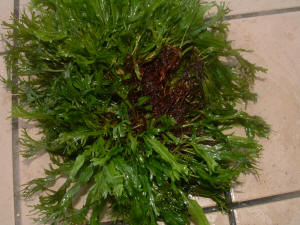
tank. I have attached pics. I'm not sure what type of plant
it is but you can see the pocket of roots in the center.
<It's a "Windelov" variety of the Java Fern.
Nice plant.>
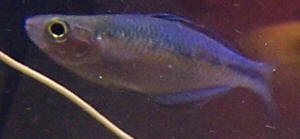
PS...I have some fish I believe to be Rainbow fish and was
wondering if you could confirm this. Again, I have attached
pics.
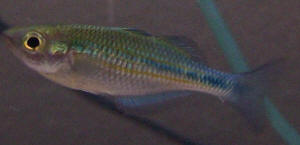
<You do, the red fish are male Glossolepis incisus, and the
silvery fish with colourful horizontal bands are Melanotaenia
fluviatilis or some other Australian Rainbowfish species. You
also have some Hyphessobrycon tetras, which tend to be nippy,
especially the group of species we call Serpae Tetras. Among
other things, these fish could easily harass your Paradisefish,
and I'm surprised the Angel hasn't been nipped.>
Thanks again for all your help.
<Cheers, Neale.>
|
 [1]%20blur%20rain.JPG) |
Re: Paradise Gourami with Curved Tail
9/18/10
Wow! I knew you guys were AWESOME but now I know you are totally
AWESOME!.
<Yes we are.>
Dead on with the rainbow fish. I have a third one that is
opalescent/iridescent with a yellow tail that I forgot to attach
pics from (in the second and third pic he is the one at the top of
the tank, you can sort of see the yellow tail).
<Looks red in those photos, in which case Melanotaenia praecox
would be likely. But really, to identify fish we need sharp, in
focus photos that don't have so much flash you can't see
the colours. If you have to explain where the fish is, and use
words like "sort of see" it's a good clue the photo
isn't good enough. In the meantime, avail yourself of Fishbase,
and review the species in the genus Melanotaenia.>
I am relieved to here that you don't think that she got suck in
the fern as the reason why she passed. I will be looking to place
the fern into my main tank but will need to make room. It's
almost 8" in diameter as a large ball so it will need some
space. As for the tetras, I know of their nipping history, along
with black & white skirt tetras I have in the tank but have had
them successfully in there for several months now.
<For "now" being the operative word here. Both
Hyphessobrycon eques and Gymnocorymbus ternetzi are nippy
fish.>
They don't even chase anyone around and kind stay out of the
way of the Angles, so I figured I will take them out when they get
too mean. I have been keeping an eye on the rest of the fish that I
have in the tank since I have gold gouramis and blue dwarf gouramis
but I do not see this mysterious curved/arched tail symptom.
<Cheers, Neale.> |
Australian natives - Attention Neale,
and his BW book 5/1/08 Hi Neale, Not a question, more of a
conversation. You can tell me to stop bothering you if you want. I
don't often get the chance to talk Australian freshwater natives (I
use the term freshwater loosely), which are a bit of a favourite of
mine. I have read some of Bruce's work, although I can't say
I've read any of his stuff on Pseudomugil. Will have to try to get
hold of a copy of your book. Just to make sure, its title is
"Brackish-Water Fishes: An Aquarist's Guide to Identification,
Care & Husbandry" right? <Indeed so; should be available at
all good bookstores, or else via your library system. I have to admit
to enjoying Bruce's chapter enormously, as well as Richard
Mleczko's chapter on Mudskippers, another group of fish Aussies may
well be able to enjoy better than anyone else.> I've done a fair
bit of research on many Australian natives. Both personal and
professional. I did my masters thesis on Melanotaenia splendida
splendida. An often overlooked yet stunning rainbowfish if I do say so
myself. Some of the regional colour morphs I've collected far
outshine many of the more common rainbowfish sold in the trade. My
personal favourite has to be the ones from a little stream on the way
to Greenvale. Absolutely stunning. I still have some of those from my
research (they'd be pushing 8 years now). <I would tend to agree
with you on this species. It used to be quite commonly traded here in
the UK (along with M. maccullochi) as the "Australian
rainbow" but you hardly ever see these fish now. They always
seemed incredibly variable, and also very hardy and reliable. Seemed to
put with anything, even quite salty brackish water.> I do agree that
the P. signifer colour up fantastically in brackish water, they also
tend to live longer and grow bigger as well, but I've personally
found they breed much better in fresh (more eggs, with a significantly
increased fertilisation, hatching and survival rate). For several years
I changed their water type seasonally. Three months full brackish,
three months changing from brackish to fresh, three months full fresh,
and three months changing from fresh to brackish. I do have to admit
I've gotten rather lazy with that one of late and have had them in
full fresh for at least a year now. I do tend to try to breed any that
I wild collect so in some ways it's probably more practical to keep
them in freshwater from the breeding point of view. I've had quite
good luck breeding all the different specie of blue eye and found that
even most of the euryhaline specie breed best in freshwater. That's
one of the reasons I want to speak to more people about the P.
cyanodorsalis. My prior experience tells me they should do well in
fresh, but my gut tells me they may be more brackish then any of the
others I've kept. <Bruce says P. cyanodorsalis is "more
consistently found in brackish water".> I've had a few of
the gudgeons as well and have had limited success with them. The Empire
Gudgeon (Hypseleotris compressa) and Northern Purple Spotted Gudgeon
(Mogurnda mogurnda) are my newest projects. I've had luck with the
empire from the Rolling Stone area, and am working on my success with
the purple spotted. I am hoping to go out west and get some from the
interior in a year or so when I have their reproduction a bit more
stable. I've heard the ones from some of the inland areas are
beauties. <Oddly enough, Morgunda spp. and also Peacock Gobies are
quite common here, and some stores have Chlamydogobius eremius as well,
another superb little goby. Gudgeons (or Sleeper Gobies as we call
them) are fairly popular, thanks to their good colours and generally
hardy nature. Regular gobies always seem that bit more fussy about
their food.> Unfortunately a lot of the regional colour morphs are
being threatened. One of the reasons why I collect and breed according
to location. Up here the Gambusia is doing a real number on the blue
eyes and tilapia are threatening just about everything else. It's
always disappointing to me when I go to an area to collect fish and
discover an introduced species when I am there. I always try to remove
any introduced that I can catch, some are harder then others.
Unfortunately it seems every time I go out there are more introduced
fish and more different types then the year before. The number of Oscar
I've been finding of late has me a bit concerned. I also caught a
disturbing amount of other cichlid species which I hadn't
encountered before. I always take a deep breath and enjoy any place I
go that I don't encounter any introduced fish although those seem
to be getting fewer and farther between. The flooding we get during the
wet season is the real problem. It allows the introduced fish to get to
new water that they wouldn't be able to access otherwise. <This
is a problem everywhere. The UK govt. has recently gotten serious about
limiting the trade in species that could become established in UK
waters. Aquarists do have to deal with the fact that they, or at least
their trade, has been responsible for some terrible exotic species
introductions. So while I'm not wild about the idea of "white
lists" of species my government says we can keep, there's an
argument for making the hobby a lot more aware of their potential to do
harm. I can't think of any other hobby where for small amounts of
cash a person can buy wild fish from location X and feel free to
release them at location Y.> Anyway, I'll stop before this turns
into a novel. Cheers! Amanda <Cheers, Neale.>
| Rainbow Congos? 7/27/06 Dear Mr. Fenner,
Thank you for taking the time to read my e-mail. <Hotay> I
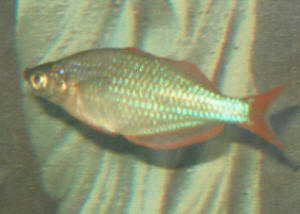
was sold five of these fish and told they were Congo tetras. Three
with red fins, which I take to be males, and two with yellow fins
(female). They behave in the way I have read about Congos behaving,
but their fins appear different. Are they Congo tetras? Or another
species in the family Alestiidae? I have enclosed a photo. Thank
you again for your help, Johan Kohler Cave Creek, AZ <Please
read here: http://wetwebmedia.com/FWSubWebIndex/rainbows.htm
Bob Fenner> |
|
|
|
Re: Rainbow Congos. (Dwarf) Neon Rainbows from
New Guinea. You are quite right. <Have been out,
collecting these...> Still glad to have the fish; they are
beautiful, peaceful, and reproducing! Thank you again, Johan
Kohler <Yay! Bob Fenner>
|
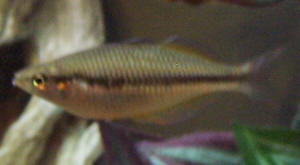
| Blue and yellow rainbow fish ID -- 07/23/07
Hi Crew, <Hi Branon. Marco here with you.> I've been
looking all over for a good ID on some rainbow fish I bought
recently and have pulled up zeros on WWM, Fishbase, and a few Bow
sites...though it was a case of "Which picture looks like
you?...". <It would be good to know where they came from.
That'd make an ID easier. Have a look at
http://www.fishbase.org/keys/keyslist.cfm?famcode=564 . The first
link will provide information on genera, the other ones on species.
These keys provide probably almost any ID information on this group
available (e.g. fin rays, head shape etc.). With the fish in front
of you and those keys you likely will be able to identify your
fishes. That's better than just comparing pictures.> They
were labeled 'blue-green rainbow' and 'Yellow
rainbow'. Please help me ID these guys. <My first guess for
the yellow ones is: colour morph/subspecies of Melanotaenia
splendida e.g.
http://www.fishbase.org/Photos/ThumbnailsSummary.php?ID=13102 . If
the black stripe is very prominent also have a look at
http://www.fishbase.org/summary/SpeciesSummary.php?id=11307 . If it
is bordered orange or reddish see
http://www.fishbase.org/summary/SpeciesSummary.php?id=25621 . The
blue one is possibly an colour morph/subspecies of M. splendida
e.g. Melanotaenia splendida inornata. Anyway, using the keys
probably will give you more reliable information.> Thanks,
Branon. <Hope that's sufficient. Cheers, Marco.> |
|
|
|
|
|
|

