|
FAQs on the Rainbowfishes Health/Disease 1 Related Articles: Rainbowfishes, Fishes at the rainbow's
end; An
introduction to the Atheriniformes, the Rainbowfish and
silversides by Neale Monks
Related FAQs:
Rainbow Disease
2, Rainbow Disease 3, Rainbow Disease 4,
Rainbowfishes 1, Rainbowfishes 2, & FAQs on: Rainbow Identification, Rainbow Behavior, Rainbow Compatibility, Rainbow Selection, Rainbow Systems, Rainbow Feeding, Rainbow Disease, Rainbow Reproduction,
|
 |
White Patches/Swelling on Australian Rainbowfish's
Eyes & Subsequent Blindness, BobF's go 8/21/10
Hi,
<Hello Heather>
I have an Australian Rainbowfish that I thought would've died a
long time ago because of the multiple health problems it has over the
past year.
<This fish, most of the families labeled as Rainbows are generally
quite hardy... given consideration of simple water quality needs,
decent nutrition, members of their own kind to school with>
I originally asked for your advice back on January 9th of the year
about open body sores this fish got after having gotten Popeye
twice.
<Something is amiss here>
The newest issue is this poor fish's
eyes. They are both swollen, covered with nasty white patches that are
really thick and lumpy. On one eye, the white of the eye looks brown
(like dried blood) in certain areas.
<... nutritional deficiency? Flukes?>
The fish is definitely blind. He runs into everything, he hasn't
eaten in probably 2+ weeks, so I'm not sure how he's even
alive.
<?!>
I've checked our water quality and our levels always come back on
par.
<... need actual values to help you... Can't discern what folks
mean by golf terms>
All of our other fish our completely healthy.
<What other species? This data can be very helpful...>
I don't know what to door for this poor guy. I feel like he's
going to die soon, but this seems to be the fish that is incapable of
death.
<Life strengthens life>
We have treated the whole tank (55 gallon) with a round of API
Pharmaceuticals'
"Fungus Cure" and then we tried API Pharmaceuticals'
"Triple Sulfa" and then we tried just leaving it alone. The
fish has gotten really bad and it looked like it had clear bubbles on
it, so tonight I moved it to a hospital tank with Tetra's
"Fungus Guard," thinking that the patches on the eyes are
fungus, and maybe the bubbles on the scales had to do with a fungus,
too. Although, the more I looked at the fish in the hospital tank, I
think he may have come down with a secondary Ick infestation.
<... yet the "other fishes" show nothing? Not
likely>
Needless to say, this fish is not doing well at all.
What should we do?
<Unfortunately, I urge you consider euthanizing this one specimen...
Something has gone terribly wrong here that is highly unlikely to be
solved>
I hate that this poor fish is suffering like this. I truly think this
fish may just be genetically predisposed to these health problems
because it's not the water or the tank.
Thanks for any advice.
Heather Richardson
<Please read here re: http://wetwebmedia.com/euthanasia.htm
Clove oil... painless.
Bob Fenner>
Boesemanni Rainbowfish finnage tipped/edged in Black is this
normal? 5/30/2010
I've spend a lot of time searching the web, can't seem to find
the answer to my question . I've had this fish for about 3 years
seems healthy in everyway. except the bottom dorsal fin is edged in
black instead of white.
the anal fin too. Is something wrong with him? I had not noticed this
before. I recently lost to rainbows they were elderly past there
life-span.
could this be stress because he lost he's buddies? Please help as I
would hate to lose this guy.
Thanks,
Karyn
<Hello Karyn. If what you're seeing are simply continuous black
fringes to the anal and dorsal fins, them yes, these are probably
normal. Melanotaenia boesemanni has a lifespan of more than 5 years, and
is generally a very hardy species, but like most Rainbowfish it
dislikes acidic conditions, so check the pH isn't below 7.0, and
that the water isn't too soft, around 10 degrees dH is about right.
Black marks can sometimes indicate ammonia burns or very rarely
protozoan infections, but I don't think that's the case here;
in those situations, the dark marks are irregular blotches on the fins
and skin. Cheers, Neale.>
Re: Boesemanni Rainbowfish finnage tipped/edged in Black is
this normal?
Hi Neale,
<Karyn>
Thank you soooo much for getting back to me I really appreciate it. I
can relax now!
<Cool.>
The water here in (east bay area, ca) is soft
<Not ideal for this species.>
The water has a high ph when it comes out of tap-fish stores have
tested my water and have said my ph is low-those readings have to be
wrong I contacted Kordon who's here in Hayward and he gets water
report weekly .said it is impossible to do a water change and have a
low ph using Hayward water.
<Do read here:
http://www.wetwebmedia.com/fwsubwebindex/fwh2oquality.htm
You might find it helpful to use the cheap, easy to make Rift Valley
salt mix [Epsom salt, baking soda and marine salt mix] at one-quarter
to one-half the recommended dose. This Rainbowfish species comes from a
Lake where the water is basic and moderately hard, and it's life
will be quite short in soft water. Aim for pH 7.5-8.5, 10 degrees
dH.>
I will support your wonderful site that I recently discovered. Thanks
again-Karyn
<Glad to help. Cheers, Neale.>
|
Melanotaenia Praecox - dwarf neon rainbow fish with
black dust on face. 3/8/10
Hello, I am looking for information on what this black/grey color
might be on my Melanotaenia Praecox. The "dust" has no
visible depth to it at all. Just a different coloration.
<This fish isn't diseased; it's damaged somehow. The
nerves that control colour seem to be damaged, and that's why
its got weird colours, like "stuck" pixels on an LCD
screen (fish "think" their colours, which are
controlled by special cells in the skin).>
We have 11 Melanotaenia Praecox. 6 males and 5 females. All
around 2-3 inches (5.1-7.6cm) in size. Got them in late December
and they looked great up until last week. The one in the picture
is the worst off, but all of them are less bright than they
should be. The males no longer flash their breeding stripe on
their foreheads much at all. They all still have an excellent
appetite. Tank is at 78-79F (25.5-26.1C), 7ph, no ammonia, no
nitrite, 10ppm nitrate. Floating plants and underwater ferns.
<All sounds fine.>
Several years ago we had another small school of these fish. They
got this "dust" on them one by one. A week or 2 later
they would start to bloat and get a white belly. A week or 2
after that they would die. As the worst off would die, the next
worst off would be beginning the bloating stage. We never did
figure out what to do to fix this.
<Quite why all these fish are acquiring the same problem
isn't obvious. Sometimes you see a single fish in a batch
like this, and that's easy enough to put down to bad luck or
bad genes. But if a whole bunch of them exhibit this symptom,
that's something else again. Possibly something poisonous?
Maybe copper in the water, or something in the air, like paint
fumes? It could also be viral, and that would explain why it
spreads. But really, I can't think of anything
obvious.>
I don't think it's columnaris or velvet. There's no
visible depth to the dust. Nor is it gold in any way.
<I agree, this isn't Velvet.>
Any suggestions you can provide would be greatly appreciated!
Matt
<I'm afraid I can't offer anything more concrete than
this. I've asked Bob to comment; perhaps he can say something
more sensible. Cheers, Neale.> <<This appears to be a
"classical case" of melanization related to nervous
damage or congenital lack of development. There is no
"treatment/cure". BobF>>
|
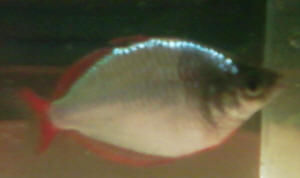 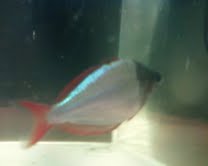 |
Re: Melanotaenia Praecox - dwarf neon rainbow fish with
black dust on face. (RMF?) 3/8/10
You mean like when they are washed out due to stress?
<Not quite.>
But this *is* an overlay on top of the fishes scales.
<Odd. Is it mucous like? Costia is a dangerous disease that
causes excessive mucous production, and that can make fish look
darker or lighter than normal. But usually that's the whole
fish, or at least patches across the fish, not something that
only affects a neatly divided front half the fish.>
If it progresses like it did 2 years ago, they will get darker
and darker until about half the fish is covered and then the
bloating starts.
<Oh.>
The water is 75 gallons of Reverse Osmosis. (The one gallon jugs
fit nicely in the microwave to push the temp up to an instant
78F.) We have 5 teaspoons of API brand Aquarium Salt (made from
evaporated sea water) in the 75 gallon tank. Not much, just
enough for a small buffer without bothering the plants too
much.
<Salt doesn't buffer the water. This may well be one thing
you're doing wrong. RO water plus a few teaspoons of sodium
chloride does not make anything remotely comparable to
freshwater. All it makes is very weak brine. Sodium chloride
doesn't raise carbonate hardness for thing, and we really
don't know the extent to which fish absorb essential minerals
from the water around them.>
2 years ago we treated the RO water with Electro Right and Kent
PH stable.
Currently we use a bag of crushed coral in each filter. (about 2
small fistfuls in each mesh bag.)
<OK, this is certainly better than adding salt, but still.
I'd much sooner you'd use a proper freshwater salt mix.
In fact there's little/no reason to use just RO water in most
freshwater tanks. Mixing RO water with hard tap water is much
better, a 50/50 mix often being ideal. In any case, if you must
use RO water, then African Rift Valley salt mix, perhaps at
25-50% the usual dose, should provide the right carbonate and
general hardness, while automatically fixing the pH in the
slightly basic range that Rainbowfish prefer.>
No known paint vapors, copper salts, etc. Short of a bad batch of
gravel or drift wood, there are no known toxins to account for
this.
<Except, perhaps, the odd water chemistry.>
Also the tank, decorations and gravel with this tank are
different from the tank the last batch was in 2 years ago. All
other symptoms are, so far, identical.
<Indeed. It does sound as if *you* are doing *something* that
causes successive batches of Rainbowfish to develop these
symptoms. My guess would be the water chemistry, but I'm
asking Bob to chime in here. On the whole Rainbowfish do best in
water with moderate general hardness, low to moderate carbonate
hardness, and neutral to slightly basic pH; aim for 10 degrees
dH, 3-5 degrees KH, and pH 7.5, and you won't go far wrong
with most of them.>
If there is someone you might recommend me to, I would be glad to
give up the school of fish to some University, etc. For
dissection or whatever. We never figured it out last time, and so
far it looks like it will progress the way it did 2 years ago.
That was the last time we tried a batch of these fish. All 11
fish are still alive right now. I should have about 2 to 3 months
before the final fish dies.
<Yikes!>
Thanks for any assistance you can provide!
Matt
<Hope this helps. Cheers, Neale.>
More re: Melanotaenia Praecox - dwarf neon rainbow
fish with black dust on face. (RMF?) 3/9/10
<<This appears to be a "classical case" of
melanization related to nervous damage or congenital lack of
development. There is no "treatment/cure".
BobF>>
<Maybe so, Bob, but the fact this has happened to two batches
of fish, several years apart, suggests to me that there's
something else going on here, whether dietary deficiency, water
quality issues, toxins in the air/water, etc. Cheers,
Neale.>
>Mmm, possibly yes. Though could be summat genetically
defective in both batches... had not seen the second posting
before responding to the first. B<
<<It is quite the mystery, Bob. Thanks for commenting,
Neale.>>
<Welcome. I have some strong/er sense of premonition that we
are to learn more re this... some time soon. Cheers, B>
|
|
Open Body Sores/Striped Raphael Catfish culprit?
Rainbowfish hlth./env. 1/10/10
Hello,
<Hi there>
We have a 55 gallon tank with: 2 turquoise Rainbowfish, 2 zebra
Danios, 2 emerald Cory cats, 2 praecox Rainbowfish, 1 Australian
Rainbowfish, 1 Plecostomus, and 1 striped Raphael catfish.
<Mmm, the Rainbows are social species... should be kept in
groups>
Recently we've had a problem with our Rainbowfish having open
body sores and subsequently getting Popeye twice.
<Water quality? Measures?>
This has gone on for probably 4 months now and we've done
treatments with: Lifeguard, Melafix, Tetracycline, and EM
Erythromycin.
<Mmmm. Please read here:
http://wetwebmedia.com/FWSubWebIndex/atheriniforms.htm
and the linked files above>
Our last attempt at treatment was done by setting up a hospital
tank and dosing only this fish with the Erythromycin. After
several courses of treatment we had quite a bit of improvement,
but the sores were still present. We placed the Australian back
in the 55 gallon tank with the others about 6 weeks ago.
Now the sores are looking worse and the Popeye is back again. I
also noticed that one of the praecox rainbows has a huge gash in
it's side. I checked the water levels and they're all
fine.
<Please send values, not subjective evaluations>
Four days ago I started dosing the entire 55 gallon with
Melafix,
<Worse than worthless... see WWM re>
at the recommendation of pet store, because it is inexpensive
<Bingo>
and supposed to treat the problems we are experiencing,
<... it will not. In fact, it forestalls folks seeking, using
real cures;
sometimes disrupts nitrogen et al. cycling... is worse than a
placebo>
but it doesn't seem to be doing much. Today I noticed that
the praecox seems to be struggling and staying at the surface of
the water, so I put both it and the Australian in the 10 gallon
hospital tank, added aquarium salt, and started treatment with
the Erythromycin and aeration with an air stone. Do you have any
suggestions on what else I can do?
<Yes... water changes, the use of carbon et al. chemical
filtration, the adjustment of water quality, determination of
root cause/s here... There is something amiss with the
environment... NO treatment/medicine is going to solve
this>
I'm also wondering if you have any opinion on whether the
Raphael cat may have caused the injuries to these fish with his
hard and spiny exterior?
<It has not... Lives on the bottom...>
Thanks,
Heather Richardson
<Please send along water test data, history and make-up of
this set-up, images of all including the livestock if you can.
Bob Fenner>
Pictures Re: Open Body Sores/Striped Raphael Catfish
culprit? 1/10/10
Attached
<Mmm, no. Unfortunately no pix attached. Please try again.
BobF>
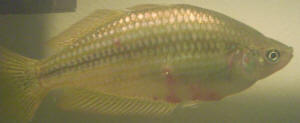
please find pictures of the Australian Rainbowfish that has
Popeye and body sores as well as a picture of the praecox
Rainbowfish that has the gash on its side. Please also note that
where I said, "Recently we've had a problem with our
Rainbowfish having open body sores and subsequently getting
Popeye," I was referring to only the 1 Australian
Rainbowfish that I've attached the pictures of.
Thanks,
Heather Richardson
Re: Open Body Sores/Striped Raphael Catfish culprit?
1/10/10
The pictures should be attached this time. Also attached are
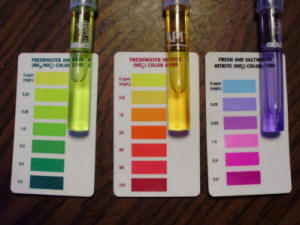
photos of the water chemistry as of this morning in the 55 gallon
tank (which I replaced the carbon in yesterday after transferring
the sick fish into the hospital tank). It seems the levels are
off now.
<They are... do you agree that there is detectable ammonia and
nitrite here? Toxic!>
The temperature hangs around 76.6F.
It was unclear as to whether you wanted pictures of the healthy
fish, <Mmm, no>
so none are attached (I did try to take pictures of them, but
they're too fast to catch.)
<The Praecox is Ich infested... the others...>
It may be of worth to mention that the reason we don't have
several of each social fish is because we've had some
problems in the past with a malfunctioning heater.
<?! Replace this>
Over the past couple of years, our heater has malfunctioned three
times causing our tank temperature to soar to 90+ degrees,
<...>
which has killed off probably 10-15 of our fish. The last time
this happened was during the time that the Australian was
treating in the hospital tank, so I don't think it's
related to the condition.
As far as the praecox with the gash in the side, it died
overnight.
Should I continue to treat the Australian in the hospital tank
with erythromycin until I figure out what is wrong in the 55
gallon tank?
Thanks,
Heather Richardson
<First and foremost, the water quality... whatever is
subtending nitrification needs to be FIXED. Pronto... See WWM
re:
http://wetwebmedia.com/FWSubWebIndex/fwmaintindex.htm
the third tray down. The issue here is a priori environmental.
Pouring in more med.s is counterproductive. BobF>
|
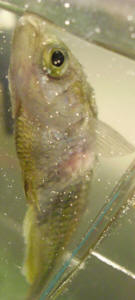 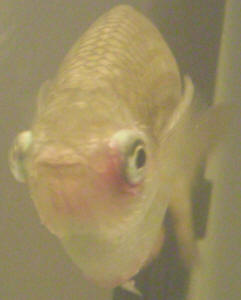
  |
Re: Open Body Sores/Striped Raphael
Catfish culprit? 1/11/10
Thanks for link as far as where to look for information, however,
there are a lot of links and stories and I'm not sure what
exactly it is that I'm looking for instruction on.
<Hello Heather. Platydoras-type catfish are generally extremely
hardy, and the last fish to show signs of stress. So if your
specimen is currently sick -- and I better make the point here
they're social animals that don't thrive kept singly --
it's a good idea to review the reasons why. As Bob mentioned, a
broken heater serves no purpose. When shopping for a new one,
choose one that either has a clip-on heater guard, or else pick up
a heater guard that can be fixed over whatever heater you buy.
These catfish are notorious for burning themselves as they nestle
against the heater. They like to hide, and switched off, a heater
is mistaken for a plant root or something. By the time they feel
the heat when the thing switches on, their skin is burned. Catfish
don't have scales -- their armour is actually just thickened
skin -- so unlike most other fish that can slough off damaged
scales easily, catfish can be severely harmed by otherwise
superficial burns and cuts. Optimal water conditions should ensure
spontaneous healing of such wounds, but any trace of ammonia or
nitrite, as well as excessive heat or cold, will stress the fish
sufficiently to allow secondary infections. In any event, if
you're getting a variety of sick/dead fish, it's a very
good sign the aquarium environment is poor. Review tank size,
filtration, diet, etc. and act accordingly. To recap, a community
of talking catfish and Rainbowfish would need to be upwards of 180
litres in size and equipped with a robust filter rated at not less
than 4 times the capacity of the tank in turnover per hour (e.g., a
200 litre tank would need a 4 x 200 = 800 litre/hour filter). Water
chemistry should be neutral (pH 6.5-7.5) and the water slightly
soft to moderately hard (8-15 degrees dH). Avoid extremely soft or
extremely hard water, and don't add salt.
Ammonia and nitrite should both be at zero levels all the time; if
they're not, then the filter is immature, the filter not
properly maintained, the fish overfed, or the tank overstocked.
Cheers, Neale.>
Re: Open Body Sores/Striped Raphael Catfish culprit?
1/11/10
Thanks for the information, Neale. Fortunately, our Raphael catfish
is not the one with the sores.
<Oh.>
It is the Australian rainbow that is having the problems with the
wounds that won't heal and the recurring Popeye.
<Almost certainly a water quality issue, perhaps aggravated by
collisions with solid objects, fighting amongst themselves, or a
vitamin-poor diet.
Check the Rainbows aren't throwing themselves into the glass
because of sudden noises, lights coming on in the dark,
etc.>
To recap my previous discussions, we have a 55 gallon tank with: 2
turquoise Rainbowfish, 2 zebra Danios, 2 emerald Cory cats, 2
praecox Rainbowfish, 1 Australian Rainbowfish, 1 Plecostomus, and 1
striped Raphael catfish.
<I see. I will make the observation an adult Plec, anything
upwards of 20 cm, and up to 45 cm when fully grown, can overwhelm
an aquarium this size, preventing good water quality. There is no
obvious reason to keep a Plec in a tank this size, and you'd be
much better with an Ancistrus Bristlenose.>
We use an Emperor 400 BioWheel filter (400 gallons per hour) in
conjunction with a submersible bio filter. We should be getting a
pretty good flow with these.
<In theory, yes. But even the best filter clogs up with time,
and some designs waste precious filter media space on stuff like
carbon and Zeolite you don't need.>
I'm not sure if you saw the photos of the sick fish or the
water chemistry, so I have attached copies for your review.
<OK.>
As you see, our levels were a little high.
<I'll say! First check your tap water doesn't contain
ammonia or nitrite. It shouldn't, but some supplies do. Water
conditioners are available that neutralize (not remove) the ammonia
that comes with tap water (no good for fixing ammonia produced by
fish, though). If your water contains nitrite, that's a bigger
deal, and you really should call your water supplier.>
In an attempt to solve this problem, I did some gravel vacuuming
today and a huge water change.
<Gravel cleaning doesn't dramatically change much of
anything, though it makes the fishkeeper feel a bit better I
suppose. There really shouldn't be much organic matter in the
gravel assuming the tank is properly filtered and you stir the
gravel a bit each time you do a water change.>
The levels are still the same, though. I'm wondering if the
fact that our tap water tests high for ammonia has anything to do
with it?
<Yes, can do. Obviously a filter neutralizes ammonia at a fixed
rate, and is designed to remove the ammonia produced by the fish.
If you also have ammonia in the water, and this isn't
neutralized first, then filter could be overwhelmed. The WHO
recommend water for drinking contain less than 0.2 mg/l, and higher
levels are often taken to imply a mix of dirty water (i.e., sewage
or agricultural run-off) with potable water. If you're getting
above 0.2 mg/l, pick up the phone and call your water supplier.
Such levels are potential health hazards to you and your family,
let alone your fish.>
I've read online that although the results say it's ammonia
(on the tap results), it may just be Chloramine that shows on the
test as ammonia.
<Yes, this can happen. The interaction between Chloramine,
dechlorinators, ammonia removers, and ammonia test kits is complex.
See for example these explanations by manufacturers:
http://www.rena.net/reference-center/articles/Article.aspx?ArticleID=7
http://www.novalek.com/kordon/articles/about_water_conditioners.htm#anchor549256
The bottom line is that using one or more products to condition
your water (for Chloramine and ammonia) may be necessary, and at
least initially, try doing small (10-20% water changes more
frequently to avoid flooding the tank with extra ammonia. As an
experiment, try skipping a water change one weekend, and see what
happens. If you find ammonia and nitrite drop to zero after a
couple of days and stay there for the next ten days, then the
problem is the TAP WATER. If the ammonia and nitrite levels do not
drop to zero, then the problem (in part at least) is THE AQUARIUM.
Why? Because even a crummy filter should process the ammonia in
your tap water. Once it's gone, it's gone. So if levels
don't drop to zero, that means there's some other source of
ammonia that keeps topping up the levels in the water.
This is, of course, the fish (either directly, or via the food you
give them).>
Regardless, I don't think either are probably things I want in
our tank.
We use AmQuel Plus when doing water changes. Any suggestions on
what to do next?
Thanks,
Heather
<Cheers, Neale.> |
Australian rainbow fish, hlth., env. 12/19/09
I am writing concerning one of my rainbows. I have 55 gal. freshwater
aquarium with 15 fish 6 of which are rainbows.
<All one species, I hope. Australian Rainbowfish are not only
schooling fish, but also prone to bullying one another if insufficient
numbers. Keep at least six of each species, and don't mix species
of radically different sizes. Make sure there are equal numbers of
females and males (or better yet, more females than males).>
My perimeters are Ph-7.0-7.2, Ammon.-0, No2-0 and No3-10, with weekly
water changes.
<Fine. But what about water hardness? Rainbowfish on the whole come
from either soft water habitats or hard water habitats depending on the
species.
A good all-around option would be medium hard water (~10 degrees dH)
and neutral to slightly basic pH (7 to 7.5).>
Two days ago I noticed one the rainbows swimming almost vertical with
head down and tail up. He is also using his whole body in a wiggly
motion as he swims. There are no spots or marks on him and he is eating
fine. At times
he looks like he doesn't know where he is swimming to because he
almost bumps into other fish.
<Doesn't sound good. Review water chemistry and water quality.
Check for potential sources of poisons: insect sprays, paint fumes,
children doing stupid stuff like putting soda pop into the aquarium
(happens). Make sure
the food you are offering is adequate. Flake, pellet and freeze-dried
foods are fine up to a point, but they tend to cause constipation if
used on their own, and in some cases this can lead to swimming problems
(I guess the extra weight inside them messes up their buoyancy). A mix
of quality flake with wet-frozen bloodworms and mosquito larvae, plus
live brine shrimp and daphnia would be a good balanced diet. Live brine
shrimp and daphnia are laxatives, so highly recommended for all small
fish now and again.>
Is this cause for concern-something internal---parasite-etc.
<Most likely caused by the environment (i.e., the aquarium) rather
than a mystery parasite; while there are Whirling Disease parasites,
they have complex life cycles that can't be completed in aquaria,
so usually affect only pond fish. Live Tubifex can introduce them
though, but I don't think anyone uses live Tubifex anymore.>
Need for quarantine?
<Would likely kill a schooling fish like a Rainbowfish. Much better
to identify the possible source of problems, and fix the aquarium. Even
though you have zero ammonia and nitrite, be open minded about this
aspect, and think about whether there could be other problems like
unstable pH or inadequate oxygen distribution throughout the tank that
could be to blame.>
I would appreciate any info you can give me.
Thank you for your time,
<Cheers, Neale.>
Are my rainbows too far gone? 06/29/09
Hi folks,
<Hello,>
I have a 29G long tank. I have two questions but let me give you some
background. First, unfortunately, in spite of my best intentions, my
two Parkinson rainbows suffered through a week of toxic levels of
ammonia and, obviously, the ensuing week of toxic levels of nitrites.
The water has been good for about 10 days now. No chemical additives
for 3 ½ weeks now. Ammonia 0, Nitrites 0, Nitrates 30. I
have very hard water. GH is steady at 180, KH 120, PH was holding at
7.5, but today has dropped to 6.5 for no explainable reason.
<To be honest, this isn't anything daily water changes
couldn't handle. If all else fails, replacing 25% of the water each
day through a crisis works well. This isn't so much water chemistry
is drastically altered, but should be enough to take the edge off
whatever problems you're experiencing. In the case of Rainbows and
Gouramis, these are broadly hardy fish that should get through
occasional problems, though I admit Dwarf Gouramis these days are
pretty dire in terms of quality.>
When the ammonia spiked I removed what fish I could to my 10G but just
could not squeeze these two or my Dwarf Gourami in. I placed the
Parkinson's and a Dwarf Gourami in a 5G bucket with an aerator but
no heater. It was a bad situation. After about 5 days the rainbows got
Ich (no surprise there), the ammonia was still spiked at 6.0 or above
regardless of the twice daily partial water changes and so I took a
sample to my LFS (not one of those commercial pet stores but a true
fish store with knowledgeable people).
<Jeez! Ammonia at 6.0 would kill most anything, and I have a hard
time believing this is accurate. What's going on in your tank? Do
you have a moose rotting in there somewhere? Seriously, assuming
you're just adding flake food and stocking sensibly, there's no
reason at all ammonia should get that high.>
My tank had been up for over 2 months at this point but he came to the
conclusion I had over cleaned my tank and stopped the cycling process
at some point and now the tank needed to recycle. On his recommendation
I removed half of the gravel (apparently an inch and a half is too
much),
<Unless an undergravel, you can replace 100% of the gravel and
it'd make zero difference to water quality. Virtually all nitrogen
cycle management goes on in the filter, and almost none in plain gravel
or in the water column.>
did another 50% water change, reacclimated the rainbows and Gourami
into the tank and �rode it out�.
Since the Ich needs heat to be treated he said to treat if there were
still Ich spots 24 hours after they were back in the tank.
<Hmm...>
The one Parkinson did show spots when I first put him back into the
tank, but by next morning there were no spots on him or the other two
fish. I did not treat for Ich. Since then the Gourami seems to be fine,
but the Rainbows started showing signs of red under the side fins
behind the gills after about a week. Now about 3 weeks later the one
Parkinson in particular is still showing streaking and signs of
bleeding, more obvious at some moments, then seeming almost healed at
others. The other Parkinson looks healed most of the time but at
moments appears very red in the same place as the other.
<I see.>
He seems OK. It's the other one showing signs of distress. He has
become aggressive and chases everyone into the corners, he swims
constantly in the current from the filter (suffocating), and the
moments he �s not doing either of these he actually
seems to be trying to mate with my male Dwarf Gourami.
<Actually, more likely either schooling behaviour or aggression...
have seen this betwixt Rainbows and Mollies.>
Is this ammonia poisoning?
<Usually signs of this are heavy breathing, gasping at the surface,
skittish/nervousness, lack of appetite, subdued/dark colours, and
eventually sickness or death.>
Is there any hope he will recover or am I extending his misery?
<If he's swimming about, albeit in a peculiar way, I'd think
he's basically fine.>
Is there anything I can do to help him? Still no signs of Ich, but
disease is sure to follow and I'm afraid to treat my tank for fear
of killing off the bacteria that is finally functioning.
<I'd honestly focus on water quality, and let the fish take
their chances. Pull out anything that's obviously dying or dead,
but otherwise observe rather than act.>
The other fish have also been moved back into the tank a couple at a
time over the past 10 days. So I now have 1 Dwarf Gourami, 2 Parkinson
Rainbows, 1 Boesemanni Rainbow, 3 Congo Tetras, and a pair of Mickey
Mollies. At adult size this comes out to 28 inches max.
Am I overstocked considering the types of fish I have and the type/size
tank?
<Proof is in the pudding. If you have a real hard time keeping zero
ammonia and nitrite, and the filter is a generous size, then perhaps
you are overstocked. Certainly Congo Tetras and non-dwarf Rainbows
aren't good choices for 29 US gallons. In terms of filtration, aim
for at least 4 times the volume of the tank in turnover per hour, and
quite possible 6 times; i.e., a filter rated at 4 x 29 = 116
gallons/hour would be my idea of the minimum filtration rate for your
tank. That often comes out as the "next size up" with regard
to what manufacturers recommended; if you see a filter recommended for
a 30 gallon tank, it's best to buy the next model up in the
range.>
I really appreciate your help. I have searched everywhere and can't
find an answer to whether or not he can recover from this stage of
poisoning. I will be purchasing a 5G hospital tank setup and heater as
soon as I can in the next couple of weeks but really have no resources
for that right now.
<Waste of money anyway. A hospital tank by definition needs to be
BETTER than the tank your sick fish lives in; that's virtually
impossible to guarantee with a mere 5 gallons. Save your money.>
Thank you.
D
<Cheers, Neale.>
Addition to Are my rainbows too far gone?
06/29/09
Hi again,
Sorry to bug you but I left out some important info regarding my
Parkinson's. Appetites are fine, ravenous actually, and fins are
open and often flared. Color remains good except for the red which also
runs along the belly line. The one that I'm particularly concerned
about also has a dark spot behind the fin. It's been there since
shortly after he started showing signs of bleeding.
<Not sure the two things are connected.>
I have a mix of plastic and live plants all around the edge of the
tank; live sword plant, Aponogeton, java moss, a mixed bunch of leafy
plants, a little curly grass thing, and a bunch of water sprite
floating on top. One tree trunk decoration and a white lace rock.
I'd like to remove these and put in a nice leggy piece of
driftwood. Will the driftwood change my water?
(other than the tannin which should filter out, right?) I have a
10,000K deep ocean bulb.
<Driftwood and bogwood will lower the pH over time, though how
quickly depends on the carbonate hardness of your water. If you have a
reasonable amount of carbonate hardness, say, 4-5 degrees KH, then
water changes will offset any acidification caused by the bogwood, and
the pH changes between water changes will be minimal. Still, even if
the pH doesn't change, the water will be stained
yellowy-brown.>
That's all. Thanks again.
D
|
Rainbowfish: Health\Disease 3/30/2009
Hello there,
<Hi Andrew>
I've been keeping fish on and off for many years. I currently
have a 75Gal mixed reef and a 43Gal FW rainbow setup.
<Nice, I have a 75 Gal Rainbow setup myself.>
The marine tank, while it has had its ups and downs, is doing
great at the moment, and until today, the rainbow tank has been
doing very well too. The rainbow tank is 2 1/2 months old now,
and was cycled using "Cycle" and some Platys (10 little
ones to be exact). Once cycled 4 juvenile Boesemanni Rainbows were
added ( they were about 1 1/2" when I got them). The tank
ran beautifully, without any problems until I found a fish shop
that stocked Dwarf Neon Rainbows (which is incidentally what this
tank was set up for, but were nowhere to be found!).
<Not exactly easy to find here either.>
I traded back the Boesemanni Rainbows and Platys, and bought 2
Checkered Rainbows (Splendid I think) and a pair of Praecox
Rainbows. Yesterday I bought the remaining Dwarf rainbows (Taking
my total to 2 Checkered, and 10 Dwarf Rainbows). Having removed
all but two of the original fish (two small sucking cats
remained), I figured this was a fair load for the tank, and would
not likely upset the filter.
<Hmm.... depends on the filter really, What are the details on
the rest of your setup?>
The tank param.s are PH 7.0 (which I dropped to 6.8 this
evening), Ammonia = 0, Nitrite = 0, and Nitrate unmeasured. I do
a 50% water change weekly, as I read that Rainbows enjoy and
benefit from this. Water temp is at a steady 26.5C.
<Sounds very good, though I would keep the pH in the 7 range,
unless you were planning on breeding.>
Today I came home, and discovered that one of the male
dwarf's was swimming listlessly at the surface with a opaque
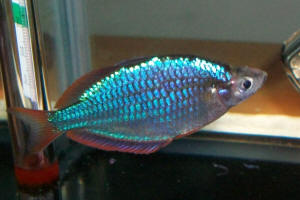
white "film" over the top of his head and eye's
(but not gasping). I've added a pic in the hope that it might
help (thought the quality is not great).
<I do see what you are talking about, but there isn't much
detail to be helpful I'm afraid.>
None of these fish were quarantined as they were all going into
the same tank together, but I have now setup a small spare tank
with some water from the main tank, a small heater, and an air
stone for the sick male. I expect he will not survive, as I have
seen this before, and the outcome was not good.
On my first attempt at keeping rainbows (in a different tank,
with different decor and plants), I experienced the same problem.
At the time Bob was kind enough to offer some advice, but could
not identify the fault as anything but "new tank
syndrome". On that Occasion, I lost all 8 Bow's over the
space of about a week.
<Hmm..... what is your source water and how does it test? Any
copper in your source water perhaps?>
The fact this this tank has been well cycled, and had Rainbows in
it up until the very same day (and doing very well) the new bows
went in confuses me somewhat. As I mentioned earlier, today I
lowered the tank PH from 7.0 to 6.8 as this is what the PH at the
store was, but I didn't think this was enough of a PH
difference to effect the fish so dramatically.
<Hmm, it can...especially if done rapidly. Generally a shift
of more than 0.1 per day can cause stress and health
issues.>
I'm hoping that you might be able to offer some help, as I
have invested quite a bit of money and time getting this tank
setup, and finally added the fish that I truly wanted, only to
find that something has gone wrong.
<A little more detail is needed here: What kind of filtration,
source water testing, etc. I would slowly raise the pH back up
into the 7.0 range as well.>
I have noticed that all the Dwarf Bow's seem to have a tiny
white patch on the very front of their top lip, as if the skin
has been worn down from rubbing up against something. I noticed
this in the first set of Boesemanni that I introduced to the
tank, but it soon cleared up.
<Probably injury from shipping and should clear up in
time.>
Once again, I hope you might be able to help, as I really
don't want to see these beautiful little guy's suffer the
same fate as my first rainbow attempt some months ago.
<lease get back with the questions I've answered. In the
mean time, have you ready here:
http://www.wetwebmedia.com/fwsubwebindex/rainbows.htm >
Thanks for your time.
<My Pleasure>
Andrew
<Mike>
|
 |
|
Re: Rainbowfish: Health\Disease
3/30/2009 ATTN NealeM, Any other input? 3/31/09
Mike,
<Hi Andrew. I'm combining the two emails together, and
asking Neale for his opinion.>
Just an additional update. After replying to your first email, I
have now noticed another Male with the same symptoms as the
first. Not as bad at this stage but I fear he will not survive
the day.
<Hmm... Something amiss>
Thank you so much for your quick reply. The one Rainbow in
question died last night, only hours after I got home. SO sad, I
feel for the poor little guy. As far the additional info, I shall
add it in point form below:-
*Source water is dechlorinated tap water, PH is about 8.0
(reduced to 7.0 using PH down).
<In the 7 range is fine.>
*Filtration is Provided by overhead wet/dry trickle filter
<Sounds fine>
*Copper Level untested - is this likely to be a big problem? If
so I will need to get myself a test kit.
<Hmm... No, see below.>
I like to think I know a bit about fish keeping, but will also be
the first to admit when I need help, and this is one of those
occasions!
Thanks again Mike, your assistance is greatly appreciated.
<I am not a big fan of applying medication without cause, but
in this case, something is clearly amiss. From the symptoms it
almost sounds like Costia or Chilodonella. Please isolate these
fish and treat with Formalin and\or
Malachite Green.>
Further Reading here:
http://www.wetwebmedia.com/FWSubWebindex/fwfshparasites.htm
>
Andrew
<Best of Luck>
<Mike>
Re: Praecox Rainbow Problem 3/31/09
Hello Neale.
Would you mind having a look? It sounds like Costia or a similar
protozoan. There should still be a picture in the emails with
images folder.
Thank you
MikeV
<Hello Mike. I'm not sure how to diagnose Costia
positively, though it is probably one of the more common causes
of "slime disease". I've only had to deal with an
outbreak of "slime disease" once, on a pair of
Carinotetraodon irrubesco puffers. My approach was this. Firstly,
I dipped each fish in seawater. Puffers are very tolerant of
seawater, even the freshwater species, but I'd fully expect
Rainbows (being secondary freshwater fish) to tolerate seawater
quite well. Certainly, the usual rule of dipping freshwater fish
for 2-20 minutes, removing them as soon as the fish shows signs
of distress (e.g., rolling over) would be applicable. This dip
cleaned up the white slime overnight. I then treated the water
with eSHa 2000, an anti-fungal/bacterial to deal with secondary
infections. Between the two, this seemed to work very well, and
after the second dip a week later, both fish were cured. Costia
itself is vulnerable to formalin medications and apparently is
killed by temperatures over 30 C, so either of these might be
options. The problem with the high temperature approach is that
Costia can enter a dormant cyst stage, coming back to life when
conditions suit it. So not necessarily a perfect solution. Hope
this helps, Neale.>
Re: Rainbowfish: Health\Disease 4/1/2009 Update: Good
news
Thanks again for your speedy reply.
<Hi Andrew, no problem at all.>
During the day, and before I was able to read your email, I
popped into a fish shop while out and about on a service call and
discussed the issues I and my little friends were having with the
store manager. He came to the same conclusion that you have, and
narrowed it down to a likely fungal/bacterial infection, as per
the your hyperlink for suggested reading (thanks again, it was
most helpful).
<Excellent.>
The fish shop manager suggested triple Sulfa, as a good place to
start, so I purchased the product and administered it.
Going by your suggestion of Malachite Green or Formalin, I assume
you considered this to be a Columnaris Fungal infection, which
after reading more about its symptoms, looks to be exactly what
my rainbows were suffering from. I was also pleased because your
website along with the Malachite Green and Formalin, also
suggested Sulfa based meds. I imagine that the stress of shipping
added to the small worn patches on their top lips was enough to
allow the infection to take hold.
<Most likely.>
I am pleases to say that none of the other fish appear to exhibit
any symptoms any longer, although some of them did yesterday! I
can only assume that the Tri Sulfa is doing some good work.
,Very Good.>
It may also be worth noting, that a small patch of white
"fluff" (fungus) was growing on one of my pieces of
driftwood. This was never present in the past (in this tank
anyway) and has since disappeared. I do recall my first bad
experience with Rainbows yielded the same catastrophic outcome,
and at the time, the mysterious white fluff was also present in
that tank on a piece of driftwood.
<Hmm... interesting, Is this the same driftwood as before? I
wonder if it is the source...>
By this time I'm sure your wondering if I quarantined and
treated the fish...... well due to timing, and work commitments,
I was unable to set up a big enough QT for these guys so I
medicated the main tank. I understand that this will kill of some
if not most of the good bacteria in the filter, but at the time
it was a race against the clock to medicate these guys, and it
proved to be the only option while I continued the rest of my
work day (after dropping the Sulfa home to my wife). So frequent
testing, and water changes will be required here.
<Most definitely. Do make sure that you are not running any
carbon in the filtration as well, as it will remove the
medication before it can do its work.>
Your assistance is most appreciated, and I hope to never have to
seek your advice again.... at least for the fishes sake!
<hehehe, I understand.>
Having said that, it is wonderful to have such a learned group of
people offer assistance to others for no more than a "thank
you"... I just wish I could offer more.
<Keep reading, learning, sharing with others.>
Andrew
<Mike>
Re: Rainbowfish: Health\Disease 4/11/2009 Update: Good
news
Hi Mike,
<Hi Andrew>
Just wanted to let you know that everything seems to have cleared
up now (whatever it was!)
<Excellent News>
Going off the symptoms that were displayed (but no longer
present) by the remaining living fish, I'm leaning towards a
Cotton mouth, Columnaris outbreak. At any rate, I am now left
with 6 beautiful females, and two very happy males! Of course the
two checkered bow's are still in there as well as the two
algae eater sucking cats. In addition to the fishies which I knew
about, while doing a gravel vac and water change, I
was pleasantly surprised by 4 baby platies that must have been
born just prior to me returning their parents!
<Hehehe, not surprised.>
They are such cute little fellows, that I just may keep them.....
although I know that 4 platies won't stay 4 platies for
long!!
Thanks again for your support, and all the best for the
future.
<My pleasure, glad that everything worked out!.
Andrew.
<Mike>
|
|
Need to diagnose an illness... 11/04/2008
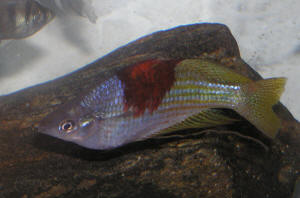
Hello! I have a fish with a puzzling "illness". I use
the quotations because I don't know what it is. I have
enclosed some pictures of the issue in hopes it will help. I will
try to give you as much information as I can. This is, I believe,
an Australian rainbow. I do not know the age of the fish as it
was given to me. But, it's about four inches. I'm
guessing it's fully grown. I got this fish from a friend.
This friend works for one of the large fish wholesalers in
Florida. This fish and what I believe is a female, were removed
from one of the large sumps at the farm. My friend brought the
fish home and gave to me about a week later. The fish already had
the, for lack of a better description, lesion. The fish was
rather thin when I got him but has since fattened up. He's
eating well. He is not displaying any signs of being sick, other
than the lesion. It's been there for at least six months, as
this is how long I've had the fish. It does not affect any
other fish. It does not appear to be contagious in any way. For
several months, the lesion has appeared to be contained. It did
not get any better or any worse. However, I have notice over the
last month or two that it has progressively gotten larger and
darker. It does seem to have some effect on the dorsal fin as
there is a place where you can see the spine of the fin with no
webbing. At first I did nothing because it kind of looked like
latex paint had been spilled on him. I didn't really think
this was the case but thought maybe just some TLC would make it
go away. This didn't happen. When it didn't get any
larger I thought maybe it was some sort of deformity. My friend
has a soft spot for special needs fish and thought maybe this was
just another one of those. But, with it getting larger I
don't believe that is the case. I would like to treat this if
at all possible. But, don't want to give medications that
would be ineffective. I've posted this question, including
pictures, on various fish forums, including here at WWM. No one
seems to be able to tell me what it is. I've gotten
everything from "your fish will die tomorrow",
"it's a flesh eating bacteria" to "it's
fish TB and all your fish will die". None of my other fish
are sick. And this fish does not display any "sick"
behavior. He doesn't flash, he doesn't hide, he eats well
and stays with all the other fish in the tank. Any ideas on what
this might be or how best to treat it? Details: 55 gallon tank,
HOB Whisper filter for 60 gallons & HOT Magnum 250 Marineland
filter Feed: Spectrum Thera A once a day no live foods Other
inhabitants: 6 long finned black skirts, 6 Serpaes, one (female)
Australian rainbow, 1 pearl Gourami, 1 chocolate albino Pleco, 1
common Pleco, one (small) red tail black shark, 3 green tiger
barbs, and 3 olive Nerite snails, Water changes are 20-30% every
two weeks. Some live plants but not many - Rotala, java fern,
Ozelot sword, water sprite. This tank was well established when
this fish was added. As I said, the fish had this issue when I
got him. If I can give any other details please let me know. All
other fish in this tank are healthy and have no problems at all.
Thanks in advance. Tina <Tina, in all honesty I have
absolutely no idea what this is. I have never seen anything like
it. You should certainly treat with a suitable antibiotic. You
might need to try both gram-positive and gram-negative
antibiotics (e.g., Maracyn followed by Maracyn 2). If one course
of treatment doesn't work, the other should. But that assumes
it's a bacterial infection, and I have no idea if that's
the case. It could be viral for all I know. This is really one of
those times where advice from a vet would be helpful. Possibly
Bob Fenner might have some thoughts, but he's away right now
and won't be back for a couple weeks. Sorry can't offer
much more help than that. Cheers, Neale.> <<Was this
fish treated with... iodine or an iodine-containing solution?
Looks to be a mechanical injury that became secondarily
infected... than dyed with...? RMF>>
|
 |
|
Re: Need to diagnose an illness... 11/5/08
Neale, Thank you for the quick reply. I will try the gram neg/pos
treatment and see what happens. If they don't work, then I
will try and email again when Mr. Fenner is back. Thanks so much
for all your help. One last question, am I right in thinking this
is an Australian rainbow of some sort? Tina <Hi Tina. The fish
is absolutely some New Guinean or Australian species of
Melanotaenia. The yellow fins with black edges remind me of
Melanotaenia parkinsoni, but there are quite a few species in the
genus. Most are very adaptable and easy to keep, and I'm not
aware of any rainbow-specific diseases that might be causing
this. You could get in touch with the people at ANGFA; these guys
collect, keep and study native Australasian fishes and might have
come across this disease before. Cheers, Neale.>
|
What would you do? Stocking 20 gal. 9/9/08
Hello Crew!
<Hello Audrey,>
I am in need of some guidance. We have recently upgraded our tank to a
20gal. We moved the plants and snails to the new tank. After a while,
we decided to get some Pseudomugil Furcatus. We brought home 6 of them.
All was well for the first 36 hours or so.
<Lovely little fish; hitherto very rare in the trade, but thankfully
starting to appear a little more often.>
After about 36 hours I found fuzz on one of the males - not Ick, one
big infection spot. The fish was still active and eating at that point
so I moved him to a treatment tank and treated with what I had around
(Furan - supposed to treat mouth fungus, cotton wool and infections so
I thought it would work). I found him dead the next day. I examined the
body and saw a big red zone, an injury under the fuzz, so I think he
died as a result of a mechanical injury, either in transit or at the
store (they're too small and fast to do a thorough exam at the
store).
<I'd be treating with a combination Finrot/Fungus medication
such as eSHa 2000 or Maracyn. This should handle the "big
three" -- Fungus, Finrot, and Mouth Fungus -- all of which are
possibilities here.>
The day I found the injured male dead, I also found a dead female in
the main tank, this one with no visible sign of illness or injury.
<Do check other issues: water chemistry, oxygen, temperature. It is
possible they simply travelled badly, but still, for the sake of your
peace of mind, check the tank.>
Now I am left with only four fish. I think they would be much happier
in a bigger group. I'm also worried because I have a trio and a
solo, and, although the lone female comes out for food, I have a
feeling she'd be more happy if the dominant fish had more fish to
chase away.
<Indeed.>
It has barely been a week and, while the other 4 fish seem happy,
I'm worried they'll die suddenly like my female.
<Always a concern when you're keeping an apparently delicate
species for the first time.>
Now, this is my dilemma. This LFS where we bought or fish is the best
close to us, they're the only serious, specialized fish store
around, but we haven't been happy with the fish we've bought
there so far. There is a pet store that has healthy-looking, vigorous
fish, but their selection is limited, and they don't have any
Furcatus. There is also a very new fish store a little further away who
insists heavily on the virtues of wild-caught fish - I'm weary of
them because the seller told me I was crazy to have a heater for my
Betta (another tank), and was rambling on some nonsense about UV
sterilization. I know this doesn't mean they have bad stock, but I
don't know if I can trust their husbandry. I also don't know if
they have Furcatus in stock.
<You pays your money and you takes your choice... In this case, I
think you need to focus on the matter at hand, grabbing a few more
female Blue Eyes. Get them from whichever store has them, or online if
you prefer.>
So, do I wait a few weeks before I get new fish until I'm certain
enough my current 4 are going to make it? But if I do that, should I
worry about my lone female?
<Depends on the price. If getting another batch only sets you back a
few dollars, then go for it. I'd be looking to see that my existing
stock are settled in and feeding. I'd like them to have nice
rounded bellies -- and just for once, I'd perhaps overfeed slightly
with live daphnia or whatever just to be sure. If this was all in the
positive, I'd order/buy some more Blue Eyes.>
If I do get more fish should I go back to our usual LFS and risk buying
another half-dozen, and hope those make it?
<Ask if he can get a batch in just for you, and you pick them up
when they arrive before they're unboxed. Otherwise, buy a decent
size group, factoring in a certain amount of attrition. Maybe get twice
as many females as males, just to be on the safe side.>
My other choice is mixing the Furcatus with long-fin rainbows (those
are easy to find) - would they even interact, given they're not the
same species?
<Not even the same family, so doubt they'd have any meaningful
interaction.>
What would you do?
As usual, I appreciate your guidance. I have options, I just don't
know where I should go from here...
Thank you,
Audrey
<Good luck, Neale.>
Re: What would you do? Stocking 20 gal. 9/10/08
Hello again,
<Ave,>
I'm including the previous correspondence below for reference.
Well, things didn't work out. I lost another male a day after I
wrote you, then yesterday night one of my remaining females pineconed
(I euthanized her when she started swirling). I have two Furcatus left.
I'm wondering if I should put my misfortunes down to bad stock or
bad husbandry.
<Maybe both...?>
My tank is 20 gal standard, with Fluorite substrate, plants (Bacopa,
Anubias, Amazon chain sword, Dwarf Hygrophila), two Coralife T5 bulbs.
pH is steady around 7.4-7.5. Temperature was a bit high, hovered around
80 but is now going down with the cooler weather coming in, is now
steady around 78 - this is with the heater set on low, if I remove it,
it goes down to 70-72.
<In summer I have to confess I tend to switch the heaters off;
leaving tanks to daily fluctuate slowly from 68-78 F is entirely in
keeping with the wild, and nothing most tropical fish can't handle.
Overheating, and the resulting loss of oxygen from the water, is more
critical.>
No detectable ammonia, nitrite or nitrate (the algae must use it all).
Filtered with two Aqua-Clear Minis (each rated up to 20 gallons), with
sponge. One with added ceramic media, the other with carbon (I know
what you think of carbon - I'll explain myself later). We were good
in the last few weeks and did weekly water changes, about 25% each
time. Not much vacuuming because the plants were new and there were
only three snails in the tank. We had a problem with BGA these last few
months, but with the new substrate, new plants and new lights it's
slowing down radically. We still remove it manually.
<Very good.>
The first thing we tried keeping was Mollies, but they all died of
Camallanus over the course of a few months. They were in brackish water
too. We now know the tank was too small anyway.
<Ah, yes, Mollies can be sensitive. Camallanus is not common among
the (Asian) fish I see in the UK; it seems to be more of a problem with
(perhaps) the Mollies bred in Florida?>
The Amano shrimp lasted a long while (several months), and we used to
have Cherries also. At some point, they started dying too. The only
thing I changed was that I stopped using carbon, so I put it back. No
luck. Our new batch of Cherries didn't make it past two weeks
either. The Apple snail seemed to fare better, he's been with us
for about 6 weeks and seems happy.
<OK.>
The Nerites, though, are with us since the beginning and growing at a
steady rate. The beginning was when we got our Betta, over a year and a
half ago. He's his usual increasingly-grumpy old self, in another
filtered, heated tank of his own.
<Interesting; Nerites are quite good "bellwethers" and
will climb out of the tank if oxygen drops or they get too warm. So if
they're happy, the tank can't be seriously hostile.>
Basically, even if we know that Bettas are resilient, I'd be
surprised we kept it this long (even neglected it at some point along
the way) if our husbandry or water was this bad. And snails are
sensitive to contaminants, or so I hear, but they seem to be doing
fine. But we seem to be serial shrimp and fish killers.
<Well, shrimps are sensitive to copper. Snails are to a varying
degree, but shrimps usually react immediately and fatally. But as you
say, this mix of fatalities and survivors is interesting.>
What is our problem? Did we start with bad stock?
<Always possible. Fish are often bred to a price rather than a
standard, and couple that with ropey husbandry in some stores, and the
track record of many species is poor. None of the fish you're
keeping is "delicate" by default, so poor stock is certainly
something I'd consider.>
Or are we doing something wrong?
<Difficult to say; if you're doing things by the numbers,
keeping on top of water quality and feeding issues especially, I
can't imagine you're doing anything fatally wrong.>
Can you point us in the right direction?
<The first thing would be to leave the tank as it is for a couple
weeks. Don't do water changes. Every 2-3 days, do nitrite and pH
tests. Keep a record. Ditto water temperature. Try and develop a
picture of how the aquarium is operating in terms of environment and
stability. By the end of two weeks you can return to your normal
maintenance schedule. Slight variation in pH over time is normal, but
if it's great (e.g., from 7.0 to 6.0) then you may have a problem
there. Carbonate hardness is often overlooked in this regard.>
What would be your absolutely easiest, sturdiest, non-plant-eating,
compatible with inverts, non-aggressive, easily available fish for a 20
gal tank?
<Many options. Depends what you're after. At the moment in my
10-gallon tanks with shrimps and snails I have peacock gobies,
Aspidoras pauciradiatus catfish, bumblebee gobies, and Limia
nigrofasciata. Wrestling halfbeaks are also good, being able to adapt
to a very wide range of water chemistry values.
http://homepage.mac.com/nmonks/Projects/freshwaterreef.html
Most of the smaller tetras should be good too, though they usually
prefer soft water. If you have hard water, then the smaller livebearers
are better choices. Endler's Guppies for example should be easy to obtain
and tend to be quite robust. Don't overlook "feeder
Guppies"; these are much hardier than fancy Guppies and have added
benefit of more natural colours.>
I doubt we'll have the heart to try Furcatus again any time
soon.
<Oh.>
We're at the point where we barely glance at the aquarium anymore
because we always expect to see some tragic event taking place. This is
supposed to be a fun hobby...
<It IS fun... but sometimes it seems otherwise. Once a tank is
stable and working, and provided you haven't added too many fish or
the wrong type of fish, they're pretty much autopilot things that
need little maintenance. Do be patient, and go slowly, leaving things
to settle for a while before rushing out to buy some more
livestock.>
Thank you for your guidance,
Audrey
<Good luck, Neale.>
DWARF NEON RAINBOWFISH GILL PROBLEMS 9/1/08 Hi
Crew, <Brian> I have a 125 gallon tropical tank containing 6
Dalmatian Mollies (2M 4F), 1 Swordtail (F), 1 Queen Arabesque Pleco
(F), 1 Betta (M), 12 Pentazona Barbs and 8 Dwarf Neon Rainbowfish (2M
6F). There used to be 12 Rainbowfish but 4 have died. The inside of
their gills looked red and swollen and they were gasping at the surface
away from the shoal before finally dying after a few days. <Mmmm>
All the other fish are fine. The mollies are characteristically
breeding like rabbits! Ammonia = 0, Nitrite = 0, and Nitrate = 25ish,
<A bit high... I'd keep this under 20 ppm> PH = 7.2 (It is
"London tap" water), Temp 27 degrees Celsius but this has
risen to 28.5 at times due to summer heat. I have an air curtain and
lots of surface agitation to ensure plenty of oxygenisation I change
30% water every 2 weeks. I originally worried that the problem may be
ammonia or nitrite related but it is not. I can't see it being gill
flukes either as they are not flashing and other fish are unaffected.
<Mmm, Flukes aren't always evidenced by such behavior> I know
these fish have big mouths but small throats so I crush their flake
food up into small pieces. I also feed them daphnia about once a week.
I have treated the whole tank with eSHa Exit and eSHa 2000 but still I
am losing fish one at a time. Almost as soon as one dies, another
becomes ill. Could this be hierarchy related with one fish at a time in
the group being bullied to death?? <Yes, could> I don't see
signs of this but am often away from the tank and could be missing
problems. I hate to helplessly sit by and watch these fish suffer. Any
advise you may have to prevent further casualties would be greatly
appreciated. Many thanks Brian <Is a mystery to me as well... this
system is large enough to largely discount death by bullying... and I
too don't think gas exchange is really an/the issue here either.
Perhaps there is an unknown internal parasite issue (Melanotaeniids
have shown these pandemics at times in the hobby over the years). At
any length, I would abandon the stocking/use of this species going
forward. Bob Fenner>
Advice, please! 05/23/08 Hey Bobster,
<Jorie> How are you? Are you still traveling about in Egypt? I
can't recall. Heck, I can't even keep my own schedule straight,
let alone yours:-0 <Now in Germany> I wanted to "pick your
brain" a little with regard to my newest fish drama. Long story
short, I've got a 44 gal. planted FW tank, well-established,
that's been home to 3 boesemanni rainbows for several years now. No
new additions, regular water changes, etc. Temp = 77 degrees F, pH =
7.5. Tank also houses 2 emerald Corys, 4 platies, 2 Botia striata and 1
SAE. All have been with me for quite some time now; newest addition was
2 platies about 4 months ago (they were QT'd for a month!) Since
the beginning, I've had issues with recurrent Lymphocystis on the
largest of my male boesemanni. As I understand it, this is a virus,
thus never truly goes away. At one point (this was several years back),
the problems were recurring on a more frequent basis, and I invested in
a UV sterilizer. That seemed to help. When we moved 2-ish years ago, I
didn't set up the sterilizer again, as the bulb was broken. I do
have a replacement for it, but never got around to setting it up again,
as the problems seemed to be virtually non-existent. In any case, I got
some new food for the boesemanni (3mm Spectrum New Life sinking
pellets), thinking they would appreciate something a bit more
substantial than their usual 1mm pellet meal. I think the boesemanni at
issue ate 2 of the larger pellets stuck together, and injured his
mouth. This was approx. 1 week ago. I noticed that he couldn't shut
his mouth. I stepped up the water changes, changed the filter media,
etc., to prevent any secondary infection. A few days later, the mouth
was able to close more, but the Lymphocystis nodules were back in full
force (the mouth area was always one of this fish's problem
areas...seemed to be very susceptible to the virus). I am starting to
worry, as it has been almost a week now. He's interested in food,
but seems to be unable to swallow. I haven't used the larger
pellets since this issue arose; the 1 mm pellets come right back out,
as does the flaked food. I'm afraid the virus could be obstructing
his throat, or that he really hurt himself with the large pellet. I can
see into his mouth/throat - there doesn't appear to be any visible
obstruction. What worries me is that the Bailey and Burgess book talks
about this issue, and says it is "very important" to bring
the affected fish to the vet for possible surgery. We don't have a
"fish vet" in our area...so that doesn't appear to be an
option. In fact, I've never encountered a vet that handles fish at
all... <There are a few> Unfortunately, I broke our QT tank while
cleaning it several months ago. I need to purchase a new one, which I
plan to do today. I've got 15 gal. of RO/DI water made up, thank
goodness for that. Aside from QTing this rainbow and keeping the water
as clean as possible, what can I do? As I understand it, antibiotics
will do nothing for Lymphocystis. Do you think there's benefit to
treating for secondary infection? Or perhaps MelaFix (I know Chris
thinks nothing of it, and I know you and I have talked about using it
in conjunction with good husbandry...maybe it works, but maybe it's
just the latter...) <I would NOT use the "fix">
Anything else I can/should try? Aquarium salt? In all my reading, it
seems as though now the biggest problem is the potential of the fish
starving to death. I did see him pooping today, so that's a good
sign; I will say it was a small string of feces, though...much smaller
than usual. Any advice you can give would be appreciated, as always!
Looking forward to seeing you soon! Best, Jorie <You could try a
bath (higher concentration) of a Furan compound... but I'd likely
leave the fish in and as is... focusing on improving and sustaining the
best water quality here. BobF> Jorie K. Johnson, J.D.
Rainbowfish update 5/26/08 Bob,
Neale: Just wanted to let you both know that the boesemanni in question
actually ate heartily last night; I fed the tank frozen, thawed
bloodworms. He had previously been spitting out flakes and pellets, but
happily consumed the worms. I am keeping water quality good (i.e., more
water changes than usual) and hoping for the best. His mouth still
doesn't look "normal", but hopefully in time it will.
Still need to set up the UV sterilizer. Thanks again, and hope you are
both well. Best, Jorie <Hi Jorie. Thanks for the update. Sounds as
if the fish is on the mend! Good luck, Neale.>
| Rainbow wounds
05/23/08 Hello, <Hi there> I am hoping you can help
and give me some suggestions in regards to one of my rainbows.
<Will do so if able> I first noticed this about three weeks
ago. It was just a small wound and did not look infected to me. I
suspected at the time it was due to trauma of some sort and so I
decided to leave it and keep an eye on him. In fact at the time it
looked like a wound a naughty loach might leave upon his victim.
<Agreed> A couple of days ago, I noticed the missing scales
above the larger wound. As you can see, his colour is actually
quite pale on the damaged side and much darker where there are no
wounds. This is my largest male. His behaviour is as it should be
and he is eating. If in fact the original wound was a nip or trauma
of some sort how come there are now more? Which leaves to me
suspect from my reading on your site that I may have a TB infected
rainbow or some other bacteria. <Hopefully not
Mycobacteria...> When this occurred originally the nitrates in
the tank were high, 40ppm. They were coming out of the tap that
way. <I would NOT drink this water...> They are now down to
10ppm both in the tank and tap. The nitrites and ammonia have
always been 0. I am wondering how you would suggest I proceed with
this fellow. Thanks in advance Aileen <If it were mine, just
good water quality and nutrition, time going by. Bob
Fenner> |
<nice pics! -Sara M.>
| Re: Rainbow wounds -- 6/17/08
Hello again, <Aileen> I was hoping you would take
another look at this fellow. Clearly there is more going on
here then a loach nip. But what? He continues to be the only
one showing any symptoms, however I have taken the precaution
of adding a uv sterilizer at the lowest flow rate. I know it
will not cure this guy but I was hoping to prevent any
spread. Any suggestions you have would be most appreciated.
Aileen <To me this "appears" to be some sort of
(thank goodness somewhat limited) secondary bacterial
involvement following mechanical damage (the loach?)... I say
the qualifiers to emphasize the fact that in general
Rainbowfishes literally "fall apart" if so damaged,
infected. If it were me, mine, I might try antibiotic-laced
foods (commercial or DIY, covered on WWM... see the search
tool), but again, I would NOT move this fish, nor be
"that" concerned re infecting other fish present.
The specimen appears well-fleshed, healthy otherwise. Bob
Fenner> |
|
|
|
Boesemanni Rainbows in trouble. New tank syndrome... -
3/21/08 Hi guys, <Andrew> I've learned much from your
website in the past, but so far have not been able to find any sort of
real answer to my question. I have been keeping marines and corals for
about three years now, with great success, but recently decided I'd
like to go back to my roots and set up a small FW tank. In addition to
my 75Gal deepwater reef setup (LPS and soft corals) I've had a
20Gal tank that was home to a nice BTA and clarkii clown, along with a
yellow coral goby and Gold headed sleeper goby (who put on heaps of
weight after purchase!). Anyway, the idea was to move what stock I
could to my main display, and traded the BTA and clarkii back for store
credit. I stripped and cleaned the tank THOROUGHLY and refilled it with
new filter media, and substrate, and of course FRESH water. I ran the
tank for three days and tested PH only and it was 7.2, with temp of
about 78 (which fluctuates cause of the ambient air temp here in Aus) I
got myself 6 neon tetras and popped them in, and they seemed to be
quite happy despite the fact that they like slightly acidic water
usually. <Mmmm... how was this new FW system cycled?> The whole
idea behind this tank was to raise some juvenile Boesemanni
Rainbow's and move them to a new home when big enough, so seeing
that the tetras were doing fine I bought 8 X 1 - 1 1/2" rainbows.
Now I know that this is a rather large load for a new filter, but was
able to use a little filter media from another healthy FW system to get
it started (this is starting to read like war and peace!). <Mmm,
no... this is far more exciting> After about three days of happy
swimming (and daily 15Gal water changes with dechlorinated tap water)
the fish began developing white opaque patches on their bodies, one at
first then the others day by day. It did not look like anything
I've seen before, almost like slightly cooked flesh! and though I
could not try it looked like it might rub of with your finger. I
continued with the daily water changes as per plan to alleviate filter
overload, but the fish continue to succumb to this white patch. after
about a day, each fish moves to the surface where it breathes rapidly
and dies almost hours later. Of course after seeing the first fish with
the gasping symptoms, I cranked the Air bubble up to max to help with
oxygen saturation in the water, but it had no effect, as I imagine
their gills were likely coated in the same "substance". I
also tried using Stress coat (with aloe vera) as I thought this might
help, though I've never used the product before. <Is a good
product... but not efficacious here... for what you have going on
won't work> Strangely enough the Neon tetras seem to be
unaffected, and none have any signs of disease. I have now lost 3
Rainbows in total, and expect to lose another over night. Now I know by
now you neck must be sore from all the shaking with contempt, but any
help would be much appreciated = ) Andrew <Is really very likely
"just" new-tank syndrome... the Rainbowfishes being more
sensitive than the Neons... I would either look for a real bacteria
culture product like BioSpira or Dr. Tim's equivalent... or move
the Melanotaeniids to a better-established setting. Bob Fenner>
| Boesemanni Rainbow Losing Scales? 1-22-08
Hello folks, Thanks for keeping up such a great resource. I have
searched throughout the site, but have had trouble finding any
scenarios similar to mine. I have 4 Melanotaenia boesemanni in a 10
gallon tank that had been doing pretty well for about a year and a
half now. There is a small Marineland BioWheel filter, and a 50
watt heater keeping the temp at 79-80 F. A few Anubias are
currently the only plants. They can definitely stand to be in a
bigger tank now, and as such, I have been getting a 55 gallon
prepped for them. Within the past few weeks, one of them has
developed a small patch by the base of one of its pectoral fins
where the scales seem to be flaking off. It started off small, but
has been gradually getting bigger and bigger. Please see the
attached pics. I have never noticed any of them to nip one another,
so I don't believe that is what has caused this. The behavior
of this boesemanni doesn't seem to be affected: appetite is
good, actively swimming and interacting with the others, etc. Color
seems to be good otherwise as well. In addition, one of the others
has developed a number of small red dots along its side, and what
looks to be a small red sore area. Attached is a pic of this as
well. I have been watching this one carefully, as I'm afraid it
might develop into a condition similar to the other? Or is it
something completely different?? Water quality is as follows: pH =
7.4, Ammonia and Nitrite = 0, Nitrates = 30-50. I have been doing
30% water changes plus gravel vacs every couple days for the past
week to try and get the nitrates down. I regretfully admit that
during the past 4-5 months tank maintenance had slipped. Water
changes were not done as frequently as they should have, probably
around 20% every 90 days. I'm sure nitrates skyrocketed during
this period, and I feel certain that the drop in water quality was
at least partly, if not completely responsible. Any ideas what
either of these skin conditions may be, and what the best course of
action is? I do not have a quarantine tank, but am scrambling to
put one together. On another fish keeper's advice, I have begun
adding very small amounts of Epsom salt to the tank (approximately
1/8 teaspoon Epsom salt per 5 gallons water). While I don't
believe it will hurt, I'm not positive it is addressing the
problem. Should I continue this, and/or change dosage? Thank you in
advance, NS <Greetings. The problem here is almost certainly a
bacterial infection of the sort we'd call Finrot if it was on
the fins. In any case, it'll be Aeromonas bacteria at the root
of the problem. So you need to use a suitable antibacterial or
antibiotic medication, such as eSHa 2000 or Maracyn. Use as
instructed on the package (taking care to remove the carbon from
the filter, if you use it). Adding a small amount of tonic salt to
the water (rather than Epsom salt) may help, but by itself salt is
an unreliable cure for Fungus and Finrot. There's no real need
to quarantine the fish, as Finrot isn't by itself
"contagious" since the bacteria that cause it are in the
tank already (and in all tanks, all the time). But something has
happened to weaken or damage this fish, as that's how Finrot
gets started. It's possible it jumped into something sharp:
I've seen very similar damage on Hatchetfish that have jumped
into the metal reflectors behind aquarium lights. You should also
check that there aren't any opportunistically predatory fish in
this aquarium. Chinese Algae Eaters (Gyrinocheilus aymonieri),
Otocinclus spp., and Pufferfish can all cause this sort of damage.
So look at your stock and see if anything might be to blame. Water
quality is, nine times out of ten, the root cause of Finrot, but
your water chemistry/quality seems good. Cheers, Neale.> |
|
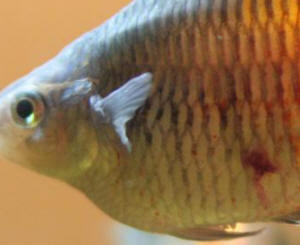
|
Best thing to use for bacterial pop-eye? Hi guys, One of my
big rainbows has pop-eye....again. What's the best anti-bacterial
medication to use for this?? Thanks, Ananda <a broad-spectrum
antibiotic in QT is the best bet, but if it happened recently and is
simply swollen (may not be infected yet/at all) then one Tablespoon of
Epson salt per five gallons may alleviate the water buildup behind the
eye. Do consider especially if removal to QT is not convenient or
possible. Kindly, Anthony>
Sick Rainbows ><Ananda...whaaaaasssssup, er... I
mean... How are YOU doing? >Anthony> Just got the splint taken
off today, & my arm hurts w/o the support. Still using the sling.
And the model name of the sling is "Encore" -- I keep hearing
a commercial along the lines of "Go ahead! Break your arm again
and we'll be just as useful next time!" Argh.... <<ouch!
Do feel better soon!> >One of my neon rainbows has two bumps on
his skin. ... >< ...You haven't added any wild caught fish or
live plants recently have you (parasitic larvae/copepods)?> Um, yes,
actually... just put a couple of new plants in about a week ago.
<and the plants were quarantined like fish for 2-4 weeks first? or
given a good rinse and alum bath first? That's OK... I usually
don't either... although it does help to buy plants from fishless
systems when possible> >Her eyes are looking like they might be
developing pop-eye. ><starting to sound like bacteria are at
least part of it (exopthalmia (eye-popping)> That's what I
figured. ><reapply antibiotics... although this time use a
product with both Nitrofurazone and Furazolidone That's why I'm
using the Furan-2 (Aq. Pharm.); each capsule has 60mg Nitrofurazone
& 25mg Furazolidone & 2mg Meth. blue. I've been using 1
capsule daily in a 10g hospital tank, & the silicone is now a nice
pretty turquoise color. Should I change the dosage? <the dose you
are giving is actually mild... however, the small scaled rainbows may
not take a higher dose. Just increase the duration of the treatment in
QT. kindly, Anthony> Thanks, Ananda
Praecox Rainbow <Ananda here today...> I want to let
you all know how much I appreciate this site. Early last year I
ventured back into Aquarium keeping with a small 10 gallon set up for
my daughter. After 20+ years away I had a lot to re-learn. <Yep. A
lot has changed in this hobby!> Bob helped me with an early disaster
and since then I have been able solve most problems by reading from
this site and other suggested sources I found here. <Good to
hear> About 8 months ago I set up another aquarium (29 gallon) and
it has been running very well. It does however seem to me, that the
local fish stores, would rather have me kill my fish and come to buy
more than to keep them well. Their advice often conflicts with WWM.
Your site has kept me from needing to replace fish very often. <We
have no commercial interest in selling you fish, so....> The
Aquarium is a beautiful addition to our home. I do have a problem now
with some Praecox Rainbowfish I have had for about 3 months. I started
with 4, lost 1 with it's tail caught in the filter intake, and 1
more to what I believe to be some sort of internal nematode. The fish
showed no signs of sickness but developed a dark spot near the tail
which became swollen over a 10 day period, and then over night the fish
had symptoms of dropsy. I quarantined, but the fish died in a few
hours, before I had any idea how to treat it. After death, I dissected
it and found a few (6) small (3mm) worms bright red and visible to the
naked eye. Under 400X microscope, they seem to be a nematode of some
variety (I need more experience with specific identification). <Do
pick up Dieter Untergasser's book "Handbook of Fish
Diseases". It has many, many photos of various nasties that make
our fish less than healthy.> The remaining 2 Praecox seem healthy,
eating fine, no signs of stress, but 1 has a swelling at the base of
his tail. The swelling is similar to the swelling on the fish I just
lost. I have quarantined, and I am treating with Nitrofurazone. The
fish seems fine other than the swelling. Might it have the same worm?
<Likely yes.> and if so how would you recommend I treat it? Is
there some precautionary thing I should consider doing to the tank as a
whole? No other fish in the tank show any signs of illness. <If you
can find or make an anti-parasitic food, I would feed this to the tank
for several days. Without being sure exactly what type of parasite this
is, I can recommend only a general anti-parasitic medication. Do keep
the remaining Praecox in a separate tank.> My water here is hard,
8.0 so I have checked Fishbase for fish that are tolerant. I have some
brass (Hyphessobrycon bifasciatus) tetras, 2 Boesemann's, 2 lace
Gourami's, 2 Corys, and a bushy nose Pleco. With 20% weekly water
changes I never see a rise in Nitrite or Nitrate levels. I am finished
stocking and expect to have about 33 inches of fish, if everyone
reaches maximum size. I have about 25 inches now. <It sounds like
you have been stocking your tank according to the outdated "one
inch of fish length per gallon of water" rule -- it sort of works
for slim-bodied fish like neon tetras, but you have several deep-bodied
fish. If even some of your fish reach their maximum size, you will end
up with an overstocked tank. I think a better measure to use is adding
the height of the fish to the length of the fish (and the
"thickness" of the fish for wide-bodied species) to get the
total "fish length" to compare to your tank gallonage. And
even then, this works better for tanks that are shorter and wider, with
more surface area compared to their depth, than for tanks that are
taller with less surface area compared to their depth.> Thank you
again for the wealth of information you provide, Mark <You're
welcome. --Ananda>
Picking Up from Here >Dear WWM Crew: Thanks to all for
your invaluable help and support up to this point. >>We do what
we can, though my efforts are new. Here's the deal: >I've
got a 44 gal. freshwater tank that housed the following fish: 2
Boesemanni rainbows 3 male threadfin rainbows 5 balloon-bellied mollies
3 green Cory cats. >The tank's parameters are all normal, no
nitrites, ammonia, pH = 7.5; I haven't tested for nitrates yet, but
will do tonight. Unfortunately, through an error of mine, there was
introduced to my tank something horrible and insidious last week. I did
not fully understand the benefits of QTing *all* new tank members, but
believe you me, it's a mistake I'll not make again. Anyway, I
introduced four dwarf neon Rainbowfish w/out QTing, and within
forty-eight hours, two had died and the other two looked *horrible*.
Symptoms included lethargic behavior, not eating, grayish/whitish
patches with some red underneath, and fin/tail rot. I immediately
pulled the two remaining dwarf Neons and put them in a hospital tank,
and based on the symptoms I saw at the time (and with much help from
the chat forum!), began treating these guys w/ Maracyn-Two. Well,
within another 24-48 hours, they had also died. Again, through my
posting on the chat forum, I discovered that very possible I had
stumbled across "Rainbowfish disease", or fish tuberculosis.
So, I began researching that, and everything I've seen thus far
leads me to believe that this disease is virtually impossible to treat.
Yesterday, I noticed one of the Boesemann's not looking very good,
so he was put into a hospital immediately. His outward symptoms did not
look like what had affected the dwarf Neons - the boesemanni appeared
to have "true fungus". As such, I chose to treat his hospital
tank w/ Maracyn-Two and MarOxy. Well, this morning I woke up and he was
gone too. >>Oh dear, my heart is breaking for you! In doing even
more research today, I've decided that if another rainbow exhibits
disease symptoms, I'm going to treat him in a hospital tank w/
erythromycin...I believe that sometimes that works against fish
TB...please confirm if that's the case. >>IIRC, it is,
however, you would do well to have several medications on hand, I would
add Melafix and Spectrogram to the list of meds you already have on
hand. >I'm *very* concerned about my remaining fish, and so far,
here's what actions I've taken and/or plan to take: increase
water changes from 10-15% to 20% weekly, I've ordered a UV
sterilizer (scheduled to arrive next week...hopefully soon!) to kill
any free-floating bacteria in the water, and, in general, will try to
keep the stress level (for both the fishes sake and mine) at a minimum.
Is there anything else I can/should do? >>Truthfully, you're
doing everything I would do, the only advice I can add is to use salt
(ratio of 1tsp./gal) while medicating and q/t'ing. You cannot use
this in the display with the plants. >If we are truly dealing with
Rainbowfish disease (fish TB) - can it be contracted by the mollies
and/or Corys? >>It may, but I must apologize for not having
better answers at this time. I do not think fish TB is specific to any
genus or species, treat everyone the same right now. >At what point
do I need to completely break down the tank? In the event I do need to
break down the tank, do I need to toss the plants (Aponogetons and
Anubias )? >>I don't think that you need to break the tank
down, though putting everyone in q/t for a minimum of one month and
letting the tank lie fallow may be helpful. Remember not to use the
salt with the plants. I don't know that plants can act as carriers
for disease, Google has provided me with nothing helpful. >Please
help- I do realize that I made a mistake by not using proper
fish-introduction techniques (i.e., quarantining), but what can I do
from here? Thanking you in advance, Jorie >>You are doing
everything you can at this point, with the exception of the salt. I
cannot say, "You should do this, that, or the other thing",
because you're doing what I would. My suggestion is to stay the
course right now, and we'll keep our fingers crossed that you lick
this! Best of luck, Jolie! Marina>
FW Fish Disease Dear WWM Crew: Thanks to all for your
invaluable help and support up to this point. >>We do what we
can, though my efforts are new. Here's the deal: >I've got a
44 gal. freshwater tank that housed the following fish: 2 Boesemanni
rainbows 3 male threadfin rainbows 5 balloon-bellied mollies 3 green
Cory cats. >The tank's parameters are all normal, no nitrites,
ammonia, pH = 7.5; I haven't tested for nitrates yet, but will do
tonight. Unfortunately, through an error of mine, there was introduced
to my tank something horrible and insidious last week. I did not fully
understand the benefits of QTing *all* new tank members, but believe
you me, it's a mistake I'll not make again. Anyway, I
introduced four dwarf neon Rainbowfish w/out QTing, and within
forty-eight hours, two had died and the other two looked *horrible*.
Symptoms included lethargic behavior, not eating, grayish/whitish
patches with some red underneath, and fin/tail rot. I immediately
pulled the two remaining dwarf Neons and put them in a hospital tank,
and based on the symptoms I saw at the time (and with much help from
the chat forum!), began treating these guys w/ Maracyn-Two. Well,
within another 24-48 hours, they had also died. Again, through my
posting on the chat forum, I discovered that very possible I had
stumbled across "Rainbowfish disease", or fish tuberculosis.
So, I began researching that, and everything I've seen thus far
leads me to believe that this disease is virtually impossible to treat.
Yesterday, I noticed one of the Boesemann's not looking very good,
so he was put into a hospital immediately. His outward symptoms did not
look like what had affected the dwarf Neons - the Boesemanni appeared to
have "true fungus". As such, I chose to treat his hospital
tank w/ Maracyn-Two and MarOxy. Well, this morning I woke up and he was
gone too. >>Oh dear, my heart is breaking for you! In doing even
more research today, I've decided that if another rainbow exhibits
disease symptoms, I'm going to treat him in a hospital tank w/
erythromycin...I believe that sometimes that works against fish
TB...please confirm if that's the case. >>IIRC, it is,
however, you would do well to have several medications on hand, I would
add Melafix and Spectrogram to the list of meds you already have on
hand. >I'm *very* concerned about my remaining fish, and so far,
here's what actions I've taken and/or plan to take: increase
water changes from 10-15% to 20% weekly, I've ordered a UV
sterilizer (scheduled to arrive next week...hopefully soon!) to kill
any free-floating bacteria in the water, and, in general, will try to
keep the stress level (for both the fishes sake and mine) at a minimum.
Is there anything else I can/should do? >>Truthfully, you're
doing everything I would do, the only advice I can add is to use salt
(ratio of 1tsp./gal) while medicating and q/t'ing. You cannot use
this in the display with the plants. >If we are truly dealing with
Rainbowfish disease (fish TB) - can it be contracted by the mollies
and/or Corys? >>It may, but I must apologize for not having
better answers at this time. I do not think fish TB is specific to any
genus or species, treat everyone the same right now. >At what point
do I need to completely break down the tank? In the event I do need to
break down the tank, do I need to toss the plants (Aponogetons and
Anubias )? >>I don't think that you need to break the tank
down, though putting everyone in q/t for a minimum of one month and
letting the tank lie fallow may be helpful. Remember not to use the
salt with the plants. I don't know that plants can act as carriers
for disease, Google has provided me with nothing helpful. >Please
help- I do realize that I made a mistake by not using proper
fish-introduction techniques (i.e., quarantining), but what can I do
from here? Thanking you in advance, Jorie >>You are doing
everything you can at this point, with the exception of the salt. I
cannot say, "You should do this, that, or the other thing",
because you're doing what I would. My suggestion is to stay the
course right now, and we'll keep our fingers crossed that you lick
this! Best of luck, Jolie! Marina>
Sores on Rainbowfish <Hi! Ananda here tonight...>
It's happened before and now two of my mature Rainbowfish, one a
Yellow and the other a Boesemanni, have open sores on their sides. In
both cases the sores are, more or less oval in shape and leave an open
wound of about 3/4 on an inch in length. In both cases, too, the wounds
appear about an inch back from the base of the fish's pectoral fin.
<This sounds sadly familiar. See if you can track down a copy of
Dieter Untergasser's "Handbook of Fish Diseases" and take
a look at the photo on page 22...it shows a Rainbowfish with something
that sounds very much like what you are describing. Untergasser labels
the photo as an example of "open tuberculosis", which is
caused by a mycobacterium that is found somewhat frequently in fish
tanks.> I don't know if this is something specific to
Rainbowfish, but this has happened to Rainbowfish that I've had in
the past and on a number of occasions, most recently... about six
months ago I lost a Parkinson's Rainbowfish after the same kind of
sore developed. <I have lost four neon rainbows, four Australian
rainbows, and three turquoise rainbows to this before I knew what it
was. If you check the forums at http://wetwebfotos.com/talk and do a
search for posts by JKJ454 about her rainbows, you might find some
useful information there, too.> Presently, none of the other fish in
the tank, including a New Guinea Red Rainbowfish and a Melanotaenia
trifasciata (Goyder) and an M. herbie, have this kind of sore. <Keep
your water quality pristine... that can keep what may be an existing
infection from taking over and becoming lethal. JKJ is using a UV
system on her tank, and her Boesemann's are looking good.> Is
this something that is particular to Rainbowfish? <No, but it seems
sadly common in rainbows.> In any event, I haven't been able to
find anything written on it and if you can identify the problem it
would be appreciated. THANKS....Alan <There has been word that
Mycobacteriosis, aka fish TB, can be treated with Kanamycin -- however,
the cost of the treatment may be quite high. Much more info available
at the links here:
http://www.fishdisease.net/cgi-bin/search.cgi?ps=10&q=mycobacteriosis&t=&Submit=Search
... and check the WetWebMedia site, too. Now that you know what to
search for, you should be able to find a fair bit of info. I do hope
that this is *not* what your fish have, but fear that it might be. If
it is, do wear full-arm-length aquatic gloves when you mess around in
the tank. --Ananda>
Australian Rainbow Howdy Folks! <Hey, AJ! Please do
forgive the delay; I've been in the middle of half a dozen computer
crashes this past week/weekend> I've been reading up all night
at your (lovely) site, and haven't found the answer I'm looking
for. <Wow! Guess we'd better try and help out, then!> I have
a 55 gal FW community-ish tank. Of my tank members, I have 2 Australian
Rainbows (that's what PetSmart calls'em anyway). <Certainly
covers a lot of fish.... check out this site: http://members.optushome.com.au/chelmon/Austrailian
Rainbows if you're interested in identifying your fish and learning
more about them.> I've had them for a least a month now and both
have been doing great! <Good to hear.> I recently won a battle
against a nasty low pH problem and have been testing my water regularly
ever since. <Heh, I'm envious of your low pH!> So, when I
came home tonight to see my large Rainbow swimming in circles (to the
right) with two huge swollen eyes, I was baffled. I pay pretty close
attention to my fish, and I don't recall having seen his eyes
looking even slightly swollen before. As a matter of fact, everyone was
fine when I left for work (9 hours earlier). To double check, I ran all
of my tests... no ammonia, no nitrites/nitrates, pH 7.3, GH 7.5, KH 6,
temp 77F... all of which are in good/acceptable ranges according to my
test kit (it is right, isn't it?). <The only thing that I'm
concerned on is "no nitrites/nitrates" - just wanted to make
sure you understand these are two completely separate nitrogenous
wastes that must be tested with separate kits.> The swollen parts of
his eyes are also red from the front, like he has internal
hemorrhaging, but its not his actual eye that is red. Are these
symptoms of the dreaded bacterial Popeye? <Though there can be other
causes (injury, for one), yes, this sounds like "Popeye"
(exophthalmia).> If so, it is likely that my (many) other fish are
in harm's way? <This is certainly possible. It'd be a good
idea to isolate him in a quarantine/hospital tank, if at all
possible.> His behavior is very erratic as sometimes he's acting
normal, and sometimes he's spinning around, and sometimes he's
being spastic at the surface (like he's trying to jump out). He
didn't appear to be interested in food but he's not doing the
typical 'twirling head down' pre-death dance. <The spinning
is possibly of great concern.... please do check out the links on this
page:
http://www.fishdisease.net/cgi-bin/search.cgi?ps=10&q=whirling+disease&t=
. Although it is (hopefully) more likely that he's just having
trouble swimming from his illness(es), it would be good for you to
understand more about Whirling Disease in case that is what you're
looking at.> So, overall, I guess I just want to know what I can do
to save him and, more importantly, the rest of my fish. Oh yeah (this
may be important), I read on ONE little unprofessional site that a
cause of Popeye is excessive aeration(?)! <Er, not really, no. It
can be related to having too much dissolved gas in the water, but
you'd probably be seeing other symptoms of "gas bubble
disease" in that case, including bubbles in the fins of the fish
and very heavy breathing.> Several days ago I purchased a 48"
flexible bubble line so that my fish would have more bubbles to play in
(the Corys LOVE them) and it is attached to the same air pump the
12" bubbler was attached to. Is the excessive aeration thing true
or is all of that just an unlikely coincidence? <Coincidence, IMO.
You could try removing the second airstone for a couple days and see if
that helps. Right now, the best recommendation I can give you is to
isolate the sick fish in a separate tank and add Epsom salt to the
water at a rate of 1-2 tablespoons per ten gallons; this will help
relieve the pressure in the eyes, possibly clear the issue up
altogether. Do please watch for any other symptoms of illness, as well;
it may be a good idea to get the fish on some antibacterial food
(perhaps with Oxytetracycline, provided you can find it), in case it is
a bacterial issue. Otherwise, it'd be a good idea to use a good,
broad-spectrum antibiotic like Kanamycin in the water.> Thanks a
million for any help (and for all the help you've given in the past
simply by posting your replies to other people's questions!)!! AJ
<Our pleasure, AJ! I do hope this reaches you in good time, again, I
apologize sincerely for the delay. Wishing you well, -Sabrina>
Ailing Rainbowfish 5/14/06 Good
afternoon, everyone! <Well hello there - this is Jorie> I have
searched through your site but still have a few concerns... I
appreciate any advice since I know you are all very busy answering
questions. :) <I'll try my best to help - Rainbowfish are one of
my all-time favorite FW fish - I've got several different
species!> One week ago, I bought two Rainbowfish, a Boesemann's
and a what I believe is a Lake Tebera. I have a 29 gallon community
tank with two red platys, three zebra Danios, two young lemon tetras,
two elderly black tetras, one mature Angelfish, and two sword tails.
Also two common Plecs (the other one is recovering in this tank from a
bad fin nipping - seems to be doing fine now, happy and active with
beautifully healed fins!) and two small Corys. <Yikes! My friend,
this is a lot of fish, some pretty sizeable (esp. the common Plecos,
the angel, and the boesemanni). First of all, if there's any chance
of returning the rainbows, I'd say that is your best bet. Rainbows
are schooling fish, and do best (both health-wise and color-wise) when
kept in groups. Obviously you don't have room to add any more
rainbows to your tank, so if it's at all possible, I'd say find
them another permanent home.> I do 10-15% water changes every week,
<I'd be doing at least 25%, probably more like 50%...> use
Stability each week, <...I am not familiar with this product...>
sometimes using Amquel+ & NovAqua+ combo instead. <I assume this
means you are using tap water? Many people think rainbows are
super-easy beginner fish, but this just isn't so. In my experience,
rainbows demand *pristine* water conditions; in fact, due to continuous
problems with my boesemanni and ended up investing in a RO/DI water
system and a UV sterilizer...> This tank is very stable,
<...great...> never had any incidence of Ich except when I bought
two clown loaches from Wal-Mart (very bad impulse buy, will never do
again), <Hey, we've all learned this lesson the hard way. All
you can do is take the knowledge, incorporate it, and move on, smarter
and stronger. I hope you've now learned how big clown loaches can
grow (i.e., min. of 12"!)...definitely too big for your tank,
notwithstanding the fact that you are already overstocked...> and
everyone in the tank is acting and looking perfectly normal, with good
appetites and activity level. Water tests are as follows - ph 7.0,
nitrite 0.5 ppm, somewhere between 250-425 ppm total hardness. (These
Mardel starter test strips leave a lot of room for the imagination when
it comes to hardness!) <Yes, test strips, in general, are
notoriously inaccurate...I'd suggest investing in a good liquid
test kit, like Tetra's Master Test Kit...everything you need is in
there, and it's fairly reliable...> I live in Central Florida,
so tap water is pretty hard. <Fish generally appreciate consistency
more than exact precision, so that's the most important thing.
However, as I mentioned above, I never had much success keeping
rainbows in tap water. Check out www.airwaterice.com for good deals on
RO/DI units...they are quality products with long life spans, and I
think you'll see a great improvement in the rainbows, as well as
the other fish.> This morning I found the Lake Tebera (I think)
Rainbowfish hanging out above the powerhead, near the heater (temp is
78 F, and I'm using a Penguin 125 w/BioWheel, BTW), with his eyes
looking red and cloudy and acting as though he were blind. He bobs
along, bumps into fake plants, doesn't eat. His tail fin seems to
have what looks like a tiny bite, but I am worried is maybe fin rot?
Most distressing though are his red cloudy eyes. One eye is so badly
clouded that his pupil is not even visible. <This sounds like Popeye
- a bacterial infection usu. caused by poor water conditions. Based on
your complete information, am I correct to presume you did not
quarantine your new rainbows when you first got them? Quarantining all
new livestock is truly the best plan, but is even more important when
you are introducing wild-caught fish, like rainbows, into your
community. They are notorious for bringing along various diseases and
should be observed in QT for a min. of 3-4 weeks. Having said that, all
you can do is learn from the experience. At present, you need to get
the affected fish into his own hospital tank...> (Oh, and I say he,
but I have no idea what sex this fish is.) <It can be difficult to
tell with rainbows, esp. when they are juvies. Once they mature, the
males and females have different colorations that make it a bit easier
to know...> I have a Styrofoam cooler (holds maybe 3 gallons if
filled to the brim), and I put him in there. I put in a new, never used
Fluval 1 filter that I was planning on using for a turtle tank, so that
the water stays clean and aerated. I put in 2 tsp of Epsom, since the
tank is filled with 2 gallons of water -- half is tank water, other
half is brand new dechlorinated tap water, as well as two .5L water
bottles of Zephyrhills just to top it off, Heh) and also a few drops of
Stress Coat and NovAqua+. Could this medication do any harm? <First
off, distilled water is not generally great for fish - it is missing
essential elements, minerals, etc. Also, you may have shocked him when
you transferred him from straight tap water in your main tank to this
setup. For now, consistency is key - keep the water clean and do not go
back and forth between tap and distilled. I'd stick with tap. Also,
in this QT, is there a heater? Make sure there aren't significant
temperature fluctuations, as this can wreak havoc on a fish's
immune system. I don't think the Stress Coat and NovAqua+ will do
any harm, but I'm not generally a fan of adding all sorts of
chemicals. Right now, you need to focus on keeping the water clean and
stable. Also, you may want to try a broad-spectrum antibiotic, such as
Maracyn I and/or II. Whatever you choose, dose according to
instructions and keep a close eye on the fish...> I am very
reluctant to try any OTC fish medication and thought maybe these
conditioners would help. <I applaud you for not running out any
buying every medication in town - that can many times make matters
worse. Conditioners, however, won't generally help a sick fish, and
in my opinion, nine times out of ten are unnecessarily used also. For
you, if you stick with distilled water, you will need to look into
additives like Electro Right and pH Adjust - as mentioned above,
distilled water is lacking certain necessary elements for fish, and
likely has a pH of 5.0 - way too low. And, if you go the route of a
RO/DI filter, those products work nicely as well. If, however, you
stick with your tap water, you will simply need a chlorine remover, as
you have been using, and that should be sufficient. I cannot stress
enough that stability is much more important that a precise pH, level
of hardness, etc. Use your test kits regularly to ensure there
isn't great fluctuation.> The CopperSafe I used for the clown
Ich outbreak seemed to be so harsh! <Copper is a very harsh
medicine, no doubt about it.> I also cut a plastic 1 gal water
bottle in half so that he would have a little transparent
"cave" for security, <Nice thought, but your fish might
appreciate a non-transparent one...> and put a 120v incandescent
bulb over the water. (It's a ceramic heater type lamp, which I was
planning on using for the turtle tank, also.) I am hoping the plastic
and Styrofoam will help keep the water warm without a heater, as I have
no extra heaters at the moment. <Do keep an eye on the temperature
of the water - you don't want it to fluctuate. If need be, you can
purchase a 25watt heater for this 2-3 gal. tank. Do be sure there's
a thermometer in the water.> I made sure to cut the plastic bottle
very smoothly; I didn't want him to run into anything sharp in his
blinded state. <Good idea.> Also, I know this was a bad idea, but
I thought he might be hungry so about three hours after putting him in
the makeshift hospital tank, I caught him with my hands (freshly &
carefully washed with Dawn) and put him back in the main tank. <You
are right - not a good idea. You can feed your sick fish sparingly
while in QT...> He didn't eat anything, but I thought he looked
worse. He seemed so pale, with a whitish cast over him and his eyes
seemed a little redder (though maybe I'm imagining this.) The
thought of salt on red irritated eyes sounds so painful, but I realize
this is probably a secondary bacterial infection so I thought I'd
try Epsom salt on my own before writing to you guys. <Epsom salt
cannot hurt and may help. You need to stop moving this fish back and
forth, though, as you are needlessly stressing him out. Also, when you
do need to transfer him, please consider investing in a fish-safe net -
this is much less traumatic on the fish. For now, keep him in QT,
observe with the Epsom salt, keep the water clean and stable, and
heated, if possible. If conditions don't improve or worsen, look
into a broad spectrum antibiotic. Also, be sure to feed him quality
nutritious food, esp. while he is ailing - bloodworms (frozen, then
thawed), or Mysid shrimp, or a good quality pellet (such as Spectrum
New Life) if he'll accept them.> Sorry for the wordiness of this
e-mail. <It's helpful to have more, rather than less information
- don't apologize!> If you could give me an idea of what else to
do, I would be so grateful! <Hopefully I've done so.> I feel
I have been irresponsible somehow and the death of this little guy
might prompt me to start re-evaluating my skills as a fishkeeper, or
for that matter, my worthiness as a human being... ;( <OK, don't
do that, but do keep in mind QTing is very, very important, whenever
you get new livestock. Also, with your current stocking list, you
really shouldn't be looking to add any new fish. All you can do is
learn from your mistakes - we've all made them, and ultimately, it
makes us better fishkeepers!> You all do such terrific work! To
think, it is purely in the volunteer spirit. If I ever hit it rich
I'll contribute richly to the WWM!! <LOL! Thanks for the kind
words...'tis a great group of folks here at WWM and they have and
continue to help me immensely!> Thank you in advance, Nicole <You
are welcome. BTW, how is the boesemanni doing? Jorie> P.S. Oh,
forgot to mention that he is back in hospital tank now since he
didn't seem hungry or sociable, and I wanted to treat him and
quarantine him in case his condition is contagious. <Excellent -
leave him there and monitor him closely. After he's improved,
you'll still want to leave him for at least 2 weeks to ensure he is
totally healed and doesn't relapse.>
Re: Ailing
Rainbowfish 5/14/06 Hey Jorie! <Hi again, Nicole!>
Thank you for the lightning-fast reply! I do realize my tank is
overstocked right now. This is because these are two tanks -- a 20 and
a 29 gallon -- consolidated into one. I know this seems very mean and
careless to do! It's because I had to move, going from having my
own 2 bedroom apartment to being somebody's roommate (long story,
I'll spare you the details, just that I am having some financial
difficulties right now). <I totally understand - financial
difficulties are no fun for anyone. As long as you realize that your
take is quite full, that's quite different that not knowing. I am
sure you will do right by your fish and provide them with a bigger
space once you are able. In the meantime, just be sure to do more,
rather than less, water changes, to keep up with the extra bioload.>
I am setting the 20 back up soon, but for right now I have one very
busy tank. It seemed like things were ok because everyone gets along
real well and seems to have found their own place in the tank, but I am
getting to work on the 20 now that this poor guy has developed this
crud. Popeye, you think? His eyes don't seem swollen, just cloudy
and red. <He could have injured his eye, and this is a secondary
bacterial infection...> I will continue to observe and treat him as
I have been, if he doesn't improve I'll try the Maracyn.
<Sounds like a good plan.> I have the established gravel and the
old filter and filtration unit from the 20, but not the heater, I
accidentally cracked it :(. <Been there, done that! Glad you
realized before you put it in the tank!> When I set it back up
I'll let it cycle -- fishless cycling for about 3 weeks -- maybe by
then he will be looking and seeing better. <Sounds like a great
plan.> Oh, I forgot to mention this, but I do get R/O water, about
five gallons worth, from my LFS to do my weekly water changes. I just
used tap water right now for the emergency W/C and 50% water for the
quarantine tank. The 5 gallons is what I do my 15% change with, but I
will buy another canister and up that to 10 gallons a week. <Got it.
When you have some spare $$$, I'd suggest looking into your own
RO/DI unit - it will definitely save you money (not to mention the
hassle of lugging 5 gal. of water around!) in the long run. When you
are ready, as I mentioned, www.airwaterice.com is a great site...very
helpful folks.> My 20 gallon was my beginner aquarium, hence where
my platys and Danios came from. Also the source of the other Pleco and
the angelfish, who was such an adorable little baby - now grown up to
the size of a moon pie!! Alas, what else could I have expected?
<Hey, most of us have been there - this is how we learn. And, side
bonus is having the larger fish to control the livebearer population -
my rainbows must be eating all my platy fry, as I haven't seen a
single one in about a year now!> I am sorry to say I did not
quarantine the rainbows. I didn't realize they were wild caught
fish, I just heard that they were very adaptable to hard water, easy
beginner fish, etc. as you mentioned. <Many people will tell you
they are an easy fish - I tend to disagree based on personal experience
and second-hand stories from folks like you. I really don't know
why so many LFS tell people how easy they are to keep. They definitely
require stability more than anything - they just aren't as
"forgiving" as platys, for instance.> My LFS seemed not to
know much about them (they specialize in marine setups, although that
to me seems like no excuse), since they were labeling them
"rainbow tetras." <Uggh - perhaps you should politely
educate them?!> The Boesemanni is doing just fine, beautiful color,
eats everything. Except for glassworms, which the container said were a
favorite of "rainbows, ram cichlids, etc." but nobody seems
to like these. I do feed a variety of foods every day. For example
(feel free to skim this part) <...no, this is helpful info!...>
Freeze dried: Spirulina flakes, color flakes, Bio Blend granules, brine
shrimp, Cichlid omni and Community formula flake food from Ocean
Nutrition, Frozen: Bloodworms, Spirulina & vitamin enhanced brine
shrimp, also the glassworms duds. <Sounds great. The only change
I'd suggest is substituting Mysid shrimp for brine - much higher
nutritional content. But, of course, use up what you already have!>
For the bottom feeders: sinking pellets, algae tabs and blanched
zucchini. The platys liked skinned peas but nobody else did, and what a
mess! <LOL! At least you must have had very "regular"
platys...> I know I shouldn't have gotten the Rainbows with the
stocked conditions, but I had planned to have my 20 already set up by
now. *sigh* It just seems so daunting to set up an aquarium, on my one
day off a week! But with this new impetus I will be doing just that.
<It is a lot of work at the beginning, but will pay off in the long
run...> I also have been wanting to give the angel away, either
trading him in or selling him since he has grown so large, but the LFS
I got the rainbows from doesn't sell angelfish, and the other store
is an all purpose pet store that doesn't take trade ins. Also the
aforementioned LFS is not interested in any fish like Danios, platys,
etc. They would probably take them for free as feeder fish, maybe!
<I couldn't bring myself to do this, either. With regards to the
angel, maybe try www.aquabid.com or even post on the forum at
www.wetwebmedia.com Maybe someone local can/will help you out?> Any
ideas? Besides giving back the rainbows, which I will do if I have to,
but I sure do hope to find another alternative. They have really grown
on me, probably my favorite fish... <Yes - me too! Play it by
ear...I'm glad the boesemanni is doing well. Hopefully your other
rainbow will recover as well. In the meantime, you can read up on your
new "favorite" fish in Dr. Gerald R. Allen's
"Rainbowfish: In Nature and in the Aquarium" (ISBN:
1-56465-149-5). I cannot wait to have a rainbow species dedicated 90 or
110 gal. tank one day:-)> A million thanks, Nicole <You're
welcome...hope all goes well. Jorie> P.S. Thank you for the advice
on the liquid test kit. I am going to look online for one. <Try
www.drsfostersmith.com - good prices on dry aquarium goods, generally.
Or www.bigalsonline.com> P.P.S. I have heard conflicting advice on
netting fish. I do have a big and little net, those coarse green ones,
but... Heh, my hand just seemed less harsh on red, irritated eyes than
that mesh! I won't move him again, though - he is staying where he
is for a couple of weeks until he is all the way better. <I am
surprised you were able to catch him w/ your hands! Maybe b/c he
isn't feeling well...my rainbows are impossible to catch! The green
nets are just fine, but if you are truly concerned, you can always pick
up one of the marine white ones that are softer, with less
holes...truly not necessary though.>
Parasites Attacking The Rainbows - 05/10/2006 Hello! I seem
to have encountered a problem that I cannot answer through the vast
resources of this website, or even my home library on fish diseases. I
have a 125 gallon tank set up primarily for Rainbowfish. There are 18
various Rainbows in there at the moment with a handful of Corydoras,
loaches and a Pleco. This is an established aquarium that I have not
added any new fish to in over six months. A couple of days ago I
noticed one of my Rainbows (m. parkinsoni) had almost a perfect
segmentation in its color, or rather, the complete absence of color
starting at the tail and reaching halfway up the body. It is almost as
if the latter half of the fish is not receiving proper circulation. I
thought this may have been due to a change in diet, since I have been
feeding more flake food than normal. These fish are accustomed to
frozen treats like bloodworms and brine shrimp, which I resumed
feeding. Now a second fish (g. Wanamensis) has this same half
de-coloration. I ran the normal water tests, ammonia/nitrite read 0 and
nitrates only came in at 10 ppm. The pH read 6.8 which is the same as
fresh tap water where I live. To be safe, I moved the two fish to a
hospital tank but I have not begun any treatment since I don't know
what I may be treating them for. Any ideas? The Wanamensis is still
eating. The Parkinson I'm afraid has stopped taking food. I seem to
recall encountering something similar to this a few years back.
Ironically, it too involved a Rainbow, m. Splendid I think, but I had
the afflicted fish in quarantine and I returned it without learning
what it was or the outcome for that particular group of fish. Any
insight you could share would be greatly appreciated. Thanks, Brook
< I have found that these things turn out to be bacterial and
respond well to Erythromycin. Watch for ammonia spikes because this
medication will affect the good bacteria needed for biological
filtration.-Chuck>
Response to Rainbow Fish Email - 1/6/06 Hello, I sent an
e-mail about a weird lump on the underside of one of my rainbow fish,
just in front of the bottom fin. The lump seems to be getting smaller
but it still worries me to not know what it is. I hope it's not
something my other fish can get. I thought I'd send you another
e-mail to ask if there is a certain FAQ site I should be checking for
the answer to my original e-mail, or do you reply in another e-mail? I
look forward to hearing from someone. Thanks a bunch, Kris < We get
lots of email everyday from all over the world. We answer everything
eventually, usually not more than a couple of days. We do have
computer/server issues from time to time and things just disappear. We
try to figure it out as we go but sometimes we never know what happens
to the emails. Go to the WWM homepage and do a Google search on rainbow
fish. You should find a response there. Lumps a can be many things. If
it was bacterial you would eventually see it burst into an open sore. I
am guessing that it may be a parasitic worm that could be cure with
Fluke-Tabs. This is more common with pond fish, or new fish that may
have been imported after being raised in a pond.-Chuck>
Your notes about Rainbowfish 1/8/07 To Whom It May Concern:
<Paul> I am a veterinarian conducting a major review of diseases
of Rainbowfish and was interested in reading your notes on Rainbowfish
at the following website: http://www.wetwebmedia.com/FWSubWebIndex/rainbows.htm <Ah,
yes> Can I quote you for a project I am doing and if so who will I
quote as the author of this material? <Certainly, and myself>
Kind regards Paul Hardy-Smith <And to you, Bob Fenner>
Re: Your notes about Rainbowfish 1/8/07 Thank you Robert
Another quick one - besides Mycobacteriosis have you had any other
experience of significant infectious disease in Rainbowfish? <In
commercial settings there have been what appears (unfortunately not
confirmed by examination, culture...) Aeromonad-related losses. I
suggest a querying of the various "Rainbow" groups BB's
here... many fine folks, some quite sophisticated... that am sure will
cooperate with you openly... I would definitely seek out Kent Webster
on the U.S. West Coast... a breeder> Also - pardon my asking, but
where do you come from (when I put in a "pers. Comm., I generally
like to acknowledge where the person resides!) Cheers Paul <Oh! Am a
Yank... out in Hawai'i' currently. Permanent residence in San
Diego, S. California. Cheers, Bob Fenner> Re: Your notes about
Rainbowfish - humble request for follow-up Attention Jorie Johnson
- 1/22/07 Dear Jorie, I can indeed notify you and your team
there when the review is complete. It will at some stage be released as
a public document, so downloadable. <Sounds great - looking forward
to it!> On another note, I was wondering whether you may be able to
help me. <I'll sure try.> We are trying to get some idea of
the trade in Rainbowfish in the US as we understand it is quite
substantial. Do you have any idea what sort of numbers are traded each
year over there and the most commonly traded species? If not, do you
know of someone who may have this information? <This is not
something I know, but perhaps Bob himself can shed some light...am
copying him here. And, if he doesn't know, he certainly would be
equipped to give you some alternative names within the
industry...Bob?> <<Mmm... the biggest breeder/supplier I know
is Kent Webster... in LA... Do you have contact with the Rainbowfish
Study Group (www.rainbowfishes.org/), am hopeful they might have such
data. RMF>> We are at this stage restricting our review to
Rainbowfish in the family Melanotaeniidae. <Excellent.> Kind
regards Paul Hardy-Smith <Thanks for responding - hopefully Bob will
be able to help you further, or at least point you in the right
direction! Best regards, Jorie>
Re: Your notes about Rainbowfish
1/8/07 Dear Paul, I am a part of the WWM Crew; I was reviewing
Bob's reply to you, and I just wanted to ask if you would perhaps
be so kind as to notify me/us when your review is complete? I am very
interested in Rainbowfish myself, having kept boesemanni, threadfins,
furcatas, Celebes, etc., and would love to read your findings on this
subject. Many thanks! Jorie Johnson>
|
Gourami Swim Bladder Problem -- 06/14/07
Good evening, <Hello!> My name is Carol. I have a couple of
(I hope) quick questions for you. I have a 75 gallon FW community
tank. I went out of town for two days and came back to find out
that my fish sitter didn't notice the filter had been turned
off (guess she hit the power strip while grabbing food). The
water quality was bad needless to say. I didn't even bother
to test how bad just did a 50% water change. Of course I made
sure ph was similar for water change. <Good... or even
lower...> The next day one of my two large Gouramis was unable
to keep himself righted in the water. Tail up, then tail down. He
could swim just not stabilize himself. <Likely metabolite
poisoning of some sort...> He ate what he could get to for two
days. I did another 30% change two days after I got home. The
same day I finished reading what I could about what his problem
was and came up with swim bladder problems. <But what root
cause/s?> I moved him to a 10 gallon hospital tank and treated
with Epsom salt (1 tsp per 5 gal) two days ago. I've tried
feeding him peas to no avail. I am confused on whether I should
also try treating with an antibacterial food? <I would not>
From what I can figure out the filter being off can cause swim
bladder problems but the bad water quality could have caused an
internal bacterial infection mimicking the same symptoms.
<Yes> I don't want to start treating him with
everything under the sun if I should wait some more time to see
if the Epsom salt will work. <Yes, this is what I would do>
Everything I've read and nobody had both aeration <Mmm,
not this... these Anabantoids are facultative aerial
respirators... can just go to the surface to breath...> and
water quality issues together with swim bladder problems. Thank
you so much for your time. I truly hope we can help save George
and get him back to his buddies. All of my other fish in the main
tank are fine. In fact, I need to find a good birth control
method for my guppies. Thanks again. Carol <Heeee! So hard to
get them to take those little pills, or... I'd like to repeat
that I would NOT continue to treat this fish per se... but would
likely return it to the main display... Recovery from such
environmental insults can take weeks to resolve. Bob
Fenner>
Re: Gourami Swim Bladder Problem --
06/15/07 Bob, <Carol> Thank you so much for your quick
reply. What ph would you recommend for him? <Mmm,
"middling"... actually much more important to not have
this shift than be much (like half or so a point) higher or lower
than 7... The comment I made was in reference to nitrogenous
waste anomalies. Turns out that ammonia and nitrite are MUCH more
toxic at higher pHs...> My only concern with moving him back
to the display tank is that he cannot compete for food. Is he not
better off where he is so I can try to hand feed him? <Likely
so...> Just a side note, you're next on my list to meet. I
just started my first reef tank at Christmas (so much to learn)
and have already had the good fortune to have both Kelly Jedlicki
and Anthony Calfo come to town. <Ahh! Very nice folks,
friends> Ask Anthony, Jeff and the rest of HRRC can throw a
pretty good party for speakers. <Heeee! Ugh, am trying to
recover from last nights regular Thurs. eve dinner party... did
my bit stretching putting away the fancy wine glasses thus far...
gots to sit down a while...> We would love to see you in
Virginia Beach some time soon. <Oh! One of my sisters was born
there (Dad was a lifer in the Navy...)> Thanks again for all
of your help. You and the rest of the crew deserve many thanks
for the countless fish you have saved and people you have kept
from leaving the hobby. Carol <Ah, yes... one of our indirect
intentions. Cheers, Bob Fenner>
|
| Re: Gourami Swim Bladder Problem - attn: Bob
Fenner -- 06/15/07 Bob, <Carol> Thanks for getting back
to me again. I (of course) have a couple new questions. I still
can't get him to eat anything. I can hold him in my hand and
was thinking perhaps something out of a syringe. Kelly showed us
how to tube feed but I don't think that's necessary and
I'm too big of a chicken to do it anyway. <Mmm, don't
be... think on how important the life of this animal is to you...
the good you are trying to do it> Can you make any suggestions
as to how and what to feed him? <Mmm, yes... my fave, a small
piece blanched (or microwaved) zucchini... with a bit of the skin
peeled off> Also, his fins and lower lip are getting really beat
up from rubbing the rocks originally and now just the bare bottom
of the QT. Should I use something along the lines of Melafix to
help with that? <Mmm, not a fan. I would add nothing... too
likely to upset bio-filtration, do more harm than good> Ok, one
more little incentive for coming here. I can hook you up with the
local beach hashers. <Oh! This IS a bonus... Heeeeee!> I won
a few down-down challenges in my day. So, are you a runner with a
drinking problem or a drinker with a running problem ? Thanks
again, <A bit of both... On out, Dogfish/BobF> |
| Re: Gourami Swim Bladder Problem (new info) -
Attn: Bob Fenner -- 06/15/07 Hi Bob, I know you haven't had
a chance to reply to my last e-mail but I wanted you to know that
George finally seems to be having some sort of bowel movement. He
still hasn't eaten. The feces is long, stringy and almost
colorless or whitish. What I have read says that it is usually
internal parasites. I'm confused so I thought this new
information would help you help me. Thanks again, Carol <Do see
Neale (Monk) and my comments re the use of Flagyl/Metronidazole and
Anabantoids... Bob Fenner> |
| Re: Gourami Swim Bladder Problem -PLEASE
DON'T SHOOT ME - Attn: Bob Fenner -- 06/15/07 Bob, <Big
C> Ok, I come to you with head hung low and hat in hand. You can
use me as an example of not doing completely thorough research. A
little history. The FW tank was my boyfriend's project until he
said "oh, George is dying. I'll miss him but I guess
I'll have to flush him". <Mmm... I don't
"like" such cavalier stmt.s...> I told him to get out
of my way and took over. However, he is innocent in the cause
because he was out of town with me. My really dumb mistake was
asking him what kind of fish George is. He told me Gourami and I
bought it. When you sent me to the last link I noticed my fish was
nowhere to be found. In fact, no Gouramis had horizontal stripes. I
hope I get a little credit for realizing I hadn't actually
researched the fish itself in images before I medicated him. So, I
took pictures to the LFS and he is a Rainbowfish. From what I can
find, he is an Eastern Rainbowfish. I am so sorry for wasting your
time earlier (well, I do have two dwarf Gouramis I now know). This
fish isn't even a facultative aerial respirator, is he?
<Mmm, no my friend> Knowing all of the symptoms, is the cure
still Flagyl/Metronidazole ? <Is the treatment of shotgun
approach, yes> I guess I have a few new fish to ID, huh? Again,
I am so sorry. <No worries. BobF> |
| Re: Gourami Swim Bladder Problem -PLEASE
DON'T SHOOT ME - Attn: Bob Fenner -- 06/15/07 Bob, Oops, in
my embarrassment I forgot to attach the photos of George. I
don't want to be wrong again. Carol <Is a Melanotaeniid...
http://www.wetwebmedia.com/FWSubWebIndex/rainbows.htm BobF> |
|
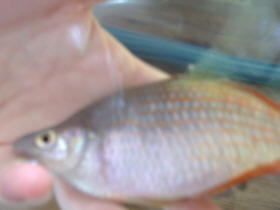 
|
|
Re: Gourami Swim Bladder Problem -PLEASE
DON'T SHOOT ME - Attn: Bob Fenner -- 06/16/07 Bob,
"Knowing all of the symptoms, is the cure still
Flagyl/Metronidazole ? <Is the treatment of shotgun approach,
yes>" I'm not trying to indiscriminately treat him.
You had suggested that I should use Flagyl/Metronidazole when I
wrote to you about the stringy, white feces. When I thought he
was a Gourami. If I should just wait longer to see if he recovers
I'm willing to do that. However, I don't want to leave
him untreated if it is internal parasites. Please clarify your
answer. I just really want to help this fish. Thanks again, Carol
<I would treat sequentially with this and an Anthelminthic...
as proscribed on WWM. RMF>
Re: Gourami Swim Bladder Problem -Answer not in
Daily FAQs - Attn: Bob Fenner -- 06/17/07 Bob, Good morning.
I checked the daily FAQs and the last post is not there. You
know, the one you couldn't get to me in the e-mail. I know
this is a pain but I still don't know exactly what to do for
George. Since you read so many e-mails here's a recap of my
last question. <Hasn't been posted yet... I would use the
Flagyl and an Anthelminthic sequentially>
|
Lady boesemanni with a sore belly 4/15/07 Hey Crew. I have a
school of seven boesemanni Rainbowfish in a 55 gallon tank. Over the
last few days the female has taken ill. <Only one of the seven is
female?> She's breathing heavily, and her belly is looking a
little swollen. Also, the skin around her ventral area has turned
slightly pinkish, and the ventral fins are extended (boesemanni almost
always have their ventral fins held tight against the body). <Good
observation... and the general "health" trend is indeed that
freshwater fishes keep their fins retracted most all the time, marines
extended...> She is still feeding and otherwise behaving normally.
I'm fairly sure the cause is not environmental (ammonia 0, nitrite
0, nitrate is always 5ppm or less, pH 8.0). As I write this, I'm
about to isolate her in a 10g hospital tank, and I'll probably
treat with aquarium salt. I don't really expect this will solve the
problem, but I'm not sure what else to do. Do you have any
suggestions? Thanks for your help! JM <I would add a course of Furan
compound to this ten gallon treatment tank... 250 mg. every three days,
changing out half the water for three periods. Please read on WWM re
Melanotaeniid health, the use of this class of antimicrobials. Bob
Fenner>
Boesemanni Rainbows, hlth. 7/19/07 Hello
WWM crew, I have to tell you I have learned so much from your web site.
You do a GREAT job. I have a problem with what I think is fungus on the
mouths of my Boesemanni Rainbows. My tank is 55 gal with a Marineland
c-360 canister filter which I used for bio filtration. I also use a
AquaClear 70 for mechanical filtration and occasionally carbon. I have
been doing 50% water changes every 4-5 days. The tank has 0 ammonia, 0
nitrite, 20-40 Nitrate, ph is 8.0, total hardness is 250, total
alkalinity is 300 ppm and temp is at 79.Inhabitants include 12
Boesemanni Rainbow, 6 Turquoise Rainbow, 6 Corydoras, 2 Opaline Gourami
and 1 L-137 Pleco. The tank has been up and running for 6 months,
cycled with Bio-Spira. I have some live plants that grow slowly but
look healthy, I don't know the varieties. I am religious about
water changes and vacuuming the gravel. I admit that I over feed at
times but am trying to curb this. No new fish have been added for 3
months. They are fed omnivore frozen foods once a day, live mosquito
larvae a couple times a week and Spirulina flakes daily along with a
few algae wafers at night. I keep noticing some white fluffy looking
stuff on the Boesemann's mouths. It seems to be attached around
their lips. I don't notice any on their bodies. It comes and goes,
will be there a few days then gone a few then back again. Various other
fish are scratching occasionally some days and not other days. I
don't want to medicate but I also feel things aren't right. I
thought I could correct it by increasing water changes but I've
been doing that for over a month and nothing has changed. The fish eat
good, have very good color and are active. What can I do to be rid of
the occasional scratch and the tufts of white stuff on my fishes
mouths? I appreciate the time it take you to reply and am so glad you
are there to help and offer advice. Lynnette <Hello Lynette. The
white stuff on their mouths is either plain fungus or mouth fungus
(which, despite its name, is neither a fungus nor confined to mouths!).
Either way, your retailer will have medication to treat the fish.
Prompt action is essential because it is easy to cure early on but
impossible to cure when it becomes severe. Be sure and remove any
carbon from the filter before treating the tank. Mouth fungus is
typically caused by water quality issues. Though your numbers look good
to me, perhaps you're not keeping in the "safe zone"
consistently. Overfeeding is definitely one way to mess up water
quality. Double check you're doing things "by the
numbers" -- reflect on whether you're using the right
amount/type of dechlorinator (e.g., one with Chloramine remover if
there's Chloramine in your water supply). Review your filter
cleaning routine (are you doing anything that might kill off the
bacteria, like rinsing under a tank). Just go through the basics and
think about what might be amiss. Mouth fungus rarely comes out of
nowhere. Good luck! Neale>
Question about injured scale on boesemanni rainbow
6/25/07 Dearest Bobster- How're you doing? What's new with
you? We are gearing up for our trek out to HI at the end of next
month...it's rapidly approaching - I'm very excited! <Fine,
thanks and oh yessss> I wanted to ask you a quick question about
scale damage on one of my beautiful boesemanni rainbows. I'm almost
positive it was caused by an over-excited SAE, who generally goes
berserk at feeding time and is quite aggressive to the larger fish in
the tank (3 boesemanni, 2 boys and 1 girl). He's such a monster
that he actually killed his companion SAEs many years ago.
<Uncommon, but does happen> This over-aggressive behavior's
been going on for years and perhaps I should have removed him before,
but 1- I don't have anywhere else to put him, and 2- several years
passed with no problems. Thus, I've let him continue to remain as
the tank bully, as up to now, there haven't been any significant
issues resulting from his poor behavior. As of late, my alpha male
rainbow has a very obvious couple of damaged scales right in his
midsection (the area where the SAE usually head-butts the others). I
understand that secondary infections are always possible when a fish
has a lesion, so I've been very careful to do extra water changes
on this tank. Also, I've been adding MelaFix about once a week (who
knows if it does anything, but it makes me feel better!). I understand
that scales grow back in time (I should mention that the damaged scales
are still present and haven't actually fallen off, but they are
raised like a scab of sorts); generally how long does that take?
<Quite a while with Melanotaeniids... weeks to months> Should I
be using any sort of antibiotic or other medication, in your opinion,
to speed healing/prevent infection? <Mmm, no, not a good idea in
general to use antibiotics... I would use... two nets... to remove this
Crossocheilus> Or just leave things alone? The good news is that the
problem definitely hasn't gotten any worse over the past few
months, but I do realize that the underlying issue is still present-
this SAE just can't get along with any other fish. I'm going to
start asking if any local fish stores would take him for their larger,
aggressive display tanks. Probably not, but doesn't hurt to ask,
right? Too bad he can't live in brackish with Puffy, the F8 - that
may teach him a lesson. <Yikes> Just curious if you'd
advocate any additional treatment for this Rainbowfish. Oh, and
salt's not an option, since the tank's heavily planted. I could
transfer the boesemanni to QT (well, after I replace the hospital tank
I broke a couple of weeks ago!) - do you think that's warranted?
<As you state... optimized water quality with water changes...
perhaps soaking foods...> Your advice is always appreciated. Hope
you are well. See you soon! Jorie <Looking forward to it. BobF>
Boesemanni fungus 8/8/07 Hi to the crew, <Hello Lynnette,>
I want to thank Neal for his response to my earlier question/problems.
(previous email included at bottom of page) I have evaluated my
maintenance. I am making a conscientious effort to try to provide the
best environment (other than nature) for my fish. <Very good.>
After I received the response from Neal my fish did not display the
white mouths again until this week. I have kept up with the water
changes as previously noted. I have well water that I heat and aerate
for a few days before each water change. <Ah, but do you add
dechlorinator? This does more than remove chlorine. It also neutralises
ambient ammonia (e.g., from agricultural run-off) and locks away metals
like copper (e.g., from the pipes). Aerating won't do these things,
so isn't a substitute.> My water parameters are the same as
before. I have stepped up cleaning my canister filter in hopes that
would help. I rinse the bio media in a bucket of tank water every two
weeks. The hob filter media is rinsed at every water change.
<Don't clean the filter too often. Once a month is probably too
often, and I do mine a couple of times a year in some cases. You see,
every time you take the filter apart, you stress the bacteria a bit,
and you definitely run the risk of cleaning away the bacteria. The sign
to clean a filter is when the flow of water is obviously less than
before. Otherwise, leave it be.> Since the fungus symptoms have
returned I am ready to medicate the fish. From my research it looks
like sulfa meds are the med of choice? My local fish store is Petco and
I don't trust them to recommend medications for my fish. Is there a
drug that would be better suited? <Here in England I'd use
Interpet combined Finrot/fungus, but in the US your options seem to
include things like Seachem Sulfathiazole and Mardel Maracyn. Just
don't either "tonic salt" or new-age cures like Melafix
or Pimafix. None of these are consistently effective.> I also would
like to know if I could treat the whole display tank since 14 of the
Rainbows show varying degrees of small white tufts on their mouths?
<Always always always treat the entire tank with something
communicable like this. This holds true even if you have to remove a
sick fish to a hospital tank.> I know this isn't the best choice
but I don't have a quarantine tank large enough to treat all at
once. I have quite a few plants in the main tank ,Corydoras and the
Pleco. I considered moving out the Corydoras and the Pleco but I
honestly don't know if I could catch them out without tearing the
whole tank down. What's your opinion/recommendation? If I treat the
main tank should I remove the plants? <The cats and the plants
should be fine. Check the medications available against the information
provided on the packaging or the company web site. I don't have
experience of those American brands so can't speak personally. But
generally, as long as you follow the instructions to the letter (and
remove carbon from the filter) medications are safe and effective.>
Trying to figure out how to do this so all fish that need treated are
treated and the catfish aren't negatively affected. <With cats,
it is specifically copper and formalin that are suspected to cause
problems for them. I've never found that to be the case, but then
playing Russian Roulette once and surviving doesn't mean its a safe
game!> I appreciate all the time, patience and knowledge that is put
into this web site and the responses to questions. I totally respect
all of you. <Cool. And thanks for saying so; I'm sure we all
appreciate it.> Thanks for helping, Lynnette <Good luck,
Neale>
Re: Boesemanni fungus -- 08/08/07 Thanks to Neal
for his help. I have another question for Neal or someone to help me
with. After I medicate my 55 gal tank with the sulfa what kind of
aftermath can I expect as far as cycling again. I have a full bio load
now and fear what the ammonia and nitrite spikes will do to my fish.
What can I do to make sure my fish make it thru till the tank is stable
again after the medication? I appreciate your help.. many thanks.
Lynnette <Hello Lynnette. While I can't verify this from
experience (Sulfa drugs are not sold over the counter in the UK) my
assumption is that provided you follow the directions on the package,
your biological filter should not be harmed by aquarium-specific drugs.
Having said that, I'd still remove 33% of the filter media and keep
it alive in a bucket of untreated aquarium water by bubbling through
some air via an air pump and airstone. That way, if something does go
wrong, you can do a 90% water change and then restore the filter to
near-normal output by putting the "saved" filter media back
in. Regardless, visit the web site of the drug you intend to use, and
read up any FAQs they have online. Most of the big aquarium drug
companies have this information online. Cheers, Neale>
Re: Boesemanni fungus 8/10/07 Hello Crew,
<Hello Lynnette.> Neale answered my last question and I really
appreciate his efforts. My problem now is the color of my water.
I'm treating my 55 gal display tank with triple sulfa manufactured
by API. I did check their web site and sent an email to them asking
questions about the effects on the bio filter. I did not receive a
response and decided to go ahead and medicate according to the
directions. <OK.> I administered the first dose last night and
watched apprehensively to see how my fish reacted. They all seemed to
tolerate the medication without any ill effects. Tonight when I came in
from work I noticed the water looked like strong tea. I tested the
water, but was unable to read the results clearly. The color in the
water made the tests impossible to read. I used the dip stick tests and
the test where you add the drops to the tubes of water. Just guessing
by the intensity of the color results the ammonia and nitrite appeared
negative and the nitrate looked darker. So I presume I had nitrate but
not sure of the reading. I have 4 pieces of driftwood in the tank. Each
piece is about 14 inches long and of various shapes. The tank also
contains live plants and the substrate is natural colored river gravel
of pea size and smaller. The drift wood has been in the tank for 4
months without causing any discoloration in the water. I purchased the
wood from a pet store and the wood was specifically labeled for
aquarium use and stated it was "ready to use". <Odd. Does
sounds like the bogwood has coloured the water, though. Did you remove
carbon from the filter? One thing carbon does is absorb the tannins
from bogwood, so if you've removed the carbon recently, as you
should have done before treating the fish, then the tannins will start
to accumulate in the water. Result: tea-coloured water.> Will this
discoloration in the water harm the fish or affect the effectiveness of
the medication? How will I get accurate test readings so I can monitor
the ammonia and nitrite? I don't know the effect of sulfa on the
bio filter but am prepared for the worst. The fish are acting as usual,
still with the tufts of white on their mouths. They are all feeding
good including the Pleco and catfish. Actually the colors of the
rainbows look really stunning in the dark water. I searched them for
any signs of distress but couldn't find any. <The colour of the
water is largely immaterial. Like cloudy water, tea-coloured water is
something that annoys aquarists more than it troubles the fish.
Provided water chemistry and water quality remain stable, don't
worry about it. The main thing is to finish the course of medication.
You can then do regular water changes to dilute the tannins. Many fish
actually quite like "black water" and you'll notice that
their colours will become more intense. This is most obvious with
tetras and cichlids, but you might see it with rainbows, too.>
Thanks for all your assistance. The knowledge and willingness to help
of the WWM Crew is priceless. <Happy to help> Lynnette
<Cheers, Neale>
|
Gasping Rainbow 1/3/08 Great site!! I think
I have found a little piece of heaven here at WWW! I've read
many articles but can't seem to find an answer for this
problem. First. the specs: Tank 46g bowfront, moderately planted,
Emp. 400 BioWheel filter (with ceramic rings), Rena 100W heater,
Amm = 0, nitrIte = 0, nitrAte = around 20, temp = 78-80, oxygen
saturation between 5 and 8 mg/l, pH 7.8, dKH = 3, GH = 89.5,
phosphate 1.0 ppm, weekly water changes (20-25%) with half tap
water/half RO water, weekly detritus vac (not a deep gravel vac
due to plants), livestock: 2 pair Boesemanni, 2 pair Praecox, 2
flying foxes, 3 Otos, 5 Harlequin Rasboras, 4 Cardinal Tetras, 1
Skunk Botia. Tank has been set up and fine for a year. I feed
flakes and Spectrum pellets once per day and maybe once per week
a treat of Mysis shrimp, white mosquito larvae - all cleaned up
within a matter of minutes. The only new addition is the Botia
about 3 weeks ago - thought I had a snail/plant-eating problem.
Approximately 5 days ago, I noticed the two male Praecox were
gasping for air, not at the top of the tank, still
eating/swimming/acting normal - except for the gasp. New
Year's morning, the largest Praecox male dead, other one
still gasping. All other fish are acting normal, no gasping,
eating well. The remaining Praecox male is gasping, mouth area is
dark blue, in fact his whole body is a little darker. No
spots/wounds anywhere. He goes through the motions at feeding
time, but doesn't seem to actually eat much. It's just
weird that only these two seem to be affected. I've never
noticed any fighting between these two or with any of the other
fish. My other tanks (30g planted and 55g Oscar) are maintained
in the same way and all is fine. Any help will be greatly
appreciated. Michele <Hello Michele. Your aquarium water
chemistry/quality stats sound pretty good, so the problem here
doesn't seem to be a water chemistry/quality issue. I'd
do a 50% water change today, and then another 50% tomorrow
though... not so much for water quality, but in case there are
toxins in the water. It's surprisingly easy to poison fish:
tobacco smoke, paint fumes, and other chemicals can get into the
water. People sometimes (accidentally or otherwise) add food or
drink to tanks during holiday season parties, imagining the fish
would somehow enjoy it, so that's another thing to think
about. Big water changes will help. This said, if it's just
the one species in distress, then there's a chance the issue
isn't so much environmental as disease, some pathogen
specific to Rainbowfish. Treating with an antibacterial or
antibiotic medication could be worthwhile in this case. I
don't know how old your fish are, but the lifespan of dwarf
Rainbowfish is not long, likely well under 5 years. Finally,
Skunk Botias are hardly what one would call peaceful fish. Though
they usually mix well with rainbows, do look out for signs of
chasing. Cheers, Neale.>
Re: Gasping Rainbow 1/6/2008 Good to
know. I do fret over water quality a bit. Although, I guess I
could work a little harder to drop the phosphates! My tap water
is pretty phosphate-high. <Shouldn't be a problem,
especially if you do generous water changes. 50% water changes
once a week couple with careful feeding should cure pretty much
any nitrate/phosphate issues in freshwater community tanks.> A
50% change was done the day before the first fish died. I thought
I totally stressed him. <Unlikely to be killed by a water
change, unless the new water had a very different chemistry (pH,
hardness) than the old water. Fish don't easily die from
"stress" any more than people do. As a long term thing,
yes, perhaps stress can weaken fish or allow pathogens to do more
harm. But most fish don't get scared to death just by a water
change!> This said, if it's just the one species in
distress, then there's a chance the issue isn't so much
environmental as disease, some pathogen specific to Rainbowfish
This is what I am thinking and finding in research. <Ok.>
All of the Rainbows were mature, except the two female Boesemanni.
Could just be their time to check out. <Usually there are
obvious signs that fish are life-expired, typically things like
deformities or a certain slowness about repairing damage to
scales and fins.> Finally, Skunk Botias are hardly what one
would call peaceful fish. Though they usually mix well with
rainbows, do look out for signs of chasing. I'll keep an eye
out. I did notice a bit of chasing the first two days he/she was
in the tank, but none since then. <Good. You may be fine.>
Thank you so much, Neale. Michele <Happy to help.
Neale.>
|
|
|

