|
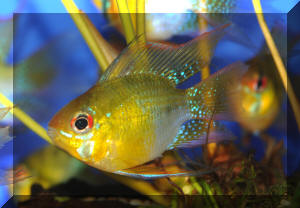
FAQs on Dwarf Ram Cichlid
Selection
Related Articles: Rams,
Dwarf South American Cichlids,
Discus, Juraparoids, Neotropical Cichlids, African Cichlids, Asian Cichlids, Cichlid Fishes in General,
Related FAQs: Rams, Ram Identification, Ram Behavior, Ram
Compatibility, Ram Systems,
Ram Feeding, Ram Disease, Ram
Reproduction, Cichlids of the World, Dwarf South American Cichlids,
Cichlid Systems, Cichlid Identification, Cichlid Behavior, Cichlid Compatibility, Cichlid Selection, Cichlid Feeding, Cichlid Disease, Cichlid Reproduction,
|
|
Re: LED lighting for 55 gallon tank. Now German Rams stocking
3/8/16
Another question for ya.
<Indeed..?>
As mentioned I have 12 zebra danios and 10 guppies and two dwarf Cajun
crays. And now 20 assassin snails.
<Neat.>
I have become enamored recently with the possibility of having some
German dwarf blue rams in my tank.
<Waste of time.>
I am thinking 1 male and four females. I realize that the pH is a
concern, but I contacted a breeder in California who says he keeps his
in 7.8 pH with no problems.
<pH actually isn't the key thing so much as hardness and temperature.
And nitrate. But if this breeder has them in your local water chemistry
and they're fine, then sure, worth a flutter. But if isn't local, I'd
ask him what the hardness and nitrate levels are before spending any
money. With that said, it's the farmed stuff that's hopeless. Locally
bred specimens tend to be better bets.>
My concern is with water temp. He is advising a temp of 82.I would think
that is too high for my other fish right?
<Danios, yes much too warm. Guppies would be fine, though it's hard to
imagine any overlap in water chemistry requirements! Rams want water
that contains almost no dissolved minerals; Guppies want liquid rock.
Crayfish,
again, very soft water isn't going to be helpful to them. They need the
calcium for their shells, and suffer "pitting" in water with a pH below
7.>
Can I go lower than 82 safely with rams?
<Not and expect them to live for long.>
Also, my tank is only about 2 months old, is that an established enough
tank for the apparently fickle ram?
Thanks as always.
<Most welcome. Neale.>
|
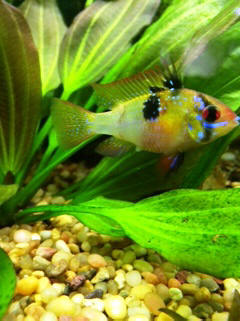
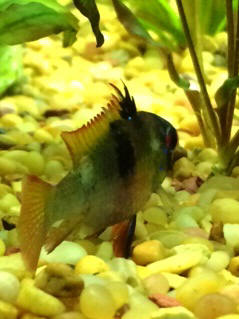
Why do my German Blue Rams keep dying?
8/11/14
Hello,
I have a question that I am at odds with: I have been trying to keep
GBRs alive for a few months now and they keep dying on me.
<Mmm; not a hardy species (anymore)... their genetic stock is weak; have
become less aquarium suitable with inbreeding, hybridization>
I am an experienced aquarist with decades of home fish keeping
experience.
I currently have a 90 gallon planted discus focused tank. Driftwood, 4-
3-5 inch Discus, 1 mature female Angel, 9 cardinal tetras, 3 bushy nose
Plecos, a few Corydoras, 4 pentazona barbs, 2 clown loaches, 2 Siamese
algae eaters, 2 glass catfish. I've had some of these fish for 3 years,
and all are thriving.
Feeding varied, nutritious diet of Hikari frozen bloodworms, brine
shrimp, tetra bits, cobalt Mysis flakes, omega one flake food, Hikari
discus gold, north fin krill pellets, and Hikari algae wafers.
<I'd drop the Bloodworms... significant health issues implicated; and
add more frozen, live foods to this mix>
I'm running 2 Eheim 2217's, temp is between 83 and 84,
<Hopefully with the discharges mixing air and water. I'd add more
agitation, circulation. Too little DO may be a factor here>
T5 HO lighting with LED morning and evening graduated lighting to ease
stress on fish. Light gravel vacuum water changes every 3-4 days,
replenishing with 40% aged, heated and aerated tap water.
<Great!>
Treated with Seachem Prime, Excel and Flourish and API Amazon Extract.
PH in tank and out of tap is 7.2-7.4.
<Mmm; a little high for Microgeophagus... I'd keep 7.0 and under>
Hard water, don't have reading at the moment, but know it's not "very
hard" on tetra strips, just "hard."
My LFS gets rams from local breeders,
<They're to be congratulated, shopped for their efforts here>
and water in the store is hard also with PH of around 8.0.
I've also purchased rams out of town from stores using RO water.
<I'd get, use your own RO device (I do and have done for decades)>
It's been running for 6 months. Water parameters have been consistent,
ammonia 0, nitrites 0, nitrates 2-5 ppm. Nitrogen cycling time during
the first 2 months was different as the bio filter was becoming
established but stable since then.
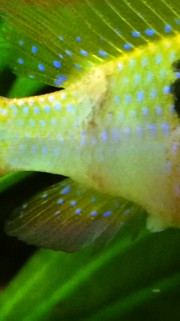
In my estimation and experience there is no reason why GBR's shouldn't
thrive in my aquarium, but they keep getting skin lesions and then rapid
breathing and then dead. I've gone through many, like 8, and don't get
why this keeps happening. I have treated my tank 2 months ago with tank
dose Praziquantel and metronozidole soaked food
<Just once w/ the Metro/Flagyl... too toxic (nephro-) to keep
over-exposing>
with focus and garlic guard to deworm my discus, other fish were
treated, but no losses or ill effect on fish during that time. I'm
attaching pics, if you have any idea what is causing this, I would
greatly appreciate it.
<Do appear to be "breaking down"... bacterial likely... But what
cause/s, or more importantly, what can be done to prevent? Better
nutrition and water quality are the areas I'd emphasize. MOSTLY, I'd
contact your stores supplier of the Rams and ask them what they're doing
re both these>
Since most of these rams have been kept for weeks at LFS in 8.0 ph very
hard water and look great when I bought them I don't get what is wrong
with my conditions. I'm suspecting they are so inbred they've become
extremely susceptible and weakened?
<This for sure; I agree>
Help please! I give up!
Another fish...
Another...
<Again; I'd contact your LFS, get their breeders contact info.; in turn
contact them re foods/feeding and water quality.
Do please report back your further experiences, findings. Bob Fenner>
|
  |
|
Re: Why do my German Blue Rams keep dying?
8/11/14
Thank you so much for your insight and speedy reply.
<Welcome>
I forgot to add the sponge filter I've also been using to pre-filter and
clear fine particles (including bacteria I assume?) and at the same time
provide aeration that is needed for DO (I noticed a positive difference
when the initial airstone went in, and a month ago decided to add the
sponge filter to be a dual purpose improvement.)
<Ahh>
RO is not a practical option for me at this time.
<Mmm; not to be argumentative; but IF you have pressurized source water,
not "that" expensive to procure gear, easy to install... MUCH more
reasonable in long/shortish time frame than driving, buying, hauling
otherwise>
I understand I would still have to mix it with tap water since it's
stripped of all dissolved minerals,
<Or add back purposely via a commercial product, or one of your own
devising (MgSO4 and sodium bicarbonate likely principally)>
and since all my fish (except GBR's) are thriving in my current routine,
I need to keep these things the same. Peat to lower PH leaves me with
the issue of PH swing when I do the necessary 40%water changes (I've
tried it) causing too much stress on my fish. I was advised at my LFS to
work with
what I have to maintain stability over and above what the PH and
hardness "should" be. That makes good sense to me.
<Real good>
Great idea to inquire with their breeders to find out more on how they
are kept/fed while at the breeder.
It sounds like GBR's have an issue in their genetics at this time, very
unfortunate since they are amazing fish. I suppose there will need to be
a slow process of selective breeding for hardiness to change what
breeders have (unintentionally) done to their immune systems over time.
<Ah yes; the tried and true method of adding back heterogeneity via
introduction of wild stock/s>
I may have to give up on them for the time being:(
Thanks again for your help.
Regards,
Kathryn
<And you, BobF>
|
Fish questions about German blue rams.
2/9/13
I will find out soon about my water hopefully this weekend. I got it
tested at pet land they just did a basic ph test. but I'd rather do it
at world of fish or Aqualand- more reputable. If I cannot get the water
tested due to time/staff gas mile payments what kind of test kit should
I get to test my tap.
I think I know what kind of dwarf cichlid i want to have in my 20 gallon
set up when I get it set up. Germen blue rams I saw a you tube video of
a guys ram collection with some discus. they were very nice well bred
fish.
Rdlee1000 is his online you tube name. I think he is outside the us
though.
And I don't know if he is selling any right now. the video is over 3
years old. Do you know of any good reputable germen ram
breeders/collectors I could contact.
Thanks Alex.
<Where do you live? The best approach would be to join / contact your
national cichlid association. Failing that, a local / city aquarium
club.
Do remember that German Rams (like any other Mikrogeophagus ramirezi)
need very soft, very acidic, and very warm water to do well. That's why
they're great with Discus -- same needs. You're aiming for 0-5 degrees
dH, pH 5.5-6.5, temperature 28-30 C/82-86 F. Basically incompatible with
community tropical fish, with a few exceptions (like Discus and Cardinal
Tetras).
Failure to understand this is why the vast majority of people who buy
Rams end up watching them die within 12 months, often within 6 months.
Two alternatives: Bolivian Rams and Cockatoo Cichlids, both of which are
small colourful, adaptable, and basically easy to keep. Cheers, Neale.>
Want 2 balloon dwarf German
rams 4/3/11
Hey I am a new guy and I love your site! It's brilliant! I have a
little over 25 gallon tank. Lots of live plants and lots of hiding
places. I have 2 sunset gouramis,
<Sometimes a good species, Colisa labiosa, but sometimes a very
difficult to maintain species, Colisa chuna or Colisa lalia.>
2 red skirt tetras,
<Gymnocorymbus ternetzi; nippy, and a schooling species.>
2 golden wonder kellies,
<Predatory; territorial.>
2 blue dwarf gouramis,
<These are difficult to maintain.>
2 angels, 2 Corys and 2 spotted leaf fish.
<Ctenopoma acutirostre? The Spotted Climbing Perch I assume you
mean; a nice fish, but potentially predatory, and doesn't usually
take flake or pellet foods. Needs wet-frozen or live invertebrates such
as bloodworms, brine shrimp and earthworms. In any event, two will be
territorial and need much more space than 25 US gallons.>
They all are really great with each other and the 2 tetras don't
even hang with each other 'and they are supposed to be
schooling.
<If you know they're schooling fish, why get two? Schools need
to be 6+ specimens.>
Also I have an extra tank if the angels get to big. Now I wanted to
know if I can have 2 dwarf balloon German rams'¦..
<Unless you have a good quality, locally bred specimens, avoid this
species. As I and many others in the hobby have pointed out,
Mikrogeophagus ramirezi is extremely difficult to maintain long-term,
partly because the species is extremely demanding, and partly because
the farmed stock is junk, juiced up with antibiotics and liable to die
once those wear off. Unfortunately the species appeals to beginners
because it's colourful, but few if any experts will give it space
in collection, at least, not farmed ones. On top of that, you want to
keep a deformed, inbred variety that's even weaker than the
commoner sort!>
Side note'¦.I have 2 convict cichlids and they were breeding
at the store'¦.now the male hates the female and I have tried
separating them, changing tank arrangements and leaving female alone in
tank for a very long time and then introducing the male after a long
silence in the dark'¦..nothing works'¦..tired and I
just want to get new fish now'¦..but is there a possibility
that they will mate after some time again?
<There's no guarantee two cichlids will pair off, and moving
them from one tank to another invariably breaks the pair bond. The use
of egg-crate as a divider has been used to keep them together where
they can see one another, but apart physically so they can't harm
one another. Try that for a few weeks if you want. But really, why
bother? Convicts are so easy to breed that shops are inundated with
fry, yet the species is so aggressive and uncolourful that the fry are
difficult to sell. They're a zero-value species in most cases. If
you want to try your hand at breeding, try breeding something you can
sell. Corydoras are ideal if you want an egg-laying species because
they produce big eggs and large fry that are easy to rear, even on
liquid fry foods.>
Thanks so much for your help and I have gotten a lot of answers for
other things
<Glad to help.>
OH PS: both tanks are at temp of 80 and pH unfortunately at
7.8'¦ish (actually I think it's higher)
<Then Ram Cichlids aren't an option anyway, so your question is
completely academic. Ram Cichlids need soft water, very soft water in
fact, less than 5 degrees dH, and realistically, 1-2 degrees dH for
optimal results. On top of that, this very soft water needs to be
buffered down to a very low pH, ideally around 5.5, and certainly no
more than 6. Very low pH reduces biological filtration to almost zero,
so understocking their tank is crucial, and you may need to supplement
biological filtration with something else, perhaps Zeolite or
fast-growing floating plants to remove ammonia directly. Finally, they
need extremely high temperatures, 28-30 C/82-86 F. Despite what
retailers suggest -- but in keeping what you'll see in every book
written by an expert -- Ram Cichlids ARE NOT community fish and ARE NOT
for beginners. That you're talking about pH rather than hardness
here suggests you aren't at the level of expertise where you should
think about changing water chemistry (expert fishkeepers realise that
you change hardness not pH, e.g., by using RO or rainwater; and that pH
itself is rather unimportant). Cheers, Neale.>
Re: Want 2 balloon dwarf German rams 4/4/2011
HEY, thanks so much for your help Neale!
<You're welcome.>
I did at one point have 5 tetras...3 died due to Ick a while back when
I was first starting...now I got a good school of 6. Really quick what
issues will I have with the blue dwarfs? Im a little worried now. And
now I officially hate those balloon German rams! Goes to show how much
of a beginner I am!
<Perhaps. Do be open minded to good quality Ram cichlids being
worthwhile, if you can find them, especially locally bred ones. And the
closely related Bolivian Ram, Mikrogeophagus altispinosus, is an
outstandingly good aquarium fish. Another excellent species is
Apistogramma cacatuoides, a small, very colourful fish available in
several varieties such as the "Super Red". Although it
prefers soft water, it'll live and breed in moderately hard, around
neutral water too.>
I most definitely will try that with the convicts, but I wanted to know
is their any cichlids out there that can be in a 15 gallon tank and
have at least 2?
<Apistogramma cacatuoides would be one option. But the classic
choices for tanks this size are the Shell-Dwellers, such as
Neolamprologus multifasciatus, a colony of which can be kept in a tank
around 15 gallons, perhaps even with a few Ender Guppy dither
fish!>
I tried looking up on some site and books but I found 2 (including the
original German rams the other name I forgot)
Oh and all my tanks have hard water....ill try the rain water
thing.....Hmmmm
<Do read:
http://www.wetwebmedia.com/fwsubwebindex/fwsoftness.htm
http://homepage.mac.com/nmonks/Projects/rainwater.html
>
At my moms work she has a tall 10 gallon tank, she wants to make it a
salt water tank but after much advice we agreed it would not work. She
now wants to put in 2 angels, 1 male Betta, and 1 Cory cat.....or 10
neon tetras, 2 angels (small) and 1 Cory.....either or she wants
angels!!! I convinced her to try something else...and now its 4 red
skirt tetras, 1 male Betta and 1 Cory...or now 2-3 balloon rams (which
I will convince other wise) and 1 Cory'¦..
She also has a 55 gallon tank down at the work place that she has taken
over to redo...but there is Hoover...our 8-9 inch Pleco! she
doesn't want to get rid of it but what can u possible put in
there?!
<Big Plecs work quite well with all sorts of fish. Have a look at a
Rotkeil Severum Cichlid, a classic companion fish for a Plec. These
fish can be big, but not too big, 20 cm/8 inches is the max, but have
wonderful red colours easily comparable to a marine fish. They're
quite hardy and adaptable, and apart from being vegetarian, don't
present any real problems. If you have very hard water, then a single
largish Malawi cichlid could work, perhaps a single Aulonocara; use
Google, and then pick your colour! Red, yellow, and blue are all
available.>
Not to mention we cant get into the building with the 10 gallon tank
and 55 gallon during vacations.... days at a time we will not be able
to take care of either of those tanks.....what would be the best
solution to our problem? The water is hard, pH is high, temp is around
80F What would be hardy enough to stand that kind of conditions? I told
her take the 10 gallon home and leave Hoover in with an Oscar or
something....idk'¦.
Thanks again for your patience!
JP
<Cheers, Neale.>
Re: Want 2 balloon dwarf German rams 4/4/2011
Thanks once again Neale!
<Joshua,>
Thanks for the names of those awesome rams! and I want to try those
shell-dwellers!
<They are very cool.>
And Guppies?
<Endler's, rather than common Guppies; Endler's are smaller,
and do better in 15 gallons.>
That's really cool! how many of both fish would you suggest I get
for the 15.
<I'd start off with four or five Shellies, and a trio of
Endler's. See how you go.>
And also about the rams....would they work well in the vertical 10
gallon my mom has?
<No; M. altispinosus is quite big, 8 cm/3 inches, so you want a good
20-25 gallons. A. cacatuoides might work though.>
what about in the Plecos? mom doesn't want large fish like the
Oscar...she wants 2-4 inch each.....she wants many fish in the tank.
but I will run by these new ones you have told me about. hope she is
alright with these! I know I am!
<Most any sized fish will be happy with Plecs, even Endler's Guppies.
Plecs will uproot shells and plants, so dwarf cichlids that need those
might be a bit perturbed. Good choices are the more robust Acaras, such
as Blue Acaras, which aren't too big, but have enough presence not
to mind hulking great catfish. In hard water, Julidochromis species are
a fun alternative, as are biggish Lamprologus, such as Neolamprologus
tetracanthus and Lamprologus cylindricus.>
JP
<Cheers, Neale.>
Re: Want 2 balloon dwarf German rams 4/4/2011
PS: mom told me she wants fish like gouramis, sharks, platies, loach,
Killies.....maybe even a black knife....a lot of tetras angels,
rams,.....the list goes on'¦..
<Among Gouramis, Pearl Gouramis, Moonlight Gouramis, Colisa labiosa
and Colisa fasciata are all good, reliable species. Fairly peaceful,
and enough presence to look good in big, planted tanks. Have fun
selecting! Cheers, Neale.>
Re: Want 2 balloon dwarf German rams 4/6/11
Thank you for the info again!
<My pleasure.>
Ill try all of that! and I have a good understanding of what kind of
fish work well in my tanks! Im guessing ill need lots of floating
plants? what would be some good one that can tolerate low sunlight and
really be a great help for the ammonia prob.?
<Floating Indian Fern is a good, safe bet.>
also for my convict cichlids, I don't have a single cave....would
be wise to get one?
<Yes.>
Im also having a weird clear gel substance on the sucker cup that hold
the heater in place in the tank...im not sure what it is and its quite
annoying!
<No idea. Snail eggs perhaps?>
HELP! also my ammonia is little high and I've had the tank for a
good 3 weeks before putting in the cichlids...my tank has 6 live
plants'¦3 mondos, one feathery looking one that lost all of
its needles,
<Both of these plants are dead/dying; remove. Mondo Grass for
example is a land plant, not an underwater one.>
and 2 thick batches of elodea'¦..
<Can be difficult to grow in tropical tanks; needs very bright
light. Does take a while to die though, and you can always replace
every few weeks I suppose.>
thanks again,
JP
<Cheers, Neale.>
Re: Want 2 balloon dwarf German rams... more chatting... bb
dest. 4/15/11
Thanks for all the help!
Really quick question what are some really good online pet stores that
I can buy fish from? For reference sake I live in
California'¦
<Can't really help here, I'm in England! Perhaps best to ask
on the Forum, here: bb.wetwebmedia.com
For what it's worth, a good starting point is your own local fish
club. Many cities have one; check out the back of TFH Magazine for a
pretty comprehensive listing. Cheers, Neale.>
Re: Want 2 balloon dwarf German rams
Alright! I have my convict cichlid...his mate got torn
so I gave her away'¦.
<Convict Cichlids fighting is not uncommon.>
im guessing probably a bad idea to get another convict?
<Indeed.>
could I possible put a red crab in there?
<No. Red-Claw Crabs, Perisesarma bidens, are amphibious brackish
water animals that need mostly land together with a bit of brackish to
marine water to bathe in. They are not compatible with fish.>
I really love my convict now, he eats from my fingers!!! and he comes
out of his cave whenever I walk by!
<Convicts do make good pets but lousy community fish, and are best
kept on their own. In sufficiently large tanks, 55+ gallons, they may
be combined with other aggressive Central American cichlids, preferably
species bigger and more aggressive than they are, for example
Parachromis managuensis. Cheers, Neale.>
Re: Keeping Rams and Neon/cardinal tetras.
3/2/09 Sourcing Mikrogeophagus ramirezi Do you know of any
local Ram breeders that sell decent/or excellent quality rams? I'm
going to wait a few years before getting them, but I wanted to look for
breeders. I live in St Paul MN. <Best bet is to contact your
national cichlid fishkeeping club, e.g., American Cichlid Association,
British Cichlid Association, Deutsche Cichliden Gesellschaft or
whatever depending on your location. There's a good list of them
here: http://cichlidresearch.com/clubs.html Local fishkeeping clubs can
also be extremely useful, and by getting in touch with them, you can
meet breeders in your area. Cheers, Neale.>
Blue Rams... hormone treated? Too
often so. Sel. 11/3/07 Hey, I enjoy the website.
Tons of info. It's great! I have a question about blue rams. I
searched on your site and didn't find the info. How can I tell if a
blue ram is hormone injected? Thanks Ed <Hello Ed. You really
can't be sure. But in general, if the fish are being kept in
generic water conditions in a retailer's tank and brightly
coloured, assume they're "juiced" with hormones. Healthy
Mikrogeophagus ramirezi only develop full colours in very warm, soft
and acidic water when kept under quiet conditions and fed suitable
foods. Thrown into a regular temperature, hard water, alkaline generic
community tank they tend to look a bit pale (and eventually, die).
Price is another indicator. Quality Mikrogeophagus ramirezi are
expensive; here in the UK, I'd expect to pay around £20
($40) for a pair of wild-caught fish, and maybe a bit less for
something tank-bred by reputable breeders. But if the Mikrogeophagus
ramirezi on sale cost the same as, say, fancy angelfish, assume the
worst. Mikrogeophagus ramirezi are not the sort of fish that can be
cranked out to a high standard *and* cheaply both at the same time.
It's one or the other. Fish from the Far East are especially poor
quality, while fish from Central Europe is generally considered the
best. Ask your retailer where his come from, though be street-smart and
don't lead him to the "correct" answer! Cheers,
Neale>
Re: Blue Rams, sel. 11/3/07
Thank you for the quick response. Whenever I ask the staff at my LFS,
they say when they order from the distributor, the distributor
doesn't tell them where the fish came from. What should I do? Also,
does 15 us dollars seem like a price that you would pay for quality
rams? Also, is it advised to stay away from blue ram
"varieties"? Such as long fin ram? Thanks you so much for
your time, Ed <Hello Ed. I'd answer this question this way: Are
you an experienced cichlid keeper? If the answer is yes, and you're
ready to set up an aquarium with clean, slightly acidic, low carbonate
hardness water at a well above average temperature (28C upwards), then
by all means have a flutter with Mikrogeophagus ramirezi. Avoid the
inbred forms: anything with long fins or "all-gold"
colouration; these are notoriously difficult to maintain for any length
of time. Look for fish that are as close as possible to the wild type,
and pay particular attention to the shape of the fins and body;
there's a lot of poor stock out there with tubby body builds and
deformed fins. These are classic signs of inbreeding, and you don't
want them. Let someone else waste their money on 'em. Find a
retailer who keeps said Mikrogeophagus ramirezi in clean, soft water
aquaria away from generic community tropicals. Don't waste your
money on Mikrogeophagus ramirezi that have been treated like Danios or
Blue Gouramis -- these will have been too cold to maintain their immune
systems properly and will likely be incubating all sorts of fun
bacterial and protozoan parasites for you to play with once they get
home! Ideally, find a local breeder via your a fishkeeping club or
similar: if you can get Mikrogeophagus ramirezi that only travel
between their breeder's aquarium and your aquarium, so much the
better. If you can't do any of these things, then honestly, skip
Mikrogeophagus ramirezi completely. Opt for Mikrogeophagus altispinosus
instead. This fish may not be quite so colourful as Mikrogeophagus
ramirezi, but it is a better aquarium fish in oh-so many ways: wider
range of water chemistry values, does well at regular temperatures,
hasn't been inbred yet, is much less shy, and doesn't get
nearly so plagued with things like Hole-in-the-Head and Hexamita (which
may be one and the same things in terms of causative agents). It's
actually about as easy to keep as something like a Kribensis really. It
isn't a "showy" fish in a retailer's tank, but once
settled in and properly fed on a mix of algae flake and crustaceans, it
colours up very nicely and will live for many years given reasonably
good conditions. Mikrogeophagus altispinosus is, simply put, a great
aquarium fish; Mikrogeophagus ramirezi is, by contrast, usually a very
poor investment and apt to disappoint the average fishkeeper who winds
up with dead fish within a few months of purchase. Do also read around
the entire dwarf cichlid subject: there are a whole host of excellent
species out there, from Orange Chromides to Nannacara anomala to
Laetacara curviceps -- all massively overlooked despite being
colourful, easy to keep, and very well behaved even in community tanks.
Cheers, Neale.> Thank you so much!!! You are the only one who gave
me straight answer. thank you thank you thank you! Ed <Happy to
help. Good luck with whichever fish you go with. Cheers,
Neale>
Planted tank question... set up, Ram
spp. sel. -- 10/28/07 Hi there, I have tried
researching in the forums for info and couldn't find specifics.
This website is great by the way! I just got a 29 gallon tank that I
would like to setup as a planted tank eventually. Due to financial
costs I have to get the equipment a little at a time and purchase the
plants at a later date. I wanted to know: 1) Can I put 2 inches of Eco
Complete with 1 inch of aquarium gravel on top, on the bottom and then
begin to cycle my tank without putting plants in it right away (for a
few months)? I am wondering if any nutrients leak out of the
EcoComplete causing things like algae growth and if its necessary to
put plants into right away.. <Hmm... I think you'd need to plant
right away or else algae certainly will take advantage of the good
conditions in the tank. If you're limited on funds right now, some
cheap fast growing species like Cabomba, Elodea, Hygrophila and
Vallisneria could be pressed into service. These would keep the algae
at bay, and could be replaced in due course. Alternatively, floating
plants could be used and then thinned out once you start serious
planting. It's hard to fault Indian Fern, Ceratopteris cornutus for
this. It's cheap, hardy and practically indestructible.> 2)
After my tank is cycled I would like to put in a pair of either German
Blue rams or Bolivian rams, are they ok with just either no plants/fake
plants in the interim? Will they die if they have no live plants
around? <As far as commercially bred fish go, they couldn't care
less. They are commercially spawned in practically empty tanks with
little more than flower pots for shelter and some floating plants above
for shade. What cichlids don't like is bright light. So they do
need shade and hiding places. But beyond that, real or man-made makes
no difference.> 3) I've read so much conflicting info on Germans
or Bolivian rams...your personal opinion, which is better
personality/hardiness wise? <Mikrogeophagus ramirezi (including the
"German blue" variety) is hugely variable in quality. You get
what you pay for. Cheap stock is often only brightly coloured because
of heavy use of hormones and colour-enhancing food. Once you get them
home, they gradually fade away to drabness. Internal bacterial
infections seem to be rife among them to, and again, it's the use
of antibiotics on the fish farms that keeps them alive, and once they
hit the retailer's tanks, they gradually weaken. Wild
Mikrogeophagus ramirezi are expensive and not widely available, but
they are much more consistent if given precisely the right conditions:
very warm (~28-30 C), soft (< 10 degrees dH), and acidic (pH 5-6)
water. Mikrogeophagus altispinosus (the Bolivian ram) is altogether a
hardier fish simply from the get-go, and while quality varies, these
fish are never quite so poor as Mikrogeophagus ramirezi. They are also
less demanding in terms of water chemistry, requiring average
temperatures (25-28 C) and neutral to moderately hard water. Given that
relatively few aquarium plants like the conditions favoured by
Mikrogeophagus ramirezi, Mikrogeophagus altispinosa definitely makes a
better all-round choice, though this will of course depend on your
local water chemistry.> thanks so much and keep up the great work!
cheers Terri <Hope this helps, Neale>
The Blue Ram - Queen of the Desert
12/17/06 Dear WWM Crew, I think I have trans -
gender Rams... <Happens> So, I've heard that Rams
in pet shops, come in, commonly all males, or all male-ish,
due to breeders infusing the Rams with Hormones, to produce
the more colorful males. Which really bites. <Mmm, mostly do
"juice" the males... and send mainly these... as females by
and large "don't sell"> I have just bought a
'pair' of Rams, in MD. The third ray
of 'the male' was elongated and the 'female'
had no third ray elongation and was smaller. <Could be
just immature...> After only a day or so they have come out of
their shell and are happily chasing each other around and
strobing their colors as they flirt about. <Okay> The
thing is, the bigger male has developed the rosy abdomen
that I hear belongs to the female and has lowered the ovipositor
or something like that. They both have blue speckles over
the spot on their side. The 'male' is about an 1.25
inches. <Oh! Is a bit large to be a male here...> Do you think
these fish are essentially infertile and most probably
effected artificially by hormones? <Mmm, might be infertile... have
almost assuredly been hormone treated...> I questioned the
dealer/owner, at the time of purchase about such effected
Rams, as I made the purchase, the rosy abdomen was not
noticeable at the time, and he assured me these Rams
were not those 'phony' Rams. <... Well... there
are such as this about... on the West Coast often labeled as
"German" this or that Rams... But...> I paid $15 for the
pair. I plan on getting more for my basic
Ram/Orinoco Biotype set-up, at least two more pairs so
perhaps these two will be lessons learned and
interesting conversation pieces. <Good... good attitude>
I have a school of six Pristella Tetras and am also planning
on getting a school of about ten Cardinals, a few Corys and
a Royal Pleco, so far, for my 55 gallon. <Mmm, the Plec
may be a bit too much here ultimately size-wise> Any advice or help
would be greatly appreciated. <I'd look to other
Loricariid species> Thank you for all the help you've given me,
your services are a boon.. Ishan <Thank you for sharing.
Bob Fenner>
Mysterious Rams! Dear Crew, Greetings from
Blighty! In my lovely freshwater tank (240l, ph 6.5-7, nitrates 0, v.
low alk) we have finally added 3 Rams, on the advice of the LFS we
bought what we thought were 1 male and 2 females....however...it has
since turned out to be 2 lads and 1 lass, as the boys have been
fighting, so, back to the LFS we went with boy1 (sadly missing a couple
of scales) to return with what we were promised was a girl <Mmm, am
surprised to find so much damage with this species in such a sized
system...> ...but having put her/him into our tank, she coloured up
lovely and turned out to be...(can you guess!) another boy, intent on
chasing boy2, so that he is also missing a couple of scales. So we will
be taking him back to the LFS as soon as humanly possible. Is there a
fool proof way of telling the difference? <More "fool
proof" when Microgeophagus spp. are larger... the size, color,
morphological (particularly the first few spines of the dorsal fins
being longer)... are discernible sexual characteristics> and is
there anything we can do to help boy2's wounds heal more quickly?
Concerned and amazed by my feisty fish. Nicola <There are chemicals
that can/could be used (administered to treatment water as dips/baths,
introduced in foods, even injected in cases where the specimens are
severely debilitated or valuable), but I would do nothing other than
keep the specimen/s in ideal, stable conditions... soft, acidic water,
not-too brightly lit... well-fed, and they should recover nicely.>
Nicola Blay, BSc, MSc International Zoo Veterinary Group Keighley
Business Centre South Street, Keighley West Yorkshire, BD21 1AG UK
<Oh! BTW, these fishes are sometimes treated with androgens,
producing what appear to be males (with elevated agonistic behavior),
but may well be genetically females... This is a long-standing practice
with a few species/groups of fishes coming out of the orient (though
the fishes originate elsewhere)... to "boost sales", provide
"pairs" to human customers... I mention this to encourage you
to seek your Rams from more than one source (perhaps a local breeder).
Bob Fenner, phenotypically a male and a real one as well>
Re: Edit: Ram question Edit: I also forgot
to ask if I would need to get more than one; I wanted a ram as an
ornamental fish but had no intentions on breeding. Do they
prefer more of their kind? Which sex would you recommend for
a non-breeding tank? <Is better to have more than one... is a social
species... A male and female are best, but two or more males or females
can/will do. Bob Fenner>
Ram Cichlids, Water - 08/18/2005 Hello!
GREAT site. <Glad you enjoy it!> My question to you is if my
local water ph is high (sometimes reads to the maximum of my regular ph
test kit which is 7.6 - 7.8, I don't have a higher reading test
kit, so I can only guess if it's more) <Do please get a test kit
for higher ranges, and find out what, exactly, your pH is.> can I
still keep dwarf rams? <Likely, if you can find a local breeder who
raises them in similar conditions.> I have a 55 gal. with tetras, an
angelfish, and two Corys who all seem to be doing well. I have yet to
lose a fish in the two years since setting up the tank except for the
second angel that the first one terrorized. I know these are all from
similar waters as the dwarf rams, so what do you think? <Likely no
compatibility issues here. Sounds good.> Have you ever
seen them do well in a high ph environment? <Yes.... even
breeding. But again, you should strive to find rams that are
already used to such a pH from a breeder in your area. Try
asking around at fish stores, and join any local fish clubs within
reasonable distance.> I do have lots of driftwood in there, but no
real plants, only fake ones. Also, I never tested the hardness of the
water. Will that be a factor? <Possibly; it is certainly worth
knowing when you seek out someone with similar conditions from whom to
purchase your fish.> THANKS! -Marty <Wishing you
well, -Sabrina> Sorting Out Ram
Cichlids 1/19/06 Hello there, I have been
reading, and thinking, and reading some more. Thank you for such a
comprehensive site! I would like to set up a South American freshwater
tank. I would like to get a few rams (Microgeophagus
ramirezi). I have read that the German rams are healthier
(or hardier might be a better word,) than the Asian bred ones. I live
in Alaska and do not have a LFS. I need to order
online. So, I am looking at the few suppliers that will ship
up here, namely Dr. Fosters and Smith. They have 'German
rams' but they are listed as bred and shipped from
Thailand. Is this a sub-species? When I read it
earlier in an article I took it to mean that the Germans were breeding
a hardier line. I probably misunderstood, could you clear
this up for me? Thank you so much for your valuable time, Cindy
Haralson < First you have the wild rams from Venezuela/Colombia
area. A very beautiful but somewhat delicate species. The Germans began
to breed the rams and developed a domesticated strain that is hardier
than its wild counterpart. In Asia the farms were breeding rams, golden
rams and now German rams. German rams have a few more darker spots
around the head and back. Check aquabid.com for German rams too. I know
a local breeder at Mainlycichlids.com that can sell mated pairs. He is
in Calif and could easily airfreight a box of fish up the
coast.-Chuck>
|
|