|
Related FAQs; Flatworms/Planaria 1, Flatworms 2, Flatworms 3, & FAQs on:
Flatworm Identification, Flatworm ID 2, Flatworm ID 3, Flatworm Behavior, Flatworm Compatibility, Flatworm Control, Predator Control, Chemical Control, Flatworm Selection, Flatworm Systems, Flatworm Feeding, Flatworm Disease, Flatworm Reproduction,
Related Articles: Pest Flatworm Control by
Anthony Calfo, Worm
Diversity,
/The Conscientious Reef
Aquarist:
Flatworms, including
"Planaria" & Marine Aquariums, Part
3
To: Part 1,
Part 2, Part 4,
Part 5,
Part 6
|
|
|
By Bob Fenner
|
|
Genus Pseudoceros:
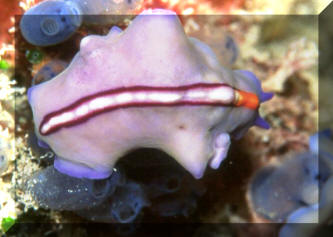
| Pseudoceros bifurcus Prudhoe 1989. Eastern
Africa to Indonesia, Australia, Philippines. Pseudotentacles as
simple folds. Distinctive white mid-line stripe that is orange at
the anterior of the animal. To a bit over two inches in length. Off
of Heron Island shown feeding on tunicates, another in N.
Sulawesi. |
|
Bigger PIX:
The images in this table are
linked to large (desktop size) copies. Click on "framed"
images to go to the larger size. |
%20MD.JPG) |
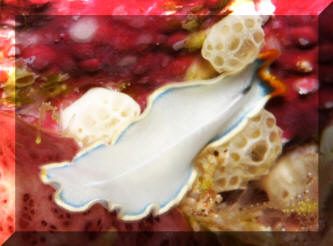
| Pseudoceros contrarius Neman &
Cannon1995. Creamy body with yellow line down the middle. Dual
color banding around perimeter... Yellow/orange and blue/black. New
Guinea... This one in Raja Ampat 08. |
|
Bigger PIX:
The images in this table are linked
to large (desktop size) copies. Click on "framed" images
to go to the larger size. |
|
|
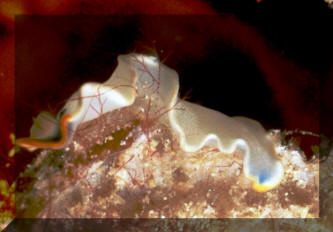
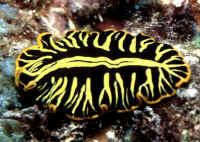
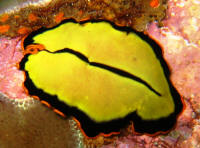
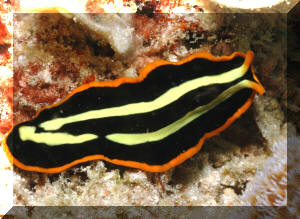
| Pseudoceros dimidiatus von Graff 1893. Look
for the double yellow "racing stripe" down the middle for
this species. Other markings are variable to missing. Central
to western Pacific. One off of Kailua Kona, Hawai'i by RMF,
another in PNG by PhilS. |
|
Bigger PIX:
The images in this table are
linked to large (desktop size) copies. Click on "framed"
images to go to the larger size. |
.JPG)
%20MD.JPG) |
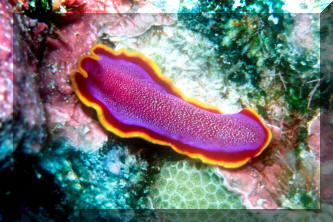
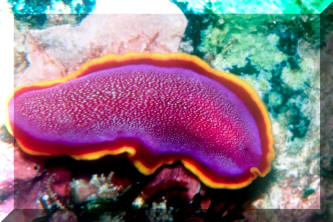
| Pseudoceros ferrugineus Hyman 1959. The
Fuchsia Flatworm Central and Western Pacific at moderate depths.
Out during both day and night, often appearing bluish until
artificial light is applied, and more round when fully opened.
Hawaii pix. |
|
Bigger PIX:
The images in this table are linked
to large (desktop size) copies. Click on "framed" images
to go to the larger size. |
|
|
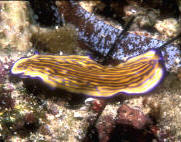
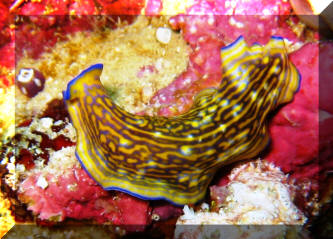
| Pseudoceros gravieri N. Sulawesi. |
|
Bigger PIX:
The images in this table are linked to large (desktop size) copies.
Click on "framed" images to go to the larger size. |
%20MD.JPG)
 |
To: Part 1,
Part 2, Part 4,
Part 5,
Part 6
|
|

