Featured
Sponsor


Related FAQs; Flatworms/Planaria 1, Flatworms 2Flatworms 3, & FAQs on: Flatworm Identification, Flatworm ID 2, Flatworm ID 3, Flatworm Behavior, Flatworm Compatibility, Flatworm Control, Predator Control, Chemical Control, Flatworm Selection, Flatworm Systems, Flatworm Feeding, Flatworm Disease, Flatworm Reproduction,

Related Articles: Pest Flatworm Control by Anthony Calfo, Worm Diversity

/The Conscientious Reef Aquarist:

Flatworms, including "Planaria" & Marine Aquariums

By Bob Fenner

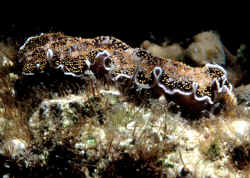
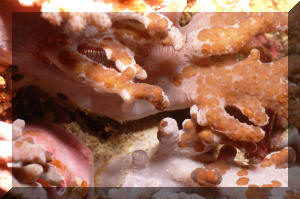
Thysanozoon nigropapillosum

Of the worms, the Platyhelminthes ("flat worms") are considered the prototypes, having developed such innovations as bilateral symmetry, a head, tail, and three germinal tissue layers (stinging celled animals, comb-jellies... only have two). These simple soft-bodied animals use their skin to breath through and only have one body opening, the mouth serving also as an anus. 

    The Flatworm Phylum includes two groups of well-known parasitic species; the Tapeworms (Class Cestoda) and Flukes (Class Trematoda). These are important species to humans directly and indirectly through their negative interactions with food and ornamental animal life, including fishes. There are many species of both cestodes and trematodes that live on/in fishes and their gill cavities. Fortunately, due to complex life histories and careful quarantine, dips/baths, most aquarists don't come in contact with these parasitic forms. 

    The free-living (i.e. non-parasitic) species of Flatworms, the Class Turbellaria are more of note... True, some of them do trend toward being pests when their numbers get out of control... and can be problematical should you provoke a poisonous variety to the point of toxin release... most are benign organisms that are best ignored. Most of us have had contact at High School science classes with the tiny freshwater genus Planaria. These are the remarkable worms that you cut in two and witnessed regeneration with.

Class Turbellaria: Mostly free-living Flatworms; about 3,000 described species. 

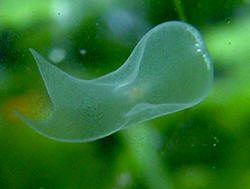
Acoel Flatworms: Simple, "gut-less", small worms... including the ones that "reproduce like rabbits" in reef tanks... best left alone... or selectively siphoned off (mainly) soft corals, out of reef systems.

Amphiscolops sp.,  a harmless acoel that "shows up" at times in reef tanks. Photo by Mike Giangrasso

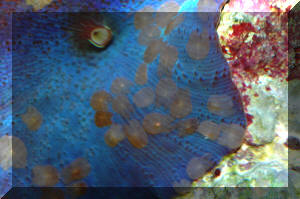
Does this look like fun to you? Here's an infestation of acoel flatworms (perhaps Convolutriloba retrogemma) on someone's (Birch Aquarium, San Diego, California, USA) Corallimorphs... Best to... leave them alone, siphon off, seek a predator?

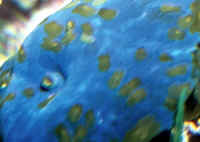
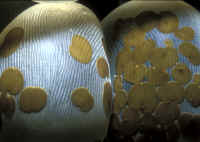
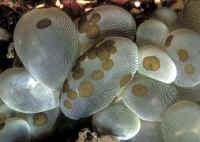
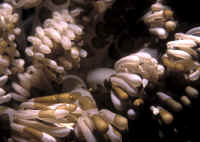
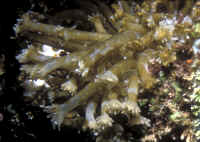
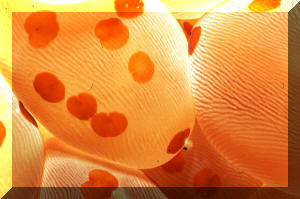
Waminoa sp. 1 Characterized by having a pumpkin silhouette appearance and a yellow dot at the base of their caudal notch (and a lack of other unknown members of the genus other coloring, marking characteristics...). Overall color due to algal symbionts (dinoflagellates, diatoms?). Think you've seen infestations? Here are some images made in the Lembeh Strait in N. Sulawesi. Below: on Bubble Coral (Plerogyra), Goniopora (Flower Pot Coral) and a Fungiid (Heliofungia actiniformes). 

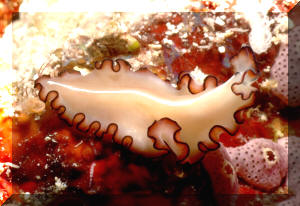
Polyclad Flatworms: Referring to their multi-branched digestive system. Similar to Nudibranchs, but lacking the latter's "naked gills"; flatworms are "flatter", and often much faster moving. 

Genus Pseudobiceros:

Pseudobiceros bedfordi (Laidlaw 1903). Amongst the more commonly encountered Indo-Pacific (East Africa to Micronesia) Flatworms. Feeds on tunicates, crustaceans. Fast moving. N. Sulawesi image. 

Pseudobiceros gloriosus Newman & Cannon 1994. Black velvet bodied with three marginal bands, outer dark burgundy. Melanesia, Australia, Fiji. N. Sulawesi image. 

Pseudobiceros hancockanus (Collingwood 1876). Highly undulated body margin with white and orange bands. To six inches in length. Indo-Pacific; Maldives to Fiji, Australia, Japan. Off Heron Island, QLD, Australia, and Nuka Hiva, Marquesas, Polynesia. 

Pseudobiceros sp. "#7". Here in S. Sulawesi.

Pseudobiceros sp. Here in S. Sulawesi.

Genus Pseudoceros:

Pseudoceros bifurcus Prudhoe 1989. Eastern Africa to Indonesia, Australia, Philippines. Pseudotentacles as simple folds. Distinctive white mid-line stripe that is orange at the anterior of the animal. To a bit over two inches in length. Off of Heron Island shown feeding on tunicates, another in N. Sulawesi. 

Pseudoceros dimidiatus von Graff 1893. Look for the double yellow "racing stripe" down the middle for this species. Other markings are variable to missing.  Central to western Pacific. One off of Kailua Kona, Hawai'i by RMF, another in PNG by PhilS. 

Pseudoceros ferrugineus Hyman 1959. The Fuchsia Flatworm Central and Western Pacific at moderate depths. Out during both day and night, often appearing bluish until artificial light is applied, and more round when fully opened. Hawaii pix. 

Pseudoceros lindae. Here in S. Sulawesi.

Pseudoceros monostichos Newman & Cannon, 1994. New Guinea and Australia. PhilS pic in PNG.

Pseudoceros sapphrinus Newman & Cannon 1994. Western Pacific; eastern Australia, Philippines, Marshall Islands. This one photographed in Fiji. Often encountered (day and night) crawling over Acroporids. 

Pseudoceros sp. N. Sulawesi.

Pseudoceros sp. Mabul, Malaysia and North Sulawesi. Black marginal stripe, undulated margin...

Pseudoceros sp. 4 Here in S. Sulawesi.

Pseudoceros sp. 5 Here in S. Sulawesi.

Pseudoceros sp. 6. PhilS pic in PNG.


Thysanozoon flavomaculatum Red Sea image.

Thysanozoon nigropapillosum (Hyman 1969). Dorsal surface black with short papillae tipped with yellow. White band around edge. Mid Indian Ocean east to Western Pacific. Photo taken off Pulau Redang, Malaysia. 

Parasitic Flatworms: Black-Spot Disease of Yellow Tangs

My graduate school roommate Mike Kent worked out the life-cycle of this Platyhelminth, Paravortex for his Master's Thesis. Other authors list the use of organo-phosphate containing medications to rid Yellow Tangs and other fishes (7 families, 130 some species) and their system of this turbellarian, but a simple freshwater dip, sans copper or anything else, wipes them out without having to put anything in your main system. After this knowledge became common and a routine freshwater dip procedure was adopted by wholesalers, we had a Dickens of a time getting more Paravortex. If your system will accommodate a cleaner goby, shrimp, by all means include one.

Flatworm Predators on Parade! 

Due to their bad taste, often outright toxicity, most flatworms are unpalatable to predators. However, there are notable exceptions. Some that may work are listed/pictured below:

Chelidonura varians Eliot 1903, THE Flatworm Eating Sea Slug! Tropical Indo-West Pacific. To seven cm. in length. This one off of Heron Island, Queensland, Australia. 

Lysmata wurdemanni (Gibbes 1850), Peppermint Shrimp, Caribbean Cleaner Shrimp. Tropical West Atlantic. Lives singly or in groups. Gets along with all aquarium species. Commercially produced. A reclusive, sometimes misidentified species (there are other shrimp from the area that are similar) used in the fight to limit Aiptasia Anemones in aquariums.

Halichoeres chrysus Randall 1981 (1), is a fish of two "good" and one bad common name. It should be called the Golden or Canary Wrasse for its bright bold sun-yellow color, but is most often listed as the Yellow Coris Wrasse (Arggghhh!, it is not a Coris genus member of course). This is an exemplary aquarium species that is suitable for peaceful fish-only and reef systems. To a mere 4 inches or so total length. Aquarium & S. Sulawesi photos. Eastern Indian Ocean distribution. http://fishbase.sinica.edu.tw/Summary/speciesSummary.php?ID=4855&genusname=Halichoeres&speciesname=chrysus


Pseudocheilinus evanidus Jordan & Evermann 1903, the Pin-Striped or Striated Wrasse (2). I like this fish’s other common names, the Disappearing or Vanishing Wrasse for its bashfulness. To a grand size of three inches. Indo-Pacific, including Red Sea and Hawai'i. Two in the Red Sea.

Pseudocheilinus hexataenia (Bleeker 1857), the Sixline Wrasse (2). A feisty, though small (to 4") a reef tank species. Indo-Pacific, including the Red Sea in its distribution. Aquarium and Queensland, Australia images.


Foods/Feeding/Nutrition:

    All Polyclad Flatworms are carnivorous, and specific about their prey. Most feed on sea squirts, bryozoans, small worms, crustaceans, or snails, but some are cannibalistic.

Reproduction:

    Platyhelminths are true hermaphrodites... being both male and female. Cross-fertilization is the rule with a "pair" rudely stabbing one another with a hard penile stylet to enact sperm transfer. As you know due to exposure with Planaria, they can also generate new individuals by splitting asexually.


Featured Sponsors:
Google
 
Web www.WetWebMedia.com

Amazon Honor System Click Here to Pay Learn More