|
FAQs about Flatworm Identification
2
Related Articles: Flatworms
(incl. Planaria), Pest
Flatworm Control by Anthony Calfo, Worms, Featherduster
Worms,
Related FAQs: Flatworm
Identification, Flatworm ID 3,
Flatworms/Planaria 1, Flatworms 2, Flatworms 3, & FAQs on: Flatworm Behavior, Flatworm Compatibility, Flatworm Control, Predator Control, Chemical Control, Flatworm Selection, Flatworm Systems, Flatworm Feeding, Flatworm Disease, Flatworm Reproduction, & Worms, FAQs: Worm Diversity FAQs, FAQs 2,
FAQs 3, & Worm IDs
1, Worm IDs
2, Worm IDs 3, Worm IDs 4,
Worm IDs 5, Worm IDs 6, Worm
IDs 7, Worm IDs 8, & Worm ID
FAQs by Group/Phylum: Flatworm
Identification ID, Nemertean,
Proboscis, Ribbon Worm ID, Nematode, Roundworm ID,
Nematomorpha,
Horsehair Worm ID, Acanthocephalans,
Thorny-headed Worm ID, Polychaete Identification, Polychaete ID 2, Tubeworm ID, Hirudineans, Leech ID, Echiuran Worm ID, Invertebrate
Identification,
|
|
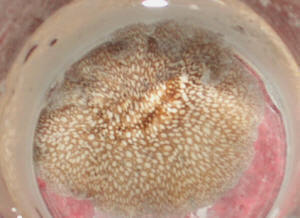
| Strange Creature 7/2/06 OK, so
I've been meaning to ask you guys (and gals) about this
creature, but I've only caught glimpses of it until now. Its
about 3-4" in diameter and roughly circular. It has no
discernible body and when it moves (which it can do pretty
quickly), it flows almost like water, following the contour of the
rocks. It is grayish-brown, spotted, and very thin. If touched it
gets agitated and the edges become very scalloped. I'm sure
someone there must know what this thing is. It's certainly
interesting. Its right below the orange sponge in the 2nd picture
and roughly in the center (towards 8 o'clock from center in the
first. Thanks TJ <Good description and nice photo of a resident
flatworm. See similar here: http://www.wetwebmedia.com/flatworms.htm Mmm, though many
folks seem to panic re such animals presence, I would leave this
one be... not likely harmful. Bob Fenner> |
|
|
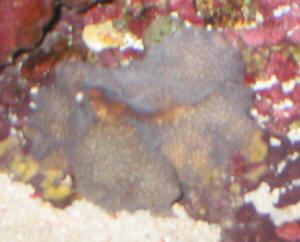
Black Nudibranch appears at night Hi WWM guys-
<Malcolm> Another ID question. Attached is a
blurry photo of a pure black Nudibranch (I guess) that appeared
first about six months after the live rock was placed in my 125
gal. We've seen it twice since the first time - only
at night. It moves very slowly on the
rock. Appears to have two tiny antennae. It
is pure velvety black. About 2 square inches and flat as
a piece of paper. I've searched my books and the net
and can't find it. <Looks like a flatworm to me, Pseudoceros
sapphrinus. And not a problem. Please see here: http://wetwebmedia.com/flatworms.htm>
(Up 9 months, 30g Eco-style sump with Caulerpa, 150#LR,
2"sandbed,2 soft corals, 2 polyp colonies, scattered native
corals and polyps, peppermint shrimp, pistol shrimp, 20 snails and
5 hermits, 7 Chromis, tang, 6-line wrasse, goby, Dottyback, pair of
perculas with a bubble-tip (now cloned into two), too much red hair
algae; 1.024, 80F, 0 ammonia, 0 nitrites, 4 nitrates, 6x65watt
compact fluorescents) You guys are invaluable to beginners like me!
Malcolm Young, Brevard, NC
<Glad to share. Bob Fenner> |
|
|
Mexican Skirt Dancer (Pseudoceros mexicanus), not Spanish Dancer
(Hexabranchus sanguineus) or Mexican Dancer (Elysia
diomedea)? 3/7/07 Hey <Yo!> I'm pretty sure I
know the Scientific name to this but I'm looking for pictures of it
but can't seem to find any. Its common name is swimming flatworm
(Mexican skirt dancer). <I have not found any images of (Pseudoceros
mexicanus). I'm presuming you don't mean a Spanish
Dancer (Hexabranchus sanguineus), which isn't a flatworm, but a
Nudibranch, or a Mexican Dancer (Elysia diomedea) which is a sea
slug. But we do have pics of these two! > I think the
Genus and species are Genus: Pseudoceros Species: Mexicanus.
However, I'm not fully sure. If you could confirm this that would
be great. <There is a flatworm with this name, Pseudoceros mexicanus
Hyman, 1953.> Also this If you could send me a pic of it that would
be awesome I've searched all over. <Nothing that I've found
on WWM. RMF any in your personal collection? <<Mmmm, no
unfortunately. RMF>> All right; thank you for your time
<You're welcome, sorry I couldn't be more helpful.> -A
person who loves marine biology <Ditto! -Mich>
ID this worm(?) please, and
Medusoid 1/17/06 Dear Sir/Madam,
<Will you read my book? Oh, sorry, not one of the Beatles
here> I have my marine tank 29 gallon BioCube in the 5'th
week of cycling. I also have about 28 lb of live rock and about 2
lb of live sand. This past weekend I've added an 11 snails and
6 red-legged hermits. Snails took a very good care of the algae on
the rock... Everything seems to be looking perfect, until I found
some kind of worm(?) on the inside glass eating the pods. <Mmm,
yes... some sort of Platyhelminth...> I have an extremely high
pods population: when I clean the glass inside, they will reappear
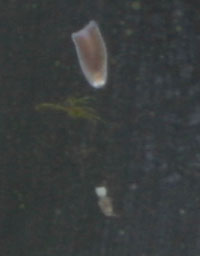
within the same amounts in about 2-3 days. I'm attaching a
picture with 2 critters one on the top is an unidentified one
(length of about 3-4 cm) and the bottom the pod that is about to be
eaten. This thing on the top moves really fast! I also noticed,
that there are one that is splitting on the glass, that looks like
there will be another two instead of one soon. It took that thing
to split up about 5-6h. Thank you very much for your time and
effort in maintaining such an excellent site. <Welcome... these
are flatworms... I would just wait, let them pass on their own here
(likely will in short order... no need to try and selectively
poison...)> There are also something else that I noticed
today...I turned off my powerhead, and noticed those little tiny
thing (about 2-3cm), that move by pulsating. Looks like jellyfish.
Are these ones good or bad ? <Mmm, could be bad... but likely
will also go of their own accord... Are likely some sort of
tissue-grade life (Cnidarian, Ctenophoran)... that are arising from
a hard substrate...> Unfortunately I were not able to make a
good picture of it, but it is on the 2'nd picture... <I see
this... a Medusoid of some sort... you can read about such with a
search of WWM, the Net... and the terms above.> Thank you very
much for all your help...Regards, Andy Stavickis
<Welcome. Bob Fenner> |
|
|
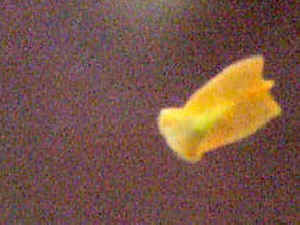
| Flatworm? Hi WWM crew, <Hi Manus> My
reef tank has been running for more than a year and everything
seems fine until recently I notice something like flatworm are
rapidly populating. But I'm not sure what it is
actually. I've attached a photo and hope you can
help me to identify. BTW, should I worry about this.
Regards, Manus <Is a flatworm of some sort. Please read through
the postings on www.WetWebMedia.com re these animals. Can likely be
ignored at this point. Bob Fenner> |
|
|
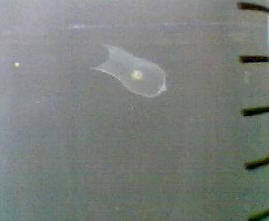
| Copepod eating flatworms... harmless 8/28/04 Hi
guys, Just a quick question. my tank has been set up for
a little over a year now and has had its ups and
downs. I was watching the tank when this odd creature
passed my line of sight. I watched until it settled on a
piece of LR and marked the spot with my flashlight. I
got a syringe I use for testing the water and was able to suck it
up. The pic attached here is of that syringe so you have
a little bit of a size reference. I have no idea what
this is or where I could start to look for information on
it. Any help is greatly appreciated. Another
size reference would be that it is about the size of a lower cased
"I" at 10 font. Thanks again, Todd <this
creature is a harmless copepod eating flatworm. They wax and wane
as copepod populations do. Most every aquarium has these critters.
No worries :) Anthony> |
|
|
ID Flatworms 2/10/05 Thanks a lot for your time
and for supplying an invaluable source for us reefers. <Always
welcome> Now the groveling is out of the way I wonder if I could
pick that wonderful marine brain of yours? My 50g reef has been set up
6wks and I have just started to add a few inverts, over the last week I
have added 6 blue legged hermits, 1 red legged and 6 turbo snails, all
seem very happy and active and are eating well, but as soon as I
introduced the blues, while waiting for the first inhabitants of my
reef to disperse. I noticed one of the blue legged isn't blue!
<Arghhh... some rogue species do enter this way. Do be very
careful> It is completely chalk white! After much searching over the
net and through books- to no avail. <do look in Paul
Humann's "Reef Creatures"> I came to the conclusion
that this must be an albino! <Ahhh... well, hmmm. Just because
you could not find a book that ID'ed the creature? Your pulling my
leg, right? :)> But I have observed further and the white hermit has
slightly different features, the right claw is about twice the size of
the left one, and as the other crabs stroll around the white one sits
in the sand with his shell buried at the front of the tank! he rarely
walks far! he has shed once so I am assuming he is good and healthy-
any ideas? <Many Diodenidae species> And is he reef safe?
<Hard to say, but the large claw is a concern. Form Follows
Function. That claw has a use/need> I do hope he will be ok, as I
have gotten rather attached to the little guy! Also I have a few small,
what appear to be sea slugs in the tank, they are about half the length
of your little finger nail.. <Please do read, learn, and apply
quarantine habits my friend. These risks and dangers will be
eliminated> ...and just have that Nudibranch shape with the rounded
head, and a kind of a lyre tail rear! <Chelidonura?> But
after a bit of reading thought they might be flatworms! <Hmmm...
similar general description, and preying on copepods if so, perhaps. A
Small white variety that fits that descriptions is rather common in
tanks> but cannot find reference to any flatworms (or anything
similar) this colour- they are a kind of translucent white, sort of
opaque- any ideas their? <Ah, yes... copepod eaters> And if they
are a pest, any methods of removal or reef safe predators I can
introduce? <They are harmless> Thanks a lot for your time, and
the service you provide. Mark <Best of luck and life,
Anthony>
Flatworm ID - 04/19/2006 Hello and greetings from sunny
Woodland Hills CA, <Hello.> Please accept
my apologies for not sending this directly through your website
link - somehow I managed to type-in the outgoing server information
wrong and now I can't seem to correct the format in my
computer. <We've gotten it just fine.>
I want to thank you for your website; it is an excellent resource
for novices like myself trying to create the most natural
environment possible for my marine pets. <Thank you, we're
happy to help.> By way of background, I have
been keeping a 40 gallon hex tank the "old school" way
(undergravel filter and dead coral skeletons) for years with some
success. I recently woke up to the new techniques available and
upgraded my tank to live rock (plus protein skimming, vigorous
water movement and addition of a 96 W power compact light and UV
sterilizer). Unfortunately, I had some trouble along the way
keeping water temperature stable and had to remove all my fish to
quarantine for Ich treatment. <Ouch!> Right now, I am in week
4 of a (minimum 12 week) fallow period. The tank still contains a
small Diadema urchin, two cleaner shrimp, one Peppermint shrimp and
a small colony of Zoanthids (live rock stowaways) which are all
doing very well. Ultimately, I would like to add back a few fish in
this tank, plus a small green star polyp colony currently in
quarantine (also a live rock stowaway) and maybe some mushroom
polyps later. <Ok.> Due to the stress of
having to remove everything to catch and quarantine my fish, the
tank had to recycle through its algae cycle. It is through the
diatom period and nearing the end of the Cyanobacteria phase. The
tank now is going through a hair algae bloom, which is subsiding.
Water chemistry is excellent. Now for my question - over the past
week or so I have been noticing ever increasing levels of what
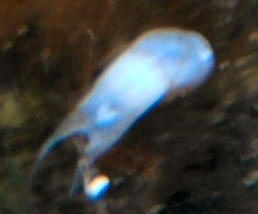
appear to be small slugs or snails grazing on algae. They are about
5-10 mm long and a translucent white-blue color. They seem to be
soft bodied with an internal "shell". Photos are
attached. Would you kindly advise if you can help identify and
provide any pertinent information. <This is a flatworm. Perhaps
Amphiscolops sp.> If this is a reason for concern or fish food
later? <Harmless. Here's some more info. http://www.wetwebmedia.com/flatworms.htm > They are
definitely multiplying pretty fast. <Can reproduce by splitting.
They can't really exist in high flow areas though, are they
growing quickly in dead flow areas? Likely won't last too
long.> Thanks in advance for your reply.
<Hope it helps some.> Scott (AKA
SharkBait)
<Josh.> |
|
|
| What the H, E, Double Hockey Sticks is
This? 1/8/07 Hi! I was wondering what this is. it
is slightly green in color, very flat, no shell, <That you can
make out> around 2 inches long and almost as wide. Movement is
similar to a snail, almost looks like some sort of Nudibranch.
Cannot see eyes, mouth, etc. It's kinda trippy, little
freaky! I have been having problems with margarita and
Astrea snails dying, don't know why. I found this creature
simply draped over 2 margarita snails in the sand at night, trying
to get at them. I think it was feeding on them but not sure. Do you
guys know what it is? <Mmm, is it very flat, wavy at the edges?
If so, might be a flatworm of some sort... If not, possibly a sea
slug of many possibilities...> It is certainly out of my tank!
It took some effort to capture, but I was successful. It is
currently in a cup with pinhole size holes in it, in a net, in the
sump! LOL! I had it in a sealed cup with bigger holes (approx.1/4
inch in diameter). Damn thing escaped within 3 minutes! captured it
again. I am gonna bring it to my LFS for identification tomorrow,
but not sure if they can help. Attached to this e-mail is the best
photo of it. Thank you! <Oh! Does appear to be a Platyhelminth
to me. Bob Fenner> |
|
|
|
|

