|
FAQs on Butterflyfish Diseases
2
FAQs on Butterflyfish Disease:
Butterflyfish
Disease,
Angels and Butterflyfishes &
Crypt,
FAQs on Butterflyfish Disease by
Category: Diagnosis,
Environmental,
Nutritional, Social,
Trauma,
Infectious, Parasitic,
Treatments
Related Articles: Butterflyfishes,
Related FAQs: Butterflyfish Disease 1, Angels and Butterflyfishes & Crypt,
Butterflyfish, Butterflyfish Identification, Butterflyfish Systems, Butterflyfish
Foods/Feeding/Nutrition, Butterflyfish Compatibility, Butterflyfish Behavior, Butterflyfish Selection,
Butterflyfish
Reproduction,
Hawaiian Butterflyfishes, Raccoon B/F's, Double-Saddlebacks, Threadfins,
|
|
 |
Butterflyfishes for Marine
Aquariums
Diversity, Selection & Care
New eBook on Amazon: Available
here
New Print Book on Create Space: Available
here
by Robert (Bob) Fenner |
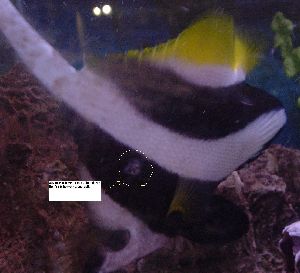
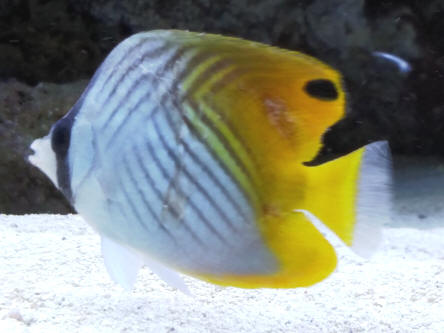
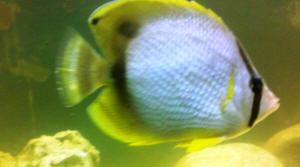
Threadfin butterfly; mystery single dot
9/10/18
I have a 130 gallon tank and just added a Sailfin tang and threadfin
butterfly to. Both fish came from. The same lfs from the same tank.
<Okay>
The owner did formalin bath/dip and had the fish for almost 4 weeks.
Only fish in the tank are those and 2 gold stripe maroon clowns and 2
weird looking Chromis who have been in the tank for at least a month.
The female maroon clown is constantly stirring sand up in her end of the
tank. I noticed a tiny white spot on my butterfly and panicked thinking
Ick. Later that night the spot was gone ( or seemed to be) didn't see
anything yesterday but this morning there is another one but in a
completely different spot and the first one is still not showing. Could
this be sand from the crazy maroon.
<Fish produce a sticky slime coat that protects them against infection
and disease, so you may be right, this could be just sand on your
butterfly´s body.>
The female clown will fan sand at the front of the tank anytime you walk
in the room or pick up a mouth full and spit it at you.
<Oh yes, these guys can be very aggressive guarding their territory>
I am new to the hobby so hoping I am just over reacting.
<Better safe tan sorry>
I have a qt set up ready for the b/f just in case. Water quality ammonia
is a little above 0 after adding the 2 fish,
<Your filter will adjust to the new bioload in a few days, so don´t
worry about the slight raise of ammonia, just don´t overfeed>
nitrites are at 0 and nitrates are <5. Salinity is 1.024 and pH is 8.0,
<I advise you to add a buffer to maintain ph at 8.3>
all fish are eating normal, no scratching that I have seen (and I watch
for hours or until I get a headache).
<Looks like you don´t have to worry, just keep an eye on the butterfly
and keep us posted.>
Thank you for any help you can give me. Stacey
<Glad to help. Wilberth>
Re: Threadfin butterfly 9/10/18
Thank you so much for the response. It was all gone later that night
then I actually saw the clown spray the b/f with sand. Clean as a
whistle all day yesterday.
<Great!>
I am glad I didn't have to stress them out again trying to net them.
Again, thank you for easing my mind. Has no idea the anxiety I would get
with this hobby!
< ¡Ah yes, the beauty of aquarium hobby! sometimes stressful but most
rewarding.>
Stacey
<Thanks for sharing, Stacey. Wilberth>
|
Bacterial lesion on Longnose butterfly?
12/4/17
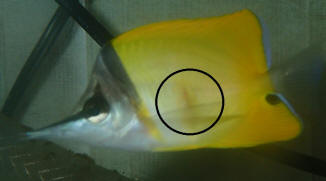
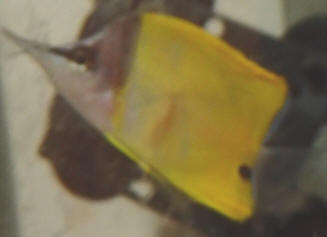
Hi Crew. Got a bit of a problem on a Longnose butterfly in quarantine.
<Mmm; I see this... inflammation, reddish patch>
I noticed a raised light colored patch on it this morning. Now this evening it
looks bigger, and deeper colored, and I am concerned that I need to do something
fast. It is in its second week of quarantine, and still eating and pretty
active. As always it is sort of hard to photograph, but the first photo is from
this morning at around noon, followed by ten this
evening. Any ideas?
<A few... this mark could be resultant from a physical trauma... whacked with a
net, bonked during handling, keeping... Might be bacterial involvement... to
some degree pathogenic perhaps. Is this Uronema or some other Protozoan
involvement? The only way (that I know currently) to tell is by sampling,
possibly culturing, and looking under a microscope... What would I do?>
Thanks! And once again, quarantine is the only way to go!
<Mmm; not in all cases, but the vast majority; yes>
Bruce
<I'd likely do a preventative dip/bath as detailed on WWM :
http://www.wetwebmedia.com/dips_baths.htm
and move this fish to the main display.
Yes; I'd take the risk of introducing a parasite (small enough chance here), to
save this fish by moving it to more stable, ideal conditions. Have made this
"triage decision" many thousands of times in handling imported fishes, retail,
service accounts.
Bob Fenner>
|
Re: Bacterial lesion on Longnose butterfly?
12/5/17
Thanks Bob. Unfortunately, when I got home from work, the fish had died.
<Aughh! I should have been more emphatic re moving it NOW. >
I hate killing fish! Assuming that it died from a bacterial infection, is
there anything special that I should do with my quarantine tank to make it
safe to add new fish?
<Mmm; not the system, or quarantine, but the protocol itself for given
species, AND specimens that are better off being "expedited". Not possible,
well, practical to try and relate the vast range of decision making here.
"It" would take reading all of WWM, us chatting for a few days re>
There is nothing in there but a filter, a skimmer, and a piece of live rock.
I assume emptying it and drying out the equipment should help.
Bruce
<Again; I don't think the issue here was "biological" (pathogenic), but the
species, this individual being "diffed". Bob Fenner>
|
|
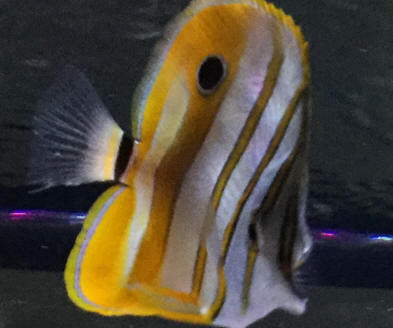
Copperbanded Butterfly with new spots
11/21/17
Hello. Love your guys site. Was hoping you could help me ID this disease.
<... 9 megs of uncropped pix John!? Looks to me to be Crypt-like.
VERY common w/ imported Chelmons... s/b pH adjusted freshwater dipped/bathed
enroute to quarantine for a couple weeks...>
Got this Copperbanded 3 weeks ago and he spent a week in QT.
<Need at least two>
Is eating bloodworms very aggressively and looks otherwise healthy.
<Ahh! Good signs>
Overnight he developed so damage to his caudal fin and now it has a
single white spot on it.
<Only the one? Might be naught/nothing... a pinch w/ accumulated mucus.
I would NOT treat>
He has no other spots or damage to fins. I’m hoping it’s lymph and plan to leave
him be and not stress him by throwing him back in QT. Doing a water Change today
as it is that time of month. Info on the tank he is in it is a
75 with a 30 gal sump and has been running for more then a year. All tank mates
look healthy (2 O. Clowns and a Flame angel, one first shrimp, one cleaner
shrimp). Thanks for any advice.
John
<Do stay vigilant.. i.e., keep an eye on this fish. Have a read on WWM re
Protozoans of marine fishes.
Bob Fenner>
|
 |
|
Ailing Pearlscale Butterflyfish 7/18/17
HI,
<Mike>
Thank you in advance for "listening" to my sick fish problem.
<What we're here for!>
Back in May (`24th) I picked up a group of Butterflyfish for my FOWLR tank (2
Pakistani, a Longnose, a Saddleback and a Pearlscale).
<Ohhhh, all faves of mine>
I have been using a three 50gal tank QT system with hyposalinity (1.01 SG) (I
have since read your recommendation of skipping the QT and just doing a FW dip).
They stayed at that level for 3 weeks. Everyone did well except the Pearlscale -
he would not eat. Since the QT tanks were all one system I took 3-4 days to
raise the salinity to 1.021 which is where my display tank is at and moved
everyone but the Pearlscale into the display tank. I was tempted to move him to
but then I noticed he had a patch of darker scales on his side (pic
1). After a few days I noticed there were a few dark dots near the base
of his tale - I thought - black spot disease?
<Mmm; no; not this. Likely simple trauma; damage from collection, handling,
shipping>
I didn't see how that could have
survived the hyposalinity but nonetheless I tried a treatment of PraziPro.
After 5 days I remembered I had some Chloroquine Phosphate in the house.
So I did a 20% water change and treated him with that. I spoke to the
manufacturer and they suggested giving 2 treatments 3 days apart. If that had no
effect to try erythromycin. There was no change - in fact the dark
area on his side was getting larger. I added carbon and a 20% water change.
Then I went to the LFS and he didn't have erythromycin so he have me two
treatments worth of CLOUT tablets to try. I tried two treatments.
<Mmm; I wish you would have written sooner. None of these treatments is
of use; will help. I'd move this fish into the main/display and not worry re
biological disease here>
No improvement (Pic 2). By the way it had now been 6 weeks and I still haven't
seen him eat. I added carbon again and did another 20% water change and figured
I would let him live out the few days he had left in peace. A few days went by
and I found some OLD (probably ineffective) erythromycin (it still has a 'Mail
Order Petshop' label -so real old). I figured the worst it could do is hasten
the death of a lost fish so I treated him with that.
Still no change. I put carbon back in. Now I am out of options (I probably
poisoned him with too many drugs). Unless you have any other suggestions I will
just let things lie. But from the pics, do you have any idea what this might be?
I would appreciate any insight you can give.
Thanks,
Mike S.
<Move this fish. Bob Fenner>
|
 |
|
Small brown lesion on new butterfly
11/13/16
Hi WWM Crew, As always, thanks for your great service to the community!
<Welcome Bruce>
I just received three lemon butterfly fish for my 200 gallon Hawaiian
biotope aquarium.
<A fave species>
They are in the quarantine tank and all eating very well. On the third day,
I noticed on one fish a small, brown lesion at the attachment of the left
anal fin. Today is day ten, and it seems to be slowly growing. The fish is
somewhat more timid than the other two, but is eating well, and swimming
about the tank with the other two.
<Good>
When the fish arrived I performed a fifteen minute freshwater/Methylene blue
dip. At first, I thought the lesion might be a flat worm. Since the fish was
swimming about so quickly, I could not get a good view of the sight for long
enough to evaluate. I therefore started treating with Prazipro this morning,
but now I am not so sure it actually is a flatworm.
<Mmm; no>
I finally was able to get a photograph. It is not as clear as I would like,
but I have attached it. I have searched your site and others, but have not
been able to identify the lesion with any degree of certainty.
Are you able to tell what this might be, and recommend an appropriate
treatment plan?
<Well; this appears to be a sore... resultant from collection likely... got
whacked by a hand-net or struggled against the barrier net or such>
As background, the QT is currently running at 1.024 spg, with an on-the-back
filter, and an air stone for increased oxygen, as well as a skimmer, with
the collection cup removed while I am treating with the Prazipro.
<I'd not continue the Prazi... of no help here and likely debilitating to an
extent>
Thanks for any help you can provide.
Bruce Ritter
<Good conditions and time going by will tell here. Bob Fenner>
|
 |
|
Re: Quarantine question
9/15/16
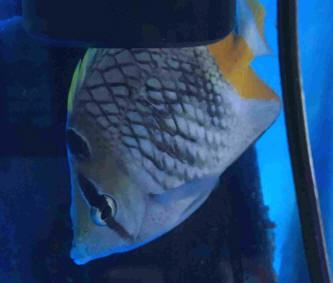
I have a Threadfin Butterflyfish that looks like it is hemorrhaging and some
of the scales seem to be separating.
<Mmm, I see this>
Attached is a picture. It is especially evident near the dorsal fin and down
the side of the fish. Any idea what this might be?
<Yes; this fish is classically "breaking down"... can't tell exactly from
what from the pic (need more information re the recent past... system,
handling... AND sampling and microscopic exam to be sure re ext. parasitic
involvement. HAVE seen Uronema, Cryptocaryon... Mycobacteria almost
always.... w/ such fishes. I would tell you that w/o immediate action (I'd
lower spg drastically; like to 1.010) this fish will soon perish. I WOULD
remove it, or all other fishes from the same system. There are blitzkrieg
type treatments... that attempt to treat all likely pathogens... A poor
avenue to take.... Do you have time to study, NOW? Bob Fenner>
Ciao,
Steve
|
 |
|
Re: Quarantine question. Auriga BF
9/16/16
Hi Mr. Fenner,
<Hey Stephen!>
Thank you for the input and analysis. Unfortunately, the fish perished
yesterday. All of the other fish appear to be healthy - eating very
well, behaving normally.
<Ahh; yes to the early demise of the BF. As prev. stated, DO KEEP AN EYE on your
other fish livestock. It may well be that they will be similarly stricken....
and COULD perish in likely soon order>
As you can see from the email string, I have had unbelievable challenges trying
to get the last two fish in my main tank. I was trying to get a Yellow
Long-nosed Butterfly fish and the Threadfin. Per your advise, we had been
bypassing the QT and doing a freshwater dip and placing them in the main tank. I
have lost two sets of each of these fish with this Threadfin being the last -
having survived for 41 days. I purposely chose these two fish because everything
I read said they are the easiest Butterfly fish to keep. I am now ready to throw
in the towel on trying to add these two fish to my aquarium.
<I'd look to other families of fishes>
I currently have the following in the 220 gallon tank: 3 orange Ocellaris
Clownfish, 2 Black Ocellaris Clownfish, Flame Hawkfish, Tailspot Wrasse, Yellow
Tang, Hepatus Tang, Blond Naso Tang, and a Coral Beauty. I would like to add two
more fish. Do you think this size tank will accommodate two more?
<Yes I do>
All of the fish I have are small except the Blond Naso Tang which is about 7".
If you think I have room, I was thinking about adding a Blue Throat Triggerfish
and a Royal Gramma. What are your thoughts?
<These are good choices. >
Thank you as always.
Ciao,
Steve
<And you; Bob Fenner>
Re: Quarantine question 9/16/16
Thank you!
Ciao,
Steve DeFilippis
<Certainly welcome. BobF>
|
Mueller Butterflyfish
7/29/16
Greetings,
<Salutations>
I'm an experienced reef-keeper attuned to fish disease and am looking for
insight into this situation:
I have a 187 gal reef with a Mueller, Tinker, Percula Clown pair,
Bristletooth Tang, Melanurus & Pygmy wrasse. All my fish go through Tank
Transfer Method, a freshwater dip and quarantine prior to introduction to the
display and all inverts/rock/anything wet is fallow for 12 weeks in a qt.
<Commendable>
For the past month, about the time the Melanurus wrasse was introduced (possibly
related, although, I haven't witnessed aggression) the Mueller has displayed
frayed fins and lethargy during feeding. I've had this fish for years and feed
it 3x/day (most days) and am aware of its shy feeding behavior and nutritional
needs, but something
is off. I see no evidence of parasites aside from torn fins, the gills are
functioning normally, fins/body clear, no clamping, twitching, flashing, shaking
etc. What I do see is a raised scale and frayed fins, I also see a section of
the bristletooth's tail fin is torn, so I suspect a bully, but haven't narrowed
in on any of the inhabitants.
<Could be the Halichoeres>
Is it plausible that ectoparasites are the culprit?
<Mmm; possibly, but what? Trematodes? From where?>
This has been going on for many weeks and no other symptoms have developed that
would suggest.
In microscopy, is a skin scrape effective or should I take a gill sample or
scale?9
<The skin, near the fins>
My other thought is that something is internally wrong with the Mueller, his
body weight is ideal, eyes are clear, diet is proper, but I'm seeing this slow
dwindling behavior and perhaps the other fish are picking on him for it and it's
not something I can resolve.
Sincerely,
Sarah
<If there was a simple way to catch, keep the Melanurus out for a couple weeks;
or float in a plastic colander if you don't have other room; this is what I'd
do. Bob Fenner>
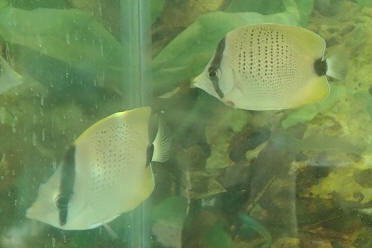
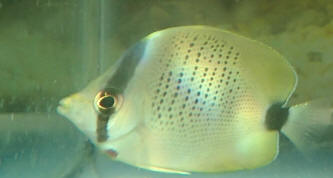
Miliaris #1 & #2
3/6/16
Greetings,
<Salud>
I've been attempting to keep C. miliaris and the first died in qt after
10 weeks from what I thought was an internal bacterial infection -
bloat, constipation, stopped eating and died. Attempted to treat
with Kanamycin and used Epsom salts for constipation.
<Mmm; this is a fave B/F; Hawaiian endemic>
I ordered yet another and reduced the overall time spent in qt to 8
weeks, here we are at 9.5 wks and the fish has looked quite good in the
display, but now is displaying similar symptoms to the first:
minor bloat, constipation, enlarged anus which looks frayed, still
eating, a bit reclusive. I stopped feeding and the constipation
improved, but it left his anus large and damaged. I'm thinking of
leaving him in the display with hope his own defenses can take care of
the perceived infection.
My question is whether this is common for this species and if it is
likely tied to the shared qt both used?
<These sorts of losses are (too) common for Chaetodontids period. I am
not a fan of quarantining, isolating any member of the family (and
a few others). Better to expedite... dip/bath new specimens, and plunk
them into established displays directly>
Are internal bacterial infections contagious?
<Mmm; not really... there is some more issue w/ hyper-infective states,
but it is the pre-disposing conditions: stress, starvation, ammonia
burn.... a myriad of other factors; that tip the balance between health
and disease>
I think I will sanitize the qt, but am concerned for the other fish in
the display.
Sincerely,
Sarah
<Do read here:
http://www.wetwebmedia.com/mardisease.htm
and as much of the linked materials at top till you feel you have a good
grasp.... Bob Fenner>
Re: Miliaris #1 & #2 3/7/16
Thank you, this was knowledge I needed...I'm assuming you're referring
to a formalin dip?
<Mmm; possibly.... please read here: ....
I've used it successfully to treat flukes (2 wks in hospital tank with
dosage from bottle), but each fish developed a post treatment condition
seemingly related to a suppressed immune system. For ex. the female
percula's colors faded and the Butterflyfish and tang continually
developed small infections whereas
beforehand they were all long-time seemingly healthy inhabitants, all
which died within the next year. Perhaps a dip would not have this
side-effect? Or are there other recommended meds such as Acriflavine?
<Here:
http://www.wetwebmedia.com/dips_baths.htm
and the linked files at top>
Btw, the miliaris is demonstrating improvement with the infection, I'm
continuing very small 3x/day feedings and optimal water quality.
<Good>
Sincerely,
Sarah
<BobF>
Treatment for Internal Bacterial Infection; BFs
12/31/15
Greetings,
<Salutations Sarah>
I'm a seasoned aquarist and had a newly acquired C. miliaris Butterflyfish doing
well in quarantine. The water was clean and no ammonia/nitrate/nitrite; fed
homemade seafood blend in small amounts multiple times/day. Fish began to
display bloat and constipation (no worms present in feces). With no improvement
over a week, I added Epsom salts to the water (which appeared to help the fish
pass some feces) and Kanamycin to the frozen seafood. After 3 days of treatment
the fish continued to decline and died. I don't suspect ectoparasites as there
were no behavioral or visible symptoms.
<Mmm; well; for the record and browsers I should mention that Butterflyfishes
are notoriously poor shippers; get very stressed in the process of collection,
holding, transit...>
My question is, for next time do you recommend a different antibiotic for
internal bacterial infections.
<Mmm dos; the best all the way around is likely chloramphenicol
(chlormycetin).... most places have to get a doctor or vet's help>
Should I have bumped it up to something like doxycycline or any general advice?
<Not likely of use.... am a fan of dip/bath processing Chaetodontids.... and not
quarantining usually. Too many (much higher percentage) are lost to delay,
further stress... best to speed along to placement in main displays.
This is my hard-earned opinion borne of handling many thousands of these fishes.
I also include Blennioids, gobioids; quite a few other fish groups here.>
Sincerely,
Sarah
<Cheers, Bob Fenner>
|
Butterfly fish
10/4/14
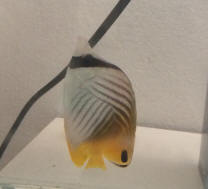
My Auriga butterfly has been swimming upright since I woke up..
I dosed Cupramine 2 days ago when he showed some spots on his tail.
Will send a pic later!
<Mmm; likely poisoned, or too far gone from... ? Bob Fenner>
Butterfly fish
10/4/14
He's been like that for around 2hours so far
<Damage to the gas bladder? Need data. See WWM re Chaetodon auriga. BobF>
|
 |
|
Re: Butterfly fish
10/5/14
Anything I could do to help?
<... can't say w/o data... Read where you were referred to for examples of
what we're looking for. B>
|
Klein's Butterfly Heavy breathing no appetite; and no data
4/17/14
Hi I have a Klein's Butterfly been in my tank about 2 months. He is
usually a ravenous eater of nearly everything but in the last 24 hours
he has stopped eating and his breathing is heavy and very fast.
<Mmm... time for a quick partial water change, wicking off any surface
film... Possibly just low DO or high CO2 here>
All parameters in tank perfect.
<Null...>
55 gallon, 6 year old tank? Anything I can do to help it?
Thanks for any help offered. John
John McGuire
<... need more info... e.g. what else is in the tank, gear,
maintenance...
Bob Fenner>
Re: Klein's Butterfly Heavy breathing no appetite... Poisoned by
algicide use 4/17/14
Hi bob,
<john>
Tank mates are marine beta, 6 line and fire shrimp. The tank is at my
office and professionally maintained. Have an algae problem and the
person who looks after it applied API algae fix
<Uhh, a huge mistake... poisoned the system>
about 3 days ago. Plenty of water movement. Other tank mates are fine.
Refugium, large skimmer etc. thanks for any help offered. John
<.... see/SEARCH on WWM re chemical algicides... CHANGE as much of the
water as you can/have... and look into the chemical filtrants in your
reading. BobF>
|
Chelmon Muelleri with likely infection
12/16/13
Greetings,
<Sarah>
I have a well established 120 gal reef system, in Aug I introduced flukes
via snails and had an epidemic. My Chelmon Muelleri survived and has
been the only fish in the tank (was reintroduced Oct 26th) since the others
weren't as fortunate.
<I see>
After the fluke infestation was treated I've been battling secondary
infections with this fish, all were healed when suddenly he's developed a
rather large bump (~3/8") behind and above his eye. There is slight
underlying redness and seems slightly irritated. My question is does
this warrant erythromycin in food for 10 days or would it be wise to simply
observe?
<I think so. Unfortunately "what it takes" to actually sample, culture and
test for resistance/efficacy in the way of anti-microbials isn't "worth the
damage" here (in my perception, experience of course)>
I've attached two pictures from when the lights are out, strangely that's
when I get the best pictures-you can see the redness and the bulge.
Sincerely,
Sarah Hlavenka
<I would instead seek to boost immunity, recovery via optimized, stable
conditions and improved nutrition (HUFA, vitamin soaking of foods). Bob
Fenner>
|
.JPG)
.jpg) |
Re: Chelmon Muelleri with likely infection
12/16/13
Basically he said treat with optimal water conditions, fatty acid and immune
system supplements.
<Ah yes. BobF> |
|
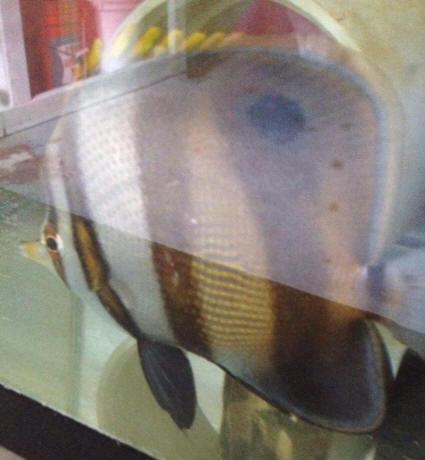
Fluke surviving Muelleri Butterflyfish in QT with bacterial
infections (?) 10/13/13
Greetings,
<Good eve Sarah>
A friend of mine recommended you with the highest regard. I've
attached a cell phone picture (I don't have a regular camera, sorry) of
the affected area on my Butterflyfish. I've had him 15 months, he
eats live blackworms and a homemade frozen seafood blend.
Parameters are good in the quarantine.
The photo: Below the glare line in the middle brown stripe the lesion
like area is visible. There is some redness, the scales are raised,
inflammation is visible from the profile view and there are a couple
white apparatus' attached next to the inflammation. The white apparatus
will begin small and hard like, very bright white and after a couple
days grows larger and more flesh like, hangs off the fish (can visibly
see it moving as he swims) and then falls off. Above the glare line is
an example of one that can be seen moving in the current as the fish
swims. A 5 min fw dip didn't seem to affect the area.
<... have you looked at this material under a 'scope?>
I dosed Kanamycin into the water 2 days ago, also have been feeding in
frozen food. It seems too early to know if it's working.
Currently, the fish is eating, but hiding in his pvc most of the
time.
Additionally, he had a lower jaw (inside the mouth) infection that is
now reoccurring.
Thank you for your time.
Sincerely,
Sarah
<I suspect the white material is simply "mucus" (body slime)... an
exudate... from...? Not curable w/ antibiotics, nor
quarantine/isolation.
Do you suspect there is a parasite here? I would move this fish back to
the main/display system. Bob Fenner>
|
 |
|
Re: Fluke surviving Mueller Butterflyfish in QT
with bacterial infections (?) 10/14/13
Thank you, Bob. I've been actively looking for someone to look under a
'scope, although, I'm concerned about increasing the fish's stress level as
he's been in hiding except for feeding time for several days.
<You are wise here... life is indeed "a series of compromises", and you are
right to consider the trade-off in handling this (or any) specimen>
This fish has undergone 17 days Praziquantel treatment (unsuccessful)
followed by 23 days Formalin, which I believe, effectively eliminated the
flukes.
<... am very surprised it didn't eliminate the fish>
I feel the lesions/mouth infection are some sort of secondary ailment - i
have read flukes are like portals for other diseases.
<Can be>
I do not know if there's some sort of parasite at this time.
<Highly unlikely... grossly appears to be "sores"...>
The fish's name is Ziggy.
<"Ziggy played guitarrrrrrrr" Bowie>
I appreciate your time.
Sarah
<And I everyone's. BobF>
Re: Fluke surviving Muelleri Butterflyfish in
QT with bacterial infections (?) 10/15/13
Good Day Bob,
<Sarah>
Took Ziggy in this morning for a biopsy. The man said there is no mucus
by the sores (which is bad), so he pulled a scale via tweezers
and looked under the 'scope.
<Good>
He told me there are no parasites (I assumed) and that
the infection seems to be coming from the inside out.
<Yes>
All he could say is that it's bacterial and suggested running a
full 5 day course of antibiotics, which I have been (Kanamycin - in food
too) with today being the 5th day. Lastly, he said to begin treating
tomorrow with a Nitrofuracin product because they are absorbed well.
<Yes; better... though best would be to do a rudimentary sensitivity
test/run... >
I have a seeded identical QT and could treat with NFP Nitrofuracin green
powder immediately or I could wait out the day with the Kanamycin
treatment like the man suggested?
<I'd just stop the one and start t'other if you're adamant re
such antibiotic/antimicrobial treatment (I am not... most such
treatments are more destructive than useful... microbial issues
starting w/ other causes... mostly environmental, social, nutritional...
and cured by fixing the same. Moving, isolating specimens... is much
more likely to kill them>
I'm reluctant to wait and "see what happens," yet, very cautious.
He also said the fish looks very healthy aside from the bacterial
infection.
<Yes; all the more reason why I'd move it... not treat>
For the past few days, the fish has been hiding in a pvc and reluctantly,
(which is a new development) ate a few live blackworms today.
Sincerely,
Sarah
<Cheers, B>
PS - I am very thankful to have found your site, will donate.
|
|
Re: acclimatization; Mmm, sand use in QT sys., BF dis f's
7/1/13
Hello my Mentor. :)
<Hola Tomasz!>
Regarding the sand I was concerned about whether to keep the fish in
tanks shop with sand or without it, how is better. Ok invalid.
<With sand is better unless the water, fish is being treated with
chemical/s that absorb it too much>
In Annex I send photo, if you could see and write what kind of
disease (bacteria / parasites). Is it contagious? if so, how to treat
other fish?
How to prevent.
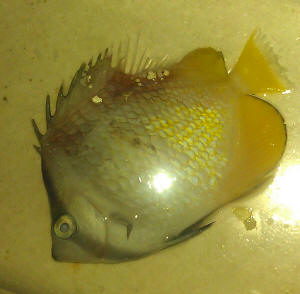
<Looks like this Klein's Butterfly has been consumed by some sort of
flesh eating bacteria. But such infections are almost always secondary;
caused by primary challenges of the environment, some lack of nutrition,
bullying, luminal worm, external parasite issue/s... The bacteria only
jumping in number, pathogenicity due to weakening of the fish/food
consequently.
Please read here re:
http://www.wetwebmedia.com/mardisease.htm
I installed on my system ozone. At this time, ORP is 270mV, I understand
that it would be best as that was 400mV?
<Yes; between 325 and 400 mV>
Thanks again for help Bob.
Tom
<Ah welcome. Bob Fenner>
|
 |
to quarantine or not to quarantine <Chaetodontids>
4/25/13
Hello Crew,
Rich here.
Here is my dilemma; I had a 55 gallon FOWLR for seven years. I set up a 29
gallon high as a quarantine tank, Emperor filter, heater, light, air
pump, some PVC pipe at bottom for a place to hide. I used water from my
55 to fill it along with some RODI water.
<Good>
Temp is 79, salinity 1.023, PH 8.3. ammonia zero, nitrites zero. nitrates
5. I moved my five zebra barred dart fish into the 29 high.
<Mmm, I hope they were all friendly/known to each other before being
crowded here>
I then set up my 180: two overflows into 40 gallon sump, two Tunze pumps
moving about 450 GPH each after head and turns in plumbing, two Koralia
circulation pumps each rated at 850 GPH, 160 lbs of live aragonite,
about 100 -120 lbs of live rock from my 55 gallon, Tunze DOC 9011
skimmer. I filled it with about 30 gallons from my 55 gallon tank and
RODI water.
<With you thus far>
For ten days ammonia and nitrites were zero, and nitrates 10. Temp is
79. PH 8.3, salinity 1.022. I took a chance and put my dart fish in the
180. No change. I quarantined six small, about 1", green Chromis
<A touchy species when small>
for ten days, and moved them into the 180. Everything has remained stable.
No change. I quarantined six small, about 1", green Chromis for ten
days, and moved them into the 180. Everything has remained stable.
The 180 has been up and running for a total of about 30 days. I purchased
two butterflies, a 3 inch Indian Ocean Double Saddle Back and a 4"
Pearly Scaled. They were in the LFS for over three weeks and looked and
acted and ate fine. I put them in my quarantine tank four days ago and
they seem OK.
They are fed frozen Mysis shrimp along with frozen Cyclop-eeze and
occasional flake. I planned on keeping them there for three weeks so my
180 would have two months to run, but now I am reading that some people
think it is better not to quarantine butterflies.
<Yes; depending on their apparent condition, the species; better to
expedite, perhaps run through a prophylactic dip/bath enroute from
shipping instead>
OK. They are fed frozen Mysis shrimp along with frozen Cyclop-eeze and
occasional flake. I planned on keeping them there for three weeks so my
180 would have two months to run, but now I am reading that some people
think it is better not to quarantine butterflies.
<Shouldn't be a problem w/ these species to keep in the 55 for a while;
even the 29 if they're getting along>
I fear that my 180 is too new to put them in. Do you recommend taking a
chance keeping them in the 29 gallon or move them into the 180? I
feel like I have no easy decision here. Thanks.
<I'd leave them where they are for a while; closely observe. IF they
begin to quarrel, move. Bob Fenner>
Quarantine Question, and BF hlth. f'
4/16/13
My current tank is a 150 gallon FOWLR that has been running for 18
months now. No new additions in nearly a year.
Current residents in the tank are in order of introduction are 2 - 11
year old Amphiprion Ocellaris (Ocellaris Clowns) mated pair and laying
eggs about every 4 to 8 weeks
<Neat>
10 - Margarita Snails
10 - Dwarf Yellow Tip Hermits
10 - Turbo Snails
10 - Nassarius Snails
3 - Chromis viridis (Blue/Green Chromis)
1 - Pseudocheilinus hexataenia (Six Line Wrasse)
1 - Coral Banded Shrimp (Stenopus hispidus)
1 - Ecsenius midas (Midas Blenny)
1 - Ctenochaetus strigosus (Kole Tang)
1 - Centropyge eibli (Eibli Angel)
I do a 10% water change weekly and test water conditions each week with
a test kit along with monitoring PH and temperature with a Neptune
controller.
Controller also controls my top off system.
<Ahh, am familiar. Nice units>
Latest tank conditions are PH 8.20; Ammonia 0.0 PPM; Nitrite 0.0 PPM,
Nitrate 10.0 PPM, dKH 8; Calcium 320 PPM, Phosphate 0.0 PPM.
<All fine; yes, including the "low" calcium>
I am thinking of adding a couple of butterfly fish (2 of the 3
following:
Raccoon BF- Chaetodon lunula; Longnose BF- Forcipiger flavissimus;
and/or Auriga Butterflyfish - Chaetodon auriga). I prefer the
Raccoon and Longnose, but based on availability am flexible. I would
really like to get a <http://www.wetwebmedia.com/raccoon.htm >
Chaetodon fasciatus over the lunula but that's a pretty big price
premium.
<Mmm... any two of these should work here; though I wish your tank was
fifty gallons larger and two feet wider>
Considering the circumstances and as a general rule, which is better to
quarantine two new (or multiple) fish simultaneously and upset the
balance of the whole system at once or quarantine sequentially and
stress the whole
system twice.
<Good question... as it is complex... Depends on the species involved
mostly; next their relative (to established tank-mates principally)
size/s; and apparent/real health... In this case, placing whatever of
these Chaetodontids at the same time is better... though they will be
much better isolated/quarantined separately if more than 2-3 inches in
overall length (many BFs "quarrel" as adults unless (until) "paired">
Regards,
Brian
<And you, Bob Fenner>
|
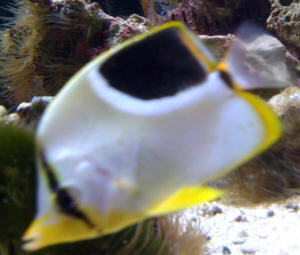
Sick Spotfin Butterflyfish 06/18/11
Good Evening,
<Eric>
I am hoping you can help me nurse my Spotfin Butterfly back to
health. I caught this fish myself off the cost of New Jersey five
years ago and raised it since it was the size of a dime.
<Neat, and you are to be commended. This BF is not easily
kept>
About a month ago we had a long power outage. The next day the
fish developed white film over both of it eyes.
I let the fish be for two weeks and did frequent water changes
thinking this would cure the problem.
<A good approach I'd warrant>
The fish than proceeded to get these white attachments that would
hang on the tail. I attached a picture and hoping you can see
what I am referencing.
<Barely>
When none of these symptoms cleared and the eyes still remained
cloudy I decided to treat for a bacterial infection.
<Mmm>
I treat with Maracyn which had no effect and most recently with
Nitrofurazone. I have not seen any improvement in the fish and am
kind of lost on what to do next. Does this look or sound familiar
to you?
<Yes... "just" stress, mucus...>
Is there a treatment you can recommend?
<Yes... just time going by and good care. Should clear of its
own accord in a month more or so>
I appreciate any advice you can provide.
Thanks,
Eric
<Welcome. Bob Fenner>
|
|
|
quarantining
b/f's and mandarin? 6/8/11
Good morning,
<Mike>
I will be receiving 3 B/F's and a Mandarin Fish mail-order later
this week. I have a 30g quarantine tank ready to go but have a couple
of questions.
Would it be best to do a PH-adjusted, freshwater dip w/Methylene Blue,
on the Mandarin and place him in my established 125g FOWLER tank?
<Yes; this is what I would do; not quarantine this family
(Callionymidae) and a few other fish groups, unless there was something
apparently "wrong" with them>
After reading most of the FAQ's on these fish, I realize they are
not as susceptible to Ich but I am quite paranoid about its (Ich's)
re-introduction into my tank as I have battled it on and off for two
years (luckily with me winning or more likely in a stalemate with the
enemy!) with no loss of fish.
<Mmm, well... up to you>
On to the B/F's! I'm getting a Tear-Drop, Pakistan and
Black-Backed. I realize these fish are quite sensitive and will most
likely start eating prepared foods and re-build their resistance once
placed in the main tank, but would a week or so in quarantine then a
freshwater dip w/Methylene Blue or Formalin (safe for B/F's ?)
<Toxic, but if they're in "good shape", likely worth
using>
be better for the fish than acclimating them, freshwater dipping them
and immediately placing them in the main tank?
<I would likely quarantine these, given your system (the 30)>
I've read about every FAQ's on B/F's and added to them with
some of my questions in the past but I am on the fence here on whether
to quarantine or not.
<Me too/I as well>
Even though I have run my tank fallow for several 8-week periods over
the last two years I know I still have some entrenched Ich. The last
time I added 4-week quarantined B/F's I had an outbreak but decided
to treat with Selcon soaked Spectrum flakes and Spectrum Thera-A
pellets. The fish kept the cleaner shrimps very busy, but all came
through and continue to thrive.
My point is, quarantining or not, with my particular tank, probably
means a small outbreak of Ich once new fish are added.
Lastly, even though the HOT refugiums are small, about 3-4 gallons,
would you recommend one for pod growth for the Mandarin or am I wasting
my money?
<Are worthwhile. Even what appear to be small volumes of
"live" sand, other substrates, macro-algae, a very
considerable amount of life is produced>
Thanks in advance for all your insight and wisdom. I spend most
evenings perusing your excellent site and wish you all lived closer so
I could buy you a beer or two!
<Oooh! Let's hope we meet! Bob Fenner>
Mike
Quarantining
Butterflies/Quarantine, Yes, Or No 8/5/10
I have been reading some opposing views on butterfly quarantining.
<Oh, I know where we are going.>
I have read of course, that ALL fish should be quarantined for a period
of at least two weeks, and best to QT for four weeks.
<Better for four.>
But I have also read that QT'ing butterflies can be chancy.
<I have to agree somewhat.>
Indeed, my experience has been that my I lost three butterfly fish in
QT (one C. miliaris,
<Lemon Butterflyfish for our readers.>
and two Blackback, C. melannotus) <melannotus> These fish did not
show any outward signs of illness. They simply died after a few
days.
All of my other fish have survived QT (another C. miliaris, Naso
lituratus, three Centropyge, and Chromis).
If it is ill advised to QT butterfly fish, then what is a safe
alternative?
If QT'ing a butterfly is still recommended, what would be a way to
increase their chance of survival?
<I would tend to agree with you, with all things being equal,
chances of success are in your favor directly acclimating the fish to
the display tank. There is a downfall to that; Should one of these fish
noticeably develop a life threatening disease, you risk wiping out your
entire fish livestock collection if a large enough QT is not available
to house and treat these fish.
There are of course other reasons that can be attributed to your
demise.
Butterflyfish are likely one of the worse shippers, they do not handle
stress well, and they get fed plenty of that from reef to your
tank.
Quarantine just adds another dose of stress to an already stressed out
fish. Although I am not recommending that you do not quarantine, the
choice will be yours to make. Some guidelines to avoid future deaths is
to choose Butterflyfish which are known to be hardy and good
acclimaters, there are a handful. The two you mention above, I would
put at 5-6 on a scale of 1 to 10 in terms of long term survivability
with 10 being the better number.
Inspect the fish thoroughly before buying. Ask the LFS to feed the
fish, observe it's feeding personality, does it go after the food
aggressively, or does it sample and spit.
I personally do not QT Butterflyfish, but then I have a dealer who is
willing to hold a fish for me for several weeks providing I pay for it
and expect no refund if it dies.
One of the good points about my dealer, other than being meticulous, is
that he will rarely bring in fish that are known to be difficult to
keep.
I'd like to suggest reading here before making future purchases to
help you decrease future losses.
http://www.wetwebmedia.com/MarLvSel.htm
>
Thank you very much for your help!
<You're welcome. James (Salty Dog)>
Bruce
26/02/10
Stumped.... Forcipiger hlth., troubleshooting
Hi everyone.
<Hi Jay>
I am quite confused about medicating a Long nose Butterfly.
<Ok>
I recently treated my long nose with Quinine Sulfate for Ich and after
about three weeks it's finally gone.
<In Quarantine? Or in-tank? If you did this in tank, then the Crypt
will not be gone>
From a previous email one of the representatives from WWM recommended
that I treat with a product called PraziPro because my Butterfly was
flashing (he said, based on what I told him, he probably has gill
flukes).
<Ok>
I started treating with the Prazi and ever since then my BF has
increased rapid gill movement and twitches a lot.
<Mmmm>
If in fact he did have flukes, I thought the Prazi was supposed to help
kill them.....why are they getting worse?
<Are they flukes? If you remove the fish and freshwater dip him, you
might see one or both of two things that would give you a better idea:
If he stops flashing afterwards, then it is probably flukes. If you can
see specks on the base of the dip container (usually white, so a dark
dip container might be prudent), then they also could be flukes.
Removal of these and placed under a cheap microscope will confirm. If
neither of these happen, then it is probably not flukes>.
He has been clear of spots for over two weeks
<Could have just cycled off... the fish may still be infested with
Crypt.. in the gills, thus the heavy breathing & flashing>
and I proceeded with the full treatment recommended for QS. Please
help!
<Another possibility here... medication in the water can/ does
irritate fishes, to the point where they exhibit 'flashing'
behaviour. You might find that with the removal of the medication and
improved water quality this will ease off>.
Thank you folks
<No problem, Simon>
Re: 26/02/10
Stumped.... Forcipiger hlth. 2/28/10
<Hi Jay>
Yes he is in a 40g quarantine tank.
<Ok>
I am going to lose my long nose, this morning I woke up and his gills
are moving very fast and he's just in the middle of the tank
gliding in the water.
<Mmm, don't give up hope. What are your tests for ammonia/
nitrite? Is the fish feeding?>
I also have an Auriga BF in the same tank which I previously treated
for Oodinium and he is fine but my long
nose is not.
<Mmm, you have been treating for three different things? Likely only
one was the cause/ problem here.. a pointer to the fact that correct
diagnosis is vitally important to do BEFORE any fishes are
medicated>
Seems like ever since I dosed with PraziPro a second time, all things
got worse. What do you think?
<I think you have been using too many medications, without certain
knowledge of what you are treating. I would remove all with some carbon
& a skimmer, keep ammonia/ nitrite down and try to get the fish
feeding, see if he can recover while you consider your next
step>
I also use baking soda to buffer the water and ever since I put it in,
there's like a smoke in the water.
<You've used too much, this will not help the fish breathing -
can irritate it. This should precipitate out and the water will clear.
. maybe a large water change w/ out the baking soda might be
appropriate. I never do this in quarantine anyway, because a higher pH
means that any ammonia in the water is in it's more toxic form.
Just standard salinity will be fine, maybe in this case lowering it a
couple of points might help the fish w/ osmosis>
I can see this in the flow from the filter
under the tank light. Is this unusual?
<Posted. Simon>
Re: 27/02/10 Re: Stumped.... 2/28/10
<Hi Jay>
Ok. My nitrite and ammonia are zero.
<That is good news, and makes this much easier to manage>
Both of them were feeding but now only the Raccoon is. The Auriga looks
at the food and grabs it but doesn't swallow it.
<Mmm, maybe some damage from the medications..>
I am going to do what you said but I just don't understand why
they're breathing fast constantly.
<Why do you have these separated from the main system? Are you some
way into a 'fallow' period for crypt? If not, if there is no
improvement with the removal of the meds from the system I would
consider returning the one
at least to the display>
And they both had one gill closed at certain times. I've done
everything I could at this point. Hopefully it's
just the baking soda and it's harmless.
<You might find with the removal of the med from the water and a
water change things improve>.
Thank you
<No problem, Simon>
Re: 27/02/10 Re: Stumped.... 3/1/10
<Jay>
Yes I'm letting my tank be without any life.
<Ok, don't put the fish back yet then>
And I did remove the meds and that's when I noticed both fish only
using one gill to breathe.
<Mmmm>
After a freshwater dip they seem to be full of life for a good day.
Then the rapid breathing starts again.
<So the dip provided some relief? This is a clue.. I would dip
again,
watch, and see if anything identifiable comes out in the dip
container>
The Prazi pro did not work so I am assuming this isn't a fluke.
<Mmmm, maybe>
So the only other possibility this is leaning toward is the start of
Ich or Velvet right?
<No, there are others... as posted.. incl. the meds themselves, the
baking soda..>
I just dosed another of Quinine yesterday morning. Do you think I
should keep this up or just skip on the dosing and leave the water
be?
<You have not yet diagnosed the problem, and you state these meds
have not yet worked, so I would cease for the moment. Your nitrite
& ammonia are zero, so you have some time here...I would cease the
medications, do the
water change, try to nurse the fish back to health..get it to feed.
Freshwater dip the fish and watch.. if this provides relief then it is
likely not crypt or velvet as these are too far embedded for freshwater
to have an effect. You may have already treated the initial cause here
with your previous administrations. Simon>.
Re: 01/03/10 Re:
Stumped.... Forcipiger hlth. 3/2/10
<Hello Jay>
Ok thanks a lot for getting back, I am going to do this now.
<Please write back with your results, Simon>
02/03/10 Re:
Stumped. Multiple medications, no diagnosis, not listening, QT tanks.
Forcipiger, other BF hlth.
Simon,
<Hello Jay..>
My Raccoon is better and swimming around more. <Good> My Auriga
will not eat no matter what I do, the tank was left medicine free like
you suggested for three days and no change.
<Impossible. I suggested this on the 26th Feb, and again on the 1st
of March. You then dose QS on the 1st of March AFTER I suggest you
remove it. It is now the 3rd and you posted this yesterday on the
2nd>.
He's wasting away and I just feel it's something more than
malnutrition.
<Yes, the fish is stressed out. It is probably your own actions, NOT
some unknown and mysterious pathogen causing this. People always want
to find some other solution that means it is not their own fault, but
invariably there is no other solution. What size is this quarantine
tank?>
About five days ago he was eating like a pig then all of a sudden his
bones start showing (the time frame in which he went from healthy to
unhealthy was unbelievable, I almost felt like I was seeing things). I
have tried Mysis, algae sheets, algae tabs, brine shrimp,
angel/butterfly formula, Spirulina and omega brine, you name it. He
still goes for it but he doesn't swallow it.
<Damage from all the medications you've been chucking in, probably.
Keep trying to get it to feed, with just Mysis, and try to keep
yourself as small as possible. A giant hovering over a small QT tank is
enough to stress anyone out>
And I also can't understand for the life of me why it still looks
like there's smoke in my water. I didn't add any baking soda
like you suggest and I STILL have water that looks like someone took a
drag of a cigarette and exhaled into my tank, lol.
<? Your own actions.. and a clue as to why the fish is not feeding.
Perhaps set up another QT tank with clean water and move the filters
and fish over, acclimated>
Is this harmful to the fish? What could it be from?
<You have been using multiple medications...>
My ammonia is zero, nitrite is
zero and nitrate is below 30ppm, ph is around 8 and salinity is at
about .019. <1.019, ok for the minute> Any ideas?
<Posted, or perhaps moving the fish back to the display>
After seeing how the fish reacted without medicine
<When? Never. They have not been without medication for any length
of time>
I realize that there is definitely something going on. <Me too>
So I went ahead and treated with PraziPro again because at this point,
all symptoms lead to gill flukes.
<?? Did you freshwater dip these like you were advised to try and
check? I told you that chucking medications willy-nilly into the tank
could easily be your problem here, and what do you do? You chuck some
more in, and not just one but two! Problems are not always unseen
parasites or bacteria but quite often are the result of aquarists own
actions. And you wonder why your water is smoky. Would you have much of
an appetite if the air you were breathing was full of chemicals? Right
now you have a starving Butterfly and a mixture of Quinine Sulphate and
PraziPro in your tank. This is madness, and a pre-cursor for
disaster.>
Since PraziPro is considered a very non-stressful medication I figured
it would be ok on the fish.
<But your fish are sick, and you don't know why. You are taking a
crap shoot approach here, and this approach more often that not kills
fishes. I warned you about this>
Before I did this I went ahead and called the specialist at the company
listed on the PraziPro bottle and he was also
convinced we are dealing with gill flukes.
<Did you put one under a microscope and send him a photograph? No.
Did you tell him that you have already tried treating with this twice
before and it has not worked? I doubt it>.
The fish have no spots, they're not flashing and the Quinine
Sulfate did not help any with slowing down gill movement.
<Why would it?>
At this point, the only symptoms are rapid breathing and
twitching/darting.
<They will do this anyway in a QT tank because of the stress,
especially in the presence of chemicals! It is likely there are no
parasites in there, especially with the cocktail of drugs you have been
administering>
Simon, after two weeks of these symptoms, by this time I would see some
spots or body slime if this was Velvet or Crypt. Right?
<Oh, dear. I repeat my previous advice to you and well see where we
go. The biggest danger to this fish here (since ammonia/ nitrite are
both zero) is the lack of food. This should be your priority. Fishes
often will lose their appetite in conditions of stress and in the
presence of meds. You need to remove this stress from the fish and get
it to feed, otherwise it will die. It is that simple. Do this by
stopping the medications, giving it some more space if possible, maybe
moving back to the display via a freshwater dip. I repeat, again, the
presence of medication in the water can also show these symptoms on
fishes. You are your own worst enemy here. Calm down, think clearly,
improve the conditions for the fish and get them to feed>
When my fish had velvet before it's almost like they "go
nuts" and after about four days of that they die rather fast. This
just doesn't seem to be similar to that of Velvet
symptoms.....through my experience anyway. I'd like to have your
input again.
<Please stop thinking about parasites, YOU are the problem. This
fish needs food. Feed it>.
Thanks so much
<No problem, Simon>
Re: 02/03/10 Re: Stumped. Multiple medications, no diagnosis,
not listening, ...
<Jay>
Wow, way to go Simon! With all that pessimism in the last email I feel
hopeless and all motivation has gone down the tubes. I guess the thin
Auriga will just have to die, I refuse to buy another QT tank.
<I have given you a couple of options that do not involve buying a
new tank. Shall I repeat them again? Ok, here we go... 1) Remove the
med, improve the conditions and get the fish to feed in QT. 2) Move the
fish to the display and get it to feed there.>
I didn't pay enough money for the fish to put more money into
another tank. I did everything I could do (for me).
<No, you did not. First, your lack of quarantine in the first place
has introduced the parasites, followed by your 'shotgun'
approach to treating with various meds without a diagnosis, followed
lastly by your failure to take the advice you were given>
Thanks for the input, next time be more optimistic with someone whose
asking for your advice.
<Jay, I spent a long time giving you advice here, and was happy to,
over a period of days. This advice you have ignored. I have to ask
myself, and you, what is the point in coming back for advice time and
again if you don't bother to follow it? Am I wasting my
time?>
Otherwise, like this particular situation, all goes down the tubes with
your showering of negativity.
<Negativity, no. I was trying (in a blunt manner, since you had not
listened up to then) to get you to see the truth of what is happening,
since tip-toeing around the subject is no good for anyone. I/ we are
not here to molly-coddle and be nice to you. We are here to help you
with your fish problems.>
Have a good one
<Thank you, Simon>
BF dis., Quinine
use f' 2/23/2010
Hey Crew.....
I value you each and every one of your opinions but I would like
Bob's advice on this one if at all possible. I just recently
upgraded from a 10g QT to a 20g long QT. I have a small 2.5 inch
Heniochus and a 3" Raccoon
(Chaetodon Lunula).
<I do want to (re)state for browsers, that I'd look for larger
(but not too large) specimens of Chaetodontids to start>
I have treated my Heni for ten days with Quinine Sulfate. Then added
the Raccoon after the full ten day treatment and a few additional days
(for a total of about two weeks later). Bodies and fins are clear of
spots and there are no visible symptoms of a parasite (rapid breathing,
flashing, etc.). My concern here is that my Heniochus has a very slight
cloudy glaze over his eyes and fins.
<Likely "just stress" from the treatment... i.e., not
parasitic>
I do want to say that even when he had velvet from the start his fins
were never cloudy like this. After two weeks of being treated with QS
he has developed this (without any spots or symptoms). Is this
normal?
<Yes>
Shall I treat with something else? Or will this go away eventually?
<No and yes>
I have called National Fish Pharm. and when I spoke with the Doctor, he
said it could be from the treatment of QS.
<Yes; this is so>
There isn't much info regarding this med in your forums or at all
on the WWW. Bob, what do you think, I would like your opinion?
Thanks so much
<Welcome. BobF>
Hello
everyone... BF hlth, QT, H2O quality 2/18/10
<Hello Jason>
I have a slight concern here and I wanted some input.
<Ok>
I follow "The Conscientious Marine Aquarist" and the WWM site
faithfully.
I started QT on my Heniochus and Raccoon BF about a week ago. I am
battling a small amount of nitrite and ammonia (ammonia only on
occasion).
<Yes, common>
I am a month into a two-month fallow period with my 90g display tank so
I will have these BF's in QT for another 30 days approx.
<Ok>
Under the profile of Chaetodon Lunula and Chaetodon Fasciatus is
states:
"Butterflyfishes as a whole do not appreciate much in the way of
nitrite or nitrates. A successful approach to their keeping is to place
them in established (six months plus) aquariums...."
<Yes>
My concern is that (based on the verbiage from the fish's profile)
this fish will eventually perish from poor water quality.
<It will indeed>
I do everything possible including 25-30% water changes daily,
ammonia/nitrite remover, live bacteria, etc. Although the nitrite never
exceeds .25ppm and ammonia never exceeds .50ppm
<Both toxic, and the ammonia is high and worrying>
(rarely ever gets this high, only on a day without daily water changes)
I am still concerned.
<I would be as well>
Do you feel this is a need for concern or will the fish temporarily be
ok for a month in these water conditions?
<No, I don't think so. Something needs to be done here - you say
these have been in QT a month like this and you are still getting
ammonia? I am guessing that your QT tank is too small>.
I'd appreciate any advice you wish to give and maybe some more
ideas of ways to keep ammonia and nitrite at minimal levels.
<Buy a larger QT tank/ vessel for these fishes, even if it is just a
large plastic water container (a Rubbermaid or something)>
Thanks a lot
<No problem, Simon>
SW med. reading,
BFs, Velvet, Copper 01/30/10
Hi everyone
Hi again guys lol. Ok, so I am in the middle of a two month fallow
period in my 90gal tank due to a velvet outbreak. I currently have my
3..5" Heniochus in a ten gallon
<Yikes>
QT tank with a penguin 150 HOB power filter a heater and some sand in a
pouch from my main tank to avoid a level spike (or at least help with
it). I have medium amount of circulation and an airstone for oxygen. I
just made the first dose of Cupramine.
<... I would not expose these, or most other Chaetodontids to
copper... Look into/use a Quinine compound instead. Read here:
http://wetwebmedia.com/quinmedfaqs.htm>
Now, the label says to dose this for two weeks
<Not w/o testing for free copper daily>
and your good to go (if no signs of spots or symptoms), but do you
think this is long enough?
<I suggest you read re Cu use on WWM>
I know for a face there is velvet in the water because it's the
same water that was from my display tank. If not two weeks, what amount
of time do you feel is safe enough to say the fish is free of velvet
and can be placed back into the display? And, how do you feel about the
"Prime" product by Seachem just in case I run into problems
with ammonia and water changes aren't completely
cutting it?
Thanks,
J
<Start here: http://wetwebmedia.com/mardisindex.htm
scroll down... Bob Fenner>
Re: Crypto or
something else? & BF dis. 11/29/09
Thanks for the quick reply, Bob. The saddleback butterfly, who has been
"cleaning" the rock beauty, has a blood-red, swollen mouth
now (doom I know for B/F fish!). Wonder if it could be from
"cleaning" the rock beauty?
<Mmm, doubtful. Much more likely resultant from dashing around the
small system in the dark, banging into things>
Parasite or bacteria that has been transferred, perhaps?
<Mmmm, duet... not really... Most all are omnipresent to
extents>
Anyhow, I'll keep an eye on things and treat with Crypto Pro
(quinine sulphate) if I feel like the mystery spots are looking like
Ich on the rock beauty. Not sure what to do for the poor
saddleback.
Mike
<Not much can be done unfortunately... Keep some light on outside
the system at night. BobF>
Re: Crypto or
something else?& BF dis., beh. 11/29/09
Think I have figured out how the saddleback is damaging it's mouth.
It seem to "peck" madly at the front glass as it swims up and
down on it's side.
Very strange!
<Mmm, actually... not "strange" in the meaning of
"uncommon".
Butterflyfishes and many other families display both territorial
behavior in detecting their reflections, and "do this" sort
of thing in small volumes>
Anyhow, put a fresh oyster in the tank tonight and it went to town on
it!
<Ah! Very good>
Continued after feeding to keep going up and down the glass though,
which is troubling.
<Do please tape a piece of paper (newspaper will do) on one end and
a long side of this tank... Should have a discernible effect
immediately>
Thanks again for the insight and quick reply. I won't trouble you
any more on this particular subject. Take care.
Mike
<Never a trouble Michael. BobF>
|
Disease Diagnosis 11/14/09
Hello WWM Crew,
<Jarred>
I am embarrassed to have to write you under these circumstances
but I am looking for help diagnosing the problem I have going on
here.
<No need/cause for embarrassment>
First, the background information. I have a 160 gallon tank with
120lbs live rock, a purple tipped anemone, two tank raised clowns
and a purple tang. I have had all of this in the tank for about 3
years with zero problems. I felt it was time to add to the tank
so I set up a QT tank (not sure if you can call it this, as I put
live rock in, fed it with water and some substrate from the main
display and let it cycle for over a month now. so really it's
just a small 'other tank'). I then went to the LFS and
purchased
a Saddleback BF and a Raffles BF. After staring at them for
almost too long in the tanks at the LFS and talking with an
employee (here is where the problem starts), he convinced me that
they have had these fish for a few weeks, the water isn't
shared with the other thanks, they are eating just fine
<Did you see this?>
and are essentially quarantined right there in the store. So I
took them home, fresh water dipped them and plopped them in my
160 gallon tank, totally ignoring the fact that I had a perfectly
good QT tank beside it (yes I know. lesson learned.).
Here we are a week later, with the Raffles doing wonderfully -
eating happily, swimming around with personality, picking at
rocks. even happy to see me when I come around with some food.
The Saddleback, however, is doing some things that I am not sure
about. Last night, for the first time, I saw him rub on one of
the rocks -
<Some rubbing behavior is fine>
he would line up his fin / gill area, press against it and then
do a swoop off of the rock. I only saw him do this twice at that
moment, and after watching them for hours, he hasn't done it
again.
Another thing he did last night was move his mouth open and
closed quite a bit, and do some very heavy fast breathing while
staying still in the water.
He also once in a while does a body shake / shiver.
<Also natural>
He isn't nearly as active as the Raffles, and doesn't
pick at any rocks.
<This is bad... this specimen is very thin... has a low index
of fitness as we say in fisheries>
He also won't eat (I have been feeding Mysis). There are no
signs of white specs on him, and he looks totally fine, other
than maybe his gills look a little red (see attached photos).
I'm thinking I am going to move him to the QT tank, treat the
tank with copper
<I would not do, use this>
(obviously move the LR out before doing this) and if you think it
would be a good idea, do 3 - 5 formalin dips on him.
<Perhaps one enroute to quarantine>
However, I am looking for some sort of confirmation that this is
Velvet.
<Is not. If so, all your fishes would have contracted it, and
likely be dead by now>
as I am now thinking that even though all the other fish are
fine, they are going to eventually come down with it too.
<And your system would be infested>
Oh, and one thing I forgot to mention is that when I decided his
gills were slightly red, I couldn't believe it as I can't
remember the last time I have had water problems in the big tank,
but I figured my ammonia or nitrite levels were high. so I did
that check and everything is perfect (0 and 0). Nitrate is even
fine at just above zero.
So this once again confused me (if the water was bad the other
fish would be complaining too I would assume).
So first things first, based on the pictures and the actions
described above, what do you think I am looking at here?
<For one, a "bad" specimen... IF it is not too
inconvenient, I would simply return it to the store
myself>
Is it a parasite I can be rid of by copper and formalin
treatments?
<This regimen will almost certainly kill this fish in its
present condition. Even when Chaetodon ephippium, actually all
Chaetodontids are in excellent shape, they fare poorly if exposed
to copper, formalin>
If so, I assume this means the other fish are infected as well
and I should treat everyone and leave the main tank fallow for a
month or two?
<Again, I don't read or see in your pix evidence of
parasitic infestation>
Or should I just treat the Saddleback and see how the others fair
in the meantime? Or, maybe I should see how it plays out, which
means I should concentrate on getting the Saddleback to eat?
<If you can't return the B'fly, I'd try interesting it
in other foods, soaked in a vitamin & HUFA prep. (liquid
stimulant) like Selcon... Try adding some new/er live rock, try
frozen/defrosted bloodworms, a small opened shellfish (from the
human food store or Gamma brand), try even some live brine
shrimp. This "upon the horse": ephippium (which for
humans is a saddle) is likely just stressed from capture,
handling, transport...
starved from lack of nutrition through the process. In future, I
would demand that such potential purchases be fed in my presence.
Please read here:
http://wetwebmedia.com/bffdsfdgfaqs.htm
Bob Fenner>
Thank you in advance,
Jarred
P.S. I apologize for my dirty tank - I haven't cleaned it
since the arrival of the BFs as the Mag-float stresses them out
and I am trying to avoid any unnecessary stress!
|
 |
Collare
butterfly QT 09/19/09
Hello Wise Ones:
<Mmm, okay>
Thanks for all your great advice.? I've been a reader? for the past
year, ever since I began my recent foray into marine aquaria.?
At the end of last year I set up a 125 gallon? FOWLR system.? It houses
a 5" annularis angel,
<Will need more room... actually now>
two small Heniochus Bannerfish, and about 165 pounds of very purple
live rock with here and there a snail, a stow-away limpet, a bristle
worm and some cool red macroalgae.
Two days ago, I received a pair of 3" collare butterflies? Via
FedEx.? I did a long gradual acclimation and put them in a bare QT tank
where they began, almost immediately, to nibble on Mysis and frozen
brine shrimp.? I planned on putting them through a typical two or three
week quarantine. Then, gleaning your site, specifically for anything
having to do with Collares, the advice given to "Matt" (who,
like me, acquired some Collares by mail order), baffled me. In lieu of
quarantine, Matt was told to do a pH adjusted freshwater dip and place
his BFs in his main system right away so as to avoid inflicting too
much stress on them. It was suggested that the threat of disease
transmission was low and that, probably, they would succumb to disease
were they to endure a typical? quarantine.
<Yes>
Know that I've regarded your words about quarantine as gospel.
<Not an absolute... there are exceptions in other words...>
Early on, my angel had to endure a long separation from the main tank
as it lay fallow after an outbreak of some nasty ecto-parasitic combo
platter.
<I'll have the Mac and Cheese please>
It took three months after purchase before he was finally home, noshing
on lifeline cubes and marine cuisine in the big tank.? I therefore
followed your advice to the letter when I added the Henis. Everything
went fine.?
The purple peaceful tank gets more beautiful by the day.? The Henis
peck at the live rock and steal mouthfuls of food from the spoiled
angel.? Needless to say, I? fear placing? the Collares too quickly only
to end up yanking the whole crew ten days later as I? frantically hunt
for my Cupramine and copper
test kit. Either I'm not much of a gambler,? or these incredibly
beautiful creatures have, for me, so much more value than the money
they cost.? So, could you elaborate a bit on the relative risks and
benefits of how best to proceed?
Thanks again,
Randy
<Please read here: http://wetwebmedia.com/quarfaqs13.htm
and the linked files above till you understand my position. Bob
Fenner>
collare BFs
& QT, follow-up 10/1/2009
Dear Robert:
<Rand>
Just wanted to thank you for your attention and advice and, as ever,
your excellent web site.? I wrote a couple weeks ago regarding
quarantine for two recently acquired collare butterfly fish.? Just
wanted to say that they appear to be thriving amid the live rock and
are aggressively feeding.? I'm sure they wouldn't have fared as
well had I gone with my plan of isolating them in a bare bones tank.?I
performed the freshwater dip, then put them into a container of water
from the main tank so they would become "sensible" before
having to meet? my other fish.?They began acting normally the minute
they were released into the main system, searching? for food, as
opposed to merely hanging out in one corner of the? quarantine
tank.?It's
taken them some time to learn to catch the food as it is swirled about
by the Koralia pumps. Maybe eating coral polyps is easier than catching
dinner on the fly!? Regardless, it's a pleasure to watch. Thanks
again.
Sincerely,
Randy
<Thank you for this follow-up. BobF>
A question for
Bob, please (since he wrote the article), B'fly fish sel.,
disease 8/20/09
Hi there Bob. I have learned much from your book, the photos are
fantastic, as well.
I have a question on the disease resistance nature of two species you
place high on the list of suitable aquarium inhabitants. In one write
up on Golden Butterflies, and in a few questions from readers, you
state they usually come in pretty clean, and would really only
recommend a dip before placing directly in the display, skipping the QT
for these.
However, I followed a link you posted to a reader that gave an updated
version for the care of these butterflies, and in that article
you'd stated they are quite susceptible to Ich and velvet.
Perhaps I interpreted your statement incorrectly?
<Sorry for the confusion... this Chaetodontid is "more
susceptible" than many fishes/groups used in our interest, but
amongst the Butterflyfishes as a family is very sturdy, typically
parasitic et al. disease resistant. Does this make (more) sense? Tough
as BF's, but BFs themselves are quite susceptible...>
do not point this out to show a contradiction, for I don't believe
there is one...only to receive clarification on the disease prone
nature of the Golden Butterfly.
Are they as susceptible to Ich and velvet on the level of a Hippo Tang?
Or more hardy (disease-wise)
<Much less susceptible than Paracanthurus... which in turn are
relatively tough for Acanthurids!>
like a damsel or a Mac Angel?
<Two notches down from a Mac let's say>
Your approval of them had me put a pair on hold at my LFS.
My second choice for my 320 FOWLER display (that currently only houses
an 8" Naso Tang) would be a pair of schooling Bannerfish if the
Golden Butterfly is not the best choice. I would like to get a pair of
either one. It all comes down to which of the two are more susceptible
to getting those marine diseases of Ich/velvet.
<Heniochus of all species are about "on par" with
Chaetodon larvatus...>
I am aware that even the hardiest of fishes can succumb to such
parasites, but I'd love to hear from you which of the two species
you'd recommend on just that one factor alone.
Your decades of fish keeping and wholesale importing have certainly
yielded some fascinating files of information.
Thank you kindly,
Martha
<Happy to share, Bob Fenner>
FW dipping for
Butterflies, R. Fenner, please... 7/31/09
Greetings wise one, a person just posted a query today regarding the
signs of Ich showing up on his blue stripe Butterfly. Glen said he
performed a second FW dip and put it back into QT. You commented at the
end that Butterflies were one of those species that you'd recommend
not QT'ing....
<The entire family, yes>
just the careful FW dipping regimen.
Glen FW dipped his Butterfly in the beginning, and it still showed
signs of getting Ich about 10 days later, causing him to wisely dip
again. Here is my fear/question then...
how can I safely introduce the pair of Golden Butterflies I have on
order at my LFS to my 300 gallon display tank if they are best added
without QT?
<Best to use a simple bath...>
That FW dipping I'd planned may not dislodge all parasites as
in Glen's case, for he had to repeat the dipping less than 2 weeks
later. From a past experience with a horrendous velvet outbreak 8
months ago, I cannot imagine having to break that rock work down again,
and drain out 250 gallons just to remove the two new Butterflies (if
they contract Ich) after only a FW dip that may not work. In reading
your input on Hippo Tangs, you also suggested the same...best not to
QT, just FW dip with or without chemicals. Due to my hard learned
lesson about adding fish all willy-nilly with no QT, I am afraid a dip
may not be sufficient. So how can I add these to my 300 tank?
Your articles on QT-ing plus my own experience has really taught me the
priceless value of a QT tank. Heck, I worship that QT tank so much now,
I've placed candles on each side if it, and bow down as I pass it
by! It's services has just been so appreciated.
Thanks in advance for your valuable insight and response.
April.
<Mmm, well... the species in question, Chaetodon semilarvatus itself
is, for the family, very tough, and usually quite biological et al.
disease "resistant"... Were it me, mine, I would just do the
perfunctory dip/bathing and place these fish. Bob
Fenner>
thick white
patches on butterfly's fins... hlth.
7/30/09
Hi Bob and crew.
Thanks for last weeks help with my Anthias.
New problem different tank. I have a blue stripe butterfly-C. fremblii,
it is about 6 inches.
<Wow; this is large for this Hawaiian species>
It was put into a 29 gallon QT, was and continues to be active and
eating well (chopped clam, chopped shrimp, Mysis, enriched brine some
pellets).It started to show signs of Cryptocaryon after about 10 days.
I did a second freshwater dip, the first prior to entering the
quarantine tank. It looked good for a day or so and then developed
thick white patches on its fins(pectoral) along with three noticeable
spots. Some of the patches appear like little mounds. They look like
they could be scraped of with your fingernail. I thought maybe this is
related to the crypto (embedded organisms?) I do not want to use Cu and
I think most of the quick cure meds are more often quick death or quick
waste of money, so I did some homework and started treating with
quinine sulfate. So far no new spots but the white patches are still
there. Also he has darkened a lot, which I am assuming is a reaction to
the quinine sulfate in the water.
<Maybe... could be "just stress" in general. This group
(Chaetodonts) don't care for small quarters>
Additionally it has slightly elevated respiration rate although not
anywhere near panting. The next morning after the second freshwater
bath, one eye became cloudy. It cleared a little but now the cloudy
patch seems
to stay the same day by day. Any thoughts on the white patches, cloudy
eye.
Also how to progress? what mistakes I made or continue to make?
Thank you very much again
Glen
<Butterflyfishes are another group of fishes that I don't
suggest quarantining... but using (carefully) FW pH adjusted dips/baths
with formalin, aeration... Per the S.O.P. posted on WWM. The
"stuff" on the fish
one can only determine with a microscope, some staining (see Edward
Noga... search with his name on WWM...). BobF>
Pakistani
Butterflyfish/Health And No Useful Info 3/18/09
Good Day Crewmember:
<Hello>
I'm hoping you can help me out. I had purchased a beautiful
Pakistan Butterfly fish. I had it almost 2 weeks. I was warned that
this breed of butterfly are very hard to maintain. Within the last 2
days it has started
to twitch and it's acting spastic, but has not been rubbing against
the live rock as it would if it was Ick. I have my water checked every
week by our salt water vendor. Everything seems to be fine including
the copper level.
A week ago it did have a open wound but I treated with Maracyn Plus and
the would healed. After treatment I did a water change, treated water
with Garlic and fed the fish with food soaked in Zoe. All the other
fish are doing well. I've been keeping a close eye out. Is there
something I'm missing to check?
<Too little useful info here, size of tank, water parameters, diet,
tankmates, etc. What are you implying by "fine including the
copper level." Are you treating this fish or is this indicating
the absence of copper? James (Salty Dog)>
Re Pakistani
Butterflyfish/Health And No Useful Info 3/18/09
In my 55 gal these are the levels: Ammonia=0, Nitrites=0, PH=8.2,
Alkalinity=normal, salinity=1.024, Nitrates=0 Temp 76
In my Eclipse 6 gallon Treatment Tank the copper just tested yesterday
was 0.020 all other levels same as above except for Temp ranges between
76-78.
I wondering if the copper was giving the fish side effects. Reading
from your website I've learn butterfly's are sensitive to
copper.
<Yes. Is the above level, "0.020" a typo. Normal treatment
levels are .15 to .20 with .20 being too high for Butterflyfish.
A level of .15 is recommended.>
After transferring to main tank after open wound healed the fish
started twitching and swimming like crazy and jerking.
Tankmates: 2 large Chromis, <Chromis> 1 Midas Blenny, 1 Coral
Beauty, 1 Powder Brown Tang, 1 Dispar Anthias, 1 Spiny Box Puffer, 1
Engineer Goby, 1 Royal Gamma Basslet, 1 Orange Shoulder Tang, and 1
Bicolor Blenny.
<YIKES, in a 55? You've got to be kidding me. Tank is too small
for what you have in there by a long shot.
I'm surprised the tangs are surviving let alone the butterfly. Too
much environmental stress going on here for sure and trouble lies ahead
soon if this bio-load isn't reduced. The puffer can grow to 9
inches and requires at least a 75 gallon tank.
Tangs need somewhere near 120 gallons, better yet, 180+ for long term
success.>
Diet: 3 times a week I feed Seaweed in a Veggie Clip, Krill for puffer,
alternate between Frozen Emerald Entree for Omnivorous and Rod's
Brine Shrimp for the remaining fish. I do pour drops of Zoe on all
food.
<You need to stock your tank based on it's size, and a more
realistic stocking level would be the Chromis', blennies, Coral
Beauty, Royal Gramma, and the Engineer Goby. Even at that, it would be
cutting it close. Ohhh Boy. James (Salty Dog)>
Re Pakistani
Butterflyfish/Health And No Useful Info 3/18/09
The copper level is .20 in the treatment tank and in the main tank, all
of my fish are small. Tangs are small ranging from 1 1/2 to 2 inches,
butterfly is 1 1/2 inch,
<<And being poisoned by the Cu++. RMF>>
orange tang is 1 inch and I know minimum tank size is 125
gallon,
<Glad to hear that.>
powder brown tang is 2 inches and minimum tank is 70
< I wouldn't keep a Powder Brown Tang in anything less than a
125.>
and puffer is 1 1/2inches minimum tank 70. You're correct, the bio
load will be an issue in the future, but being in small sizes currently
fish have been fine. Except for the butterfly. I have good filtration
system and plenty of live rock. Regular water changes. I bought the
tangs at even smaller sizes of 3/4 to 1inch, so far so good. But not to
worry I'm saving for a bigger tank with all the goodies before they
get any bigger.
What is the advise for the butterfly? Jim don't be a (salty
dog).
<Don't mean to be, just trying to help you. Remember, I cannot
see your tank, I have to try and visualize the best I can. As to the
butterfly, if no visible signs of a parasitical disease is noted,
I'd just keep a very close eye on the situation and be ready to
treat. Really do not want to expose butterflies to copper unless
it's necessary. And then, only at a .15 level. James (Salty
Dog>
We don't
want to lose our new addition! please help! (Butterfly Qs)
11/05/08 Hello, <Hi.> I am writing to you in
desperation. My husband and I have purchased a long nosed butterfly
over the weekend. He looked happy and healthy at the store though we
did notice a few spots when we got home. <It should have been
quarantined or even brought back.> The number of spots has increased
and we are unsure how to treat him. The spots are small and white
(possibly looks like Ich, I have attempted to take pictures but have
yet to get one that is not blurry) and are all over his body.
<Please see here http://www.wetwebmedia.com/ichartmar.htm and
http://www.wetwebmedia.com/ichart2mar.htm and get familiar with the
disease, symptoms and treatments described. See here
http://www.wetwebmedia.com/forcipdisfaqs.htm for Longnose butterfly
disease cases.> He has taken to hanging out behind some live rock in
the bottom right corner of the tank but this evening I noticed he was
hanging out near the surface in the top right corner. He started
floating with his tail towards the surface and head down late this
evening (similar to what our clownfish do), and seemed to be moving
slower and floating instead of swimming is this normal? <Floating
tail up at the surface? Not normal, I would be concerned, too.> Once
the lights when out he went back to the bottom corner (to sleep?).
<Probably.> We have a 35 gal tank <Too small for the new
addition. Please see here http://www.wetwebmedia.com/forcipig.htm .
There is some good disease information found as well.> with 2 clown
fish, 2 damsels, 1 chocolate chip starfish and our recently added long
nosed butterfly, along with fair amount of live rock. We are looking to
expand but due to financial constraints have post boned the expansion
(We started with a 10gal saltwater take 14 months ago <If you still
have this one running, it would be a small-but-better-than-nothing
quarantine or treatment tank.> and upgraded to 35 early last spring,
but are looking to upgrade again). Our readings are consistently normal
<What's that?> and other then a slight algae over growth
lately we have had no problems in the 14 months we have had our reef
tank. We have fallen in love with our butterfly (still working on a
name for the colorful little guy) and would hate to lose him. How can
we help him? <Read where you have been referred to above and act
accordingly. Good luck. I hope the butterfly (and your other fish) get
well again.> Desperate in Tennessee <Marco in
Heidelberg>
Anorexic
Butterflies & QT process--Correction 4/7/08 Hello again,
Realized the Second main paragraph might not make sense, It should
have read in part as follows: Sorry for the confusion. ...The QT
is monitored for ammonia twice daily, and has registered .25 mg/l at 24
hours, .5 at 48 hours and .75 at 70 hours. <To degrees toxic at all
concentrations> The QT is treated with a dose of Prime (according to
label to bind ammonia of .6mg/l at 24 hours and 45 hours and a double
dose at about 64 hours. <Mmm... okay> The fish are removed with
as little extra water as possible (plastic clear container, no net) at
under 72 hours... <Good technique. Will have to look for whoever
responded previously (did they?)... but in reviewing your prev. email,
this looks like a solid protocol/plan. BobF.> Hello, Thank you for
your site, it has been a wealth of information for new saltwater fish
hobbyists such as myself. I have two questions, one as relates to your
comments on my quarantine process, and two as relates to non-eating
butterfly fish. I purchased the following from Saltwaterfish.com. They
arrived 7 days ago, and were drip acclimated over 2-3 hours and placed
into a 17 gal quarantine tank made up of water transferred from my main
tank: parameters 1.023, PH 8.15, Temp 78, Ammonia Zero, Nitrates
between 0 and 2.5. The quarantine tank (QT) is bare bottomed, has a few
colored hard plastic cups for hiding, dark construction paper on three
sides and the bottom, and has a hang on filter with ammonia absorbing
pad. The new arrivals include a 3.5 inch Pearlscale Butterfly, a 3 inch
Punctato Butterfly, a 2.5 inch (was expecting it to be between 3 and 4
inches) Pakistani Butterfly, a 3 inch thin Dragon Goby <I'd
summarily move this animal and get it solid, high-protein food-feeding
ASAP> and a 1 inch Skunk Cleaner Shrimp. The QT was treated with 500
mg Chloroquine diphosphate fully dissolved before fish placement. The
QT is monitored for ammonia twice daily, and has registered .25 mg/l at
24 hours, .5 at 48 hours and .75 at 36 hours. The QT is treated with a
dose of Prime (according to label to bind ammonia of .6mg/l at 24 hours
and 45 hours and a double dose at about 30 hours. The fish are removed
with as little extra water as possible (plastic clear container, no
net) at under 36 hours and transferred to a new QT with the same
parameters from main tank (new dose of Chloroquine and all). Filter,
tanks and reusable objects in the tank are treated in dilute bleach,
then rinsed, then soaked in prime treated water and dried before reuse.
Overhead light only on for short time before, during and after feeding
attempts for observation and feeding. This new QT tank rotation has
been repeated three times so far. My thinking on this was to remove
with a high degree of confidence any Velvet, White Ich or Black Ich
present on the fish before entrance to main tank. (This was used
successfully with a pair of Heniochus Butterflies a few months
previously, one of which arrived with two white dots on its fins about
0.5 mm size, which disappeared from the fish between day 3 and 5 of QT
and has not showed back up after transfer to main tank.) Do you see any
weak link in this plan? Second question involves the fish themselves.
The Pearlscale arrived with many black dots on its side, as of day 7 in
QT3, they are all gone, and it appears to be very healthy -- has been
eating everything I offer including Formula Two pellets. It is mildly
pushy with the Punctato, but appears to ignore the Pakistani. The
Dragon Goby, which arrived thin but with no lesions noted so far, has
filled out with good feeding and is doing great also. The Pakistani
arrived with one 0.6 mm white dot on its rear fin and pectoral fin and
two fuzzy 1 mm white lesions on lower fin edge. As of day 7, only the
white fin edge lesions remain. The Pakistani has not been eating. It
ate 2 Mysis offered 20 hours or so after arrival, and 2 live brine
shrimp offered day 6 in the a.m (in QT2). and 2-3 more offered that
p.m. (in QT3) The Punctato arrived with no lesions, is swimming just
fine, but has only eaten 1-2 Mysis offered on that first day. I have
tried the following so far over the last 7 days: Mysis offered at least
every other day, Formula Two pellets, fresh clam on the half shell,
fresh mussel in shell (diced up), diced squid, a seafood medley of
shrimp/whitefish/Nori/clam all slenderized and lastly live brine
shrimp. The Pearlscale and Goby are in heaven and will eat everything
offered, but the Pakistani and Punctato are fasting. I have tried a few
drops of fresh squeezed garlic water and also Entice by Seachem. (I
have been unable to find Selcon, which I see recommended on your site,
anywhere locally). The Punctato goes crazy swimming rapidly around the
tank with the Entice, but does not eat. Neither Pakistani nor Punctato
have any mouth lesions that I can see. The Pakistani frequently goes
and sits with its sides near the Cleaner Shrimp, did stare at the clam
shell put in the tank, has rubbed its gill/side area intermittently on
a few shells added on day 7 and its gill rate is more rapid than the
other fish, but does not appear in distress. Unless I see anything else
problematic, my plan is to move the Pearlscale, Dragon Goby and Cleaner
Shrimp to the main tank at day 9 since they appear healthy and their
presence may be affecting the two anorexic ones; and move the Pakistani
and Punctato into a new 10 Gal QT treated with 250 mg Metronidazole and
not move them to main tank till eating and well. Do you have any other
feeding or treatment suggestions? <Mmm, just to move all along
expeditiously... through this process and to your main system in a
minimum of time... with live rock et al. there> Am I right to think
that if they are not eating in the QT, they are unlikely to eat in the
main tank? <Mmm, no... much more likely to commence feeding in the
main display> Thanks for comments on my QT process and suggestions
on feeding anorexic Butterfly fish. Joe <The non-feeding... due to
collection, handling stress, isolation in small, bare settings is par
for this course... Finish the quarantine and move them.
B>
| about a weird thing grow on the fish...
Crap English, dead plebeius... 3/9/08 hi again
today I've noticed 1 of the fish has something grow on the
right side of his body. I think it maybe a decease... But every
other fishes are ok, and the Singapore angel. let's take a look
at the attached pic. He seem to not eating, and almost these 2 days
seen him on top of the water, and breathing hard.... Is there any
chance to safe him? He's acting normal most of the time when
light was on. Peter <... you're joking? This fish is dead...
See WWM re BF Disease, Systems... Maybe Pathogenic Marine
Diseases... Sheesh, is there a full moon? Bob Fenner!> |
|
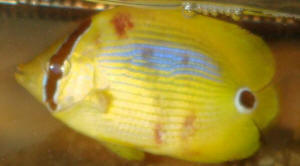 Hey dude, you're dead! Hey dude, you're dead!
|
Long
Nose Butterfly/Acclimation 1/29/08 Good Morning Crew! <Hello
Gans> I have had a Long Nose Butterfly in my tank for a 6 days now.
He is the only fish in a 60gal/LR 6 month old tank. He was doing great
for the first 3 days & ate everything I fed him but since yesterday
he is just hiding in the same spot among the live rock and doesn't
want to come out. When I feed him Mysis he doesn't seem interested
anymore. I gave him a clam this morning and didn't seem interested
either. I understand from the material in WWM that these guys take time
to adjust etc but I am asking because he was doing great for the first
few days but now has become a recluse. I don't see any physical
evidence of something going on. I have increased the temp from 75 to 78
and turned off the MaxiJet 1200 inside the tank that I had for extra
circulation. <No, no, turn that pump back on, these fish need good
circulation.> SG is 1.025 though. I see you recommend 1.020.
Anything else I can try to help him adjust? <Since their primary
source of food is zooplankton, I'd try feeding some Cyclop-Eeze. I
would do a 10% water change with the makeup water adjusted to 1.020.
The goal isn't to get down to 1.020 but somewhat lower than 1.025.
Keep in mind that these fish require very good water quality. I would
suggest using a good chemical media such as Chemi Pure. Do keep a close
eye on the fish for signs of parasitical infection and, if present,
quarantine and treat immediately. You may want to keep the lights off
until this fish hopefully acclimates to it's new surroundings.>
Thanks <You're welcome. James (Salty Dog)>
Gans
Re:
Hyposalinity for Butterflies 11/28/2007 Hi Crew, I had sent
this question in a couple of weeks ago and am hopeful for a reply.
<Thanks for re-sending. I don't recall ever seeing this>
Thanks, Tom Hi Crew, <Tom> I have a follow up question to
Roy's reply yesterday titled "QT hospital tank and poor water
conditions". Would you recommend this specific QT hypo treatment
for a LNB and CBB if they're showing Crypt symptoms? <I myself
would not... am decidedly NOT a fan of hyposalinity treatments period.
RARELY effect cures, OFTEN ultimately kill by seriously weakening fish
livestock. Bob Fenner> I've used copper successfully in the past
but don't want to use it for these new fish that I'll be
getting soon. I have a 30G QT set up and waiting for the new additions.
Here's the text of Roy's reply: <<Art: It sounds like you
are using a lot of medication and chemicals in your QT. If you only QT
one fish at a time, a 10 gallon should work. In my experience, the best
treatment for Ich is to slowly lower the Specific Gravity (SG) in your
QT to 1.009 (as measured with a refractometer), leave it there for 6
weeks, and then slowly raise it to your main tank SG. Before I started
using this method, I used to have many of the same issues and problems
you mentioned. I usually don't like to move the SG more than .002
per day up or down (as measured with a refractometer). The SG 1.009 Ich
treatment will work just fine without any meds; however, you can't
have any live rock or inverts in your QT because the SG 1.009 is too
low for them. When you need to do a water change, make sure the SG is
the same as your QT. After the 6 weeks, no Ich should have survived.
You then slowly raise the QT from SG 1.009 to where your main tank is.
After that, you can introduce your fish to the main tank. While the
whole process takes several weeks, you will beat Ich for good and you
won't have to use a bunch of medication and chemicals. In the
future, never introduce a fish without going through the 6 week QT.
It's the way I do it and I have never had Ich in the main tank
(though I have had it seen it many times at the start of the QT
process). Best of luck, Roy>> Thanks,
Tom
|
Unknown Fish Disease? Chelmon spots 11/12/07Hello there, Love
the site it saved my sick sand sifting star fish (he's now in
a MUCH MUCH bigger home) not to mention research here prevented
me from buying a horse shoe crab my LFS was trying to push on me.
Hopefully you can help me with my most recent problem for
starters I'll run my tank info at ya. 50 Gallon Tank about 4
months running Remora C Protein hang on Skimmer 2 Hydor Koralia
Pumps #3 850gph each 1.5" Dolomite bottom <Mmm, do
replace this in time> 2" live sand bed on top of the
dolomite would this be considered a plenum of sorts? <Of a
sorts... but do you have the defined "gap" water space
alone underneath?> probably 40 or 50 lbs of live rock good
coralline coverage on pumps and back wall Water parameters: last
tested 10/26 at LFS <I'd get your own kits... water
chemistry changes with movement, time...> Ph 8.1 Ammonia 0
nitrite 0 nitrate 10 (was told this might be due to a 350 magnum
canister filter that I have removed from the system) KH 9 Calcium
450 Salinity 1.023 Live Stock: 10 Blue leg hermit Crabs 6 Red Leg
hermit crabs 3 zebra striped Astrea snails 1 turbo snail 1 gold
ring cowry 1 queen fighting conch 1 Pencil Urchin 1 Cleaner
Shrimp 1 long tentacle Anemone 1 anemone crab 2 emerald crabs 1
brittle starfish brown How's the cleaning crew look? light
heavy? <A mix... I'd keep your eye on the Mithraculus>
1" colony of star polyps 1" colony of Zoanthids 1"
Florida Ricordea Fish: 1 green mandarin (he eats live brine,
frozen Mysis, and chilled ArctiPods along with the live pods on
my LR) My current worry is my only other fish a Copper band
butterfly <Hard to keep in small tanks like this> he has 3
black spots on the very edge of his pectoral fin and one black
spot on the farthest back edge of his dorsal fin I've
searched your site for black spots but all I can find is black
Ich these spots are about the size of #2 pencil lead seemingly
MUCH larger than the pictures of black Ich I've found they
haven't spread or moved but just hold on. He hasn't shown
any signs of rubbing against anything or discomfort he's
still eating an lot of Mysis shrimp he never ignores it so I just
feed him a few minutes worth and leave it at that. <I would...
do nothing overt here... The spots could be "just
coloring"... melanism from?...> He won't stay still
long enough for my cleaner to go near him I don't think
it's a lazy cleaner because it loves to pick at my fingers.
I'm nervous that these black spots have the potential to
spread to my mandarin I haven't set up a QT tank yet Any
ideas what these might be? Please help <Not likely at all to
be a spreading problem> I'm also considering in the future
a black false percula clown and a flame angel I don't want to
overload the system though does it sound ok to you? Thanks, Very
nervous <Don't be... Do start planning re where you're
going to put the new, larger system... You've got the bug,
not the Chelmon. Cheers, Bob Fenner>
Re: Unknown Fish Disease? Chelmon spots
11/14/07 Hello again! I didn't properly proof read my
E-mail and there was a miscommunication here on the Copper band
spots. I'm terribly sorry... They aren't really spots but
have the size of small black ants attached to the fins. <I see
them...> 3 on the pectoral and one on the tip of the dorsal
I've enclosed two pictures hopefully they're high enough
quality and yet small enough to meet your standards. <Yes...
good images... Don't appear to be
"organismal"...> here are some interesting bits of
info that might or might not help. The fish seems to have a very
minor case of Ich on the fins that do not have these black things
on them but no sign of white spots on the pectoral that has them.
I can't seem to get a closer shot then the one I'm
sending you and they have shown no signs of movement it might be
my imagination but it seems like one has actually "fragged
itself" with 3 tiny spots next to it that I did not notice
before but I might be more paranoid now than before. Please help,
Sincerely Confused <Again... I do think these are random bits
of melanization... perhaps this specimen was physically whacked,
as with a net... even dropped to the ground at some time. They
could be from an accidental run-in with the Zoanthids. I would
leave it as is... not subject the specimen to medication,
moving... the marks will likely fade over a long period of
time... though a purposeful cleaner might well remove them post
haste... Maybe a Lysmata species. Oh! I see you list a cleaner
shrimp below. Hopefully these will partner. Bob Fenner>
|
|
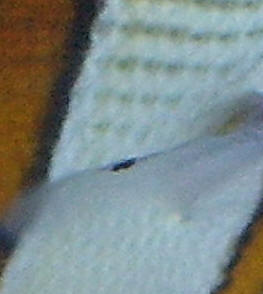 .jpg)
|
Auriga
Scratching 9/27/07 Hello Bob & Co, I come to you guys
more often than I take my kids to the doctor!! My Auriga which is the
only fish in my 60gal/60lbs/skimmer/FBD tank is scratching a lot and
shaking her face. She tries to scratch around the area behind her eyes.
No sign of white spots and she eats very well. I have a cleaner shrimp
in the tank as well. I have a 10 gal QT tank. What should I do? 1.
Dip/Bath and then to QT? 2. Lower SG of QT and then let him sit there
for a while? 3.Copper etc? 4. Other? As always, thank you for all your
help. -Gans <4... just observe for now. Bob Fenner>
Re: Auriga Scratching
9/30/07 Hi Bob, He was still scratching as of yesterday. Today he
is acting very lethargic. Just hanging out in one place or the other
without swimming much. Not his usual self for sure. Still takes food
and eats it all. No spots or anything else in the body that I can see.
Should I still stay put and observe? Thanks! Ganz <Yes.
RMF>
Re: Auriga Scratching
10/1/07 He didn't make it Bob! Found him dead this morning. I
am 2 1/2 months into this hobby and am off to a rough start. Killed 2
Henis by having them in a 10 gal qt tank, now the Auriga . Pretty
depressing! Not sure if I should continue. If I do, should I wait a
month before I add anything to the tank? <A good idea, yes> I
just have snails, crabs and a shrimp in there. Thanks for all your
help! Cheers Gans <Convert, re-direct the energy, feeling into
progressive activity... READ before buying... BobF>
Need Help with Diagnosis: Copperband
Butterfly 09/17/07 I purchased a Copperband Butterfly fish on
Friday (9/14) from an online vendor. I noticed some redness on the
bottom right and left sides of this fish today (Sunday, 9/16). The
eyes and fins are clear. I have pics of this fish located here:
http://www.flickr.com/photos/7329275@N05 <Bad scrape... likely a
thrashing with being roughly netted in the wild...> The fish is
not eating yet, prolly still recovering from his trip. Is this a
viral or bacterial issue? Is this something that can be treated? If
so, with what? <May become bacterial... No "treatment"
suggested other than good care...> The other fish in the tank
<... this fish was not quarantined? Mistake> are a pair of
cinnamon clownfish and a gold spotted Rabbitfish. The clownfish
have been in the tank for 2.5 months and the Rabbitfish for one
month. they are healthy and are eating vigorously. Salinity- 1.024
Nitrates-0 Ammonia-0 Nitrites-0 Calcium-420 Alk-3.43 Temp 80.6 Any
advice and suggestions are appreciated. Thanks
Kirk
<Read... on WWM re Chelmon care... Bob Fenner> |
|
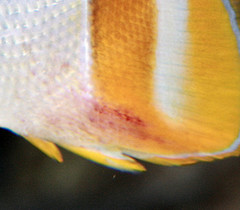
|
|
Bump on my Auriga 9/6/07 Hello WWM Crew! My tank is 7wks
old and water param.s are all ok. It's a
60gal/skimmer/FBD/LRock system. I have an Auriga for about 9 days
in the tank now. She's eating everything and doing great but
I see a small bump with some white icing like thing on top of the
bump, in the area where her tail joins the body. I have attached
a couple of pics but they are not that clear. <I see this>
She gets in and out of the live rock a lot. She is showing no
signs of illness at all but the bump is noticeable. Not
sure what to make out of it doc? The water temp has been in the
83-85 range for the last week as its been hot in SD. But the temp
has finally come down. Cheers Gans <The water is a bit warm...
and this volume is marginal... Does look to me like a sore,
perhaps bacterially involved... resulting from a trauma... likely
during capture, handling... I would look into antibiotic laden
foods if this fish will accept them. Perhaps Thera A. Bob
Fenner>
Re: Bump on my Auriga 9/7/07 Hi Bob! Thank you
for the quick response. I looked around for Thera-A with
antibiotics but they all say they are non-medicated. I am unable
to find a medicated version of it with anti-biotics.
http://www.marinedepot.com/ps_searchItem.aspx?IdCategory=&SearchText=thera%20a
<Sorry re... I would add the antibiotic to this Spectrum
product...> Do you want me to try just the Anti-Parasitic
Formula? <No my friend... I would just add... per this sort of
protocol:
http://www.wetwebmedia.com/PondSubWebIndex/holedispd.htm Cheers
Gans <And to you. BobF, who just got off the phone with
friend/manufacturer Pablo Tepoot... we're all hauling out
tog. for the CIPshow in Nov... and he mentioned that Thera only
has garlic...>
Re: Bump on my Auriga 09/14/07 Bob, You are a fish
genius! The spot fell off as you said. Thanks! Gans
<Ah, good. Thank you for the update Gans. BobF>
|
|
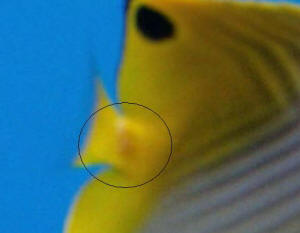
| Re: Bump on my Auriga
9/12/07 Hi Bob& Co, Good evening to you all! <And
to you Gans> The bump on my Auriga has healed completely.
I did not feed any anti-biotic. However there is a white
thing latched to her tail and a smaller white thing on the
top of her fin for the past 4 days. Pic attached. The fish
itself is acting very normal and eats everything. I am
confused if its Ich or something else? Its the only fish in
the tank. Do I pull her into QT and start treatment or just
wait and see. Thanks Gans <Is very likely simply
"residual" material... that can/will fall off... Do
you have plans to introduce a purposeful cleaner organism?
Please read here: http://www.wetwebmedia.com/clnrfaqs.htm and
the linked files above. BobF> |
|
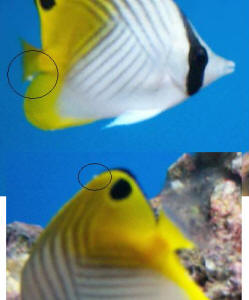
|
|
Pearlscale
Butterfly Problem, induced 8/27/08 Hi there, Just want
to say thanks for your assistance! Your website has answered so many of
my problems over the last couple of months and what you do for others
in need is really saying something about you, so thank you. Anyway.. i
currently have: 1 Pearlscale butterfly 2 false Perc clownfish 1 Chromis
In a 35 gallon tank. <Mmm, too small a volume for this or any other
species of Butterflyfish> My concern is the butterfly fish. I know
this species does need a fair bit more room i have heard of alot
<... no such word> worse, and as a 16 year old this tank is all i
can afford. <Then... return the BF> I have had the butterfly for
about a month now and after about a week it started to scratch itself
on rocks. I noticed a few spots similar to Ich so i turned the heat up
a bit they soon disappeared and the scratching stopped. But it has been
2 weeks since and he/she breathes quite rapidly. <Maybe just/simply
the increased metabolic rate from the elevated temp. and lower DO at
that temp...> And he never used to breath so fast and it is starting
to concern me because i don't know what it could be. He eats alot
and swims fine. My ammonia and nitrite is 0 and nitrate is 7ppm. The
other fish aren't having any problems with their breathing. Any
ideas on cause and solution would be much appreciated, thanks so much.
Kind regards, Patrick <Could be a psychological component here as
well... the Damsels frightening the BF... Again, I'd return this
fish, get something more appropriate to your setting. Bob
Fenner>
Butterflyfishes and copper
treatment 2/16/07 Hello, <Good morrow to
you> I would appreciate any help you could give me on my tank
situation. I am really frustrated after losing a couple of fish and
would like to figure out what I can do differently and what is the best
course of action. <Okay... as in I will try to assist you> I have
a 90-gallon quarantine tank that has been running consistently for
about a year now. My water chemistry is all within normal range
(Ammonia=0, Nitrites=0, PH=8.2, Alkalinity=normal, salinity=1.024); I
don't know the nitrate level, and I will have to get a kit to test
it. I assume it is pretty low, as I do 20-gallon water changes every
two weeks, and I do not overfeed. <I see> Ten days ago, I moved
four fish (3 wrasses and a Firefish) from my quarantine tank to my main
tank after treating and quarantine them for Ich for about 4 months.
They are doing well in my main tank. However, the fish I bought in the
last 3-10 days have started to show signs of Ich, and I have lost 2 of
them--a yellow head Jawfish and a yellow Longnose Butterflyfish.
<Generally very sturdy aquarium species> Within a couple of days
of adding them, they started showing signs of hemorrhaging and stopped
eating. <Yikes... troubles, challenges ahead of your receiving
them...> I found the yellow Longnose Butterflyfish this morning
moving around in a 360 degree circular pattern, bumping into things,
and it was dead shortly thereafter. My copper sulphate level is
slightly below .20ppm. Does the hemorrhaging seem like it is a reaction
to the parasites, the copper or both? <Mmm perhaps a combination...
no way to tell... w/o knowing the history of these animals ahead of
your receiving them... Were they at your dealers a good few days or
more before your picking them up?> When I bought them, they were all
eating and appeared in good health. All of them, with the exception of
the Jawfish, were in tanks with a copper level of .20ppm for at least a
few days. Could the hemorrhaging indicate that they were exposed to
copper for a few weeks? <Mmm, again... a possibility... but would
take more than this exposure to "do them in" as you state>
The fish store also was keeping the Butterflyfish in a salinity around
1.018, <Typical...> so I took about 3 hours to acclimate the fish
since my salinity is so much higher. <I would do this much more
gradually... about a thousandth in density changer per any given
day> I'm concerned about treating my Butterflyfish (a Pearlscale
butterfly, a raccoon butterfly, a threadfin butterfly, and a
Klein's butterfly, all around 2-3" each) with copper since I
have done it unsuccessfully in the past (with a Pakistan butterfly, a
latticed butterfly and a Pearlscale butterfly), and I understand that
Butterflyfish are more sensitive to copper treatments. <Yes> In
the past, I treated the Ich early, but the level got a little high,
around .25ppm. I appreciate your help. Jenny <I would not use copper
of any sort if this is to be simply a Quarantine, and not a treatment
tank... and if pressed to use copper, only a chelated variety/brand...
and lower on the useful/efficacious concentration... 0.15 ppm free
cupric ion. Bob Fenner>
Re: Butterflyfishes and
copper treatment 02/17/07 Thank you for your
feedback. I have a couple more questions regarding copper and treating
Ich. <Okay> My 90-gallon tank has been a quarantine and treatment
tank for a year now, and I want to start stocking it as a regular fish
tank. Since I've already got the nonchelated copper in my tank, I
would imagine that I need to remove it with carbon or a poly filter
before adding chelated copper? <Yes, I would> Since I want to add
more fish and copper is so effective at treating Ich, I'm thinking
my best route would be to treat with copper, although I am concerned
about its effects on the Butterflyfish. Are freshwater dips really a
good alternative? <Yes... can be... if the Cryptocaryon is not
"too advanced"... as in cases where multiple generations are
entrenched, embedded deep in the fish hosts integuments> It
doesn't seem like it is nearly as effective as the copper
treatments. Thanks again for your help. <Is much safer, less
toxic... You have read here: http://www.wetwebmedia.com/mardisindex.htm scroll
down... to dips/baths, the voluminous materials on Crypt, its
treatment... the use of Copper... Bob Fenner>
Sick Heniochus
butterfly 7/26/06 Hi! My Heniochus butterfly
fish has Popeye. I put him in a quarantine
tank. I am going to the LFS this evening to buy some
medicine. Would should I buy? <... Likely nothing. If
this Exophthalmia is one-sided, maybe I'd add some Epsom Salt...
Please read here: http://wetwebmedia.com/popeyefaqs.htm
and the linked FAQs2 file above> Also, what should I do about the
main tank? I purchased LF from a dealer online back in
January. He told me to spray it upon arrival.
<"Spray it?"> I did not, figuring that my
tap water, which is bad, would kill the organisms on the
rock. Instead, I scrubbed it in a plastic tub to get the
'muck' off. Shortly after, my hands were extremely
Ichy. <Common... there are physical components as well
as biological that will do this...> And for the next month or so, I
noticed that my hands and arms would itch when I put them in the tank.
<Little cuts, abrasions...> I have cleaned LR before and I'd
never had a problem. An employee at the LFS told me that the problem
was probably bristle worms but they were harmless. I waited
a few months before adding a blue damsel. He did fine. Plus
I noticed that my hands stopped itching when I had to go into the
tank. In June, I moved the damsel to another tank and added
the butterfly fish. Could there be something wrong with the LR?
<Doubtful> I do not want to get rid of it, but I will if
necessary. I am afraid to return the fish to the main tank,
after it is well. <If one-sided, this Pop-eye is likely due to a
physical trauma. Bob Fenner>
Swollen Long Nose Butterfly
7/19/06 Hello Ladies and Gentlemen, <Tamara> I have struck a
bit of a problem with my long nose butterfly. He has become quite
"swollen" (the best way of describing it) around the top and
bottom sections of his body. I have searched your site and have found
nothing on this, only swelling around the eyes and mouth (which my fish
does not have). <Yikes... the condition is/can be termed
"Ascites", bloat... dropsical... many causes... some more
primary than others... but something causing fluid to leave cells,
tissues... and occupy intracellular space, body cavities...> I took
the fish, with minimal stress, to my fish shop after they said they
have never heard of such thing and would need to see it. Consequently
he put me on to your website. They do have an enormous amount of
experience but said they have never seen anything like it and will look
into it themselves further also. Looking from behind; say the fish is
3mm in width; where it is swollen at the top and bottom, it is more
like in excess of 10mm wide - like someone has pumped it full of air!
It is still feeding and active - apart from the "swelling" it
is behaving fine. Any reply would be greatly appreciated as I am rather
concerned. Thank you. Regards Andrew Brown Melbourne Australia. <It
may be that there is a "simple" bacterial involvement here
(from?) that can be thwarted with the application of one/some form of
antimicrobial/antibiotic. If this were a very valuable fish or a bunch
of them, I would avail myself of injectable material (Chloramphenicol
succinate would be my first choice)... For home/hobbyist purposes, it
may be that a water-administered product is best... a Furan compound:
http://www.wetwebmedia.com/antibiofaqs.htm
and a search on WWM with the name. If this/these are not available
locally or easily, do look into what you can get in the way of a
gram-negative, broad-spectrum antibiotic... administer at 250 mg. per
actual ten gallons of water... change a good part of the water out and
replace, re-treat every three days for three treatments... Not in the
main/display system... Bob Fenner>
Re: Swollen Long Nose
Butterfly 7/22/06 Hi Bob, <Tamara> Thank you so
much for your reply. My fish shop said your site, and your staff, would
be extremely helpful and he was 100% correct. I will track down a
antimicrobial/antibiotic today. Just for my own knowledge, will this,
or can this affect the other fish in the tank; or is fish specific
(i.e.. is it contagious and should expect more fish to become this
way?) <Not able to say, but generally such involvements are
"not catching"> Secondly, was there a way of preventing
this, or is it just a pure random occurrence? Thanks so much. Tamara
<Mostly the latter. One can do their best to provide optimized,
stable conditions, good nutrition... and still have such incidents. Bob
Fenner>
Copperband/Disease Treatment 7/11/06 I read on
your website that Copperbands can be prone to copper medication.
<<Prone? RMF>> <Yes.> I have a Copperband in a QT
tank with several other fish. Should I use the same does as indicated
on the bottle or should I reduce the dose? I am using SeaChem activated
copper, if this helps. <No such thing as activated
copper. You are referring to Cupramine, a buffered, active
copper. I would isolate the Copperband in another
tank. Copperbands are very sensitive to copper
treatment. Freshwater dips and formalin (Rid-Ich+ by Kordon,
formalin and malachite green) would be my choice. > Thank you.
<You're welcome. James (Salty Dog)> A
BF spot, Dottyback color
loss, Centropyge feeding in QT 7/12/06 Thanks for your
prompt reply, <Please include prev. corr...> I have done as you
said and given my Copperband with a freshwater dip mixed with M/Green.
He has a parasite attached to his front left fin, I hope it will come
off after a few more dips. But he is looking much better after the
first dip, the itch has receded significantly. And he's eating well
as usual. <Mmm, a parasite? Might just be a "spot" from
bumping into something... I'd try a purposeful cleaner organism...
perhaps a Lysmata sp. shrimp... Gobiosoma goby...> Now onto my
Dottyback. He has lost a lot of colour, when I got him he was a bright
magenta and yellow, now he's faded to a dull purple and yellow. I
have been told this is due to him not being the dominant fish in the
aquarium, as the Anthias don't seem to like him too much and chase
him sometimes. <Possibly a/the factor here> I feed him Mysid
shrimp, brine, algae flakes, angel fish mix, ocean plankton, pretty
much whatever I can get my hands on, and he is still showing no signs
of his original colour. Any suggestions? <Spectrum pelleted
food/s> My final question is about my eibli angel, which is refusing
to eat Mysid shrimp, marine algae, brine shrimp and flakes. He is in my
QT tank atm, and I'm worried that he hasn't eaten for 2 days. I
am not treating the tank with any medication so I am thinking of buying
a small piece of live rock for him to nibble on. Would you suggest Nori
too? <Do add a good deal of ready-cured live rock with obvious algal
growth> I'll just like to add that you guys provide a valuable
service and your advice is greatly appreciated. Thanks. Albany
<Welcome. Bob Fenner>
Heniochus acuminatus with Ich
6/23/06 Hi WWM crew!! <Hi> I have an Heniochus acuminatus
that show symptoms of ick. <Uh oh> It has white spots, that look
like salt. It doesn't have that much but it still concerns me.
<It should> It is still eating well. It doesn't breathe
rapidly. All the other fish are healthy. <All other fish are
infected with Ich, just not symptomatic.> I don't want to treat
the main tank, because I have some invertebrate. <Almost always a
bad idea.> I am not able to set up a hospital tank, I don't have
the space for it, since I live in an apartment. <Really need one,
doesn't need to be always set up, can be taken down when not in
use. Without a QT/hospital tank expect to continue to have
problems with communicable diseases.> Yesterday, I have give it a
freshwater bath( specific gravity: 1.008) with blue Methylene for 10
minutes. <Provides temporary relief, not a cure.> But, today, it
still shows symptoms of ICK. <Most likely will continue until the
Ich life cycle is broken.> What should I do to treat my fish? <If
you are unable/unwilling to get a hospital/QT tank and remove and treat
all fish and allow the tank to run follow there is not much you can
do. Provide good quality water and food and hope the
fish's immune system and fight off the Ich.> I have bought a
Formaldehyde - green malachite solution to use it in a bath, but I am
not sure if it is a good idea and how much should I use and for how
long. <Toxic stuff, I'm not a big fan of it. Baths
will help temporarily, but when the fish is returned to the tank they
will be reinfected.> Could I use copper in a bath that would last
for a long time? <Not effective.> If yes, how much should I use
and for how long? Any other treatment I could try? <Not that
wouldn't nuke the tank. Medications are not specific
enough to kill the Ich and not destroy the live rock and
biofiltration.> Thank you very very much!!! I hope
my fish will be fine, I really like it!! <Hope so.> Steve T.
<Chris>
Heniochus
acuminatus with Ich Part II 6/30/06 Hi Chris, <Hi> As per
your advice, I am actually looking to setup a hospital tank for my
fish, to help to get ride of the ick problem... I have 2 clown fish, 2
green Chromis, 1 neon goby, 1 six line wrasse and the Heniochus. What
size of hospital should I go with? <Good to hear, at least a 20 for
all those fish. If easier you could go with a couple of
smaller tanks and split up the livestock.> Today the Heniochus have
stopped to eat... :( <Uh-oh> What is my best bet with it? Should
I give it a freshwater bath until I set-up the hospital tank? Any other
ideas? <A bath may help, make sure its ph adjusted and the right
temperature. Try adding either Selcon or garlic to the
food. Both seem to stimulate the feeding
response. If it goes too long try some live brine
shrimp.> Thank you very much... Steve <Good luck and remember to
QT any new additions to avoid these problems in the future.>
<Chris>
Heniochus
acuminatus with Ich Part III 7/1/06 Hi again Chris, <Hi>
Sorry to bother you again, <No bother.> I promise I will
quarantine any new addition to my tank in the future. <Good> But,
I just have a idea of what I could try to cure my fish from ick and get
it out of my main tank. I know that the WWM crew are not big fan of
hyposalinity, but could I just buy a tank (the one I would use in the
future to quarantine any new addition) and use it to put all my hermit
crab. They are the only invert I have in my system. I would put many
pieces of live rock with them. So I would not kill all the zooplankton
in LR and the crabs would be more safe... Could I lower the SPG in the
main tank to kill the ick in it? I would keep the hermit crab apart for
6 weeks. Would it be effective? If yes, at what SPG would it cure the
fish without being stressful to the fish? I have read from ATJ (the
only name I have found of that guy) that the SPG should be at 1.009 to
kill the ick. You can see this article here : '' http://www.petsforum.com/personal/trevor-jones/hyposalinity.html''
What do you think of that? <Well, it will get rid of the Ich if kept
at that salinity long enough. However, it will also kill off
most of your live rock, and in the process cause a huge ammonia
spike. If you remove all the LR there will probably not be
sufficient biofiltration and cause the same problem.> Thank you very
very much for your help. If I found that the better treatment is the
copper in a hospital tank, I will do it... Honestly, I don't feel
confident about my capacity to keep them all alive in a basic none
established system, though. <With lots of water changes should be
fine. Could also use Bio-Spira to jump start the
biofiltration.> Steve <Chris>
Heniochus acuminatus with
Ich Part IV 7/3/06 Hi again, <Hi> I just wanted to say that I
should have listen to you one week ago. I mean I should have treated it
as fast as I could. Even if the Heniochus had finally eaten yesterday,
I have found it today in my overflow box dead. <Sorry to
hear.> I just feel like crap. The worst thing, it was my
girlfriend fish... It was her birthday present. <Yeah, I learned
that lesson the hard way too, no fish for gifts.> I
don't think she will like the tank anymore... I feel right now like
I would give up too... It is sad that I had to make that fish die just
to learn a so simple lesson!! <Been there, done
that. Almost quit after losing my possum wrasse, loved that
fish.> So, I know that I will sing the same old
song!!!!!!!!!!!!!!!!!!!!!!!!!!!!!!!!!!!!!!!! TO EVERYONE, don't be
damn stupid like me, DO QUARANTINE YOUR FISH!!!!!!!! <A convert, and
ready to give others the advice, some good out of a bad situation.>
So now that the only really sick fish is dead (the wrasse only had 2-3
spots and it is now gone), should I just wait 1 week or 2 before I
start to treat them in a hospital tank? <Start immediately.> I
mean that way I could let some sponge in my tank to have some
biofiltration ready for the quarantine process. <See if you ca find
some Bio-Spira to kick-start the biofiltration. But do not
buy it if it hasn't been kept refrigerated, some stores don't
and without it the bacteria will die.> Should I start using the
biofiltration right at the beginning or after the copper treatment so,
the copper would not kill the biofiltration? <From the
beginning.> Can I use filter pad that absorb ammonia with
a copper treatment? <No, all will also remove the copper as far as I
know, just have lots of new salt water ready for water
changes.> If not, would it be better to use hyposalinity,
so I could use absorbent resin to help to maintain good quality of
water ? <Most of the bacteria cannot survive the salinity change
anyway, so copper is probably the better way to go.> Again Thank YOU
VERY VERY MUCH for your patience Chris!!! <Anytime>
<Chris>
H. acuminatus, sel.
dis. 4/14/06 Hi Bob, <Joseph> I have a
quick question on my 2 newly acquired H. acuminatus which I bought 2
weeks ago. I picked them up from my LFS as soon as they were delivered
from a wholesaler. <Mmm, generally better to leave most all marines
at a dealers a week or more... with deposit if you "must have
them"...> They are about 3 inches in size and both looked
healthy. They have been in quarantine since then and during that time I
have noticed that one of them absolutely loves every food I give it:
brine shrimp with Spirulina, sea veggies, flakes, tiny pieces of shrimp
and squid, and Nori seaweed. This one has maintained a healthy weight.
The other fish, however, will only eat the Nori seaweed and spits out
everything else. I would like it to start eating some fleshy foods. I
have noticed that this fish has slightly lost a bit of weight. Other
than this both fish look healthy and very happy. My question is whether
I should be concerned about this fish's eating habits ahead of
it's release into the display tank next week? <Ummm, a tough
one... w/o seeing the actual specimen. But I would very likely risk
moving this/these "Heni's" in the hopes of furthering the
ones appetite... and not worry re the small risk in disease
transmission here> By the way, this is the first time I have used a
quarantine tank and I now appreciate the benefits it gives to us in not
only preventing disease, but allowing us to observe the new animals in
a much more tightly controlled environment. <Ah, bingo!> It makes
it so much easier to acclimate the fish to the water chemistry and
especially to new foods, which would be a lot trickier in the display
tank (i.e. size, competitors etc.). Thanks for the informative articles
on this topic! Thanks in advance, Joe <Welcome Joe. Bob
Fenner>
Stressed out B/F's...
some valuable life lessons in resource limitation -
03/11/2006 Hello, <Hi there> I'm hoping you can help me
out here. I have a 55 gal. with 2 small Perc. Clowns & 2
Butterflies (Pearlscale & threadfin). <Mmm, this sized system
for these chaetodonts is problematical...> My husband came home with
a new tank mate 2 days ago and my butterflies have gone crazy. He added
a Sailfin Tang, very small, still a juv. The Sailfin is doing great,
very friendly, but the butterflies & clowns have all crowded into
the top corner of the tank. <Sort of like having "Jack the
Knife" move into your home here> After the first night, I woke
up and both B/F's were covered with spots, on the fins and the
body, looked like someone took a salt shaker to them. <Ahh...
Cryptocaryon... very likely present in your system in sub-symptomatic
level... brought on to hyperinfective state by the added stress...>
I called my LFS and they said that was very strange for that to happen
overnight and to re-arrange the decor and make new homes. <Mmm,
no> They said maybe the sailfin was trying to take over the tank.
<Has> What should I do? It is the second day and they look better
but still have visual signs of the spots, and are still acting scared
for there lives. Thanks, Wendy Thank You, <The Ich/crypt is
cycling... going into a soon-to-be much larger stage... Very big
trouble likely brewing here... There is a bunch for you to know, and
the only expedient way (not knowing what you know...) is to sift
through materials on this and related situations: http://wetwebmedia.com/ichartmar.htm
and the linked files above. You need also to address the root cause of
the troubles here: crowding, the mixing of incompatibles in such a
system, and the lack of quarantine... I'd separate the Zebrasoma
tang, and get ready to do what you will for your Ich infested system...
and soon. Bob Fenner>
Sick Longnose BF? 03/07/06 Hi
all! I have another question for you fine folks. I just
got my Longnose Butterfly and he has done great so
far. He eats very well, and he loves to swim around like
he's strutting his stuff. <Is then> But i noticed today
that he has a little red spots , at the base of his beak at both
sides. I attached a picture for you. <Unfortunately
these didn't "come through"> I researched other
pictures on the net and none of them had his little
spots. Is this something i should be worried about or is
something that varies from fish to fish. <Some reddening does
occur in Forcipigers... due to? Stress? From? In general this is
not a sign to treat their system... unless it is affecting feeding
behavior> His skin is clear right there and the red is
underneath the skin. Thanks for the help!! Nick
<I would not "panic" here. Bob Fenner> |
| Re: Sick Longnose? 03/07/06 Sorry for the
picture not going through. I will try to attach it as a
file this time. <No worries. And do see it here> Today it
seem to be not as red as it was yesterday so maybe it was a
"stress situation, upon arrival, into his new
home. He eats very well so i guess it is not a problem.
<I hope not as well> I the picture can help. Or maybe it
could help someone else since a popular fish. Thank you
very much for my newfound peace of mind. <Welcome. Do see the
"blood mark"... appears to be well-defined... likely from
a "bump" into something and likely will heal of its own
accord. Cheers, Bob Fenner> |
|
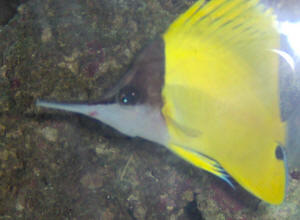
|
Heniochus
acuminatus health 3/2/06 Hi Bob, <James with
you today.> Just a quick question regarding H. acuminatus. I am
expecting to buy two 3" - 4" size specimens within the next
week. Is a freshwater dip with a commercial dip mix a safe option for
these fish? How long should this dip last? <I wouldn't do a
freshwater dip unless I have a valid reason to do
so. Quarantining is your best option. Plenty of
info on this on the Wet Web. James (Salty Dog)> Thanks in
advance,<You're welcome.> Joe
Re: Heniochus
acuminatus 3/3/06 Thanks James. <You're
welcome.> However I am curious as to why there is an acceptance
among the marine hobbyist community of dips/baths as a necessary step
in quarantining, when you have suggested that it need only be done when
there is a reason for it... By this do you mean visible signs of
parasite infection? <Yes...I don't take cold medication as a
precaution. Why stress the fish out if it isn't
necessary. My opinion.> In furtherance of my question
yesterday on H. Acuminatus, my quarantine tank is only 10gallons. Since
these fish require a large amount of space, will the 2-3 weeks in
quarantine be more stressful for them and outweigh the benefits of the
actual quarantine? <I'd suggest a larger QT. Putting
the fish in the main display without QT just risks possible disease
outbreak to the other fish.> Thanks, <Your
welcome. James (Salty Dog)> Joe
| My Copperband, a new addition, has developed two white
patches 2/1/06 on its left side. Please see
attachment. Please advise if you can identify what this may be and
how to treat. Thanks, Tom <Is trouble... could be protozoal
and/or bacterial/pathogenic in nature. This fish is (too) skinny,
and this is likely a factor here as well... There are a few
"things" you might do to bolster its immune system,
indirectly curing the apparent complaint... Soaking foods in
vitamin et al. prep.s... offering foods with more caloric content,
adding purposeful cleaner/s... Without these changes this animal
will perish (sooner). Bob Fenner> |
|
Follow-on from sick Chelmon 2/3/06
Contagious and or a risk to fellow tank inhabitants?
<Potentially... yes. Depends on what the root cause/s are,
what "it" actually is... Copperbands "break
down" much easier... on a sliding scale than other fish
groups... the hyperinfectivity this inspires can be trouble,
contagious... Bob Fenner>
|
|
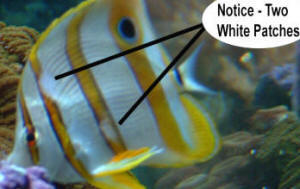
|
Right Thinking -- Wrong
Timing; CU poisoning... 12/5/05 I recently purchased a med. size Raccoon
Butterfly for my 55 gallon fish only tank. I have 2 False Percula
Clowns, and 1 medium size Blue Tang. On the 3rd day I noticed the
raccoon scratching on my fake coral and not eating. (The only thing he
would eat was frozen brine.) I checked my water and copper and all
fine. I brought it to the shop I bought it from and they said it was
fine, but to add some more copper. So I did , and it was just
above .15 The next morning he stopped scratching, but that night when I
got home, he was breathing heavy and sitting on the bottom of the tank, and still wouldn't eat. I noticed as I got him that my tang and him
were getting along just fine. So I don't think he was being
bullied. I put him in my hospital tank, after a brief FW dip, and he is
laying on his side breathing very rapidly. He probably won't make
it. I was just wandering if you had any ideas of what might of been the
problem. Thanks, Aaron <Well, Aaron, this is a case where all of
your intentions were good, but the execution was a bit off. First, you
indicated that you have a "hospital tank", which is good!
However, you need to use it as a quarantine BEFORE adding new fishes to
your display. This will give you the ability to catch and treat
illnesses before they get introduced into the display. Also, do think
about the long-term implications of your stocking plan. These
fishes need a lot more space than a 55 can provide, so consider this...
Next, it is always advisable NOT to treat in the display tank, for a
variety of reasons. Use that extra tank. Copper sulphate, although
highly effective at treating many diseases, can be hard on many fishes,
including Butterflies. <<Butterfly-fishes are one of the few
animals the staff at the LBAOP will NOT use copper meds on.
Marina>> Sometimes, the collateral damage caused to the fish
in treating the disease is too great. Formalin-based treatment is
recommended in the case of more copper-sensitive fishes. Again,
you'll have far greater control of the dosage in a separate
tank. Unfortunately, it's hard to say what you're looking
at, but it could be a parasitic illness. If your Butterfly is
struggling, you may need to reduce the copper level in the treatment
tank. Although it may be too late for this fish, if you take this as a
valuable lesson, the experience will not have been in vain. Chin up!
Don't forget to quarantine before adding fishes to the display!
Regards, Scott F.>
Copper treatment and bad
reaction - 10/28/2005 Hey guys, another question for you. <Fire
away.> My Pakistani in QT has been in copper for a week now
and he has no more Ich left but now he's
darting/flashing/twitching. <Uh-Oh.> Is this another
outbreak coming or is it from copper exposure? <It does sound like
poisoning.> Should I take him out or leave him in for the
maximum of the two week period (it states in the FAQ'S that a good
rule of thumb is 2 weeks of copper exposure for a fish to avoid giving
copper poisoning)? <You should do an immediate, large water change.
Run some PolyFilter or carbon to remove the rest of the
copper.> I went this long without harming him, I don't
want to take on any additional high risk. <I would back off of the
copper treatment and watch for improvements. How high is your copper
reading?> Thanks, Jay <Thank you for helping me address a weak
point. - Josh>
Re: Copper treatment and
bad reaction - 10/28/2005 I'd be cool with doing that, but I
don't want to put any parasites in my display tank so I feel like I
need to go the full two weeks. <I don't mean that you would be
finished with QT, but that you should step back to observation at this
point. Further treatment may/may not be necessary.> I measured
the copper very carefully every time I redosed after a water change (if
anything, I put less than what I was supposed to). <Does this mean
you only measured what was going in, not total concentration? Even with
water changes, the existing copper would still be there, at least to
some extent (I doubt you are draining all water and cleaning the tank
with each). Do this a few times in a row and there's bound to be
trouble. Everything added needs to be adjusted for what already
exists.> He's really not breathing fast, is it possible
that he's just reacting to the copper exposure sort of like how we
react to an antibiotic? <I think you most likely lost control of
your copper level by accident. Take care of his basic needs now (water
quality, feeding), and be prepared to "start over" if the
problem manifests itself again. Oh yeah, sorry if you got another blank
response. I think this thing timed out on me when I was ready to send,
hence no message showed as sent for you. Good luck Jason. -
Josh>
Re: Lemon Butterfly only
using one gill Can't find the exact answer to my question in
the faq's, if that's what your trying to tell me
<Strange...I remember typing...Well here goes again.> Yes
he's brand new and he's in a 20g QT tank with malachite green.
<Ah, good!> Should I do something else, or is this medicine
good? <A good start and possibly all that you will need> I
should be concerned? <Safer than assuming all is well.> Is
this fatal? <Possibly. I don't mean to scare you here, but that
is what the QT is for. Now you've noticed something worth
monitoring. I would advise you to research all of the possibilities
here as you will need a positive ID to know what you need to do.
Without this you can mistreat/harm your fish through good intentions.
Some things merely start in the gills, then get worse; others stay in
the gills and cause suffocation. Check here and the links, http://www.wetwebmedia.com/parasiti.htm
. Much to review but it should help.> Thanks again <Welcome and
sorry for the blank response earlier. - Josh>
<<Editor's note: This does happen from time to time - if
you receive a blank reply, do look in the next day's FAQs to see if
it's been posted there. This query and response was posted
yesterday, click on the TBPFAQs page and you might find the original
response there. Marina>>
Re: Lemon Butterfly only
using one gill Hey Josh no problem man, I appreciate your
competence! <I hope I deserve the kind words, and thank
you.> I have formalin, malachite green, and Cupramine at home.
Obviously, I don't have much time as I just read on the FAQ's.
<Can't give up. Remember to keep a cool head and not get
"too experimental".> So, which medicine would be
most beneficial and work the fastest in killing these parasites?
<I must confess here that I've been beyond lucky in this realm.
Despite all of my ignorance starting out, I've never had one sick
fish! Hence all I say here now is from my "studies". This is
important to get right so I will ask Bob to confirm/correct
this.> Seems B/F's are more sensitive to these gill
problems (flukes, parasites, one-gill movement, etc.). Any suggestions
on trying new things, I don't want him to die.<People beat this
all the time.> If you were me, what would YOU do in this situation?
<Here goes... if this fish hasn't worsened then I would probably
do a f/w dip/bath. Praziquantel @1ppm is the other popular choice I
believe. After these I would just observe and hope that it was over
before trying more. Sorry I don't have more hands on experience
here but hopefully someone else will chime in.> Josh, thanks again,
greatly appreciated!!! <Wish I could do more. - Josh> <Mmm, I
encourage you both to peruse the Butterflyfish Disease FAQs... I do
agree with Josh's input here. Bob Fenner>
Threadfin/disease
10/12/05 Hey guys. Can you tell me what to treat my threadfin b/f
with, if after two weeks there is no visual signs (white spots) of a
parasite and he's constantly twitching and scratching off
rocks? <Doesn't necessarily mean the fish doesn't have
it just cause you can't see it.> I don't want to use
copper because of how strong it is. What meds should I use to treat for
just "bugs" I guess you could say? Not sure of what else it
could be if there are no spots. Water quality is great and plenty of
oxygen along with all other parameters being right on point.
<Copper is by far the most effective treatment. As long as you use a
test kit to insure a safe and effective dose (0.015-0.020), you
shouldn't have a problem using it. A test should be done on a daily
basis during treatment, which should last a minimum of 21 days @ 80
degrees. James (Salty Dog)> <<Please read on WWM re copper and
test kit use. What has been stated here is too scant to be of use.
RMF>>
Possible Disease, missing
info 10/6/05 My question is 'what is wrong with my
Copperband Butterflyfish?' <Ok.> - The chemistry of the water
is fine 0 ammonia, 0 nitrite very little nitrate <How much is a
little? Please be specific in the future.> - The Copperband was
living alone in a 30 gallon tank <Far to small for this
specimen.> - A day ago I added a percula Clownfish <With or
without quarantine?> - Since then both fish have been hanging at the
top of the tank and the Copperband seems agitated <Understandably
so, the tank he is in is to small and you added another fish to its
territory.> - So I did a 10 percent water change but both fish are
still at the top of the tank and seem agitated. <Gasping at the top
of the tank is usually an indication of poor water quality and/or a
lack of oxygen.> - Prior to the clownfish the Copperbanded was
acting very relaxed swimming at the bottom <Only at the bottom?
These fish, when healthy, roam the entire tank, grazing on the
liverock.> - The temp fluctuates between 78.8 and 80 degree f
<Best to be stable but this fluctuation is not to bad.> - Added
some copper blue 2 weeks ago but since then have done several water
changes <Did you use a copper test kit to monitor the levels? Along
with the water changes I would run some carbon. Furthermore
next time, medication should occur within a quarantine tank you
may/could have destroyed the beneficial bacteria on nay live
rock/filter media you may have.> What could be causing this problem?
<Sounds like lack of oxygen. There are a few other ingredients
missing that would help to get to the problem. What type of filtration
are you using? Is a protein skimmer being employed? Are/What are the
fish eating? Are there any noticeable physical differences on the fish?
Without QT it could be a number of things. Please read WWM FAQs re:
disease to try to identify your problem. Adam J.>
Raccoon Butterfly, Copper, Quarantine 9/30/05 My name is Kristen
and I just bought a raccoon butterfly for my 70gal
tank. Currently he is in my 25gal QT tank that I am treating
with copper. The last fish in the QT tank had been treated
with copper before because of either velvet or angel fish disease (I
figured after 4 months of letting the tank sit with no hosts, the
parasite would die off). <Although Ick and velvet would die after
this amount of time, quarantine tanks should always be drained and
allowed to completely dry between uses to be absolutely sure than any
pathogens can't survive.> Surely enough, my butterfly started to
get white spots and was darting all over the tank. So
I'm assuming he contracted the same thing. <Most likely, it was
carrying the disease when you purchased it.> I do notice that he is
breathing very fast and heavy at times, other times not. I
have a good-sized air bar in the tank along with good circulation with
a bio filter running and heater. <Rapid gill movement is usually a
sign of stress and often of parasites damaging gills. This
occurs even when there is plenty of oxygen in the water.> Before I
put my butterfly in the tank, the copper treated water had been sitting
a good four months w/o any fish in it. One quarter of the
water evaporated, and I sucked out the other 1/4 of the water for a 50%
water change (including the water that evaporated). So 50%
of the old water still remained and I put the other 50% full of new
water. <Yikes! If the water was allowed to evaporate 25%,
this could cause unpredictable changes in water
quality. Also, if you have not done so, please be sure that
the salinity is correct as it would have increased with
evaporation. I would suggest performing a couple of large
(25-30%) water changes with water from your display to ensure proper
water quality. Replace the water in your display with new
well aerated salt water.> Do you think after all that time there was
still copper left (I forgot to test to see)? As of right
now, I only put the first dose of two in the tank. Im going
to hold off on putting the second and final dose in until I hear from
you. <It is impossible to predict how much copper might have been
left in the water. Copper treatment must be done according
to the package directions and should be tested regularly during
treatment (some preparations can't be tested for... just follow the
directions to the letter).> Do you think his fast breathing are
signs of a copper overdose already, only after 2
days? I'm concerned even though the fish looks
great/very colorful, is eating, and is active. He just seems
a little spazzy. Please help!! Thanks so much, Kristen :-)
<I doubt that this is copper toxicity. I would guess that
it is a water quality/stress issue. The fish should have
plenty of cover to make it feel secure (flower pots or pieces of PVC
pipe work well) and water quality should be optimized with water
changes and good filtration. Be sure to add the appropriate
amount of copper to make up for water changes. Hope this all
helps. Best Regards. AdamC.>
Stop writing,
and read 10/5/05 ok thanks. What is "too
long" of a copper treatment for a raccoon butterfly? <Please
see WWM re copper treatments, butterfly disease. Bob
Fenner>
Red coloration on a raccoon
8/25/05 Hello again WWM crew. Update. My pacific tang has started
eating just about anything I put in his QT tank, and is now also rather
hyper. He has another week to go before his trip to the big tank! I
purchased a raccoon butterfly yesterday from my local LFS. I looked for
all of the bad indicators as described in the article on raccoon
Butterflyfish. ( http://www.wetwebmedia.com/raccoon.htm)
He ate at the store, had no reddening, and was very bright colored.
This evening I got home from work and noticed that the top of his
mouth/nose area was starting to get slightly red and it looked like he
had a small piece of flesh coming off. <Common... from being moved,
netted... bumping into things... dangerous if the mouth is too
damaged...> I attempted to take a picture, but it is hard to get a
close up shot of his nose with any sort of clarity. I didn't notice
any red coloration around his fins as of yet. Today he seems less
energetic and would eat none of the brine shrimp I dropped in the tank
unlike last night. He still has good coloring, but does appear to be
breathing slightly quicker. I'm not sure how the reddening nose
ties into this next fact, but I have seen him glance off of the pvc
couplings I have put in his QT tank. After researching your
site, and searching for just about every combination of red mouth,
glancing, and Butterflyfish I could think of I'm now writing to you
for help. He is currently in a 10 gallon tank with a whisper 10 gallon
power filter, a heater set to 81 degrees, and two 3'' pvc
elbows (I have been thinking about putting in an air stone). <I
would> The water parameters are 1.0235 specific gravity, ph of 8.2,
ammonia and nitrites at zero, and a slightly detectable nitrate of
about 2-3(barely registers on test kit). The water from the tank came
directly from my main tank which currently has about 75 lbs of live
rock and 18 turbo snails. The raccoon was drip acclimated for about 2.5
hours when I initially obtained him. Thanks in advance for any tips on
care or diagnosis you can provide. Rick <... very likely just
resultant from the move... keep observing, be ready to dip, move the
fish to better, larger quarters... Bob Fenner>
Chaetodon
decussatus 7/31/05 Hi! <Hello> I am from India and I have
been referring to this site for information quite regularly but this is
the first time that 'am actually asking a question. <I see>
Couple of days back I got myself an Juv. Koran Angel and a Chaetodon
decussatus. Today I noticed that the Chaetodon decussatus has some kind
of reddish bruise above the right eye, other than that all the fish are
doing fine. Could you give me some insight into the situation. Any help
appreciated. <Mmm, very likely the butterfly has suffered some sort
of physical trauma (a "knock" on the head) in being captured,
transported... I do hope it recovers in your good care. Optimized,
stable water quality and frequent feedings are what you want to be
careful to provide here. Bob Fenner> Regards Rajeev Menon
Strange
Spots on Butterfly Fish 7/18/05 I have a Falcula Butterfly in my
main tank. He has good color and is very active, eats, etc. He has a
large white clump on the top of his tail and about 4 to 5 small white
spots on fins & tail. Should I leave him in the tank to see if they
go away, or should I move him to a quarantine tank for treatment? I
know the water quality in my main tank may be better for him, but
should I move him anyway? If I need to move him to another tank, do I
add any meds and which if any? Thanks. Mitch <Well, Mitch, with a
fish that seems otherwise healthy and active, I'd be inclined to
leave him in the display, continue good husbandry, and watch him
keenly. Of course, do be prepared to take immediate action if the fish
takes a sudden turn for the worse. Hard to be certain what this is
without photos, but I'd rather you take the careful approach than
to just start some potentially more stressful treatment. Hang in there!
Regards, Scott F.>
| Heniochus diphreutes maybe in Trouble - Urgent
- Please advise Hello WWM Crew - Need some advice. I purchased
a 5" Heniochus diphreutes about 3 days ago, which is in my 40
G quarantine tank. My quarantine tank is cycled and I don't
usually use copper in it unless I really need to. The water
parameters are: Ammonia 0, pH 8.3, Nitrites 0, Nitrates ~ 10, Temp
80. I do about a 5 - 10% water change in the quarantine directly
from my 300 Gal reef which has very stable water conditions. o.k.
-- Now the problem - The butterfly is eating very well and I feed
it vitamin enriched Mysid shrimp fairly frequently in small
quantities. It also seems to be swimming around the quarantine,
somewhat curious and looking for food all over. However, over the
past three days, I have started to see a small white growth/sore on
one of the sides of the fish. It started out looking like a small
wound, but it is starting to show some white foam like growth on
it. The fish does seem to shiver every now and then. I was
originally planning on using Melafix to see if I could disinfect
the wound, but now I am not so sure that this is not a parasite.
<I would not use this tea mixture> I have attached a picture
of the fish, and have marked the wound/parasite as well. Could you
please help me identify what this may be? Should I start copper
sulphate? Or move ahead with my plans for a MelaFix treatment.
<Likely either an "owee" from capture, transport... or
an expression of stress...> I look forward to your advice. Thank
You as always. -Azim <If it were me, my fish, system, I
would subtend the quarantine procedure in this case... dip/bath the
Heniochus... place it in your main system... where there are
hopefully biological cleaners... This is "worth the risk"
(small) of actual biological disease transmission. Bob
Fenner> |
|
|
Klein's butterfly I
have a 120gal with two Eheim 2229's, 10watt UV and a MagDrive
320gph pump to move water around. Things have been great for over a
year with my 3" Klein's Butterfly, 4" Koran Angel,
3" Maroon Clown, 3" Yellow- eyed Tang, 4" Sweetlips and
8 hermit crabs to help with the cleanup. It's a fish only
tank. Just after my last water change of 25% a week ago, my Klein's
Butterfly has lost his ability to swim upright. His fins seem to be
stuck in opposite directions making him spiral constantly. Now,
here's the kicker, he still has beautiful coloring; is eating well
and when other fish investigate he seems to regain control just for
those few seconds to get away. Now here is what I think. when I changed
the water, my thermometer was registering 79 degrees the whole time.
After refilling the tank and placing the rocks back in place, I noticed
by touch that the water felt very cool. I immediately grabbed my
camping thermometer and it registered 74 degrees. I immediately drained
the tank a few inches and reintroduced warmer water slowly. I brought
the tank up to 80 degrees and nobody else seemed to mind the accident.
However, my Klein's butterfly looks like a Top Gun fighter pilot in
the tank and it makes me queasy just watching the poor guy. Any
suggestions??? Tank parameters are back to normal. Actually salinity is
a little low after I reintroduced the warmer water. Salinity -
1.018 (I just didn't have anymore salt after the water change a
week ago). Nitrates - 0 Nitrites - 0 Ammonia - less than .25 but not
quite 0 pH - 8.1 Copper - less than 1ppm. residual from a treatment
over a year ago (any way to get rid of this without starting over? I
have tried lots of water changes and a copper removal solution that was
a crock.) <Richard, when you say salinity is a little low
(1.018), that is more than a little low. I'm wondering what your
salinity was before the water change. First thing to do is get the
parameters back up to normal. You are going to have to get the SG back
up to 1.023/024, and see if any improvement was made. Butterflies are a
touchy fish in that regard. James (Salty Dog)>
Re: ailing butterfly thanks
-- 6/31/05 have done so and didn't find anything similar to
what I'm seeing. My biggest concern is that he's
gone from being a greedy eater to barely picking at the
food. any thoughts? I was wondering if perhaps he
could have a blockage? <I really can't answer the question on
the blockage, I'd be guessing. Being you've read the
info and FAQ's on butterflies, you are aware that they are not the
easiest fish to keep to start with. Pristine water quality
and a healthy diet are a must. Live copepods would be a good
start in triggering an eating response. There are places on
the web that do sell them. James (Salty Dog)>
Gill Irritation: water
quality or Disease? 3/2/05 I've tried posting this at
WetWebFotos board but no one has answered. Here's the thing:
I've had a double saddle butterfly for 2 months and he recently
began exhibiting a strange new behavior. After evening feeding
time, he occasionally (not all the time) starts swimming oddly on his
side and kind of charging abruptly on and off at the live rock and
glass. <this is called "glancing" or
"scratching" and is a sign of gill irritation caused by
parasites, disease or water quality> Like he's confused or
addled. He also develops an instant fright/night coloring, and breathes
rapidly. It only happens after feeding (an hour before lights go out).
<sounds more like parasites that handicap its higher respiratory
(excitement from food, etc) periods> I've been trying to
pinpoint the cause but can't determine it. It seems to happen when
I feed foods he's not fond of (for variety purposes) and hence
maybe he's angry he hasn't gotten enough to eat(?). That sounds
nuts I know. He's a pretty aggressive eater when it comes to foods
he likes. <parasites are mostly likely... and being expressed not
surprisingly after some weeks after import (very stressful). Hence the
critical need to understand and apply proper quarantine to all new
fishes (4 weeks minimum) to prevent these things from contaminating
your tank as well as having a better shot at curing them (in bare
bottomed QT)> Just recently he's been breathing rapidly and
presenting himself numerous times to the neon goby for cleanings.
Should I freshwater dip him or wait until other classic Ich signs
emerge? <do dip promptly... and do so once daily for 8 consecutive
days for the best chance at breaking the larval cycle> I have just
added a coral beauty and yellow watchman goby after a 4 week qt (the cb
had Ich in qt and I treated with hyposalinity) <if this BF was in QT
for a 4 full weeks... I wonder if it wasn't the addition of some
snails, algae or live food (without QT) to the tank that infected this
fish?> tank 100 gallons 8.2 pH ammonia, trite and trate 0 salinity
1.024 Thanks kindly, Angela <best of luck! Anthony>
Re: weird butterfly
behavior Thanks for the quick reply Anthony. <Antoine's out
till the 7th> The butterfly was in QT for 5 weeks before introducing
him into the main tank. He, like all of my fish, got Ich
immediately in the QT and I treated him with hyposalinity (1.009) for
2.5 weeks in a bare-bottomed tank then raised salinity slowly over the
next 2 weeks. <Sounds like the Crypt was in your system...>
He was fine up until the weird addled behavior started a month after
introduction to main tank (he doesn't scratch on the rocks but
looks like he's lost a bit of control over his swimming ability and
the change in color is spooky) I will dip him now as I fear he may have
gotten Ich from the recent tank additions (even though they were
QT'd for 4 weeks). I don't see any spots or scratching yet,
just rapid breathing and the constant begging for a cleaning.
<Bob Fenner>
Butterfly with gill
flukes? My double saddle butterfly has been breathing rapidly for a
week now. It's not Ich or velvet as I'm familiar with these
diseases, and all of my fish have been QT'd for a month before
introduction to the main tank. The bf isn't scratching, there are
no spots on him, just the heavy breathing. I'm pretty sure he has
gill flukes... <Stop! Where would these Trematodes have "come
from?"> ...so I've been administering 50 min formalin baths
(2 teaspoons Kordon's formalin/gallon) everyday for the past 3
days. Is this a sufficient treatment? <Possibly... there are more
efficacious "de-worming" medicines... as you will see:
http://www.wetwebmedia.com/fshwrmdisfaqs.htm>
I've read that it's better to treat with formalin as a bath
rather than constant exposure in a qt tank. <Yes... please read:
http://www.wetwebmedia.com/formalinart.htm>
So far, the butterfly is still eating well, not hiding, but still has
the rapid breathing. I've also noticed that he has thread-like
poops. Could he have internal parasites as well? <Yes... but very
much more likely this is just symptomatic of the toxic formalin
exposure> All other fish are fine, although I noticed a long stringy
poop coming from the coral beauty (I've never seen her poop like
this). Are internal parasites contagious? I've attached a photo of
the coral beauty poop. Ammonia, ni trite, nitrate, 0 Salinity 1.024 pH
8.2 79º Thanks, Angela <Angela, I would suspend the formalin
treatments, look into Praziquantel... what you are doing is too toxic
to continue, not likely helpful... the fish do not have monogenetic Trematodes... unless you've observed these under a microscope I
strongly suspect there is not a pathogen involved here. Bob
Fenner>
Re: butterfly with gill
flukes? Ok thanks for the reply Bob. I actually went and bought
Prazi-pro yesterday and administered an hour long bath as directed. I
plan to do another bath 3 days from now. Are the baths ok or should I
just treat long term in a qt tank? <I would take the latter
route> So far no breathing improvement. <... sometimes these
fishes do "just" breathe hard... perhaps environmental
influence/s... maybe social... I would not panic re> He's still
eating well. As far as the stringy poops, the BF has always had them (I
never saw him poop in QT, and was suspicious of that. It's because
the thread-like poops are very hard to see) I figured he had gill
flukes because of the internal parasite signs... <I do wish
everyone had ready access to a decent microscope (I have a neat, but
cheapy QX3 Mattel/Intel unit... that's fabulous) to LOOK before
using toxic chemical treatments... as I assure you that orders of
magnitude more livestock is "bumped off" by well-meaning
aquarists than dies from actual pathogenic infection/infestation>
...but also I'm at a loss as to what other pathogen would cause the
rapid breathing (he has no spots or other signs) -a <As stated...
there is almost certainly not a pathogen present. BobF>
Re: butterfly with gill
flukes? Again, thanks for the quick reply Bob. I'll let him be
for the rest of the week and then QT him on the weekend. I do wish I
could help him! He's also constantly begging the neon goby for a
gill cleaning (which he never did before), that's another reason I
suspected the flukes. -a <Mmm, well "general
irritation"... a zillion possible causes... will elicit the same
behavior. Bob Fenner>
- Pearlscale
Flashing - I have a 90 gal with a dwarf lion and a Pearlscale
butterfly. The Pearlscale has been scratching on the rocks for a few
days now. <Uggh.> I have only had him for about a
week. <Does this mean you did not quarantine or at least give
it a freshwater dip on the way into your tank?> He does not
scratch all the time. <May be ok, but if it happens several times in
a five minute period, then you likely have a parasitic problem looming
on the horizon.> My pH is a little low and my alk is low
also. <Wouldn't worry as much about the alkalinity as I
would the pH, although they are related. Do work on your water
quality... poor water quality is a big source of stress and will lead
to other problems, susceptibility to disease.> I don't see
any spots on him what so ever. <No so easy to see spots inside
the gills... keep a very close eye on things.> He is not
eating anything I put in there only the algae on the rocks.
<You may want to try this... find a lumpy piece of live rock or a
dead brain coral. Thaw out a Formula One or Two type of food and then
press into the spaces in the rock and re-freeze. Once the food has set
back up, put the rock in the tank so the fish can employ its natural
feeding habits on some real food. This will acclimate it to your
various foods and will also [more importantly] get it eating.> So my
question is, is this Ich? <Could be... scratching can often
occur before you see spots so I'd keep a close eye on things and
get that quarantine tank ready to go.> TIA <Cheers, J --
>
- Pearlscale
Flashing, Follow-up - Thanks for the fast response. <My
pleasure.> No I did not do a freshwater dip. I am getting
ready to get a QT tank. The main tank is only 1 month old so I thought
there was no need for a QT tank yet, but I should have done the fresh
water dip. <There is ALWAYS a need for quarantine.>
Anyway thanks for all the great info and I will try the rock thing you
talked about feeding him. <Cheers, J -- >
- Running on
One Gill - So sorry to bother you again but I'm concerned about
my Raccoon Butterfly. As I wrote before, he, along with 2 perculas are
in a QT with CopperSafe as treatment for Ich. This is day 5. I
haven't seen spots on any of these guys for 4 days now. However,
the b/f is only using one gill to breathe today. The clowns are fine.
And the information I read about this problem on your site was in
regards to smaller fish doing this because of Ich. He is 4" and
has been in the with the CopperSafe. Could this still be Ich?
<Or worse, Oodinium... both infest the gills but Oodinium tends to
spread very quickly and is fatal if not addressed.> If not,
what else could be going on? <Well... butterflies are
sensitive to copper, and I would have treated with formalin. Likewise,
if this is Oodinium, it is not particularly responsive to copper and
would have to be treated with formalin.> He definitely is
doing double time with the other gill. <Is not a good sign...
the best I can say is that if the fish is still with you by the time
you get this mail, I'd run some activated carbon on the quarantine
to remove the copper. Then I'd set up a pH-adjusted, freshwater dip
for this fish and a follow-up bath in tank water with a formalin
solution. Once the fish is returned to quarantine, I'd begin
re-treatment with formalin and work on keeping the water quality as
good as possible. Follow the instructions on the formalin bottle to the
letter - formalin is bad news when overdosed. Because both copper and
formalin are toxic, they will make it impossible to keep a running
biological filter so you'll need to have several days worth of
water changes ready to perform perhaps 25% every other day, perhaps
more. You have a set of compounding problems here that will keep you on
your toes... keep the water quality as high as possible... diligence
will prevail.> Thanks once again, Christy
<Good luck. Cheers, J -- >
|
|
Butterflyfishes for Marine
Aquariums
Diversity, Selection & Care
New eBook on Amazon: Available
here
New Print Book on Create Space: Available
here
by Robert (Bob) Fenner |
|
|

