 |
|
| Home | Marine Aquariums |
Freshwater Aquariums |
Planted Aquariums |
Brackish Systems |
Ponds,
lakes & fountains |
Turtles & Amphibians |
Aquatic Business |
Aquatic Science |
Ask the WWM Crew a Question |
| Please visit our Sponsors | ||||
Star or Mat Polyps present a mixed bag for hobbyists; on the one hand,
many are gorgeously beautiful; and the group is hardy, tolerant of
vacillating conditions and easy to propagate. On the other hand, their
propensity for growth, crowding out other sessile, sedentary life can be
problematical; AND they can generate significant toxic materials if
disturbed.
As usual, the onus is upon you, the aquarist, to investigate the needs
of these animals, provide basic husbandry, AND limit their expansion and
possible mal-influence in your systems. Detail on Taxonomy:
Stolonifera is a suborder of soft corals (Order Alcyonacea); and in turn
Octocorallians (Subclass Octocorallia), bearing tentacle arrangements in
numbers, multiples of eight. There are eight currently recognized
families of Stoloniferans, though the hobby only sees the Clavulariidae
(Star Polyps) and Tubiporidae (Organ Pipe Coral)
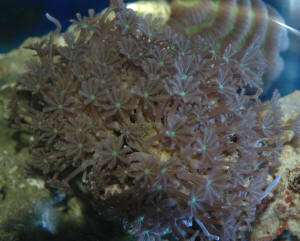
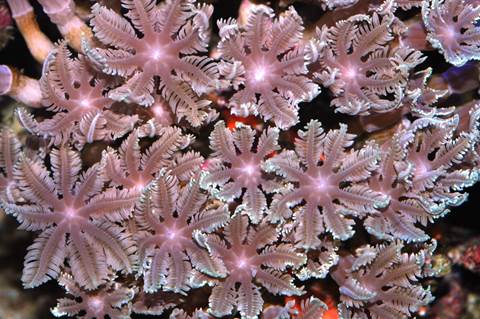
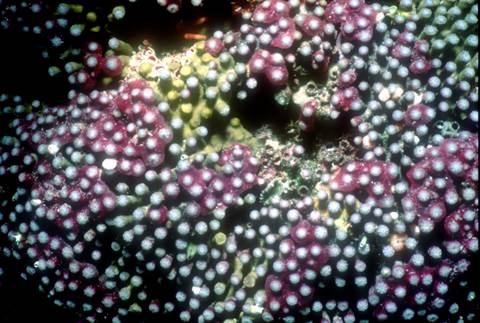
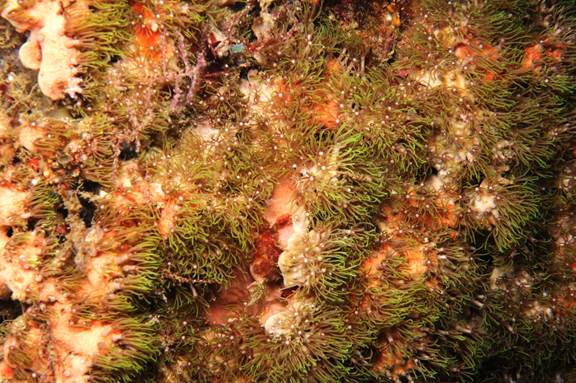
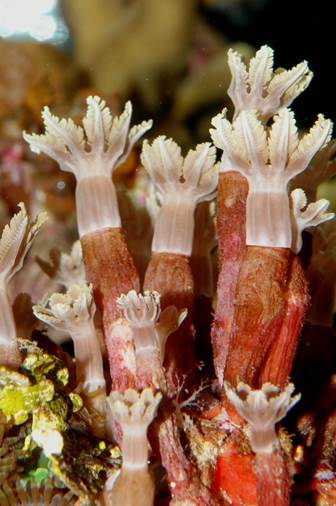
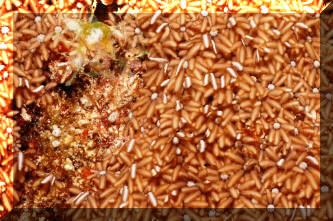
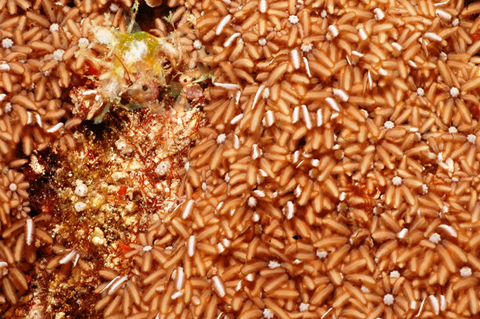
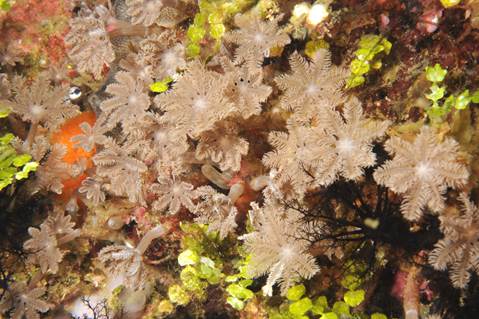
Shown above, an open Clove
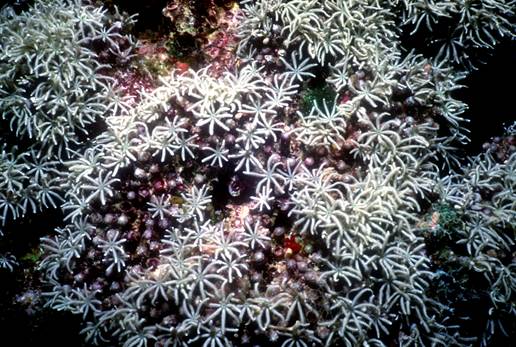
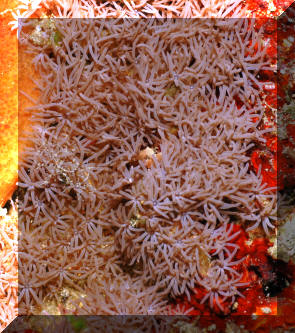
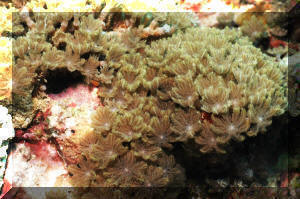
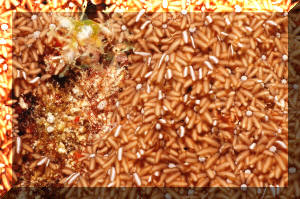
Polyp and a closed Organ Pipe. The “Star Polyps” are made up of individual
polyps arising from a colonial stolon mass. Clavulariids have internal
supportive spicules and Tubiporids are supported externally by a horny
cuticle. Stoloniferans are found worldwide in shallow temperate to
semi-temperate seas. Stoloniferans
on Parade!
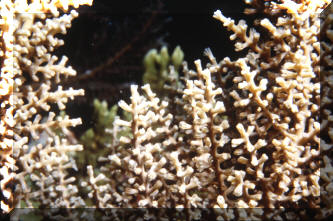
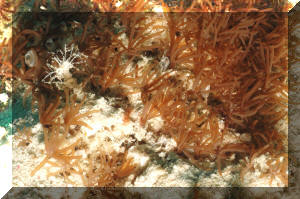
Genus Carijoa:
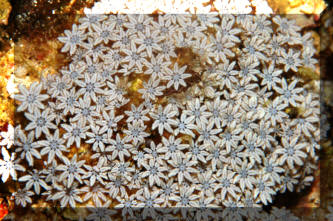
Genus Clavularia (et al. Clavulariids):
Individual polyps are encased in calyces (sing., calyx) of half to two
inches in length. Tentacle enclosed by feathery pinnules, often
side-branched. Occur in pinks, blues, white to cream, brown to yellow
colors, at times with contrasting centers. Unlike pulsing soft corals
(Family Xeniidae), Clavulariids can withdraw their tentacles completely.
Tubiporidae:
Pipe Organ Coral:
Compatibility: “Ya gotta keep ‘em separated”
Stocking, Selection:
It’s easy enough to pick out healthy specimens of these species; good
ones will be open during the day; without obvious dead spots amongst
them. Note that they will move onto gravel and sand substrates as well
as directly onto viewing panels. Again, it is best that they be
restricted by regular pruning.
The best specimens are those that have been reared locally; available as
trades with other hobbyists as in at frag swaps, or through an
intermediary stockist at your local fish store. These animals are proven
to live in captive conditions, accepting foods, artificial light… If you
must buy wild-collected stock, DO take care to observe it carefully
ahead of purchase to assure it is healthy. Stoloniferans are capable of
retracting their polyps completely (unlike Xeniids, Pulsing Corals), and
will do so given negative stimulus; but all sections of a colony should
be open and full if in good to go shape.
All, and I mean without exception new purchases must be isolated,
quarantined if you will, for a few to several weeks; to assure their
health as well as give you a chance to assure there are no unwelcome
hitchhikers that have accompanied them. After you’re certain these
criteria have been met; my standard operating procedure is to utilize a
process of introducing the new and established organisms chemically;
over a period of days; by routinely scooping out a cup or so of water
from the main, display tank and pouring this into the isolation system,
and vice versa. Systems:
Stoloniferans are great candidates for small, nano systems. As long as
you can maintain optimized, stable conditions, they’re fine in volumes
of a few gallons. Likewise they are not very lighting or circulation
dependent. “Moderate” to higher intensity of both is fine for them.
Star Polyps make for great bio-assay organisms; showing early signs of
lack of iodide-ate, and trace elements. I am a huge fan of administering
both on a regular, weekly basis, in conjunction with gravel-vacuuming,
water change outs and topping off, adding all supplements first to the
make-up water to ensure complete mixing. I will admit to being lax re
actually measuring “iodine” concentration in ongoing set ups; and even
being careful with its administration. Simply squirting in several drops
has never proved to be trouble; and whatever format I’ve employed
(Lugol’s, commercial preparation, my own mixed iodide-iodate) has proven
to be non-measurable within a day or two of application.
Calcium I keep in the higher three hundred to lower four hundred parts
per million range; Magnesium at about three times the concentration; and
I rely on quality synthetic salt mix, new water to supply Strontium and
most all else in the way of macro- and micro- minerals. I do test for
alkalinity and strive to keep this at 5-8 meq/liter. For large and
valuable collections I utilize calcium reactors; for smaller volumes
dual commercial or DIY preparations of ostensibly the same formulation.
Vitamins, HUFAs, chemical feeds that include Iron, Nitrogen, Phosphorus
and Potassium I supply through do-it-myself mashes of foods, as
mentioned in the section below.
Foods, Feeding:
Stoloniferans, like most Cnidarians, produce food photosynthetically via
Zooxanthellae as well as consume small planktonic life. They require
measurable N, P, K… nitrogen, phosphorus and potassium in their water,
as well as periodic micro-plankton feedings; supplied via incidental
fish feeding, a large, robust refugium or exogenously by your adding
commercial or home-made preparations.
There are some great shelf-available food products nowayears that one
can simply defrost or make a solubilized mash of if dried, and add to
the water column near your filter feeding livestock. I am a huge fan of
isolating gear like internal pumps separate from ones that power water
through particulate filter media. Using a timer to temporarily switch
off the latter while being able to continue circulate the water in the
system is valuable to move the bits of foods about to the open polyps
while they’re feeding.
Do it yourselfers might well enjoy making their own filter feeder foods.
Personally I’ve found it more economical to get out and buy ingredients
and put my own mashes together. My basic formula involves ocean-based
organisms of small and not sizes: Including “white” fish fillet vs.
dark/oily, small crustaceans like Cyclops, Mysids, Copepods; algae of
human palatability and Ogo/Gracilaria, liquid vitamin product (children
or adult is fine), HUFAs (Highly Unsaturated Fatty Acids (from
mail-order or health food stores), and the standard “Poor Man’s Dupla
Drops) formula available on line on the Aquatic Gardener, Krib and wiki
websites, for ferrous, N, P, K and other essential nutrients.
These I whip, frappe, blend together in a food processor, fill small
zippered lock freezer bags (polythene) and freeze laying down flat. If
the mash is intended to feed fishes as well as filter feeders I may use
a bit of emulsifier to cause the mix to stick together in larger, more
discrete clumps. For this my choice is alginate (which you may order
on-line) rather than gelatins for human foods; as the latter can prove
problematical used long term. Diseases, Pests:
It should be noted that Aluminum compounds employed in many phosphate
removing media are toxic to Stoloniferans. Hair and other pest algae are
detrimental to them as well; easily overgrowing and smothering their
stolons.
Stoloniferans are easy losers to more potent allelopathogenic
Cnidarians. Coming too near many soft corals; particularly Sarcophytons;
and the more-stinging stony corals like Oculinids, Galaxea will cause
your Polyps to die back. In fact, IF prompted by stress period, the more
toxic stinging-celled life in your system may produce copious negative
chemical metabolites resulting in die-back even if they’re located
distally from each other.
The usual call to keep your systems optimized and stable; maintaining
regular water changes, the assiduous use of chemical filtrants; and if
it’s not too dear, the application of ozone, measure of reduction
oxidation potential, will go a long way in ensuring the health of all
your aquatic life. Reproduction/Propagation:
Stoloniferans reproduce in an assortment of ways. Daughter polyps may be
exited from the edge of mats; some produce planulae larvae which brood
on the surface of the colony.
Clove and Star polyps are the easiest of
stinging-celled life to propagate; breaking off a piece, cutting the
stolon off in sizable chunks (outside the aquarium, discarding the frag
water) is a simple matter. Adhere, or band the stolon piece to a rock. I
encourage a triple dosing of iodide-ate in this process; administered to
the fragging recovery water, and again in the recovery (isolation) tank. Personal Experiences with Star Polyps:
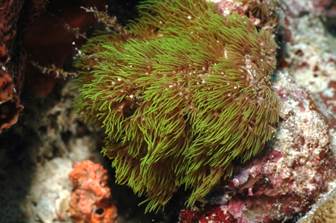
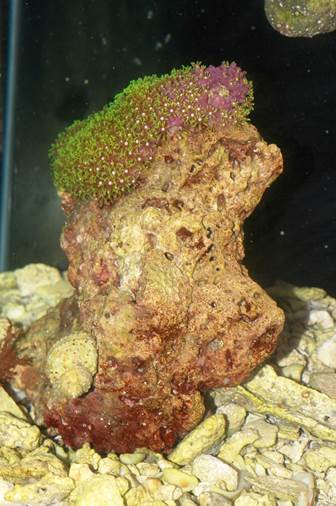
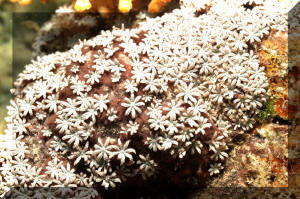
Simple Pachyclavularia violacea, Green
Star Polyps were amongst the earliest “corals” I had success keeping.
Starting in the mid 1970’s, they were also about the only Cnidarians
offered for sale and considered “hot” for Californian marine aquarists
back then. Did they live? Did they grow! Well; yes; the batch I had took
over the rock bommie I’d situated them on within a few months; then
branched on over to the adjacent glass panel, then onto the crushed
dolomite substrate. Was I surprised? Was I fretful? No; I was proud and
delighted with ‘my reproducing’ this colony! Growth exceeded more than
three centimeters per month!
My delight and pride were short-lived however, once the GSPs had managed
to spread to my other “true” (soft and hard) corals; smothering and
killing them until I wielded my mighty chisel and chipped the two apart.
But oh what fun to razor blade off a patch of these Star Polyps and hoof
on over to local stores for sales and trading. In those early reefing
years, most all locally cultured livestock (Caulerpa, Xeniids in
particular) were high dollar trade-in items. But, alas, as with all easy
to breed livestock, ready markets are quickly overwhelmed; saturated
with hobbyists excess material. What to do? Look to other, newer
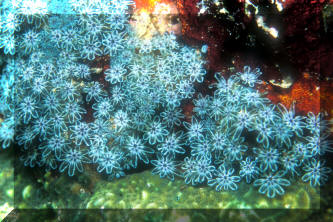
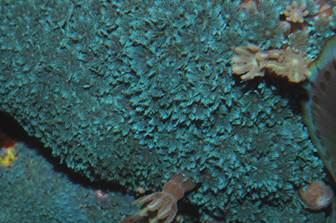
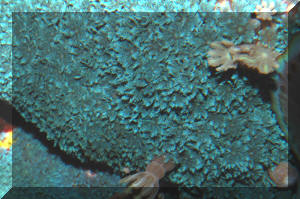
varieties to add to the market! Some keen
examples currently include a gorgeous blue Clavulariid:
Other Choices
Abound!
Cloze:
Stoloniferans, Clavulariids in particular, can make interesting and
easily kept “corals” for beginning marine/reef aquarists; they are
not-picky in terms of water quality, compared with stony and other soft
coral groups. Indeed, some folks employ them as organic
pollution/nutrient filters in their systems.
|
|
||||||||||||||||||||||||||||||||

|
Features: |
|
| Featured Sponsors: |
%20MD.JPG)
%20MD.JPG)
%20MD.JPG)
.JPG)
.JPG)
.JPG)
.JPG)
%20MD.JPG)