Clingfish FAQs
Related FAQs:
Related Articles: Clingfishes,
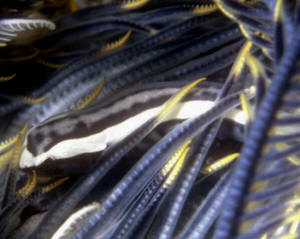
Discotrema crinophila... at
home in KBR, N. Sulawesi.
|
|
|
re: Some help... Now, Clingfish
8/29/15
Mr. Neale,
A pet store owner just gave me a free fish yesterday that he really didn't want
I have a 65gallon saltwater tank, with CoraLife super skimmer 65g,1 240
powerhead,
This is a octagon tank, fish tank only mmay I say... Well he had it for a year
and didn't want it and it was free...(name clingfish) I took it to give it a
better home and life, I know it eats algae they people really didn't know
anything about it really I look it up but was having trouble finding my
clingfish any help here please???
<Clingfish are members of the family Gobiesocidae. Despite looking like gobies,
they're not gobies.
https://en.wikipedia.org/wiki/Gobiesocidae
They're mostly adapted to living on rocky shores and reefs, hidden away from
predators. They're pretty neat animals. Some information about them here:
http://www.wetwebmedia.com/gobiesocidae.htm
http://www.wetwebmedia.com/clingfishfaqs.htm
They aren't demanding fish, but they are slow-moving micro-predators, so best
suited to nano tanks kept alone or with shrimps and perhaps small gobies such as
Neon Gobies, which are excellent aquarium fish.
http://www.wetwebmedia.com/neongobies.htm
One nice thing about Neon Gobies is that they're a lot easier to keep than their
small size and bright colours might suggest.>
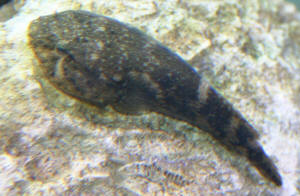
Clingfish is colors are gray and it looks lika a rock.
<Do need a photo.>
Can u give me any info on were this fish is from???
<Without identifying the fish, hard to say. Your biggest challenge is
determining whether it's a tropical or coldwater species. Coldwater marine
species sometimes get traded as "filler" alongside the tropical fish, and if
kept in tropical tanks don't live long. Some of the tropical species are
difficult to keep, Diademichthys lineatus in particular. So we do need a photo.
Failing that, enter "clingfish" in Google Images and see if you can find your
little chap.>
Thank u sincerely terry
<Cheers, Neale.>
re: Some help... (Bob, Snowflake Eel + Clingfish = ???)
8/29/15
I will try 2 sir, I just added dry live rock 2 my tank, once it all settles and
I can find him ill send pic's of my tank and him...
<I'm not an expert marine aquarist. Most of the marine experience I have is with
coldwater systems and I haven't kept a reef tank since the early 90s... so I'm
going to direct you to the marine side of WWM. Perhaps these article will get
you started nicely:
http://www.wetwebmedia.com/ca/volume_5/volume_5_3/first_steps.htm
http://www.wetwebmedia.com/marsetupii.htm
Henceforth, if you need help with marine fishkeeping, I'll direct you to Bob
Fenner, James Gasta or one of the other "saltwater" crew.>
He looks not like a goby at all but more like a freshwater sucker fish...but he
is full saltwater and about 3inchs long, very cool
animal...only worry now is when I order my snowflake Eel that he don't eat
him...I will be setting up a nano tank for seahorse at some point and will move
him if he makes it with the Eel,
<Not with the eel. The Clingfish will become dinner.>
he was in bad living conditions and I can't leave a animal like that and when
they said he was free I took him... U do have my permission 2 post all talks and
emails and pic's... I will be ordering from marcorocks 2 get the sand mix 2
build a skull out of it so it will sit in my tank and will be the show piece.
Im stoked about it...but I would love 2 show u pic's and let u post it.
What u will see now is just my basic idea and once I get everything in order I
will be switching to a 125 gallon Coralife super skimmer and a 40gallon sump
completely hindin...
<Indeed. Sounds good.>
I have about 35pound of rock about 9 pounds of seed live rock and the rest dry
live rock...1 maroon clwon fish and 1 Chromis jumbo green and 1 clingfish,1 red
legged hermit crab,2 blue legged hermit crads,2 turbo snails,3 bumble bee
snails,9 lil brittle stars and about 50 bristle worms with a bunch of other
living animals...
<Do read carefully; keeping marine fishes is not much different to freshwater
fishes and really not that difficult, but keeping marine invertebrates is much
harder than anything in the freshwater side of the hobby.>
I love it, and yes Mr. Neale I do know that a lot of these animals crabs are
50/50 in danger with my Eel and I will do my best 2 keep it feed so it will not
eat anything...
<Not a wise approach. Snowflake Eels are specialists on shrimps and crabs to be
sure, but their eyesight is lousy, and they hunt by smell. So should they bump
into something at night that doesn't move quickly, and if for some reason
they're hungry, they'll treat that item as food. Good companions for active
midwater fish such as Damsels, but not good companions for very small goby-like
creatures that sit still rather than than keep moving in my opinion. Cheers,
Neale.>
re: Some help... (Bob, can you ID a Clingfish?)<<I'll try. B>>
8/29/15
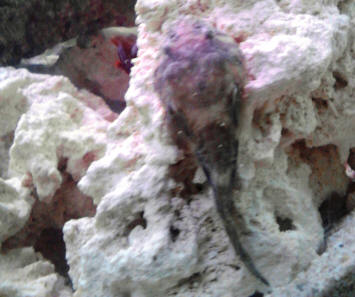
First 4 are my saltwater aquarium octagon tank...
First 1 on the rock is the cling fish...
<Yep, that's a Clingfish.>
This last one 55 gallon long tank is wife's freshwater tank with 2 African
clawed frogs all live plants,
<Cool animals and a nice tank for them!>
I bought this 4 her as a b-day gift one frog is mine the albino frog is here's
...
Tell me what u think Mr. Neale.
<I think you've got a challenge there with the Clingfish. I'm not sure what
species it is. Perhaps a Tomicodon species? I'm concerned that it might be a
subtropical or temperate species... large size, dull colours are suggestive of
this (tropical species in a given family of fish tend to be smaller and/or more
brightly coloured). I'd definitely be ensuring extremely high oxygenation just
in case it isn't a tropical species, because low oxygen level is what kills
subtropical and temperate species
most quickly when kept indoors or too warm. DO TRY and get the Latin name (or
even a better common name) from the retailer... it should be on his "list" of
livestock he got from the wholesaler, sort of like a receipt.
Have you seen it feed yet? That'd be my next aim. A bamboo/satay skewer is a
good length and can hold a small piece of white fish fillet or prawn.
Wave enticingly, perhaps at dusk/dawn with the tank lights out, and see if it
feeds. Be sure to read here:
http://www.wetwebmedia.com/ca/volume_6/volume_6_1/thiaminase.htm
Thiaminase destroys vitamin B1 and is almost certainly a major reason for
failure with oddball predatory fish. Good luck, Neale.>
|
 |
|
Subject: re: Some help... (Bob, can you ID a Clingfish?)
8/29/15
<IS A Gobiesocid, but... of the 161 species on Fishbase:
http://www.fishbase.org/identification/specieslist.php?famcode=434&areacode=
and asking Google re aquarium species, ones for sale.... I can't quite make out.
BobF>
re: Some help... (Bob, can you ID a Clingfish?) 8/29/15
Mr. neale,he had that clingfish 4 a year, he just said it was a clingfish and it
eats algae...
<Nope, they don't; this family are all micro carnivores of some sort or
another.>
I don't like these pet store that don't know anything they are sale 'in and it
bothers me
<It bothers me too. Mostly pet shops expect you to do your research first.
Not necessarily a bad idea. But for some folks without the right books or access
to the Internet, it's unhelpful if they can't trust their local retailer.>
and yea I do know all about the Eels and understanding of them...
I needed a cleaning crew, ill watch and pay attention 2 c what happens. From
what I read which there isn't a lot about the clingfish but they was algae
eaters and he is in the saltwater tank as he was reported 2 be for that year at
the pet store...I don't understand when u said about him eatin raw fish with a
tong, shoulda I offer him a piece then???
<This fish looked pretty big. What, 8 cm/3 inches maybe? Hard to tell in a
photo. But yes, try some chopped up fish fillet or shrimp, or some frozen brine
shrimps. Don't pollute the tank of course, Try a bit of something, and if it
isn't eaten, remove. But you want to see him feed some time in the next couple
days.>
And my tank stays at 79 degrees and all ph and all levels are good...my set up
is better that what that lil guys was in at the pet store...and dude has know
idea on its name...sighin like people...they shouldn't be allowed 2 have pet
store. If they don't know what the hell they are doin...sorry for that but its
true,I wanna open up a saltwater/freshwater shop but money is
so tight and I know I woulda make a killin and treatin the animals right and
givin the people the right info and help that is 100% needed.
<Does your city/state have a fish/aquarium club? Many do; you want to join one,
and find out ways you can get more practical experience and also outreach...
setting up tanks in schools, old folks' homes, that sort of thing. Very
rewarding and a good way to build up your skill set.>
Ooo I do have 1 book I wrote that needs sent out and 2 on the way,I am a writer
and also have poems and other writings,I went 2 college for art and later 4
personal trainer and I tattoo right now...
But that's for another day and thank u so much 2 say I am already apart of what
u do and the site,it means a lot to me sir thank u so much...
<Welcome.>
How did u like my saltwater tank and I 4got 2 put that one rock back...sorry
abouth that but I sent u more pics of the tank right... I repsect u and what u
do!!!
<Looked very nice to me! Do find one of the friendly fish forums out there...
you should find sharing photos rewarding. I'm not marine expert so not really
the person to chat to about this topic.>
If anytime u woulda like to talk on the phone or write ill give u my number and
address
Terry
<Good luck with your new projects! Cheers, Neale.>
|
|
Fish Identification?; Skilletfish --
01/16/10
Greetings,
<Hi Steve.>
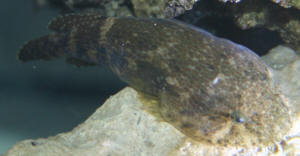
I have found this little guy in the west side Mobile Bay, Al.
under a rock about 6 months ago. He was about 2 inches and a
yellowish color as I recall. He is now mostly brownish and about
4 inches. Attached is a couple pictures of his topside and
bottom-side. He roughly looks like a Plecostomus, in shape and
general appearance although a bit shorter. He does have a set of
suction plates on his abdomen which he definitely knows how to
use on the glass. About 6 to 8 "small barbs" or
"stubby whiskers" on his chin, and the very small
raised antenna
like things above the eyes.
<A Clingfish (family Gobiesocidae). Likely a Gobiesox
strumosus (Skilletfish.>
He seems well behaved in my 75g reef, loves to eat, gets most of
the left overs off the bottom, and rather shy, stays in the
rocks, or out, but hidden.
<Has been kept and even been bred here and there, but is not a
very common aquarium fish.>
You guys are very good at IDing fishes, I figured that one of you
should be able to tell me what he is, or at least point me in the
correct direction to get me started. Thanks, Steve
<Welcome. Marco.>
|
 |
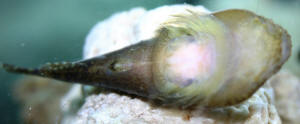
Urchin Clingfish Advice - 08/31/07 Hi Guys,
<Kirsty> I got a call from my LFS asking if I would take an
Urchin Clingfish from them. I had previously been researching these
little fish but could not find much info, apart from females having
longer snouts, that juveniles rely more on urchins, but as they grow
older, they rely more on commensal shrimp eggs, burrowing bivalves,
copepods etc for food, and that generally, these poor fish tend to fade
away and disappear in aquarium situations. <About all I know as
well... this and their association with Diadema spp> I have only had
my clingfish for 5 days, but so far, have had to feed him 3 nights in a
row in a bag!! I do not net him, but hold the bag under the water line
and wait for him to come to the surface and then gently herd him in to
the bag. He is a very friendly fellow and has even attached himself to
my arm and just sat there, so I sincerely believe I am not stressing
him out when I do this. I am offering him lobster eggs and frozen
Cyclop, both of which he hoovers up well. <Neat!> I decided to
feed him in this manner as unfortunately, I believe he was wild caught,
<Assuredly> and I found out that the place that my LFS got him
from tend to keep their livestock in really small holding
"tanks" before they are sold on. Because of this, when I
previously put food in my nano for him, even with the skimmer turned
off, he would miss this food and not appear to feed. Since I have been
bagging him, he also appears much more lively and "fatter" -
if a clingfish can look fat! <Good technique> I am also currently
trying to fashion a feeding box for him to see if I can teach him by
association to enter this box to feed, and in this box, the food will
not get blown away by water movement and always be visible for him to
eat. Can you offer any more advice on these little fish, such as
feeding and if they fare better in numbers? (I do not intend to get an
urchin due to the small size of my nano and through fear of the toxin
release into my tank if it died). Thanks in advance, Kirsty <What
little further we have is here:
http://www.wetwebmedia.com/clingfishfaqs.htm and the linked file above.
Am hopeful that you will record your observations, speculations, and
share them with others. Bob Fenner>
Re: Urchin Clingfish Advice 9/1/07 Hello Bob,
<Kirsty> thank you so much for your reply as to my questions.
<A pleasure to chat with you> Well, he was waiting for me to bag
him last night when I got home, and therefore, ate well again last
night! My feeding box is nearly ready to start the association training
as he obviously learns very quickly, I think I will be on to a winner
here! I'm going to try other food items, and am trying to source
some mussels or such like, that I can leave in the tank for him to take
a nibble off from time to time. Would you think this would be a good
idea? <A refugium would likely be better... with a DSB,
Macroalgae... for ongoing culture, supply of live food organisms>
I'll definitely keep you posted as to my observations, as if this
helps anyone keep these great little fish happy and alive, I'll
keep writing! Should I just collect some more info and then email it
across? <I encourage you to consider an actual article... Which I
will gladly help you place... Do make photographs to go along with if
you can> Thanks again Bob, Kirsty <Again, welcome. BobF>
Re: Urchin Clingfish Advice 9/1/07 Thank you so
much again Bob. <Welcome Kirsty> I got a call from my LFS just
before I left work saying they had a female urchin clingfish, and would
I like to have her. Of course, I said yes as at least I feel I can keep
them well fed now. I asked the caller how he knew it was a female, and
he said it was because she had a shorter snout.....having read the
information on WetWebMedia, I would think that this would be a male? It
will be interesting to see the difference between the two, if any. Ah!
a refugium! Thanks Bob, a great idea. I'll see what I can make, but
don't know how feasible it will be with my type of nano due to the
strange rim on it - I'll not give up on the idea anyway as its a
great one! It certainly appears that this little fish notices food on
surfaces much more than floating food which has really got me thinking.
Thanks again Bob, I'll try and get photos and an article of sorts
going - its been a long time since I did anything like that so wish me
luck! Kirsty <I sense a long and distinguished "content
providing" carrier potential here... BobF>
Re: Urchin Clingfish Advice 9/2/07 Hi Bob,
<Kirsty> sorry, I know I said I'd keep my notes and get back
to you, but just wanted to let you know about my further observations
today. I'm excited, so had to share it with someone! <Well, all
right!> New clingfish collected today and whilst acclimatizing in
the bag, my first clingfish spotted it in the bag. Straight up to the
bag, trying to get in, acting flirtatious and then changed colour!
<Have seen this sort of interaction with coastal species (we live in
San Diego) in tide pools...> The yellow stripes went a browny orange
colour. Once the second clingfish had acclimatised enough to release
from the bag, my first clingfish was dancing all around it, curving its
tail upwards and constantly fanning; I do not know if this was
"courting" behaviour or territorial as the other clingfish
was having none of it. I also do not know if this then makes my first
one appear male or not, as at the moment, apart from a obvious
difference in size, (2nd one larger), it is hard for me to see any
obvious difference in snout length. The second clingfish also appears
much more shy; ?to do with the fact that it is the second clingfish in
the tank? <Likely so...> ?or being hassled by the first? ?or just
generally more stressed? <Who can say?> This one did not want to
eat in the bag whilst acclimatizing. <Not surprising eh? Must be
very traumatic> Secondly, my feeding box mark 2 is a success! My
first clingfish spied it, nosed all around it and then swam straight in
through the hole on the floor I created. It fed, then swam out again. 3
more times after this it entered the feeding box and fed. <Great>
Sorry again for prematurely contacting you, but I am very excited and
sincerely hope that the second clingfish will follow suit. Speak soon
Bob! Kirsty <Be chatting! Bob Fenner>
Re: Urchin Clingfish Advice 9/6/07 Hi Bob, <Kirsty>
hope you are well and happy? <Yes, thanks... though the coffee is
too caffeinated and music too loud at the S*bucks am using the Net at
currently> Sad today as I had to return the second urchin clingfish
to my LFS today, but at least it had a full stomach.... My first would
not stop hassling it, and was really quite aggressive, so yesterday I
had to separate the two which is not easy in a nano. I made another box
to keep it safe over night, and whilst it was in there I introduced
some lobster eggs and shredded brine shrimp which it ate with gusto. I
kept it in the box overnight and offered more food this morning which
again, it ate. I had not at any point seen it take food whilst free in
the tank. <Too bad you don't have another system> Ok, I know
I will have a few photos to send to you re the "feeding
boxes" I have prepared etc, and possibly the odd really simple
diagram of how to make one, but wanted to impart a little more info on
what I have observed as the more available, the more it will help
people decide if these fantastic fish are for them, or if hopefully
these fish will not be wild caught and maybe, hope against hope, that
someone will be able to breed them. If I had more money I would
dedicate a tank to these guys and learn more...if only! <Ah yes>
Observations on Urchin Clingfish so far; Not stressed by human
interaction Feed from surfaces - actually look and hover around food
before deciding to take it. When they take food it is with a stabbing
motion. So far, they do not show interest in taking food from mid
water. Their mouths are uniquely shaped, overshot upper jaw, almost
pointed at the tip, undershot lower jaw with an obvious gap when mouth
closed - assumingly to feed from urchin pedicallariae, commensal shrimp
eggs etc. (A quick in, jab and out action!). These fish, when placed in
a suitable feeding box within the tank will eat to their hearts
content. They learn quickly to utilise a simple feeding box, preferring
to enter the box from below, and will visit this box several times a
day. They will mouth different food types, but will spit out any types
not preferred - as do most fish! Likes so far; lobster eggs, finely
shredded brine shrimp Not sure so far; Dragon Feeds size 0.5ml, frozen
Cyclops which I think is too small to be of interest? Dislikes; too
early to tell Going to try; live mussels, (once I've sourced some
that have not been treated and are hopefully parasite free), frozen
shredded mussels and upping my pod cultures. Semi aggressive to
aggressive fish. Query because of same sex? <Gots me> And query
because of me having a nano and very small territory! Whilst able to
observe the 2nd clingfish in its temporary box, the snout shapes were
visibly similar although a definite size difference between the two was
visible, assumingly down to age.... I could be wrong! I am currently
trying to collect as many photos as possible of clingfish to see if I
can denote any difference in snout length. So far, I have found appx 2
photos of possible males, (due to the sorter snout length?) out of appx
80 x photos. I'll send you some photos soon of my clingfish using
its feeding box and let you know how cheaply I made it and out of what.
Initially, I was being too complicated in my ideas and the simplest
ones turned out the best. I will keep observing and keep reporting back
on these wonderful fish as and when I think I've got something
interesting. Sorry for being a pest, and please never ever stop what
you do with WetWebMedia, you guys are a source of information and
inspiration to us all, Kirsty <Not a pest... thank you for sharing.
BobF>
Re: Urchin Clingfish Advice 9/12/07 Hi Bob,
<Kirsty> I trust you are well and that the coffee is not too
bad?! <Java this AM not too bad, thanks> Thought I'd send
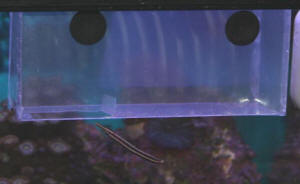
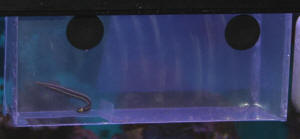
you a couple of pics of my urchin clingfish using box number one.
Prototype number two is tidier looking and only slightly different,
but going to make a third with some other changes to see how that
goes. This little fish is doing great, and now when he rests on the
glass I am happy to say that you can actually see where his abdomen
ends and his tail starts! <Ah, yes> It was such a shame I
could not keep the second, but due to lack of aquariums, (I only
have one!), and space, (no room for another!), it was kinder to
take him back to the LFS, otherwise I am sure my first would have
eventually killed him, or, through the sheer fact of harassment, he
would never have eaten. Although, as I mentioned in my previous
email, I am sure this second fish would have learnt as quickly as
the first to use a feeding box. If anyone has a larger tank than I
have, they can be placed very inconspicuously within, and food
placed in them a few times a day in order for them to feed.
I've siphoned old food out through a small tube, but would
recommend cleaning them thoroughly at least every few days. If you
think its worth it, and will help, I will take pics of the 3rd box
and submit diagrams, just tip me the nod! <Please do send
along> Sorry the pics aren't clearer, and sorry you
can't see the food being taken. Speak soon,
Kirsty
<Be chatting! BobF> |
|
|
| Re: Urchin Clingfish Advice, sexing and pix!
10/2/07 Hi Bob, <Kirsty> I trust you are well? <Yes my
friend, thank you> Thanks so much for your correspondence and
your encouragement, I will definitely have something for you to
read through and help me with in the near future. <I look
fwd...> I went to my LFS yesterday and they had 2 urchin
clingfish in stock. I could have cried; they were so thin. Thin to
the point that their abdomens were concave. I wish I could have
taken them with me when I left.......I now believe I can visually
tell the difference between male and female just by looking at
them. I hope this is not just wishful thinking, but I believe the
two at the LFS are the same sex as mine, and I believe mine is
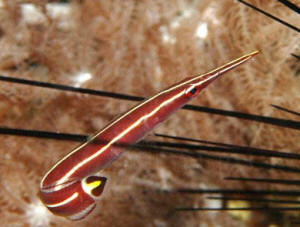
male. I have attached two photos of what I believe are the opposite
sex, the female being the one with the longer snout. I've spent
an age trawling through photos and the two I've attached are
just a couple showing what I believe to be an obvious difference. I
have many more but won't bore you with them! <I am in
agreement with your assessment> Thank you again Bob, I wish I
could meet you in person! <Likely someday, perhaps soon. Do
consider coming out to the pet-fish conventions... "clubs of
clubs"... many of us (WWM et al.) convene at these... Do you
dive/SCUBA?> Hope the coffee manufacturers are being kind to
you, <Or pick coffee? Heeee! An incidental/occupational hazard
visiting on the Big Island for every half year. BobF>
Kirsty |
|
 .jpg)
|
Re: Urchin Clingfish Advice 07/27/07 Hi Bob, <Kirsty>
long time no speak! Many apologies for not being in touch for a while,
things have been pretty hectic for me recently. <No worries> Re
your question about if I scuba; sadly I don't. I'd love to but
money stops me from being able to....well, the lack of it anyway!
<Mmm, save up... "attention is narrow perception"... focus
on what is more/most important. Something to shoot for in the
future...> I'd love to come out to one of the conventions, but
again, due to lack of funds, coming to America is not an issue. Also,
who would look after my beloved little reef and of course, my two
dogs?! <Oh... yes... You're in the UK... Well... one never
knows> I have a week off work soon and have a small upgrade planned
for my little tank. I'm planning everything thoroughly so as to try
and be less stressed on the "big swap over" day. I know its
going to be hard work and stressful but at the same time I'm so
very much looking forward to it. <Ah, good> Back to my urchin
clingfish; he's still doing great. He's still extremely healthy
and well fed, and I'm still on the lookout for a female. I'm
hoping that on my week off I'll be able to make some headway with
the write up, and I'm pleased to say that my boyfriend announced
today that he has bought a remote shutter cable release for his camera
so we'll be able to get some much better pics of the fish and box
etc. <Ah, very good indeed> Hope you are well and happy Bob,
Kirsty <Thank you my friend. BobF>
Clingfish FAQs 7/17/06 http://www.wetwebmedia.com/clingfishfaqs.htm This is what I
have found about the feeding of the Clingfish I personally feed the
inhabitants of my nano tank which now includes a Yellow Striped
Clingfish, Brine Shrimp and baby Brine Shrimp Environmental Biology of
Fishes Publisher: Springer Netherlands ISSN: 0378-1909 (Paper)
1573-5133 (Online) DOI: 10.1007/BF00004787 Issue: Volume 34, Number 1
Date: May 1992 Pages: 95 - 101 Sexual dimorphism and food habits of the
clingfish, Diademichthys lineatus, and its dependence on host sea
urchin Hiroko Sakashita1 (1) Department of Marine Sciences, University
of the Ryukyus, Nishihara, Okinawa, 903-01, Japan Received: 16 August
1990 Accepted: 5 March 1991 Synopsis Stomach contents of the clingfish
Diademichthys lineatus, 10-56 mm standard length, revealed changes in
food habits with growth and sexual differences. Soon after settlement,
D. lineatus obtained food from their host sea urchin (genus Diadema)
and other associated symbionts. They became less dependent on the host
with growth. The juveniles ate pedicellariae and sphaeridia of the host
and commensal copepods, whereas the adult fish ate burrowing bivalves
in corals as well as tube feet of their host and eggs of a commensal
shrimp. The young fish were transitional in their food habits. The
change in food habits of the fish coincided with behavioral changes;
i.e. enlargement of home ranges and less dependency on the host. The
adult females, having a longer snout, ate shrimp eggs and bivalves more
frequently than the adult males, which ate tube feet of the host more
often than the females did. Sexual difference in food habits was
apparent after the sex of the fish became identifiable by comparing
snout shapes. The polygynous mating system of this species suggests
that conspicuous sexual dimorphism might have developed under sexual
selection. However, niche partitioning of food is also likely to be
related to this sexual dimorphism. Key words Gobiesocidae - Symbiosis -
Nutritional dependency on the host - Sexual dimorphism - Niche
partitioning _____ The references of this article are secured to
subscribers Olaf <Thank you for this. This family is becoming one of
the "darlings" of the public aquarium trade. Have you seen
the system/demonstration in Monterey? Bob Fenner>
Re: Clingfish FAQs 8/17/06 I still have my
Clingfish and it is doing well. Once in a while I notice it picking on
a hermit crab. <Yes... I suspect these fish/es eat these in the
wild> I feed my nano inhabitants brine shrimp and baby brine shrimp
(frozen cubes). I also raise Amphipods and Copepods in a 6 g nano. I
sometimes take a few out and put them in my 24 g nano. 24 Gallon Nano
Stock List: FISH Six-Line Wrasse <Keep your eye on this> Royal
Gramma Basslet Court Jester Goby Yellow Stripe Clingfish Hi Fin Red
Banded Goby Tail Spot Blenny INVERTS Scarlet Skunk Cleaner Shrimp
Peppermint Shrimp Blue Leg Hermit Crab Scarlet Reef Hermit Crab Emerald
Mithrax Crab (Mithrax sculptus) Red Mithrax Crab (Mithrax
spinosissimus) Porcelain Crab other unidentified crabs (3) Marble
Starfish Sand Sifting Starfish <I would remove one or both of the
above... too infaunal predaceous> Micro Brittle Starfish Small Fan
Worms (Tan, Striped, & Purple) Cerith Snail (Cortez & White)
Astrea Conehead Snail Banded Trochus Snail (Black body and tan body)
Bumble Bee Snail Pacific Nerite Snail Limpet Mexican Turbo Snail
Stomatella Snails Strombus Snails Chiton (very small) Purple Lipped
Mussel or clam inside a 1" hole through the live rock. Lettuce Sea
Slug Majano Anemone, Anemonia majano Coral Polyps Green & Orange
Pacific Green Spotted Ricordea Few Unidentified Polyps or Anemones
(Discosoma bryoides (?)) Peanut Worms Reef Bristle Worms Copepods
Amphipods MACROALGAE Caulerpa prolifera (large leaf) Caulerpa brachypus
(small leaf) Caulerpa bikinensis (cup) Caulerpa racemosa (grape) Red
Dictyota Wire Algae Green Bubble Algae Sea Lettuce Neomeris annulata
Ogo Green Hair Algae <! That's a lot of life in a small volume!
Bob Fenner>
Clingfish FAQs (8/17/06)
05/18/09
Hi Bob,
<KL>
I have sad news, my Yellow Striped Clingfish died. It was over 2"
long. I measured it, it was almost 2?" You told me to watch the
Six-line Wrasse, he was fine with all residents. The Yellow Striped
Clingfish seemed to not be scared of anything, even my hand. It had
landed on my arm once while I was cleaning the tank. Sorta spooked me.
LOL Didn't know what was on me. I am sure it died of natural
causes. I fed it around the same time every day. When I would walk up
to the tank it would stick its nose out of the water. I was wondering
what the life expectancy is for the Clingfish in the wild, since
majority seems not to last long for others aquarist. My Six-line is
giant and crazy it displays all the time and it will even display at
me. It gets ticked off when I have my hands in the tank and will
actually go up to the glass and erect all of its fins and then nip the
glass, making a clicking sound as it bites the glass. It zips through
the tank until I remove my hands.
<Even more feisty than typical>
My friends can't believe how big my Six-line has gotten. It has to
be over 2 3/4".
Thanks,
KL
JBJ 24-gallon with Magnum H.O.T. hanging on the front filled with tube
worms (Spirorbis spp. And others that look like small coco worms -
Calcium tube up to 3" long) and sponges (Sycon sp.). The tank has
been running since early 2004.
FISH: Six-Line Wrasse, Royal Gramma Basslet (Died a while back at full
size over (3") tried, replacing but Six-line killed each newbie
(2) so I stopped putting new fish in.), Court Jester Goby (Died at full
size over (2.5") six months ago. Had him for a long while. Yellow
Stripe Clingfish, Hi Fin Red Banded Goby (Died over a year and a half
ago. Found it in its cave DOA.) Tail Spot Blenny (scaredy-cat) hides in
its cave most of the time.
INVERTS: Scarlet Skunk Cleaner Shrimp (taken out by Alpheus armatus
after living together for almost two years. One morning Alpheus was
eating the scarlet :( Scarlet was bigger than all my fish.), Peppermint
Shrimp (give to one of my clients to rid glass anemones. Didn't do
the job, ended up terrorizing the tank. Picked on coral polyps and
other things. Trapped them and gave them to a LFS) Blue Leg Hermit
Crab, Scarlet Reef Hermit Crab, Emerald Mithrax Crab (Mithrax
sculptus), Red Mithrax Crab (Mithrax spinosissimus) (disappeared),
Porcelain Crab (still kicking and huge other unidentified crabs (3)
(all MIA) Marble Starfish (lasted for about two years then got the
deteriorating issue that I have seen with a lot of star in captivity)
Sand Sifting Starfish (gave to client that had more sand room) Micro
Brittle Starfish (Tons - see breed often, clouding up the tank with
sperm and eggs.) Small Fan Worms (Tan, Striped, & Purple) Cerith
Snail (Cortez & White) (hermits took all over for the shells)
Astrea Conehead Snail Banded Trochus Snail (Black body and tan body)
Bumble Bee Snail, Pacific Nerite Snail, Limpet (micro limpets Max size
1/4" breed in captivity and doesn't scratch the acrylic),
Mexican Turbo Snail, Stomatella Snails, Strombus Snails, Chiton (very
small) (haven't seen it in over a year, but this is normal I only
see it maybe once a year), Purple Lipped Mussel or clam inside a
1" hole through the live rock. (shell found cracked and on the
sand empty) Lettuce Sea Slug (Elysia diomedea - still kicking had for 5
years now) Majano Anemone, Anemonia majano (they started multiplying so
I Joe's Juiced them), Jewel anemones (Corynactis sp.), Colony
anemones (???), Pacific Green Spotted Ricordea (over run by Green
Mushrooms), Branching Green star polyps (showed up one day), Peanut
Worms, Reef Bristle Worms, Copepods, Amphipods,
MACROALGAE: Caulerpa prolifera (large leaf) (took it all out), Caulerpa
brachypus (small leaf) (can't get rid of it!), Caulerpa bikinensis
(cup) (None left), Caulerpa racemosa (grape) (none left), Red Dictyota
(something ate it.), Wire Algae (Sea slug and Mithrax crab ate it),
Green Bubble Algae (still a very small amount less than a dime size),
Sea Lettuce (gone), Neomeris annulata (gone Mithrax ate it), Ogo
(gone), Green Hair Algae (gone),
The fish and only a few inverts were all I added everything else came
in on the live rock from Bali.
PS I have a few things in one of my nano cubes that I have been
raising. I am not sure what exactly they are. One is a colony anemone
largest it gets is about 1/2" wide they multiply in the tank.
Another looks like a Jewel Anemone from doing searches for info.
Corynactis sp. This anemone is found in the shade and over hangs in my
tank rarely in the open or in the light. I also have a kind of worm
that has whiskers and it seems to have jaws that come out of its
trachea once in a great while. These worms are extremely small and seem
to feed on copepods and smaller micro-inverts. They have legs on their
sides like millipedes. I have also seen them swim, it looks like a
tight cork screw motion. I also have a limpet that reaches only
1/4" long and reproduces in my tank. They don't scratch the
acrylic. I sent these off to one of my friend John Flynn at Pet
Solutions and he has never seen any of these before. He has looked
through his books and has not found anything either. How can I find out
what they are?
<Mmm, among other possibilities, take good pix and send them in to
WWM. Ask for LynnZ. Bob Fenner>
Clingfish questions Hey there.... <Hello to you> God
this place is just heavenly!!!!!!!! A place for all keepers to familiar
with for sure. I'm proud to be a "reader" here and I hope
you guys are more than thrilled being the actual people behind this
site. Kudos to each and every one of you. <Thank you my friend>
Now.......My inquiry is in regards to my Yellow Stripe Clingfish, AKA:
The Urchin Clingfish-- Diademichthys lineatus. <Ahh, an unusual
species, family of fishes to be sure> I've attained him from
ordering him/her from LFS in my area, and was thrilled to get him/her
after doing all the reading I could about them, even though mind you,
there is close to nothing regarding their care and dwelling in the home
aquaria. <I have seen some really innovative exhibits... my fave the
upstairs "children's" area of the Monterey Bay Aquarium
where they had a tall tube tank with a button for draining the water...
with the Clingfish holding on to the sides... different species of
course> He is doing great, active displaying his health and not
over- active displaying signs of stress. Such a truly amazing species,
one I wish was made available more often as well as reported in home
aquaria more often in regards to care, feeding and the likes. <Do
you have this specimen housed with urchins?> Saying all of the
above. To my knowledge, at feeding time, which is twice a day, I never
see him/her take anything. Frozen Cyclop-eeze, PE Mysis, Spirulina
Brine and I've even tried blended and mashed Cyclops, yet to my own
sightings, still no feeding. <May well be eating "miscellaneous
organisms" from LR, sand... during the night> I know that in
the wild they will usually more often than not be found with their
host, the long spine urchin....and that they will rely much as clowns
seem to with their host anemone. <Yes> I've read that they
can be kept without an urchin, no urchin in my tank. I've read that
they will accept frozen meaty foods as mentioned above. None accepted.
It has also been said they, although not too often available for
purchase, do fare well in the home aquaria. <Unfortunately I have no
captive experience with this species.. and Paul Mansur (who has
voluntary time in public aquariums) is temporarily "out". As
long as you don't think, see that the specimen is overly thin I
would not be concerned> I was hoping you could lend some more
information on this species, as there is NOTHING more with all of my
searching and the likes, that enables me to read up more about my
little buddy, Velcro! <Hee hee! Good name> He may just as well,
be eating pods, isopods, amphipods and such, but nothing that I have
taken notice to. I certainly didn't purchase the clingfish until I
read all I could that was made available by me searching for it on the
web or what was available in the libraries. I felt secure enough that I
was going to house the animal in a realistic and fair fashion and so
proceeded to invest in him/her. <Good for you and the planet> I
would appreciate your advices and input on the feeding situation as
well as some more information on the species as well. In closing my
system is >29gallon all glass >1 fridmani Pseudochromis >1
yellow clown goby >1 green clown goby >1 Banggai cardinal <1
urchin/yellow stripe clingfish >1 Engineer goby (quickly outgrowing
the system, catching him should prove to be stressful for both
parties!!! >Numerous species of shrimp including, skunk cleaners,
Sarons, L. wurdemanni, L. rathbunae, a species of anemone cleaner
shrimp (unidentified thus far) >no sump and no fuge > Eheim
professional 2 canister model 2028 > AquaC Remora with maxi12 and
pre skimmer box > 35 pounds maybe a little over of LR > 2.5
inches of LS > 130watt PC CSL lighting, all daylights, no actinics
running. > Macroalgae, "string of pearls" (unidentified).
shaving brush, Caulerpa prolifera, species of Codium, two other species
of red macroalgae unidentified as well although thought to be species
of Gracilaria... "Tank" you for your time....I look very
forward to hearing from you guys..... be well. Tank on! <I would
continue the offerings and observations as you have. Bob Fenner>
The Urchin Clingfish Hi, <Hi there! Scott F. with you
today!> i recently purchased the clingfish Diademichthys lineatus
from liveaquaria.com. Its mouth was absolutely tiny. I did not see it
eat. It flitted about my 125 gallon reef for a week or two then
disappeared. <Unfortunately, this seems to be a rather common
occurrence with these fishes!> I noticed on your website that it is
associated with the diadema urchin. Is this a fish that should not be
kept? I hate getting anything that is doomed to die in my tank. Of
course, I should have researched it before I purchased it. if you have
any advice regarding its care, I would consider getting another one.
Otherwise, I'll pretend its a Moorish Idol and leave it in the
ocean. Thanks, John Kim <Well, John, I have a friend who has
purchased several of these specimens over the last few months, with
similar results to yours. The fish tend to disappear over time. Based
on the rather limited hobby information that I have found regarding
this fish, I'd have to say that success is a rather hit-or-miss
affair. According to the great reference, fishbase.org, this species
does consume some copepods, zooplankton, and other benthic animals.
However, this may be a specialized feeder that has difficulty making
the switch to captivity. Perhaps it's association with the Diadema
urchin is a clue- or a requirement for success? I suppose the best
results could be achieved by housing the fish in a very well
established aquarium, connected to a thriving refugium (for production
of natural plankton). Even then, it's possibly a matter of luck!
I'd probably defer purchasing this fish, myself- at least until
it's dietary needs in captivity can be more thoroughly understood.
Since you have the fish, do experiment, and be sure to document your
experiences, so that you can add to the limited body of knowledge. Here
is the FishBase link with information on the fish that you may find to
be a good starting point:
http://fishbase.org/Summary/SpeciesSummary.cfm?ID=12891&genusname=Diademichthys&speciesname=lineatus
Good luck! Regards, Scott F>
|
|

