|
|
| Home | Marine Aquariums |
Freshwater Aquariums |
Planted Aquariums |
Brackish Systems |
Ponds,
lakes & fountains |
Turtles & Amphibians |
Aquatic Business |
Aquatic Science |
Ask the WWM Crew a Question |
| Please visit our Sponsors | ||||
Not cleaner shrimp?
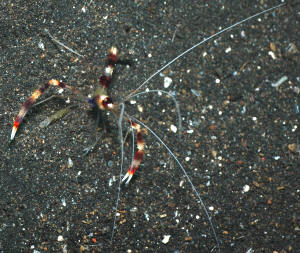
1/28/13 Coral Banded Shrimp ID 7/15/06 I recently purchased what was listed as a gold coral banded shrimp. He has the typical red and white claw and tail coloring with the yellow thorax and white antennae. The part that is disturbing me is that he also has blue colored legs. <<Mmm, yes...have seen this on the "red" variety as well>> I have been trying to verify name and information so I can learn more about this particular species. Is this just an regional variation, or is this a sub-species or a completely different type of shrimp, although that would seem rather unlikely. <<I suspect this is a color variant of Stenopus hispidus>> He is currently very small, only 1 to 1 1/2 inches in length. <<Will get big (as aquarium shrimp go) and will "rule" the other inverts>> I have searched through numerous books, Google, any different combination of searches and was not able to find anything. <<...? Did you do a search on the genus (Stenopus)? I did find things on the Blue Coral Banded, but he definitely has the Yellow, not Blue thorax. <<Yes, a different species...some eight or so in all>> Thank you in advance for any information or direction you can point me. Chuck Davis <<Have a read here Chuck ( http://www.wetwebmedia.com/marine/inverts/arthropoda/shrimp/corlband.htm). Be sure to check out the bibliography, and do follow the blue links at the top of the page. Regards, EricR>> Re: Coral Banded Shrimp ID 7/15/06 Thanks for the information guys. <<Did it help?>> I had read the links you gave, but was not able to determine which based on what was there. <<Guess not <grin> >> I finally did end up just trying to look up a listing with picture for all of the Stenopus species. Luckily there are not too many. I finally found a page on reefcorner.org that listed species and a brief description. While this main page is in another country, it did give me a scientific name that I could search with, and found a picture of on another site. It looks almost exactly like the Stenopus cyanoscelis shown. <<"Almost"...but?>> Now I just need to find some more detailed information regarding this subspecies. I would guess based on how hard it was to find any information specific to this shrimp that he is fairly rare or just not brought into the hobby. I did find that there must be similar species if not the same that occurs in Australia because of re)description regarding the Stenopus cyanoscelis and a new Stenopus chrysexanthus. If you know where I can find more specific information regarding these, please let me know. <<I just did some looking around and based on your earlier description, what you have might be Stenopus scutellatus. Take a look here and see what you think: http://www.liveaquaria.com/product/prod_Display.cfm?pCatId=685 >> Thank you in advance. Chuck Davis <<Regards, Eric Russell>> Re: Coral Banded Shrimp ID, Help! Stenopus cyanoscelis 7/15/06 Bob, I'm struggling to provide/find any real info (in English, anyway) to help this guy out. Can you CC Helmut Debelius re to see if he can/would help? Eric <Will cc Helmut... but this is a valid species: http://www.google.com/search?q=stenopus+cyanoscelis> Coral Banded Shrimp ID III - 07/16/06 Eric, <<Chuck>> I looked at the picture you had on Live Aquaria. I had looked at it previously, but in the description, it very specifically says it has yellow legs. The reason I stated before that it "almost" looked like the ones I have, was due to the fact, you are trying to compare a picture to an individual, and because the one I have is very small also. <<Indeed...and obviously, you are in a better position to make the call>> I have included a link to the picture I found of it http://www.meerwasser lexikon.de/de/55/839/Stenopus/cyanoscelis.htm and also of the one that refers to them as the blue leg boxer shrimp http://www.reefcorner.org/species/family.asp?FAMILY_ID=159 <<Mmm, yes...quite similar but for the "legs". Too bad none of these sites offer "multiple language" translations>> Thank you in advance, Chuck Davis <<Doesn't look like I'm helping you much here Chuck, you obviously have searched out well what little info there seems to be. I'll ask Bob if maybe he can CC Helmut Debelius and see if we can get some information re this species (Stenopus cyanoscelis). EricR>> <There are a few other similar-appearing Stenopid species... Bob Fenner> Cleaner shrimp species check Hi Mr. Fenner, Sorry to bother you, but I couldn't seem to get the right info from any other source, and you are unusually responsive and knowledgeable. We have Aiptasia cropping up, which at first seemed pretty until we realized exactly what kind of a tank dandelion it was. <Very lucidly put> I decided to use the natural approach and find something which would munch it before subjecting them to lethal injection. Already have a Pacific cleaner amboinensis (Whiskers), which is great at free-loading on the fishies, but not much at cleaning Aiptasia. So I got several peppermint shrimp from the LFS. I couldn't get a good look at them in the store tank, as they took a bit of capture and things got stirred up. Once in my tank, they disappeared. I spotted one under an overhang a few days later and it didn't look like ones on the WetWebMedia site. <Then probably not...> I have never seen the other one. Another LFS (I use about 4 to bounce questions off) <Good idea> suggested that for my size tank, I could use 5-6 of the peppermints. So I bought 4 more wurdemanni (Groucho, Harpo, Chico, and Zeppo) from a very clean tank where I could identify them. When introduced, they acted very much different than the first two, being much more visible and active. <Yes... do a sort of side to side dance> Could the first two be a different species entirely? <Definitely... there are a few others that are very similar in static appearance> Tank specs: 55 gal, 40 lbs Fiji LR, 1.5" crushed coral bed Livestock: Domino damsel (very small), (2) Firefish, Fiji damsel, Valentini puffer, Orange Clown (percula or ocellaris - I can't tell), Pajama cardinal, Pacific cleaner shrimp, Condy anemone, (4) peppermints, and (2) suddenly unidentified shrimp. All species are small and non-aggressive (except occasional outbursts from the Fiji). Questions (at last) 1. What could the first two shrimp be? From peering into their hidey-hole, they are red with no markings. <Many choices still... do you have access to a large college library?> 2. Is it a mistake to have small cleaner shrimp at all with the Valentini? <Hmm, not usually... if enough space, food for the Toby, hiding spaces during molts for the shrimp...> They are supposed to like shellfish - does that include the wurdemanni and the poor missing variety? <In the "right/wrong" circumstances assuredly yes> 3. If peppermint shrimp do indeed eat Aiptasia, how many is appropriate for a 55-gal tank and how quickly do they get around to it? <A couple or three... a few weeks to a couple of months or so> 4. I'm sure the Valentini would like Nori. Does leaving it in the tank muck up your conditions, or do you remove it when he is done feeding? <Puffers don't eat much of this sheet algae... should be removed after an hour or so> 5. Is the Marine Conference you are speaking at this summer in Baltimore appropriate for the home hobbyist, or just marine professionals? <For home hobbyists specifically... There are "scientific" and "business" associations as such... the hobby groups ones are for hobbyists in particular.> Thank you so much in advance. Kevin. West Virginia <Be seeing you my friend. Bob Fenner> Some questions about reefs (Lysmata) Hi Bob, Thanks for the answers :) I brought a 2228 Eheim this time. I will also leave the shrimp shell in the tank. I'm very lucky to have this shrimp and I really like it also. When I do tank maintenance he sometime jumps onto my hands and start picking at them. Very cute these cleaner shrimps. <Yes, and very useful> I will leave the pictures until I get the whole thing setup, including the new tank. When that happens I will let you now where to find the pictures on the net. <Okay> Thank you again for your patience and help :) Warmest regards, Lucien <You're welcome my friend... Bob Fenner> Re: Cleaner shrimp species check Dear Bob, Oh me, oh my. Thank you so much for the info on peppermint shrimp and other topics. Why can't I learn to do my homework before purchasing, as I am not yet familiar with the subtleties of species ID. Judging from the pictures I now found, my latest were 4 Candy shrimp (Rhynchocinetes uritai), not the peppermint shrimp (Lysmata wurdemanni) I was expecting. They are definitely clever little things, but now I have my doubts whether they will eat the Aiptasia. <They won't> Thank you so much for your patience and wisdom. Kevin Milne. West Virginia. <All attainable through study, discipline my friend. Bob Fenner> Cleaner Shrimp Question Bob, Can you tell me a positive way to tell the Indo-Pacific Cleaner Shrimps from the Atlantic variety? <Of the genus Lysmata? Yes... differences shown, link provided to more... on the Cleaner shrimp files, FAQs... on our site: www.WetWebMedia.com> I had one cleaner shrimp in my tank and decided to buy a second so they would possibly produce fry for fish and coral food. I am suspect as to whether the two that I have are actually the same species. The only difference between the two of them is the coloration on their tail. I have read on several web sites that the Indo-Pacific variety has the inverted "T" at the base of the tail and the Atlantic variety is supposed to have the white stripe go all the way from head to the end of the tail. I am assuming that the Atlantic variety is not supposed to have the inverted "T". Is that correct? <Yes...> I have been looking for pictures of both of the species on the Internet to try and find a definite answer, but all of the pictures I have found look the same or don't show the tail area good enough for a positive identification. <See our site or Baensch Marine Atlas v.1...> Also, if one is Indo-Pacific and the other is Atlantic will they still mate or did I just waste my money? <They will not produce viable young as far as I'm aware... you may want to posit your question to the folks at "The Breeder's Registry" as well... link on WWM. Bob Fenner> Thanks for your help. Chad N. Re: Cleaner Shrimp Question I have seen the pictures on the " http://www.wetwebmedia.com/cleaner.htm" page on your site. However, it appears as if both pictures of the cleaner shrimps on that page have the inverted "T" shape at the base of the tail and start of the tail fin. That is what's confusing me. And yes we are talking about Lysmata cleaners. Thank you for your fast response! <Sorry to seem so daft... but is this Lysmata grabhami and L. amboinensis you're trying to discern? And the telson markings shown on the above link unclear? Or are you sorting through wurdemanni et al. from the tropical Western Atlantic... and something like californica from the Pacific? Bob Fenner, still jet-lagged from yesterday night> Re: Cleaner Shrimp Question Yes I am trying to discern Lysmata grabhami and L. amboinensis. The markings on that link are at least unclear to me anyway. It appears in the picture as if both species have the inverted "T" mark where the tail and tail fin meet. I had assumed that grabhami was not supposed to have the "T" mark, but it looks as if it does in that picture. <Ah... Hmm, perhaps I should suggest stressing the markings on the "tail" itself... notice the four distinct white dots on L. amboinensis... and connected "U"s on the tail of L. grabhami? This is definitive difference and one easily seen. Bob Fenner> Re: Cleaner Shrimp Question Thank you very much. That's what I was afraid of. I was hoping it was only a matter of whether the "T" shape was present at the end of the tail (before the telson). But apparently that is not the case. Thanks for your help. I will try to return the one I bought today and find one that is a match for the one I already had. <Ah, good. Sorry again for the confusion. Do take a further look at the references listed on the "Cleaners" and "Shrimps", and "Cleaner Shrimps" files for more. Bob Fenner> |
|

|
Features: |
|
| Featured Sponsors: |