|
|
| Home | Marine Aquariums |
Freshwater Aquariums |
Planted Aquariums |
Brackish Systems |
Ponds,
lakes & fountains |
Turtles & Amphibians |
Aquatic Business |
Aquatic Science |
Ask the WWM Crew a Question |
| Please visit our Sponsors | ||||
|
Saltwater Ick, treatment, 1/19/10 Adding Cleaner Shrimp'¦How Many? --
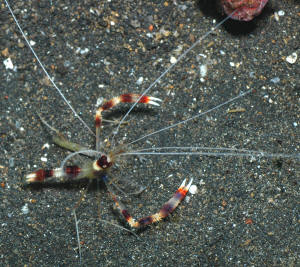
03/13/09 Can I have two cleaner shrimp? 3/14/07 Can I put two cleaner shrimp together in a 38 gallon tank with out them fighting each other? <Yes> I currently have a false clownfish and a maroon about the same size never fight with lots of live rock. Should I only put one in? <Two will be fine. However, I do suggest starting out with one. If you are happy with one, go ahead with the second. I was unable to view the picture, but not necessary to answer your question.> <Brenda> Peppermint Shrimp Pricing 8/8/06 Dear Bob, <James today. Bob is probably exploring Two Step Reef in HI.> <<Nope, working on WWM, writing and pulling weeds... oh, and making a fab. ground turkey enchilada pie. RMF>> I love your website for it is so helpful! <Thank you, glad you enjoy/use.> I have a quick question for you. I am looking to buy within the next week or sooner a bunch <Don't come in bunches.> of peppermint shrimp for my 250 gallon reef tank. The cheapest I could find them was 3.50a piece from Reeftopia.com. Do you know of anyone who sells these shrimp cheaper? If so please email me the info so that I can make an order. <Chris, best thing to do is Google Peppermint Shrimp, check prices in that regard. We really do not keep tabs on such.> Thank you for your time and I look forward to reading your response. <You're welcome. James (Salty Dog)> Sincerely, Christopher Faiola Peppermint Shrimp Dear Mr. Fenner (or WetWebMedia crew), Let me start off by giving praise to "The Conscientious Marine Aquarist", it is the best book ever written. I would also like to thank you for this wonderful website and your feedback to our questions! I know your time is extremely valuable and that you read a BULK of e-mails. I will try and keep this short. I have a question regarding Peppermint Shrimp (Lysmata wurdemanni). Do they clean parasites off of fish like the common cleaner shrimp? <I have seen them clean Moray Eels before.> I know they are known for going after Aiptasia. <Yes, their claim to fame.> The reason I ask is because my Clarkii (Amphiprion clarkii) keeps swimming over to a pair of Peppermint Shrimp I have in the tank. The Clarkii doesn't appear to have any ich (white dots) on his body. <Come on, scratch my back! Please!> If the Peppermint doesn't clean parasites, can I add common cleaner shrimp with the peppermint shrimp? <Depends on tank size and individual's disposition.> I have a 30 gallon setup with 10 gallon sump. <I would put your odds at 50/50. I have seen Peppermint's with Cleaner's, but I have also heard of several instances where one killed the other.> Light bio-load, only the clown fish, a green carpet anemone, two Peppermint Shrimp, and a couple turbo snails. If I can add the common cleaner shrimp, is there an easy way to identify the Indo-Pacific White-Striped Cleaner (Lysmata amboinensis) from the Atlantic White-Striped Cleaner (Lysmata grabhami)? <Yes, the Pacific amboinensis has more dots on its tail. Baensch's Marine Atlas, volume 1, has excellent back to back photos comparing the two.> One last question, if my Clarkii does develop ich, what is the best way to treat him? <Quarantine and daily water changes to start would be my preference.> Move to quarantine? <Yes> Lower salinity, temp? <An option> I read that copper shouldn't be used with anemone fish. <I have seen the same thing in Wilkerson's book.> I've had the Clarkii for over six months, he seems healthy, will the problem go away on its own if I don't intervene? <I am not sure there is a problem.> Is the Clarkii going over to the shrimp a bad sign, or is it just natural behavior? <It could be either.> Thanks for your time and patience, Jeremy <You are welcome. -Steven Pro> Peppermint Shrimp I recently set up a reef aquarium. It's gone through a number of ups and downs, I asked you about fish lice in another correspondence. <Okay> Shortly after setting it up, I had the usual assortment of Aiptasia anemone. I rid my aquarium of many of them with the solution of Calcium Hydroxide. However, there were a number of smaller ones and several that were difficult to get to. After reading a number of articles on the problem, including yours, I decided to try biological control and purchased half a dozen peppermint shrimp. Also from reading the article, I was aware of the left coast imposters. I am quite certain that these were the wurdemanni species. Appearances are that they did their job rather well. I haven't seen one in months. But, however, ... Peppermint shrimp appear not to be particularly finicky eaters. It shouldn't take a real leap of faith to believe that the similarities between one polyp and another might lead to some problems. Some of my first purchases were yellow polyps, green star polyps, Zoanthus, and a carpet anemone. <Yes> I had seen them acting suspiciously around the yellow polyps, green star polyps, and Zoanthus, but never caught them red handed (pun only slightly intended). However, upon introducing the carpet, they began to show a rather intense interest in it. I also noticed that the anemone was reacting rather severely to their proximity. I got a closer look and they were picking at individual tentacles. The next morning, there were a couple of circular patches about 6mm in diameter that were tentacle free toward the edges of the carpet. The next night, there were a few more such patches. I withheld food from the system after the first night and decided to trap the shrimp. Further, they began to show increased interest in the other polyps and I began to see some damage on them. The shrimp are now out of the system, having learned a lesson in the law of unintended consequences. One of the other Aiptasia eating critters is the Berghia Nudibranch. I had chosen the Peppermints because the Berghia are somewhat pricey, due to their small size, they are somewhat less than aesthetically pleasing and once they eliminate Aiptasia, they die off. As it turns out, the quantity of Peppermints was similarly priced to a pair of Berghia, the appearance of the bald spots on my carpet (the one in the aquarium, not the one by the tank I wore on the floor biting my fingernails as I watch my carpet take a beating,, and not many folks seem to want to take back peppermints due to quarantine, etc., so they are likely to meet their demise. In conclusion, there is absolutely no doubt in my mind that these were indeed Lysmata wurdemanni and that they were consuming my carpet anemone. Although I have no direct evidence that they do eat Aiptasia, the anecdotal evidence supports that conclusion. There is absolutely no doubt in my mind that they were eating my carpet anemone, I saw them on several occasions picking violently at the polyps, distorting the shape of the anemone considerably in the process. <They do, will eat anemones> I would suggest to anyone who still desires to put wurdemanni in a reef tank keep a wary eye on them and that they ensure that the system is overfed. Renaming the species to Lysmata alquaidaii might not be a bad idea, either, they were little terrorists in my tank. :) <Agreed> Thanks for your pages, by the way. With the exception of information on Argulus, your pages seem to be absolutely the best sources of information on the web. <Okay> Best regards, Dale Chatham <Bob Fenner> Better Contact a University >Re: Lysmata amboinensis I need to find out what temperature ranges they can tolerate, and what diseases or parasites they are prone to or are know to be able to carry. >>Alright, "tropical" temps are best, in Fahrenheit that's going to be in the 74F-84F degree range, comfortably. Let me whip out my Palm with the new conversion calculator (freeware, thank you very MUCH!) to sort out this range in Celsius <tapping away on her Palm> and that would be from 23C - 28C. Wow! I LOVE freeware! >I live in Hobart Tasmania Australia, which is an Island State having very strict import controls, and any information I can find about Lysmata amboinensis will further my chances of being allowed to import a few. >>Aaahh.. well, unfortunately, there is indeed a real dearth of this information available to the hobbyist. I would contact some universities, there's one in Arizona that's done quite a bit of research on a couple of different Lysmata spp.'s, but don't expect too fast a response. Try some of the contacts on this page, too (seems to me that aquaculture facilities would have a great deal of experience with such things, yeah?) http://www.phone-soft.org/layout-3/cyber-world/make-frame.php3?framename=0876i.htm http://www.ecotao.com/holism/agric/aqua.htm http://cgi.botbot.com/dir/$/Business/Industries/AgricultureandForestry/Aquaculture/ http://www.reefkeeping.com/issues/2002-05/rs/ Best of luck! Marina >Cheers, Simon Cleaner shrimp overuse? 3/8/04 Greetings! Thanks again for providing a wonderful site! I always learn so much while reading through the FAQ's. I have scanned and have not found anything like what I have now so perhaps you could shed some light on it. <Hi Ray. Adam here. Let's see what we're dealing with...> I have a 55gal mini-reef. I got a coral beauty last Sunday after waiting 5 weeks for one to come in with the right colors (I love him!). He is in my main tank now after only 3 days of QT (damn dog, knocked over lamp and broke QT tank, lucky I was home to respond). I did do a quick fresh water & formalin dip (didn't like it past 1 min). <What an unfortunate event! I am sure you know that a quarantine period of more like 3-4 weeks is optimal. Also, FW dips less than about five minutes are very ineffective. The fish often appear to be very stressed, but it is best to tough it out.> Thursday (day after putting in coral beauty) I saw that both he and my yellow tang (been in there a while and was doing fine) were scratching. On closer exam I saw several small black dots (10-15) on my tang. I did a quick search on WWM and realized that it was most likely black spot disease. After a long and wet battle, I managed to get the tang out and gave him a 5 min dip of pH and temp balanced RO/DI with formalin. Thinking my Coral beauty was infected the same, I did the same with him and he tolerated the 5 minute dip well this time. By Friday, no black spots were visible on the Tang and neither was scratching on the rocks. <"Black spot" is very common in yellow tangs. It is an external parasite and as you have seen, it responds very well to FW dips. Your five minute dip is still at the very minimum.> Friday I went to my LFS and the guy that works there was kind to my situation. He sold me a scarlet skunk cleaner shrimp (Lysmata amboinensis ) from one of his display tanks (been in there months) so I could bypass my now destroyed QT with little chance of introducing anything. <This is very bad advice. Biological cleaners like shrimp, neon gobies and wrasses are helpful, but in an aquarium environment they don't have a chance of preventing or stopping outbreaks of common parasitic diseases. Quarantine should still be considered a mandatory practice!> It took all of an hour for my Coral Beauty to find the cleaner shrimp and he visited it almost every 5 minutes for the remainder of the day. He will go up to it, tilt on his side and open his mouth and gills for it. Now for my questions (thanks for sticking with me this long). Can a fish over use a cleaner shrimp? Will too much use hurt my fish? Is there still something infecting my coral beauty and if so, will the shrimp get rid of it? He is eating great and everyone else in the tank is doing fine. Tank parameters optimal. <If the fish is still infected with something, the cleaner shrimp might help, but it will likely be too little too late. All biological cleaners have the potential to injure the subject they are cleaning, but in the case of the shrimp, the fish would simply swim away and regulate it's own cleanings. It sounds like you are likely safe in terms of disease, but please do replace your q-tank for future additions and don't rely on cleaner shrimp to prevent outbreaks! Best Regards. Adam> Thanks -Ray Cleaner shrimp Bob- Which Cleaner Shrimp do you prefer: Pacific Cleaner Shrimp or Scarlet Cleaner? Rob <<The Pacific (Lysmata amboinensis) over the more expensive L. debelius (Scarlet, as in O'Hara)... the former is cheaper and hardier sez me. Bob Fenner>> Lysmata wurdemanni Hi there We here in SA are trying to get e few of these specimens into our Country, All other types of Shrimp gets imported but for some reason not this one .. if it does it disappears so fast it's mind boggling. <Eaten by other livestock?> Now 3 of us are keen on trying to breed this shrimp but we need the shrimp to begin with, so I was hopping that you may be of help to us. If you can could you please contact me ASAP. Thanks in advance, Jaco <Believe I can be of service here. Please contact, have your suppliers contact Tropic-Marine Centre in the UK re this species (they breed it and L. debelius, and have had great success with other shrimp, invertebrates... fishes...), and read over the husbandry, production notes posted on the "Breeders Registry" (the link posted on the www.WetWebMedia.com links pages) for a few people's telling of how they've kept, bred this species. Bob Fenner> Being cautious (fish health) Well, it's me again. Sorry to bother you with more questions. Just to refresh, my family has an established 100 gallon reef tank setup with lots of live rock and invertebrate life (corals, crabs, banded shrimp) along with: 1 percula clown with carpet anemone host 1 Dottyback (Pseudochromis aldabraensis) 1 regal/palette tang 1 lemon tang (Acanthurus pyroferus) 1 rusty dwarf angel 1 mandarin 1 algae blenny 2 blue-green Chromis 1 Starck's damsel (Chrysiptera starcki) Well, I thought everything was going well, but some interesting, somewhat worrisome things have happened in the past two days (all of them appear to be unrelated, but nonetheless, within a short time span it's been a lot to take in). first off, we had a 3-4 hr. blackout in the area two days ago...we have a backup power source that ran the pumps for an hour, but after that no one was there to aerate the water...but the fish seemed to be fine when we got home. Also, there used to be two Perculas. An hour after feeding them this morning, one of them has disappeared. No sign of it. I think that it may have been eaten by one of the corals...a "cup"...large, round green anemone-like invert with rows of small cone-shaped growths on the inside of its disc. Additionally, the damsel has some white "growths" on its tail, right in front of its tail fin on either side. They sort of look like small bumps or thorns. the damsel has been hovering in place a lot since we've noticed these bumps, and its respiratory rate has risen. Finally, the regal tang has begun scratching periodically. Every now and then, he'll scratch against some rock or snail shell 4-8 times and then go on about his business. He's been eating fine, and its respiratory rate is about normal...maybe a little on the fast side. Other than that, though, all the other fish appear to be in good condition. We checked the water quality late last week, and everything was in good shape. no other fish are scratching or show visible signs of trauma or injury like the damsel. what should I do about the damsel and the regal tang? Thanks for all your help and happy 4th. Chris Pua <At this point I'd place another cleaner other than the Coral Banded shrimp (maybe a couple of Lysmata... perhaps a Gobiosoma goby... add vitamins to the foods offered... and keep an eye on the stock. Bob Fenner> |
|

|
Features: |
|
| Featured Sponsors: |